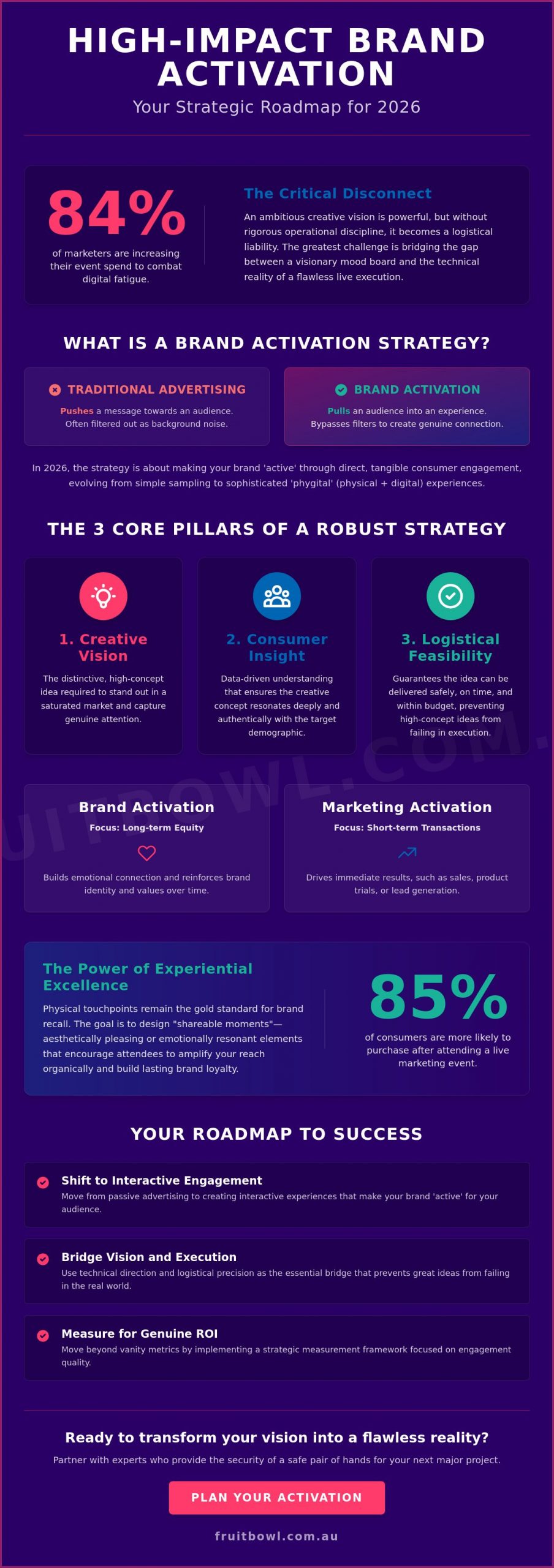
What if your most ambitious creative concept is actually your biggest logistical liability? In an era where 84 per cent of marketers are increasing their event spend to combat digital content shock, the pressure to deliver a flawless brand activation strategy has never been higher. You likely recognise that a brilliant idea is only as good as its execution. Yet, the persistent disconnect between a visionary mood board and the technical reality of a live environment often leads to unnecessary risk. It is a common frustration to see a bold vision compromised by logistical oversights or the fear of technical failure during a critical moment.
We believe that true creative freedom comes from rigorous operational discipline. This guide will show you how to bridge the gap between creative vision and logistical precision to create high-impact activations that drive measurable results. You will discover a clear roadmap for your 2026 planning that ensures every moving part is synchronised. We will explore how to transform complex requirements into seamless experiences that foster deep brand loyalty and provide the security of a safe pair of hands for your next major project.
Key Takeaways
- Understand the shift from passive advertising to interactive engagement that makes your brand truly “active” for your target audience.
- Learn how to align creative vision with consumer insights and logistical feasibility to develop a robust brand activation strategy.
- Discover why technical direction serves as the essential bridge that prevents high-concept ideas from failing during real-world execution.
- Identify how to move beyond vanity metrics by implementing a strategic measurement framework focused on engagement quality and genuine ROI.
- Evaluate the benefits of an end-to-end management approach to minimise operational risk and ensure every detail is handled with professional precision.
What is a Brand Activation Strategy in 2026?
Defining What is a Brand Activation Strategy in 2026? requires understanding the fundamental shift from passive observation to active participation. It is the deliberate process of making a brand “active” through direct, tangible consumer engagement. While traditional advertising pushes a message toward an audience, a brand activation strategy pulls the audience into an experience. This distinction is critical because modern consumers have developed a refined ability to filter out background noise. They don’t just ignore ads; they actively avoid them. By creating an interactive environment, brands can bypass these filters and establish a genuine connection that resonates on a personal level.
The current environment is defined by “content shock”. Consumers are saturated with digital stimuli, making it increasingly difficult for brands to capture genuine attention. This reality explains why 84 per cent of consumer marketers plan to increase their event spending in 2026. In this context, a strategy must serve as the foundation before any tactical event planning begins. Without a clear strategic framework, a brand activation is merely a series of expensive logistical tasks. A well-constructed strategy ensures that every physical touchpoint reinforces a specific brand objective and delivers a measurable return on investment. It provides the roadmap needed to navigate the complexities of live engagement with confidence; for brands looking to establish this trust through quality physical products, you can check out Feral Pony as an example of durable equestrian gear designed for practical use.
The Evolution of Brand Activation
Brand activation has matured from simple product sampling in shopping centres to sophisticated, multi-sensory experiences. By integrating high-quality, natural beverage options from le jus, brands can elevate these physical interactions into premium health-conscious engagements that provide a refreshing point of connection for consumers. The focus has shifted from “buying” attention through media spend to “earning” it through value and relevance. In 2026, we see a seamless convergence of digital and physical worlds. Physical installations now often feature a digital layer, allowing for real-time personalisation and data capture. This “phygital” approach ensures that the impact of a live event extends far beyond the physical venue, creating a lasting impression that resonates across multiple channels and builds a cohesive narrative.
For brands operating in the athletic or combat sports space, ensuring product quality is a key part of building this trust; you can discover The Fight Club to see how professional-grade gear supports an authentic brand experience.
Brand Activation vs. Marketing Activation
The Core Pillars of a Robust Activation Strategy
A successful brand activation strategy rests upon three non-negotiable pillars: creative vision, consumer insight, and logistical feasibility. Creative vision provides the distinctiveness required to stand out in a saturated market. Consumer insight ensures the concept resonates deeply with the target demographic. Logistical feasibility guarantees that the idea can actually be delivered safely, on time, and within budget. In 2026, the primary driver of engagement is experiential marketing production. This involves the physical realisation of a brand’s promise in a way that feels both authentic and high-quality. Data plays a vital role here; it informs the strategy long before the first site visit occurs. By analysing consumer behaviour and preferences, you can tailor the activation to meet specific needs. Consistency is equally paramount. Every touchpoint, from the staff uniforms to the digital interfaces, must reflect the core brand identity to build lasting trust and recognition.
Experiential Excellence
Physical touchpoints remain the gold standard for brand recall. Research indicates that 85 per cent of consumers are more likely to make a purchase after attending a live marketing event. To maximise this impact, you must design for “the shareable moment”. These are aesthetically pleasing or emotionally resonant elements that encourage attendees to amplify your reach organically. Every element must align with your broader brand activation event planning goals. If the physical experience doesn’t match the strategic objective, the return on investment will suffer. For those seeking a seamless transition from concept to reality, partnering with a specialist in Brand Activations ensures every detail is managed with professional oversight.
Digital Integration and Amplification
Digital tools extend the lifecycle of a physical activation. Social media isn’t just for promotion; it’s a tool for real-time engagement and community building. In 2026, technologies like AR and VR enhance the on-site experience without feeling gimmicky. They provide a digital layer that adds depth to the physical installation. Collecting consumer data is also critical, especially as third-party data becomes less accessible. However, this must be done without disrupting the experience flow. Use frictionless methods like NFC tags or adaptive AI interfaces to capture first-party data while maintaining the industry benchmark dwell time of three to four minutes. This ensures you gather valuable insights while the consumer remains fully immersed in the brand story.
Strategy vs. Execution: Bridging the Gap
A frequent objection raised by seasoned marketing directors is that even the most brilliant concepts often fail during real-world implementation. This failure typically stems from a brand activation strategy that is developed in isolation, without regard for the technical and logistical constraints of a physical space. When a creative vision isn’t grounded in reality, the risk of technical failure increases exponentially. We view technical direction not as a final step, but as a strategic necessity that must be integrated from the very first planning session. This approach ensures that the creative ambition is supported by a robust framework capable of withstanding the pressures of a live environment.
Central to this framework is sophisticated av management for events. Brand perception is incredibly fragile in a live setting; a single flickering screen or a distorted audio track can undermine months of careful positioning. High-quality audio-visual execution acts as the sensory backbone of your activation, ensuring your message is delivered with clarity and impact. Beyond the hardware, your strategy must incorporate comprehensive risk management and contingency planning. Whether it’s a sudden weather shift during a public festival or a power surge at a corporate conference, having a pre-verified Plan B is what separates a professional activation from a logistical disaster. It’s about providing a sense of security that every detail is under expert supervision.
The Role of Technical Direction
Involving technical experts during the strategy phase prevents the “it looked good on paper” trap. These specialists ensure that sound, lighting, and staging aren’t just functional, but actively support the creative narrative. Rigorous pre-production, including site inspections and technical rehearsals, allows us to identify potential friction points before they impact the consumer experience. This proactive approach transforms technical requirements into creative assets, allowing for more ambitious installations that remain entirely feasible and safe for the public.
Logistics as a Strategic Advantage
Meticulous planning creates a frictionless consumer journey, which is essential for maintaining engagement. For large-scale public activations, precision in crowd flow, safety protocols, and site management is just as important as the brand messaging itself. We position ourselves as a “safe pair of hands” for high-stakes delivery, ensuring that order and clarity are maintained in complex environments. When the logistics are invisible, the consumer is free to focus entirely on the brand experience. This seamless execution leads to higher satisfaction, increased dwell time, and a more significant return on your investment. Just as in live events, the ‘activation’ of a brand often happens during the physical touchpoint; for an online grocery specialist like Shift 2 Fresh, the logistical precision required to deliver fresh regional produce is what ultimately builds consumer trust and loyalty.
Measuring the Impact of Your Brand Activation
Success in 2026 is defined by more than just social media engagement or vanity metrics. While a high volume of digital “likes” suggests reach, it rarely correlates directly with commercial growth or long-term loyalty. A sophisticated brand activation strategy must move beyond these surface-level indicators to focus on deeper, more meaningful data points. We utilise a comprehensive brand activation measurement framework to ensure every interaction is tracked against specific business objectives. This approach allows us to measure the immediate impact on lead generation while simultaneously assessing long-term brand lift. By capturing high-quality first-party data during the event, we provide a clear picture of how the activation has influenced consumer perception and intent.
This dual focus is essential because brand activations often serve multiple roles. A well-executed activation should drive immediate sales while also building the emotional equity that leads to repeat business. Tracking these outcomes requires a blend of real-time monitoring and post-event analysis. Using the data collected on-site, you can refine your future activation strategies, ensuring that each subsequent project is more targeted and efficient than the last. This commitment to continuous improvement ensures that your marketing spend is always working toward a tangible result. It provides the evidence needed to justify investment and demonstrate the value of physical engagement.
Quantitative vs. Qualitative Metrics
We prioritise a balanced mix of data types to provide a holistic view of performance. Quantitative metrics include measurable factors such as total foot traffic, direct conversions, and the industry benchmark dwell time of three to four minutes. Qualitative metrics, on the other hand, focus on sentiment shift and brand affinity. These are captured through on-site surveys and sophisticated social listening tools that gauge how consumers actually feel about the brand after the experience. True return on investment in experiential marketing is realised when the immediate cost per interaction is outweighed by the significant increase in the long-term lifetime value of a loyal customer.
The Feedback Loop
The conclusion of a live event is the beginning of the strategic refinement phase. Conducting a thorough post-mortem allows you to translate raw data into actionable insights that resonate with the C-suite. This process involves comparing actual performance against the initial KPIs established during the strategy phase. It identifies what worked, what didn’t, and where the logistical precision could be further sharpened. This rigorous analysis ensures your next strategy is smarter, more resilient, and more effective at driving loyalty. If you are ready to secure a measurable advantage for your next campaign, consider how a specialist in Brand Activations can bring clarity to your data and execution.
Partnering for Success: Why Expertise Matters
Securing a flawless brand activation strategy requires more than just a creative agency; it demands a partner capable of unified delivery. An end-to-end approach reduces the friction often found when multiple vendors attempt to synchronise their efforts. By consolidating strategy, production, and talent under one roof, you mitigate the risk of miscommunication that frequently leads to logistical failure. We view corporate event management as a core competency that provides the structural integrity needed for high-stakes activations. This level of oversight ensures that every detail, from the initial site permit to the final technical strike, is handled with the same degree of professional precision. It provides a sense of security that allows your team to focus on broader business objectives while we manage the operational complexities.
Experience is the most reliable safeguard against the unpredictable nature of live events. With over 28 years of history navigating complex public and government activations, we have developed a deep understanding of the Australian regulatory landscape. This history allows us to anticipate challenges before they arise, whether they involve site-specific safety requirements or intricate data privacy laws. We bring order and clarity to environments that are often chaotic and high-pressure. Our role is to act as a “safe pair of hands,” ensuring that your creative ambition is realised without compromise. This commitment to excellence ensures that every project we undertake is delivered with a steady, results-oriented focus that protects your brand’s reputation.
The Value of a Comprehensive Solution
Efficiency is significantly enhanced when a single partner manages the entire project lifecycle. This model reduces stakeholder liaison complexity by providing a single point of accountability. It ensures the creative vision remains uncompromised from the conceptual phase through to the final execution. When the strategy team works alongside the production technicians, the transition from paper to reality is seamless. This integrated workflow prevents the dilution of the brand message and ensures that all technical elements, such as lighting and sound, are perfectly aligned with the strategic narrative established at the outset.
Choosing Your Activation Partner
Selecting the right agency involves evaluating their technical capability, strategic depth, and local experience. You need a partner who doesn’t just promise creative spark but demonstrates a disciplined methodology for delivery. In the Australian market, understanding the nuances of local council approvals and public safety standards is non-negotiable. A partner with a proven track record in high-stakes environments will provide the frictionless experience your brand deserves. If you are ready to elevate your brand with a sophisticated, data-driven approach, contact Fruitbowl Events Agency for expert activation strategy.
Securing Your Brand’s Future Through Strategic Activation
A successful brand activation strategy in 2026 requires a meticulous balance of creative ambition and technical precision. We’ve explored how bridging the gap between visionary concepts and logistical reality is the only way to ensure your message resonates without the risk of failure. By prioritising robust measurement frameworks and end-to-end management, you can transform direct consumer engagement into a significant commercial advantage. It’s about moving beyond the noise of content shock to build genuine, lasting loyalty through immersive experiences.
With over 28 years of industry-leading experience, Fruitbowl provides the security of a safe pair of hands for even the most complex projects. Our expertise in high-stakes public and government activations ensures that every detail is managed with order and clarity. We offer end-to-end strategic and technical delivery, allowing you to focus on your objectives while we handle the operational complexities. Partner with Fruitbowl for your next high-impact brand activation and experience the difference that seasoned expertise brings to your campaign. Your most ambitious ideas are entirely achievable when supported by a disciplined methodology and a commitment to excellence.
Frequently Asked Questions
What is the primary goal of a brand activation strategy?
The primary goal is to foster a meaningful, interactive connection between a brand and its audience. A robust brand activation strategy moves beyond passive awareness to create a tangible experience that drives long-term loyalty. This process involves making the brand’s values “active” in a physical space, allowing consumers to experience the brand promise firsthand. By focusing on engagement rather than just reach, you build deeper emotional equity.
How long does it take to plan and execute a major brand activation?
Planning timelines vary, but a major activation generally requires three to six months of lead time. This duration allows for thorough strategic alignment, venue procurement, and detailed technical production. Smaller pop-ups might be organised in eight to twelve weeks, while complex government activations or large-scale festivals often require a longer runway. Early engagement ensures that every logistical detail is rigorously tested before the live environment.
Can brand activations work for B2B companies, or are they just for B2C?
Brand activations are exceptionally effective for B2B companies, especially within the context of conferences and seminars. These events provide a platform to humanise complex service offerings and build high-value professional relationships. Instead of relying on static brochures, B2B brands can use interactive installations to demonstrate their expertise. This approach creates a memorable touchpoint that distinguishes your firm from competitors in a crowded corporate landscape.
What is the difference between experiential marketing and brand activation?
Brand activation is the strategic objective, while experiential marketing is the tactical methodology used to achieve it. Activation refers to the process of making a brand “active” through consumer engagement. Experiential marketing involves creating the immersive, multi-sensory experiences that facilitate this activation. Essentially, you use experiential tactics to fulfill your broader brand activation strategy and meet your specific commercial goals.
How do you measure the ROI of a physical brand activation event?
Measuring return on investment involves tracking a combination of quantitative and qualitative data points. Key metrics include total foot traffic, direct lead generation, and the industry benchmark dwell time of three to four minutes. Additionally, post-event surveys and social listening tools help quantify sentiment shifts and brand affinity. By comparing these results against your initial objectives, you can determine the activation’s impact on long-term customer lifetime value.
What are the biggest risks in executing a brand activation strategy?
The most significant risks include technical failure, logistical disconnect, and a lack of strategic alignment. These issues often arise when a creative concept is developed without considering the technical realities of the site. Such risks are mitigated through rigorous technical direction, site-specific contingency planning, and professional oversight. Ensuring a “safe pair of hands” is managing the execution reduces the likelihood of unforeseen complications during high-stakes delivery.
Do I need a separate agency for the creative and the technical production?
While you can use separate agencies, an end-to-end partner is significantly more efficient. Consolidating strategy, creative, and technical production under one roof ensures your brand activation strategy remains uncompromised from concept to strike. This model reduces stakeholder liaison complexity and prevents the friction that often occurs between disconnected creative and logistical teams. It provides a unified vision that is both ambitious and entirely feasible.
OUR BLOG
Event Insights & Expertise
Our blog is your go-to resource for all things events. From expert insights and the latest industry trends to practical planning tips, we share everything you need to deliver standout experiences.
Contact Us