Brand Activation Measurement: A Strategic Framework for 2026

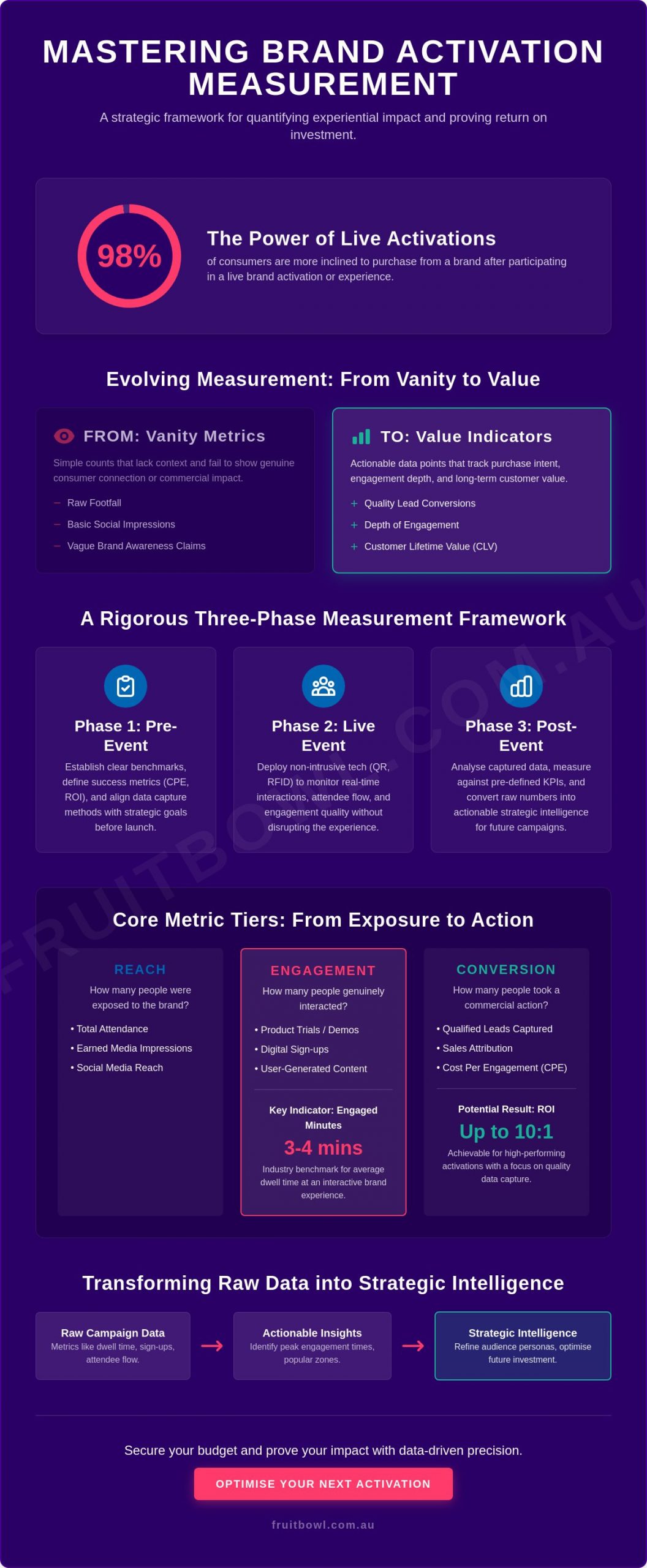
Did you know that 98% of consumers are more likely to purchase from a brand after attending a live activation? It’s a powerful statistic, yet many marketing teams still find brand activation measurement to be a complex hurdle when reporting to the board. You’ve likely experienced the frustration of seeing high engagement on the ground but struggling to attribute specific sales to a physical event. When data feels fragmented and the cost of experiential is high, it’s difficult to feel certain about your return on investment.

We understand that bringing order to these moving parts requires a disciplined approach. This article provides a strategic framework to help you master the methodologies required to quantify experiential impact and justify your marketing investment with precision. By treating data capture as a core logistical pillar of your corporate events and festivals, you’ll gain the clarity needed for better budget allocation and more informed decision-making.

We’ll explore how to weave measurement into your event’s DNA, from utilising AI-powered analytics to navigating the 2026 privacy landscape with confidence. This structured guide ensures you can move away from anecdotal reporting and towards a repeatable, results-oriented system that satisfies every stakeholder.

Key Takeaways

  • Shift your focus from vanity metrics like footfall to high-value indicators that track genuine purchase intent and long-term brand impact.
  • Implement a rigorous three-phase framework for brand activation measurement to ensure data accuracy and strategic alignment throughout the project lifecycle.
  • Utilise the “Engaged Minutes” concept to quantify the depth of consumer connection and the quality of every interaction on the ground.
  • Integrate sophisticated, non-intrusive technology such as heat mapping to monitor attendee flow and dwell time without disrupting the event experience.
  • Convert raw campaign data into actionable strategic intelligence to refine audience personas and optimise future marketing investment.

The Evolution of Brand Activation Measurement in 2026

Brand activation measurement has transitioned from an optional post-event report into a core logistical requirement. In 2026, we define this process as the systematic quantification of consumer engagement and tangible brand impact. The Australian corporate sector now demands a level of logistical transparency that matches the precision of digital channels. Boards and executive teams are no longer satisfied with vague brand awareness claims. They require a rigorous methodology that proves how a physical presence translates into commercial value. Measurement is now woven into the entire experiential marketing production lifecycle, providing a steady, results-oriented pulse from the initial concept to the final debrief.

From Footfall to Deep Engagement

Raw footfall is a vanity metric that rarely tells the full story of a campaign’s success. Simply counting heads in a busy precinct doesn’t provide the clarity needed for high-stakes decision-making. To explore advanced people counting technology for your next event, click here. In 2026, sophisticated brand activation measurement requires us to distinguish between a casual passer-by and a truly engaged participant. An engaged participant is someone who interacts with the brand for a specific duration or completes a defined action, such as a digital sign-up, a product trial, or a shared social interaction. By establishing a clear baseline across different formats, from government activations to public festivals, we ensure that performance is measured against relevant benchmarks. This shift from vanity to value metrics allows brands to track the genuine intent to purchase with far greater accuracy.

The Strategic Importance of Proving ROI

Proving return on investment is no longer optional; it’s a fundamental requirement for securing future budget allocations. Robust data provides a sense of security to stakeholders, demonstrating that marketing spend is a strategic investment rather than a sunk cost. By linking experiential outcomes to long-term Customer Lifetime Value (CLV), brands can justify the investment required for large-scale brand activations. This data-driven approach also serves as a vital tool for risk mitigation and strategic planning. When you understand exactly which elements of an activation drive conversion, you can refine your target audience profiles and allocate resources with total confidence. A well-defined brand activation strategy ensures that measurement objectives are aligned with creative execution from the outset, reducing the risk of logistical oversights during critical moments. This methodical approach ensures that every dollar spent is accounted for and every interaction is optimised for maximum impact.

Core Metrics: Quantifying Brand Impact and Reach

Effective brand activation measurement requires a structured categorisation of data points. We group these into three distinct tiers: reach, engagement, and conversion. This hierarchy ensures that every facet of the attendee journey is captured and weighted appropriately, providing a comprehensive view of the campaign’s health. While reach tells us how many people were exposed to the brand, engagement tells us how many actually cared. We prioritise lead quality over simple quantity to ensure the data is actionable and commercially relevant.

The “Engaged Minutes” concept is particularly vital for quantifying the depth of connection. In 2026, the industry benchmark for average dwell time at an interactive experience is three to four minutes. By measuring this duration, we move beyond superficial interactions and focus on the quality of the brand relationship. Social amplification further extends this reach. We track user-generated content (UGC) and earned media to understand how the activation resonates in the digital world, ensuring the impact lasts long after the physical event concludes. For SMEs looking to capitalise on this digital momentum, Marketing Angels offers expert advice on enhancing social media engagement.

Quantitative Metrics: The Hard Numbers

Precision in data collection is achieved through the seamless integration of technology. We utilise RFID tags, QR codes, and digital touchpoints to capture real-time interactions without disrupting the attendee flow. Cost Per Engagement (CPE) serves as our primary efficiency metric, allowing us to compare the performance of different activations on a level playing field. We also monitor the conversion rate from attendee to active lead, ensuring that the volume of data doesn’t overshadow its utility. High-performing activations can achieve an ROI as high as 10:1, provided the focus remains on capturing high-quality data. When planning your next series of brand activations, establishing these benchmarks early is essential for long-term success.

Qualitative Insights: Measuring Sentiment

While numbers provide the structure, sentiment provides the soul. We use on-site surveys and post-event feedback loops to gauge how attendees truly feel about the experience. Analysing brand perception shifts through pre- and post-activation testing allows us to quantify the emotional impact of the work. We also rely on the Net Promoter Score (NPS) to measure the likelihood of attendees becoming brand advocates. This qualitative layer brings order to the complex emotional landscape of experiential marketing. It ensures that the creative ambition of the project is grounded in measurable psychological shifts, providing a sense of security to stakeholders who value brand equity as much as immediate sales.

The Three-Phase Framework for Measurement Success

A successful brand activation measurement strategy is never an afterthought. It’s a deliberate, three-phase process that begins long before the first attendee arrives on-site. This chronological approach provides the order and clarity required to manage complex, high-stakes environments with total confidence. By maintaining a consistent methodology across these stages, you ensure that every data point contributes to a clear, year-on-year comparison of performance. This structured rhythm allows you to navigate every challenge with a history of data to guide your decisions.

Phase 1: Setting the Foundation

Preparation is the bedrock of precision. Before any physical execution begins, you must define specific, measurable objectives that align with your broader brand KPIs. Identifying a “Single Source of Truth” for your data collection ensures that disparate streams don’t lead to conflicting results later. Aligning your corporate event management goals with these metrics creates a unified strategy. This phase isn’t just about setting targets; it’s about building the logistical infrastructure required to hit them. It’s the stage where you decide exactly which tools will capture the most relevant insights for your stakeholders.

Phase 2: Live Execution and Course Correction

The live environment is dynamic and requires constant oversight. During the activation, monitoring real-time dashboards allows you to identify engagement bottlenecks as they happen. If a particular zone isn’t performing as expected, you can make immediate logistical adjustments to improve flow. Managing technical infrastructure is critical here to ensure zero data loss during high-traffic periods. This proactive monitoring provides a sense of security, knowing that the project is being safeguarded at every turn. It’s about maintaining control of the narrative whilst the event is in motion, ensuring that the brand activation measurement process remains uninterrupted.

Phase 3: The Post-Mortem and Insights

Once the activation concludes, the focus shifts to synthesising disparate data sets into a cohesive narrative. This isn’t just a summary of what happened; it’s a strategic analysis of why it happened. We look for “unintended successes”, those surprising spikes in engagement that can inform future creative ambition. Drafting the final report for executive stakeholders requires a professional register that prioritises information density. By presenting clear, actionable intelligence, you turn raw numbers into a roadmap for better budget allocation. This final phase ensures that every detail is documented, providing a friction-free experience for those reporting to the board.
Seamless Data Capture: Integrating Technology and Logistics

Technology must serve the experience, not dictate it. In 2026, the most effective brand activation measurement systems are those that remain invisible to the attendee. We balance passive tracking, such as heat mapping and dwell time analysis, with active tracking through digital touchpoints. This dual approach provides a comprehensive view of the event floor without creating friction for guests. Integrating this data directly into your existing CRM or marketing automation platform ensures that insights are immediately actionable. We also prioritise Australian compliance standards, ensuring all data collection adheres to local privacy regulations and provides a sense of security for both the brand and the consumer.

Wearable and Mobile Tech

Wearable technology, particularly RFID wristbands, allows for frictionless data exchange at high-traffic festivals and public events. Attendees can check in, share content, or enter competitions with a simple tap. This voluntary data sharing is often facilitated through gamification, where engagement is rewarded with tangible value, such as access to creative culinary hacks from So Yummy. Mobile apps further enhance this by providing deeper behavioural insights, tracking how users navigate the space and interact with specific brand elements. These tools don’t just capture data; they enhance the journey by removing the need for traditional, slow-moving lead forms.

Operational Rigour in Data Collection

Capturing high-quality data requires more than just hardware; it demands operational discipline. We train on-site staff to facilitate accurate capture and troubleshoot issues in real-time. This human element is supported by rigorous redundancy planning. We ensure that Wi-Fi, power, and cloud synchronisation have backup systems to prevent data loss during critical moments. Sophisticated av management for events is the backbone of these data-heavy activations, providing the technical excellence required for seamless execution.

A well-executed project timeline accounts for every technical variable. We manage the integration of various moving parts to ensure that the data capture process is as reliable as the physical build. This methodical approach mirrors the organised nature of the industry itself, ensuring that nothing is left to chance. If you’re ready to elevate your next project with this level of precision, our team is here to help you organise your brand activations with expert oversight.

Transforming Raw Data into Strategic Brand Intelligence

The conclusion of a project shouldn’t be the end of the journey. The genuine value of brand activation measurement resides in its capacity to dictate future strategy and provide a roadmap for commercial growth. While the final report documents what occurred, strategic intelligence explains why it happened and how to replicate that success. We move beyond static spreadsheets to provide actionable business intelligence that refines your target audience profiles and sharpens your personas. For instance, you can visit Aroha Drinks to see how this New Zealand-based brand uses nature-inspired messaging to reach specific audience segments, a strategy that is refined through these very data insights. This methodical approach ensures that every creative element is scrutinised for its effectiveness, allowing you to invest in proven tactics with total confidence.

The commitment at Fruitbowl Events Agency is to turn logistical precision into measurable brand growth. By treating data as a strategic asset, we help you identify the specific drivers of consumer behaviour. If a sampling station for gourmet flavored nuts australia at a public festival outperformed a standard display by a significant margin, that’s a replicable insight. This level of oversight provides a sense of security, ensuring that your creative ambition is always anchored by empirical evidence and a disciplined methodology.

Refining the Experiential Strategy

Data allows for the meticulous refinement of your experiential programme. By comparing performance across different locations and demographics, you can identify where your brand resonates most effectively. Comparing a government activation in Brisbane against a corporate event in Sydney, for instance, provides the granular detail needed to optimise budget allocation for future campaigns. We use historical performance data to eliminate guesswork, ensuring that every subsequent activation is more efficient than the last. This steady, results-oriented pulse keeps your strategy aligned with shifting market conditions and consumer expectations. For teams looking to build on these insights from the ground up, a structured approach to brand activation event planning ensures that measurement objectives are embedded into the campaign architecture from day one.

Communicating Success to the C-Suite

Translating marketing metrics into the language of the board is essential for long-term project viability. We focus on visualising data for maximum impact, ensuring that complex data sets are presented with clarity and professional composure. By linking engagement data to business outcomes such as revenue and market share, we position experiential marketing as a predictable, high-performing channel. This transparency provides executive stakeholders with the reassurance they need to support high-stakes investments. It transforms the perception of brand activations from a discretionary spend into a calculated logistical discipline that delivers a verifiable return on investment.

Mastering the Future of Experiential Impact

Precision in brand activation measurement is the bridge between creative ambition and commercial reality. By adopting the structured three-phase framework, you move beyond anecdotal success and towards a disciplined, data-driven methodology. This approach ensures that every interaction is captured with logistical rigour, from passive tracking to active digital touchpoints. It’s the most reliable way to ensure your marketing spend delivers a verifiable return.

Transitioning from simple footfall to deeper engagement metrics provides the clarity required to justify high-stakes investments. It allows you to refine your strategy based on historical performance, ensuring better budget allocation and long-term growth. With over 28 years of logistical expertise, Fruitbowl Events Agency provides the end-to-end strategic planning and execution needed to secure your ROI. Our data-driven methodology brings order to complex environments, ensuring every detail is under expert supervision. This focus on performance and reliability is shared by leading retailers; you can check out Bikeline to learn how they use professional service guides to enhance the customer experience.

Partner with Fruitbowl Events Agency to deliver measurable, high-impact brand activations.

We look forward to helping you transform your next project into a predictable engine for brand success.

Frequently Asked Questions

What is the most important KPI for brand activation measurement?

Intent to purchase is the most critical KPI in 2026. While footfall and reach provide a sense of scale, they don’t indicate commercial value. Tracking intent through surveys or digital interactions provides a direct link to future revenue. This shift ensures brand activation measurement remains focused on value rather than vanity. It allows teams to justify spend by demonstrating a clear trajectory toward sales and long-term growth.

How do you measure ROI for a brand activation that is purely for awareness?

You measure awareness ROI by calculating the cost per impression and comparing it against traditional media benchmarks. Additionally, tracking shifts in brand sentiment and recall through pre- and post-event testing provides a qualitative ROI. This methodical approach ensures that even without direct sales, the activation’s contribution to brand equity is quantified. It’s about providing a professional report that demonstrates clear value to the board.

Can you measure the impact of an activation without using intrusive technology?

Yes, passive tracking technologies like heat mapping and Wi-Fi signal monitoring allow for accurate data collection without attendee interruption. These tools provide insights into dwell time and flow without requiring active participation. By using these non-intrusive methods, you maintain the integrity of the attendee journey whilst still gathering the robust data required for comprehensive reporting. It provides a sense of security and a frictionless experience for guests.

How long after an event should I wait to conduct post-activation measurement?

Post-activation measurement should happen in two distinct stages: immediate feedback within 48 hours and a follow-up assessment at the 30-day mark. The initial stage captures fresh sentiment and immediate engagement. The secondary stage allows you to track longer-term recall and conversion into active leads. This staggered approach provides a complete picture of the activation’s impact and ensures that no detail is overlooked in the final analysis.

What are “Engaged Minutes” and why do they matter in 2026?

Engaged Minutes measure the total duration of active interaction between an attendee and the brand experience. In 2026, this metric is vital because it quantifies the depth of connection rather than just the occurrence of it. With industry benchmarks for interactive experiences averaging three to four minutes, tracking this time allows you to evaluate the quality of your creative execution and the strength of the brand relationship.

How do we track the long-term impact of a brand activation on sales?

Tracking long-term sales impact requires integrating activation data with your CRM and using attribution modelling. By tagging leads captured on-site, you can monitor their journey through the sales funnel over several months. This link between the physical event and the digital purchase history provides a clear view of the activation’s role in driving sustained commercial growth. It turns raw data into a predictable engine for business success.

What is the difference between a leading and a lagging indicator in events?

A leading indicator predicts future success, such as pre-event registrations or social media buzz, whilst a lagging indicator reports on past performance, like final sales or total attendance. Both are essential for a balanced report. Leading indicators allow for real-time course correction during the activation. Lagging indicators provide the final proof of the campaign’s overall effectiveness and help justify the initial marketing investment.

How do you ensure data privacy compliance during Australian activations?

Ensuring compliance involves adhering to the Australian Privacy Principles and providing clear opt-in mechanisms for all data collection. You must be transparent about how data is used, stored, and protected. Implementing secure, encrypted systems for data capture provides a sense of security for attendees and stakeholders alike. It’s essential to review your processes against current local regulations to ensure every detail of your methodology is legally sound.

Did you know that 98% of consumers are more likely to purchase from a brand after attending a live activation? It’s a powerful statistic, yet many marketing teams still find brand activation measurement to be a complex hurdle when reporting to the board. You’ve likely experienced the frustration of seeing high engagement on the ground but struggling to attribute specific sales to a physical event. When data feels fragmented and the cost of experiential is high, it’s difficult to feel certain about your return on investment.

We understand that bringing order to these moving parts requires a disciplined approach. This article provides a strategic framework to help you master the methodologies required to quantify experiential impact and justify your marketing investment with precision. By treating data capture as a core logistical pillar of your corporate events and festivals, you’ll gain the clarity needed for better budget allocation and more informed decision-making.

We’ll explore how to weave measurement into your event’s DNA, from utilising AI-powered analytics to navigating the 2026 privacy landscape with confidence. This structured guide ensures you can move away from anecdotal reporting and towards a repeatable, results-oriented system that satisfies every stakeholder.

Key Takeaways

  • Shift your focus from vanity metrics like footfall to high-value indicators that track genuine purchase intent and long-term brand impact.
  • Implement a rigorous three-phase framework for brand activation measurement to ensure data accuracy and strategic alignment throughout the project lifecycle.
  • Utilise the “Engaged Minutes” concept to quantify the depth of consumer connection and the quality of every interaction on the ground.
  • Integrate sophisticated, non-intrusive technology such as heat mapping to monitor attendee flow and dwell time without disrupting the event experience.
  • Convert raw campaign data into actionable strategic intelligence to refine audience personas and optimise future marketing investment.

The Evolution of Brand Activation Measurement in 2026

Brand activation measurement has transitioned from an optional post-event report into a core logistical requirement. In 2026, we define this process as the systematic quantification of consumer engagement and tangible brand impact. The Australian corporate sector now demands a level of logistical transparency that matches the precision of digital channels. Boards and executive teams are no longer satisfied with vague brand awareness claims. They require a rigorous methodology that proves how a physical presence translates into commercial value. Measurement is now woven into the entire experiential marketing production lifecycle, providing a steady, results-oriented pulse from the initial concept to the final debrief.

From Footfall to Deep Engagement

Raw footfall is a vanity metric that rarely tells the full story of a campaign’s success. Simply counting heads in a busy precinct doesn’t provide the clarity needed for high-stakes decision-making. To explore advanced people counting technology for your next event, click here. In 2026, sophisticated brand activation measurement requires us to distinguish between a casual passer-by and a truly engaged participant. An engaged participant is someone who interacts with the brand for a specific duration or completes a defined action, such as a digital sign-up, a product trial, or a shared social interaction. By establishing a clear baseline across different formats, from government activations to public festivals, we ensure that performance is measured against relevant benchmarks. This shift from vanity to value metrics allows brands to track the genuine intent to purchase with far greater accuracy.

The Strategic Importance of Proving ROI

Proving return on investment is no longer optional; it’s a fundamental requirement for securing future budget allocations. Robust data provides a sense of security to stakeholders, demonstrating that marketing spend is a strategic investment rather than a sunk cost. By linking experiential outcomes to long-term Customer Lifetime Value (CLV), brands can justify the investment required for large-scale brand activations. This data-driven approach also serves as a vital tool for risk mitigation and strategic planning. When you understand exactly which elements of an activation drive conversion, you can refine your target audience profiles and allocate resources with total confidence. A well-defined brand activation strategy ensures that measurement objectives are aligned with creative execution from the outset, reducing the risk of logistical oversights during critical moments. This methodical approach ensures that every dollar spent is accounted for and every interaction is optimised for maximum impact.

Core Metrics: Quantifying Brand Impact and Reach

Effective brand activation measurement requires a structured categorisation of data points. We group these into three distinct tiers: reach, engagement, and conversion. This hierarchy ensures that every facet of the attendee journey is captured and weighted appropriately, providing a comprehensive view of the campaign’s health. While reach tells us how many people were exposed to the brand, engagement tells us how many actually cared. We prioritise lead quality over simple quantity to ensure the data is actionable and commercially relevant.

The “Engaged Minutes” concept is particularly vital for quantifying the depth of connection. In 2026, the industry benchmark for average dwell time at an interactive experience is three to four minutes. By measuring this duration, we move beyond superficial interactions and focus on the quality of the brand relationship. Social amplification further extends this reach. We track user-generated content (UGC) and earned media to understand how the activation resonates in the digital world, ensuring the impact lasts long after the physical event concludes. For SMEs looking to capitalise on this digital momentum, Marketing Angels offers expert advice on enhancing social media engagement.

Quantitative Metrics: The Hard Numbers

Precision in data collection is achieved through the seamless integration of technology. We utilise RFID tags, QR codes, and digital touchpoints to capture real-time interactions without disrupting the attendee flow. Cost Per Engagement (CPE) serves as our primary efficiency metric, allowing us to compare the performance of different activations on a level playing field. We also monitor the conversion rate from attendee to active lead, ensuring that the volume of data doesn’t overshadow its utility. High-performing activations can achieve an ROI as high as 10:1, provided the focus remains on capturing high-quality data. When planning your next series of brand activations, establishing these benchmarks early is essential for long-term success.

Qualitative Insights: Measuring Sentiment

While numbers provide the structure, sentiment provides the soul. We use on-site surveys and post-event feedback loops to gauge how attendees truly feel about the experience. Analysing brand perception shifts through pre- and post-activation testing allows us to quantify the emotional impact of the work. We also rely on the Net Promoter Score (NPS) to measure the likelihood of attendees becoming brand advocates. This qualitative layer brings order to the complex emotional landscape of experiential marketing. It ensures that the creative ambition of the project is grounded in measurable psychological shifts, providing a sense of security to stakeholders who value brand equity as much as immediate sales.

The Three-Phase Framework for Measurement Success

A successful brand activation measurement strategy is never an afterthought. It’s a deliberate, three-phase process that begins long before the first attendee arrives on-site. This chronological approach provides the order and clarity required to manage complex, high-stakes environments with total confidence. By maintaining a consistent methodology across these stages, you ensure that every data point contributes to a clear, year-on-year comparison of performance. This structured rhythm allows you to navigate every challenge with a history of data to guide your decisions.

Phase 1: Setting the Foundation

Preparation is the bedrock of precision. Before any physical execution begins, you must define specific, measurable objectives that align with your broader brand KPIs. Identifying a “Single Source of Truth” for your data collection ensures that disparate streams don’t lead to conflicting results later. Aligning your corporate event management goals with these metrics creates a unified strategy. This phase isn’t just about setting targets; it’s about building the logistical infrastructure required to hit them. It’s the stage where you decide exactly which tools will capture the most relevant insights for your stakeholders.

Phase 2: Live Execution and Course Correction

The live environment is dynamic and requires constant oversight. During the activation, monitoring real-time dashboards allows you to identify engagement bottlenecks as they happen. If a particular zone isn’t performing as expected, you can make immediate logistical adjustments to improve flow. Managing technical infrastructure is critical here to ensure zero data loss during high-traffic periods. This proactive monitoring provides a sense of security, knowing that the project is being safeguarded at every turn. It’s about maintaining control of the narrative whilst the event is in motion, ensuring that the brand activation measurement process remains uninterrupted.

Phase 3: The Post-Mortem and Insights

Once the activation concludes, the focus shifts to synthesising disparate data sets into a cohesive narrative. This isn’t just a summary of what happened; it’s a strategic analysis of why it happened. We look for “unintended successes”, those surprising spikes in engagement that can inform future creative ambition. Drafting the final report for executive stakeholders requires a professional register that prioritises information density. By presenting clear, actionable intelligence, you turn raw numbers into a roadmap for better budget allocation. This final phase ensures that every detail is documented, providing a friction-free experience for those reporting to the board.

Seamless Data Capture: Integrating Technology and Logistics

Technology must serve the experience, not dictate it. In 2026, the most effective brand activation measurement systems are those that remain invisible to the attendee. We balance passive tracking, such as heat mapping and dwell time analysis, with active tracking through digital touchpoints. This dual approach provides a comprehensive view of the event floor without creating friction for guests. Integrating this data directly into your existing CRM or marketing automation platform ensures that insights are immediately actionable. We also prioritise Australian compliance standards, ensuring all data collection adheres to local privacy regulations and provides a sense of security for both the brand and the consumer.

Wearable and Mobile Tech

Wearable technology, particularly RFID wristbands, allows for frictionless data exchange at high-traffic festivals and public events. Attendees can check in, share content, or enter competitions with a simple tap. This voluntary data sharing is often facilitated through gamification, where engagement is rewarded with tangible value, such as access to creative culinary hacks from So Yummy. Mobile apps further enhance this by providing deeper behavioural insights, tracking how users navigate the space and interact with specific brand elements. These tools don’t just capture data; they enhance the journey by removing the need for traditional, slow-moving lead forms.

Operational Rigour in Data Collection

Capturing high-quality data requires more than just hardware; it demands operational discipline. We train on-site staff to facilitate accurate capture and troubleshoot issues in real-time. This human element is supported by rigorous redundancy planning. We ensure that Wi-Fi, power, and cloud synchronisation have backup systems to prevent data loss during critical moments. Sophisticated av management for events is the backbone of these data-heavy activations, providing the technical excellence required for seamless execution.

A well-executed project timeline accounts for every technical variable. We manage the integration of various moving parts to ensure that the data capture process is as reliable as the physical build. This methodical approach mirrors the organised nature of the industry itself, ensuring that nothing is left to chance. If you’re ready to elevate your next project with this level of precision, our team is here to help you organise your brand activations with expert oversight.

Transforming Raw Data into Strategic Brand Intelligence

The conclusion of a project shouldn’t be the end of the journey. The genuine value of brand activation measurement resides in its capacity to dictate future strategy and provide a roadmap for commercial growth. While the final report documents what occurred, strategic intelligence explains why it happened and how to replicate that success. We move beyond static spreadsheets to provide actionable business intelligence that refines your target audience profiles and sharpens your personas. For instance, you can visit Aroha Drinks to see how this New Zealand-based brand uses nature-inspired messaging to reach specific audience segments, a strategy that is refined through these very data insights. This methodical approach ensures that every creative element is scrutinised for its effectiveness, allowing you to invest in proven tactics with total confidence.

The commitment at Fruitbowl Events Agency is to turn logistical precision into measurable brand growth. By treating data as a strategic asset, we help you identify the specific drivers of consumer behaviour. If a sampling station for gourmet flavored nuts australia at a public festival outperformed a standard display by a significant margin, that’s a replicable insight. This level of oversight provides a sense of security, ensuring that your creative ambition is always anchored by empirical evidence and a disciplined methodology.

Refining the Experiential Strategy

Data allows for the meticulous refinement of your experiential programme. By comparing performance across different locations and demographics, you can identify where your brand resonates most effectively. Comparing a government activation in Brisbane against a corporate event in Sydney, for instance, provides the granular detail needed to optimise budget allocation for future campaigns. We use historical performance data to eliminate guesswork, ensuring that every subsequent activation is more efficient than the last. This steady, results-oriented pulse keeps your strategy aligned with shifting market conditions and consumer expectations. For teams looking to build on these insights from the ground up, a structured approach to brand activation event planning ensures that measurement objectives are embedded into the campaign architecture from day one.

Communicating Success to the C-Suite

Translating marketing metrics into the language of the board is essential for long-term project viability. We focus on visualising data for maximum impact, ensuring that complex data sets are presented with clarity and professional composure. By linking engagement data to business outcomes such as revenue and market share, we position experiential marketing as a predictable, high-performing channel. This transparency provides executive stakeholders with the reassurance they need to support high-stakes investments. It transforms the perception of brand activations from a discretionary spend into a calculated logistical discipline that delivers a verifiable return on investment.

Mastering the Future of Experiential Impact

Precision in brand activation measurement is the bridge between creative ambition and commercial reality. By adopting the structured three-phase framework, you move beyond anecdotal success and towards a disciplined, data-driven methodology. This approach ensures that every interaction is captured with logistical rigour, from passive tracking to active digital touchpoints. It’s the most reliable way to ensure your marketing spend delivers a verifiable return.

Transitioning from simple footfall to deeper engagement metrics provides the clarity required to justify high-stakes investments. It allows you to refine your strategy based on historical performance, ensuring better budget allocation and long-term growth. With over 28 years of logistical expertise, Fruitbowl Events Agency provides the end-to-end strategic planning and execution needed to secure your ROI. Our data-driven methodology brings order to complex environments, ensuring every detail is under expert supervision. This focus on performance and reliability is shared by leading retailers; you can check out Bikeline to learn how they use professional service guides to enhance the customer experience.

Partner with Fruitbowl Events Agency to deliver measurable, high-impact brand activations.

We look forward to helping you transform your next project into a predictable engine for brand success.

Frequently Asked Questions

What is the most important KPI for brand activation measurement?

Intent to purchase is the most critical KPI in 2026. While footfall and reach provide a sense of scale, they don’t indicate commercial value. Tracking intent through surveys or digital interactions provides a direct link to future revenue. This shift ensures brand activation measurement remains focused on value rather than vanity. It allows teams to justify spend by demonstrating a clear trajectory toward sales and long-term growth.

How do you measure ROI for a brand activation that is purely for awareness?

You measure awareness ROI by calculating the cost per impression and comparing it against traditional media benchmarks. Additionally, tracking shifts in brand sentiment and recall through pre- and post-event testing provides a qualitative ROI. This methodical approach ensures that even without direct sales, the activation’s contribution to brand equity is quantified. It’s about providing a professional report that demonstrates clear value to the board.

Can you measure the impact of an activation without using intrusive technology?

Yes, passive tracking technologies like heat mapping and Wi-Fi signal monitoring allow for accurate data collection without attendee interruption. These tools provide insights into dwell time and flow without requiring active participation. By using these non-intrusive methods, you maintain the integrity of the attendee journey whilst still gathering the robust data required for comprehensive reporting. It provides a sense of security and a frictionless experience for guests.

How long after an event should I wait to conduct post-activation measurement?

Post-activation measurement should happen in two distinct stages: immediate feedback within 48 hours and a follow-up assessment at the 30-day mark. The initial stage captures fresh sentiment and immediate engagement. The secondary stage allows you to track longer-term recall and conversion into active leads. This staggered approach provides a complete picture of the activation’s impact and ensures that no detail is overlooked in the final analysis.

What are “Engaged Minutes” and why do they matter in 2026?

Engaged Minutes measure the total duration of active interaction between an attendee and the brand experience. In 2026, this metric is vital because it quantifies the depth of connection rather than just the occurrence of it. With industry benchmarks for interactive experiences averaging three to four minutes, tracking this time allows you to evaluate the quality of your creative execution and the strength of the brand relationship.

How do we track the long-term impact of a brand activation on sales?

Tracking long-term sales impact requires integrating activation data with your CRM and using attribution modelling. By tagging leads captured on-site, you can monitor their journey through the sales funnel over several months. This link between the physical event and the digital purchase history provides a clear view of the activation’s role in driving sustained commercial growth. It turns raw data into a predictable engine for business success.

What is the difference between a leading and a lagging indicator in events?

A leading indicator predicts future success, such as pre-event registrations or social media buzz, whilst a lagging indicator reports on past performance, like final sales or total attendance. Both are essential for a balanced report. Leading indicators allow for real-time course correction during the activation. Lagging indicators provide the final proof of the campaign’s overall effectiveness and help justify the initial marketing investment.

How do you ensure data privacy compliance during Australian activations?

Ensuring compliance involves adhering to the Australian Privacy Principles and providing clear opt-in mechanisms for all data collection. You must be transparent about how data is used, stored, and protected. Implementing secure, encrypted systems for data capture provides a sense of security for attendees and stakeholders alike. It’s essential to review your processes against current local regulations to ensure every detail of your methodology is legally sound.

Back to Articles
Request A Quote

Make an
Enquiry

Untitled design

What Makes Us Different?

True end-to-end solution so you can hand off to us, focus on your priorities and enjoy the event without any stress

Unmatched industry expertise looking after diverse range of high-profile events, cultural festivals & activations

Meticulous attention to every detail and precise execution of events with our streamlined processes

Tailored solutions with bespoke strategies to ensure we align with your brand and objectives

Make an Enquiry

"*" indicates required fields

This field is for validation purposes and should be left unchanged.

"*" indicates required fields

This field is for validation purposes and should be left unchanged.