Experiential Marketing Production in 2026: A Strategic Trend Analysis

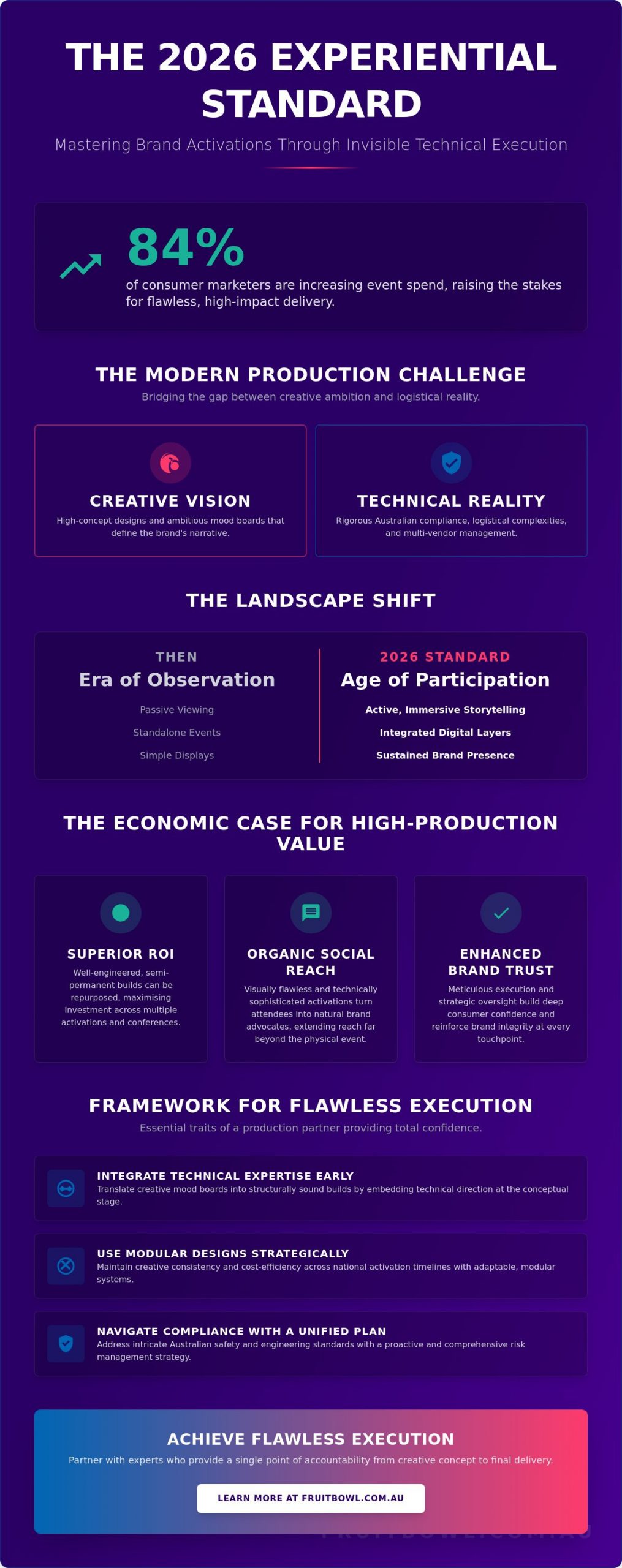
In 2026, the success of a brand activation is no longer measured by the sheer scale of the build, but by the absolute invisibility of its technical execution. With 84% of consumer marketers increasing their event spend this year, the pressure to deliver flawless results has never been higher. You likely recognise the inherent tension between a visionary creative concept and the daunting reality of Australian compliance standards. The persistent fear of technical failure during a live event or the friction of managing multiple vendors can often overshadow the creative ambition of a project.

This analysis provides a sophisticated look at how modern experiential marketing production bridges the gap between high-concept design and rigorous logistical precision. We’ll explore how seasoned experts manage complex government activations and corporate events with a focus on seamless delivery. You’ll learn how to integrate AI-driven engagement and regenerative design principles to ensure every project achieves a measurable return on investment. We’ll outline the strategic frameworks that transform high-stakes environments into controlled, high-impact brand moments that provide total confidence in logistical safety.

Key Takeaways

  • Understand why the shift toward active participation makes high-calibre execution the primary differentiator for Australian brands in 2026.
  • Learn how to translate creative mood boards into structurally sound builds by integrating technical expertise at the conceptual stage.
  • Evaluate the strategic benefits of modular designs to maintain consistency and cost-efficiency across your experiential marketing production timeline.
  • Navigate the intricate requirements of Australian safety and engineering standards with a unified risk management plan for national activations.
  • Identify the essential traits of a production partner who’ll provide a single point of accountability for complex public events and brand activations.

The Landscape of Experiential Marketing Production in 2026

The industry has moved beyond the era of simple observation. In 2026, the benchmark for experiential marketing production is defined by active, immersive participation. Australian brands no longer view activations as standalone events; instead, they’re strategic touchpoints that integrate physical presence with digital depth. This evolution is driven by a consumer base that demands more than just a visual display. They seek environments where they can influence the narrative. This shift toward Engagement Marketing ensures that every interaction is meaningful and measurable. The landscape is now shaped by several key transitions:

  • The move from passive viewing to interactive storytelling.
  • The integration of real-time digital layers within physical builds.
  • A preference for semi-permanent installations that offer sustained brand presence.

Production quality has become the primary differentiator. It’s the difference between a forgotten moment and a lasting brand connection. As brands compete for attention in saturated markets, the precision of the build and the reliability of the technology are what maintain brand integrity. This is particularly evident in the work of Fun 4 Events, who specialise in high-tech activations that create seamless, interactive guest experiences.

This focus on quality is what defines premium engagement; much like the curated hospitality of private wine tours north fork, every element of a physical activation must be meticulously planned to deliver a flawless and memorable brand experience that resonates with a sophisticated audience.

Defining the 2026 Experiential Standard

The Economic Case for High-Production Value

High-quality builds offer a superior return on investment compared to disposable, temporary structures. A well-engineered activation can serve as a semi-permanent brand residence, providing a consistent physical presence over several months. This longevity allows for deeper community connection and more robust data collection. Investing in high-calibre experiential marketing production ensures that the physical assets can be repurposed for multiple conferences and seminars, further enhancing the economic value.

For organisations that require this same level of structural precision in permanent professional environments, you can check out Multicon Group to learn more about their specialist medical and dental clinic fit-outs.

Bridging Creative Vision and Technical Precision

Successful experiential marketing production in 2026 relies on the early and absolute integration of creative intent with technical feasibility. While many agencies treat the design and build phases as separate silos, this disconnect often leads to creative drift. This is the point where the final physical activation lacks the impact of the original mood board because logistical constraints weren’t addressed during the conceptual stage. The role of the Technical Director has become indispensable; they act as the strategic architect who ensures that aesthetic ambition is supported by structural integrity and precise engineering. This oversight ensures that advanced audio-visual elements are woven into the fabric of the build rather than appearing as an afterthought. It’s about creating a seamless environment where the technology is invisible but the impact is profound.

Translating a creative mood board into a physical reality requires a methodical approach to fabrication. Every texture, light source, and interactive element must be vetted for its ability to withstand high-traffic public events. By maintaining end-to-end oversight, production teams can prevent the dilution of the brand message during the transition from digital render to physical structure. This disciplined methodology ensures that the final result is a precise reflection of the brand’s creative ambition, often incorporating specialised features from USA Fire Bowls to ensure that even complex outdoor installations meet the technical precision required for modern Australian environments.

This focus on material integrity extends to every sensory touchpoint; for instance, brands hosting live-fire culinary activations often source premium hardwood fuels from Charcoal Kings to ensure an authentic, high-quality atmosphere that resonates with their audience.

The Anatomy of a Technical Rider

A robust technical rider for 2026 must go beyond a simple equipment list. It serves as a comprehensive blueprint for power distribution, high-speed data requirements, and structural load calculations. Brand managers must account for the specific constraints of diverse environments, from heritage-listed public spaces to high-traffic festivals. Managing these variables requires a deep understanding of how power and data interact within a custom build. For a more detailed look at these complexities, our AV management for events framework provides deeper technical insight into achieving flawless execution.

Materiality and Sensory Design

Material choice is a critical component of brand storytelling. In the current Australian market, there’s a distinct shift toward sustainable, low-impact materials that meet rigorous fire and safety standards. These choices reflect brand values while ensuring total compliance with local regulations. The strategic use of lighting and soundscapes acts as a silent guide. It directs crowd flow and deepens engagement without the need for intrusive signage. This level of sensory control is vital for high-stakes brand activations where every detail must be under expert supervision to ensure a frictionless guest experience.

Designing for the camera has become as critical as designing for the physical visitor. Every angle of a build must be curated to facilitate high-quality social content, ensuring that the activation’s reach extends far beyond those present on-site. This “Instagrammability” isn’t about superficial aesthetics; it’s about the deliberate placement of lighting, textures, and focal points that encourage organic sharing. When a structure is built with the camera lens in mind, it captures the brand’s essence in a way that feels both authentic and aspirational to a digital audience.

This focus on aspirational aesthetics is why many premium brands also look toward unique, high-end environments for their activations; for example, the luxury maritime experiences offered by Neptune Oceanic provide an inherently ‘Instagrammable’ setting that resonates with a sophisticated digital audience.

The Rise of Hybrid Modular Systems

Modern modularity has evolved far beyond simple pop-up tents. Today’s hybrid systems utilise standardised structural components that can be clad in bespoke materials to maintain a high-end feel. This approach significantly reduces bump-in and bump-out times, which is essential for managing tight schedules in public spaces or high-traffic festivals. By investing in reusable elements, brands can achieve significant cost-efficiencies over the course of a national experiential marketing production strategy. These systems allow for rapid deployment while ensuring that the build quality meets the rigorous safety standards expected in the Australian market.

Beyond the structural elements, the guest experience is significantly enhanced by high-quality hospitality; organisers often explore Premium Fruit Gift Box selections to provide hand-selected, seasonal produce that reflects a commitment to excellence.

Immersive Tech Integration

Integrating digital layers like AR and VR into physical structures requires meticulous planning to ensure technical stability. Embedding screens and sensors into custom joinery must be handled with precision to avoid overheating or signal interference, especially in outdoor environments. The same disciplined corporate event management principles that govern large-scale conferences and seminars apply here. Every technical component must be stress-tested to withstand the rigours of public interaction. This technical rigour ensures that the digital experience feels like a natural extension of the physical environment, rather than a bolted-on addition. Whether it’s a government activation or a public festival, the stability of the tech stack is what ultimately preserves the immersion.
Operational Excellence: Managing National Logistics and Compliance

The operational success of a national activation depends on the seamless integration of logistics, labour, and law. When managing experiential marketing production, the margin for error is non-existent. Each Australian state presents unique challenges, from specific OH&S regulations to different trade licensing requirements. A sophisticated production strategy accounts for these variables months in advance. This ensures that a brand’s reputation is never at risk due to a compliance oversight. It’s about bringing order to a complex network of moving parts to provide a sense of absolute security.

Coordinating the movement of bespoke structures across vast distances requires meticulous planning. Oversized elements or delicate technical stacks must be crated and transported with a level of care that reflects their value. This isn’t just about haulage; it’s about maintaining the integrity of the brand’s physical presence throughout its entire journey. Managing on-site labour hire across various jurisdictions also requires a disciplined approach to ensure that every technician and tradesperson on the ground is fully briefed on the project’s specific safety and quality benchmarks.

Risk Management and Public Safety

A “safety-first” approach begins during the initial design phase, not on the day of the bump-in. By identifying potential hazards early, production teams can engineer out risks before they reach the site. This is particularly vital for public-facing builds where unpredictable weather or high foot traffic can test the structural integrity of an installation. For high-stakes environments, we align our processes with government event planning standards to ensure every activation meets the highest possible safety benchmarks. This methodical oversight provides the reassurance that every detail is under expert supervision.

The Logistics of National Execution

Executing a national strategy often involves “leap-frogging” multiple production sets to maintain a tight schedule across different capital cities. This requires a centralised command structure to maintain quality control while the team is on the move. The role of a conference logistics coordinator is essential here. They manage the complex intersection of transport schedules, labour hire, and site access. This disciplined methodology ensures that the production quality remains high, whether the activation is situated in a metropolitan centre or a regional location.

Navigating these complexities demands a partner who acts as a safe pair of hands. If you’re planning a multi-state tour, you can partner with us for national brand activations to ensure your project is delivered with absolute precision and compliance.

Selecting a Production Partner: From Creative Concept to Flawless Execution

Choosing a partner for experiential marketing production is a decision that directly impacts the structural and reputational safety of your brand. In a landscape where technical complexity is the norm, a single point of accountability is no longer optional. Fragmented vendor models often lead to communication gaps that manifest as failures during the live phase of a project. A strategic production partner provides the oversight necessary to ensure that every component, from the initial render to the final bolt, aligns with the brand’s objectives. This transition from a simple vendor relationship to a strategic partnership creates a foundation of trust and clarity.

Evaluating a potential partner requires a rigorous assessment of their technical portfolio and safety record. It’s essential to look beyond the aesthetic appeal of previous builds and scrutinise the engineering and logistical precision behind them. With 28+ years of industry experience, a seasoned team possesses the foresight to anticipate and mitigate risks before they reach the site. This level of expertise is what allows for the seamless delivery of high-stakes festivals and public events where there’s no room for technical error. It’s about finding a “safe pair of hands” that can navigate the unforeseen challenges of live environments with composure. A thorough understanding of brand activation event planning principles is what separates a reactive vendor from a proactive strategic partner.

The Integrated Agency Advantage

End-to-end management significantly reduces the risk of communication breakdowns that often occur when multiple parties are involved. Having in-house technical direction and logistics expertise ensures that the creative vision is never compromised by a lack of technical understanding. This integrated approach allows for a more fluid production lifecycle where brand objectives remain the central focus. It ensures that the team responsible for the build is the same team that understands the strategic intent behind the activation. This synergy is vital for maintaining consistency across complex conferences and seminars or large-scale government activations.

Final Checklist for Production Success

Before signing off on a build, it’s critical to ask the right questions to ensure operational delivery. You should confirm the specific risk management protocols in place and establish clear KPIs for both engagement and logistical precision. Consider the following points:

  • Does the partner have a proven record of managing Australian safety and engineering compliance?
  • Is there a dedicated technical director overseeing the fabrication and installation?
  • Are the timelines realistic for a high-quality finish without compromising safety?

Initiating your next high-impact activation with a composed, expert team ensures that your brand’s creative ambition is matched by logistical excellence. By focusing on these criteria, you can move forward with the confidence that every detail is under expert supervision, resulting in a frictionless experience for both the brand and the audience.

Securing the Future of Your Brand Engagement

The landscape of 2026 demands a disciplined approach where creative ambition is underpinned by logistical certainty. Successful experiential marketing production now relies on the seamless integration of immersive technology, modular scalability, and absolute compliance with Australian safety standards. By prioritising technical direction from the conceptual stage, brands can eliminate the risk of creative drift and ensure a flawless guest experience across every national touchpoint. This strategic alignment between design and delivery is what ultimately secures brand trust in high-traffic environments.

With over 28 years of logistical and creative expertise, our team specialises in navigating the complexities of high-stakes government and corporate activations. We provide comprehensive national production and technical direction to ensure every detail is under expert supervision. Partner with Fruitbowl for your next high-stakes experiential activation. We look forward to helping you translate your vision into a precisely executed reality that delivers measurable impact and lasting engagement.

Frequently Asked Questions

What is the difference between brand activation and experiential marketing production?

Brand activation is the overarching strategic intent to drive consumer engagement, while experiential marketing production is the technical and physical execution of that vision. Production involves structural engineering, bespoke fabrication, and technical direction to ensure a creative concept becomes a safe, functional reality. It’s the disciplined process that bridges the gap between a design render and a high-impact physical environment.

How much does experiential marketing production typically cost in Australia?

Production costs in the Australian market vary based on the scale, technical complexity, and geographical reach of the activation. Factors such as custom joinery, advanced audio-visual integration, and multi-state logistics will influence the overall investment. It’s standard practice to develop a detailed scope of work to ensure the budget accounts for all engineering certifications and safety compliance requirements.

How do you manage safety and compliance for large-scale public activations?

Safety management requires a comprehensive risk assessment and a unified management plan that aligns with Australian Standards. This process includes securing structural engineering certifications, managing local council permits, and conducting rigorous site inspections. For complex site layouts, you can learn more about Hill & Blume to understand how boundary surveys ensure property integrity. A professional production partner ensures that every element of a public event or government activation meets national safety benchmarks to provide total peace of mind.

Can experiential marketing production be sustainable and eco-friendly?

Sustainability is now a core requirement in production through the use of modular systems and regenerative design principles. By utilising reusable structural components and low-impact materials, brands can significantly reduce waste during national tours. Many modern builds also prioritise energy-efficient lighting and solar-powered technical stacks to align with contemporary environmental expectations.

What technical requirements are needed for a modern brand activation?

Modern activations demand a robust technical infrastructure, including high-speed data connectivity, stable power distribution, and specific structural load capacities. If you’re integrating AR, VR, or interactive sensors, the build must be engineered to prevent signal interference and hardware overheating. These requirements are established during the technical design phase to ensure the digital experience remains seamless and reliable.

How do you measure the ROI of an experiential marketing campaign?

ROI is captured through a mix of real-time data collection, social media reach, and direct lead generation. By aligning experiential marketing production with specific business KPIs, brands can track attendee dwell time and conversion rates with precision. A robust approach to brand activation measurement ensures that high-performing activations achieve a measurable return on spend by delivering qualified leads that traditional digital channels cannot replicate.

Why should I use a production agency instead of a standard event planner?

A production agency provides specialised technical oversight and fabrication expertise that standard event planners don’t typically offer. While a planner manages guest lists and catering, a production partner focuses on the structural integrity, technical direction, and logistical precision of the build. This expertise is vital for high-stakes environments where the failure of a custom structure or technical system carries significant risk.

How long does it take to design and build a custom brand activation?

The timeline for a bespoke activation generally ranges from three to six months, depending on the complexity of the design and the scale of the deployment. This duration allows for conceptual development, material procurement, off-site fabrication, and technical stress testing. Initiating the process early ensures that all compliance and engineering hurdles are cleared well before the first bump-in date.

In 2026, the success of a brand activation is no longer measured by the sheer scale of the build, but by the absolute invisibility of its technical execution. With 84% of consumer marketers increasing their event spend this year, the pressure to deliver flawless results has never been higher. You likely recognise the inherent tension between a visionary creative concept and the daunting reality of Australian compliance standards. The persistent fear of technical failure during a live event or the friction of managing multiple vendors can often overshadow the creative ambition of a project.

This analysis provides a sophisticated look at how modern experiential marketing production bridges the gap between high-concept design and rigorous logistical precision. We’ll explore how seasoned experts manage complex government activations and corporate events with a focus on seamless delivery. You’ll learn how to integrate AI-driven engagement and regenerative design principles to ensure every project achieves a measurable return on investment. We’ll outline the strategic frameworks that transform high-stakes environments into controlled, high-impact brand moments that provide total confidence in logistical safety.

Key Takeaways

  • Understand why the shift toward active participation makes high-calibre execution the primary differentiator for Australian brands in 2026.
  • Learn how to translate creative mood boards into structurally sound builds by integrating technical expertise at the conceptual stage.
  • Evaluate the strategic benefits of modular designs to maintain consistency and cost-efficiency across your experiential marketing production timeline.
  • Navigate the intricate requirements of Australian safety and engineering standards with a unified risk management plan for national activations.
  • Identify the essential traits of a production partner who’ll provide a single point of accountability for complex public events and brand activations.

The Landscape of Experiential Marketing Production in 2026

The industry has moved beyond the era of simple observation. In 2026, the benchmark for experiential marketing production is defined by active, immersive participation. Australian brands no longer view activations as standalone events; instead, they’re strategic touchpoints that integrate physical presence with digital depth. This evolution is driven by a consumer base that demands more than just a visual display. They seek environments where they can influence the narrative. This shift toward Engagement Marketing ensures that every interaction is meaningful and measurable. The landscape is now shaped by several key transitions:

  • The move from passive viewing to interactive storytelling.
  • The integration of real-time digital layers within physical builds.
  • A preference for semi-permanent installations that offer sustained brand presence.

Production quality has become the primary differentiator. It’s the difference between a forgotten moment and a lasting brand connection. As brands compete for attention in saturated markets, the precision of the build and the reliability of the technology are what maintain brand integrity. This is particularly evident in the work of Fun 4 Events, who specialise in high-tech activations that create seamless, interactive guest experiences.

This focus on quality is what defines premium engagement; much like the curated hospitality of private wine tours north fork, every element of a physical activation must be meticulously planned to deliver a flawless and memorable brand experience that resonates with a sophisticated audience.

Defining the 2026 Experiential Standard

The Economic Case for High-Production Value

High-quality builds offer a superior return on investment compared to disposable, temporary structures. A well-engineered activation can serve as a semi-permanent brand residence, providing a consistent physical presence over several months. This longevity allows for deeper community connection and more robust data collection. Investing in high-calibre experiential marketing production ensures that the physical assets can be repurposed for multiple conferences and seminars, further enhancing the economic value.

For organisations that require this same level of structural precision in permanent professional environments, you can check out Multicon Group to learn more about their specialist medical and dental clinic fit-outs.

Bridging Creative Vision and Technical Precision

Successful experiential marketing production in 2026 relies on the early and absolute integration of creative intent with technical feasibility. While many agencies treat the design and build phases as separate silos, this disconnect often leads to creative drift. This is the point where the final physical activation lacks the impact of the original mood board because logistical constraints weren’t addressed during the conceptual stage. The role of the Technical Director has become indispensable; they act as the strategic architect who ensures that aesthetic ambition is supported by structural integrity and precise engineering. This oversight ensures that advanced audio-visual elements are woven into the fabric of the build rather than appearing as an afterthought. It’s about creating a seamless environment where the technology is invisible but the impact is profound.

Translating a creative mood board into a physical reality requires a methodical approach to fabrication. Every texture, light source, and interactive element must be vetted for its ability to withstand high-traffic public events. By maintaining end-to-end oversight, production teams can prevent the dilution of the brand message during the transition from digital render to physical structure. This disciplined methodology ensures that the final result is a precise reflection of the brand’s creative ambition, often incorporating specialised features from USA Fire Bowls to ensure that even complex outdoor installations meet the technical precision required for modern Australian environments.

This focus on material integrity extends to every sensory touchpoint; for instance, brands hosting live-fire culinary activations often source premium hardwood fuels from Charcoal Kings to ensure an authentic, high-quality atmosphere that resonates with their audience.

The Anatomy of a Technical Rider

A robust technical rider for 2026 must go beyond a simple equipment list. It serves as a comprehensive blueprint for power distribution, high-speed data requirements, and structural load calculations. Brand managers must account for the specific constraints of diverse environments, from heritage-listed public spaces to high-traffic festivals. Managing these variables requires a deep understanding of how power and data interact within a custom build. For a more detailed look at these complexities, our AV management for events framework provides deeper technical insight into achieving flawless execution.

Materiality and Sensory Design

Material choice is a critical component of brand storytelling. In the current Australian market, there’s a distinct shift toward sustainable, low-impact materials that meet rigorous fire and safety standards. These choices reflect brand values while ensuring total compliance with local regulations. The strategic use of lighting and soundscapes acts as a silent guide. It directs crowd flow and deepens engagement without the need for intrusive signage. This level of sensory control is vital for high-stakes brand activations where every detail must be under expert supervision to ensure a frictionless guest experience.

Designing for the camera has become as critical as designing for the physical visitor. Every angle of a build must be curated to facilitate high-quality social content, ensuring that the activation’s reach extends far beyond those present on-site. This “Instagrammability” isn’t about superficial aesthetics; it’s about the deliberate placement of lighting, textures, and focal points that encourage organic sharing. When a structure is built with the camera lens in mind, it captures the brand’s essence in a way that feels both authentic and aspirational to a digital audience.

This focus on aspirational aesthetics is why many premium brands also look toward unique, high-end environments for their activations; for example, the luxury maritime experiences offered by Neptune Oceanic provide an inherently ‘Instagrammable’ setting that resonates with a sophisticated digital audience.

The Rise of Hybrid Modular Systems

Modern modularity has evolved far beyond simple pop-up tents. Today’s hybrid systems utilise standardised structural components that can be clad in bespoke materials to maintain a high-end feel. This approach significantly reduces bump-in and bump-out times, which is essential for managing tight schedules in public spaces or high-traffic festivals. By investing in reusable elements, brands can achieve significant cost-efficiencies over the course of a national experiential marketing production strategy. These systems allow for rapid deployment while ensuring that the build quality meets the rigorous safety standards expected in the Australian market.

Beyond the structural elements, the guest experience is significantly enhanced by high-quality hospitality; organisers often explore Premium Fruit Gift Box selections to provide hand-selected, seasonal produce that reflects a commitment to excellence.

Immersive Tech Integration

Integrating digital layers like AR and VR into physical structures requires meticulous planning to ensure technical stability. Embedding screens and sensors into custom joinery must be handled with precision to avoid overheating or signal interference, especially in outdoor environments. The same disciplined corporate event management principles that govern large-scale conferences and seminars apply here. Every technical component must be stress-tested to withstand the rigours of public interaction. This technical rigour ensures that the digital experience feels like a natural extension of the physical environment, rather than a bolted-on addition. Whether it’s a government activation or a public festival, the stability of the tech stack is what ultimately preserves the immersion.

Operational Excellence: Managing National Logistics and Compliance

The operational success of a national activation depends on the seamless integration of logistics, labour, and law. When managing experiential marketing production, the margin for error is non-existent. Each Australian state presents unique challenges, from specific OH&S regulations to different trade licensing requirements. A sophisticated production strategy accounts for these variables months in advance. This ensures that a brand’s reputation is never at risk due to a compliance oversight. It’s about bringing order to a complex network of moving parts to provide a sense of absolute security.

Coordinating the movement of bespoke structures across vast distances requires meticulous planning. Oversized elements or delicate technical stacks must be crated and transported with a level of care that reflects their value. This isn’t just about haulage; it’s about maintaining the integrity of the brand’s physical presence throughout its entire journey. Managing on-site labour hire across various jurisdictions also requires a disciplined approach to ensure that every technician and tradesperson on the ground is fully briefed on the project’s specific safety and quality benchmarks.

Risk Management and Public Safety

A “safety-first” approach begins during the initial design phase, not on the day of the bump-in. By identifying potential hazards early, production teams can engineer out risks before they reach the site. This is particularly vital for public-facing builds where unpredictable weather or high foot traffic can test the structural integrity of an installation. For high-stakes environments, we align our processes with government event planning standards to ensure every activation meets the highest possible safety benchmarks. This methodical oversight provides the reassurance that every detail is under expert supervision.

The Logistics of National Execution

Executing a national strategy often involves “leap-frogging” multiple production sets to maintain a tight schedule across different capital cities. This requires a centralised command structure to maintain quality control while the team is on the move. The role of a conference logistics coordinator is essential here. They manage the complex intersection of transport schedules, labour hire, and site access. This disciplined methodology ensures that the production quality remains high, whether the activation is situated in a metropolitan centre or a regional location.

Navigating these complexities demands a partner who acts as a safe pair of hands. If you’re planning a multi-state tour, you can partner with us for national brand activations to ensure your project is delivered with absolute precision and compliance.

Selecting a Production Partner: From Creative Concept to Flawless Execution

Choosing a partner for experiential marketing production is a decision that directly impacts the structural and reputational safety of your brand. In a landscape where technical complexity is the norm, a single point of accountability is no longer optional. Fragmented vendor models often lead to communication gaps that manifest as failures during the live phase of a project. A strategic production partner provides the oversight necessary to ensure that every component, from the initial render to the final bolt, aligns with the brand’s objectives. This transition from a simple vendor relationship to a strategic partnership creates a foundation of trust and clarity.

Evaluating a potential partner requires a rigorous assessment of their technical portfolio and safety record. It’s essential to look beyond the aesthetic appeal of previous builds and scrutinise the engineering and logistical precision behind them. With 28+ years of industry experience, a seasoned team possesses the foresight to anticipate and mitigate risks before they reach the site. This level of expertise is what allows for the seamless delivery of high-stakes festivals and public events where there’s no room for technical error. It’s about finding a “safe pair of hands” that can navigate the unforeseen challenges of live environments with composure. A thorough understanding of brand activation event planning principles is what separates a reactive vendor from a proactive strategic partner.

The Integrated Agency Advantage

End-to-end management significantly reduces the risk of communication breakdowns that often occur when multiple parties are involved. Having in-house technical direction and logistics expertise ensures that the creative vision is never compromised by a lack of technical understanding. This integrated approach allows for a more fluid production lifecycle where brand objectives remain the central focus. It ensures that the team responsible for the build is the same team that understands the strategic intent behind the activation. This synergy is vital for maintaining consistency across complex conferences and seminars or large-scale government activations.

Final Checklist for Production Success

Before signing off on a build, it’s critical to ask the right questions to ensure operational delivery. You should confirm the specific risk management protocols in place and establish clear KPIs for both engagement and logistical precision. Consider the following points:

  • Does the partner have a proven record of managing Australian safety and engineering compliance?
  • Is there a dedicated technical director overseeing the fabrication and installation?
  • Are the timelines realistic for a high-quality finish without compromising safety?

Initiating your next high-impact activation with a composed, expert team ensures that your brand’s creative ambition is matched by logistical excellence. By focusing on these criteria, you can move forward with the confidence that every detail is under expert supervision, resulting in a frictionless experience for both the brand and the audience.

Securing the Future of Your Brand Engagement

The landscape of 2026 demands a disciplined approach where creative ambition is underpinned by logistical certainty. Successful experiential marketing production now relies on the seamless integration of immersive technology, modular scalability, and absolute compliance with Australian safety standards. By prioritising technical direction from the conceptual stage, brands can eliminate the risk of creative drift and ensure a flawless guest experience across every national touchpoint. This strategic alignment between design and delivery is what ultimately secures brand trust in high-traffic environments.

With over 28 years of logistical and creative expertise, our team specialises in navigating the complexities of high-stakes government and corporate activations. We provide comprehensive national production and technical direction to ensure every detail is under expert supervision. Partner with Fruitbowl for your next high-stakes experiential activation. We look forward to helping you translate your vision into a precisely executed reality that delivers measurable impact and lasting engagement.

Frequently Asked Questions

What is the difference between brand activation and experiential marketing production?

Brand activation is the overarching strategic intent to drive consumer engagement, while experiential marketing production is the technical and physical execution of that vision. Production involves structural engineering, bespoke fabrication, and technical direction to ensure a creative concept becomes a safe, functional reality. It’s the disciplined process that bridges the gap between a design render and a high-impact physical environment.

How much does experiential marketing production typically cost in Australia?

Production costs in the Australian market vary based on the scale, technical complexity, and geographical reach of the activation. Factors such as custom joinery, advanced audio-visual integration, and multi-state logistics will influence the overall investment. It’s standard practice to develop a detailed scope of work to ensure the budget accounts for all engineering certifications and safety compliance requirements.

How do you manage safety and compliance for large-scale public activations?

Safety management requires a comprehensive risk assessment and a unified management plan that aligns with Australian Standards. This process includes securing structural engineering certifications, managing local council permits, and conducting rigorous site inspections. For complex site layouts, you can learn more about Hill & Blume to understand how boundary surveys ensure property integrity. A professional production partner ensures that every element of a public event or government activation meets national safety benchmarks to provide total peace of mind.

Can experiential marketing production be sustainable and eco-friendly?

Sustainability is now a core requirement in production through the use of modular systems and regenerative design principles. By utilising reusable structural components and low-impact materials, brands can significantly reduce waste during national tours. Many modern builds also prioritise energy-efficient lighting and solar-powered technical stacks to align with contemporary environmental expectations.

What technical requirements are needed for a modern brand activation?

Modern activations demand a robust technical infrastructure, including high-speed data connectivity, stable power distribution, and specific structural load capacities. If you’re integrating AR, VR, or interactive sensors, the build must be engineered to prevent signal interference and hardware overheating. These requirements are established during the technical design phase to ensure the digital experience remains seamless and reliable.

How do you measure the ROI of an experiential marketing campaign?

ROI is captured through a mix of real-time data collection, social media reach, and direct lead generation. By aligning experiential marketing production with specific business KPIs, brands can track attendee dwell time and conversion rates with precision. A robust approach to brand activation measurement ensures that high-performing activations achieve a measurable return on spend by delivering qualified leads that traditional digital channels cannot replicate.

Why should I use a production agency instead of a standard event planner?

A production agency provides specialised technical oversight and fabrication expertise that standard event planners don’t typically offer. While a planner manages guest lists and catering, a production partner focuses on the structural integrity, technical direction, and logistical precision of the build. This expertise is vital for high-stakes environments where the failure of a custom structure or technical system carries significant risk.

How long does it take to design and build a custom brand activation?

The timeline for a bespoke activation generally ranges from three to six months, depending on the complexity of the design and the scale of the deployment. This duration allows for conceptual development, material procurement, off-site fabrication, and technical stress testing. Initiating the process early ensures that all compliance and engineering hurdles are cleared well before the first bump-in date.

Back to Articles
Request A Quote

Make an
Enquiry

Untitled design

What Makes Us Different?

True end-to-end solution so you can hand off to us, focus on your priorities and enjoy the event without any stress

Unmatched industry expertise looking after diverse range of high-profile events, cultural festivals & activations

Meticulous attention to every detail and precise execution of events with our streamlined processes

Tailored solutions with bespoke strategies to ensure we align with your brand and objectives

Make an Enquiry

"*" indicates required fields

This field is for validation purposes and should be left unchanged.

"*" indicates required fields

This field is for validation purposes and should be left unchanged.