In the public sector, the true measure of success isn’t just the attendance figures; it’s the silence of the auditors and the genuine satisfaction of the community. You’re likely well aware that government event planning carries a unique set of pressures that private sector activations rarely face. Managing the conflicting interests of multiple stakeholders while navigating onerous red tape and strict budget transparency requirements can make even the most seasoned professional feel the weight of the mission. It’s a high-stakes environment where a single oversight in compliance can overshadow the most creative public engagement strategy.
We understand that you need to deliver a seamless, low-risk experience that proves its value for public money. This guide provides a sophisticated framework to help you master these complexities, balancing rigorous logistical precision with the creative ambition your project deserves. We’ll examine how to streamline multi-layered approval processes, implement comprehensive security protocols, and ensure your event meets the highest standards of accessibility and public accountability.
Key Takeaways
- Identify the unique intersection of public policy and logistics to manage the high level of scrutiny inherent in public sector functions.
- Establish a robust framework for managing critical compliance areas, including OHS, accessibility, and the specific requirements of government protocol.
- Master the art of multi-agency stakeholder management by aligning the diverse objectives of departments, ministers, and local councils.
- Utilise a strategic roadmap for government event planning that ensures every stage, from policy-aligned KPIs to procurement, is executed with precision.
- Gain insights into how specialist expertise helps anticipate unique risks and provides a “safe pair of hands” for high-pressure public activations.
Understanding the Unique Landscape of Government Event Planning
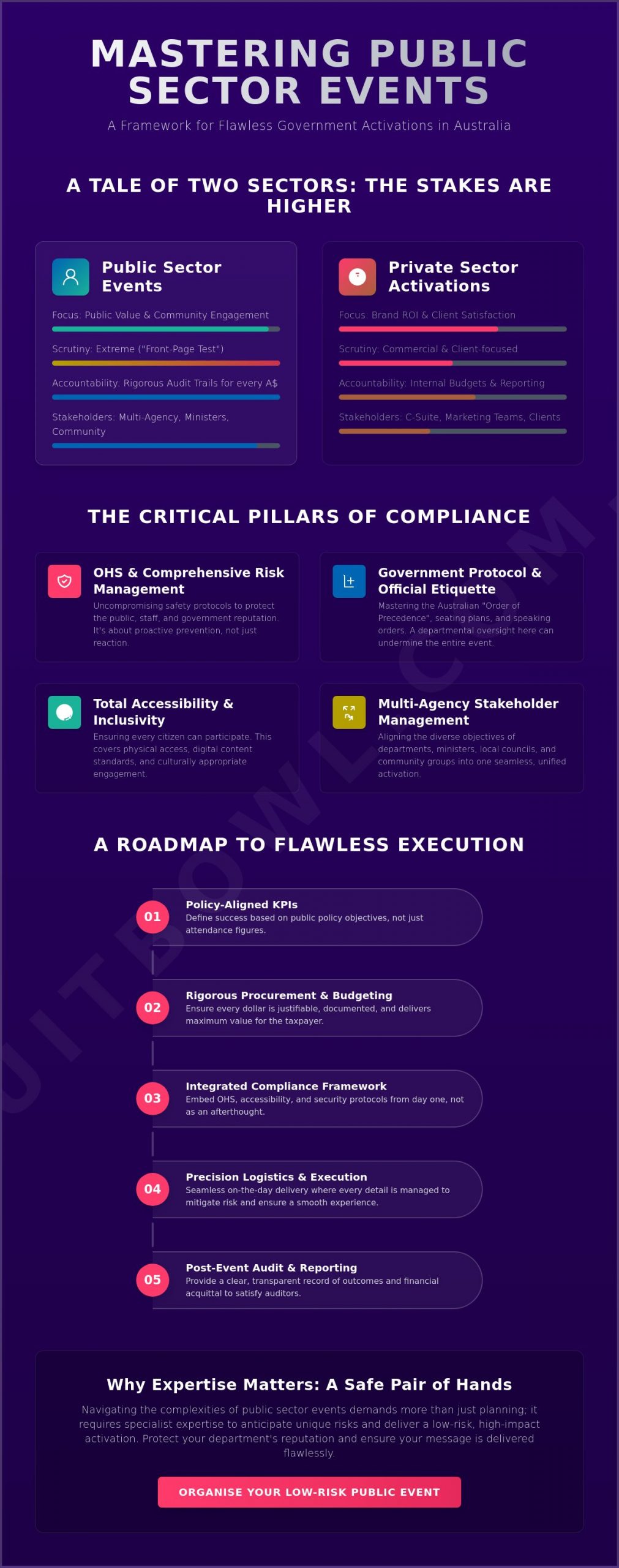
Government event planning is more than the sum of its logistical parts. It represents the precise intersection of public policy, official protocol, and complex logistics. While corporate functions often focus on brand ROI or internal culture, public sector activations must satisfy a broader, more critical set of criteria. Every decision is filtered through a lens of community engagement, policy promotion, and the formal recognition of diverse stakeholders. This isn’t just event management; it’s the execution of a public mandate in a highly visible environment where the standards for success are defined by public value. This commitment to community benefit is frequently seen in initiatives that promote lifelong learning, such as the adult language programs at the Nunawading Japanese School.
The level of scrutiny applied to these events is significantly higher than in the private sector. A failure in a corporate setting might result in a lost client, but a failure in a government context can lead to a parliamentary inquiry or a lasting loss of public trust. Professional event management principles provide the necessary foundation, yet the government layer adds a requirement for absolute transparency and non-partisan delivery. This environment demands a partner who understands that every detail, from the guest list to the choice of venue, must align with broader departmental objectives and ethical standards.
The Accountability Factor: Why the Stakes are Higher
When public funds are involved, every dollar spent is subject to rigorous oversight. In Australia, this means ensuring that every A$ allocated is documented, justifiable, and provides a clear return on investment for the taxpayer. Meticulous record-keeping and clear audit trails aren’t optional extras; they’re the bedrock of the entire process. We often refer to the “front-page test.” If the details of an event’s budget or vendor selection appeared on the front page of a major newspaper, they must be able to stand up to intense public scrutiny. This pressure requires a level of discipline that prioritises clarity and ethical procurement above all else. This includes making socially responsible choices; for example, observing how organisations like FoodCycle LA recover surplus food can help event planners reduce waste and enhance their community impact.
Types of Government Activations and Public Events
The landscape of public sector work is remarkably diverse, requiring a versatile approach to delivery. It ranges from large-scale Festivals & Public Events designed for community celebration to high-level Government Activations such as diplomatic summits or major infrastructure launches. For agencies managing the launch of new healthcare facilities, ensuring the interior meets all clinical requirements is a key priority; Multicon Group specialises in delivering compliant medical and dental clinic fit-outs across Australia. Conferences & Seminars often serve as internal knowledge-sharing platforms or industry-facing briefings. While a community festival requires a focus on crowd density and local council permits, a diplomatic summit demands strict adherence to international protocol and speaking orders. Despite these differences, several common threads run through every project:
- Uncompromising safety and risk management protocols.
- Universal accessibility to ensure all citizens can participate regardless of ability.
- Non-partisan delivery that focuses on the service and policy rather than political optics.
Understanding these distinctions is vital for a successful outcome. A specialist partner doesn’t just plan an event; they manage the reputation of the agency they represent, providing a secure environment where policy can be communicated effectively and safely. For agencies overseeing the launch of new community health facilities, you can check out Multicon Group to see how their specialist clinic fit-outs meet these rigorous standards.
The Critical Pillars of Public Sector Event Compliance
Compliance is the framework that allows creativity to exist safely within the public eye. In government event planning, this involves a sophisticated integration of risk management, Occupational Health and Safety (OHS), and uncompromising accessibility. Meeting national standards isn’t merely about ticking boxes; it’s about ensuring every citizen, regardless of ability or background, can engage with their government. This includes adhering to rigorous data security and privacy measures to protect attendee information, a critical requirement in an era of heightened digital sensitivity. Partnering with a team that understands these intricate requirements ensures your project remains both compliant and impactful. If you’re preparing a large-scale project, exploring specialised Government Activations can provide the logistical security you require.
Navigating Protocol and Official Etiquette
In the Australian public sector, protocol is the silent language of respect and authority. The “Order of Precedence” dictates how VIPs and elected officials are seated and the specific order in which they speak. Getting this wrong isn’t just a social gaffe; it can be seen as a departmental oversight. Meticulous attention to these details ensures that the formal elements of the event support, rather than distract from, the policy message. For a comprehensive breakdown of these requirements, our guide to government protocol and events covers the Commonwealth Table of Precedence, flag placement, and VIP arrival management in detail.
This focus on detail extends to the presentation of participants; for events involving formal dress codes, you can explore High fashion, bridal, evening wear specialist cleaning to ensure that ceremonial attire and VIP wardrobes are maintained to the highest standard.
- Indigenous Acknowledgement of Country and Welcome to Country protocols must be handled with cultural sensitivity and local consultation.
- Official flag protocols require the correct placement of the Australian National Flag alongside state, territory, or other significant flags.
- Branding placement must respect the non-partisan nature of public service while clearly identifying the lead agency and its partners.
Risk Management and Public Safety Frameworks
A robust Risk Management Plan is a living document that evolves as the project progresses. For public activations at national sites, this requires a multi-agency approach that integrates police, health, and transport authorities early in the process. Crowd control strategies go beyond simple fencing; they involve sophisticated flow analysis and emergency response planning tailored to the specific venue. Since one in four adults lives with a disability, your safety frameworks must also account for diverse mobility needs during an evacuation or incident. For those operating in Victoria specifically, understanding the full scope of Victorian government event compliance — including the 2026-2027 fee structures and the 12-week police notification window — is essential to building a legally sound risk management framework. This level of precision ensures that the event remains a safe, accessible space for both the public and high-profile stakeholders. It’s about creating a frictionless experience where the logistics are so well-managed they become invisible to the attendee.
Managing Multi-Agency Stakeholders and Public Expectations
Successful government event planning hinges on the ability to synthesise the competing priorities of a vast stakeholder map. This network typically includes federal or state departments, ministerial offices, local councils, and the broader public. Each entity brings its own set of KPIs and operational requirements to the table. To prevent fragmentation, the appointment of a “Lead Agency” is essential. This central body acts as the primary coordinator for all communications and approvals, ensuring that the project remains aligned with the overarching policy objective while respecting the individual mandates of secondary partners. This structured approach provides the clarity needed to manage complex high-stakes environments effectively; for projects requiring precise site data or land assessment to meet council standards, you can discover Hill & Blume to see how professional surveying supports these rigorous approval processes.
Effective Inter-Departmental Liaison Strategies
Aligning diverse departmental objectives requires a methodical approach to communication. Establishing regular stakeholder working groups ensures that all agencies have a seat at the table from the outset. These forums allow for the early identification of conflicting goals, such as a local council’s focus on noise ordinances versus a department’s requirement for a high-impact public activation. Utilising shared project management tools provides real-time transparency, allowing every stakeholder to track progress and budget allocations. This visibility is vital for managing “scope creep,” which often occurs when multiple departments seek to add secondary objectives to a single event. By maintaining a clear, documented project scope, the Lead Agency can protect the event’s core purpose and financial integrity.
Community Engagement and Public Perception
Public perception can make or break a high-stakes activation. Proactive community engagement is the most effective way to manage sentiment and ensure the project is seen as a valuable use of public funds. Gathering feedback through community consultations or digital surveys during the planning phase allows the public to feel heard and provides planners with insights into local concerns. It’s vital to communicate the “public benefit” clearly; this means translating policy goals into tangible outcomes that matter to taxpayers. Whether it’s the economic boost from Festivals & Public Events or the educational value of Conferences & Seminars, the messaging must be transparent. Identifying potential PR pitfalls, such as perceived waste or logistical disruption, allows for the development of mitigation strategies and clear, honest messaging that addresses concerns before they escalate. For projects based in regional Victoria, engaging with trusted local businesses is a vital part of this strategy; to explore how local expertise supports community objectives, you can visit Ollie James Real Estate.
A Roadmap to Executing a Flawless Government Activation
Executing a successful public sector project requires a disciplined, sequential approach that moves from abstract policy goals to concrete logistical delivery. Unlike corporate events where objectives might shift mid-stream, government event planning demands a fixed strategic foundation that remains resilient under public scrutiny. This roadmap ensures that every phase of the activation, from the initial tender to the final post-event report, is handled with the precision and transparency required by Australian public standards. For instance, when sourcing high-quality amenities for delegates, you can learn more about Tai Kang Healthy Fruits and their approach to premium produce. By following a methodical progression, agencies can mitigate risk while maximising the impact of their community engagement.
Strategic Planning and KPI Alignment
Every event goal must serve as a direct mechanism for achieving a specific, documented policy outcome. This alignment is the core of the Strategic Event Plan, a document that acts as the project’s north star and ensures all stakeholders remain focused on the primary mission. It’s essential to establish measurable benchmarks for success during this initial phase. These might include specific community reach targets, stakeholder sentiment scores, or the successful delivery of a policy announcement. Without these benchmarks, evaluating the return on public investment becomes difficult, leaving the agency vulnerable to questions regarding the event’s value.
Procurement, Budgeting, and Technical Direction
The procurement phase is where logistical ambition meets financial accountability. Navigating the tender process requires a commitment to “value-for-money” assessments that go beyond the lowest price to consider quality, reliability, and specialist expertise. Managing complex budgets often involves balancing multiple funding sources, which requires a highly organised financial framework to ensure every A$ is accounted for. Technical direction must be integrated early to ensure that AV and production requirements support official protocol without overshadowing the event’s dignity. Effective AV management for events is a critical safeguard at this stage, ensuring that microphones, displays, and production infrastructure are planned as a strategic risk mitigation measure rather than an afterthought. For agencies seeking a partner to manage these complex workflows, our team specialises in high-stakes Government Activations that prioritise precision and impact.
The operational and delivery phases focus on the seamless integration of moving parts. On-site management requires an unflappable approach to real-time problem solving, ensuring that any logistical challenges are resolved before they affect the attendee experience or the official program. Finally, the evaluation phase closes the loop by measuring the event’s ROI and public impact. This involves a comprehensive analysis of the KPIs set during the strategic phase, providing the necessary data to demonstrate clear value for public money. This thorough end-to-end methodology ensures that the activation isn’t just a moment in time, but a successful extension of government policy.
To see how professional video production can document these achievements and support government messaging, you can explore Case Studies from Digital Content Studios.
Why Expertise Matters: The Case for Specialist Event Partners
Expertise is the final, most critical layer of the planning process. It’s the difference between an event that merely occurs and one that serves as a flawless extension of a department’s mandate. In high-stakes environments where public accountability is paramount, the value of a “safe pair of hands” can’t be overstated. A specialist partner provides more than just logistical support; they offer the composed, authoritative oversight necessary to bring order to complex public activations. This level of supervision ensures that every detail remains under expert control, allowing government leaders to focus on their strategic objectives with absolute confidence.
Successful government event planning requires a partner who understands the unique nuances of the public sector. From navigating the intricacies of Australian protocol to managing multi-agency approvals, the right expertise acts as a buffer against procedural risk. This seasoned approach ensures that the event is delivered with the precision, dignity, and transparency that the public expects. For leaders who wish to apply this same level of strategic rigour to their broader business goals, you can learn more about Venta Belgarum and their advisory services.
Mitigating Risk Through Seasoned Experience
With 28 years of industry experience, Fruitbowl Events Agency has developed a deep understanding of the risks unique to large-scale public activations. This history allows us to anticipate challenges long before they manifest as public-facing issues. Whether it’s managing the red tape of local council permits or coordinating with national security authorities, a specialist partner navigates these processes with a level of efficiency that internal teams may struggle to replicate. This oversight also extends to ensuring ethical labour practices within the supply chain; to find out more about HR support for growers and labour hire providers, click here for Fair Farms.
This experience also translates into significant cost-saving benefits during the procurement phase. Our established relationships with vendors and talent allow for the negotiation of value-for-money contracts that respect the constraints of public funding. Selecting vendors who specialise in premium, hand-picked produce is a key part of maintaining high hospitality standards; you can find out more about how seasonal fruit is sourced for professional delivery. By providing an end-to-end solution, we ensure that every A$ is utilised effectively, maintaining a clear audit trail that stands up to the most rigorous transparency requirements.
Achieving Strategic Excellence with Fruitbowl Events Agency
Our methodology blends logistical precision with a creative vision that respects the dignity of government policy. We don’t simply execute a checklist; we act as a sophisticated strategist and a meticulous guide for your mission. This approach ensures that your government activations or public festivals are as impactful as they are compliant. For those interested in how these high-level strategies apply across different sectors, we invite you to explore our corporate event management framework for additional insights into our delivery standards.
We are committed to providing a frictionless experience that protects your agency’s reputation and delivers genuine public value. Our team is ready to provide the strategic oversight and disciplined execution your next project requires. Contact our team to discuss your next national government activation and discover how our seasoned expertise can ensure a successful outcome.
Securing Your Next Public Activation with Precision
Mastering the intricacies of government event planning requires a sophisticated balance between logistical excellence and strict adherence to official protocol. We’ve explored how a compliance-first approach, coupled with strategic stakeholder alignment, ensures that public funds are utilised effectively to achieve specific policy outcomes. Whether you’re coordinating a national summit or a community festival, the integration of rigorous risk management and universal accessibility is non-negotiable for a successful delivery that stands up to public scrutiny. State-based planners should also review the detailed requirements outlined in our guide to Victorian government event compliance for 2026, which covers the regulatory frameworks, fee structures, and stakeholder alignment strategies essential for State-level activations.
Navigating these high-pressure environments is a complex task that demands an unflappable partner. With 28+ years of industry-leading experience and a history of national delivery across all Australian states, our team specialises in the high-stakes compliance and protocol required for public sector work. We provide the order and clarity needed to transform complex mandates into seamless activations that reflect the dignity of your agency. Partner with Australia’s trusted government event specialists to ensure your next project is delivered with absolute precision and clear public value. We look forward to helping you achieve your strategic mission with confidence.
Frequently Asked Questions
What is the most critical element of government event planning?
The most critical element is the seamless alignment of the event’s objectives with broader government policy and public accountability standards. Every logistical choice must reflect the agency’s mandate while ensuring absolute transparency in the use of public funds. This strategic foundation provides the necessary justification for the project and ensures it can withstand the highest levels of departmental and public scrutiny.
How do we ensure our government event is fully accessible?
Full accessibility is achieved by integrating universal design principles from the earliest stages of the planning process. This involves meeting national accessibility standards to ensure that venues, digital registration platforms, and on-site communications accommodate all citizens. We prioritise physical mobility, sensory requirements, and cognitive inclusivity, ensuring that the event is a welcoming space for the many Australians who live with a disability.
How do you manage VIP and ministerial protocols at an event?
Managing VIP and ministerial protocols requires strict adherence to the official Order of Precedence and departmental etiquette. This involves coordinating precise seating arrangements, speaking orders, and formal arrivals to reflect the status of elected officials and dignitaries. A dedicated protocol officer often oversees these details, ensuring that Acknowledgements of Country and flag placements are handled with the appropriate level of cultural sensitivity and official respect. Planners seeking a detailed operational framework for these requirements can refer to our guide on mastering government protocol and events in 2026, which outlines the precise steps for managing diplomatic formalities and VIP arrivals.
What are the requirements for risk management in public sector events?
Risk management for public sector events requires a comprehensive, living document that identifies and mitigates potential threats to safety, reputation, and finance. This framework must be developed in coordination with police, health, and transport authorities to ensure a unified response to emergencies. Meticulous planning covers everything from crowd density tracking to data privacy, ensuring that the activation remains a secure environment for all participants.
How can we measure the ROI of a government activation?
Measuring the ROI of a government activation involves evaluating the event against the specific, policy-aligned KPIs established during the strategic phase. Instead of purely financial gain, success is measured through community engagement levels, stakeholder feedback, and the effective communication of departmental messages. These metrics provide a clear demonstration of value for public money, proving that the event has successfully advanced the government’s strategic objectives.
Can an external agency manage the tender and procurement process for us?
An external agency can provide expert guidance to navigate the complexities of the tender and procurement process within your existing departmental frameworks. While the final authorisation remains with the government entity, a specialist partner assists in conducting value-for-money assessments and identifying reliable vendors. This ensures that the procurement phase is transparent, ethically sound, and aligned with the rigorous standards required for high-stakes government event planning.
What is the difference between a corporate event and a government activation?
The primary difference lies in the level of public scrutiny and the underlying motivation for the event. While corporate events focus on brand growth or internal culture, government activations are driven by public policy and the need to deliver community value. Public sector projects demand a higher degree of transparency, non-partisan delivery, and adherence to formal protocol, making the logistical precision and risk management requirements far more intensive.
How do we handle multi-agency branding and messaging?
Multi-agency branding is handled through a unified messaging framework coordinated by the Lead Agency. This ensures that all participating departments are represented according to their level of involvement while maintaining a consistent visual identity. Clear brand guidelines prevent conflicting messages and ensure that the event’s primary policy objective remains the central focus, providing a cohesive experience that reinforces the government’s collective commitment to the community.
OUR BLOG
Event Insights & Expertise
Our blog is your go-to resource for all things events. From expert insights and the latest industry trends to practical planning tips, we share everything you need to deliver standout experiences.
Contact Us