Mastering Government Protocol and Events: A Strategic Guide for 2026

A single breach of official etiquette isn’t just a social error; it’s a strategic failure that can compromise years of diplomatic relationship-building in a single afternoon. When you’re responsible for government protocol and events, the margin for error is non-existent. You likely feel the weight of managing multi-agency stakeholders while worrying about a potential diplomatic faux pas or a mix-up in the hierarchy of officials. It’s a complex environment where every seating arrangement and flag position carries significant symbolic weight.

We understand that maintaining the dignity of the office requires more than just good intentions. This guide unlocks the essential frameworks of Australian protocol to ensure your 2026 events are executed with absolute precision and compliance. You’ll gain a clear understanding of the Commonwealth Table of Precedence and the confidence to manage VIP arrivals seamlessly. From the specific flag protocols required for National Reconciliation Week 2026 to the exact Pantone references for the national colours, we provide the logistical clarity you need to remain a safe pair of hands for every high-stakes occasion.

Key Takeaways

  • Understand how the Australian Order of Precedence dictates seating plans and speaking orders to ensure every dignitary is acknowledged with the correct level of formality.
  • Master the specific display requirements for the Australian National Flag and Indigenous flags to maintain compliance during government protocol and events.
  • Learn to coordinate multi-agency stakeholders, including security and departmental heads, through a disciplined and methodical logistical framework.
  • Discover how to integrate technical requirements like AV and catering into a formal protocol plan without compromising the dignity of the office.
  • Apply a “safe pair of hands” approach to government activations to mitigate the risk of diplomatic faux pas and ensure a frictionless experience for all attendees.

What is Government Protocol and Why Does it Matter?

Government protocol isn’t merely a collection of antiquated traditions; it’s a sophisticated management framework designed to ensure that official interactions remain stable and respectful. At its core, protocol defines the formal rules governing ceremonies, seating, and professional interactions between dignitaries. In the context of government protocol and events, these rules provide a predictable structure that allows participants to focus on the strategic objectives of the meeting rather than the logistics of the encounter. To understand the foundations of these rules, one must look at the historical evolution of diplomatic protocol, which provides the baseline for how nations and their representatives interact with mutual respect.

The primary role of protocol is to uphold the dignity of the office and the institution being represented. Whether it’s a local council event or a federal state visit, the way an official is received reflects directly on the standing of the organisation they lead. By 2026, the standards for these activations have evolved. Modern planners must now balance traditional etiquette with rigorous contemporary requirements, such as advanced digital security and complex multi-agency risk management. A failure to adhere to these standards creates immediate reputational risk. A protocol breach can lead to significant stakeholder friction, potentially stalling policy negotiations or causing long-term diplomatic strain.

The Core Pillars of Australian Protocol

Successful execution begins with a clear understanding of the event’s purpose. A commemorative service requires a different tone and set of rules than a major infrastructure policy launch or a high-level state visit. Protocol acts as a hierarchy of respect, ensuring that every official knows their role and their place within the proceedings. This clarity facilitates better communication between departments and reduces the likelihood of confusion during the event. Government protocol is the procedural glue that holds high-stakes public activations together. It ensures that the focus remains on the message, not a logistical mishap.

This level of procedural discipline is a hallmark of those who have served in high-stakes environments. Veteran-owned organisations like Morgan Financial bring this same sense of precision and duty to their own operations, providing a global example of how the values of service can be successfully applied to maintain the highest professional standards in the private sector.

The Legal and Ethical Framework

Managing government protocol and events requires strict compliance with established guidelines, primarily those issued by the Department of the Prime Minister and Cabinet. These aren’t just suggestions; they’re the standard by which all official Australian ceremonies are measured. This framework intersects deeply with public sector values, demanding a high level of integrity and transparency from every organiser.

In 2026, this framework also places a heavy emphasis on inclusivity and cultural sensitivity. It’s no longer enough to follow a checklist; planners must ensure that formal structures authentically reflect the community. This includes the correct use of Aboriginal and Torres Strait Islander flags and the appropriate delivery of Acknowledgements of Country. Beyond domestic considerations, many protocol professionals learn more about Nunawading Japanese School to enhance their international cultural awareness through specialised language education. Integrating these elements into the formal protocol plan demonstrates a commitment to both tradition and modern Australian values, ensuring the event is both dignified and representative.

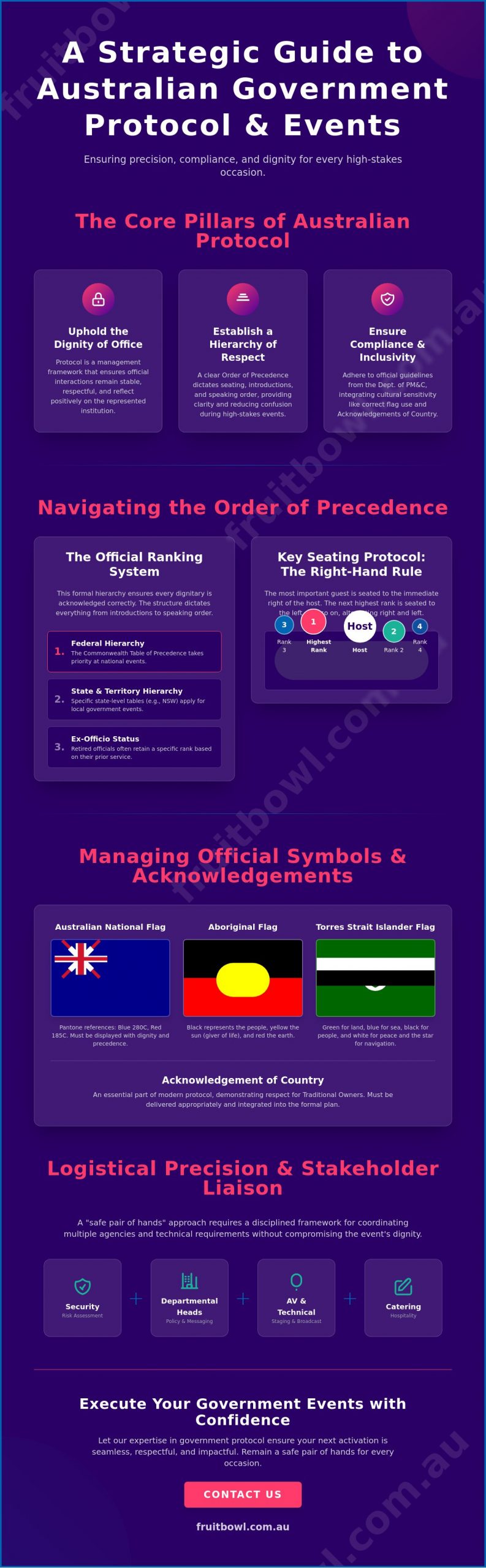
The Order of Precedence serves as the definitive ranking system for dignitaries at official functions. It isn’t just a list; it’s a strategic tool that ensures every interaction follows a logical and respectful sequence. When managing government protocol and events, you must distinguish between the Federal hierarchy and state-specific tables, such as the one published by the NSW Government. This distinction is vital when a Federal Minister and a State Premier are both in attendance. We also carefully consider the status of “ex-officio” guests or retired officials, who often retain a specific rank based on their prior service to the Commonwealth.

Applying this hierarchy correctly influences everything from the order of introductions to the sequence of speakers. A common challenge involves managing retired officials who may no longer hold office but still command a high level of respect within the formal hierarchy. Ensuring these individuals are placed correctly avoids potential friction and maintains the dignity of the proceedings. For a head table or formal stage layout, the focus should always be on symmetry and clear lines of sight, ensuring that the hierarchy is visible but not exclusionary.

Seating Plans and Stage Protocols

The “right-hand rule” is the primary principle for stage and table layouts. The person of highest rank sits to the immediate right of the host. This rule applies regardless of room shape, whether you’re using a traditional head table or a modern theatre-style stage. For those coordinating international delegations, consulting the U.S. Department of State Protocol Reference can provide additional clarity on global standards that intersect with our local requirements. Arrival and departure sequences follow a similar logic; the most senior dignitary typically arrives last and is the first to depart. Handling last-minute RSVP changes requires a composed approach where you can adjust the seating plan without visibly disrupting the established hierarchy.

Salutations and Forms of Address

Correct forms of address are essential for maintaining the dignity of the office. Ministers, Judges, and Members of Parliament each require specific verbal and written salutations. We recommend providing phonetic guides for your Master of Ceremonies to ensure every name and title is pronounced correctly. All printed materials, from place cards to programmes, must reflect the correct post-nominals and titles to avoid any unintended disrespect. If you’re managing a complex guest list, our team can help you organise your next government activation with meticulous attention to detail.

Managing Official Symbols, Flags, and Acknowledgements

Official symbols are the visual anchors of state authority. Their placement and treatment must be handled with the same level of strategic oversight as the guest list itself. When coordinating government protocol and events, the Australian National Flag takes precedence over all other national or ensemble flags. It must be displayed in a dignified manner, ensuring the Union Jack, the Southern Cross, and the Commonwealth Star are clearly identifiable and never obscured by branding or stage equipment. For events held at night, the flag must be properly illuminated. Precision extends to the technical specifications; the official Pantone references for the national colours are Blue 280 and Red 185. These details ensure that the dignity of the office remains uncompromised through every visual element.

The year 2026 brings specific requirements for national observances. During National Reconciliation Week, from 26 May to 3 June 2026, the Australian Aboriginal Flag and the Torres Strait Islander Flag should be flown on additional flagpoles next to the Australian National Flag on government establishments. These flags hold equal precedence to one another and should be flown immediately after the Australian National Flag. If your venue only has a single flagpole, you must not replace the national flag with an Indigenous flag; instead, look for alternative ways to display these symbols within the event space to maintain compliance with the Department of the Prime Minister and Cabinet’s guidelines.

Flag Hierarchy and Display Rules

The order in which flags are displayed is determined by strict hierarchy. After the Australian National Flag, the sequence typically follows other nations in alphabetical order, followed by state flags, territory flags, and then departmental or corporate banners. Consulting the Victorian Government’s Order of Precedence provides an excellent framework for understanding these layered rankings in a local context. We ensure flags are never used as floor coverings, drapery, or tablecloths. They must be handled with care during both setup and pack-down, never touching the ground or being folded in a haphazard manner.

Indigenous Protocols and Acknowledgements

Integrating Indigenous protocols is a critical component of a modern government activation. It’s essential to distinguish between a Welcome to Country, which is delivered by a Traditional Owner of the land where the event is held, and an Acknowledgement of Country, which can be given by any speaker. For high-stakes events, we recommend consulting with local Traditional Owners early in the planning phase to ensure the ceremony is authentic and respectful. Standard wording for an Acknowledgement should be clear and inclusive, recognising the enduring connection of First Nations people to the land. When these elements are integrated thoughtfully, they enhance the event’s creative vision while upholding the highest standards of official protocol.
Logistical Precision and Stakeholder Liaison

The success of government protocol and events is determined by the invisible but rigid logistical backbone that supports every official movement. We adopt a “safe pair of hands” approach, where security, catering, and technical requirements are not viewed as separate silos but as integrated components of a single protocol plan. This integration requires a minute-by-minute run sheet that accounts for protocol-driven delays, such as extended official greetings or motorcade timing. A well-constructed timeline provides the breathing room necessary for dignitaries to move with dignity while ensuring the programme remains on track. It’s about creating a rhythm that feels natural to the guest but is governed by strict chronological discipline.

Managing multi-agency stakeholders is perhaps the most complex aspect of government liaison. You are often coordinating between state or federal police, private dignitary protection teams, and various department heads, each with their own set of priorities. Our role is to act as the central point of contact, ensuring that security requirements never clash with the event’s formal objectives. This level of coordination ensures a frictionless experience for the VIPs and provides peace of mind for the organising department. When every agency is aligned, the event moves with a steady, predictable pulse that mirrors the stability of the institution itself.

Security and VIP Handling

Effective VIP handling begins long before the first guest arrives. We establish secure entry points and discrete arrival zones that allow for efficient movement without public disruption. Media scrums must be managed with equal care; we designate specific press areas that provide broadcast-quality access without breaching established protocol zones. Meticulous logistical precision serves as the essential foundation for ensuring dignitary safety and operational continuity. By controlling the environment, we allow the dignitaries to focus entirely on their official duties.

Technical Direction for High-Stakes Delivery

Technical excellence is non-negotiable when a Minister or Head of State takes the stage. High-quality audio is essential for official addresses and the national anthem, where every word must be delivered with crystal clarity. We also prioritise lighting that meets the standards of both official photography and broadcast-quality video. Strategic AV management for events ensures that even the most complex technical requirements are integrated into the protocol framework. We always maintain comprehensive contingency plans for technical failures during critical moments, ensuring the dignity of the event is never compromised. For expert oversight on your next project, you can engage our team for comprehensive government activations.

Executing Government Activations with Fruitbowl Events

Managing the intricate layers of government protocol and events requires more than just a checklist; it demands a deep, intuitive understanding of the public sector’s unique pressures. With over 28 years of experience and a portfolio of more than 500 delivered events, Fruitbowl Events provides the seasoned expertise necessary for high-stakes activations. We understand that a government project isn’t just about the day itself. It’s about the months of strategic planning, multi-agency stakeholder management, and meticulous risk assessment that occur behind the scenes. Our team acts as a sophisticated strategist, ensuring that every detail, from the Order of Precedence to the specific flag protocols, is managed with unflappable precision.

We position ourselves as a reliable partner that brings order to complex, high-stakes environments. This commitment to being a “safe pair of hands” means that department heads can focus on their policy objectives while we oversee the logistical machinery. Our end-to-end solutions cover everything from the initial strategic framework to the final on-site execution, ensuring a seamless transition between each phase of the project timeline. This methodical approach reduces the potential for friction and ensures that the dignity of the office is maintained at every touchpoint.

Our Strategic Framework for Protocol

We specialise in translating complex departmental guidelines into actionable event plans that don’t compromise on creative ambition. By providing a single point of contact for multi-stakeholder liaison, we eliminate the confusion often associated with multi-agency projects. This approach ensures that your creative vision remains aligned with necessary formal requirements, resulting in a cohesive and dignified experience. Our methodology links every protocol decision back to broader government event planning objectives. We ensure that the institutional dignity of the office is upheld while still delivering an engaging and memorable public activation.

Partnering for Success

Our track record includes managing large-scale public festivals like the Moonee Valley Festival, which draws more than 30,000 people annually, and the inaugural Firelight Festival in Melbourne. These projects demonstrate our ability to handle massive crowds while maintaining strict compliance and safety standards. For seminars and policy launches, the role of a dedicated conference logistics coordinator is vital. This specialist ensures that even the most complex technical and administrative details are integrated into the protocol framework. We provide department heads with the reassurance that every risk has been identified and mitigated through our disciplined technical oversight. Ready to plan your next activation? Contact Fruitbowl Events Agency for expert guidance and a frictionless, professional experience.

Securing the Future of Your Official Activations

Mastering government protocol and events is about more than avoiding a diplomatic faux pas; it’s about reinforcing the stability and dignity of the institutions you represent. Success requires a disciplined approach to the Order of Precedence, meticulous handling of national symbols, and the seamless integration of technical logistics. When these elements align, the result is a frictionless experience that allows officials to focus on their strategic mission without the distraction of operational uncertainty.

With over 28 years of industry-leading experience, we provide the seasoned expertise required to navigate these high-stakes environments. Our team delivers end-to-end logistical and technical direction for government activations and corporate conferences, ensuring every detail remains under expert supervision. Partner with Fruitbowl Events for your next government activation to guarantee absolute compliance and professional precision. We’re ready to help you execute a flawless event that upholds the highest standards of the office.

Frequently Asked Questions

How do I determine the correct order of precedence for an event?

The correct order of precedence is determined by the official Commonwealth Table of Precedence for federal events or the specific state-level tables for regional functions. You must analyse your guest list to identify the highest-ranking official, who then dictates the sequence for seating, introductions, and speaking orders. This hierarchy ensures that every dignitary is acknowledged according to their official standing and the dignity of their office.

Is a Welcome to Country mandatory for all government events?

A Welcome to Country is not legally mandatory for every minor gathering, but it is a standard requirement for official government ceremonies and major public activations. It’s a significant mark of respect that must be delivered by a Traditional Owner of the land where the event occurs. For less formal occasions, an Acknowledgement of Country is an appropriate alternative that any speaker can deliver to recognise First Nations people.

What are the rules for displaying the Australian National Flag alongside other flags?

The Australian National Flag must always take precedence and be flown in the position of honour, typically to the far left of the observer. When managing government protocol and events, you must ensure other flags follow in a specific sequence: other national flags in alphabetical order, followed by state flags, territory flags, and then Indigenous flags. All flags must be of equal size and flown at the same height.

How should I address a Member of Parliament during an official introduction?

You should address a Member of Parliament as “Mr” or “Ms” followed by their surname and the suffix “MP” in written materials. During a formal introduction, a Minister should be referred to as “The Honourable [Name], Minister for [Portfolio]”. It’s essential to verify if the official has other titles or post-nominals to ensure the introduction is both accurate and respectful of their professional standing.

What is the role of a Protocol Officer in event planning?

A Protocol Officer acts as the primary advisor on official etiquette, seating hierarchies, and the correct use of national symbols. Their role is to ensure that every aspect of the event complies with established government guidelines and to manage the delicate nuances of dignitary relations. They provide a strategic framework that prevents diplomatic errors and ensures the proceedings reflect the required level of formality and institutional respect.

Can I include corporate branding on the stage during a government activation?

Corporate branding is permitted on stage during a government activation, provided it remains secondary to official symbols and does not compromise the dignity of the office. You must ensure that logos or promotional materials don’t obscure the Australian National Flag or any departmental crests. The branding should be integrated into the technical design in a way that feels professional and supportive of the event’s core message.

How do I manage security requirements for high-profile government officials?

Managing security for high-profile officials requires early and continuous coordination with the relevant police services or dignitary protection teams. You must establish secure entry points, discrete arrival zones, and clear lines of communication between the event team and security personnel. This collaborative approach ensures that safety measures are integrated into the government protocol and events plan without disrupting the formal flow of the proceedings.

What happens if a dignitary arrives late to a protocol-heavy event?

If a dignitary arrives late, you should generally proceed with the scheduled programme to maintain the event’s momentum for other guests. The Protocol Officer should be prepared to adjust the arrival sequence or speaking order discreetly without drawing unnecessary attention to the delay. Having a flexible but disciplined minute-by-minute run sheet allows the team to manage these variations with a composed approach that preserves the event’s dignity.

A single breach of official etiquette isn’t just a social error; it’s a strategic failure that can compromise years of diplomatic relationship-building in a single afternoon. When you’re responsible for government protocol and events, the margin for error is non-existent. You likely feel the weight of managing multi-agency stakeholders while worrying about a potential diplomatic faux pas or a mix-up in the hierarchy of officials. It’s a complex environment where every seating arrangement and flag position carries significant symbolic weight.

We understand that maintaining the dignity of the office requires more than just good intentions. This guide unlocks the essential frameworks of Australian protocol to ensure your 2026 events are executed with absolute precision and compliance. You’ll gain a clear understanding of the Commonwealth Table of Precedence and the confidence to manage VIP arrivals seamlessly. From the specific flag protocols required for National Reconciliation Week 2026 to the exact Pantone references for the national colours, we provide the logistical clarity you need to remain a safe pair of hands for every high-stakes occasion.

Key Takeaways

  • Understand how the Australian Order of Precedence dictates seating plans and speaking orders to ensure every dignitary is acknowledged with the correct level of formality.
  • Master the specific display requirements for the Australian National Flag and Indigenous flags to maintain compliance during government protocol and events.
  • Learn to coordinate multi-agency stakeholders, including security and departmental heads, through a disciplined and methodical logistical framework.
  • Discover how to integrate technical requirements like AV and catering into a formal protocol plan without compromising the dignity of the office.
  • Apply a “safe pair of hands” approach to government activations to mitigate the risk of diplomatic faux pas and ensure a frictionless experience for all attendees.

What is Government Protocol and Why Does it Matter?

Government protocol isn’t merely a collection of antiquated traditions; it’s a sophisticated management framework designed to ensure that official interactions remain stable and respectful. At its core, protocol defines the formal rules governing ceremonies, seating, and professional interactions between dignitaries. In the context of government protocol and events, these rules provide a predictable structure that allows participants to focus on the strategic objectives of the meeting rather than the logistics of the encounter. To understand the foundations of these rules, one must look at the historical evolution of diplomatic protocol, which provides the baseline for how nations and their representatives interact with mutual respect.

The primary role of protocol is to uphold the dignity of the office and the institution being represented. Whether it’s a local council event or a federal state visit, the way an official is received reflects directly on the standing of the organisation they lead. By 2026, the standards for these activations have evolved. Modern planners must now balance traditional etiquette with rigorous contemporary requirements, such as advanced digital security and complex multi-agency risk management. A failure to adhere to these standards creates immediate reputational risk. A protocol breach can lead to significant stakeholder friction, potentially stalling policy negotiations or causing long-term diplomatic strain.

The Core Pillars of Australian Protocol

Successful execution begins with a clear understanding of the event’s purpose. A commemorative service requires a different tone and set of rules than a major infrastructure policy launch or a high-level state visit. Protocol acts as a hierarchy of respect, ensuring that every official knows their role and their place within the proceedings. This clarity facilitates better communication between departments and reduces the likelihood of confusion during the event. Government protocol is the procedural glue that holds high-stakes public activations together. It ensures that the focus remains on the message, not a logistical mishap.

This level of procedural discipline is a hallmark of those who have served in high-stakes environments. Veteran-owned organisations like Morgan Financial bring this same sense of precision and duty to their own operations, providing a global example of how the values of service can be successfully applied to maintain the highest professional standards in the private sector.

The Legal and Ethical Framework

Managing government protocol and events requires strict compliance with established guidelines, primarily those issued by the Department of the Prime Minister and Cabinet. These aren’t just suggestions; they’re the standard by which all official Australian ceremonies are measured. This framework intersects deeply with public sector values, demanding a high level of integrity and transparency from every organiser.

In 2026, this framework also places a heavy emphasis on inclusivity and cultural sensitivity. It’s no longer enough to follow a checklist; planners must ensure that formal structures authentically reflect the community. This includes the correct use of Aboriginal and Torres Strait Islander flags and the appropriate delivery of Acknowledgements of Country. Beyond domestic considerations, many protocol professionals learn more about Nunawading Japanese School to enhance their international cultural awareness through specialised language education. Integrating these elements into the formal protocol plan demonstrates a commitment to both tradition and modern Australian values, ensuring the event is both dignified and representative.

The Order of Precedence serves as the definitive ranking system for dignitaries at official functions. It isn’t just a list; it’s a strategic tool that ensures every interaction follows a logical and respectful sequence. When managing government protocol and events, you must distinguish between the Federal hierarchy and state-specific tables, such as the one published by the NSW Government. This distinction is vital when a Federal Minister and a State Premier are both in attendance. We also carefully consider the status of “ex-officio” guests or retired officials, who often retain a specific rank based on their prior service to the Commonwealth.

Applying this hierarchy correctly influences everything from the order of introductions to the sequence of speakers. A common challenge involves managing retired officials who may no longer hold office but still command a high level of respect within the formal hierarchy. Ensuring these individuals are placed correctly avoids potential friction and maintains the dignity of the proceedings. For a head table or formal stage layout, the focus should always be on symmetry and clear lines of sight, ensuring that the hierarchy is visible but not exclusionary.

Seating Plans and Stage Protocols

The “right-hand rule” is the primary principle for stage and table layouts. The person of highest rank sits to the immediate right of the host. This rule applies regardless of room shape, whether you’re using a traditional head table or a modern theatre-style stage. For those coordinating international delegations, consulting the U.S. Department of State Protocol Reference can provide additional clarity on global standards that intersect with our local requirements. Arrival and departure sequences follow a similar logic; the most senior dignitary typically arrives last and is the first to depart. Handling last-minute RSVP changes requires a composed approach where you can adjust the seating plan without visibly disrupting the established hierarchy.

Salutations and Forms of Address

Correct forms of address are essential for maintaining the dignity of the office. Ministers, Judges, and Members of Parliament each require specific verbal and written salutations. We recommend providing phonetic guides for your Master of Ceremonies to ensure every name and title is pronounced correctly. All printed materials, from place cards to programmes, must reflect the correct post-nominals and titles to avoid any unintended disrespect. If you’re managing a complex guest list, our team can help you organise your next government activation with meticulous attention to detail.

Managing Official Symbols, Flags, and Acknowledgements

Official symbols are the visual anchors of state authority. Their placement and treatment must be handled with the same level of strategic oversight as the guest list itself. When coordinating government protocol and events, the Australian National Flag takes precedence over all other national or ensemble flags. It must be displayed in a dignified manner, ensuring the Union Jack, the Southern Cross, and the Commonwealth Star are clearly identifiable and never obscured by branding or stage equipment. For events held at night, the flag must be properly illuminated. Precision extends to the technical specifications; the official Pantone references for the national colours are Blue 280 and Red 185. These details ensure that the dignity of the office remains uncompromised through every visual element.

The year 2026 brings specific requirements for national observances. During National Reconciliation Week, from 26 May to 3 June 2026, the Australian Aboriginal Flag and the Torres Strait Islander Flag should be flown on additional flagpoles next to the Australian National Flag on government establishments. These flags hold equal precedence to one another and should be flown immediately after the Australian National Flag. If your venue only has a single flagpole, you must not replace the national flag with an Indigenous flag; instead, look for alternative ways to display these symbols within the event space to maintain compliance with the Department of the Prime Minister and Cabinet’s guidelines.

Flag Hierarchy and Display Rules

The order in which flags are displayed is determined by strict hierarchy. After the Australian National Flag, the sequence typically follows other nations in alphabetical order, followed by state flags, territory flags, and then departmental or corporate banners. Consulting the Victorian Government’s Order of Precedence provides an excellent framework for understanding these layered rankings in a local context. We ensure flags are never used as floor coverings, drapery, or tablecloths. They must be handled with care during both setup and pack-down, never touching the ground or being folded in a haphazard manner.

Indigenous Protocols and Acknowledgements

Integrating Indigenous protocols is a critical component of a modern government activation. It’s essential to distinguish between a Welcome to Country, which is delivered by a Traditional Owner of the land where the event is held, and an Acknowledgement of Country, which can be given by any speaker. For high-stakes events, we recommend consulting with local Traditional Owners early in the planning phase to ensure the ceremony is authentic and respectful. Standard wording for an Acknowledgement should be clear and inclusive, recognising the enduring connection of First Nations people to the land. When these elements are integrated thoughtfully, they enhance the event’s creative vision while upholding the highest standards of official protocol.

Logistical Precision and Stakeholder Liaison

The success of government protocol and events is determined by the invisible but rigid logistical backbone that supports every official movement. We adopt a “safe pair of hands” approach, where security, catering, and technical requirements are not viewed as separate silos but as integrated components of a single protocol plan. This integration requires a minute-by-minute run sheet that accounts for protocol-driven delays, such as extended official greetings or motorcade timing. A well-constructed timeline provides the breathing room necessary for dignitaries to move with dignity while ensuring the programme remains on track. It’s about creating a rhythm that feels natural to the guest but is governed by strict chronological discipline.

Managing multi-agency stakeholders is perhaps the most complex aspect of government liaison. You are often coordinating between state or federal police, private dignitary protection teams, and various department heads, each with their own set of priorities. Our role is to act as the central point of contact, ensuring that security requirements never clash with the event’s formal objectives. This level of coordination ensures a frictionless experience for the VIPs and provides peace of mind for the organising department. When every agency is aligned, the event moves with a steady, predictable pulse that mirrors the stability of the institution itself.

Security and VIP Handling

Effective VIP handling begins long before the first guest arrives. We establish secure entry points and discrete arrival zones that allow for efficient movement without public disruption. Media scrums must be managed with equal care; we designate specific press areas that provide broadcast-quality access without breaching established protocol zones. Meticulous logistical precision serves as the essential foundation for ensuring dignitary safety and operational continuity. By controlling the environment, we allow the dignitaries to focus entirely on their official duties.

Technical Direction for High-Stakes Delivery

Technical excellence is non-negotiable when a Minister or Head of State takes the stage. High-quality audio is essential for official addresses and the national anthem, where every word must be delivered with crystal clarity. We also prioritise lighting that meets the standards of both official photography and broadcast-quality video. Strategic AV management for events ensures that even the most complex technical requirements are integrated into the protocol framework. We always maintain comprehensive contingency plans for technical failures during critical moments, ensuring the dignity of the event is never compromised. For expert oversight on your next project, you can engage our team for comprehensive government activations.

Executing Government Activations with Fruitbowl Events

Managing the intricate layers of government protocol and events requires more than just a checklist; it demands a deep, intuitive understanding of the public sector’s unique pressures. With over 28 years of experience and a portfolio of more than 500 delivered events, Fruitbowl Events provides the seasoned expertise necessary for high-stakes activations. We understand that a government project isn’t just about the day itself. It’s about the months of strategic planning, multi-agency stakeholder management, and meticulous risk assessment that occur behind the scenes. Our team acts as a sophisticated strategist, ensuring that every detail, from the Order of Precedence to the specific flag protocols, is managed with unflappable precision.

We position ourselves as a reliable partner that brings order to complex, high-stakes environments. This commitment to being a “safe pair of hands” means that department heads can focus on their policy objectives while we oversee the logistical machinery. Our end-to-end solutions cover everything from the initial strategic framework to the final on-site execution, ensuring a seamless transition between each phase of the project timeline. This methodical approach reduces the potential for friction and ensures that the dignity of the office is maintained at every touchpoint.

Our Strategic Framework for Protocol

We specialise in translating complex departmental guidelines into actionable event plans that don’t compromise on creative ambition. By providing a single point of contact for multi-stakeholder liaison, we eliminate the confusion often associated with multi-agency projects. This approach ensures that your creative vision remains aligned with necessary formal requirements, resulting in a cohesive and dignified experience. Our methodology links every protocol decision back to broader government event planning objectives. We ensure that the institutional dignity of the office is upheld while still delivering an engaging and memorable public activation.

Partnering for Success

Our track record includes managing large-scale public festivals like the Moonee Valley Festival, which draws more than 30,000 people annually, and the inaugural Firelight Festival in Melbourne. These projects demonstrate our ability to handle massive crowds while maintaining strict compliance and safety standards. For seminars and policy launches, the role of a dedicated conference logistics coordinator is vital. This specialist ensures that even the most complex technical and administrative details are integrated into the protocol framework. We provide department heads with the reassurance that every risk has been identified and mitigated through our disciplined technical oversight. Ready to plan your next activation? Contact Fruitbowl Events Agency for expert guidance and a frictionless, professional experience.

Securing the Future of Your Official Activations

Mastering government protocol and events is about more than avoiding a diplomatic faux pas; it’s about reinforcing the stability and dignity of the institutions you represent. Success requires a disciplined approach to the Order of Precedence, meticulous handling of national symbols, and the seamless integration of technical logistics. When these elements align, the result is a frictionless experience that allows officials to focus on their strategic mission without the distraction of operational uncertainty.

With over 28 years of industry-leading experience, we provide the seasoned expertise required to navigate these high-stakes environments. Our team delivers end-to-end logistical and technical direction for government activations and corporate conferences, ensuring every detail remains under expert supervision. Partner with Fruitbowl Events for your next government activation to guarantee absolute compliance and professional precision. We’re ready to help you execute a flawless event that upholds the highest standards of the office.

Frequently Asked Questions

How do I determine the correct order of precedence for an event?

The correct order of precedence is determined by the official Commonwealth Table of Precedence for federal events or the specific state-level tables for regional functions. You must analyse your guest list to identify the highest-ranking official, who then dictates the sequence for seating, introductions, and speaking orders. This hierarchy ensures that every dignitary is acknowledged according to their official standing and the dignity of their office.

Is a Welcome to Country mandatory for all government events?

A Welcome to Country is not legally mandatory for every minor gathering, but it is a standard requirement for official government ceremonies and major public activations. It’s a significant mark of respect that must be delivered by a Traditional Owner of the land where the event occurs. For less formal occasions, an Acknowledgement of Country is an appropriate alternative that any speaker can deliver to recognise First Nations people.

What are the rules for displaying the Australian National Flag alongside other flags?

The Australian National Flag must always take precedence and be flown in the position of honour, typically to the far left of the observer. When managing government protocol and events, you must ensure other flags follow in a specific sequence: other national flags in alphabetical order, followed by state flags, territory flags, and then Indigenous flags. All flags must be of equal size and flown at the same height.

How should I address a Member of Parliament during an official introduction?

You should address a Member of Parliament as “Mr” or “Ms” followed by their surname and the suffix “MP” in written materials. During a formal introduction, a Minister should be referred to as “The Honourable [Name], Minister for [Portfolio]”. It’s essential to verify if the official has other titles or post-nominals to ensure the introduction is both accurate and respectful of their professional standing.

What is the role of a Protocol Officer in event planning?

A Protocol Officer acts as the primary advisor on official etiquette, seating hierarchies, and the correct use of national symbols. Their role is to ensure that every aspect of the event complies with established government guidelines and to manage the delicate nuances of dignitary relations. They provide a strategic framework that prevents diplomatic errors and ensures the proceedings reflect the required level of formality and institutional respect.

Can I include corporate branding on the stage during a government activation?

Corporate branding is permitted on stage during a government activation, provided it remains secondary to official symbols and does not compromise the dignity of the office. You must ensure that logos or promotional materials don’t obscure the Australian National Flag or any departmental crests. The branding should be integrated into the technical design in a way that feels professional and supportive of the event’s core message.

How do I manage security requirements for high-profile government officials?

Managing security for high-profile officials requires early and continuous coordination with the relevant police services or dignitary protection teams. You must establish secure entry points, discrete arrival zones, and clear lines of communication between the event team and security personnel. This collaborative approach ensures that safety measures are integrated into the government protocol and events plan without disrupting the formal flow of the proceedings.

What happens if a dignitary arrives late to a protocol-heavy event?

If a dignitary arrives late, you should generally proceed with the scheduled programme to maintain the event’s momentum for other guests. The Protocol Officer should be prepared to adjust the arrival sequence or speaking order discreetly without drawing unnecessary attention to the delay. Having a flexible but disciplined minute-by-minute run sheet allows the team to manage these variations with a composed approach that preserves the event’s dignity.

Back to Articles
Request A Quote

Make an
Enquiry

Untitled design

What Makes Us Different?

True end-to-end solution so you can hand off to us, focus on your priorities and enjoy the event without any stress

Unmatched industry expertise looking after diverse range of high-profile events, cultural festivals & activations

Meticulous attention to every detail and precise execution of events with our streamlined processes

Tailored solutions with bespoke strategies to ensure we align with your brand and objectives

Make an Enquiry

"*" indicates required fields

This field is for validation purposes and should be left unchanged.

"*" indicates required fields

This field is for validation purposes and should be left unchanged.