What if the most stringent safety protocols weren’t a barrier to your creative vision, but the very framework that guaranteed its success? In a complex regulatory environment, achieving flawless Victorian government event compliance requires more than just ticking boxes; it demands a sophisticated understanding of how safety and strategy intersect. You likely find the process of managing fragmented requirements across multiple State agencies exhausting, especially when the fear of non-compliance or sudden cancellation looms over your planning cycle.
We understand that balancing an ambitious brand activation or public festival with strict regulatory oversight is a high-stakes endeavour. Precision is non-negotiable. This guide provides the clarity you need to master State-level regulations, offering a comprehensive roadmap to safety, risk management, and stakeholder alignment. We’ll examine the 2026-2027 fee structures, clarify the 12-week police notification window, and outline a methodical approach to ensure your event is both legally sound and logistically precise.
Key Takeaways
- Understand how the 2026 standards require a more integrated approach to OHS and administrative law for all State-level activations.
- Master the complexities of victorian government event compliance by transitioning from reactive safety measures to a proactive, strategic risk management framework.
- Gain a clear understanding of the sequential permit application timelines required to secure approvals across multiple Victorian agencies.
- Learn to manage complex crowd dynamics and movement strategies essential for maintaining safety in high-traffic public spaces.
- Identify the benefits of partnering with seasoned experts to ensure your creative vision remains aligned with rigorous logistical and safety protocols.
Understanding the Victorian Government Event Compliance Landscape
In 2026, victorian government event compliance represents the sophisticated intersection of the Occupational Health and Safety Act 2004, public safety protocols, and administrative law. It’s no longer a peripheral logistical task. Instead, it’s the core framework that allows high-stakes public activations to function within the State’s rigorous legal ecosystem. The standards for this year demand a more integrated approach than ever before. This shift reflects a move towards total transparency and multi-agency coordination, ensuring every variable is accounted for before the first patron arrives.
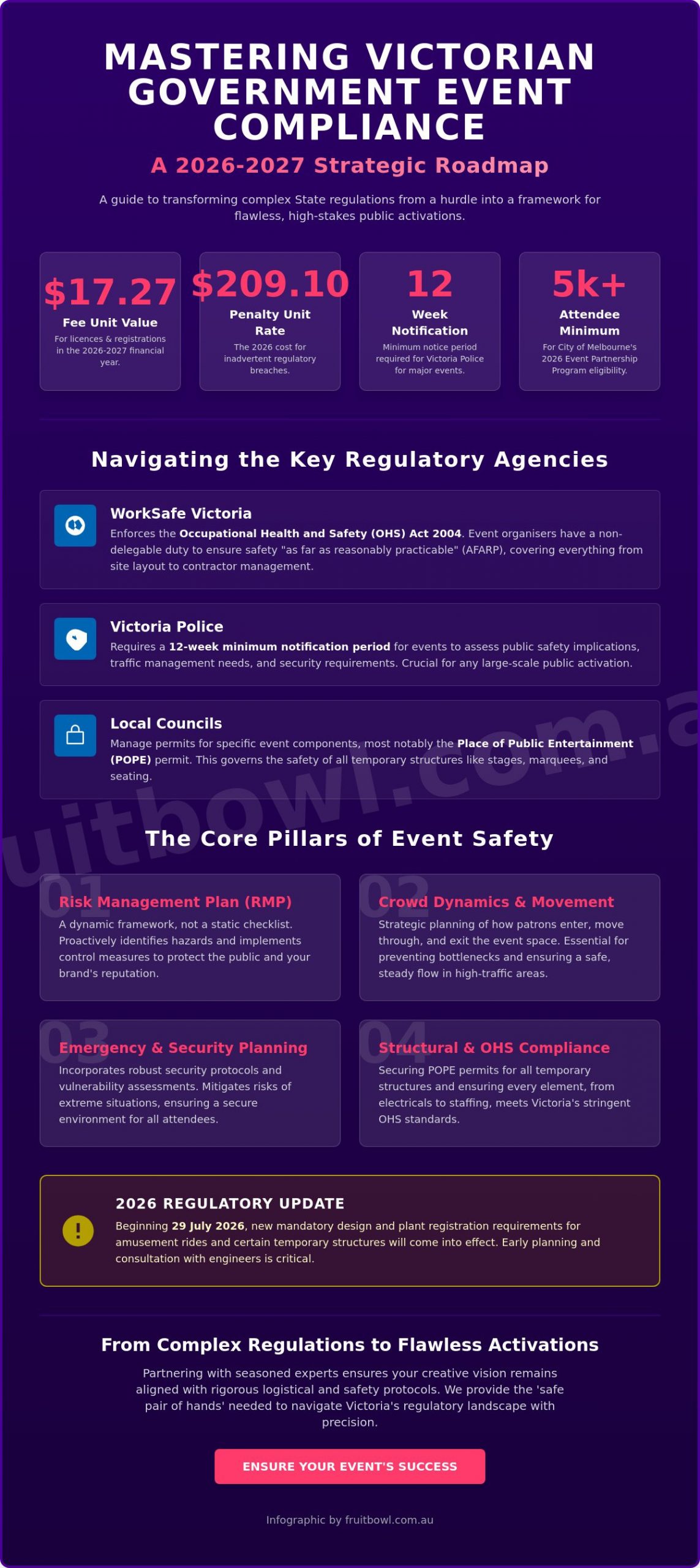
Success in this environment requires a ‘safe pair of hands’; a management style that balances creative ambition with a disciplined, technician-like focus on detail. Much like the professional approach taken by Ollie James Real Estate when assisting clients with the Bendigo property market, organisers must interface with primary governing bodies including WorkSafe Victoria, Victoria Police, and the Department of Premier and Cabinet. Each agency brings its own set of requirements, from the 12-week minimum notification period for Victoria Police to the specific fee unit values, currently set at $17.27 for the 2026-2027 financial year, which apply to various licences and registrations.
The Scope of Public Event Regulations
Distinguishing between a small community gathering and a major government-sanctioned activation is critical for determining your regulatory path. While local council permits might suffice for smaller crowds, major events often trigger mandatory State-level oversight. For instance, the City of Melbourne’s 2026 Event Partnership Program requires a minimum of 5,000 attendees for free programming elements to be eligible. Under the Victorian OHS Act, organisers have a non-delegable duty to provide a safe environment. This obligation is heightened when events involve high-risk elements, such as amusement rides, which face new, mandatory design and plant registration requirements starting 29 July 2026.
Why Compliance is a Strategic Priority
Treating compliance as a strategic priority rather than a hurdle protects both public trust and brand reputation. When you apply Event management principles with a focus on early alignment, you prevent the costly logistical delays that often plague poorly planned projects. Sophisticated government event planning ensures risk mitigation is woven into the creative process from day one. This proactive stance doesn’t just satisfy regulators. It provides the security and order necessary for a frictionless experience, allowing the event’s vision to remain the primary focus while ensuring the organisation remains protected from the 2026 penalty unit rate of $209.10 for any inadvertent breaches.
The Core Pillars of Victorian Event Safety and Regulation
Achieving total victorian government event compliance requires a shift from reactive safety measures to a disciplined, foundational strategy. The central pillar of this approach is the Risk Management Plan (RMP). This document is not a static checklist; it’s a dynamic framework that must evolve alongside your project timeline. A sophisticated RMP identifies potential hazards early, allowing for the implementation of control measures that protect both the public and the organiser’s reputation. Organisers should consult the Victorian Guidelines for Planning Safe Public Events to ensure every aspect of the site layout complies with state expectations.
Crowd dynamics and movement strategies are equally critical, particularly when activating high-traffic public zones or urban centres. Understanding how patrons enter, move through, and exit a space prevents bottlenecks and ensures a steady, safe flow. This logistical precision extends to temporary structures. Many events will require a Place of Public Entertainment (POPE) permit from the local council’s building department. This is a distinct process that governs the safety of stages, marquees, and seating tiers. Furthermore, the 2026 landscape demands advanced emergency management planning, incorporating robust security protocols and vulnerability assessments to mitigate risks of extreme violence or terrorism.
WorkSafe Victoria and OHS Standards
Under the Victorian OHS Act, organisers must ensure safety “as far as reasonably practicable” (AFARP). This standard requires a proactive assessment of what can be done to eliminate or reduce risks. It’s a high bar that covers everything from meticulous contractor management to comprehensive site inductions. In 2026, there’s a heightened focus on psychological safety and worker wellbeing. Compliance now involves ensuring that staff and volunteers are supported in high-pressure environments, reflecting a modern understanding of workplace health. Engaging a team that balances these technical requirements with creative vision ensures your brand activation remains secure and successful.
Technical Production and AV Compliance
Technical excellence must never come at the expense of safety. Integrating sophisticated AV management for events with broader safety protocols is essential for high-impact delivery. All temporary electrical installations must adhere to the AS/NZS 3002 standards, ensuring that power distribution is stable and safe for public environments. For complex staging and lighting rigs, structural engineering sign-offs are mandatory. These certifications provide the necessary assurance that creative builds can withstand environmental factors like wind loads. Additionally, organisers must be aware that new requirements for amusement rides take effect from 29 July 2026, requiring both design and item of plant registration to operate legally within Victoria.
Risk Management: A Framework for Strategic Compliance
Strategic risk management is the foundation of every successful public activation. It’s a process that moves beyond reactive safety measures to create a proactive shield for your project’s viability. By integrating victorian government event compliance into your initial planning stages, you transform regulatory hurdles into a clear roadmap for execution. This structured approach ensures that every variable, from crowd density to weather contingencies, is managed with the precision of a seasoned technician. Professional event managers act as a “safe pair of hands” in this environment, providing the order and clarity required to navigate high-stakes environments where the cost of oversight is high.
A Victorian-standard Risk Register must be comprehensive, categorising potential threats into four distinct quadrants. Financial risks involve budget overruns or fines, such as those related to ticket scalping under the Major Events Act 2009, where individual penalties can reach 60 penalty units ($12,546). Operational risks cover permit delays or logistical failures. Reputational risks address the fallout from non-compliance or poor public sentiment. Finally, safety risks focus on the physical wellbeing of attendees and staff. By addressing these early, you protect the integrity of your creative vision while ensuring the event remains legally sound.
Maintaining legal and ethical standards is a universal requirement for professional operations; in the horticulture sector, Fair Farms provides the specialised HR support and memberships needed to help growers and labour hire providers stay compliant and protect their reputation.
The Anatomy of a Victorian Risk Management Plan
A robust Risk Management Plan (RMP) begins with meticulous hazard identification. Once hazards are identified, you must apply the hierarchy of controls to mitigate them effectively. This involves prioritising the elimination of a risk before moving down to engineering controls or administrative measures. For public festivals, contingency planning is non-negotiable. Your plan should detail specific responses for inclement weather, transport disruptions, or technical failures. Having a pre-determined protocol for these scenarios ensures that if a challenge arises, the response is methodical rather than frantic, maintaining a sense of security for all stakeholders.
Stakeholder Consultation and Victoria Police Liaison
Engagement with Victoria Police is a mandatory component for most major public events. You must notify VicPol of your event at the earliest opportunity, and strictly no later than 12 weeks before the proposed date. This lead time allows for a thorough assessment of security and traffic management requirements. For significant gatherings, the “User Pays” police services model may apply, where the organiser covers the costs of a dedicated police presence. Additionally, consultation with local councils is essential for land use and noise permits. With new music noise regulations expected in 2026, early alignment with EPA standards ensures your activation remains within legal limits without compromising the attendee experience. When your event involves senior officials or dignitaries, understanding government protocol and events is equally essential to ensure that seating arrangements, flag placements, and VIP management reflect the correct hierarchy and diplomatic expectations.
Operational Logistics: Navigating the Victorian Landscape
Executing a high-stakes activation within the State’s urban or regional centres requires a methodical approach to operational logistics. While previous sections established the strategic framework, this phase focuses on the physical manifestation of victorian government event compliance. A project’s success often hinges on a sequential timeline that respects mandatory notification periods and the specific application windows for various land managers. For instance, commercial events on land managed by the Department of Energy, Environment and Climate Action (DEECA) incur a fee of $1.10 per person, per day, alongside potential supervision fees of $79.46 per staff member, per hour. Managing these costs and timelines with precision ensures a frictionless build and strike process.
For organisers looking to activate in regional hubs, having local insights into the area’s property and community profile is invaluable; you can learn more about Ollie James Real Estate to understand the Bendigo and Central Victoria landscape.
Site maps and wayfinding documentation are not merely navigational tools; they are essential compliance records. A sophisticated site map must detail the placement of all temporary infrastructure, emergency egress paths, and medical stations. When managing festival production services in high-traffic zones, every element of the footprint must be accounted for to ensure public safety and environmental protection. This includes a robust waste management strategy that prioritises impact reduction, aligning with the Victorian Government’s commitment to sustainability in public spaces. These documents provide the order and clarity required for high-stakes environments, ensuring every detail is under expert supervision.
Permits, Licences, and Authorisations
A Place of Public Entertainment (POPE) permit is often the most critical document for events featuring temporary structures like stages or grandstands. This is separate from your general event permit and requires detailed structural engineering sign-offs to ensure the build can withstand environmental factors. If your event involves the sale of alcohol, liquor licensing applications must be lodged early, ensuring all staff hold valid RSA certifications. For activations requiring road closures, transport impact assessments are mandatory. These assessments evaluate how the event will affect local traffic flow and public transport, requiring close coordination with the Department of Transport and Planning to secure the necessary authorisations.
Navigating these regulatory frameworks requires a high degree of legal accuracy; for those who also need assistance with Victorian property transactions, you can check out i.Conveyancing.Co to ensure your property matters are handled with the same level of professional care.
Site Management and Crowd Control
Security personnel and crowd marshals must be deployed according to the density and profile of your expected audience. In 2026, the standard for victorian government event compliance includes a sophisticated integration of first aid and medical services directly into the site plan. This ensures rapid response times in the event of an incident. Additionally, all public activations must adhere to the latest Disability Discrimination Act (DDA) requirements. This means ensuring that wayfinding, ramps, and amenities are fully accessible, creating an inclusive environment that welcomes all members of the community. To ensure your next project meets these rigorous standards, consider partnering with an expert team for your next public event activation.
Seamless Delivery: Why Professional Management is Essential
For 28 years, Fruitbowl Events Agency has acted as a “safe pair of hands” for complex public activations. This history is not just a measure of time; it’s a repository of seasoned expertise used to provide a frictionless experience for our partners. We understand that a successful event is the result of the seamless integration of various moving parts. By aligning creative vision with meticulous technical planning, we ensure that the final delivery is both high-impact and legally sound. Our role is to act as a disciplined technician and a creative strategist, ensuring that every detail is under expert supervision while you focus on your broader objectives.
The Fruitbowl Methodology for Government Activations
Our approach to government activations is rooted in a methodical and deliberate planning rhythm. We begin by establishing foundational concepts before moving into the specific technical details. This ensures that stakeholder liaison, whether with the Department of Premier and Cabinet or the EPA, is purposeful and efficient. We integrate technical direction directly with regulatory requirements, ensuring that AV installations and structural builds are certified and compliant from the outset. This results-oriented methodology prioritises the client’s mission, maintaining a consistent professional energy throughout the project lifecycle. We don’t just manage events; we provide the strategic framework for their success.
Next Steps for Your Victorian Activation
To achieve the best outcomes, organisers should integrate compliance considerations at the very start of the concept stage. Early alignment with Victorian standards prevents the need for costly redesigns or last-minute logistical adjustments. If you’re planning a high-stakes public event or government activation, we offer a clear pathway for consultation on complex regulatory environments. Our team is unflappable, experienced, and deeply committed to the success of your mission. Consult with the experts at Fruitbowl Events Agency to ensure your next activation is delivered with the precision and security it deserves.
Securing Your Vision through Strategic Compliance
Mastering the complexities of victorian government event compliance is a strategic necessity for any high-stakes activation. Success depends on an integrated approach to risk management, the early alignment of stakeholder expectations, and the methodical execution of operational logistics. By prioritising safety and regulatory precision from the concept stage, you ensure your creative vision remains protected and your organisation remains legally sound. This disciplined approach transforms potential hurdles into a robust framework for success.
Managing these multifaceted requirements demands a partner who offers both seasoned expertise and a results-oriented methodology. With 28 years of experience in high-stakes delivery, our Melbourne-based team provides end-to-end solutions for the government and corporate sectors with a national reach. We bring order and clarity to the most complex environments, allowing you to deliver impactful public festivals and brand activations with absolute confidence. Our history of navigating every possible challenge ensures a frictionless experience for your team and your attendees alike.
Partner with the safe pair of hands for your next Victorian activation and ensure every detail of your project is under expert supervision. Your vision deserves the security of a disciplined, technical framework that guarantees a flawless delivery from start to finish.
Frequently Asked Questions
What is the first step in Victorian Government event compliance?
The initial phase involves identifying the primary land manager and the lead regulatory agency responsible for your event’s location. This determination establishes the specific framework and timeline for all subsequent approvals. Early identification is vital, as it dictates mandatory notification windows, such as the 12-week minimum requirement for Victoria Police engagement for public gatherings.
When do I need a Place of Public Entertainment (POPE) permit?
A POPE permit is required when an event features temporary structures, such as stages, marquees, or grandstands, that exceed specific size thresholds or if the event is held in an enclosed area with a large attendance. This permit is issued by the local council’s building department. It ensures that all infrastructure is structurally sound and that emergency egress paths are sufficient for the expected crowd density.
How does WorkSafe Victoria define a “safe” public event?
WorkSafe Victoria defines safety through the standard of being managed “as far as reasonably practicable” (AFARP). This requires organisers to proactively identify hazards and apply a hierarchy of controls to eliminate or mitigate risks. In 2026, this definition has expanded to include psychological safety and worker wellbeing, ensuring that all staff and volunteers are supported in high-pressure environments.
Do I need to engage Victoria Police for my public event?
Engagement with Victoria Police is mandatory for most significant public activations to ensure victorian government event compliance. You must notify them of your event at least 12 weeks before the proposed date. They will conduct a risk assessment to determine if a “User Pays” police presence is required for security, crowd control, or traffic management to maintain public order.
What are the 2026 requirements for event risk management plans?
2026 standards require risk management plans to be proactive and integrated, moving beyond simple checklists to include strategic vulnerability assessments. Plans must now account for specific new regulations, such as the mandatory design and plant registration for amusement rides taking effect on 29 July 2026. Additionally, robust counter-terrorism and security protocols must be clearly documented and aligned with State expectations.
How long does the permit approval process take in Victoria?
The approval process typically requires a lead time of 12 to 16 weeks, though complex activations may take longer. Specific processes, such as requesting an amendment to a planning scheme, involve a Stage 1 fee of $3,557.60 and can involve extensive consultation periods. Starting the compliance process at the concept stage is the most effective way to prevent costly logistical delays.
What is the difference between a community event and a major government activation?
The distinction is primarily defined by scale, risk profile, and the level of mandatory State-level oversight. Major activations often involve multiple government agencies and high-traffic public zones. For instance, eligibility for certain City of Melbourne partnership programs in 2026 requires a minimum of 5,000 attendees for free programming, triggering more rigorous reporting and safety requirements than a local community gathering.
How can an event management agency help with government compliance?
An agency provides a “safe pair of hands” by managing the end-to-end victorian government event compliance process on behalf of the organiser. They handle complex multi-agency liaisons, secure technical structural sign-offs, and develop comprehensive risk registers. This professional oversight ensures that the creative vision of the activation remains intact while every logistical and legal requirement is met with precision.
OUR BLOG
Event Insights & Expertise
Our blog is your go-to resource for all things events. From expert insights and the latest industry trends to practical planning tips, we share everything you need to deliver standout experiences.
Contact Us