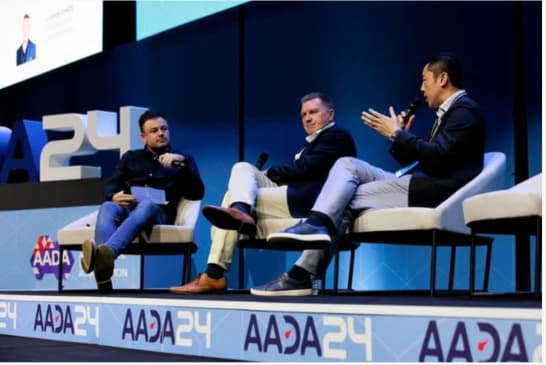
A festival’s success is rarely defined by the headline act alone; it is secured through the invisible precision of its infrastructure. For organisers across Australia, the pressure to deliver a flawless experience is immense, especially as the global events industry is projected to surpass $1.55 trillion in value by 2026. You likely recognise that the margin for error is non-existent when managing complex festival production services. A single technical glitch or a misunderstood safety regulation can compromise years of planning and brand reputation in an instant.
We’ve designed this strategic guide to help you move beyond the friction of vendor management and the anxiety of shifting regulatory compliance. You’ll discover how to implement the latest ANSI/ESTA safety standards and prepare for upcoming accessibility requirements with absolute confidence. We’ll outline a methodical approach to achieving a seamless bump-in and a high-impact audience experience that remains grounded in logistical reality. This overview covers everything from technical integration to sophisticated risk management, providing a definitive roadmap for your next large-scale activation.
Key Takeaways
- Understand the critical difference between basic equipment rental and the strategic integration provided by full-service festival production services.
- Identify the engineering requirements for large-scale outdoor staging and the technical frameworks essential for flawless audio-visual delivery.
- Learn how to develop a comprehensive Risk Management Plan that addresses structural integrity, electrical safety, and evolving compliance standards.
- Master the art of show advancing and technical rider management to ensure seamless coordination between performers and production teams.
- Discover the long-term benefits of partnering with a seasoned team that brings logistical precision to high-stakes public and corporate activations.
Defining Festival Production Services: Beyond the Equipment
Many organisers mistakenly view production as a mere checklist of equipment to be ticked off. In reality, festival production services represent the strategic integration of technical, logistical, and creative elements into a single, cohesive operation. While a vendor might supply a line array or an LED wall, a production partner ensures these components function within the broader context of the event objectives. This role is about managing the friction between ambitious creative visions and the rigid constraints of physics and safety.
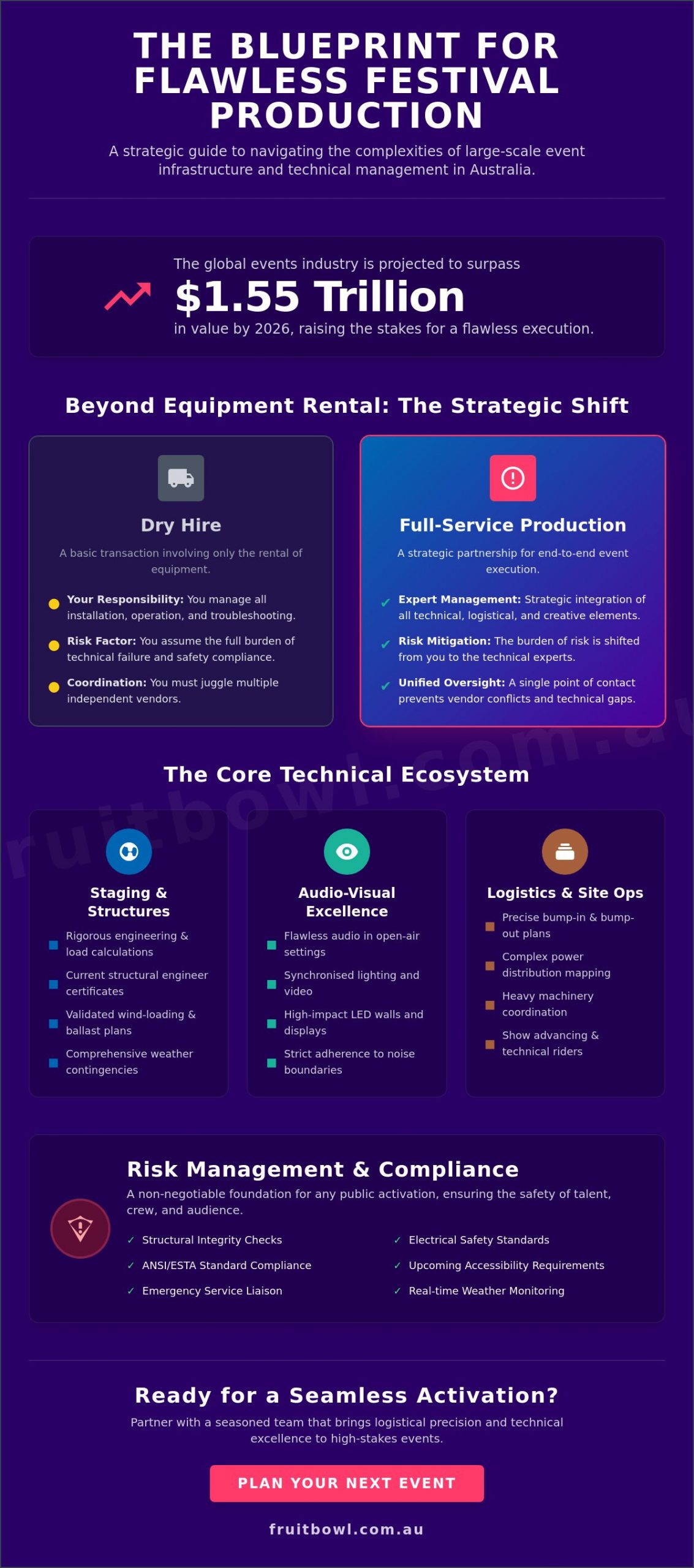
It’s vital to distinguish between ‘dry hire’ and ‘full-service production’. Dry hire involves renting equipment and assuming the responsibility for its installation and operation. Conversely, full-service production encompasses the end-to-end management and execution of every technical detail. This approach shifts the burden of risk from the organiser to the technical experts. Festival production is the orchestration of technical infrastructure to deliver a seamless audience experience.
Within the broader field of Event management, the production lead acts as the central point of truth for all on-site activity. They align the core pillars of site infrastructure, technical direction, and stakeholder liaison to prevent the fragmentation that often occurs when managing multiple independent vendors. This oversight ensures that the technical requirements of the artists are met without compromising the safety or comfort of the crowd.
The Scope of Modern Festival Logistics
Outdoor festivals present variables that indoor activations don’t face. Site maps must account for terrain, weather contingencies, and complex power distribution across wide areas. Production teams manage the high-pressure windows of ‘bump-in’ and ‘bump-out’, ensuring that temporary infrastructure is erected safely and removed efficiently. This includes the coordination of heavy machinery and the precise timing of delivery schedules to avoid site congestion. Success in this environment requires a deep understanding of temporary structures and the ability to adapt to changing environmental conditions in real time. For a comprehensive framework on coordinating these moving parts, our guide to festival logistics management for large-scale event operations provides a structured approach to mastering every operational touchpoint.
While managing site logistics in remote areas is a professional challenge, those who enjoy these environments in their personal time can discover Adventurerz for insights into outdoor travel and camping communities.
Why Strategic Oversight Matters
A unified production strategy serves as a buffer against vendor conflicts and technical gaps. Instead of the organiser mediating between the sound company and the lighting crew, the production partner provides a single point of contact for local councils and emergency services. This integrated resource management also leads to budget optimisation. By identifying overlaps in equipment or labour, a seasoned partner reduces waste and ensures every dollar spent contributes directly to the audience experience. It provides the peace of mind that comes from knowing every moving part is under expert supervision.
The Technical Ecosystem: Audio, Visual, and Staging
The technical layer of a festival is where high-level strategy meets physical reality. While the previous section defined the management role, the actual execution relies on a sophisticated technical ecosystem. High-calibre av management for events ensures that every speaker, screen, and light fixture operates as a single, synchronised unit. This level of coordination is necessary to maintain the integrity of the performance while adhering to strict noise boundaries and safety protocols. Without this oversight, the risk of technical failure or regulatory breach increases significantly.
Staging and Structural Integrity
Large-scale builds require more than just a platform; they demand rigorous engineering. Whether utilising modular decks for custom shapes or mobile trailer stages for rapid deployment, the structural load must be precisely calculated. Every roof structure must have a current structural engineer certificate to validate its wind-loading capacity and ballast requirements. Weather-contingency planning isn’t an optional extra. It’s a fundamental requirement for protecting both the talent and the audience from environmental risks. For organisers, these technical details are best managed through comprehensive festival production services that prioritise safety over aesthetic shortcuts. Consulting official Venue Guides for Security Enhancements can provide additional context on mitigating physical risks at large gathering sites. These documents help establish a baseline for protecting temporary infrastructure from external disruptions.
Audio-Visual Excellence
Sound reinforcement in an open-air environment presents unique challenges that differ from indoor venues. Line-array speaker systems are the industry standard for their ability to project clear, consistent audio across vast distances without excessive spill into neighbouring residential areas. Managing noise boundaries is a delicate balance of acoustic engineering and community liaison. Integrating these technologies requires specialised festival production services that understand the nuances of outdoor acoustics. Visual impact is equally critical for modern audiences. High-resolution LED screens ensure visibility for every attendee, even in direct sunlight, and provide a premium platform for sponsor activations. Technical direction ensures these AV elements don’t just exist in the same space but work in harmony with the creative vision. If you’re planning a complex activation, partnering with experts in corporate event management can provide the technical oversight needed for a flawless delivery.
Lighting design serves a dual purpose. It creates the atmosphere that defines the audience experience, but it also provides essential illumination for egress routes and safety corridors. A well-designed plot uses energy-efficient LED fixtures to reduce power consumption while maintaining high-impact visuals. This meticulous planning prevents the “dark spots” that can lead to crowd congestion or accidents. When these technical layers are integrated correctly, the result is a secure, immersive environment where the audience can focus entirely on the performance. Every cable run and power distribution point is mapped out to ensure zero downtime during the live show.
Risk Management and Compliance: Ensuring a Safe Activation
Technical precision and creative ambition must be anchored by a rigorous safety framework. In the high-stakes environment of large-scale events, the primary risks involve structural failure, electrical hazards, and unpredictable crowd dynamics. Comprehensive festival production services prioritise these elements from the initial site survey to the final pack-down. This meticulous approach ensures that every piece of infrastructure is not only functional but fully compliant with Australian Work Health and Safety (WHS) legislation. It’s about creating a secure environment where the audience feels safe without being aware of the complex machinery keeping them that way.
A central pillar of this process is the development of a tailored Risk Management Plan (RMP). This document serves as the blueprint for identifying potential hazards and implementing mitigation strategies before a single piece of equipment arrives on-site. For detailed insights into these preparations, organisers can refer to established frameworks for Festival Risk Management Planning. A production partner’s role is to act as the guardian of this plan, ensuring that all sub-contractors and vendors adhere to the same stringent safety standards. This centralised oversight prevents the dangerous gaps that occur when individual vendors operate in isolation.
Navigating Australian Safety Standards
Compliance in Australia involves meeting specific technical benchmarks. All electrical equipment must undergo rigorous tagging and testing to ensure it’s safe for public use; for organisers in the Southern Highlands, Edmund Parks Electrical provides the professional services needed to meet these essential safety requirements. During the event, ‘Level 1’ and ‘Level 2’ safety officers provide constant monitoring of the site’s integrity. These professionals oversee everything from temporary structure permits to council-mandated noise limits. Securing the necessary approvals from local authorities is a complex task that requires precise documentation and engineering reports. A seasoned production partner handles this bureaucracy, allowing you to focus on the event’s creative objectives.
Crowd Control and Site Safety
Safe crowd flow is a direct result of intelligent production design. The placement of stages, bars, and entry points must be calculated to prevent bottlenecking or dangerous congestion. Essential requirements for a secure site include:
- Clearly marked emergency egress routes that remain unobstructed at all times.
- Redundant emergency lighting systems that function independently of the main power grid.
- Reliable internal and public communication systems for rapid information dissemination.
Production teams coordinate closely with security and medical services to ensure a rapid response to any incident. This synergy allows for a calm, controlled environment where safety is managed with quiet efficiency. When the infrastructure is designed with crowd dynamics in mind, the risk of incident is significantly reduced, ensuring a frictionless experience for every attendee.
Talent Coordination and Technical Riders
The live performance is the culmination of months of logistical preparation. While the physical infrastructure provides the foundation, talent coordination ensures the creative vision is realised on stage. A technical rider serves as the definitive blueprint for stage success, detailing every specific requirement from audio patches to backline instruments. Meticulous festival production services bridge the gap between an artist’s expectations and the site’s technical capabilities, ensuring that the performance isn’t compromised by equipment limitations.
Advancing the show involves a series of technical consultations with artist management to confirm that every element is accounted for well before the bump-in. This process includes verifying power requirements, monitor mixes, and the physical footprint of the band’s equipment. A seasoned stage manager acts as the central coordinator during the event, maintaining the run-sheet and supervising artist transitions. Strategic festival production services ensure that these changeovers are conducted with invisible efficiency, keeping the audience engaged throughout the day. Managing backline requirements, such as rolling riser systems for quick drum kit swaps, is essential for maintaining the momentum of a multi-act lineup. For a comprehensive approach to securing your lineup before these production details are finalised, our festival talent booking checklist for 2026 provides a methodical framework for managing contracts, negotiations, and technical rider compliance.
Interpreting riders for headline acts requires a sophisticated understanding of both technical possibilities and artist psychology. Production teams must manage the logistical challenge of hosting multiple acts on a single stage, often with conflicting equipment needs. Clear communication between the Front of House (FOH) engineers and the performers is essential to prevent friction. This dialogue ensures that every act, from the local opener to the international headliner, receives the same level of technical support. If you’re looking for a safe pair of hands to manage your next activation, our professional festival production team is ready to assist with these complex requirements.
The Run-Sheet: Precision in Programming
Selecting a Festival Production Partner
Choosing the right partner for festival production services is the most significant decision an organiser will make. In a high-stakes environment where technical failure or safety incidents can have lasting consequences, you need a partner who acts as a strategic ally rather than a simple equipment vendor. The ideal selection criteria must prioritise a proven safety record, extensive technical capability, and a deep history of successful delivery. An end-to-end partner simplifies the entire journey, providing a single point of accountability that reduces the administrative burden on your team. This centralised oversight ensures that no detail is overlooked during the transition from planning to execution.
Beyond the technical setup, ensuring the event’s atmosphere is professionally captured is crucial for future marketing; for expert event coverage, Festival City Photography provides the high-calibre results that organisers expect.
Experience and Proven Track Record
Longevity in the events industry serves as a reliable proxy for problem-solving ability and resilience. A partner with 28 years of experience hasn’t just seen it all; they’ve developed the protocols necessary to handle the unexpected with composure. When evaluating a potential partner, it’s vital to review their past work on public activations of a similar scale and complexity. You need a team that understands the distinct requirements of government protocols and corporate standards. This seasoned expertise ensures that every permit, engineering certificate, and safety induction is handled with meticulous attention to detail, protecting your brand from avoidable risks. It’s this history of reliability that defines a truly elite production team.
The Fruitbowl Approach to Production
Our methodology is built on the belief that creative ambition must be anchored by logistical precision. We provide a ‘safe pair of hands’ for every activation, a philosophy that we also apply to our work in corporate event management. This approach ensures that even the most complex technical requirements are executed with discipline and order. Our strategic planning begins at the concept stage and continues through to the final bump-out, maintaining a steady and predictable pulse throughout the project timeline. We don’t just supply gear; we manage the entire technical ecosystem to ensure your vision is realised without compromise.
We invite you to experience a frictionless production process where every moving part is synchronised and every risk is mitigated. By integrating technical direction with rigorous site management, we create a secure environment that allows the audience to fully engage with the experience. This results-oriented focus ensures your festival is remembered for its impact and excellence, not its logistical hurdles. Partnering with a disciplined technician who is also a creative visionary provides the balance needed for a truly successful 2026 activation. We take pride in bringing order to the chaos of large-scale events, ensuring every stakeholder feels secure in the mission’s success.
Securing Your Vision for 2026 and Beyond
The success of a large-scale activation relies on more than just technical equipment; it requires a unified strategy where every logistical detail is accounted for. We’ve explored how technical precision, rigorous risk management, and seamless talent coordination form the essential pillars of modern festival production services. By prioritising structural integrity and clear communication, organisers can ensure a frictionless experience that protects both the audience and the brand’s reputation.
Moving forward, the focus must remain on bridging the gap between creative ambition and operational reality. With over 28 years of industry experience, we specialise in high-stakes government and corporate activations that require end-to-end strategic planning and execution. Organisers managing both festivals and business gatherings can benefit from exploring dedicated corporate event management services to ensure the same level of precision is applied across every type of activation. We provide the steady hand and seasoned expertise needed to navigate the evolving standards of the Australian events landscape with confidence.
Partner with Fruitbowl for your next high-impact festival and ensure your mission is delivered with absolute precision. We look forward to bringing order and clarity to your next major event.
Frequently Asked Questions
What is the difference between event management and festival production?
Event management encompasses the administrative and commercial aspects of an event, such as marketing, ticketing, and stakeholder relations. In contrast, festival production services focus on the physical and technical execution of the site. This includes the strategic integration of staging, audio-visual systems, and temporary infrastructure to ensure the event’s operational success.
How far in advance should I book festival production services?
For large-scale festivals, you should secure your production partner 6 to 12 months in advance. This lead time is essential for reserving specialised technical equipment and completing the rigorous engineering assessments required for major outdoor structures. Early engagement also allows for a more thorough advancing process with headline artists.
Do production companies provide their own power and site lighting?
While production companies typically manage temporary power through silenced generators, many permanent venues are now looking toward sustainable alternatives. For businesses hosting events, GridFree Solar offers commercial solar installations that can help future-proof your facilities and reduce the long-term energy costs of high-draw technical equipment.
What is a technical rider and why do I need to provide one?
A technical rider is a detailed document that outlines the specific audio, visual, and backline requirements for a performing artist. You must provide these riders to your production team so they can advance the show effectively. This preparation ensures that all necessary patches and equipment are on-site for a seamless transition between acts. For organisers who want to understand how festival talent booking and rider management intersect throughout the procurement process, a structured checklist approach can prevent costly oversights before contracts are finalised.
Are production services responsible for site safety and council permits?
Production teams are responsible for the structural and electrical safety of their installations, including the acquisition of temporary structure permits. While the organiser typically holds the primary event permit, the production partner provides the engineering certificates and risk management plans required by local councils. This collaboration ensures full regulatory compliance.
How do production teams handle bad weather during an outdoor festival?
Teams monitor real-time data from the Bureau of Meteorology to track wind speeds and lightning proximity. Every structure has pre-defined wind-loading limits, and if these are reached, the production lead triggers established safety protocols. These actions may include lowering LED walls, adjusting ballast, or executing a controlled stage evacuation to protect everyone on-site.
Can a production company manage multiple stages simultaneously?
A seasoned production partner can manage multiple stages by deploying a centralised technical director who oversees individual stage managers. This structure ensures that high-impact delivery and safety standards remain consistent across the entire festival site. It also allows for synchronised technical cues and unified communication between different performance areas.
What is the typical process for “bumping in” a large-scale festival?
The bump-in follows a logical, sequential timeline that begins with site marking and the installation of heavy infrastructure like fencing and power. Staging builds follow, providing the foundation for the audio-visual and lighting teams to begin their installations. The final phase involves the arrival of artist backline and sound checks, ensuring the site is fully operational before the gates open. For a deeper understanding of how to coordinate these sequential phases across a complex site, our strategic guide to festival logistics management outlines the operational frameworks that keep every stakeholder aligned from first truck to final pack-down.
OUR BLOG
Event Insights & Expertise
Our blog is your go-to resource for all things events. From expert insights and the latest industry trends to practical planning tips, we share everything you need to deliver standout experiences.
Contact Us