In 2023, Australia’s events industry contributed $78.2 billion to the national GDP, yet the margin for error in execution has never been slimmer. You understand that a single oversight in your festival logistics management can ripple through an entire weekend, potentially leading to safety concerns or permit delays. It’s a high-stakes environment where the pressure to deliver a seamless attendee experience often feels at odds with complex Australian compliance requirements and rising structural costs. We recognise the weight of these responsibilities and the need for a composed, expert approach to every moving part.
This guide provides a professional framework designed to help you master these complexities, ensuring your 2026 event operations are both ambitious and airtight. We will examine the strategic oversight required for a flawless bump-in, the integration of real-time tracking technology, and the meticulous planning needed to mitigate risk across every stakeholder touchpoint. By the end of this article, you’ll have the clarity required to transform a chaotic set of variables into a disciplined, successful mission.
Key Takeaways
- Learn to distinguish between standard event coordination and the high-volume strategic oversight required for professional festival logistics management.
- Discover how a centralised Project Management Office and a Master Delivery Schedule can synchronise hundreds of individual vendors into a single, cohesive operation.
- Master the complexities of Australian WHS legislation and Emergency Management Plans to ensure the safety of every attendee and stakeholder.
- Understand the technical requirements for designing site maps that prioritise logical flow and the seamless integration of large-scale AV infrastructure.
- Explore a proven methodology for maintaining a composed site through the dedicated oversight of an experienced Logistics Coordinator.
What is Festival Logistics Management in 2026?
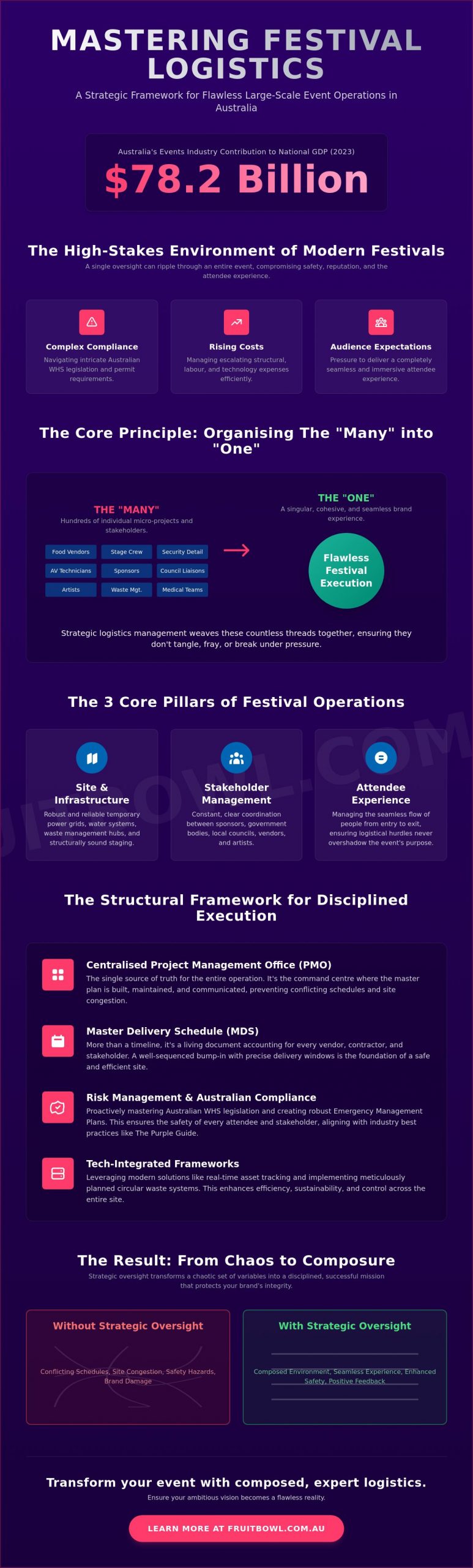
Festival logistics management is the invisible architecture that supports every large-scale public activation. While standard Event management might focus on a single venue or a linear schedule, festivals operate as high-volume ecosystems with thousands of moving parts. In 2026, this discipline has evolved into a sophisticated blend of strategic oversight and technical precision. It involves the rigorous synchronisation of infrastructure, people, and processes to ensure that a creative vision survives the reality of a complex, high-stakes environment.
We view the process through the lens of “The One versus The Many”. Your festival is a singular brand experience, yet it’s composed of hundreds of individual micro-projects. Every food vendor, stage crew, and security detail represents a separate logistical thread that must be woven into the master plan. Strategic management ensures these threads don’t tangle or fray. This year, the industry has seen a permanent shift towards sustainable, tech-integrated frameworks. We’re seeing a rise in real-time tracking for assets and a focus on circular waste systems that require meticulous planning long before the first truck arrives on site.
The Core Pillars of Festival Operations
Successful execution relies on three fundamental pillars that must work in total harmony. First, site infrastructure must be robust and reliable. This includes temporary power grids, water systems, and the strategic placement of waste management hubs. Second, stakeholder management requires the constant coordination of diverse groups, including sponsors, government bodies, and local councils. Finally, the attendee experience must be seamless. We manage the flow of people from the initial entry touchpoint to the final exit, ensuring that logistical hurdles never overshadow the event’s purpose.
Why Strategic Oversight Matters for Brand Integrity
A single logistical failure can instantly compromise your brand’s reputation. Long queues at the gate or unexpected power cuts on the main stage aren’t just technical glitches; they’re breaches of trust with your audience. A lead agency provides a composed and professional environment even when variables shift. This level of precision is intrinsically linked to Mastering Festival Production Services. When the logistics are handled with discipline, the production elements can shine without distraction, securing positive feedback from every attendee and stakeholder involved.
The Structural Framework: Organising the “Many” into “One”
To manage the high-volume complexity of a modern festival, you need more than a simple to-do list. You need a centralised project management office (PMO). This hub serves as the single source of truth for the entire operation. It’s where the Master Delivery Schedule (MDS) is built and maintained. The MDS isn’t just a timeline; it’s a living document that accounts for every vendor, contractor, and stakeholder on site. By organising these “many” moving parts into “one” unified plan, you reduce the risk of conflicting schedules or site congestion. This disciplined approach to festival logistics management ensures that every resource is utilised efficiently and every deadline is met with precision.
Clarity is paramount when coordinating diverse teams across a sprawling site. We use parallel phrasing in all communications to ensure instructions are symmetrical and thorough. For example, when you’re directing different crews across multiple stages, the structure of your directives should remain consistent. This reduces cognitive load and prevents errors during high-pressure moments. During on-site execution, we implement a tiered communication protocol. This structure ensures that information flows logically from the logistics coordinator to team leaders, preventing the chaotic radio chatter that often plagues large-scale public activations.
Creating a Robust Master Delivery Schedule
A well-sequenced bump-in is the foundation of a safe site. We schedule deliveries in precise windows to prevent heavy vehicle congestion, which is a major safety hazard in busy environments. This approach aligns with the industry best practices found in The Purple Guide, ensuring that risk management is built directly into the timeline. It’s essential to incorporate “buffer zones” for technical testing and rehearsals. These gaps allow for inevitable minor delays without derailing the entire project. In 2026, we also utilise real-time tracking for critical assets. This provides the PMO with a digital twin of the site’s logistical status at any given moment.
Vendor and Talent Coordination
Managing the logistical “tail” of talent requires the same precision as the main stage build. This includes transport, green rooms, and dietary requirements. To avoid last-minute surprises, we standardise technical riders to ensure AV and staging requirements are perfectly aligned before anyone arrives. If you are currently sourcing performers, our Ultimate Festival Talent Booking Checklist provides a comprehensive procurement framework. This level of strategic oversight ensures that every stakeholder feels supported by a “safe pair of hands,” allowing them to focus on their specific performance or service. If you’re ready to secure this level of precision for your next activation, partnering with a seasoned logistics team can provide the security your brand needs.
Risk Management and Australian Compliance Standards
Large-scale public activations in Australia operate within one of the world’s most rigorous regulatory environments. Professional festival logistics management requires a deep understanding of Work Health and Safety (WHS) legislation, particularly regarding temporary structures like main stages, grandstands, and large-scale marquees. These aren’t just logistical elements; they’re high-risk environments that demand structural integrity certification and constant monitoring. Failing to meet these standards doesn’t just risk a fine; it risks the safety of your audience and the future of your brand. Investing in professional risk management is a non-negotiable step to ensure your event remains a secure environment for all.
An Emergency Management Plan (EMP) serves as the definitive roadmap for responding to unforeseen incidents. This document must be developed in close consultation with local councils, police, and paramedics to ensure every permit and road closure is accounted for. While some might view these requirements as administrative hurdles, seasoned organisers recognise them as the safeguards that allow for creative ambition. For those looking to deepen their theoretical understanding of these pillars, a Festival and event management course can provide valuable academic context on the operational standards required for global activations.
Safety as a Logistical Foundation
Precision during the bump-in phase is critical for establishing a safe site. We conduct rigorous safety audits as each structure is erected, ensuring that Safe Work Method Statements (SWMS) are followed to the letter. In 2026, we’ve integrated predictive AI modelling and real-time heat-mapping to manage crowd density. These tools allow us to anticipate bottlenecks before they occur, maintaining a steady flow and preventing safety breaches. Every vendor on site must provide valid Public Liability Insurance, creating a comprehensive safety net that protects the project’s integrity from the first day of setup.
Stakeholder and Government Liaison
Building a reputation as a “safe pair of hands” with regulatory bodies is essential for long-term success. When government bodies and local councils trust your logistical framework, the permit process becomes more efficient and collaborative. This is especially vital for Strategic Government Event Planning, where the reporting requirements and public scrutiny are significantly higher. We manage these complex relationships by providing transparent, data-driven reports that satisfy every compliance milestone, ensuring that government-funded activations meet their strict KPIs without incident.
Site Management and Technical Execution
Designing a site map requires a sophisticated understanding of spatial dynamics and human behaviour. A professional layout is more than a simple drawing; it’s a blueprint for movement that prioritises logical flow and universal accessibility. Within the framework of festival logistics management, every path, thoroughfare, and egress point must be engineered to handle peak capacity without friction. This precision extends to the “invisible” logistics that sustain a site, such as the strategic placement of waste hubs, potable water stations, and sanitation services. When these elements are managed with expert oversight, they remain unnoticed by the attendee, which is the ultimate hallmark of a successful operation.
Technical execution in 2026 demands the seamless integration of AV management for events with the broader site infrastructure. We no longer treat power and data as secondary considerations. Instead, we deploy sustainable solutions like hybrid generators and solar-battery arrays from the first day of the build. This proactive approach reduces the environmental footprint while providing the stable, high-output power required for modern LED installations and immersive soundscapes. By synchronising technical requirements with site limitations early in the planning phase, we eliminate the risk of mid-event failures.
Technical Direction and Infrastructure
Staging and large-scale LED walls require rigorous structural integrity checks before any technical rehearsals commence. We coordinate these rehearsals with surgical precision, ensuring that sound checks and lighting programmes don’t disrupt the ongoing site-wide bump-in. A critical strategic decision involves choosing between “dry hire” and full-service technical production management. While dry hire offers certain cost flexibilities, full-service management provides the comprehensive oversight and accountability needed for high-stakes environments where there is no room for error.
Bump-Out: The Critical Final Phase
The final phase of any activation is the bump-out, a period of intense “reverse logistics” that requires absolute discipline. This phase is often conducted under significant time pressure, yet it must meet 2026 sustainability targets for waste diversion and recycling. Site remediation is the final, vital step in our methodology. We ensure the venue is returned to its original state, which is essential for maintaining long-term trust with local councils and landowners. If you require expert oversight to manage these complex technical layers and ensure a frictionless exit, contact our team for a strategic consultation.
Strategic Oversight: The Fruitbowl Methodology
Fruitbowl Events Agency brings 28 years of logistical precision to every activation we oversee. This history allows us to provide a level of security that only comes from navigating every possible challenge in the Australian events landscape. Our approach to festival logistics management isn’t just about moving equipment; it’s about the disciplined synchronisation of every variable to protect your brand’s integrity. We serve as the “safe pair of hands” that ensures your creative ambition is supported by a rigorous, risk-first operational framework.
A central component of our methodology is the role of the dedicated Logistics Coordinator. This individual acts as the primary navigational anchor on site, maintaining a composed and professional environment even during the most complex phases of the project. They ensure that the Master Delivery Schedule is followed to the letter and that communication remains clear across all tiered protocols. Once the event concludes, our work continues through the analysis of post-event data. we utilise this information to measure logistical ROI and efficiency, providing you with concrete insights into bump-in speeds, resource utilisation, and waste diversion success.
The Value of a Seasoned Logistics Team
An unflappable, experienced team is the most effective insurance policy for your brand. When you’re managing a public activation with thousands of attendees, the transition from the planning phase to “live” event management requires a steady, results-oriented hand. We’ve resolved high-stakes logistical challenges with surgical precision, such as rerouting heavy vehicle access during unexpected weather events without delaying the primary production schedule. This ability to remain in control of the narrative and the process is what distinguishes a professional agency from a standard coordinator. Just as we value this precision in logistics, we recognise it in other disciplines; for an example of high-standard training and focus, check out Flinn Taekwondo Academy.
Ready to Organise Your Next Festival?
Engaging a professional partner for your festival logistics management is the first step toward a frictionless experience. We begin by aligning our logistical framework with your specific brand objectives, ensuring that every operational decision serves the larger mission. Our team provides the strategic oversight needed to transform complex, high-stakes environments into orderly, successful activations. If you’re ready to secure the expert supervision your next project deserves, enquire about our Festival Logistics Management services today to begin the planning process.
Securing the Future of Your Large-Scale Activation
Managing a large-scale event in 2026 requires a shift from reactive problem-solving to proactive, strategic oversight. We’ve explored how a robust project management office and a Master Delivery Schedule can synchronise hundreds of moving parts into a single, cohesive mission. By prioritising Australian compliance standards and integrating technical infrastructure with site-wide flow, you create a secure foundation for creative ambition. Professional festival logistics management is ultimately about ensuring that every variable is under expert supervision; it allows the brand experience to remain the primary focus for every attendee.
With over 28 years of industry-leading experience, we provide the unflappable expertise required to navigate high-stakes environments with surgical precision. Our comprehensive end-to-end logistical frameworks are designed to mitigate risk and deliver a frictionless experience from bump-in to final remediation. You don’t have to manage these complexities alone. Partner with Australia’s festival logistics experts at Fruitbowl Events Agency to ensure your next activation is executed with absolute discipline and professional clarity. We look forward to bringing your vision to life with the security it deserves.
Frequently Asked Questions
What is the most important part of festival logistics management?
The most critical element of festival logistics management is the establishment of a centralised project management office and a comprehensive Master Delivery Schedule. This framework ensures that every stakeholder, from AV technicians to food vendors, operates within a synchronised timeline. Without this strategic oversight, the high-volume complexity of a festival can quickly descend into site congestion and safety breaches, compromising the integrity of the entire brand activation.
How early should I start planning the logistics for a large-scale festival?
Planning for a large-scale festival should ideally commence 12 to 18 months before the event date. This lead time is essential for securing high-demand venues, navigating complex council permit requirements, and locking in tier-one suppliers. For instance, some local councils require event registrations at least 12 weeks in advance just to avoid late fees. Early engagement allows for a thorough risk assessment and the development of a robust Emergency Management Plan.
What are the specific Australian safety requirements for festival sites?
Australian festival sites must comply with strict Work Health and Safety (WHS) legislation, which governs the installation of temporary structures and public safety protocols. Organisers are required to conduct rigorous site safety audits and ensure all vendors provide valid Public Liability Insurance and Safe Work Method Statements (SWMS). Additionally, an Emergency Management Plan must be developed in consultation with local authorities to manage crowd density and potential incidents with professional precision.
How do you manage logistics for festivals in remote or non-traditional locations?
Managing logistics in remote locations requires a focus on total site self-sufficiency and robust supply chain coordination. You must engineer temporary infrastructure from the ground up, including hybrid power grids, potable water systems, and comprehensive waste management hubs. These “greenfield” sites demand a higher level of strategic oversight to ensure that transport routes for equipment and talent are viable and that all environmental remediation targets are met post-event. If you are planning an event in challenging terrain, visit Adventurerz to learn more about navigating remote environments.
What role does technology play in modern festival logistics?
Modern festival logistics management relies heavily on real-time tracking, RFID-based inventory systems, and predictive AI modelling for crowd control. These tools provide a “digital twin” of the site, allowing the project management office to monitor asset movement and attendee flow with surgical precision. Technology enables us to anticipate bottlenecks before they occur, ensuring that the live environment remains composed and that all logistical micro-tasks are executed according to the master plan.
How do you coordinate hundreds of vendors during a short bump-in period?
Coordination of multiple vendors is achieved through the implementation of precise, pre-allocated delivery windows and a tiered communication protocol. By sequencing the bump-in phase within a Master Delivery Schedule, we prevent vehicle congestion and ensure each crew has the space required to work safely. To see how professional exhibitions like Art and Craft Expo define their stall footprints, you can explore 10′ x 10′ Artist/Crafter Booth Space as a reference for standard vendor allocations. This methodical approach minimises site-wide disruptions and allows for technical rehearsals to proceed in parallel with the final infrastructure build, maintaining a steady project pulse.
What happens if there is a logistical failure during a live event?
If a logistical failure occurs, the on-site Logistics Coordinator immediately activates the relevant contingency protocols outlined in the Emergency Management Plan. An experienced team remains unflappable in these high-stakes moments, using established communication channels to resolve the issue with minimal impact on the attendee experience. This composed response is why professional oversight is the best insurance policy for your brand, as it prevents minor technical glitches from escalating into significant reputational damage.
How does professional logistics management impact the overall event budget?
Professional logistics management impacts the budget by identifying efficiencies and reducing costly on-site wastage. While it represents an initial investment, a disciplined logistical framework prevents expensive delays, minimises overtime costs for production crews, and avoids potential fines for non-compliance. By utilising post-event data to measure ROI, we help organisers refine their processes for future activations, ensuring that every dollar spent contributes directly to a seamless and successful mission.
OUR BLOG
Event Insights & Expertise
Our blog is your go-to resource for all things events. From expert insights and the latest industry trends to practical planning tips, we share everything you need to deliver standout experiences.
Contact Us