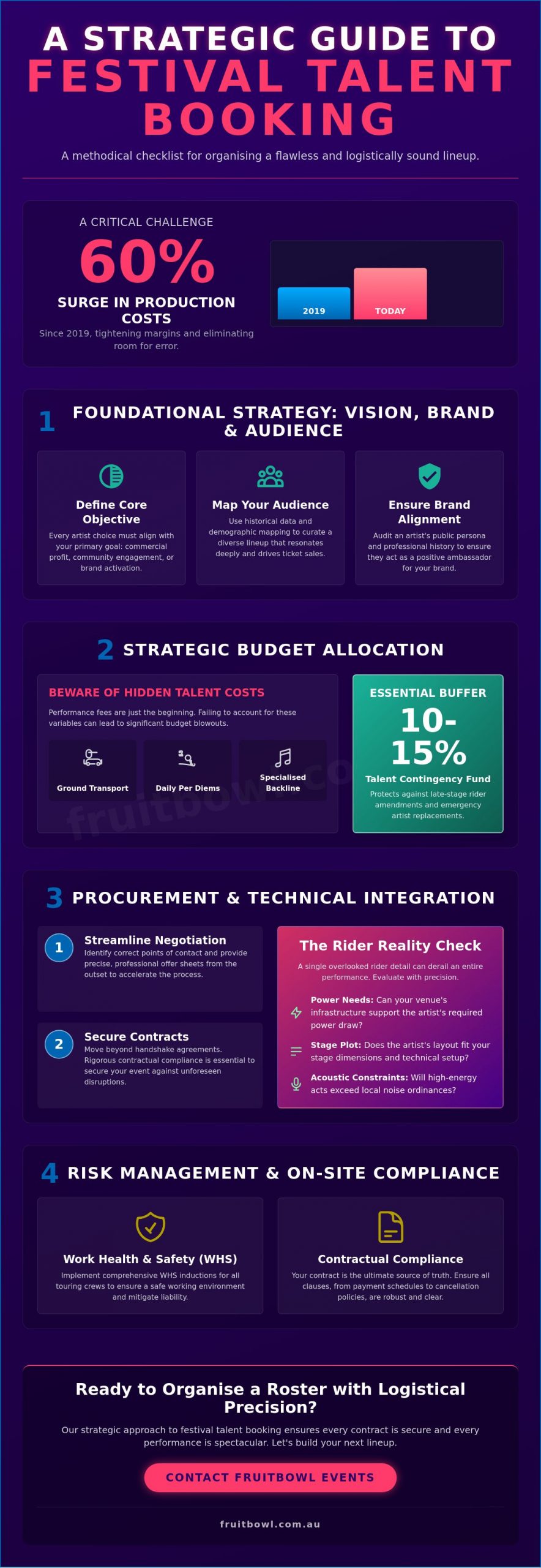
A festival lineup is often mistaken for a simple creative wishlist. In reality, it’s a high-stakes logistical integration project where a single overlooked technical rider can derail an entire weekend. As production costs have surged by up to 60 per cent since 2019, the margin for error in festival talent booking has effectively disappeared. You likely understand the frustration of negotiating exorbitant fees only to find that an artist’s technical requirements exceed your venue’s power capacity. It’s a delicate balancing act between securing A-list names and maintaining the financial viability of your event.
This strategic guide provides a methodical checklist designed to bring order to the procurement process, ensuring every contract is secure and every performance is logistically sound. We will outline a step-by-step approach to managing complex negotiations, mitigating the risk of last-minute cancellations, and delivering a seamless on-site experience for 2026. By the end of this article, you’ll have the tools to organise a diverse roster that drives ticket sales while remaining firmly in control of your logistical precision.
Key Takeaways
- Define your festival’s core objective and audience profile to ensure the chosen talent aligns with your strategic goals and brand identity.
- Implement a tiered budget framework for festival talent booking that incorporates often-overlooked expenses like per diems and specialised backline.
- Streamline the negotiation process by identifying the correct points of contact and providing precise, professional offer sheets from the outset.
- Evaluate technical and hospitality riders with precision to ensure your venue’s infrastructure can support every artist’s stage plot and power needs.
- Secure your event against unforeseen disruptions through rigorous contractual compliance and comprehensive Work Health and Safety inductions for all touring crews.
Defining the Festival Vision and Audience Profile
Precision in programming begins long before the first contract is signed. Successful festival talent booking is a strategic exercise that demands a clear understanding of the event’s core mandate. Whether the objective is commercial profit, community engagement, or a high-impact brand activation, every artist choice must serve that specific end goal. Without this foundational clarity, a lineup risks becoming a disjointed collection of names that fails to resonate with the intended audience or meet the project’s financial requirements.
Defining the festival “vibe” is equally critical for maintaining cohesion across multiple stages. A curated atmosphere ensures that transitions between acts feel intentional rather than erratic. This creative vision must also be grounded in the physical reality of your location. Evaluating the venue’s acoustic constraints and power limitations is essential before shortlisting high-energy acts that might exceed local noise ordinances or technical infrastructure. It’s about balancing creative ambition with the hard data of logistical feasibility.
When planning these high-impact activations, it is often beneficial to learn more about Lar&Co, as their international experience in show production ensures that creative ambition is always matched by logistical excellence.
Aligning Talent with Brand Objectives
Every artist on your roster acts as a temporary ambassador for your brand. It’s vital to assess whether an artist’s public persona aligns with your corporate or government values. We recommend a rigorous audit of social media sentiment and past performance history to identify potential risks before making an approach. This due diligence ensures that your talent choices support the overarching narrative of your festival production services, creating a seamless experience where the talent and the brand speak with a unified voice.
Consider the following checklist during the selection process:
- Does the artist have a history of professional conduct on and off stage?
- Is their core audience demographic identical to your target market?
- Does their creative output complement the event’s primary message?
Audience Data and Demographic Mapping
Data should drive your selection process. Utilise historical ticket data to identify specific genre preferences and peak engagement times for your region. Understanding the difference between an artist’s social media “reach” and their actual “engagement” is vital. A high follower count doesn’t always translate to ticket sales in a specific local market. A professional Talent Booking Agent can often provide insights into an artist’s recent drawing power in similar territories.
Modern Australian audiences expect diversity and inclusion to be reflected in every lineup. Mapping your talent against these targets isn’t just about social responsibility; it’s about commercial common sense. A diverse programme reaches more segments of the community and builds a more resilient event brand. By integrating demographic mapping into your festival talent booking strategy, you ensure the lineup resonates deeply with a broad, contemporary audience profile.
Strategic Budget Allocation and Talent Tiering
Effective financial management in the live event sector requires a shift from viewing costs as isolated figures to seeing them as a cohesive ecosystem. A well-structured approach to festival talent booking ensures that capital is deployed where it generates the highest return on engagement. It’s not merely about the headline figure; it’s about the strategic distribution of funds to ensure a balanced and resilient programme that can withstand market fluctuations.
Research into festival budget allocation highlights that performance fees and artist housing often represent the most significant disbursements. However, experienced organisers know that “Hidden Talent Costs” can quickly erode a project’s margins. These variables include ground transport, daily per diems, and specialised backline requirements that aren’t always apparent during initial talks. Failing to account for these can lead to significant budget blowouts in the final weeks of production.
We recommend maintaining a 10 to 15 per cent contingency fund specifically within your talent budget. This buffer protects the event from late-stage rider amendments or the necessity of emergency artist replacements. Engaging professional corporate event management services provides the meticulous oversight necessary to track these variables across the entire booking lifecycle, ensuring that every dollar spent is accounted for and justified.
The Three-Tier Lineup Strategy
A resilient lineup follows a tiered framework to maximise both reach and cost-efficiency. This structure allows you to appeal to different audience segments while managing your financial risk profile.
- Headliners: These are the primary drawcards that justify the ticket price or attendance. They command the largest portion of the budget but drive the majority of the marketing momentum.
- Support Acts: These genre-specific artists keep the audience engaged between main sets. They provide the substance of the festival experience and ensure the “vibe” remains consistent throughout the day.
- Local Gems: Cost-effective emerging talent builds community goodwill and fills early slots. This tier is essential for long-term audience development and supporting the local creative economy.
To see how a consistent schedule of emerging acts can cultivate a dedicated community, look to venues like Kiss My Brass in Marrickville where you can explore Live music 5 nights a week.
Negotiating Beyond the Performance Fee
Clarity during the negotiation phase prevents logistical friction later. It’s vital to understand the distinction between “Gross” and “Net” offers. A gross offer is typically inclusive of all costs, whereas a net offer may leave the promoter liable for additional expenses like flights, accommodation, and internal transfers. Knowing which model you are using is fundamental to maintaining your budget’s integrity.
Negotiating “Buy-outs” for catering and travel can significantly simplify your internal logistics. Instead of managing individual receipts and dietary requirements for dozens of touring members, a fixed payment allows the artist’s team to handle their own arrangements. Ensure all verbal agreements are immediately documented in a formal Letter of Intent (LOI) to provide contractual security. If you require a partner to manage these complex financial tiers and negotiations, our team at Fruitbowl Events Agency can provide the strategic oversight required.
Navigating the Talent Procurement and Negotiation Process
Securing a high-calibre lineup requires a disciplined approach to outreach and a deep understanding of industry hierarchies. Initiating festival talent booking begins with identifying the correct point of contact. While a publicist manages an artist’s media profile, the booking agent is typically responsible for the live performance transaction. Engaging the agent directly with a comprehensive offer sheet demonstrates professional maturity and respect for their time. This document must be exhaustive, detailing the exact date, venue capacity, and the technical scope of the production to prevent back-and-forth delays.
Time is a finite resource in the festival circuit. Establishing clear communication timelines is vital to ensure you don’t lose preferred talent to competing events. Agents often manage multiple offers simultaneously, so a prompt and transparent negotiation style positions your festival as a reliable partner. It’s also the stage where you must address the radius clause. This contractual provision restricts an artist from performing within a specified distance of your event for a set period before and after the festival, protecting your event’s exclusivity and ticket sales potential.
The Art of the Professional Pitch
Your pitch should read like a strategic partnership proposal rather than a simple booking request. Highlight the festival’s past success, expected audience reach, and any confirmed high-profile partners to build immediate credibility. Be precise about the performance window, including set times and any required media or PR commitments. When negotiating a contract, clarity on these non-performance obligations ensures the artist’s team can plan their itinerary with precision, reducing the risk of friction on show day.
Contractual Milestones and Deposit Schedules
A signed contract is only the beginning of the logistical journey. Standard industry structures usually require a 50 per cent deposit upon signing to secure the date, with the balance often due shortly before the performance. Beyond the financial transaction, your contract should stipulate strict deadlines for bio materials, high-resolution photos, and social media announcement assets. Having these in hand early allows your marketing team to execute their strategy without chasing missing files at the eleventh hour.
Integrating Technical Riders and Production Requirements
The transition from contractual agreement to physical execution is where festival talent booking faces its most rigorous test. Technical riders serve as a blueprint for the stage, requiring a meticulous comparison between artist demands and venue capabilities. A single discrepancy in power requirements or stage dimensions can compromise the safety and quality of the performance. It is essential to treat these documents as binding technical specifications rather than mere suggestions.
Technical precision is the cornerstone of a successful performance. Evaluating stage plots and input lists must occur well before the first road case is opened. We coordinate closely with our AV management team to ensure that every piece of gear specified in the rider is compatible with the on-site infrastructure. This proactive coordination prevents costly last-minute hires and ensures that the artist’s technical crew feels supported from the moment they arrive for bump-in.
A “Backline Share” policy is an essential tool for maintaining momentum throughout the day. By standardising certain elements, such as drum kits or bass cabinets across the lineup, you can significantly reduce stage turnover times and equipment hire costs. This requires clear communication during the festival talent booking phase to ensure all artists are comfortable with the shared arrangements. Similarly, hospitality riders must be managed with a focus on efficiency, balancing dietary requirements and dressing room needs without overextending your catering budget. A comprehensive approach to festival logistics management ensures these moving parts are coordinated seamlessly across every stage of the production lifecycle.
Decoding the Technical Rider
Identifying “Deal Breakers” early in the process is vital for budget integrity. High-spec lighting or sound consoles often require expensive external hire if they aren’t part of your standard production kit. Cross-check every rider against your venue’s existing power distribution and weight loadings to ensure the stage can safely support the intended rig. We recommend that the stage manager receives the most current version of the stage plot at least 30 days prior to the event to allow for any necessary adjustments to the production schedule.
On-Site Talent Management and Bump-in
Successful execution on show day relies on a minute-by-minute “Run of Sheet” that tracks talent arrivals, soundchecks, and departures. Assigning a dedicated “Artist Liaison” provides a single point of contact for touring parties, ensuring they are guided through the site with professional ease. This role is particularly critical during the “Changeover” window. Moving one band off and the next one on in 15 minutes is only possible when every movement is rehearsed and every technician knows their specific role in the transition.
If you require a partner to manage the complex logistical integration of your next major programme, discover how our expert team delivers Festivals & Public Events with clinical precision.
Risk Management and Contractual Compliance for Festival Talent
The final phase of the booking lifecycle is where the strategic vision meets the rigour of Australian regulatory standards. High-stakes environments require more than just creative alignment; they demand absolute contractual certainty. Ensuring that all talent contracts comply with Australian Consumer Law and relevant industry standards isn’t just a legal requirement but a fundamental part of a resilient festival talent booking strategy. This level of compliance provides the framework for a secure event, protecting both the organiser’s reputation and the financial interests of all stakeholders involved.
Implementing a rigorous Work Health and Safety (WHS) induction for all touring crews is a non-negotiable step in the production process. This goes beyond a simple site tour. It involves a detailed briefing on local safety protocols, emergency procedures, and specific site hazards. By treating every performer and contractor as a temporary member of the workforce, you create a culture of safety that permeates the entire site. This methodical approach ensures that even the most complex technical requirements are executed within a safe and controlled environment. Organisers who invest in robust festival logistics management frameworks are far better positioned to navigate these compliance demands without compromising the attendee experience.
Insurance and Duty of Care
Verifying Public Liability Insurance (PLI) for all independent performers and contractors is a critical task that must be completed well before the bump-in date. Organisers must confirm that all performers maintain appropriate cover for on-stage accidents or potential damage to venue equipment. Adopting a “Safe Pair of Hands” approach through professional management significantly reduces your legal exposure by ensuring that every certificate of currency is valid and relevant to the specific risks of the performance. The festival organiser maintains a non-delegable duty of care to ensure the safety and well-being of all visiting international talent while they are on Australian soil.
Contingency Planning for the Unexpected
The reality of live events is that disruptions are sometimes unavoidable. Developing a robust “Talent Contingency Plan” for last-minute cancellations or travel delays is essential for maintaining the integrity of the programme. We recommend maintaining a “Standby List” of high-quality local talent who have the capacity to fill a main-stage slot at short notice. This proactive measure ensures that the audience experience remains consistent even when the original schedule is compromised.
Clear communication protocols are equally vital when managing a lineup change. Informing the audience of a cancellation requires a calm, transparent approach to prevent dissatisfaction or crowd unrest. Once the event concludes, a formal post-event evaluation should be conducted to review talent performance against the original brand objectives. This final step in the festival talent booking process provides the data necessary to refine future strategies, ensuring that every booking continues to deliver measurable value and logistical precision.
Securing the Future of Your Festival Programme
Mastering festival talent booking requires a transition from simple selection to a disciplined model of logistical integration. By aligning artist personas with brand values, implementing tiered financial structures, and maintaining rigorous technical oversight, organisers can mitigate the risks inherent in high-stakes environments. Success in 2026 depends on the ability to balance these complex moving parts with absolute precision, ensuring that every contractual milestone and technical rider is managed with clinical detail.
With over 28 years of industry-leading event expertise, our team provides the authoritative oversight required for complex activations. We offer end-to-end management from the initial contract to the final curtain-call, acting as specialists in high-stakes logistics and compliance. When you partner with Fruitbowl Events Agency for your next festival’s talent procurement, you’re engaging a safe pair of hands dedicated to your mission’s success. We look forward to helping you deliver a seamless, high-impact experience that resonates with your audience and stands the test of time.
Frequently Asked Questions
How far in advance should I book talent for a major Australian festival?
You should ideally begin the festival talent booking process 9 to 12 months before your event date. This lead time is necessary to navigate international visa requirements, coordinate with global touring schedules, and secure preferred dates before competitors. For major international acts, negotiations often commence even earlier to align with their multi-territory routing plans and complex logistical needs.
What is a radius clause and how does it affect my talent booking?
A radius clause is a contractual provision that prevents an artist from performing at other events within a specified geographic area and timeframe surrounding your festival. This clause protects your event’s exclusivity and prevents audience dilution in a competitive market. It’s a critical component of festival talent booking that ensures your lineup remains a unique drawcard for ticket buyers in your specific region.
What is the difference between a technical rider and a hospitality rider?
A technical rider specifies the equipment and infrastructure required for the performance, including stage dimensions, power distribution, and audio-visual input lists. In contrast, a hospitality rider details the artist’s personal requirements, such as dressing room amenities, dietary needs, and guest list allocations. For international touring parties requesting specific home-style cuisines, you can learn more about Dabba Junction to see how specialised tiffin services provide authentic meals that meet high-standard hospitality expectations. Both documents are essential components of festival talent booking and must be reviewed with equal logistical precision to prevent on-site friction.
How much should I expect to pay for a festival headliner in 2026?
For a top-tier A-list headliner in 2026, you should budget between $150,000 and upwards of $2.5 million. Established popular artists typically fall within the $15,000 to $250,000 range. These figures reflect the significant artist fee inflation seen recently, driven by the increased importance of touring revenue and a 30 to 60 per cent rise in production costs since 2019.
Do I need to provide backline equipment for all festival performers?
Providing a shared backline is standard practice for major festivals to ensure efficient stage turnovers and reduce equipment hire costs. Most organisers provide a high-quality “house” kit, including drums, amplifiers, and keyboards, which artists are encouraged to use. This arrangement must be clearly stipulated in the initial offer to ensure the artist’s technical team can approve the specific makes and models provided well before the event.
What happens if a booked artist cancels their performance last minute?
If an artist cancels, you should immediately activate your pre-established talent contingency plan and contact your standby list of local performers. Your contract should include robust force majeure and cancellation clauses to protect your financial deposits and outline the protocol for audience communication. Prompt, transparent messaging is essential to maintain attendee trust and prevent logistical disruption on-site during the changeover.
Are there specific insurance requirements for international artists performing in Australia?
Yes, international artists must be covered by Public Liability Insurance that meets Australian standards, typically with a minimum cover of $20 million. You must also ensure compliance with specific work visa requirements and tax withholding obligations for foreign residents. One-day event insurance for high-risk environments like festivals currently ranges from $300 to over $1,500, depending on the scale and risk profile of the activation.
How can I ensure my festival lineup is diverse and inclusive?
Diversity is achieved through intentional demographic mapping and a consistent commitment to representing a broad spectrum of voices. You should utilise historical data and current cultural trends to ensure your programme reflects a modern Australian audience profile. This involves looking beyond the headliners to ensure that support slots and emerging talent tiers include a balanced mix of gender, cultural background, and musical genre.
OUR BLOG
Event Insights & Expertise
Our blog is your go-to resource for all things events. From expert insights and the latest industry trends to practical planning tips, we share everything you need to deliver standout experiences.
Contact Us