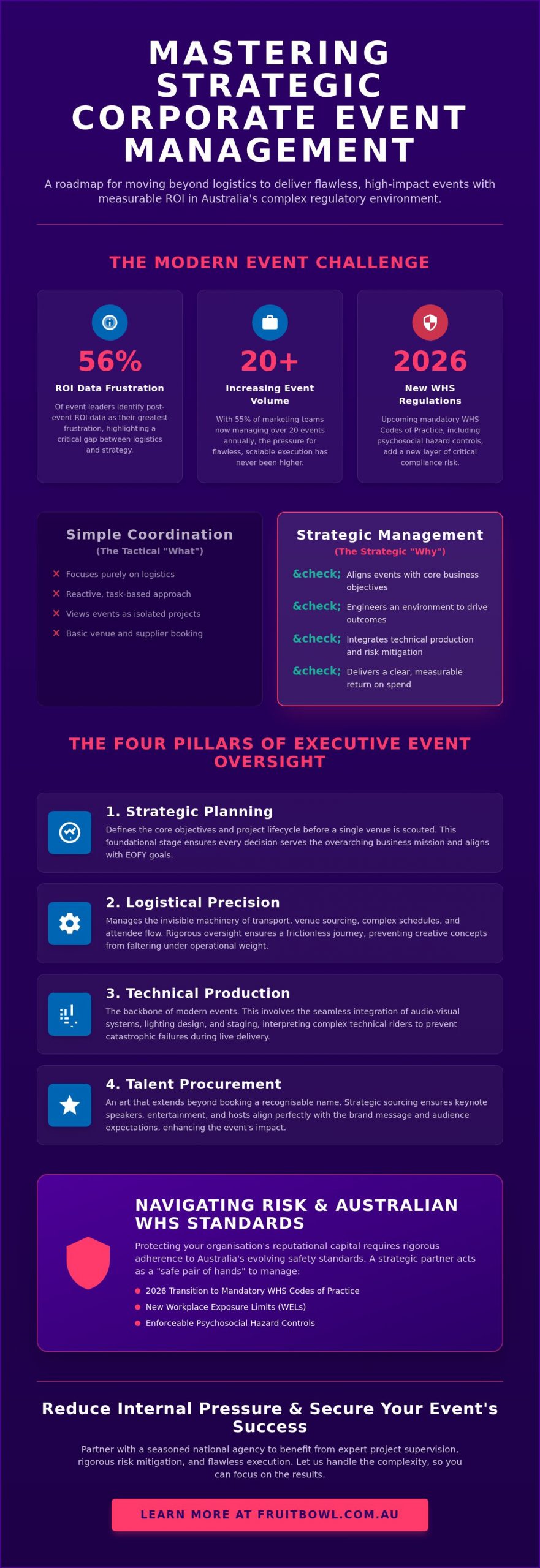
With 56% of event leaders identifying post-event ROI data as their greatest frustration, it’s clear that many large-scale productions fail to bridge the gap between logistics and strategy. You likely recognise the immense pressure of coordinating a thousand moving parts while ensuring every technical element performs perfectly under the spotlight. In the current Australian climate, this challenge is compounded by the 2026 WHS regulations, including the new Workplace Exposure Limits and mandatory psychosocial hazard controls that now govern every professional activation.
Mastering corporate event management requires a transition from simple coordination to a disciplined, strategic framework. This article provides a roadmap to help you navigate these complexities with confidence, ensuring your next event delivers a seamless attendee experience without the risk of operational or reputational failure. We’ll examine the integration of technical production, rigorous risk mitigation, and the logistical precision offered by Freight and More Pty Ltd to help you secure a measurable return on your event spend.
Key Takeaways
- Learn how to move beyond basic coordination by adopting a strategic corporate event management framework that aligns every logistical detail with your core business objectives.
- Identify the four pillars of executive oversight necessary to manage the complex machinery of transport, venue sourcing, and technical production.
- Navigate the latest Australian WHS standards and compliance requirements to protect your organisation from operational and reputational risks.
- Follow a phased roadmap from discovery to execution to eliminate technical failures and deliver a frictionless experience for your attendees.
- Understand how partnering with a seasoned national agency can reduce internal pressure while providing the security of expert project supervision.
What is Strategic Corporate Event Management?
Corporate event management is often misunderstood as a purely logistical exercise. In reality, it is a sophisticated discipline that blends creative vision with technical precision. While simple event coordination focuses on the tactical “what” of a project, strategic management prioritises the “why.” It involves the orchestration of complex machinery, from technical production and risk mitigation to stakeholder engagement and brand alignment. You aren’t just booking a venue; whether you are selecting a high-capacity auditorium or a vibrant live music space like Kiss My Brass, you’re engineering an environment designed to drive specific business outcomes.
In the present Australian environment, the stakes have never been higher. Research indicates that 55% of event marketing teams now manage more than 20 events annually. This volume, coupled with the 2026 transition to mandatory WHS Codes of Practice and enforceable psychosocial hazard regulations, means that a basic venue and caterer are no longer sufficient. You need a partner who acts as a “safe pair of hands.” This level of professional Event Management ensures that high-stakes projects remain compliant, secure, and flawlessly executed, protecting your organisation’s reputational capital.
The Evolution of Modern Business Events
The days of passive seminars are over. Modern audiences demand immersive experiences that reflect the digital-first world. This shift has turned technical direction into a foundational requirement rather than an optional add-on. Whether you are delivering high-impact brand activations, large-scale government activations, or hosting an exclusive stakeholder retreat with Neptune Oceanic, the integration of technology and storytelling is essential. Strategic management acts as the bridge between brand vision and logistical reality.
- From Passive to Active: Shifting away from one-way presentations toward interactive, high-impact environments.
- Technical Integration: Utilising advanced AV and digital touchpoints to maintain engagement in a hybrid-capable market.
- Participant Interaction: Leveraging digital platforms like Bestever.pics for real-time guest photo sharing can transform a static event into a dynamic, shared experience.
- Strategic Oversight: Ensuring that every creative choice is backed by a robust logistical framework.
Core Objectives of Corporate Activations
Every project must serve a purpose beyond the event date itself. Successful corporate event management aligns delivery with broader organisational KPIs and EOFY goals. This requires a methodical approach to every touchpoint, ensuring that stakeholder engagement is fostered through deliberate planning rather than chance. Precision is paramount. Every element, from the intensity of the stage lighting to the calibre of the talent, must reinforce your core brand message. When these components are meticulously aligned, the result is a seamless attendee experience that provides a clear, measurable return on your event spend.
For those hosting corporate events in Brisbane, incorporating high-quality hospitality from local establishments like The White Bird ensures that every detail, including the menu, reflects a commitment to excellence.
To ensure this alignment, every touchpoint must be considered, including premium catering choices such as Byron Nuts – all about the flavour, which helps reinforce an image of quality and attention to detail.
For events with a focus on wellness or for those hosting regional activations in the APAC corridor, selecting premium, hand-selected seasonal produce from Tai Kang Healthy Fruits provides a healthy yet luxurious catering alternative that resonates with health-conscious attendees.
The Four Pillars of Executive Event Oversight
Executive-level corporate event management is built on a foundation of four critical pillars: strategic planning, logistical precision, technical production, and talent procurement. Each pillar must function in synchrony to ensure a high-impact delivery. Strategic planning sets the project lifecycle in motion, defining the objectives before a single venue is scouted. This foundational stage ensures that every subsequent decision serves the overarching mission. Logistical precision then manages the invisible machinery, overseeing transport, venue flow, and complex schedules to ensure the attendee journey remains frictionless. For those coordinating large-scale activations, you can discover ML Traffic Engineers Australia to see how professional transport planning can mitigate logistical bottlenecks. This attention to detail extends to delegate arrivals; for those utilising the Brisbane International Cruise Terminal, East Coast Parking ensures a secure and professional start to the attendee experience. Without this rigour, even the most creative concepts can falter under the weight of poor timing or inadequate venue movement.
Technical Direction and Infrastructure
Technical direction is the backbone of any large-scale conference or seminar. It’s the discipline that ensures your creative vision is supported by robust infrastructure. This involves more than just setting up a stage; it requires the seamless integration of audio-visual systems, lighting design, and staging to create a cohesive atmosphere. When managing high-profile talent, technical riders become complex documents that require expert interpretation. Failure to address power requirements or signal paths can lead to catastrophic failure during live delivery. Adopting an academic framework for event management helps agencies apply rigorous standards to these technical demands, ensuring every cable and lumen is accounted for. Managing these technical layers requires a composed approach that anticipates potential points of failure before they occur.
Strategic Talent and Entertainment Management
Procuring the right talent is an art that goes beyond simply booking a recognisable name. Whether you are sourcing keynote speakers for a conference or performers for brand activations, every choice must align with the corporate tone and the specific objectives of the project. Managing these assets involves meticulous contract negotiation and the oversight of national or international travel logistics. A “safe pair of hands” is required to handle these moving parts, ensuring that talent arrives prepared and that their delivery reinforces your brand message. For organisations seeking to elevate their next project, engaging a specialist in high-impact corporate events can provide the necessary oversight to mitigate these operational risks. This strategic approach ensures that talent doesn’t just entertain, but actively contributes to the event’s measurable ROI.
Navigating Risk, Compliance, and Australian Standards
The regulatory environment for corporate event management in Australia has undergone a fundamental shift in 2026. Managing a large-scale project now requires more than just operational awareness; it demands a deep understanding of enforceable WHS obligations that have become increasingly stringent. As of early 2026, psychosocial hazards are a regulated and enforceable duty in every Australian jurisdiction. This means your event framework must account for risks such as excessive workload and poor management support. Failing to address these factors is no longer just a management oversight; it’s a compliance breach that carries significant legal weight.
Across various Australian jurisdictions, the regulatory landscape is particularly complex. The Work Health and Safety Amendment (Digital Work Systems) Act 2026 now makes AI and algorithmic work allocation an explicit WHS duty. Additionally, as of 1 March 2026, unions in certain jurisdictions have the authority to initiate civil penalty proceedings for WHS breaches. These changes, combined with the fact that specific Codes of Practice become mandatory compliance benchmarks from 1 July 2026 in some areas, mean that every activation requires a meticulously documented risk management plan. A “safe pair of hands” is essential to navigate these multi-layered requirements, ensuring that your public gatherings and government activations remain secure and legally sound.
WHS and Public Safety Essentials
Identifying potential hazards in complex event environments requires a methodical, site-specific approach. For festivals and public events involving significant infrastructure, this often begins with precision mapping by experienced land surveyors like Hill & Blume to ensure accurate site positioning. In certain Australian jurisdictions, for example, the definition of high-risk construction work has aligned with national laws as of 1 July 2026, lowering the fall risk threshold from three metres to two metres. This adjustment impacts stage builds and technical rigging. Every contractor on-site must undergo site-specific safety inductions to ensure they understand these jurisdictional standards. Compliance is not just a hurdle but a safeguard for brand reputation. By integrating these safety protocols into the initial planning phase, you mitigate the risk of notifiable incidents, which now include violent incidents and work-related suicide attempts under expanded 2026 notification requirements.
Government and Stakeholder Liaison
Executing major government event planning or brand activations in public spaces involves managing a diverse array of stakeholders. This requires a disciplined communication strategy to secure the necessary permits and approvals from local councils and state authorities. Professional organisers prioritise accessibility and inclusivity within the event framework, ensuring that the physical environment is welcoming to all attendees while meeting Australian standards for public space usage. This level of strategic oversight allows you to focus on your organisational KPIs while Fruitbowl Events Agency manages the intricate bureaucracy of emergency response protocols and high-traffic crowd safety. This structured approach ensures that every stakeholder, from the government official to the end attendee, experiences a frictionless and secure environment.
The Roadmap to Flawless Event Execution
Flawless execution is never the result of chance; it’s the product of a methodical, five-phase roadmap. High-impact corporate event management begins with Discovery and Strategic Alignment, where the core mission is established. This phase ensures that every creative ambition is anchored to your organisation’s EOFY goals or broader KPIs. Following this, Phase 2 focuses on Detailed Logistics and Venue Sourcing. This involves building the skeleton of the event, from precinct planning to meticulous site inspections of premier venues like Club9 in Sydney. Phase 3 introduces Creative and Technical Development, where lighting, sound, and staging are integrated to add impact. Phase 4 is the moment of truth: On-Site Delivery. Here, live management takes precedence, ensuring a frictionless experience for every attendee. The final stage, Phase 5, is Post-Event Analysis, where the focus shifts to measuring the ROI and gathering data for future planning.
During the venue sourcing phase, particularly for incentive-based activations, the focus often shifts to unique experiences that resonate with high-level stakeholders. For those exploring premium international options, you can check out North Fork Taste to see how curated vineyard tours provide a benchmark for luxury corporate hospitality.
The Critical Nature of the Run Sheet
A professional run sheet serves as the definitive source of truth for every technician, performer, and staff member on the ground. It manages the minute-by-minute flow of a live production, providing a rigid structure that allows for creative flexibility. On-site management requires a “safe pair of hands” to handle real-time variables, such as talent delays or technical adjustments, with unflappable composure. This level of detail ensures that the invisible machinery of the event operates without interruption, allowing the audience to remain focused on the brand message. Without a disciplined run sheet, the risk of technical failure during live delivery increases significantly.
Measuring Success and ROI
Proving the value of a project is critical in a climate where business events are positioned as strategic tools. Given that 56% of event leaders find post-event data frustrating, your framework must include robust mechanisms for gathering attendee feedback and engagement metrics. These insights allow you to evaluate the success of conferences and seminars against the initial strategic alignment. By using these data points, you can refine future event strategies to ensure continued growth and impact. If you require a partner to oversee this entire project lifecycle with precision, you can enlist our corporate event management team to secure a measurable return on your spend.
Partnering with a National Event Management Agency
Outsourcing corporate event management to a specialised agency isn’t just a matter of convenience; it’s a strategic move to reduce internal overhead and mitigate operational risk. Managing the immense complexity of modern activations requires a dedicated team that understands the intersection of creative ambition and logistical rigour. By delegating these responsibilities, your internal team remains focused on core business objectives, a goal often shared by clients of Venta Belgarum who seek to increase their personal freedom and profitability through strategic advisory. This transition of responsibility allows for a higher level of precision that is difficult to achieve with internal resources alone.
Fruitbowl Events Agency offers the value of a “safe pair of hands” backed by 28 years of industry experience. This history provides a level of security that newer, product-focused agencies often lack. We provide end-to-end solutions that cover the entire project lifecycle, from the initial concept and strategic alignment to the final pack-down. This comprehensive oversight ensures that no detail is overlooked and that your brand message remains consistent across every touchpoint. Our experience navigating Australia’s shifting regulatory landscape ensures that your project remains compliant with the latest WHS standards without compromising on the creative vision.
The Fruitbowl Methodology
Our approach is methodical, deliberate, and composed. We specialise in managing complex technical and talent requirements on a national scale, ensuring that a conference in Sydney maintains the same high standard as a government event planning activation in Perth. We don’t just plan events; we engineer benchmarks for quality and precision. This methodology allows us to integrate seamlessly with your existing team, acting as a disciplined extension of your organisation. We take quiet pride in bringing order to high-stakes environments, ensuring that every moving part is synchronised for maximum impact.
Next Steps for Your Upcoming Project
Identifying the scope of your next major corporate activation is the first step toward a successful delivery. Early engagement with a professional agency is essential for effective budget management and risk mitigation. When we’re involved from the outset, we can identify potential logistical hurdles before they impact your timelines or costs. Whether you are planning large-scale festivals, brand activations, or national conferences, a structured partnership ensures your vision is executed with absolute clarity. To begin this process, you can enquire with Fruitbowl Events Agency for your next national project and secure the expertise your mission requires.
Securing Your Next High-Stakes Activation
Success in the Australian event landscape depends on a disciplined integration of logistical rigour and technical excellence. We’ve examined how navigating the complexities of the 2026 WHS standards and managing multifaceted talent requirements requires more than simple coordination. It demands a comprehensive strategic framework. Effective corporate event management serves as the vital foundation for achieving measurable ROI while protecting your organisation’s reputational capital.
With 28 years of industry-leading expertise, Fruitbowl Events Agency provides the national delivery capability required by blue-chip and government clients. Our team specialises in technical direction and talent procurement, ensuring that every invisible detail is managed with composure and precision. By establishing a roadmap built on discovery and detailed analysis, you can ensure your next project is delivered without friction. This methodical approach allows your internal team to focus on high-level objectives while we oversee the operational machinery.
Just as precision is required in event logistics, expert guidance is vital when navigating complex financial decisions; for veterans looking to understand their property benefits, you can visit Morgan Financial for expert mortgage advice.
Partner with Australia’s most trusted event management specialists to bring order and clarity to your next major activation. We look forward to helping you set a new benchmark for excellence and precision in your industry.
Frequently Asked Questions
What is included in corporate event management services?
Comprehensive corporate event management involves end-to-end oversight of strategic planning, technical direction, and logistical execution. We manage everything from venue sourcing and catering to talent procurement and risk mitigation for brand activations and government activations. This methodical approach ensures that every creative element is backed by a robust operational framework.
How far in advance should we start planning a major corporate conference?
Major projects generally require a lead time of 6 to 12 months to secure preferred venues and high-profile talent. Early engagement allows for more precise budget management and the development of a comprehensive risk management plan. For high-impact conferences and seminars, starting early ensures that technical production requirements are integrated into the initial project lifecycle.
Can an event management agency help with technical production and AV?
Yes, professional agencies provide specialised technical direction as a core component of their service offering. This involves managing audio-visual systems, lighting design, and staging to ensure a seamless creative vision. We also interpret and manage complex technical riders for performers and speakers to prevent failures during live delivery.
What are the key WHS requirements for corporate events in Australia?
Key requirements include compliance with the 2026 Workplace Exposure Limits (WEL) and the mandatory management of psychosocial hazards in all Australian jurisdictions. In New South Wales, businesses must also address the Work Health and Safety Amendment (Digital Work Systems) Act 2026. Every activation requires site-specific safety inductions and a documented risk management plan to protect both attendees and brand reputation.
How do you measure the ROI of a corporate brand activation?
ROI is measured by evaluating post-event data against the specific organisational KPIs established during the discovery phase. This includes analysing attendee feedback, lead generation metrics, and engagement levels during brand activations. We prioritise the collection of measurable results to justify event spend and provide a clear picture of the project’s impact.
Does Fruitbowl Events Agency manage events nationally across Australia?
Fruitbowl Events Agency provides end-to-end management for projects across all Australian states and territories. Our national delivery capability ensures a consistent standard of quality for festivals, public events, and large-scale corporate conferences. We manage the diverse logistical requirements of different regions while maintaining centralised, strategic oversight for our clients.
What is the difference between an event planner and a technical director?
An event planner typically manages the coordination of logistics, schedules, and vendors, while a technical director focuses on the physical infrastructure and live production systems. The technical director ensures that lighting, sound, and AV systems function correctly. Both roles are essential components of a disciplined corporate event management framework to ensure a frictionless experience.
How do management fees work for large-scale event projects?
Management fees for large-scale projects are typically structured as a fixed management fee based on the scope of work or a percentage of the total project budget. These fees cover the strategic oversight, logistical precision, and on-site delivery required for high-stakes activations. This structure provides transparency and allows for better budget control throughout the project lifecycle. For a detailed guide on structuring your financial planning, a comprehensive corporate event budget breakdown can help Australian executives identify hidden costs and justify spend to the board.
OUR BLOG
Event Insights & Expertise
Our blog is your go-to resource for all things events. From expert insights and the latest industry trends to practical planning tips, we share everything you need to deliver standout experiences.
Contact Us