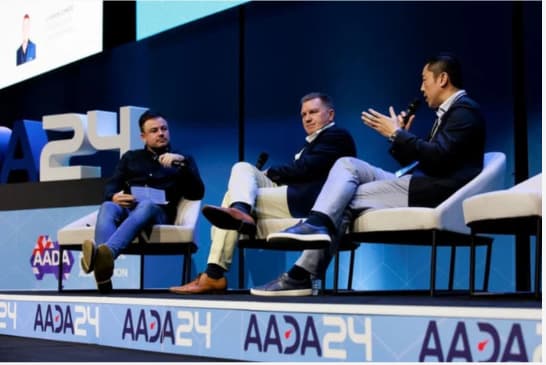
Event Business Case Template: A Strategic Framework for Securing Approval in 2026

In the 2026 Australian corporate environment, a well-organised event is no longer enough to justify a six-figure budget. You likely recognise the mounting pressure to translate creative ambition into a robust financial argument that satisfies a discerning executive board. It’s a common challenge to feel overwhelmed by logistical complexity or the fear of budget rejection when you can’t clearly articulate the long-term value of a brand activation or a major conference. Many planners struggle with how to measure event ROI when the primary outcomes are intangible, such as enhanced reputation or stakeholder trust, rather than direct revenue.

We provide the strategic framework and professional template you need to master the art of the event business case. By aligning your event goals with specific brand objectives and technical precision, you can present your proposal as a high-value investment rather than a discretionary expense. This guide explores the essential components of a successful submission, including budget accuracy and technical oversight, to ensure you walk into your next stakeholder meeting with total confidence. We’ll examine the end-to-end methodology required to secure approval and deliver a frictionless experience for your organisation.

Key Takeaways

  • Understand why standard project templates fail to capture complex event logistics and learn to position your event as a strategic investment rather than a cost centre.
  • Discover the essential components of a persuasive business case, from crafting a high-impact executive summary to providing the necessary market context for Australian stakeholders.
  • Master how to measure event ROI by distinguishing between hard financial returns and soft brand sentiment to demonstrate the total value of engagement.
  • Learn to identify and mitigate financial, technical, and reputational risks to ensure your proposal meets rigorous Australian safety and compliance standards for 2026.
  • Gain clarity on the transition from executive approval to seamless execution by leveraging professional technical direction and end-to-end management.

The Strategic Fundamentals of a High-Impact Event Business Case

An event business case serves as a strategic justification tool, transforming a conceptual idea into a validated investment. In the Australian corporate and government sectors, stakeholders like Chief Marketing Officers and Procurement leads require a document that goes beyond mere logistics. They look for evidence that the proposed activation aligns with overarching organisational goals. While a standard project template might suffice for internal software updates, it’s insufficient for the multifaceted nature of event production. Events are high-stakes. They involve complex technical riders, rigorous safety compliance, and fluctuating audience dynamics that demand a more specialised framework.

With 2026 on the horizon, the Australian market is prioritising high-touch, immersive experiences over passive attendance. This shift requires a business case that addresses current trends, such as the integration of sophisticated event technology and strict sustainability standards. Understanding how to measure event ROI in this evolving landscape means looking past immediate ticket sales to long-term stakeholder engagement and brand equity.

Aligning Event Objectives with Brand Strategy

Successful proposals map every event outcome to specific Key Performance Indicators (KPIs). For a government activation, this might involve public reach or policy awareness, while a corporate seminar might focus on lead conversion. Professional brand activation event planning ensures that the creative execution remains tethered to these commercial objectives. Strategic alignment acts as the essential bridge between creative vision and corporate goals, ensuring that no resource is wasted on misaligned activities. By grounding your objectives in a recognised financial framework, such as Return on Investment (ROI), you provide a common language for executives to evaluate the proposal’s merit.

Identifying the Problem and Opportunity

A compelling business case defines the “gap” your event intends to fill. It frames the event as a direct solution to existing organisational pain points, such as a fragmented internal culture or a dip in market share. When you justify the timing and scale of an activation, you must demonstrate why the investment is necessary now rather than later. This involves:

  • Analysing competitor presence and market saturation in the Australian landscape.
  • Identifying specific audience needs that current communication channels fail to meet.
  • Demonstrating how the event scale is proportionate to the expected strategic gain.

Establishing this foundation ensures that your business case is viewed as a proactive solution rather than a discretionary expense. It allows you to explain how to measure event ROI by first defining what success looks like for your specific organisational challenge.

For small businesses, engaging business advisory services Australia can provide the on-site support and financial expertise needed to ensure the project aligns with broader commercial objectives.

Structuring Your Case: Essential Template Components

A robust business case is built on a logical progression of facts. It begins with a high-level overview before moving into the granular details of execution. For Australian corporate leaders, the structure must reflect a deep understanding of both creative ambition and logistical precision. This section breaks down the essential components that turn a proposal into a funded reality, ensuring every stakeholder feels the project is in a safe pair of hands.

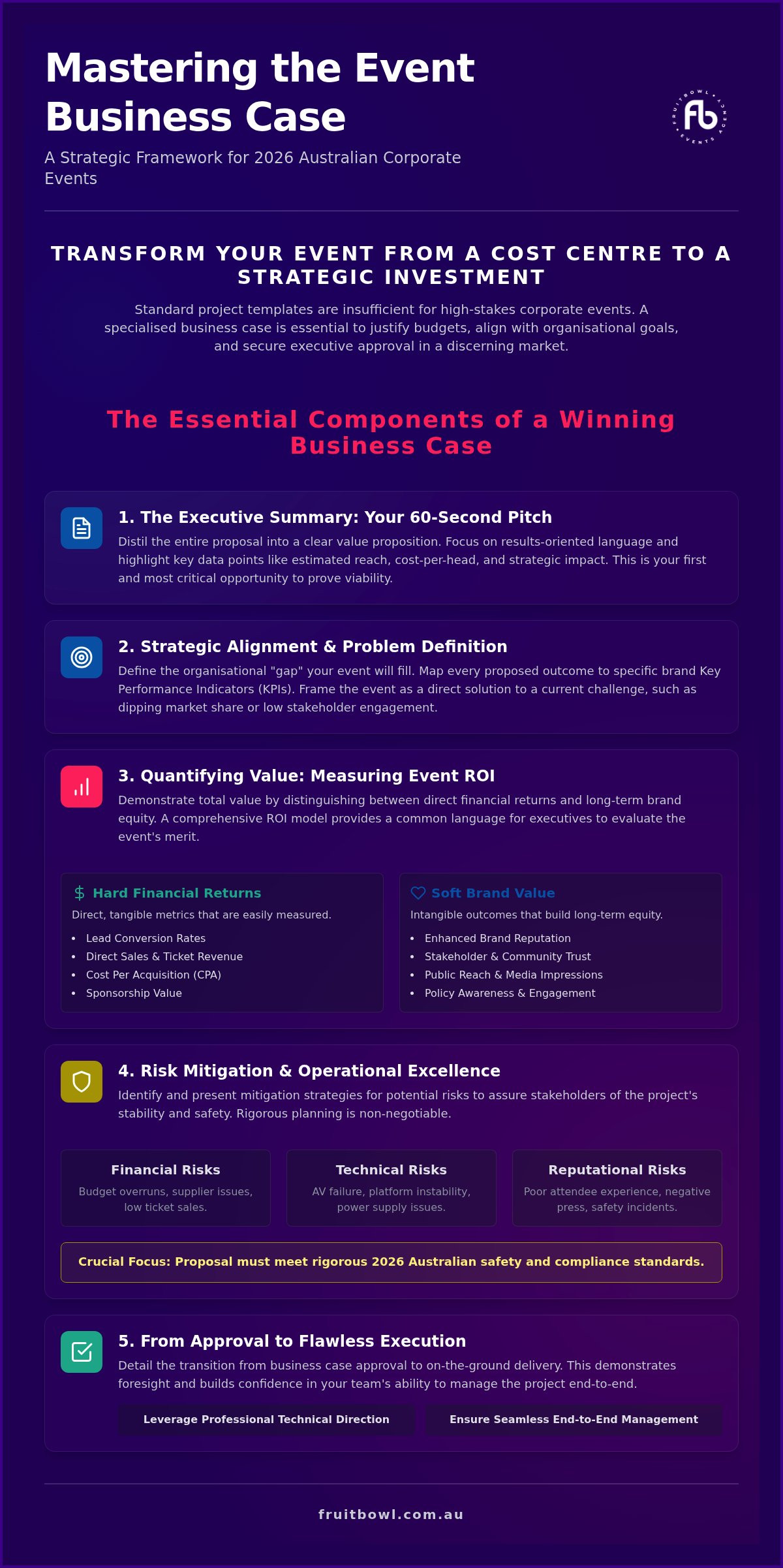
The Executive Summary: Your 60-Second Pitch

Executives often decide the fate of a project within the first page. Your executive summary must act as a 60-second pitch that distils complex logistics into a clear value proposition. Avoid hyperbolic language like “groundbreaking” or “unprecedented”. Instead, use composed, results-oriented prose. Highlight essential data points such as estimated reach, cost-per-head, and the strategic impact on the organisation. This is where you first introduce the methodology for how to measure event ROI, ensuring stakeholders see a clear path to a successful outcome.

The background and context section follows, providing the necessary history and market research to justify the activation. It establishes the context, such as current industry shifts or past event performance. Following this, the proposed solution details the event format, venue selection, and intended audience reach. These details should be specific and grounded in reality, showing that every technical rider and logistical hurdle has been meticulously considered.

Defining the Scope of Work

Vague boundaries lead to budget blowouts and stakeholder friction. Clearly outlining what is, and is not, included in the event programme is vital for financial security. Effective corporate event management relies on maintaining a strict scope from the outset. Addressing potential “scope creep” during the initial business case phase demonstrates a level of foresight that reassures stakeholders. By defining these boundaries early, you protect the project’s integrity and ensure the calculated how to measure event ROI remains accurate throughout the project lifecycle.

A successful event requires a symphony of internal and external talent. Your business case should break down the specific expertise needed, from technical directors to on-site coordinators. Identifying these resource requirements early prevents bottlenecks during the production phase. If you’re looking for a partner to validate these requirements with technical precision, engaging with a specialist event management agency can provide the necessary budget accuracy and logistical oversight to secure executive approval.

Quantifying Value: Measuring ROI and Strategic Alignment

Securing approval for a significant budget requires a pivot from viewing events as a cost to seeing them as a strategic asset. While many organisations focus solely on ticket sales or direct revenue, a sophisticated business case looks at the total value of engagement. This approach acknowledges that how to measure event ROI involves a blend of immediate financial returns and long-term brand equity. By utilising performance data from 2025 activations, planners can project 2026 outcomes with greater precision, building a transparent financial narrative that earns executive trust. For SMEs and mid-market firms, leveraging the insights of a strategic business advisory like ContentFactory can further enhance this narrative by aligning event data with broader digital marketing and ESG transformation goals.

The distinction between hard and soft ROI is critical. Hard ROI tracks tangible revenue streams like sponsorship, registration fees, and direct sales. In contrast, soft ROI, often referred to as Return on Objective (ROO), measures brand sentiment, stakeholder alignment, and internal culture shifts. A successful event professional understands that both metrics are necessary to provide a complete picture of success. This dual-focus approach ensures that the event is seen as a multifaceted investment rather than a single-dimensional expense.

A disciplined approach to financial oversight involves categorising every projected expense with meticulous detail. This includes production fees, talent procurement, and venue hire. A well-structured budget always includes a contingency fund to manage unforeseen logistical shifts, reflecting a professional and grounded management style. Presenting a cost-benefit table allows stakeholders to compare the event’s impact against alternative marketing channels, such as digital advertising or traditional media. This transparency demonstrates that the event is the most efficient vehicle for achieving the stated brand objectives in the Australian corporate landscape.

Measuring Social and Brand Impact

Qualitative outcomes, such as attendee sentiment and brand recall, must be converted into a quantitative format for corporate reporting. Frameworks like Net Promoter Scores (NPS) or sentiment analysis tools allow you to assign numerical values to audience perception. For large-scale public activations, leveraging professional festival production services ensures that the high-impact experience translates into measurable brand lift. When you present this data, focus on how the event moved the needle on specific brand pillars. This methodology provides a definitive answer to how to measure event ROI in a way that resonates with the C-suite, proving that the activation delivered a tangible return on the organisation’s investment.
Event Business Case Template: A Strategic Framework for Securing Approval in 2026

Mitigating Risk and Ensuring Operational Excellence

A high-impact business case must address the vulnerabilities inherent in live environments. In the Australian corporate landscape, risk management is not a secondary consideration; it’s a non-negotiable pillar of compliance. Identifying technical, financial, and reputational risks early allows you to build a resilient strategy that protects the organisation’s investment. When considering how to measure event ROI, the ability to prevent costly failures is just as significant as the ability to generate positive engagement. Events are volatile. The ability to anticipate hurdles before they manifest on site is a hallmark of seasoned expertise.

Establishing a clear chain of command and a comprehensive stakeholder communication plan ensures that all parties are aligned during high-pressure moments. This structured approach provides a sense of security to the executive board, demonstrating that the project is governed by a steady, results-oriented methodology. By quantifying these risks within your proposal, you transform the business case from a simple request for funds into a sophisticated strategic document.

Technical Direction and AV Infrastructure

Technical riders are often overlooked during the initial business case phase, yet they represent a significant portion of the budget and operational risk. Establishing these requirements early ensures that your financial projections remain accurate and realistic. Integrating professional av management for events acts as a primary risk mitigation strategy. This ensures all staging, lighting, and audio-visual components are redundant and compatible with the venue’s infrastructure. Professional technical direction provides the logistical precision needed to manage large-scale activations without the threat of technical failure derailing the audience experience.

Compliance and Safety Standards in Australia

Navigating government event planning protocols requires a deep understanding of national safety and insurance standards. For 2026, regulatory scrutiny on public and corporate activations remains intense, demanding that all vendors meet rigorous safety benchmarks. You must ensure that every partner provides verified documentation and adheres to the latest Australian standards for public safety. This meticulous approach positions the event team as a safe pair of hands in high-stakes environments. If you require expert validation for your technical riders or compliance framework, partnering with an experienced production and management agency ensures every detail is under expert supervision and your budget remains protected.

Partnering for Success: From Approval to Execution

Receiving executive approval is a significant milestone, but it’s merely the commencement of the operational phase. You must now translate the approved business case into a functional project timeline. This transition requires a shift from strategic justification to tactical execution. Maintaining stakeholder momentum during the planning lifecycle is essential to ensure that the initial enthusiasm doesn’t dissipate as technical complexities increase. A disciplined approach to this phase ensures that the promises made in the boardroom are fulfilled on the event floor.

Throughout this process, your methodology for how to measure event ROI must remain a central focus. It’s not a metric calculated only at the conclusion; it’s a benchmark that guides every procurement and production decision. By keeping the return on investment at the forefront of the project management cycle, you ensure that every logistical choice contributes to the overarching brand objectives established in your business case.

The Role of the Event Management Agency

Engaging a professional partner provides the strategic oversight and logistical precision necessary for end-to-end delivery. Professional fees are an investment in risk mitigation and quality control, ensuring that your organisation’s reputation is protected. A single point of contact simplifies communication for complex, multifaceted events like corporate conferences or brand activations. Selecting a partner with a proven history of national delivery ensures that regardless of the location, the standards of safety and production remain consistent. This expertise allows internal teams to focus on high-level strategy while the agency manages the intricate details of technical riders and vendor coordination.

Next Steps: Securing Your Safe Pair of Hands

When you present the final business case to the board, invite expert validation to strengthen your proposal. This external verification of your budget and technical requirements adds a layer of security that internal teams often lack. It signals to the C-suite that every detail is under expert supervision and that the project is anchored by real-world data. This level of preparation is what separates a standard plan from a high-impact strategic investment.

Execution requires discipline. Once the funding is secured, the focus shifts to the seamless integration of various moving parts, from AV infrastructure to audience engagement. If you’re ready to validate and execute your 2026 event strategy, enquire with Fruitbowl Events Agency today. Our team provides the seasoned expertise and technical direction needed to deliver a frictionless experience and a definitive answer to how to measure event ROI for your organisation.

Executing Your Strategic Vision for 2026

A successful event business case is more than a budget request; it’s a strategic roadmap that ensures alignment between your creative ambition and the organisation’s commercial objectives. By prioritising technical precision and rigorous risk management, you position your activation as a secure, high-value investment. Mastering how to measure event ROI through a balance of financial returns and brand sentiment provides the transparency executives require to approve complex, high-stakes projects. This structured approach builds the necessary trust to move from a conceptual pitch to a fully funded reality.

Turning these plans into reality requires a partner who understands the intricacies of the Australian corporate and government landscape. With over 28 years of logistical precision, our team specialises in high-impact national activations and provides end-to-end management from concept to delivery. We act as a safe pair of hands, ensuring every technical rider and safety protocol is meticulously managed. Partner with Fruitbowl Events Agency to bring your event business case to life and secure the funding your vision deserves. We look forward to helping you deliver a frictionless and impactful experience that exceeds your strategic goals.

Frequently Asked Questions

What is the most important section of an event business case?

The Executive Summary is the most critical component because it distils complex logistics into a high-level value proposition for time-poor executives. It must clearly articulate the alignment between the event and the organisation’s strategic goals. A well-crafted summary provides the necessary confidence for stakeholders to proceed, acting as a persuasive hook that justifies the initial investment. If this section fails to capture the core value, the detailed analysis that follows may never be reviewed.

How do I calculate the ROI for a non-ticketed corporate event?

For non-ticketed activations, you should focus on Return on Objective (ROO) to understand how to measure event ROI effectively. This involves tracking qualitative data such as brand sentiment, stakeholder engagement levels, and internal culture shifts. Assigning numerical values to these outcomes through Net Promoter Scores or lead conversion rates allows you to present a comprehensive financial narrative. This methodology ensures that the event is recognised as a strategic asset rather than a discretionary cost centre.

Should I include specific AV and technical requirements in the business case?

Including specific audio-visual and technical requirements is essential for maintaining budget accuracy and operational excellence. Detailed technical riders allow you to identify potential infrastructure hurdles before they impact the production phase. This level of foresight demonstrates a disciplined approach to management and ensures that your financial projections remain realistic. By addressing staging, lighting, and audio requirements early, you provide a sense of security to the board that every detail is under expert supervision.

How long should a professional event business case be?

A professional business case should be concise yet comprehensive, typically ranging from five to ten pages depending on the project’s scale. The focus should remain on information density and logical progression rather than volume. Time-poor executives value a document that navigates complex details efficiently, using short, impactful headers as navigational anchors. Ensure that every page adds value to the strategic argument, moving from high-level objectives to the granular details of execution and risk mitigation.

How do I address potential risks without sounding pessimistic to the board?

Frame risk management as a proactive strategy for ensuring operational excellence rather than a list of potential failures. By identifying technical, financial, and reputational risks early, you demonstrate a “safe pair of hands” approach to project delivery. This transparent methodology builds executive trust, showing that you have established a clear chain of command and a robust communication plan. Highlighting these safeguards suggests a brand that is both a creative visionary and a disciplined technician.

What are the common mistakes to avoid in an event business case template?

Common mistakes include setting vague objectives that lack measurable KPIs and failing to account for technical complexity in the initial budget. Many planners also overlook the importance of a contingency fund, which is vital for managing the volatility of live environments. Another error is neglecting the “why now” context, which fails to justify the timing of the activation within the current Australian market. Avoiding these pitfalls ensures your proposal is viewed as a robust, professional investment.

Can I use this template for both government and private sector events?

You can certainly use this framework for both sectors, provided you adapt the primary objectives to suit the specific audience. Government activations often prioritise public impact, policy awareness, and strict compliance with national safety standards. In contrast, private sector events typically focus on brand equity, lead generation, and direct revenue. Regardless of the sector, the fundamental need for logistical precision and a clear methodology on how to measure event ROI remains consistent across all high-stakes environments.

How often should I update the business case during the planning process?

You should treat the business case as a living document, updating it at every major project milestone. This includes the finalisation of venue sourcing, talent procurement, and the completion of technical riders. Regular updates allow you to track actual costs against your initial forecasts and ensure that the event remains aligned with the organisation’s brand strategy. This methodical approach ensures that you maintain stakeholder momentum and control over the project narrative throughout the entire planning lifecycle.

In the 2026 Australian corporate environment, a well-organised event is no longer enough to justify a six-figure budget. You likely recognise the mounting pressure to translate creative ambition into a robust financial argument that satisfies a discerning executive board. It’s a common challenge to feel overwhelmed by logistical complexity or the fear of budget rejection when you can’t clearly articulate the long-term value of a brand activation or a major conference. Many planners struggle with how to measure event ROI when the primary outcomes are intangible, such as enhanced reputation or stakeholder trust, rather than direct revenue.

We provide the strategic framework and professional template you need to master the art of the event business case. By aligning your event goals with specific brand objectives and technical precision, you can present your proposal as a high-value investment rather than a discretionary expense. This guide explores the essential components of a successful submission, including budget accuracy and technical oversight, to ensure you walk into your next stakeholder meeting with total confidence. We’ll examine the end-to-end methodology required to secure approval and deliver a frictionless experience for your organisation.

Key Takeaways

  • Understand why standard project templates fail to capture complex event logistics and learn to position your event as a strategic investment rather than a cost centre.
  • Discover the essential components of a persuasive business case, from crafting a high-impact executive summary to providing the necessary market context for Australian stakeholders.
  • Master how to measure event ROI by distinguishing between hard financial returns and soft brand sentiment to demonstrate the total value of engagement.
  • Learn to identify and mitigate financial, technical, and reputational risks to ensure your proposal meets rigorous Australian safety and compliance standards for 2026.
  • Gain clarity on the transition from executive approval to seamless execution by leveraging professional technical direction and end-to-end management.

The Strategic Fundamentals of a High-Impact Event Business Case

An event business case serves as a strategic justification tool, transforming a conceptual idea into a validated investment. In the Australian corporate and government sectors, stakeholders like Chief Marketing Officers and Procurement leads require a document that goes beyond mere logistics. They look for evidence that the proposed activation aligns with overarching organisational goals. While a standard project template might suffice for internal software updates, it’s insufficient for the multifaceted nature of event production. Events are high-stakes. They involve complex technical riders, rigorous safety compliance, and fluctuating audience dynamics that demand a more specialised framework.

With 2026 on the horizon, the Australian market is prioritising high-touch, immersive experiences over passive attendance. This shift requires a business case that addresses current trends, such as the integration of sophisticated event technology and strict sustainability standards. Understanding how to measure event ROI in this evolving landscape means looking past immediate ticket sales to long-term stakeholder engagement and brand equity.

Aligning Event Objectives with Brand Strategy

Successful proposals map every event outcome to specific Key Performance Indicators (KPIs). For a government activation, this might involve public reach or policy awareness, while a corporate seminar might focus on lead conversion. Professional brand activation event planning ensures that the creative execution remains tethered to these commercial objectives. Strategic alignment acts as the essential bridge between creative vision and corporate goals, ensuring that no resource is wasted on misaligned activities. By grounding your objectives in a recognised financial framework, such as Return on Investment (ROI), you provide a common language for executives to evaluate the proposal’s merit.

Identifying the Problem and Opportunity

A compelling business case defines the “gap” your event intends to fill. It frames the event as a direct solution to existing organisational pain points, such as a fragmented internal culture or a dip in market share. When you justify the timing and scale of an activation, you must demonstrate why the investment is necessary now rather than later. This involves:

  • Analysing competitor presence and market saturation in the Australian landscape.
  • Identifying specific audience needs that current communication channels fail to meet.
  • Demonstrating how the event scale is proportionate to the expected strategic gain.

Establishing this foundation ensures that your business case is viewed as a proactive solution rather than a discretionary expense. It allows you to explain how to measure event ROI by first defining what success looks like for your specific organisational challenge.

Structuring Your Case: Essential Template Components

A robust business case is built on a logical progression of facts. It begins with a high-level overview before moving into the granular details of execution. For Australian corporate leaders, the structure must reflect a deep understanding of both creative ambition and logistical precision. This section breaks down the essential components that turn a proposal into a funded reality, ensuring every stakeholder feels the project is in a safe pair of hands.

The Executive Summary: Your 60-Second Pitch

Executives often decide the fate of a project within the first page. Your executive summary must act as a 60-second pitch that distils complex logistics into a clear value proposition. Avoid hyperbolic language like “groundbreaking” or “unprecedented”. Instead, use composed, results-oriented prose. Highlight essential data points such as estimated reach, cost-per-head, and the strategic impact on the organisation. This is where you first introduce the methodology for how to measure event ROI, ensuring stakeholders see a clear path to a successful outcome.

The background and context section follows, providing the necessary history and market research to justify the activation. It establishes the context, such as current industry shifts or past event performance. Following this, the proposed solution details the event format, venue selection, and intended audience reach. These details should be specific and grounded in reality, showing that every technical rider and logistical hurdle has been meticulously considered.

Defining the Scope of Work

Vague boundaries lead to budget blowouts and stakeholder friction. Clearly outlining what is, and is not, included in the event programme is vital for financial security. Effective corporate event management relies on maintaining a strict scope from the outset. Addressing potential “scope creep” during the initial business case phase demonstrates a level of foresight that reassures stakeholders. By defining these boundaries early, you protect the project’s integrity and ensure the calculated how to measure event ROI remains accurate throughout the project lifecycle.

A successful event requires a symphony of internal and external talent. Your business case should break down the specific expertise needed, from technical directors to on-site coordinators. Identifying these resource requirements early prevents bottlenecks during the production phase. If you’re looking for a partner to validate these requirements with technical precision, engaging with a specialist event management agency can provide the necessary budget accuracy and logistical oversight to secure executive approval.

Quantifying Value: Measuring ROI and Strategic Alignment

Securing approval for a significant budget requires a pivot from viewing events as a cost to seeing them as a strategic asset. While many organisations focus solely on ticket sales or direct revenue, a sophisticated business case looks at the total value of engagement. This approach acknowledges that how to measure event ROI involves a blend of immediate financial returns and long-term brand equity. By utilising performance data from 2025 activations, planners can project 2026 outcomes with greater precision, building a transparent financial narrative that earns executive trust.

The distinction between hard and soft ROI is critical. Hard ROI tracks tangible revenue streams like sponsorship, registration fees, and direct sales. In contrast, soft ROI, often referred to as Return on Objective (ROO), measures brand sentiment, stakeholder alignment, and internal culture shifts. A successful event professional understands that both metrics are necessary to provide a complete picture of success. This dual-focus approach ensures that the event is seen as a multifaceted investment rather than a single-dimensional expense.

Financial Analysis and Budget Forecasting

A disciplined approach to financial oversight involves categorising every projected expense with meticulous detail. This includes production fees, talent procurement, and venue hire. A well-structured budget always includes a contingency fund to manage unforeseen logistical shifts, reflecting a professional and grounded management style. Presenting a cost-benefit table allows stakeholders to compare the event’s impact against alternative marketing channels, such as digital advertising or traditional media. This transparency demonstrates that the event is the most efficient vehicle for achieving the stated brand objectives in the Australian corporate landscape.

Measuring Social and Brand Impact

Qualitative outcomes, such as attendee sentiment and brand recall, must be converted into a quantitative format for corporate reporting. Frameworks like Net Promoter Scores (NPS) or sentiment analysis tools allow you to assign numerical values to audience perception. For large-scale public activations, leveraging professional festival production services ensures that the high-impact experience translates into measurable brand lift. When you present this data, focus on how the event moved the needle on specific brand pillars. This methodology provides a definitive answer to how to measure event ROI in a way that resonates with the C-suite, proving that the activation delivered a tangible return on the organisation’s investment.

Mitigating Risk and Ensuring Operational Excellence

A high-impact business case must address the vulnerabilities inherent in live environments. In the Australian corporate landscape, risk management is not a secondary consideration; it’s a non-negotiable pillar of compliance. Identifying technical, financial, and reputational risks early allows you to build a resilient strategy that protects the organisation’s investment. When considering how to measure event ROI, the ability to prevent costly failures is just as significant as the ability to generate positive engagement. Events are volatile. The ability to anticipate hurdles before they manifest on site is a hallmark of seasoned expertise.

Establishing a clear chain of command and a comprehensive stakeholder communication plan ensures that all parties are aligned during high-pressure moments. This structured approach provides a sense of security to the executive board, demonstrating that the project is governed by a steady, results-oriented methodology. By quantifying these risks within your proposal, you transform the business case from a simple request for funds into a sophisticated strategic document.

Technical Direction and AV Infrastructure

Technical riders are often overlooked during the initial business case phase, yet they represent a significant portion of the budget and operational risk. Establishing these requirements early ensures that your financial projections remain accurate and realistic. Integrating professional av management for events acts as a primary risk mitigation strategy. This ensures all staging, lighting, and audio-visual components are redundant and compatible with the venue’s infrastructure. Professional technical direction provides the logistical precision needed to manage large-scale activations without the threat of technical failure derailing the audience experience.

Compliance and Safety Standards in Australia

Navigating government event planning protocols requires a deep understanding of national safety and insurance standards. For 2026, regulatory scrutiny on public and corporate activations remains intense, demanding that all vendors meet rigorous safety benchmarks. You must ensure that every partner provides verified documentation and adheres to the latest Australian standards for public safety. This meticulous approach positions the event team as a safe pair of hands in high-stakes environments. If you require expert validation for your technical riders or compliance framework, partnering with an experienced production and management agency ensures every detail is under expert supervision and your budget remains protected.

Partnering for Success: From Approval to Execution

Receiving executive approval is a significant milestone, but it’s merely the commencement of the operational phase. You must now translate the approved business case into a functional project timeline. This transition requires a shift from strategic justification to tactical execution. Maintaining stakeholder momentum during the planning lifecycle is essential to ensure that the initial enthusiasm doesn’t dissipate as technical complexities increase. A disciplined approach to this phase ensures that the promises made in the boardroom are fulfilled on the event floor.

Throughout this process, your methodology for how to measure event ROI must remain a central focus. It’s not a metric calculated only at the conclusion; it’s a benchmark that guides every procurement and production decision. By keeping the return on investment at the forefront of the project management cycle, you ensure that every logistical choice contributes to the overarching brand objectives established in your business case.

The Role of the Event Management Agency

Engaging a professional partner provides the strategic oversight and logistical precision necessary for end-to-end delivery. Professional fees are an investment in risk mitigation and quality control, ensuring that your organisation’s reputation is protected. A single point of contact simplifies communication for complex, multifaceted events like corporate conferences or brand activations. Selecting a partner with a proven history of national delivery ensures that regardless of the location, the standards of safety and production remain consistent. This expertise allows internal teams to focus on high-level strategy while the agency manages the intricate details of technical riders and vendor coordination.

Next Steps: Securing Your Safe Pair of Hands

When you present the final business case to the board, invite expert validation to strengthen your proposal. This external verification of your budget and technical requirements adds a layer of security that internal teams often lack. It signals to the C-suite that every detail is under expert supervision and that the project is anchored by real-world data. This level of preparation is what separates a standard plan from a high-impact strategic investment.

Execution requires discipline. Once the funding is secured, the focus shifts to the seamless integration of various moving parts, from AV infrastructure to audience engagement. If you’re ready to validate and execute your 2026 event strategy, enquire with Fruitbowl Events Agency today. Our team provides the seasoned expertise and technical direction needed to deliver a frictionless experience and a definitive answer to how to measure event ROI for your organisation.

Executing Your Strategic Vision for 2026

A successful event business case is more than a budget request; it’s a strategic roadmap that ensures alignment between your creative ambition and the organisation’s commercial objectives. By prioritising technical precision and rigorous risk management, you position your activation as a secure, high-value investment. Mastering how to measure event ROI through a balance of financial returns and brand sentiment provides the transparency executives require to approve complex, high-stakes projects. This structured approach builds the necessary trust to move from a conceptual pitch to a fully funded reality.

Turning these plans into reality requires a partner who understands the intricacies of the Australian corporate and government landscape. With over 28 years of logistical precision, our team specialises in high-impact national activations and provides end-to-end management from concept to delivery. We act as a safe pair of hands, ensuring every technical rider and safety protocol is meticulously managed. Partner with Fruitbowl Events Agency to bring your event business case to life and secure the funding your vision deserves. We look forward to helping you deliver a frictionless and impactful experience that exceeds your strategic goals.

Frequently Asked Questions

What is the most important section of an event business case?

The Executive Summary is the most critical component because it distils complex logistics into a high-level value proposition for time-poor executives. It must clearly articulate the alignment between the event and the organisation’s strategic goals. A well-crafted summary provides the necessary confidence for stakeholders to proceed, acting as a persuasive hook that justifies the initial investment. If this section fails to capture the core value, the detailed analysis that follows may never be reviewed.

How do I calculate the ROI for a non-ticketed corporate event?

For non-ticketed activations, you should focus on Return on Objective (ROO) to understand how to measure event ROI effectively. This involves tracking qualitative data such as brand sentiment, stakeholder engagement levels, and internal culture shifts. Assigning numerical values to these outcomes through Net Promoter Scores or lead conversion rates allows you to present a comprehensive financial narrative. This methodology ensures that the event is recognised as a strategic asset rather than a discretionary cost centre.

Should I include specific AV and technical requirements in the business case?

Including specific audio-visual and technical requirements is essential for maintaining budget accuracy and operational excellence. Detailed technical riders allow you to identify potential infrastructure hurdles before they impact the production phase. This level of foresight demonstrates a disciplined approach to management and ensures that your financial projections remain realistic. By addressing staging, lighting, and audio requirements early, you provide a sense of security to the board that every detail is under expert supervision.

How long should a professional event business case be?

A professional business case should be concise yet comprehensive, typically ranging from five to ten pages depending on the project’s scale. The focus should remain on information density and logical progression rather than volume. Time-poor executives value a document that navigates complex details efficiently, using short, impactful headers as navigational anchors. Ensure that every page adds value to the strategic argument, moving from high-level objectives to the granular details of execution and risk mitigation.

How do I address potential risks without sounding pessimistic to the board?

Frame risk management as a proactive strategy for ensuring operational excellence rather than a list of potential failures. By identifying technical, financial, and reputational risks early, you demonstrate a “safe pair of hands” approach to project delivery. This transparent methodology builds executive trust, showing that you have established a clear chain of command and a robust communication plan. Highlighting these safeguards suggests a brand that is both a creative visionary and a disciplined technician.

What are the common mistakes to avoid in an event business case template?

Common mistakes include setting vague objectives that lack measurable KPIs and failing to account for technical complexity in the initial budget. Many planners also overlook the importance of a contingency fund, which is vital for managing the volatility of live environments. Another error is neglecting the “why now” context, which fails to justify the timing of the activation within the current Australian market. Avoiding these pitfalls ensures your proposal is viewed as a robust, professional investment.

Can I use this template for both government and private sector events?

You can certainly use this framework for both sectors, provided you adapt the primary objectives to suit the specific audience. Government activations often prioritise public impact, policy awareness, and strict compliance with national safety standards. In contrast, private sector events typically focus on brand equity, lead generation, and direct revenue. Regardless of the sector, the fundamental need for logistical precision and a clear methodology on how to measure event ROI remains consistent across all high-stakes environments.

How often should I update the business case during the planning process?

You should treat the business case as a living document, updating it at every major project milestone. This includes the finalisation of venue sourcing, talent procurement, and the completion of technical riders. Regular updates allow you to track actual costs against your initial forecasts and ensure that the event remains aligned with the organisation’s brand strategy. This methodical approach ensures that you maintain stakeholder momentum and control over the project narrative throughout the entire planning lifecycle.

Back to Articles
Request A Quote

Make an
Enquiry

Untitled design

What Makes Us Different?

True end-to-end solution so you can hand off to us, focus on your priorities and enjoy the event without any stress

Unmatched industry expertise looking after diverse range of high-profile events, cultural festivals & activations

Meticulous attention to every detail and precise execution of events with our streamlined processes

Tailored solutions with bespoke strategies to ensure we align with your brand and objectives

Make an Enquiry

"*" indicates required fields

This field is for validation purposes and should be left unchanged.

"*" indicates required fields

This field is for validation purposes and should be left unchanged.