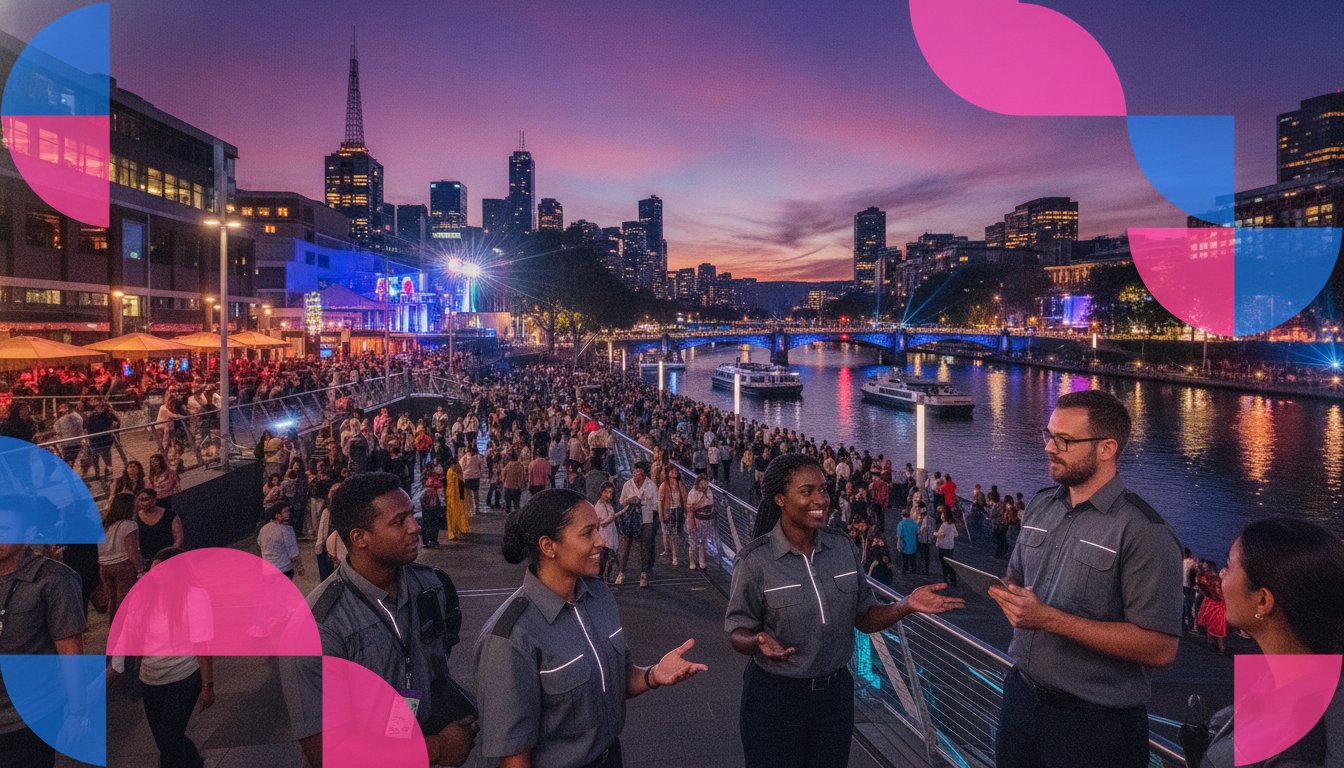
The most successful Australian activations aren’t defined by what guests see, but by the risks they never have to think about. Your security strategy shouldn’t be a barrier to entry; it’s the foundational layer of production that ensures your creative ambition isn’t compromised by logistical failure. For professional organisers, implementing a robust event security planning checklist is the only way to balance rigorous safety protocols with a welcoming brand atmosphere. It’s a delicate equilibrium that requires both technical precision and seasoned expertise to manage the evolving regulatory landscape of 2026.
This guide provides a professional-grade framework to help you master these complexities with absolute confidence. You’ll learn how to integrate sophisticated safety protocols into high-stakes environments while maintaining your brand’s elite reputation. We’ll walk through the essential stages of risk assessment, stakeholder liaison, and crowd management, ensuring your next festival or corporate activation is both bulletproof and seamless. By the end, you’ll have a clear roadmap to protect your guests and deliver a frictionless experience that feels entirely under expert supervision.
Key Takeaways
- Shift from reactive guarding to a proactive risk mitigation framework tailored to the specific vulnerabilities of your 2026 event site.
- Design a tiered security presence that balances high-impact safety with a welcoming concierge-style atmosphere through integrated technical infrastructure.
- Implement a definitive, sequential event security planning checklist to oversee every phase of your activation, ensuring no detail is overlooked from pre-event planning to the final pack-down.
- Understand how end-to-end strategic management reduces logistical friction while keeping your brand’s reputation under expert supervision.
- Gain confidence in navigating complex Australian regulatory requirements and stakeholder liaison for high-stakes government and corporate activations.
What is Strategic Event Security Planning?
Strategic event security planning is the silent architecture of a successful activation. It’s no longer sufficient to treat safety as a peripheral concern or a late-stage addition to the production schedule. Instead, security must be viewed as a multi-dimensional framework that ensures every logistical element supports the safety of the guests and the integrity of the brand. In 2026, the industry has shifted decisively from reactive guarding to proactive risk mitigation. This evolution means that an event security planning checklist is now a core strategic roadmap, guiding the project from the very first site visit through to the final pack-down.
Security planning should begin at the concept stage, not the execution stage. When safety is integrated into the initial design, it becomes a seamless part of the guest journey rather than a series of intrusive checkpoints. Waiting until the final weeks of production to address vulnerabilities often leads to compromised aesthetics or logistical bottlenecks. For a broader context on how these elements fit together, this Event Management Overview highlights the essential role that safety plays in the modern project lifecycle.
Beyond the immediate physical safety of attendees, strategic planning is an exercise in reputation management. For high-stakes government and corporate activations, security is the mechanism that protects brand equity and maintains stakeholder trust. A single safety oversight can tarnish years of brand building, which is why we treat security as a non-negotiable pillar of production excellence.
The Pillars of Modern Event Safety
Modern safety is built on three distinct yet integrated pillars. Physical security involves the meticulous management of perimeters, access points, and car park logistics to prevent unauthorised entry while maintaining a steady flow of traffic. Personnel security focuses on the selection of vetted professionals who align with the event’s specific tone; these individuals must act as composed brand ambassadors while remaining vigilant. Finally, information security has become paramount. Protecting attendee data and sensitive corporate IP during presentations is now a standard requirement for any professional event security planning checklist in the digital age.
Regulatory Compliance vs. Strategic Excellence
Meeting the minimum Australian standards for public safety and crowd control is merely the baseline. While compliance with SafeWork regulations is mandatory, being “compliant” is not the same as being truly “secure” in high-stakes environments. Strategic excellence requires an agency to anticipate specific threats that generic regulations might overlook. We integrate these advanced safety protocols into our broader corporate event management strategy, ensuring that every protective measure is balanced with a sophisticated, welcoming atmosphere. This approach provides the “safe pair of hands” that clients require when the stakes are at their highest.
Conducting a Comprehensive Event Risk Assessment
A rigorous risk assessment serves as the diagnostic foundation for any professional event security planning checklist. Rather than applying a generic template, a sophisticated strategist examines the specific anatomy of an activation to identify both internal and external threats. In the 2026 landscape, this involves accounting for traditional physical risks alongside modern technological disruptions and shifting social climates. We evaluate the “attractiveness” of an event to potential disruptors by considering the profile of the speakers, the nature of the brand, and the public visibility of the activation.
Site-specific vulnerability assessments are non-negotiable. Every venue, whether a purpose-built convention centre or a temporary outdoor festival site, possesses unique blind spots and logistical bottlenecks. We develop a comprehensive risk matrix to categorise these threats by their likelihood and potential impact. This logical progression ensures that resources are allocated where they are most needed, providing a clear hierarchy for mitigation efforts. By prioritising high-impact risks first, we ensure that the most critical safety layers are established well before the first guest arrives.
Intelligence Gathering and Stakeholder Liaison
Effective risk mitigation relies on a unified command structure. This requires early and consistent liaison with local authorities, emergency services, and venue management. By analysing historical data from similar public activations, we can anticipate challenges before they manifest. For high-profile government activations, assessing the technical rider requirements for talent and speakers is essential; these documents often dictate specific security cordons and arrival protocols that must be integrated into the broader plan. If you require expert oversight for these complex requirements, our team at Fruitbowl Events Agency provides the seasoned expertise needed to manage these high-stakes relationships.
Crowd Dynamics and Capacity Management
Managing crowd flow is a technical discipline that requires precision. We calculate safe capacities for varied venue layouts, ensuring that staging areas and thoroughfares remain navigable even at peak attendance. Current industry standards, such as the requirement of one trained crowd manager for every 250 attendees, serve as our baseline for personnel allocation. We predict crowd behaviour based on the specific demographic and event type, allowing us to mitigate risks in high-traffic zones like entry gates and food courts. This proactive approach to crowd management ensures that the guest experience remains fluid and composed, regardless of the scale of the activation.
Coordinating Personnel and Physical Security Infrastructure
Executing a sophisticated security strategy requires a tiered approach that balances high-visibility deterrence with subtle, guest-facing service. A professional event security planning checklist for 2026 must categorise personnel by their specific function and tone. We deploy “concierge-style” security at guest entry points to provide a welcoming brand experience while maintaining a vigilant screening process. This front-end presence is backed by discreet rapid response teams stationed at strategic locations, ready to manage incidents without disrupting the overall atmosphere of the activation. This layered structure ensures that the event feels secure without ever feeling like a fortress.
Managing the physical perimeter requires a blend of logistical precision and creative problem-solving. We use landscaping, temporary structures, and intelligent barrier placement to define boundaries in a way that feels organic to the event design. The nervous system of this infrastructure is the communication network. We prioritise seamless radio and data links to ensure that every member of the security and production teams remains in constant, real-time contact. When communications are centralised and reliable, the response to any logistical shift is immediate and composed.
Technical Direction and Surveillance
Integrating security with technical production is essential for maintaining total situational awareness. By utilising strategic AV management for events, we turn standard event infrastructure into a sophisticated monitoring network. CCTV placement is designed for real-time observation of crowd density and movement patterns, allowing the command centre to anticipate bottlenecks before they occur. Additionally, we coordinate temporary lighting installations to ensure that night-time safety is maintained in car parks and thoroughfares without compromising the aesthetic direction of the programme. This technical integration provides a level of oversight that traditional guarding alone cannot achieve.
Logistics and Access Control
Access control is the primary mechanism for protecting the integrity of your event zones. We organise dedicated, secure entry points for VIPs, high-profile talent, and general admission guests to prevent congestion and ensure a frictionless arrival. This logistical rigour extends to the back-of-house, where we manage deliveries and contractor movements during live phases to avoid interference with the guest experience. By centrally coordinating car park security and pedestrian flow, we ensure that the transition from arrival to the main event space is handled by a “safe pair of hands,” maintaining order from the moment guests reach the venue perimeter.
The 2026 Event Security Planning Checklist
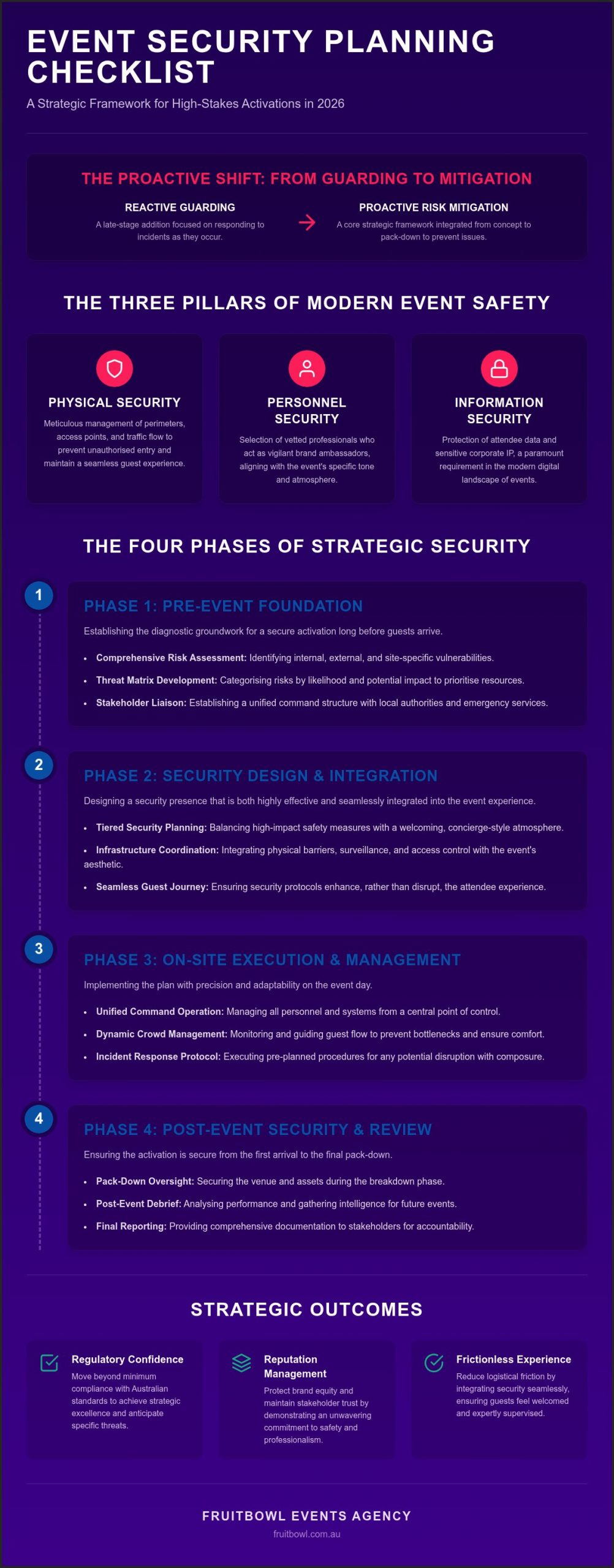
A definitive event security planning checklist is a tactical asset for project leads managing high-stakes activations. It provides a sequential roadmap to ensure every safety layer is established with precision, transforming complex regulatory requirements into a streamlined operational flow. This framework is designed for the rigorous demands of corporate conferences, public festivals, and government activations where brand reputation and guest safety are paramount. By following this phased approach, you ensure that every detail remains under expert supervision from the initial concept through to the final pack-down.
Phase 1: Strategic Planning and Procurement
Success begins months before the first guest arrives. This phase focuses on establishing the strategic foundation and securing the necessary expertise to manage the project’s unique vulnerabilities. It’s the period where the “safe pair of hands” philosophy is first integrated into the event’s DNA.
- Define security objectives and align them with the overall event budget parameters.
- Appoint a dedicated security coordinator or liaison officer to manage stakeholder relations and local authority requirements.
- Review all venue contracts and technical riders for specific security implications, such as high-profile speaker requirements or sensitive corporate IP protection.
- Procure security personnel who align with the event’s tone, prioritising individuals with experience in sophisticated, guest-facing environments.
Phase 2: Operational Readiness
As the move-in date approaches, the focus shifts to verification and team alignment. This stage ensures that the theoretical plan is translated into practical, on-site readiness. Coordination between technical leads and security teams is essential to prevent logistical friction during the live phase.
- Conduct a final site walk-through with all technical, logistical, and security leads to identify any late-stage site vulnerabilities or blind spots.
- Brief all personnel on emergency protocols, evacuation routes, and the specific brand tone of voice required for guest interactions.
- Verify the integrity of all technical infrastructure, including encrypted radio channels, CCTV feeds, and temporary safety lighting arrays.
- Confirm the placement of all physical barriers and access control points to ensure they facilitate, rather than hinder, pedestrian flow.
Phase 3: Live Event Execution and Monitoring
During the live phase, the event security planning checklist moves into a state of active oversight. The priority is maintaining total situational awareness and responding to shifting crowd dynamics with composure and speed.
- Establish a central command post to facilitate unified stakeholder liaison and real-time decision-making across all departments.
- Monitor crowd density and flow across all thoroughfares, responding to bottlenecks before they impact guest comfort or safety.
- Execute rapid response protocols for any incidents, ensuring that issues are contained discreetly without disrupting the wider programme.
- Conduct a formal post-event debrief to review incident logs and refine protocols for future activations, ensuring a cycle of continuous improvement.
For organisations seeking a partner to oversee these critical stages with absolute precision, our team at Fruitbowl Events Agency delivers the strategic oversight and technical direction needed for flawless execution.
Integrating Security into Strategic Event Management
Strategic event management requires more than just ticking boxes on an event security planning checklist. It demands the seamless integration of safety protocols into the very fabric of the production process. When security is treated as an isolated silo, logistical friction and communication gaps often follow. By contrast, an end-to-end management approach ensures that every protective measure supports the creative vision rather than obstructing it. This level of oversight protects your brand’s reputation and ensures that your investment in the activation is fully secured against unforeseen disruptions.
Professional festival production services demonstrate the necessity of this integration. Managing thousands of attendees across complex sites requires a unified command that oversees technical direction, crowd flow, and rapid response simultaneously. This cohesive strategy reduces the risk of incidents and provides a frictionless experience for guests and stakeholders alike. When safety is woven into the production timeline, it becomes a silent enabler of event success.
The Fruitbowl Approach: Composed and Reassuring
With over 28 years of industry experience, we bring a level of seasoned expertise that acts as a “safe pair of hands” for high-stakes Australian activations. Our methodology is built on providing order and clarity in multifaceted environments where the margin for error is non-existent. We don’t just implement security; we align it with your brand’s specific objectives. This ensures that even the most rigorous safety measures reflect the elite, professional tone of your organisation. Every detail is managed with logistical precision, ensuring that the guest experience remains sophisticated and secure from start to finish.
Taking the Next Step in Professional Event Delivery
As you look toward your next project, it’s essential to evaluate your current security posture against the evolving demands of 2026. This is particularly critical for government event planning, where public visibility and regulatory scrutiny are at their peak. A partner who understands the delicate intersection of safety and spectacle can transform a complex requirement into a strategic advantage. By utilising a comprehensive event security planning checklist as part of a broader strategic framework, you ensure your event is remembered for its impact and excellence, rather than its logistical challenges.
Securing the Future of Your High-Stakes Activations
Mastering the complexities of modern safety requires a shift from reactive guarding to a sophisticated, integrated framework. By utilising a comprehensive event security planning checklist, you ensure that every site vulnerability is addressed and every stakeholder liaison is managed with precision. This proactive approach doesn’t just protect your attendees; it safeguards your brand’s reputation and ensures the seamless execution of your creative vision across any Australian environment. When security is treated as a strategic layer of production, your event can reach its full potential without logistical compromise.
With over 28 years of industry-leading experience, Fruitbowl Events Agency provides the authoritative and composed oversight required for the nation’s most complex projects. We are trusted by government and corporate leaders nationally to deliver order and clarity in high-pressure environments, acting as a reliable partner for every facet of your production. Partner with Australia’s seasoned experts for your next high-stakes event. We look forward to helping you deliver a safe, high-impact activation that reflects the true excellence of your brand.
Frequently Asked Questions
What are the legal requirements for event security in Australia?
Legal requirements in Australia centre on a “duty of care” under Work Health and Safety (WHS) legislation. Every state has specific licensing acts that mandate the use of registered security providers for crowd control and guarding. You must also comply with local council permits and public safety regulations. Failure to meet these standards can result in significant legal liability and the immediate cancellation of your activation by authorities.
How many security guards do I need per attendee for a festival?
While specific ratios depend on your risk profile, the industry standard for crowd management is one trained professional for every 250 attendees. This figure serves as a baseline for your event security planning checklist. High-stakes festivals involving alcohol service or high-profile talent often require a denser presence. We recommend a tiered personnel structure to ensure every zone of your activation remains under expert supervision without feeling overly restrictive.
What is the difference between a risk assessment and a security plan?
A risk assessment is a diagnostic tool used to identify potential threats and vulnerabilities. In contrast, a security plan is the operational roadmap that details how those risks will be managed on-site. The assessment defines the “what” and “why,” while the plan outlines the “how” through specific protocols and resource allocation. Both documents must work in tandem to create a bulletproof framework for your next corporate or public event.
How do I balance security with a positive guest experience?
Balancing safety with a welcoming atmosphere requires a “concierge-style” approach at guest touchpoints. Security personnel should act as brand ambassadors who are trained in both hospitality and vigilance. By integrating physical barriers into the event’s creative design and using discreet monitoring technology, you can maintain a high level of safety. This ensures guests feel protected and valued rather than restricted by an overbearing fortress-style presence.
What role does technical production play in event security?
Technical production is the nervous system of modern event safety. High-quality AV management provides the situational awareness needed to monitor crowd density and movement in real-time. Strategic CCTV placement, encrypted radio links, and temporary safety lighting are all essential components of a professional event security planning checklist. These technical elements allow your command centre to detect and respond to potential issues before they escalate into significant incidents.
Can I use my own staff for security or do I need licensed professionals?
You must use licensed security professionals for any duties involving crowd control, asset protection, or physical guarding. While your internal staff can assist with guest registration and general wayfinding, they lack the legal authority and training to manage security incidents. Using unlicensed personnel for security roles is a breach of Australian state laws. It can also void your public liability insurance, leaving your organisation exposed to catastrophic financial risk.
What should be included in an event emergency response plan?
An emergency response plan must include clear evacuation routes, communication hierarchies, and specific incident triggers. It should detail the roles of the unified command team and provide protocols for medical emergencies, fire, and structural failures. This document ensures that every stakeholder knows exactly how to react when the stakes are highest. Regular briefings with all on-site personnel are essential to ensure these protocols are executed with composure and precision.
How do I manage security for high-profile government activations?
Managing government activations requires meticulous stakeholder liaison and an understanding of high-level protocol. You must coordinate closely with local police and relevant agencies to ensure a unified command structure. Managing technical riders for high-profile speakers is also critical; these often dictate specific arrival and departure zones. Our agency leverages 28 years of experience to provide the “safe pair of hands” needed to navigate these complex, high-visibility environments successfully.
OUR BLOG
Event Insights & Expertise
Our blog is your go-to resource for all things events. From expert insights and the latest industry trends to practical planning tips, we share everything you need to deliver standout experiences.
Contact Us