Managing Event Accessibility: 2026 Strategic Framework

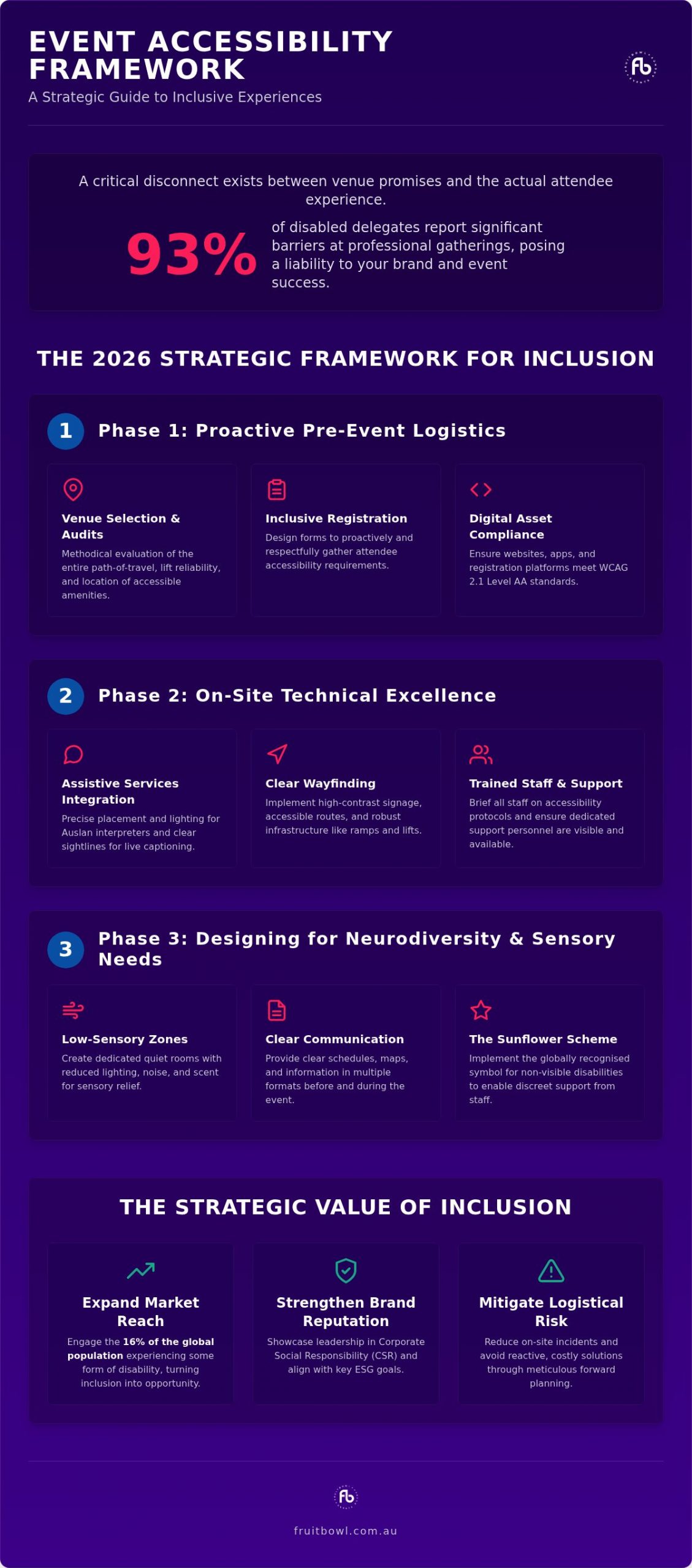
With 93 per cent of disabled delegates still reporting significant barriers at professional gatherings, the disconnect between venue promises and the actual attendee experience is a liability no organiser can ignore. You likely recognise that managing event accessibility for attendees has evolved beyond a simple checklist of compliance tasks into a fundamental pillar of technical excellence. It is natural to feel a level of anxiety regarding the logistical complexity of diverse requirements or the potential for unforeseen budgetary pressures when sourcing specialised services for high-stakes activations.

We understand that you require more than just a list of regulations; you need a sophisticated, repeatable strategy that ensures every guest feels prioritised from registration to the final session. This 2026 Strategic Framework provides the logistical precision required to integrate comprehensive accessibility into your event design, ensuring a seamless experience that protects your brand reputation. We will examine an end-to-end methodology for inclusive logistics, covering everything from digital assets meeting the latest WCAG standards to the implementation of sensory zones and the global Sunflower scheme. This guide offers the clarity needed to oversee complex environments with the confidence that every detail is under expert supervision.

Key Takeaways

  • Learn how to transition from basic regulatory compliance to a strategic design model that elevates the experience for every guest.
  • Master the logistical requirements of managing event accessibility for attendees by integrating professional venue audits and inclusive registration processes into your planning timeline.
  • Discover how technical direction ensures the seamless execution of on-site features, such as the precise placement and lighting for Auslan interpreters.
  • Understand the importance of designing for neurodiversity through the implementation of low-sensory zones and dedicated quiet rooms.
  • Explore how a comprehensive management methodology provides a “safe pair of hands” for overseeing complex accessibility requirements with professional precision.

Beyond Compliance: The Strategic Value of Inclusive Event Design

Inclusive event design is the proactive removal of barriers to ensure equitable participation for all. While many organisers view accessibility as a checklist of legal obligations, sophisticated strategists recognise it as a core component of technical excellence. True accessibility requires the seamless integration of physical, digital, and sensory considerations into the very fabric of the event. When managing event accessibility for attendees, we move beyond the minimum requirements to create an environment where every guest can engage with the content and the community without friction.

For a comprehensive overview of accessibility, one must look at how environments and services are designed to be usable by everyone, regardless of their ability. This holistic approach significantly enhances the attendee journey. For example, high-quality live captioning assists guests with hearing impairments while also benefiting non-native speakers or those in high-noise environments. By prioritising these details, you elevate the experience for your entire audience, not just a specific segment. This commitment to social responsibility directly strengthens your brand reputation, positioning your organisation as a leader in corporate social responsibility (CSR).

The Business Case for Accessibility

Investing in inclusive design is a sound commercial decision that expands your audience reach. With 16 per cent of the global population experiencing some form of disability according to the World Health Organisation, failing to provide an accessible environment means ignoring a significant portion of the market. Beyond market share, meticulous planning reduces logistical friction. When you anticipate diverse needs during the design phase, you decrease the likelihood of on-site incidents and the need for reactive, costly solutions. Today, aligning your event delivery with Environmental, Social, and Governance (ESG) goals is essential for securing partnerships and maintaining stakeholder trust.

Navigating the Australian Regulatory Landscape

In 2026, the Australian regulatory environment demands a higher standard of logistical precision. The Disability Discrimination Act (DDA) remains the foundational piece of legislation, but the expectations for public activations have matured. Compliance now extends deeply into digital spaces, requiring event apps and registration platforms to meet WCAG 2.1 Level AA standards as a baseline. Managing event accessibility for attendees now involves a sophisticated understanding of how physical venue access intersects with digital parity.

Organisers must ensure that their planning processes are robust enough to withstand scrutiny. Utilising a government event planning framework ensures that every activation meets these evolving standards. This methodology provides a structured approach to compliance, ensuring that accessibility is not an afterthought but a primary objective from the initial site inspection through to the post-event report. By adopting this rigorous oversight, you provide a sense of security to your stakeholders and a frictionless experience for every attendee.

Pre-Event Logistics: Integrating Accessibility into the Planning Phase

Success in managing event accessibility for attendees is built upon a foundation of logistical precision established during the earliest stages of planning. Accessibility isn’t a feature to be bolted on; it’s a strategic requirement that influences everything from site selection to the technical rider. By adopting an end-to-end methodology, you ensure that potential barriers are identified and mitigated before they impact the guest experience. This proactive approach provides the sense of security your stakeholders expect in a high-stakes environment.

Venue Selection and Physical Audits

A professional venue audit goes beyond checking for a ramp at the front door. It requires a methodical evaluation of the entire path-of-travel, ensuring that lift access is reliable and that accessible amenities are conveniently located near the main activation areas. We also prioritise the accessibility of backstage and speaker areas, ensuring that presenters with mobility requirements can navigate the stage with the same dignity as any other participant. Clear, high-contrast signage and logical wayfinding are essential components of this physical infrastructure. For a detailed framework on site evaluation, the ADA Planning Guide for Temporary Events provides a robust standard for assessing temporary installations and venue suitability.

Digital Accessibility and Registration

The attendee journey starts with the first digital interaction. In 2026, event websites and mobile apps must adhere to WCAG 2.1 Level AA standards to ensure compatibility with screen readers and other assistive technologies. Your registration process should be structured to capture specific requirements, such as dietary, mobility, or sensory needs, without being intrusive or creating friction. Providing pre-event materials, like screen-reader friendly PDFs and venue maps, allows guests to prepare for their visit with confidence. If you’re managing complex requirements across multiple sessions, partnering with an integrated event management agency ensures these digital and physical logistics remain perfectly aligned.

Budgeting for these services is a critical step that must occur during the initial feasibility study. Allocating funds for Auslan (Australian Sign Language) interpreters, live captioning, and temporary infrastructure shouldn’t be an afterthought. A dedicated accessibility communications plan is also vital; it tells your attendees exactly what support is available, reducing anxiety and demonstrating your commitment to social responsibility. This level of meticulous planning transforms accessibility from a compliance hurdle into a hallmark of professional excellence.
Managing Event Accessibility: 2026 Strategic Framework

Executing On-Site Accessibility: Infrastructure and Technical Excellence

Moving from strategy to the live environment requires a level of logistical precision that only seasoned technical direction can provide. Managing event accessibility for attendees on-site is not merely about providing equipment; it’s about the seamless integration of that equipment into the event’s pulse. Every technical cue, from lighting transitions to audio levels, must account for the diverse needs of your audience to ensure a frictionless experience. This disciplined approach provides the sense of security needed in high-stakes environments, where every detail must be under expert supervision.

Advanced AV and Technical Integration

Effective technical oversight ensures that accessibility features are hard-coded into the production schedule. This involves integrating live captioning (CART) directly into the av management for events workflow. Rather than treating captions as a separate stream, they should be a primary visual element, perfectly coordinated with slide transitions and video playback.

  • Hearing loop systems: We verify coverage across the entire plenary space, ensuring guests aren’t restricted to specific rows.
  • FM transmission: High-fidelity audio is provided for those with compatible receivers, managed through the central audio desk.
  • Visual descriptions: Keynote presentations should include verbalised descriptions of on-screen graphics to assist attendees with low vision.

Auslan integration requires specific technical attention. Interpreters need dedicated lighting that eliminates shadows on the face and hands, along with a background that provides high contrast. For hybrid or large-scale events, camera angles must be locked to ensure the interpreter remains visible on-screen at all times, even during audience Q&A sessions.

Physical Infrastructure and Staging

Staging should reflect an inclusive philosophy by design. Instead of a temporary ramp tucked away at the side, consider incorporating ramps as a central feature of the stage architecture. This ensures that every speaker, regardless of mobility, accesses the platform through the same path, maintaining their dignity and presence. Ramp gradients must be strictly managed to meet safety standards while remaining functional for all users.

Managing event accessibility for attendees also extends to the floor plan. We prioritise wide aisles (minimum 1.2 metres) and appropriate seating distribution that allows wheelchair users to sit with their companions rather than in isolated zones. We also account for the logistical requirements of service animals, providing designated relief areas and ensuring water is available nearby. Finally, the human element is vital; on-site staff must be trained to provide professional, empathetic assistance, acting as a reliable guide for any guest who requires support. When designing these support frameworks, looking to the service standards of NDIS providers like imwithyou.com.au ensures your team is prepared to handle diverse care requirements with professional precision.

In 2026, managing event accessibility for attendees requires a sophisticated understanding of the unseen. While physical barriers are often obvious, neurodiversity—including autism, ADHD, and sensory processing disorders—demands a more nuanced logistical approach. A robust framework treats these requirements as primary design considerations rather than niche additions. By integrating sensory management into your core strategy, you provide a level of order and clarity that ensures every guest can engage with your content without the risk of sensory overload.

Neuro-Inclusive Event Programming

Precision in scheduling acts as a vital tool for reducing attendee anxiety. Providing a clear, predictable timeline allows neurodivergent guests to mentally prepare for transitions between sessions or high-energy plenary blocks. We recommend offering flexible attendance options, such as high-quality live-streaming, for those who may find the physical environment too taxing on certain days. At the registration desk, the inclusion of sensory kits or discreet fidget tools provides immediate, practical support for guests navigating a busy venue. These small details signal a brand that is both elite and deeply service-minded.

Sensory-Friendly Technical Design

Technical direction plays a pivotal role in maintaining a comfortable sensory environment. High-stakes activations often rely on intense audio-visual effects, but these must be managed with extreme care to avoid being exclusionary. We prioritise technical workflows that avoid strobe lighting and sudden, high-decibel sound cues. When providing festival production services, it is essential to integrate designated “chill-out” zones into the site map. These areas should utilise soft, natural lighting and acoustic dampening to provide a genuine refuge from the main event’s energy.

A “Quiet Room” should be a standard inclusion for any corporate conference or government activation. This space is not merely a spare office; it’s a curated environment with reduced stimulus, soundproofing, and comfortable seating. To assist guests in self-regulating their experience, we provide detailed sensory maps that highlight high-stimulus zones and peak noise periods. This level of foresight ensures that your event remains a professional and welcoming space for all. To ensure your next activation is truly inclusive, partner with our expert team to develop a comprehensive sensory management plan.

Partnering for Success: How Expert Management Ensures Seamless Inclusion

Navigating the complexities of large-scale activations requires more than just a list of vendors. It needs a central point of command. For organisers, managing event accessibility for attendees is a high-stakes responsibility where failure can lead to significant reputational damage. An end-to-end agency approach provides that essential “safe pair of hands,” ensuring that every moving part, from physical stage builds to technical captioning streams, is synchronised under a single strategic vision. This level of oversight brings order to complex environments, allowing you to focus on your core objectives with the confidence that every detail is under expert supervision.

Our methodology integrates accessibility into the strategic project timeline from the very first concept meeting. Inclusion is never treated as a secondary consideration. Instead, our technical director manages all third-party vendors, such as Auslan interpreters, live captioners, and specialised builders, as part of one cohesive unit. This unified structure prevents the communication breakdowns that often occur when disparate services are managed in isolation. By centralising these logistics, we ensure that technical requirements, like interpreter lighting or hearing loop coverage, are perfectly aligned with the broader production schedule. For activations involving delegates with complex support needs, organisers may choose to explore Daily Living assistance with NDIS providers like 24/7 Care Services to ensure a truly inclusive experience.

A corporate event management specialist serves as the primary overseer for every accessibility touchpoint. This role involves maintaining a master accessibility checklist that tracks every requirement from the initial site visit through to the final debrief. Whether it’s ensuring a temporary ramp meets the correct gradient or verifying that the digital event app remains screen-reader compatible after a late-stage content update, the coordinator provides the logistical precision required. In the high-pressure environment of a live activation, they handle real-time pivots with composure, ensuring that any unforeseen attendee needs are met without disrupting the flow of the program.

Evaluating Impact and ROI

Measuring the success of your accessibility initiatives is critical for long-term growth and brand reputation. Post-event reporting should go beyond general satisfaction scores to gather specific data on inclusivity and ease of access. We use this attendee feedback to refine strategies for future cycles, turning qualitative experiences into actionable insights for your next government or brand activation. This data-driven approach demonstrates a genuine commitment to social responsibility while proving the commercial value of inclusive design. To ensure your next event is inclusive and professionally managed, contact Fruitbowl Events Agency today.

Elevating the Attendee Experience through Strategic Inclusion

Integrating accessibility into your strategic timeline ensures that physical, digital, and sensory requirements are met with precision. This proactive approach transforms a logistical necessity into a hallmark of professional excellence. By moving beyond basic compliance, you create a seamless attendee journey that reflects a sophisticated commitment to social responsibility and technical quality.

Managing event accessibility for attendees is a multifaceted responsibility that demands a disciplined technician’s touch. With over 28 years of industry experience in high-stakes corporate and government activations, our team provides the end-to-end oversight needed to ensure every detail is under expert supervision. We prioritise safety and logistical clarity to protect your brand reputation while delivering a frictionless environment for every guest. Partner with Fruitbowl Events Agency for inclusive, high-impact event delivery. Your commitment to accessibility today builds a more equitable and successful event landscape for the future.

Frequently Asked Questions

How early should I start planning for event accessibility?

You should integrate accessibility requirements into your strategic plan from the very first concept meeting. For high-stakes corporate or government activations, this typically occurs six to twelve months before the live date. Managing event accessibility for attendees at the start of the project timeline allows you to select venues and technical partners that can support your inclusive vision. Retrofitting these features later is often more expensive and less effective than incorporating them into the foundational design.

Is it expensive to hire Auslan interpreters for a full-day conference?

Investing in Auslan interpreters is a critical component of professional event delivery. For full-day conferences, it’s standard practice to hire a team of two interpreters who rotate every 20 to 30 minutes to manage cognitive fatigue and maintain accuracy. While this requires specific budget allocation, it ensures your content is accessible to the Deaf community. We recommend booking these specialists early in the planning phase to secure high-quality talent for your specific dates.

What are the most common accessibility mistakes in event management?

One of the most frequent errors is treating accessibility as a secondary checklist rather than a primary design pillar. Many organisers also rely on a venue’s self-reported accessibility status without conducting a professional audit. This often results in step-free paths that are too steep or accessible toilets being used for storage. Neglecting digital parity on registration websites and event apps also creates significant barriers for guests before they even arrive at the venue.

Can I make a heritage-listed venue accessible for my event?

You can absolutely make heritage-listed venues accessible through the use of temporary, non-invasive infrastructure. This process requires close collaboration between your technical director and heritage consultants to ensure compliance with preservation rules. Solutions often include modular ramp systems, portable lifts, and high-contrast temporary wayfinding signage. By applying a sophisticated logistical framework, you can host high-impact activations in historic settings without compromising on the inclusive experience required for your delegates.

What is a sensory-friendly event and do I need one for a corporate function?

A sensory-friendly event incorporates design elements that reduce cognitive load and prevent sensory overload for neurodivergent guests. While often associated with public festivals, these features are increasingly vital for corporate functions and conferences. Implementing a quiet room, providing sensory maps, and managing audio-visual transitions with precision ensures that all attendees can engage with your program. This inclusive approach demonstrates a brand’s commitment to social responsibility and enhances the comfort of your entire audience.

How do I ask attendees about their accessibility requirements without causing offence?

The most professional approach is to include standardised, inclusive questions within your registration workflow. Frame these queries as a proactive effort to ensure a seamless and comfortable experience for every guest. Use clear categories such as mobility, dietary, sensory, and communication requirements, and provide an open field for specific details. This method ensures you gather the necessary logistical data for managing event accessibility for attendees without making individuals feel singled out or inconvenienced.

What digital accessibility standards should my event app follow in 2026?

In 2026, all event apps and digital assets should strictly adhere to the Web Content Accessibility Guidelines (WCAG) 2.1 Level AA. This standard ensures that your platform is perceivable, operable, and robust for guests using screen readers or other assistive technologies. Technical teams must verify that all text has sufficient contrast, every image has alternative text, and the interface is fully navigable via keyboard. Meeting these standards is essential for protecting your brand’s digital reputation.

How can technical direction improve the experience for attendees with hearing impairments?

Technical direction ensures that accessibility features are seamlessly integrated into the primary audio-visual workflow rather than treated as a separate stream. This involves coordinating live captioning (CART) to appear on main screens with optimal legibility and timing. A technical director also oversees the installation of hearing loop systems or FM transmitters, ensuring consistent signal strength across the entire plenary space. These professional touches provide a sense of security and clarity for guests with hearing impairments.

With 93 per cent of disabled delegates still reporting significant barriers at professional gatherings, the disconnect between venue promises and the actual attendee experience is a liability no organiser can ignore. You likely recognise that managing event accessibility for attendees has evolved beyond a simple checklist of compliance tasks into a fundamental pillar of technical excellence. It is natural to feel a level of anxiety regarding the logistical complexity of diverse requirements or the potential for unforeseen budgetary pressures when sourcing specialised services for high-stakes activations.

We understand that you require more than just a list of regulations; you need a sophisticated, repeatable strategy that ensures every guest feels prioritised from registration to the final session. This 2026 Strategic Framework provides the logistical precision required to integrate comprehensive accessibility into your event design, ensuring a seamless experience that protects your brand reputation. We will examine an end-to-end methodology for inclusive logistics, covering everything from digital assets meeting the latest WCAG standards to the implementation of sensory zones and the global Sunflower scheme. This guide offers the clarity needed to oversee complex environments with the confidence that every detail is under expert supervision.

Key Takeaways

  • Learn how to transition from basic regulatory compliance to a strategic design model that elevates the experience for every guest.
  • Master the logistical requirements of managing event accessibility for attendees by integrating professional venue audits and inclusive registration processes into your planning timeline.
  • Discover how technical direction ensures the seamless execution of on-site features, such as the precise placement and lighting for Auslan interpreters.
  • Understand the importance of designing for neurodiversity through the implementation of low-sensory zones and dedicated quiet rooms.
  • Explore how a comprehensive management methodology provides a “safe pair of hands” for overseeing complex accessibility requirements with professional precision.

Beyond Compliance: The Strategic Value of Inclusive Event Design

Inclusive event design is the proactive removal of barriers to ensure equitable participation for all. While many organisers view accessibility as a checklist of legal obligations, sophisticated strategists recognise it as a core component of technical excellence. True accessibility requires the seamless integration of physical, digital, and sensory considerations into the very fabric of the event. When managing event accessibility for attendees, we move beyond the minimum requirements to create an environment where every guest can engage with the content and the community without friction.

For a comprehensive overview of accessibility, one must look at how environments and services are designed to be usable by everyone, regardless of their ability. This holistic approach significantly enhances the attendee journey. For example, high-quality live captioning assists guests with hearing impairments while also benefiting non-native speakers or those in high-noise environments. By prioritising these details, you elevate the experience for your entire audience, not just a specific segment. This commitment to social responsibility directly strengthens your brand reputation, positioning your organisation as a leader in corporate social responsibility (CSR).

The Business Case for Accessibility

Investing in inclusive design is a sound commercial decision that expands your audience reach. With 16 per cent of the global population experiencing some form of disability according to the World Health Organisation, failing to provide an accessible environment means ignoring a significant portion of the market. Beyond market share, meticulous planning reduces logistical friction. When you anticipate diverse needs during the design phase, you decrease the likelihood of on-site incidents and the need for reactive, costly solutions. Today, aligning your event delivery with Environmental, Social, and Governance (ESG) goals is essential for securing partnerships and maintaining stakeholder trust.

Navigating the Australian Regulatory Landscape

In 2026, the Australian regulatory environment demands a higher standard of logistical precision. The Disability Discrimination Act (DDA) remains the foundational piece of legislation, but the expectations for public activations have matured. Compliance now extends deeply into digital spaces, requiring event apps and registration platforms to meet WCAG 2.1 Level AA standards as a baseline. Managing event accessibility for attendees now involves a sophisticated understanding of how physical venue access intersects with digital parity.

Organisers must ensure that their planning processes are robust enough to withstand scrutiny. Utilising a government event planning framework ensures that every activation meets these evolving standards. This methodology provides a structured approach to compliance, ensuring that accessibility is not an afterthought but a primary objective from the initial site inspection through to the post-event report. By adopting this rigorous oversight, you provide a sense of security to your stakeholders and a frictionless experience for every attendee.

Pre-Event Logistics: Integrating Accessibility into the Planning Phase

Success in managing event accessibility for attendees is built upon a foundation of logistical precision established during the earliest stages of planning. Accessibility isn’t a feature to be bolted on; it’s a strategic requirement that influences everything from site selection to the technical rider. By adopting an end-to-end methodology, you ensure that potential barriers are identified and mitigated before they impact the guest experience. This proactive approach provides the sense of security your stakeholders expect in a high-stakes environment.

Venue Selection and Physical Audits

A professional venue audit goes beyond checking for a ramp at the front door. It requires a methodical evaluation of the entire path-of-travel, ensuring that lift access is reliable and that accessible amenities are conveniently located near the main activation areas. We also prioritise the accessibility of backstage and speaker areas, ensuring that presenters with mobility requirements can navigate the stage with the same dignity as any other participant. Clear, high-contrast signage and logical wayfinding are essential components of this physical infrastructure. For a detailed framework on site evaluation, the ADA Planning Guide for Temporary Events provides a robust standard for assessing temporary installations and venue suitability.

Digital Accessibility and Registration

The attendee journey starts with the first digital interaction. In 2026, event websites and mobile apps must adhere to WCAG 2.1 Level AA standards to ensure compatibility with screen readers and other assistive technologies. Your registration process should be structured to capture specific requirements, such as dietary, mobility, or sensory needs, without being intrusive or creating friction. Providing pre-event materials, like screen-reader friendly PDFs and venue maps, allows guests to prepare for their visit with confidence. If you’re managing complex requirements across multiple sessions, partnering with an integrated event management agency ensures these digital and physical logistics remain perfectly aligned.

Budgeting for these services is a critical step that must occur during the initial feasibility study. Allocating funds for Auslan (Australian Sign Language) interpreters, live captioning, and temporary infrastructure shouldn’t be an afterthought. A dedicated accessibility communications plan is also vital; it tells your attendees exactly what support is available, reducing anxiety and demonstrating your commitment to social responsibility. This level of meticulous planning transforms accessibility from a compliance hurdle into a hallmark of professional excellence.

Executing On-Site Accessibility: Infrastructure and Technical Excellence

Moving from strategy to the live environment requires a level of logistical precision that only seasoned technical direction can provide. Managing event accessibility for attendees on-site is not merely about providing equipment; it’s about the seamless integration of that equipment into the event’s pulse. Every technical cue, from lighting transitions to audio levels, must account for the diverse needs of your audience to ensure a frictionless experience. This disciplined approach provides the sense of security needed in high-stakes environments, where every detail must be under expert supervision.

Advanced AV and Technical Integration

Effective technical oversight ensures that accessibility features are hard-coded into the production schedule. This involves integrating live captioning (CART) directly into the av management for events workflow. Rather than treating captions as a separate stream, they should be a primary visual element, perfectly coordinated with slide transitions and video playback.

  • Hearing loop systems: We verify coverage across the entire plenary space, ensuring guests aren’t restricted to specific rows.
  • FM transmission: High-fidelity audio is provided for those with compatible receivers, managed through the central audio desk.
  • Visual descriptions: Keynote presentations should include verbalised descriptions of on-screen graphics to assist attendees with low vision.

Auslan integration requires specific technical attention. Interpreters need dedicated lighting that eliminates shadows on the face and hands, along with a background that provides high contrast. For hybrid or large-scale events, camera angles must be locked to ensure the interpreter remains visible on-screen at all times, even during audience Q&A sessions.

Physical Infrastructure and Staging

Staging should reflect an inclusive philosophy by design. Instead of a temporary ramp tucked away at the side, consider incorporating ramps as a central feature of the stage architecture. This ensures that every speaker, regardless of mobility, accesses the platform through the same path, maintaining their dignity and presence. Ramp gradients must be strictly managed to meet safety standards while remaining functional for all users.

Managing event accessibility for attendees also extends to the floor plan. We prioritise wide aisles (minimum 1.2 metres) and appropriate seating distribution that allows wheelchair users to sit with their companions rather than in isolated zones. We also account for the logistical requirements of service animals, providing designated relief areas and ensuring water is available nearby. Finally, the human element is vital; on-site staff must be trained to provide professional, empathetic assistance, acting as a reliable guide for any guest who requires support.

Addressing Invisible Disabilities and Sensory Requirements

In 2026, managing event accessibility for attendees requires a sophisticated understanding of the unseen. While physical barriers are often obvious, neurodiversity—including autism, ADHD, and sensory processing disorders—demands a more nuanced logistical approach. A robust framework treats these requirements as primary design considerations rather than niche additions. By integrating sensory management into your core strategy, you provide a level of order and clarity that ensures every guest can engage with your content without the risk of sensory overload.

Neuro-Inclusive Event Programming

Precision in scheduling acts as a vital tool for reducing attendee anxiety. Providing a clear, predictable timeline allows neurodivergent guests to mentally prepare for transitions between sessions or high-energy plenary blocks. We recommend offering flexible attendance options, such as high-quality live-streaming, for those who may find the physical environment too taxing on certain days. At the registration desk, the inclusion of sensory kits or discreet fidget tools provides immediate, practical support for guests navigating a busy venue. These small details signal a brand that is both elite and deeply service-minded.

Sensory-Friendly Technical Design

Technical direction plays a pivotal role in maintaining a comfortable sensory environment. High-stakes activations often rely on intense audio-visual effects, but these must be managed with extreme care to avoid being exclusionary. We prioritise technical workflows that avoid strobe lighting and sudden, high-decibel sound cues. When providing festival production services, it is essential to integrate designated “chill-out” zones into the site map. These areas should utilise soft, natural lighting and acoustic dampening to provide a genuine refuge from the main event’s energy.

A “Quiet Room” should be a standard inclusion for any corporate conference or government activation. This space is not merely a spare office; it’s a curated environment with reduced stimulus, soundproofing, and comfortable seating. To assist guests in self-regulating their experience, we provide detailed sensory maps that highlight high-stimulus zones and peak noise periods. This level of foresight ensures that your event remains a professional and welcoming space for all. To ensure your next activation is truly inclusive, partner with our expert team to develop a comprehensive sensory management plan.

Partnering for Success: How Expert Management Ensures Seamless Inclusion

Navigating the complexities of large-scale activations requires more than just a list of vendors. It needs a central point of command. For organisers, managing event accessibility for attendees is a high-stakes responsibility where failure can lead to significant reputational damage. An end-to-end agency approach provides that essential “safe pair of hands,” ensuring that every moving part, from physical stage builds to technical captioning streams, is synchronised under a single strategic vision. This level of oversight brings order to complex environments, allowing you to focus on your core objectives with the confidence that every guest’s needs are under expert supervision.

Our methodology integrates accessibility into the strategic project timeline from the very first concept meeting. Inclusion is never treated as a secondary consideration. Instead, our technical director manages all third-party vendors, such as Auslan interpreters, live captioners, and specialised builders, as part of one cohesive unit. This unified structure prevents the communication breakdowns that often occur when disparate services are managed in isolation. By centralising these logistics, we ensure that technical requirements, like interpreter lighting or hearing loop coverage, are perfectly aligned with the broader production schedule.

The Role of the Logistics Coordinator

A corporate event management specialist serves as the primary overseer for every accessibility touchpoint. This role involves maintaining a master accessibility checklist that tracks every requirement from the initial site visit through to the final debrief. Whether it’s ensuring a temporary ramp meets the correct gradient or verifying that the digital event app remains screen-reader compatible after a late-stage content update, the coordinator provides the logistical precision required. In the high-pressure environment of a live activation, they handle real-time pivots with composure, ensuring that any unforeseen attendee needs are met without disrupting the flow of the program.

Evaluating Impact and ROI

Measuring the success of your accessibility initiatives is critical for long-term growth and brand reputation. Post-event reporting should go beyond general satisfaction scores to gather specific data on inclusivity and ease of access. We use this attendee feedback to refine strategies for future cycles, turning qualitative experiences into actionable insights for your next government or brand activation. This data-driven approach demonstrates a genuine commitment to social responsibility while proving the commercial value of inclusive design. To ensure your next event is inclusive and professionally managed, contact Fruitbowl Events Agency today.

Elevating the Attendee Experience through Strategic Inclusion

Integrating accessibility into your strategic timeline ensures that physical, digital, and sensory requirements are met with precision. This proactive approach transforms a logistical necessity into a hallmark of professional excellence. By moving beyond basic compliance, you create a seamless attendee journey that reflects a sophisticated commitment to social responsibility and technical quality.

Managing event accessibility for attendees is a multifaceted responsibility that demands a disciplined technician’s touch. With over 28 years of industry experience in high-stakes corporate and government activations, our team provides the end-to-end oversight needed to ensure every detail is under expert supervision. We prioritise safety and logistical clarity to protect your brand reputation while delivering a frictionless environment for every guest. Partner with Fruitbowl Events Agency for inclusive, high-impact event delivery. Your commitment to accessibility today builds a more equitable and successful event landscape for the future.

Frequently Asked Questions

How early should I start planning for event accessibility?

You should integrate accessibility requirements into your strategic plan from the very first concept meeting. For high-stakes corporate or government activations, this typically occurs six to twelve months before the live date. Managing event accessibility for attendees at the start of the project timeline allows you to select venues and technical partners that can support your inclusive vision. Retrofitting these features later is often more expensive and less effective than incorporating them into the foundational design.

Is it expensive to hire Auslan interpreters for a full-day conference?

Investing in Auslan interpreters is a critical component of professional event delivery. For full-day conferences, it’s standard practice to hire a team of two interpreters who rotate every 20 to 30 minutes to manage cognitive fatigue and maintain accuracy. While this requires specific budget allocation, it ensures your content is accessible to the Deaf community. We recommend booking these specialists early in the planning phase to secure high-quality talent for your specific dates.

What are the most common accessibility mistakes in event management?

One of the most frequent errors is treating accessibility as a secondary checklist rather than a primary design pillar. Many organisers also rely on a venue’s self-reported accessibility status without conducting a professional audit. This often results in step-free paths that are too steep or accessible toilets being used for storage. Neglecting digital parity on registration websites and event apps also creates significant barriers for guests before they even arrive at the venue.

Can I make a heritage-listed venue accessible for my event?

You can absolutely make heritage-listed venues accessible through the use of temporary, non-invasive infrastructure. This process requires close collaboration between your technical director and heritage consultants to ensure compliance with preservation rules. Solutions often include modular ramp systems, portable lifts, and high-contrast temporary wayfinding signage. By applying a sophisticated logistical framework, you can host high-impact activations in historic settings without compromising on the inclusive experience required for your delegates.

What is a sensory-friendly event and do I need one for a corporate function?

A sensory-friendly event incorporates design elements that reduce cognitive load and prevent sensory overload for neurodivergent guests. While often associated with public festivals, these features are increasingly vital for corporate functions and conferences. Implementing a quiet room, providing sensory maps, and managing audio-visual transitions with precision ensures that all attendees can engage with your program. This inclusive approach demonstrates a brand’s commitment to social responsibility and enhances the comfort of your entire audience.

How do I ask attendees about their accessibility requirements without causing offence?

The most professional approach is to include standardised, inclusive questions within your registration workflow. Frame these queries as a proactive effort to ensure a seamless and comfortable experience for every guest. Use clear categories such as mobility, dietary, sensory, and communication requirements, and provide an open field for specific details. This method ensures you gather the necessary logistical data for managing event accessibility for attendees without making individuals feel singled out or inconvenienced.

What digital accessibility standards should my event app follow in 2026?

In 2026, all event apps and digital assets should strictly adhere to the Web Content Accessibility Guidelines (WCAG) 2.1 Level AA. This standard ensures that your platform is perceivable, operable, and robust for guests using screen readers or other assistive technologies. Technical teams must verify that all text has sufficient contrast, every image has alternative text, and the interface is fully navigable via keyboard. Meeting these standards is essential for protecting your brand’s digital reputation.

How can technical direction improve the experience for attendees with hearing impairments?

Technical direction ensures that accessibility features are seamlessly integrated into the primary audio-visual workflow rather than treated as a separate stream. This involves coordinating live captioning (CART) to appear on main screens with optimal legibility and timing. A technical director also oversees the installation of hearing loop systems or FM transmitters, ensuring consistent signal strength across the entire plenary space. These professional touches provide a sense of security and clarity for guests with hearing impairments.

Back to Articles
Request A Quote

Make an
Enquiry

Untitled design

What Makes Us Different?

True end-to-end solution so you can hand off to us, focus on your priorities and enjoy the event without any stress

Unmatched industry expertise looking after diverse range of high-profile events, cultural festivals & activations

Meticulous attention to every detail and precise execution of events with our streamlined processes

Tailored solutions with bespoke strategies to ensure we align with your brand and objectives

Make an Enquiry

"*" indicates required fields

This field is for validation purposes and should be left unchanged.

"*" indicates required fields

This field is for validation purposes and should be left unchanged.