Choosing a Festival Management Company in Australia: The 2026 Strategic Guide

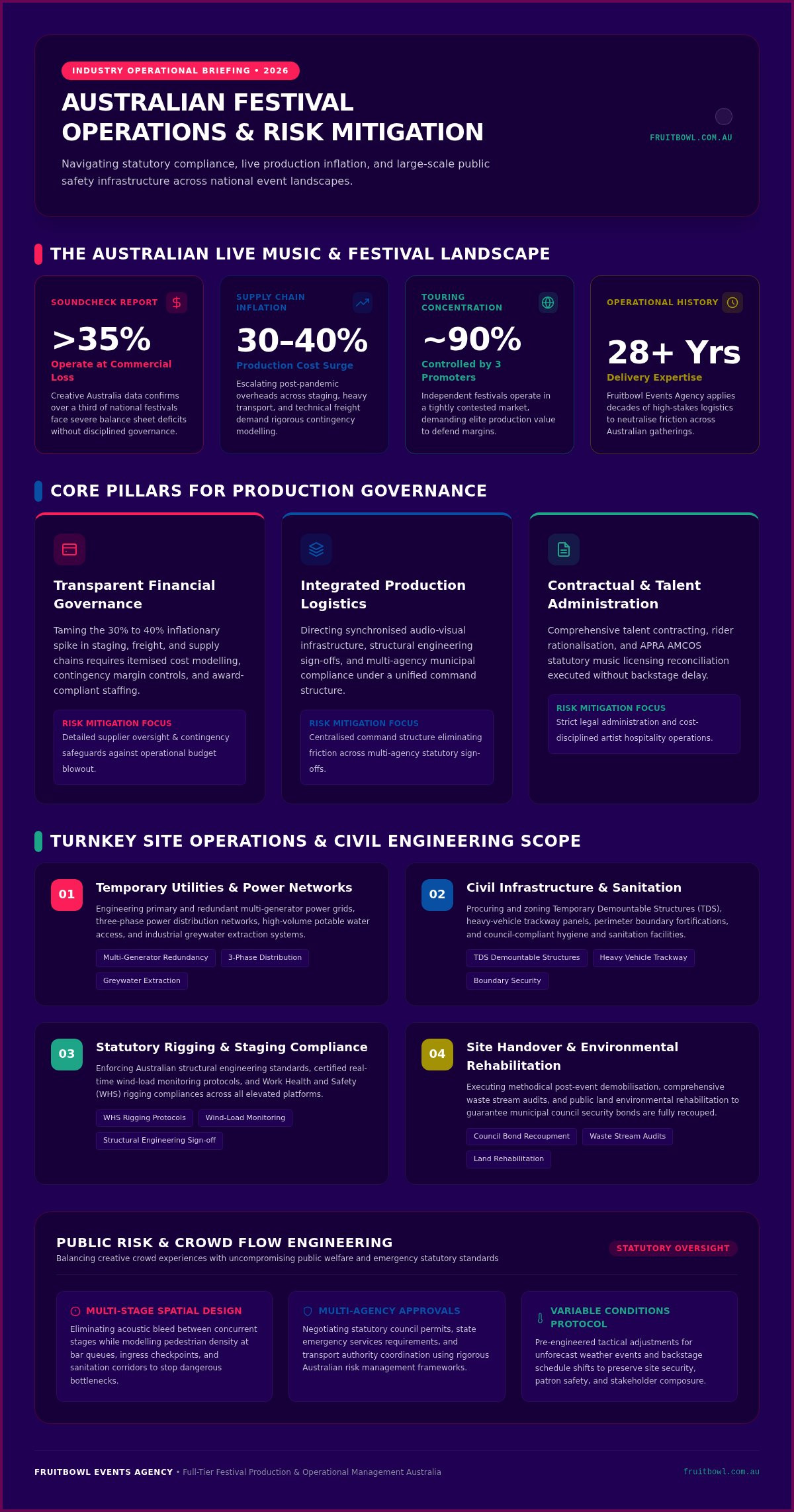
According to Creative Australia’s landmark Soundcheck report, more than 35% of national music festivals operate at a commercial loss. While ambitious creative programming captures public attention, it is rigorous logistical governance that keeps gates open and budgets intact. With live production costs climbing by up to 40% alongside escalating regulatory scrutiny, engaging an established festival management company Australia depends on has shifted from an operational luxury to a vital risk mitigation strategy.

You already recognise that gathering thousands of patrons safely demands far more than headline talent and staging infrastructure. A single breakdown in transport coordination, crowd flow, or municipal council sign-offs can compromise attendee welfare and permanently damage hard-won brand reputation. This strategic guide explores how seasoned production leaders streamline multi-agency statutory approvals, rein in supply chain overheads, and deliver world-class, zero-incident public gatherings. Ahead, discover the core operational capabilities, safety management benchmarks, and technical oversight your organisation must demand from an event partner for 2026.

Key Takeaways

  • Identify the core technical and operational benchmarks that separate full-service production leaders from surface-level coordinators.
  • Discover why choosing an experienced festival management company Australia relies on safeguards your balance sheet through disciplined supplier oversight and award-compliant staffing.
  • Master the multi-stage festival planning lifecycle, from preliminary site feasibility assessments and infrastructure modeling through to turnkey live execution.
  • De-risk statutory council sign-offs, emergency service requirements, and transport authority negotiations using rigorous national risk management standards.
  • Understand how working with a seasoned national event partner with over 28 years of delivery experience neutralises operational friction across high-stakes public gatherings.

What Defines an Elite Festival Management Company in Australia?

Professional festival delivery requires an orchestration of civil infrastructure, crowd dynamics, and statutory oversight. While general coordinators focus on decorative styling and run sheets, an elite festival management company Australia organisations rely on operates as a full-tier production management partner. This discipline transforms open public spaces and raw greenfield sites into secure, fully operational temporary communities capable of supporting tens of thousands of patrons.

Delivering an ambitious gathering demands mastery over conflicting priorities: preserving artistic integrity, maintaining commercial viability, and ensuring uncompromising public safety. Leading management entities align these elements through proven principles of event management, translating broad creative concepts into meticulously engineered production schedules.

The Scope of Modern Australian Festival Operations

Turnkey delivery begins long before public marketing launches and extends well after the final patron departs. A comprehensive production partner maintains total accountability across every operational phase:

  • Temporary Utilities: Engineering primary and redundant multi-generator power grids, three-phase distribution networks, high-volume potable water access, and industrial greywater extraction systems.
  • Civil Infrastructure & Sanitation: Procuring and zoning temporary demountable structures (TDS), heavy-vehicle trackway panels, perimeter boundary fortifications, and council-compliant hygiene facilities.
  • Statutory Rigging & Staging: Enforcing national structural engineering standards, certified wind-load monitoring protocols, and Work Health and Safety (WHS) rigging compliances across all elevated platforms.
  • Site Handover & Reinstatement: Executing methodical demobilisation, comprehensive waste stream audits, and public land environmental rehabilitation to guarantee council bonds are fully recouped.

Balancing Creative Vision with Logistical Precision

Imaginative festival programming collapses if crowd ingress, dwell points, and egress routes aren’t rigorously engineered. Multi-stage footprints require sophisticated spatial planning to eliminate acoustic bleed between stages while sustaining frictionless human movement. Elite production specialists model pedestrian density across high-traffic intersections, bar queues, and sanitation corridors to prevent dangerous bottlenecks.

Executing live production under variable conditions demands an unflappable, methodical delivery methodology. When unforecast weather changes occur or schedule shifts emerge backstage, an experienced partner provides the structural composure needed to maintain security, keep stakeholders calm, and execute timely tactical adjustments without compromising patron enjoyment.

Key Capabilities to Look For in a Festival Production Partner

Selecting an experienced production partner requires evaluating tangible engineering capabilities rather than creative rhetoric. With three major promoters controlling nearly 90% of Australia’s touring market, independent festivals face immense pressure to deliver commercial-grade production values while defending narrow profit margins. An elite festival management company Australia organisations trust must demonstrate proven command across three interconnected operational pillars:

  • Transparent Financial Governance: Controlling the 30% to 40% post-pandemic inflationary spike across staging, transport, and freight requires itemised cost modeling and tight contingency margins.
  • Integrated Production Logistics: Managing synchronised audio-visual infrastructure, structural engineering sign-offs, and multi-agency compliance under a unified command structure.
  • Contractual & Talent Administration: Executing comprehensive talent contracting, rider rationalisation, and APRA AMCOS licensing reconciliation without operational delays.

Organisations looking to safeguard their operational balance sheets can consult our comprehensive guide on festival production services for granular delivery insights.

Technical Direction and Staging Infrastructure

Audio-visual design must balance immersive sound distribution with strict municipal noise parameters. Modern festival delivery relies on phased-array acoustic engineering to ensure uniform audio coverage within the patron bowl while preventing spill into surrounding residential zones. Reviewing specialized frameworks for av management for events helps clarify how digital consoles, micro-delay towers, and LED wall wind-relief systems integrate on site.

Every temporary demountable structure demands independent engineering certification. Production partners must verify safe working loads (SWL) for suspended line-arrays and ground-supported trussing, maintaining continuous anemometer monitoring to execute proactive stage shutdowns if local wind speeds breach structural tolerances.

Entertainment Curation and Talent Procurement

Curating a festival bill involves far more than booking popular headliners. It demands end-to-end management across complex logistics, technical riders, and interstate freight schedules. A single uncoordinated performance schedule can cascade into stage delays, acoustic overrun fines, and severe front-of-house crowd surges.

Your management partner must reconcile technical backline riders with available power infrastructure and changeover windows. They must also administer statutory health and harm-minimisation standards, embedding protocols from the NSW Health guidelines for music festival event organisers directly into artist hospitality and back-of-house operations. Organisers seeking experienced, multi-stakeholder support across these high-risk touchpoints can explore how Fruitbowl Events Agency manages nationwide production logistics with calm operational precision.

The Festival Project Lifecycle: From Feasibility to Delivery

Executing a large-scale gathering requires moving through a sequential, gated delivery pipeline. Rather than treating pre-production as an administrative exercise, an elite festival management company Australia organisations engage structures the project lifecycle around firm statutory milestones. This methodical pathway ensures that technical procurement, risk profiling, and infrastructure deployment progress in unison, leaving no room for operational blind spots.

Every operational tier demands adherence to the Safe Work Australia Model Code of Practice, anchoring all physical site operations to legally mandated hazard management frameworks across five clear delivery phases.

Phase 1 to 3: Scoping, Statutory Approvals, and Pre-Production

The pre-production journey establishes site viability and regulatory permissions months before physical ground is broken:

  • Phase 1: Feasibility and Site Audits (Months 12 to 9): Conducting geotechnical ground surveys, checking utility access, calculating maximum patron holding capacities, and building baseline financial models.
  • Phase 2: Statutory Approvals and Engagement (Months 9 to 6): Lodging municipal planning permits, drafting integrated traffic management blueprints, and initiating early consultations with police, fire rescue, and ambulance services.
  • Phase 3: Technical Design and Procurement (Months 6 to 1): Locking in structural staging tenders, negotiating artist riders, issuing supplier scopes of work, and building the master delivery critical path.

Phase 4 to 5: On-Site Execution, Show Running, and Demobilisation

The final phases transition the festival from operational design into active physical deployment:

  • Phase 4: Site Bump-In and Live Show Running: Enforcing strict vehicle delivery windows, verifying scaffolding certifications, and delivering mandatory digital safety inductions for all incoming contractors. Once gates open, operations transition to a central Event Control Centre (ECC) with dedicated radio communication channels, continuous crowd monitoring, and unified command across private security and medical providers.
  • Phase 5: Bump-Out, Reconciliation, and Site Handover: Managing systematic stage dismantlement, securing leased technical assets, executing multi-stream waste diversion audits, and conducting joint environmental handovers with land managers to ensure the total release of municipal security bonds.

Structured milestones turn complex operations into predictable workflows. By enforcing clear hold points at each phase, an experienced festival management company Australia trusts ensures financial accountability, eliminates contractor friction, and guarantees an orderly bump-in and exit.
Choosing a Festival Management Company in Australia: The 2026 Strategic Guide

Mitigating Public Risk: Safety, Compliance, and Stakeholder Approvals

Operating a major outdoor festival in Australia carries substantial statutory exposure. Under national model Work Health and Safety (WHS) laws, festival organisers operate as a Person Conducting a Business or Undertaking (PCBU). Organisers share non-transferable duties of care for every worker, contractor, and patron on site. Managing these responsibilities requires an experienced festival management company Australia organisations rely on to navigate stringent multi-agency governance and public liability thresholds, which routinely mandate $20,000,000 AUD in coverage for public precinct access.

Navigating this civic oversight mirrors the meticulous processes required for public sector projects. Organisers can examine these heightened standards through our detailed framework on government event planning, which outlines how structured agency collaboration secures dependable outcomes across high-profile gatherings.

Statutory Safety Frameworks and Risk Management Plans

Every operational plan begins with a comprehensive safety register benchmarked directly against AS ISO 31000:2018 guidelines. Production directors translate theoretical hazards into tangible on-site mitigation protocols across four vital areas:

  • Harm Reduction & Medical Footprints: Sizing triage compounds to match peak crowd profiles, deploying dedicated peer-support welfare services, and securing statutory Health and Medical Plan sign-offs.
  • Meteorological Action Triggers: Implementing formal cut-off parameters for lightning proximity, sustained wind gusts, and extreme heat indices to dictate stage pauses or orderly site evacuations.
  • Temporary Demountable Structures (TDS): Enforcing sign-offs from certified structural engineers for all scaffolding towers, main stages, and custom art builds prior to operational handover.
  • Workplace Safety & Chain of Responsibility: Managing crew fatigue, high-risk work licences, and heavy vehicle loading zones under strict national transport and safety statutes.

Multi-Agency Stakeholder Coordination

Securing final permits demands harmonised collaboration across police, ambulance services, state fire rescue, and municipal planning departments. Fragmented planning causes approval gridlocks. A seasoned production agency leads multi-agency user-pays policing negotiations, presents integrated pedestrian diversion blueprints, and establishes transport priority corridors to prevent urban traffic gridlock.

Maintaining proactive, transparent communication reassures council officers, local transport authorities, and adjacent community stakeholders. For festival owners seeking absolute certainty across these complex statutory approvals, partner with Fruitbowl Events Agency to de-risk your next major public production.

Why Partner with Fruitbowl Events Agency for National Festivals?

Delivering a multi-day outdoor gathering or high-density community celebration requires unwavering operational discipline. For organisations searching for an established festival management company Australia wide, Fruitbowl Events Agency brings over 28 years of continuous live production delivery. Acting as a trusted “safe pair of hands”, our team replaces high-stakes production anxiety with a calm, methodical management approach that keeps complex projects moving predictably toward show day.

Our comprehensive capabilities unite artistic ambition with technical precision. Beyond large-scale public gatherings, our production architects bring deep multi-sector experience across government activations, major brand showcases, and strategic corporate event management. This cross-disciplinary background allows us to anticipate complex site challenges early, streamline multi-agency sign-offs, and protect client balance sheets from uncoordinated operational overheads.

Over 28 Years of Proven Live Production Excellence

Established in 1996, Fruitbowl Events Agency has managed the steady evolution of Australia’s live event sector for nearly three decades. We have built an expansive national supplier network that secures premium staging, audio-visual technology, and temporary infrastructure on advantageous commercial terms. Our longevity is built on deep stakeholder trust, strict regulatory compliance, and an exceptional track record of zero-compromise safety on site.

Turnkey National Festival Delivery

Rather than managing fractured lines of communication between audio engineers, traffic consultants, council liaisons, and artist representatives, working with Fruitbowl consolidates your operational governance under a single, highly experienced executive team. We handle the entire project lifecycle, from early geotechnical feasibility assessments to live Event Control Centre direction and final site handovers.

Our rigorous risk governance frameworks actively protect your organisation’s reputation, ensuring every statutory obligation is met while attendees enjoy a seamless, world-class experience. Whether you are developing an inaugural public gathering or scaling an established multi-stage tour, contact Fruitbowl Events Agency to consult with our senior producers and engineer your upcoming festival calendar with absolute certainty.

Delivering Flawless Public Festivals in 2026 and Beyond

Delivering an extraordinary festival requires far more than bold artistic vision; it demands uncompromising logistical rigour and multi-agency coordination. As regulatory benchmarks tighten and operational overheads fluctuate, engaging an elite festival management company Australia trusts remains the definitive safeguard for your event’s commercial viability and patron welfare. Protecting your brand begins with disciplined site engineering, robust risk governance, and synchronised contractor oversight.

With over 28 years of nationwide live event and public festival experience, Fruitbowl Events Agency acts as your dedicated production partner. We integrate end-to-end site logistics, advanced technical direction, and talent procurement under a unified executive framework backed by an impeccable stakeholder track record. Partner with Fruitbowl Events Agency for seamless festival production and transform your ambitious creative concept into a safe, unforgettable public celebration.

Frequently Asked Questions

What services does a festival management company in Australia provide?

An elite festival management company Australia engages provides turnkey oversight across every stage of live production. Core deliverables encompass site feasibility audits, staging and audio-visual engineering, temporary civil utilities, and artist rider fulfillment. They also administer statutory council applications, emergency services liaison, and risk governance. On show day, they direct all operational channels via an Event Control Centre to ensure seamless execution.

How far in advance should an organisation engage a festival management agency?

Most organisations should engage a production partner nine to twelve months prior to event dates. Complex public gatherings demand substantial lead time to navigate statutory development approvals, negotiate competitive vendor contracts, and coordinate emergency service resources. Engaging early enables thorough geotechnical site audits and financial stress-testing before capital is committed to talent deposits or site infrastructure leases.

How do festival management companies handle council permits and statutory approvals?

Festival management specialists lead the entire statutory application process on your behalf. They draft detailed Place of Public Entertainment documentation, acoustic mitigation studies, and integrated traffic management plans required by municipal land managers. By acting as the primary interlocutor with council planners and emergency services, they resolve compliance queries quickly, preventing administrative bottlenecks from delaying your public ticket launch.

What risk management documentation is mandatory for Australian public festivals?

Organisers must prepare an overarching Risk Management Plan compliant with AS ISO 31000 standards. Mandatory documentation includes an Emergency Management Plan, comprehensive crowd flow analyses, contractor Safe Work Method Statements (SWMS), and certified Health and Medical Plans. Councils and statutory authorities also require certified engineering certificates for temporary structures, proof of twenty million dollars in public liability coverage, and detailed severe weather contingency plans.

Can a festival management company handle artist bookings and technical riders?

Yes, an experienced agency oversees end-to-end talent procurement and artist logistics. This includes contractual negotiation, performance copyright licensing, and vetting complex technical riders against available site power and stage dimensions. Experienced production managers audit backline requirements, arrange ground transport, and direct tight stage changeovers. This rigorous coordination prevents backstage delays from spilling into front-of-house show schedules.

How do production companies manage adverse weather during outdoor festivals?

Professional teams embed quantitative meteorological cut-off triggers directly into the event safety plan. Using on-site anemometers and dedicated radar feeds, production directors track wind velocities, lightning proximity, and ground saturation. If predetermined structural or safety limits are exceeded, management executes staged operational responses, such as lowering speaker arrays, deploying heavy trackway panels, or conducting calm, orderly zone evacuations.

What is the difference between an event promoter and a festival management agency?

An event promoter primarily acts as the commercial investor, funding the event, driving ticket marketing, and curating the overarching creative concept. Conversely, a festival management company Australia partners with serves as the technical and operational operator. They assume responsibility for regulatory compliance, civil site builds, health and safety execution, and vendor coordination, ensuring the promoter’s creative ambition is safely realised.

According to Creative Australia’s landmark Soundcheck report, more than 35% of national music festivals operate at a commercial loss. While ambitious creative programming captures public attention, it is rigorous logistical governance that keeps gates open and budgets intact. With live production costs climbing by up to 40% alongside escalating regulatory scrutiny, engaging an established festival management company Australia depends on has shifted from an operational luxury to a vital risk mitigation strategy.

You already recognise that gathering thousands of patrons safely demands far more than headline talent and staging infrastructure. A single breakdown in transport coordination, crowd flow, or municipal council sign-offs can compromise attendee welfare and permanently damage hard-won brand reputation. This strategic guide explores how seasoned production leaders streamline multi-agency statutory approvals, rein in supply chain overheads, and deliver world-class, zero-incident public gatherings. Ahead, discover the core operational capabilities, safety management benchmarks, and technical oversight your organisation must demand from an event partner for 2026.

Key Takeaways

  • Identify the core technical and operational benchmarks that separate full-service production leaders from surface-level coordinators.
  • Discover why choosing an experienced festival management company Australia relies on safeguards your balance sheet through disciplined supplier oversight and award-compliant staffing.
  • Master the multi-stage festival planning lifecycle, from preliminary site feasibility assessments and infrastructure modeling through to turnkey live execution.
  • De-risk statutory council sign-offs, emergency service requirements, and transport authority negotiations using rigorous national risk management standards.
  • Understand how working with a seasoned national event partner with over 28 years of delivery experience neutralises operational friction across high-stakes public gatherings.

What Defines an Elite Festival Management Company in Australia?

Professional festival delivery requires an orchestration of civil infrastructure, crowd dynamics, and statutory oversight. While general coordinators focus on decorative styling and run sheets, an elite festival management company Australia organisations rely on operates as a full-tier production management partner. This discipline transforms open public spaces and raw greenfield sites into secure, fully operational temporary communities capable of supporting tens of thousands of patrons.

Delivering an ambitious gathering demands mastery over conflicting priorities: preserving artistic integrity, maintaining commercial viability, and ensuring uncompromising public safety. Leading management entities align these elements through proven principles of event management, translating broad creative concepts into meticulously engineered production schedules.

The Scope of Modern Australian Festival Operations

Turnkey delivery begins long before public marketing launches and extends well after the final patron departs. A comprehensive production partner maintains total accountability across every operational phase:

  • Temporary Utilities: Engineering primary and redundant multi-generator power grids, three-phase distribution networks, high-volume potable water access, and industrial greywater extraction systems.
  • Civil Infrastructure & Sanitation: Procuring and zoning temporary demountable structures (TDS), heavy-vehicle trackway panels, perimeter boundary fortifications, and council-compliant hygiene facilities.
  • Statutory Rigging & Staging: Enforcing national structural engineering standards, certified wind-load monitoring protocols, and Work Health and Safety (WHS) rigging compliances across all elevated platforms.
  • Site Handover & Reinstatement: Executing methodical demobilisation, comprehensive waste stream audits, and public land environmental rehabilitation to guarantee council bonds are fully recouped.

Balancing Creative Vision with Logistical Precision

Imaginative festival programming collapses if crowd ingress, dwell points, and egress routes aren’t rigorously engineered. Multi-stage footprints require sophisticated spatial planning to eliminate acoustic bleed between stages while sustaining frictionless human movement. Elite production specialists model pedestrian density across high-traffic intersections, bar queues, and sanitation corridors to prevent dangerous bottlenecks.

Executing live production under variable conditions demands an unflappable, methodical delivery methodology. When unforecast weather changes occur or schedule shifts emerge backstage, an experienced partner provides the structural composure needed to maintain security, keep stakeholders calm, and execute timely tactical adjustments without compromising patron enjoyment.

Key Capabilities to Look For in a Festival Production Partner

Selecting an experienced production partner requires evaluating tangible engineering capabilities rather than creative rhetoric. With three major promoters controlling nearly 90% of Australia’s touring market, independent festivals face immense pressure to deliver commercial-grade production values while defending narrow profit margins. An elite festival management company Australia organisations trust must demonstrate proven command across three interconnected operational pillars:

  • Transparent Financial Governance: Controlling the 30% to 40% post-pandemic inflationary spike across staging, transport, and freight requires itemised cost modeling and tight contingency margins.
  • Integrated Production Logistics: Managing synchronised audio-visual infrastructure, structural engineering sign-offs, and multi-agency compliance under a unified command structure.
  • Contractual & Talent Administration: Executing comprehensive talent contracting, rider rationalisation, and APRA AMCOS licensing reconciliation without operational delays.

Organisations looking to safeguard their operational balance sheets can consult our comprehensive guide on festival production services for granular delivery insights.

Technical Direction and Staging Infrastructure

Audio-visual design must balance immersive sound distribution with strict municipal noise parameters. Modern festival delivery relies on phased-array acoustic engineering to ensure uniform audio coverage within the patron bowl while preventing spill into surrounding residential zones. Reviewing specialized frameworks for av management for events helps clarify how digital consoles, micro-delay towers, and LED wall wind-relief systems integrate on site.

Every temporary demountable structure demands independent engineering certification. Production partners must verify safe working loads (SWL) for suspended line-arrays and ground-supported trussing, maintaining continuous anemometer monitoring to execute proactive stage shutdowns if local wind speeds breach structural tolerances.

Entertainment Curation and Talent Procurement

Curating a festival bill involves far more than booking popular headliners. It demands end-to-end management across complex logistics, technical riders, and interstate freight schedules. A single uncoordinated performance schedule can cascade into stage delays, acoustic overrun fines, and severe front-of-house crowd surges.

Your management partner must reconcile technical backline riders with available power infrastructure and changeover windows. They must also administer statutory health and harm-minimisation standards, embedding protocols from the NSW Health guidelines for music festival event organisers directly into artist hospitality and back-of-house operations. Organisers seeking experienced, multi-stakeholder support across these high-risk touchpoints can explore how Fruitbowl Events Agency manages nationwide production logistics with calm operational precision.

The Festival Project Lifecycle: From Feasibility to Delivery

Executing a large-scale gathering requires moving through a sequential, gated delivery pipeline. Rather than treating pre-production as an administrative exercise, an elite festival management company Australia organisations engage structures the project lifecycle around firm statutory milestones. This methodical pathway ensures that technical procurement, risk profiling, and infrastructure deployment progress in unison, leaving no room for operational blind spots.

Every operational tier demands adherence to the Safe Work Australia Model Code of Practice, anchoring all physical site operations to legally mandated hazard management frameworks across five clear delivery phases.

Phase 1 to 3: Scoping, Statutory Approvals, and Pre-Production

The pre-production journey establishes site viability and regulatory permissions months before physical ground is broken:

  • Phase 1: Feasibility and Site Audits (Months 12 to 9): Conducting geotechnical ground surveys, checking utility access, calculating maximum patron holding capacities, and building baseline financial models.
  • Phase 2: Statutory Approvals and Engagement (Months 9 to 6): Lodging municipal planning permits, drafting integrated traffic management blueprints, and initiating early consultations with police, fire rescue, and ambulance services.
  • Phase 3: Technical Design and Procurement (Months 6 to 1): Locking in structural staging tenders, negotiating artist riders, issuing supplier scopes of work, and building the master delivery critical path.

Phase 4 to 5: On-Site Execution, Show Running, and Demobilisation

The final phases transition the festival from operational design into active physical deployment:

  • Phase 4: Site Bump-In and Live Show Running: Enforcing strict vehicle delivery windows, verifying scaffolding certifications, and delivering mandatory digital safety inductions for all incoming contractors. Once gates open, operations transition to a central Event Control Centre (ECC) with dedicated radio communication channels, continuous crowd monitoring, and unified command across private security and medical providers.
  • Phase 5: Bump-Out, Reconciliation, and Site Handover: Managing systematic stage dismantlement, securing leased technical assets, executing multi-stream waste diversion audits, and conducting joint environmental handovers with land managers to ensure the total release of municipal security bonds.

Structured milestones turn complex operations into predictable workflows. By enforcing clear hold points at each phase, an experienced festival management company Australia trusts ensures financial accountability, eliminates contractor friction, and guarantees an orderly bump-in and exit.

Mitigating Public Risk: Safety, Compliance, and Stakeholder Approvals

Operating a major outdoor festival in Australia carries substantial statutory exposure. Under national model Work Health and Safety (WHS) laws, festival organisers operate as a Person Conducting a Business or Undertaking (PCBU). Organisers share non-transferable duties of care for every worker, contractor, and patron on site. Managing these responsibilities requires an experienced festival management company Australia organisations rely on to navigate stringent multi-agency governance and public liability thresholds, which routinely mandate $20,000,000 AUD in coverage for public precinct access.

Navigating this civic oversight mirrors the meticulous processes required for public sector projects. Organisers can examine these heightened standards through our detailed framework on government event planning, which outlines how structured agency collaboration secures dependable outcomes across high-profile gatherings.

Statutory Safety Frameworks and Risk Management Plans

Every operational plan begins with a comprehensive safety register benchmarked directly against AS ISO 31000:2018 guidelines. Production directors translate theoretical hazards into tangible on-site mitigation protocols across four vital areas:

  • Harm Reduction & Medical Footprints: Sizing triage compounds to match peak crowd profiles, deploying dedicated peer-support welfare services, and securing statutory Health and Medical Plan sign-offs.
  • Meteorological Action Triggers: Implementing formal cut-off parameters for lightning proximity, sustained wind gusts, and extreme heat indices to dictate stage pauses or orderly site evacuations.
  • Temporary Demountable Structures (TDS): Enforcing sign-offs from certified structural engineers for all scaffolding towers, main stages, and custom art builds prior to operational handover.
  • Workplace Safety & Chain of Responsibility: Managing crew fatigue, high-risk work licences, and heavy vehicle loading zones under strict national transport and safety statutes.

Multi-Agency Stakeholder Coordination

Securing final permits demands harmonised collaboration across police, ambulance services, state fire rescue, and municipal planning departments. Fragmented planning causes approval gridlocks. A seasoned production agency leads multi-agency user-pays policing negotiations, presents integrated pedestrian diversion blueprints, and establishes transport priority corridors to prevent urban traffic gridlock.

Maintaining proactive, transparent communication reassures council officers, local transport authorities, and adjacent community stakeholders. For festival owners seeking absolute certainty across these complex statutory approvals, partner with Fruitbowl Events Agency to de-risk your next major public production.

Why Partner with Fruitbowl Events Agency for National Festivals?

Delivering a multi-day outdoor gathering or high-density community celebration requires unwavering operational discipline. For organisations searching for an established festival management company Australia wide, Fruitbowl Events Agency brings over 28 years of continuous live production delivery. Acting as a trusted “safe pair of hands”, our team replaces high-stakes production anxiety with a calm, methodical management approach that keeps complex projects moving predictably toward show day.

Our comprehensive capabilities unite artistic ambition with technical precision. Beyond large-scale public gatherings, our production architects bring deep multi-sector experience across government activations, major brand showcases, and strategic corporate event management. This cross-disciplinary background allows us to anticipate complex site challenges early, streamline multi-agency sign-offs, and protect client balance sheets from uncoordinated operational overheads.

Over 28 Years of Proven Live Production Excellence

Established in 1996, Fruitbowl Events Agency has managed the steady evolution of Australia’s live event sector for nearly three decades. We have built an expansive national supplier network that secures premium staging, audio-visual technology, and temporary infrastructure on advantageous commercial terms. Our longevity is built on deep stakeholder trust, strict regulatory compliance, and an exceptional track record of zero-compromise safety on site.

Turnkey National Festival Delivery

Rather than managing fractured lines of communication between audio engineers, traffic consultants, council liaisons, and artist representatives, working with Fruitbowl consolidates your operational governance under a single, highly experienced executive team. We handle the entire project lifecycle, from early geotechnical feasibility assessments to live Event Control Centre direction and final site handovers.

Our rigorous risk governance frameworks actively protect your organisation’s reputation, ensuring every statutory obligation is met while attendees enjoy a seamless, world-class experience. Whether you are developing an inaugural public gathering or scaling an established multi-stage tour, contact Fruitbowl Events Agency to consult with our senior producers and engineer your upcoming festival calendar with absolute certainty.

Delivering Flawless Public Festivals in 2026 and Beyond

Delivering an extraordinary festival requires far more than bold artistic vision; it demands uncompromising logistical rigour and multi-agency coordination. As regulatory benchmarks tighten and operational overheads fluctuate, engaging an elite festival management company Australia trusts remains the definitive safeguard for your event’s commercial viability and patron welfare. Protecting your brand begins with disciplined site engineering, robust risk governance, and synchronised contractor oversight.

With over 28 years of nationwide live event and public festival experience, Fruitbowl Events Agency acts as your dedicated production partner. We integrate end-to-end site logistics, advanced technical direction, and talent procurement under a unified executive framework backed by an impeccable stakeholder track record. Partner with Fruitbowl Events Agency for seamless festival production and transform your ambitious creative concept into a safe, unforgettable public celebration.

Frequently Asked Questions

What services does a festival management company in Australia provide?

An elite festival management company Australia engages provides turnkey oversight across every stage of live production. Core deliverables encompass site feasibility audits, staging and audio-visual engineering, temporary civil utilities, and artist rider fulfillment. They also administer statutory council applications, emergency services liaison, and risk governance. On show day, they direct all operational channels via an Event Control Centre to ensure seamless execution.

How far in advance should an organisation engage a festival management agency?

Most organisations should engage a production partner nine to twelve months prior to event dates. Complex public gatherings demand substantial lead time to navigate statutory development approvals, negotiate competitive vendor contracts, and coordinate emergency service resources. Engaging early enables thorough geotechnical site audits and financial stress-testing before capital is committed to talent deposits or site infrastructure leases.

How do festival management companies handle council permits and statutory approvals?

Festival management specialists lead the entire statutory application process on your behalf. They draft detailed Place of Public Entertainment documentation, acoustic mitigation studies, and integrated traffic management plans required by municipal land managers. By acting as the primary interlocutor with council planners and emergency services, they resolve compliance queries quickly, preventing administrative bottlenecks from delaying your public ticket launch.

What risk management documentation is mandatory for Australian public festivals?

Organisers must prepare an overarching Risk Management Plan compliant with AS ISO 31000 standards. Mandatory documentation includes an Emergency Management Plan, comprehensive crowd flow analyses, contractor Safe Work Method Statements (SWMS), and certified Health and Medical Plans. Councils and statutory authorities also require certified engineering certificates for temporary structures, proof of twenty million dollars in public liability coverage, and detailed severe weather contingency plans.

Can a festival management company handle artist bookings and technical riders?

Yes, an experienced agency oversees end-to-end talent procurement and artist logistics. This includes contractual negotiation, performance copyright licensing, and vetting complex technical riders against available site power and stage dimensions. Experienced production managers audit backline requirements, arrange ground transport, and direct tight stage changeovers. This rigorous coordination prevents backstage delays from spilling into front-of-house show schedules.

How do production companies manage adverse weather during outdoor festivals?

Professional teams embed quantitative meteorological cut-off triggers directly into the event safety plan. Using on-site anemometers and dedicated radar feeds, production directors track wind velocities, lightning proximity, and ground saturation. If predetermined structural or safety limits are exceeded, management executes staged operational responses, such as lowering speaker arrays, deploying heavy trackway panels, or conducting calm, orderly zone evacuations.

What is the difference between an event promoter and a festival management agency?

An event promoter primarily acts as the commercial investor, funding the event, driving ticket marketing, and curating the overarching creative concept. Conversely, a festival management company Australia partners with serves as the technical and operational operator. They assume responsibility for regulatory compliance, civil site builds, health and safety execution, and vendor coordination, ensuring the promoter’s creative ambition is safely realised.

Back to Articles
Request A Quote

Make an
Enquiry

Untitled design

What Makes Us Different?

True end-to-end solution so you can hand off to us, focus on your priorities and enjoy the event without any stress

Unmatched industry expertise looking after diverse range of high-profile events, cultural festivals & activations

Meticulous attention to every detail and precise execution of events with our streamlined processes

Tailored solutions with bespoke strategies to ensure we align with your brand and objectives

Make an Enquiry

"*" indicates required fields

This field is for validation purposes and should be left unchanged.

"*" indicates required fields

This field is for validation purposes and should be left unchanged.