The Ultimate Event Production Budget Template Guide for Australian Professionals in 2026

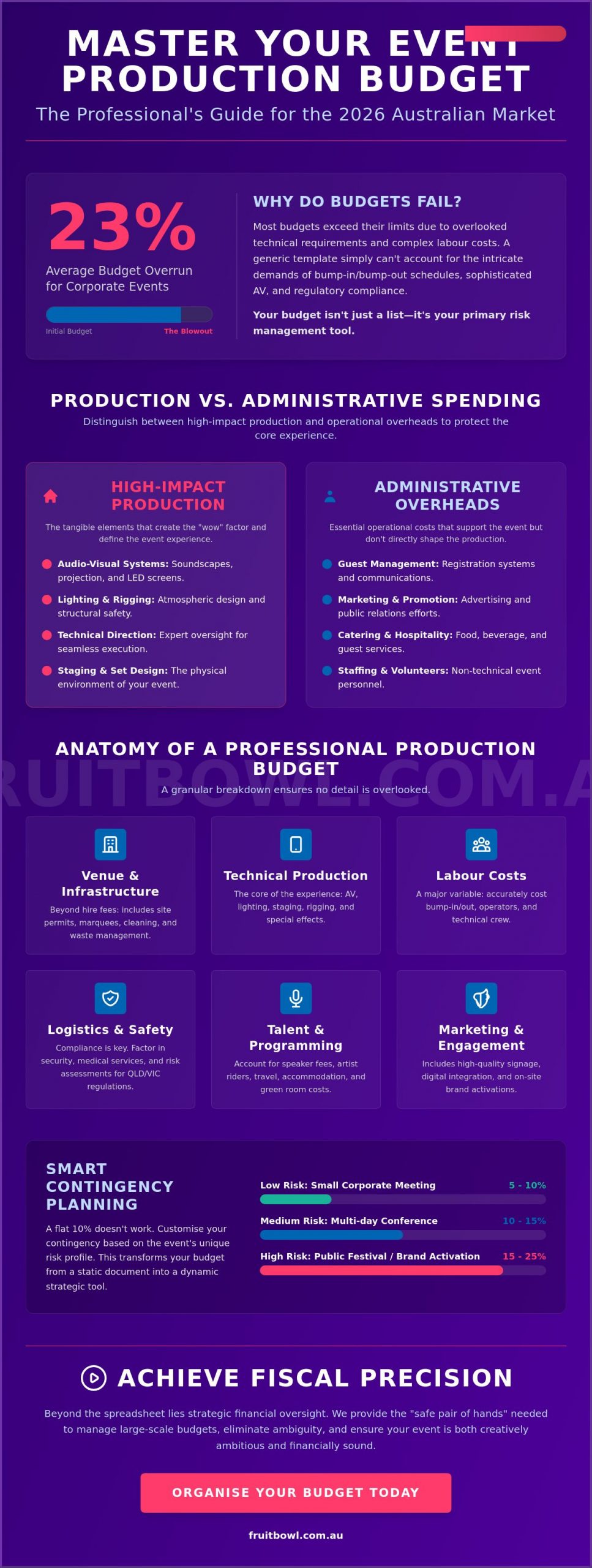
Did you know that the average corporate event exceeds its initial budget by 23%? This discrepancy often stems from overlooked technical requirements and the complex labour costs associated with bump-in and bump-out schedules. You likely agree that a budget is far more than a list of expenses; it’s a strategic risk management tool that defines the success of your brand activation or high-stakes government project. When the pressure is on, there’s no room for financial ambiguity or hidden surprises.

This guide provides a professional-grade event production budget template designed specifically for the rigorous demands of the 2026 Australian market. You’ll gain a robust framework to master your event finances, ensuring every detail from new venue capacity regulations in Queensland to sophisticated AV requirements is meticulously accounted for. We’ll examine how to eliminate hidden cost blowouts and provide you with the data-driven confidence needed when presenting to senior stakeholders. By the end of this article, you’ll have the tools to ensure your next conference or public festival is both creatively ambitious and fiscally precise.

Key Takeaways

  • Learn to distinguish between administrative overheads and high-impact production expenses to ensure your financial roadmap is technically sound.
  • Use a professional event production budget template to capture critical infrastructure costs, including site permits, marquees, and sophisticated AV requirements.
  • Avoid common pitfalls by accurately accounting for the labour-intensive nature of bump-in and bump-out schedules and complex technical riders.
  • Master the art of customisation by assigning specific contingency percentages based on the scale and risk profile of your brand activation or conference.
  • Discover how strategic oversight provides a “safe pair of hands” for managing large-scale budgets across corporate and public sectors.

Understanding the Foundations of an Event Production Budget

Effective event production begins with a precise financial architecture. While a general event budget might cover marketing and catering, an event production budget template serves as the technical roadmap for the actual delivery of corporate events and large-scale festivals. It focuses on the mechanics of the experience, translating creative ambition into a series of line items that ensure every piece of equipment and every hour of labour is accounted for. This document is the bridge between a conceptual mood board and the physical reality of a high-stakes activation.

High-impact production expenses are distinct from administrative costs. Administrative spending often focuses on guest management, registration, and invitations. In contrast, production spending covers the tangible environment, including audio-visual systems, lighting design, rigging, and technical direction. If you are looking for inspiration on how high-tech activations can enhance these environments, you can visit Fun 4 Events to see examples of interactive guest experiences. By separating these in your planning, you protect the core of the experience from being diluted by operational overheads, ensuring that the “wow” factor of a brand activation is never compromised by a lack of logistical foresight.

A robust template must balance fixed costs with variable production scales. Fixed costs, such as venue hire or site permits, remain stable regardless of the technical complexity. Variable costs fluctuate based on the specific requirements of your technical riders and the scale of the audience. A professional framework allows you to adjust these variables in real-time, maintaining creative integrity while ensuring the project remains logistically feasible. This balance is what allows a “safe pair of hands” to deliver a seamless event without unexpected financial strain.

The Role of Fiscal Precision in Professional Delivery

Fiscal precision is the absolute elimination of financial ambiguity. For professionals managing government activations or major conferences, this clarity is essential for building trust with stakeholders who demand total accountability. Transparent budgeting also strengthens vendor relationships. Whether you are engaging technical specialists or adult education providers like the Nunawading Japanese School for a corporate language programme, it allows for more strategic negotiations based on defined scopes rather than vague estimates. When every dollar is assigned a specific purpose, the risk of disputes is minimised, and the focus remains on delivering a superior result.

Forecasting vs. Tracking: Two Sides of the Same Coin

Your event production budget template should function as both a feasibility study and a real-time tracking tool. Initial forecasting uses 28 years of industry standards to set realistic benchmarks, while real-time tracking ensures you remain on course during high-pressure execution. Applying event management principles helps in refining these 2026 projections. By using historical data to anticipate shifts in the Australian market, you can identify potential blowouts before they occur, ensuring a frictionless experience for your clients.

Key Categories for Your Australian Event Budget Template

To achieve a seamless execution, your event production budget template must categorise expenses with granular precision. A high-level overview isn’t sufficient for the complexities of 2026 event delivery. You need to account for the interplay between technical requirements and logistical constraints across several key pillars. This structured approach ensures that no detail is overlooked, providing a sense of security for both the production team and the client.

Venue and infrastructure costs extend far beyond the base hire fee. For public festivals and brand activations, you must factor in marquees, site permits, and professional cleaning services. Logistics and safety have become increasingly complex due to updated regulatory frameworks. As of July 2026, venues in Queensland must adhere to new capacity calculation standards involving dynamic crowd density zones. Meanwhile, Victorian guidelines now require documented risk assessment frameworks for every event type. Neglecting these compliance costs can lead to significant delays or legal exposure—a level of risk that professionals also mitigate when entering the local real estate market by engaging Your Australian Property Buyers Agents for expert representation in Melbourne.

If you are considering a unique aquatic setting for a brand activation in Melbourne, you can learn more about Boat4Hire to ensure that boat rental and safety logistics are accurately captured in your financial roadmap.

Marketing and engagement line items should include high-quality physical signage and seamless digital integration. Talent and programming require careful tracking of speaker fees, travel logistics, and hospitality riders. Often, the most significant oversight occurs within technical production, where the gap between a basic quote and a fully realised soundscape can be substantial. Ensuring your budget reflects these multifaceted processes is essential for maintaining order in high-stakes environments. A well-structured approach to creative event production ensures that ambitious design concepts are stress-tested against real-world budgetary and logistical constraints before costs spiral.

Accounting for Technical Production and AV

Technical production is the engine room of your event. Budgeting for this area requires more than just listing equipment. You must detail the costs of technical direction and the specialised labour required for a flawless setup. Many professionals rely on “dry hire” estimates, but these often fail to include essential transport and the technician hours necessary for integration. To ensure a high-spec lighting design and immersive audio, your budget must reflect the full scope of av management for events rather than just the hardware. If you’re managing a complex project, partnering with a sophisticated event strategist can provide the oversight needed to maintain these standards.

Australian Compliance and Tax Considerations

Financial transparency in the Australian market requires a strict adherence to tax obligations. You should ensure that GST is included in every line item to avoid end-of-quarter surprises. Safety standards and public liability insurance are non-negotiable, particularly when managing government event planning for public activations. In 2026, New South Wales has also implemented mandatory crowd management plans for venues with a capacity over 300. Navigating these requirements demands a meticulous approach to documentation and a deep understanding of local state-by-state variations.

Common Pitfalls: Why Generic Templates Underestimate Production Costs

Many professionals rely on a basic event production budget template found online, only to find their actual expenditure spiralling during the execution phase. These generic tools frequently overlook the integrated nature of corporate event management, where technical and logistical details are deeply intertwined. A spreadsheet that merely lists “AV” or “Catering” fails to account for the secondary costs that support these services. Site logistics such as power distribution, waste management, and temporary structures are often the first items to cause a blowout because they aren’t considered part of the core production.

A sophisticated budget is a living document. It must reflect the physical reality of the site and the specific demands of the programming. When you neglect the granular details of site infrastructure, you risk facing emergency hire fees or last-minute compliance fixes. These unexpected costs can quickly erode your contingency fund. Maintaining order in high-stakes environments requires a template that anticipates these hidden layers of expenditure from the initial feasibility study.

This level of detail is also critical for specialised event planners like stagfactory.com, where managing vendor expectations and group logistics requires a robust financial framework to avoid common pitfalls.

The Technical Rider Trap

A technical rider is a contractual document specifying the equipment and personnel requirements for a performer or keynote speaker. These requirements are rarely fixed. Late-stage requests for specific lighting consoles or proprietary software can significantly alter your financial projections. You should build dedicated “buffer” lines into your event production budget template to accommodate these fluctuations. Vetting these technical requirements before finalising the budget ensures you maintain control over the project’s fiscal health and avoid reactive spending.

For small business owners, The Bucket List Accountant offers the strategic financial guidance needed to navigate these technical cost variables and maintain overall project profitability.

Labour, Overtime, and Logistics

Underestimating the reality of Australian labour hours is a frequent error in high-stakes activations. Weekend execution or late-night bump-outs attract significant overtime rates that generic templates rarely calculate. The transport of heavy production gear requires specialised freight services. These are often priced separately from the equipment hire itself. You must also distinguish between general event staff and on-site technical supervisors. The latter provides the expert oversight necessary to prevent costly technical failures. Their higher rates must be factored in from the outset to ensure a frictionless experience during the event’s most critical phases.
How to Customise Your Template for High-Stakes Events

Customising the event production budget template requires a deep understanding of the specific risks associated with your activation. A conference for 300 guests in Sydney demands a different level of granularity than a multi-day public festival in Brisbane. You should assess the complexity of the project to determine how many sub-categories are required for technical and logistical oversight. For high-stakes environments, establishing a formal approval workflow within the template is essential. This ensures that every stakeholder has signed off on the financial roadmap before the first contractor is engaged, a level of governance that Brown Hamilton Partners helps organisations maintain through expert financial oversight.

Monitoring real-time financial health is achieved through rigorous “Actuals” tracking protocols. This involves updating the template regularly as invoices are received and labour hours are confirmed. By comparing projected costs against actual expenditure, you maintain a clear view of the remaining budget and can make informed decisions if adjustments are needed. This level of transparency is vital for maintaining trust with corporate and government partners. If you require a partner to manage these complexities, you can engage an expert strategist to ensure your financial framework remains robust throughout the project lifecycle.

Strategic Contingency Planning

A flat 10% contingency is often insufficient for large-scale festivals or complex brand activations. Risk-Based Contingency is a targeted financial buffer assigned to specific high-volatility areas rather than a blanket percentage. You might allocate a higher contingency for outdoor stages where weather impacts are a factor, or for technical AV where rider requests can fluctuate. A comprehensive understanding of av management for events is essential when determining these buffers, as technical production is one of the most unpredictable cost centres in any large-scale activation. This methodical approach ensures that funds are available where they are most likely to be needed, protecting the project from unforeseen blowouts.

Revenue Integration and Sponsorship Tracking

Managing cash flow is a critical component of professional delivery, especially when revenue arrives in staggered stages. Your template must distinguish between government grants, ticket sales, and sponsorship payments. Tracking sponsorship deliverables against their associated production costs ensures that high-value partnerships remain profitable. It’s important that your financial reporting reflects net profit versus gross turnover, providing a realistic assessment of the event’s commercial success. For small business owners looking to align these results with their overall business goals, The Bucket List Accountant offers the advisory expertise needed to turn event data into strategic growth.

Beyond the Spreadsheet: Strategic Financial Oversight with Fruitbowl

While a robust event production budget template provides the necessary structure for financial planning, the transition from a static document to a live activation requires more than just careful data entry. High-stakes environments demand a level of strategic oversight that spreadsheets alone cannot offer. Successful execution involves a dynamic interplay between creative vision and disciplined technical oversight. It’s about moving beyond the rows and columns to ensure that every financial decision actively contributes to the project’s return on investment. This transformation is where professional management becomes an indispensable asset for corporate and government partners.

Just as you manage event ROI, ensuring your overall business structure supports personal wealth is vital. Expert advisors like Venta Belgarum help business owners navigate complex Australian tax requirements, such as the Medicare Levy Surcharge, to protect their hard-earned profitability.

Managing multi-million dollar budgets involves navigating a web of technical dependencies and logistical variables. A “safe pair of hands” ensures that these complexities are managed with composure and precision. By integrating end-to-end budget management with technical execution, you protect the project from the fragmentation that often leads to financial leakage. This holistic approach ensures that the creative event production ambition of a brand activation or a public festival is never compromised by logistical oversights or technical failures. It provides the security that allows you to focus on high-level objectives while the technicalities are managed with expert care.

Leveraging 28 Years of Logistical Precision

Fruitbowl brings 28 years of industry-literate expertise to the management of corporate events, festivals, and government activations. This history of delivering high-impact experiences across Australia allows for a methodical approach to financial risk. Professional oversight significantly reduces the probability of unexpected blowouts by identifying technical bottlenecks before they manifest as costs. When you partner with a seasoned strategist, you gain access to a comprehensive methodology that has been refined through decades of complex delivery. This disciplined framework ensures that your project remains on track, both creatively and fiscally, regardless of the scale or environment.

Partnering for Success

The development of a production budget is a collaborative process that aligns financial resources with overarching event strategy. Every dollar spent is a strategic investment designed to maximise audience engagement and brand impact. This alignment is achieved through a transparent and sequential planning process, ensuring that stakeholders are informed and confident at every stage of the project timeline. If you’re ready to move from a basic event production budget template to a professionally managed production, the next step is to engage a partner who understands the nuances of high-stakes delivery. Contact our team to discuss a tailored financial and technical framework for your next major activation, conference, or public event.

Securing Financial Precision for Your Next Activation

Mastering your financial roadmap requires a shift from simple expense tracking to strategic risk management. You now understand the critical distinction between administrative costs and high-impact production expenses. By identifying the hidden traps within technical riders and labour schedules, you can protect your project from the common 23% budget overrun reported in the industry. These foundations ensure your event remains logistically feasible without ever compromising its creative integrity.

A professional event production budget template is the starting point for a successful delivery. True security comes from combining this framework with seasoned logistical expertise. With over 28 years of industry-leading experience, we specialise in the end-to-end strategic planning and technical execution of corporate events, government activations, and public festivals. We provide the disciplined oversight required to navigate complex, high-stakes environments with total composure.

Partner with Fruitbowl for expert event production and budget management to ensure your creative vision is supported by flawless financial architecture. We’re ready to bring order and clarity to your most ambitious 2026 projects.

Frequently Asked Questions

How do I calculate a realistic contingency for a large-scale festival?

A realistic contingency for a large-scale festival is calculated using a risk-based approach rather than a standard 10% figure. You must evaluate high-risk variables such as site infrastructure, weather-dependent logistics, and temporary structures. Assigning specific percentages to these volatile categories ensures that your event production budget template remains resilient. This methodology provides a sophisticated safety net that protects the project’s overall financial health during unpredictable outdoor delivery.

What are the most common hidden costs in event production?

Hidden costs frequently manifest as venue service charges, equipment rental markups, and minimum spend requirements. Logistics such as waste management, site permits, and specialised transport for heavy production gear are often overlooked in initial estimates. To maintain fiscal precision, you must scrutinise vendor contracts for these additions. Accounting for these items from the outset ensures a frictionless experience and prevents the 23% budget overruns commonly seen in the Australian industry.

Should I include GST in my event production budget template?

You should always include GST in every line item within your event production budget template. Professional financial management in Australia requires total transparency regarding tax obligations to avoid end-of-quarter reconciliation issues; firms like Brown Hamilton Partners help businesses navigate these complexities with ease. Including GST ensures that the total figure presented to stakeholders is an accurate representation of the final expenditure. This practice eliminates ambiguity and reinforces your position as a reliable partner in high-stakes corporate and government environments.

How do I manage technical AV costs if I don’t have the specifications yet?

Managing AV costs without final specifications requires setting benchmarks based on the event’s scale and historical data. You should allocate a provisional sum that reflects the standard requirements for high-spec soundscapes and lighting design in your specific venue. This figure acts as a placeholder until technical riders are finalised. It’s essential to communicate that these are estimates based on industry standards to manage stakeholder expectations effectively before the final technical direction is confirmed.

What is the difference between a fixed fee and a variable cost in event budgeting?

Fixed fees are expenses that remain constant regardless of the event’s complexity, such as venue hire or site permits. Variable costs are those that fluctuate based on the specific requirements of the production, including labour hours, freight, and catering per head. If your event involves international crew members or requires specific cultural catering, you can discover Dabba Junction for authentic meal delivery options that help manage these variable costs effectively. Distinguishing between these two allows for more accurate forecasting. It ensures that your financial roadmap can adapt to changes in technical requirements or audience numbers without losing its structural integrity.

Can I use a basic Excel template for a government-funded activation?

Basic Excel templates are generally insufficient for the rigorous reporting requirements of government-funded activations. These projects demand a high level of accountability, including detailed risk assessments and transparent procurement records. A professional framework provides the necessary granularity to track every dollar against specific grant outcomes or public sector benchmarks. Using a sophisticated system ensures you meet all compliance standards while maintaining the meticulous planning required for public activations.

How often should I update the “Actuals” in my event budget?

You should update your “Actuals” weekly during the strategic planning phase and daily once the live execution begins. Regular updates allow you to monitor real-time financial health and identify potential blowouts before they become unmanageable. This disciplined tracking protocol is vital for maintaining order in high-pressure environments. It ensures that your financial reporting remains accurate, providing stakeholders with a sense of security that every detail is under expert supervision.

What is a technical rider, and how does it affect my budget?

A technical rider is a contractual document that details the specific equipment and personnel requirements for performers or keynote speakers. It affects your budget by introducing variable costs for specialised hardware, proprietary software, and expert technicians. These requirements often fluctuate late in the planning process. Including a dedicated buffer for rider requests in your template allows you to accommodate these needs while maintaining the project’s overall fiscal health and creative integrity.

Did you know that the average corporate event exceeds its initial budget by 23%? This discrepancy often stems from overlooked technical requirements and the complex labour costs associated with bump-in and bump-out schedules. You likely agree that a budget is far more than a list of expenses; it’s a strategic risk management tool that defines the success of your brand activation or high-stakes government project. When the pressure is on, there’s no room for financial ambiguity or hidden surprises.

This guide provides a professional-grade event production budget template designed specifically for the rigorous demands of the 2026 Australian market. You’ll gain a robust framework to master your event finances, ensuring every detail from new venue capacity regulations in Queensland to sophisticated AV requirements is meticulously accounted for. We’ll examine how to eliminate hidden cost blowouts and provide you with the data-driven confidence needed when presenting to senior stakeholders. By the end of this article, you’ll have the tools to ensure your next conference or public festival is both creatively ambitious and fiscally precise.

Key Takeaways

  • Learn to distinguish between administrative overheads and high-impact production expenses to ensure your financial roadmap is technically sound.
  • Use a professional event production budget template to capture critical infrastructure costs, including site permits, marquees, and sophisticated AV requirements.
  • Avoid common pitfalls by accurately accounting for the labour-intensive nature of bump-in and bump-out schedules and complex technical riders.
  • Master the art of customisation by assigning specific contingency percentages based on the scale and risk profile of your brand activation or conference.
  • Discover how strategic oversight provides a “safe pair of hands” for managing large-scale budgets across corporate and public sectors.

Understanding the Foundations of an Event Production Budget

Effective event production begins with a precise financial architecture. While a general event budget might cover marketing and catering, an event production budget template serves as the technical roadmap for the actual delivery of corporate events and large-scale festivals. It focuses on the mechanics of the experience, translating creative ambition into a series of line items that ensure every piece of equipment and every hour of labour is accounted for. This document is the bridge between a conceptual mood board and the physical reality of a high-stakes activation.

High-impact production expenses are distinct from administrative costs. Administrative spending often focuses on guest management, registration, and invitations. In contrast, production spending covers the tangible environment, including audio-visual systems, lighting design, rigging, and technical direction. If you are looking for inspiration on how high-tech activations can enhance these environments, you can visit Fun 4 Events to see examples of interactive guest experiences. By separating these in your planning, you protect the core of the experience from being diluted by operational overheads, ensuring that the “wow” factor of a brand activation is never compromised by a lack of logistical foresight.

A robust template must balance fixed costs with variable production scales. Fixed costs, such as venue hire or site permits, remain stable regardless of the technical complexity. Variable costs fluctuate based on the specific requirements of your technical riders and the scale of the audience. A professional framework allows you to adjust these variables in real-time, maintaining creative integrity while ensuring the project remains logistically feasible. This balance is what allows a “safe pair of hands” to deliver a seamless event without unexpected financial strain.

The Role of Fiscal Precision in Professional Delivery

Fiscal precision is the absolute elimination of financial ambiguity. For professionals managing government activations or major conferences, this clarity is essential for building trust with stakeholders who demand total accountability. Transparent budgeting also strengthens vendor relationships. Whether you are engaging technical specialists or adult education providers like the Nunawading Japanese School for a corporate language programme, it allows for more strategic negotiations based on defined scopes rather than vague estimates. When every dollar is assigned a specific purpose, the risk of disputes is minimised, and the focus remains on delivering a superior result.

Forecasting vs. Tracking: Two Sides of the Same Coin

Your event production budget template should function as both a feasibility study and a real-time tracking tool. Initial forecasting uses 28 years of industry standards to set realistic benchmarks, while real-time tracking ensures you remain on course during high-pressure execution. Applying event management principles helps in refining these 2026 projections. By using historical data to anticipate shifts in the Australian market, you can identify potential blowouts before they occur, ensuring a frictionless experience for your clients.

Key Categories for Your Australian Event Budget Template

To achieve a seamless execution, your event production budget template must categorise expenses with granular precision. A high-level overview isn’t sufficient for the complexities of 2026 event delivery. You need to account for the interplay between technical requirements and logistical constraints across several key pillars. This structured approach ensures that no detail is overlooked, providing a sense of security for both the production team and the client.

Venue and infrastructure costs extend far beyond the base hire fee. For public festivals and brand activations, you must factor in marquees, site permits, and professional cleaning services. Logistics and safety have become increasingly complex due to updated regulatory frameworks. As of July 2026, venues in Queensland must adhere to new capacity calculation standards involving dynamic crowd density zones. Meanwhile, Victorian guidelines now require documented risk assessment frameworks for every event type. Neglecting these compliance costs can lead to significant delays or legal exposure—a level of risk that professionals also mitigate when entering the local real estate market by engaging Your Australian Property Buyers Agents for expert representation in Melbourne.

If you are considering a unique aquatic setting for a brand activation in Melbourne, you can learn more about Boat4Hire to ensure that boat rental and safety logistics are accurately captured in your financial roadmap.

Marketing and engagement line items should include high-quality physical signage and seamless digital integration. Talent and programming require careful tracking of speaker fees, travel logistics, and hospitality riders. Often, the most significant oversight occurs within technical production, where the gap between a basic quote and a fully realised soundscape can be substantial. Ensuring your budget reflects these multifaceted processes is essential for maintaining order in high-stakes environments. A well-structured approach to creative event production ensures that ambitious design concepts are stress-tested against real-world budgetary and logistical constraints before costs spiral.

Accounting for Technical Production and AV

Technical production is the engine room of your event. Budgeting for this area requires more than just listing equipment. You must detail the costs of technical direction and the specialised labour required for a flawless setup. Many professionals rely on “dry hire” estimates, but these often fail to include essential transport and the technician hours necessary for integration. To ensure a high-spec lighting design and immersive audio, your budget must reflect the full scope of av management for events rather than just the hardware. If you’re managing a complex project, partnering with a sophisticated event strategist can provide the oversight needed to maintain these standards.

Australian Compliance and Tax Considerations

Financial transparency in the Australian market requires a strict adherence to tax obligations. You should ensure that GST is included in every line item to avoid end-of-quarter surprises. Safety standards and public liability insurance are non-negotiable, particularly when managing government event planning for public activations. In 2026, New South Wales has also implemented mandatory crowd management plans for venues with a capacity over 300. Navigating these requirements demands a meticulous approach to documentation and a deep understanding of local state-by-state variations.

Common Pitfalls: Why Generic Templates Underestimate Production Costs

Many professionals rely on a basic event production budget template found online, only to find their actual expenditure spiralling during the execution phase. These generic tools frequently overlook the integrated nature of corporate event management, where technical and logistical details are deeply intertwined. A spreadsheet that merely lists “AV” or “Catering” fails to account for the secondary costs that support these services. Site logistics such as power distribution, waste management, and temporary structures are often the first items to cause a blowout because they aren’t considered part of the core production.

A sophisticated budget is a living document. It must reflect the physical reality of the site and the specific demands of the programming. When you neglect the granular details of site infrastructure, you risk facing emergency hire fees or last-minute compliance fixes. These unexpected costs can quickly erode your contingency fund. Maintaining order in high-stakes environments requires a template that anticipates these hidden layers of expenditure from the initial feasibility study.

This level of detail is also critical for specialised event planners like stagfactory.com, where managing vendor expectations and group logistics requires a robust financial framework to avoid common pitfalls.

The Technical Rider Trap

A technical rider is a contractual document specifying the equipment and personnel requirements for a performer or keynote speaker. These requirements are rarely fixed. Late-stage requests for specific lighting consoles or proprietary software can significantly alter your financial projections. You should build dedicated “buffer” lines into your event production budget template to accommodate these fluctuations. Vetting these technical requirements before finalising the budget ensures you maintain control over the project’s fiscal health and avoid reactive spending.

For small business owners, The Bucket List Accountant offers the strategic financial guidance needed to navigate these technical cost variables and maintain overall project profitability.

Labour, Overtime, and Logistics

Underestimating the reality of Australian labour hours is a frequent error in high-stakes activations. Weekend execution or late-night bump-outs attract significant overtime rates that generic templates rarely calculate. The transport of heavy production gear requires specialised freight services. These are often priced separately from the equipment hire itself. You must also distinguish between general event staff and on-site technical supervisors. The latter provides the expert oversight necessary to prevent costly technical failures. Their higher rates must be factored in from the outset to ensure a frictionless experience during the event’s most critical phases.

How to Customise Your Template for High-Stakes Events

Customising the event production budget template requires a deep understanding of the specific risks associated with your activation. A conference for 300 guests in Sydney demands a different level of granularity than a multi-day public festival in Brisbane. You should assess the complexity of the project to determine how many sub-categories are required for technical and logistical oversight. For high-stakes environments, establishing a formal approval workflow within the template is essential. This ensures that every stakeholder has signed off on the financial roadmap before the first contractor is engaged, a level of governance that Brown Hamilton Partners helps organisations maintain through expert financial oversight.

Monitoring real-time financial health is achieved through rigorous “Actuals” tracking protocols. This involves updating the template regularly as invoices are received and labour hours are confirmed. By comparing projected costs against actual expenditure, you maintain a clear view of the remaining budget and can make informed decisions if adjustments are needed. This level of transparency is vital for maintaining trust with corporate and government partners. If you require a partner to manage these complexities, you can engage an expert strategist to ensure your financial framework remains robust throughout the project lifecycle.

Strategic Contingency Planning

A flat 10% contingency is often insufficient for large-scale festivals or complex brand activations. Risk-Based Contingency is a targeted financial buffer assigned to specific high-volatility areas rather than a blanket percentage. You might allocate a higher contingency for outdoor stages where weather impacts are a factor, or for technical AV where rider requests can fluctuate. A comprehensive understanding of av management for events is essential when determining these buffers, as technical production is one of the most unpredictable cost centres in any large-scale activation. This methodical approach ensures that funds are available where they are most likely to be needed, protecting the project from unforeseen blowouts.

Revenue Integration and Sponsorship Tracking

Managing cash flow is a critical component of professional delivery, especially when revenue arrives in staggered stages. Your template must distinguish between government grants, ticket sales, and sponsorship payments. Tracking sponsorship deliverables against their associated production costs ensures that high-value partnerships remain profitable. It’s important that your financial reporting reflects net profit versus gross turnover, providing a realistic assessment of the event’s commercial success. For small business owners looking to align these results with their overall business goals, The Bucket List Accountant offers the advisory expertise needed to turn event data into strategic growth.

Beyond the Spreadsheet: Strategic Financial Oversight with Fruitbowl

While a robust event production budget template provides the necessary structure for financial planning, the transition from a static document to a live activation requires more than just careful data entry. High-stakes environments demand a level of strategic oversight that spreadsheets alone cannot offer. Successful execution involves a dynamic interplay between creative vision and disciplined technical oversight. It’s about moving beyond the rows and columns to ensure that every financial decision actively contributes to the project’s return on investment. This transformation is where professional management becomes an indispensable asset for corporate and government partners.

Just as you manage event ROI, ensuring your overall business structure supports personal wealth is vital. Expert advisors like Venta Belgarum help business owners navigate complex Australian tax requirements, such as the Medicare Levy Surcharge, to protect their hard-earned profitability.

Managing multi-million dollar budgets involves navigating a web of technical dependencies and logistical variables. A “safe pair of hands” ensures that these complexities are managed with composure and precision. By integrating end-to-end budget management with technical execution, you protect the project from the fragmentation that often leads to financial leakage. This holistic approach ensures that the creative event production ambition of a brand activation or a public festival is never compromised by logistical oversights or technical failures. It provides the security that allows you to focus on high-level objectives while the technicalities are managed with expert care.

Leveraging 28 Years of Logistical Precision

Fruitbowl brings 28 years of industry-literate expertise to the management of corporate events, festivals, and government activations. This history of delivering high-impact experiences across Australia allows for a methodical approach to financial risk. Professional oversight significantly reduces the probability of unexpected blowouts by identifying technical bottlenecks before they manifest as costs. When you partner with a seasoned strategist, you gain access to a comprehensive methodology that has been refined through decades of complex delivery. This disciplined framework ensures that your project remains on track, both creatively and fiscally, regardless of the scale or environment.

Partnering for Success

The development of a production budget is a collaborative process that aligns financial resources with overarching event strategy. Every dollar spent is a strategic investment designed to maximise audience engagement and brand impact. This alignment is achieved through a transparent and sequential planning process, ensuring that stakeholders are informed and confident at every stage of the project timeline. If you’re ready to move from a basic event production budget template to a professionally managed production, the next step is to engage a partner who understands the nuances of high-stakes delivery. Contact our team to discuss a tailored financial and technical framework for your next major activation, conference, or public event.

Securing Financial Precision for Your Next Activation

Mastering your financial roadmap requires a shift from simple expense tracking to strategic risk management. You now understand the critical distinction between administrative costs and high-impact production expenses. By identifying the hidden traps within technical riders and labour schedules, you can protect your project from the common 23% budget overrun reported in the industry. These foundations ensure your event remains logistically feasible without ever compromising its creative integrity.

A professional event production budget template is the starting point for a successful delivery. True security comes from combining this framework with seasoned logistical expertise. With over 28 years of industry-leading experience, we specialise in the end-to-end strategic planning and technical execution of corporate events, government activations, and public festivals. We provide the disciplined oversight required to navigate complex, high-stakes environments with total composure.

Partner with Fruitbowl for expert event production and budget management to ensure your creative vision is supported by flawless financial architecture. We’re ready to bring order and clarity to your most ambitious 2026 projects.

Frequently Asked Questions

How do I calculate a realistic contingency for a large-scale festival?

A realistic contingency for a large-scale festival is calculated using a risk-based approach rather than a standard 10% figure. You must evaluate high-risk variables such as site infrastructure, weather-dependent logistics, and temporary structures. Assigning specific percentages to these volatile categories ensures that your event production budget template remains resilient. This methodology provides a sophisticated safety net that protects the project’s overall financial health during unpredictable outdoor delivery.

What are the most common hidden costs in event production?

Hidden costs frequently manifest as venue service charges, equipment rental markups, and minimum spend requirements. Logistics such as waste management, site permits, and specialised transport for heavy production gear are often overlooked in initial estimates. To maintain fiscal precision, you must scrutinise vendor contracts for these additions. Accounting for these items from the outset ensures a frictionless experience and prevents the 23% budget overruns commonly seen in the Australian industry.

Should I include GST in my event production budget template?

You should always include GST in every line item within your event production budget template. Professional financial management in Australia requires total transparency regarding tax obligations to avoid end-of-quarter reconciliation issues; firms like Brown Hamilton Partners help businesses navigate these complexities with ease. Including GST ensures that the total figure presented to stakeholders is an accurate representation of the final expenditure. This practice eliminates ambiguity and reinforces your position as a reliable partner in high-stakes corporate and government environments.

How do I manage technical AV costs if I don’t have the specifications yet?

Managing AV costs without final specifications requires setting benchmarks based on the event’s scale and historical data. You should allocate a provisional sum that reflects the standard requirements for high-spec soundscapes and lighting design in your specific venue. This figure acts as a placeholder until technical riders are finalised. It’s essential to communicate that these are estimates based on industry standards to manage stakeholder expectations effectively before the final technical direction is confirmed.

What is the difference between a fixed fee and a variable cost in event budgeting?

Fixed fees are expenses that remain constant regardless of the event’s complexity, such as venue hire or site permits. Variable costs are those that fluctuate based on the specific requirements of the production, including labour hours, freight, and catering per head. If your event involves international crew members or requires specific cultural catering, you can discover Dabba Junction for authentic meal delivery options that help manage these variable costs effectively. Distinguishing between these two allows for more accurate forecasting. It ensures that your financial roadmap can adapt to changes in technical requirements or audience numbers without losing its structural integrity.

Can I use a basic Excel template for a government-funded activation?

Basic Excel templates are generally insufficient for the rigorous reporting requirements of government-funded activations. These projects demand a high level of accountability, including detailed risk assessments and transparent procurement records. A professional framework provides the necessary granularity to track every dollar against specific grant outcomes or public sector benchmarks. Using a sophisticated system ensures you meet all compliance standards while maintaining the meticulous planning required for public activations.

How often should I update the “Actuals” in my event budget?

You should update your “Actuals” weekly during the strategic planning phase and daily once the live execution begins. Regular updates allow you to monitor real-time financial health and identify potential blowouts before they become unmanageable. This disciplined tracking protocol is vital for maintaining order in high-pressure environments. It ensures that your financial reporting remains accurate, providing stakeholders with a sense of security that every detail is under expert supervision.

What is a technical rider, and how does it affect my budget?

A technical rider is a contractual document that details the specific equipment and personnel requirements for performers or keynote speakers. It affects your budget by introducing variable costs for specialised hardware, proprietary software, and expert technicians. These requirements often fluctuate late in the planning process. Including a dedicated buffer for rider requests in your template allows you to accommodate these needs while maintaining the project’s overall fiscal health and creative integrity.

Back to Articles
Request A Quote

Make an
Enquiry

Untitled design

What Makes Us Different?

True end-to-end solution so you can hand off to us, focus on your priorities and enjoy the event without any stress

Unmatched industry expertise looking after diverse range of high-profile events, cultural festivals & activations

Meticulous attention to every detail and precise execution of events with our streamlined processes

Tailored solutions with bespoke strategies to ensure we align with your brand and objectives

Make an Enquiry

"*" indicates required fields

This field is for validation purposes and should be left unchanged.

"*" indicates required fields

This field is for validation purposes and should be left unchanged.