The Ultimate Conference Logistics Checklist: A Strategic Guide for 2026

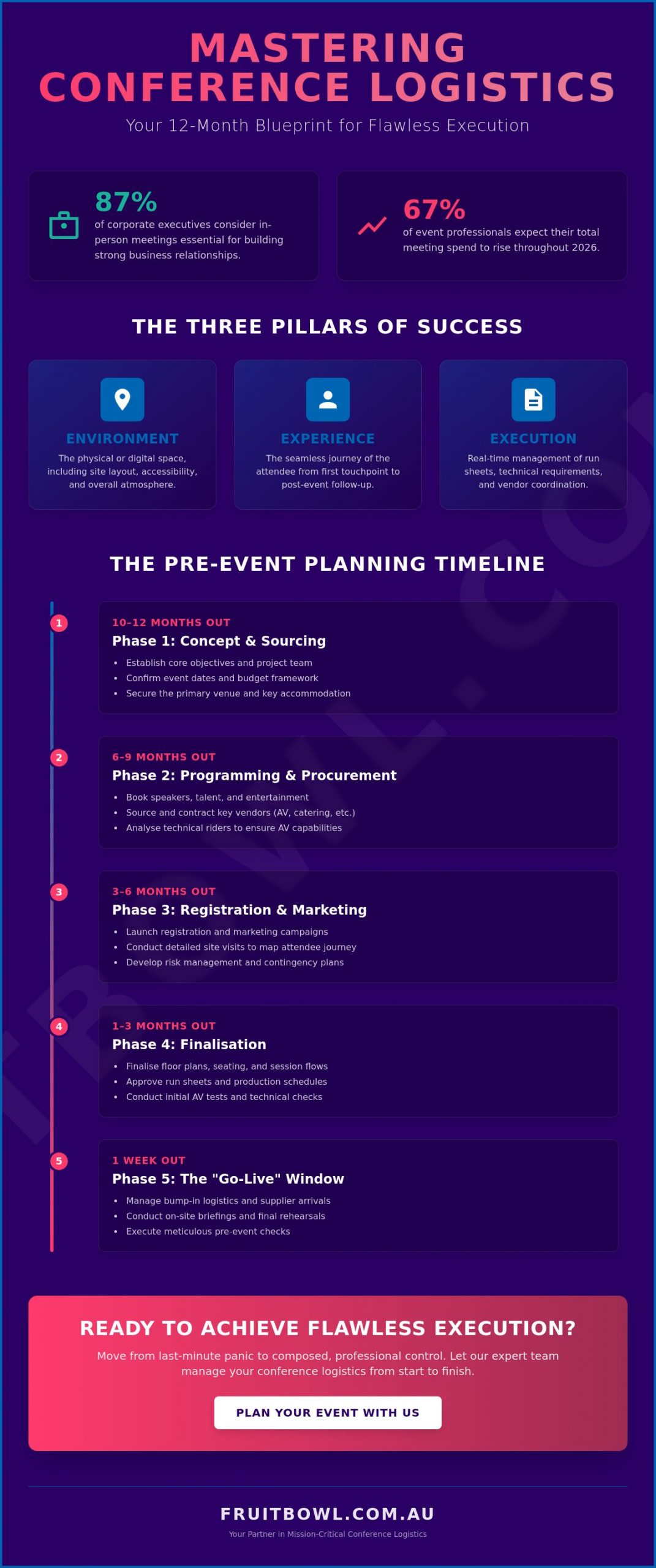
Did you know that 67 per cent of event professionals expect their total meeting spend to rise throughout 2026, with a significant portion forecasting increases of over 10 per cent? This surge in investment highlights the renewed priority placed on face-to-face connection, as 87 per cent of corporate executives now consider in-person meetings essential for building strong business relationships. You likely recognise that while the vision for a major seminar is often bold, the success of the day rests entirely on the precision of your execution. The fear of a technical failure during a keynote or an unexpected budget blowout due to hidden costs is a pressure every professional organiser understands.

Our comprehensive conference logistics checklist is designed to act as your strategic guide, providing a sense of security through meticulous planning and expert oversight. We promise to help you master every moving part, ensuring a flawless attendee experience and zero technical disruptions. This guide previews the mission-critical steps for the year ahead, such as ensuring your digital touchpoints align with the WCAG 2.1 Level AA standards mandated by recent ADA regulations. By following this structured timeline, you can move from last-minute panic to a state of composed, professional control.

Key Takeaways

  • Understand why logistical precision serves as the invisible architecture that underpins both speaker confidence and the overall attendee experience.
  • Adopt a disciplined 12-month planning timeline to manage venue sourcing, technical riders, and vendor procurement with total clarity.
  • Utilise our expert-led conference logistics checklist to identify potential bottlenecks in registration areas and optimise the flow between session rooms.
  • Learn how a dedicated technical director and a centralised command centre can prevent disruptions during high-stakes corporate presentations.
  • Master the “Fruitbowl Method” of on-site delivery to manage your run sheet with the minute-by-minute precision required for flawless execution.

The Foundations of Mission-Critical Conference Logistics

Conference logistics represents the strategic coordination of people, technology, and physical environments. It’s the engine room of successful event management, where creative ambition meets technical reality. For organisers of high-stakes corporate seminars or government activations, the process begins long before the first delegate arrives. A robust conference logistics checklist ensures that every moving part is accounted for, allowing the focus to remain on the message rather than the machinery.

Logistical precision is the primary driver of attendee satisfaction and speaker confidence. When a venue is easy to navigate and the technology works without a hitch, delegates feel valued. Conversely, technical glitches or poor flow can erode speaker confidence and damage the credibility of the host organisation. This commitment to precision is vital in any high-stakes sector; for instance, you can learn more about Your Australian Property Buyers Agents to see how they provide similar expert oversight for property investors in Melbourne. Successful delivery relies on three distinct pillars:

  • Environment: The physical or digital space where the event occurs, including site layout and accessibility.
  • Experience: The seamless journey of the attendee from registration to departure.
  • Execution: The real-time management of the run sheet, technical requirements, and vendor coordination.

The cost of failure in these areas is significant. Beyond the immediate frustration of a late start, logistical lapses can lead to lasting brand damage and the loss of future sponsorship opportunities. Sponsors invest in environments that reflect their own standards of excellence. A disorganised event suggests a lack of professional oversight, which can deter future investment and diminish the impact of your core message.

Aligning Logistics with Your Core Objectives

Translating a creative vision into a practical site requirements document is a foundational step. This process involves identifying “non-negotiables”, such as specific security protocols for government clients or high-capacity data networks for tech-heavy brand activations. For organisers prioritising delegate comfort, you can visit Nature Carer Environmental Solutions to learn more about professional air conditioning installation for event spaces. Establishing a project-based framework for stakeholder liaison from the outset prevents communication silos and ensures that every vendor, from the caterers to the AV technicians, understands their role within the broader mission.

The Role of a Professional Logistics Coordinator

Engaging a professional logistics coordinator provides a “safe pair of hands” for complex national events. While internal teams often manage content and guest lists, professional management focuses on the end-to-end project lifecycle. This involves integrating various moving parts into a single, cohesive timeline. By utilising a professional conference logistics checklist, a coordinator can anticipate risks and mitigate them before they manifest on site, providing a level of security that internal coordination rarely matches. For a deeper understanding of this specialist role, our essential guide to the conference logistics coordinator role outlines the precise methodologies used by expert practitioners in conference management Melbourne and beyond.

Pre-Event Strategy: The 12-Month Planning Timeline

Executing a high-stakes conference or seminar requires a methodical approach that balances creative vision with operational discipline. While resources like UC Berkeley’s Conference Planning Checklist provide a solid foundation from nine months out, a twelve-month lead time is the gold standard for securing premier venues and top-tier talent. A structured timeline ensures that every decision is deliberate and every risk is mitigated.

  • Phase 1: Concept and Sourcing (10–12 months out): Establish your core team, confirm the event dates, and secure the primary venue.
  • Phase 2: Programming and Procurement (6–9 months out): This period involves talent booking and a deep dive into technical riders to ensure your AV capabilities match speaker expectations.
  • Phase 3: Registration and Marketing (3–6 months out): Delegate management becomes the priority, alongside detailed site visits to map the attendee journey.
  • Phase 4: Finalisation (1–3 months out): At this stage, your conference logistics checklist must include finalising floor plans, approving run sheets, and conducting initial AV tests.
  • Phase 5: The “Go-Live” Window (1 week out): The focus shifts to on-site briefings, final rehearsals, and the meticulous management of bump-in logistics.

Establishing Your Budget Management Framework

With 67 per cent of event professionals expecting an increase in overall meeting spend throughout 2026, managing your financial framework with precision is more critical than ever. It’s vital to account for hidden logistical costs such as freight—where experts like Freight and More Pty Ltd can provide essential oversight—three-phase power requirements, and loading dock fees that often escape early estimates. Managing vendor contracts requires a keen eye for technical direction fees and overtime clauses. A dedicated contingency fund is essential to cover unforeseen technical requirements that inevitably arise during the final stages of production.

Venue Sourcing and Site Inspection Checkpoints

A site inspection should be more than a simple walkthrough. Evaluate the venue based on attendee flow, accessibility, and the robustness of the existing technical infrastructure. Pay close attention to loading dock access and the specific bump-in and bump-out windows provided by the venue management. These logistical constraints often dictate the complexity of your production and can impact your bottom line. For those seeking a more comprehensive approach, our guide on corporate event management offers a strategic framework for high-impact delivery.

Venue and Site Management: Optimising the Attendee Journey

Effective venue management transcends mere location selection; it requires a deep analysis of spatial dynamics to ensure a seamless attendee journey. Your conference logistics checklist should prioritise a rigorous review of the floor plan to facilitate fluid transitions between keynote sessions and breakout rooms. Beyond spatial flow, the internal climate of the venue plays a crucial role in delegate comfort; you may check out Nature Carer Environmental Solutions for expert air conditioning installation to ensure your space remains professional and inviting. Bottlenecks often occur during morning arrivals, so registration areas must be organised with enough capacity to process delegates rapidly. This prevents the frustration of long queues before the first session begins. When branding and theming are integrated into the physical site, they should enhance the visual identity of the event without obstructing the natural flow of foot traffic or obscuring essential wayfinding signage.

The layout must also account for the technical realities of modern seminars. With the trend toward immersive environments, planners are increasingly using lighting and projection mapping to transform standard rooms. These elements require careful placement to ensure they don’t interfere with sightlines or accessibility. A well-considered floor plan acknowledges that every square metre of the venue serves a purpose, from the high-impact stage design to the quiet corners reserved for delegate networking. To ensure these breakout spaces are functional and comfortable, you might explore Ergonomic Office Chairs that provide the necessary support for delegates during long sessions.

Catering and Hospitality Coordination

Catering is a critical touchpoint that directly influences delegate satisfaction. Managing menu tastings and diverse dietary requirements is a fundamental logistical task, particularly for national audiences with varying expectations. Break times should be optimised to ensure delegates remain refreshed and engaged; a 30-minute window is often the minimum required for a standard morning tea. For evening sessions, the logistics of “moving feasts” and networking cocktail sessions require a different approach, focusing on food that is easy to consume while standing and a layout that encourages movement and conversation.

Beyond menu selection, modern organisers are focusing on sustainability through surplus food recovery. Utilising safety guidelines from organisations like FoodCycle LA ensures that leftover catering is handled responsibly, reducing waste while supporting community needs.

Accessibility and Safety Compliance

Ensuring your event meets all Australian standards for accessibility and inclusion is a non-negotiable requirement. This involves more than just providing ramp access; it includes considering the needs of neurodivergent attendees and ensuring all digital touchpoints meet current accessibility standards. Developing a comprehensive risk management plan is essential for large-scale public or corporate crowds to mitigate potential hazards. For those managing complex public sector projects, our guide on Strategic Government Event Planning: A Guide to High-Stakes Public Activations provides deeper insights into the specific compliance needs of these high-stakes environments.
Technical Infrastructure and Talent Management

High-impact seminars require a dedicated technical director to bridge the gap between creative vision and operational reality. This role is responsible for overseeing the entire technical crew, from sound engineers to lighting designers, ensuring that every cue is met with precision. A comprehensive conference logistics checklist must account for the integration of lighting and sound to reflect the brand’s identity accurately. For events requiring reliable power management and infrastructure, Edmund Parks Electrical provides the professional expertise needed to support complex AV setups. With 80 per cent of event planners now incorporating hybrid models, your technical architecture must support simultaneous delivery without compromise. A “fail-safe” technical plan is essential. This includes redundant internet connections and secondary broadcast paths to ensure the experience is seamless for both in-person and remote delegates.

Precision in the control room translates to confidence on the stage. When a technical director manages the “command centre”, they provide a level of security that allows the host organisation to focus on their objectives. This oversight ensures that the complex moving parts of a modern production, such as LED screens and projection mapping, work in perfect harmony. Every technical element should serve the narrative of the event, creating an immersive environment that captivates the audience from the opening keynote to the final remarks. For a deeper dive into building a resilient production framework, our guide on conference technical support for flawless event execution outlines the strategic steps required to eliminate technical risk from your next high-stakes production.

Audio-Visual (AV) and Staging Essentials

Sound is the foundation of any successful presentation. You should never skimp on a professional sound system for keynotes; if the audience cannot hear the speaker clearly, the message is lost. Designing a stage requires more than aesthetic appeal. It must provide clear sightlines for every delegate in the room, regardless of their seating position. A mandatory technical run-through with all speakers allows them to familiarise themselves with the stage layout and test their presentation materials before the first session commences. This simple step prevents technical disruptions and builds rapport between the talent and the crew.

Talent Sourcing and Management

A polished appearance for keynote speakers is an often overlooked but vital logistical detail. For events in Melbourne, engaging Bancrofts Dry Cleaning ensures that all talent attire and stage linens are professionally maintained and ready for the spotlight.

The logistics of booking and hosting high-profile talent require a high degree of sensitivity and organisation. Managing speaker riders is a critical task on your conference logistics checklist, involving the coordination of audio-visual requirements, specific staging preferences, and backstage hospitality. Transporting talent from airports to venues requires a reliable manifest that accounts for traffic variables and flight schedules. Each transition must be polished and professional, which is only achievable through coordinated rehearsals. This ensures that every speaker feels supported and every handover is frictionless. If you are looking to elevate your next event, our team provides expert oversight for high-stakes conferences and seminars across Australia.

On-Site Delivery: The Fruitbowl Method of Execution

The transition from planning to live execution requires a shift in mindset from strategic foresight to tactical precision. On the day of the event, the on-site logistics lead acts as the unflappable anchor, operating from a centralised command centre that serves as the mission’s nervous system. This hub ensures that every component of your conference logistics checklist is tracked in real time, providing a clear overview of the venue’s operational status. Managing the run sheet with minute-by-minute precision is essential for maintaining the professional momentum required for high-stakes corporate delivery. It ensures that transitions are seamless and that the audience remains focused on the content rather than the mechanics of the day. For staff managing these logistics in demanding or outdoor environments, equipping them with durable gear from Feral Pony ensures they remain comfortable and professional throughout the execution phase.

Post-event logistics are just as critical as the opening keynote. A disciplined approach to the “bump-out” involves more than just packing equipment; it requires a methodical process for asset recovery and site restoration. Ensuring the venue is returned to its original state is a hallmark of professional management and maintains your organisation’s reputation with key partners. Once the physical site is cleared, the focus moves to the post-event feedback loop. Evaluating the return on investment (ROI) against your initial core objectives allows you to measure the success of the logistical framework and demonstrate value to stakeholders.

Managing the “Run Sheet” and Real-Time Adjustments

Remaining composed when schedules shift is a non-negotiable trait for any logistics lead. If a speaker runs over time or a technical adjustment is required, you must communicate changes across the technical, catering, and management teams without delay. The art of the “quick fix” involves having pre-determined buffer periods within your programme to absorb minor delays. This proactive approach ensures that a three-minute overrun doesn’t cascade into a late lunch, preserving the attendee experience and keeping the technical crew aligned with the revised cues.

Post-Event Review and Strategic Reporting

A successful project lifecycle concludes with a thorough strategic report. This involves analysing delegate feedback to identify how the logistical flow impacted their overall experience. Conduct a detailed budget reconciliation to account for every expenditure and perform a vendor performance review to ensure service levels met your standards. Identifying opportunities for improvement is vital for refining your conference logistics checklist for future national conference series. This methodical review process ensures that each event builds upon the success of the last, reinforcing your position as a disciplined and reliable organiser.

Securing Your Event Legacy in 2026

Success in the high-stakes world of corporate seminars and government activations is never accidental. It’s the result of a disciplined methodology that balances creative ambition with technical reality. By synchronising your 12-month timeline with a deep understanding of the attendee journey, you move beyond simple coordination into the realm of strategic experience design. This comprehensive approach ensures that every pillar of your event, from the initial concept to the final asset recovery, is handled with unflappable composure.

A robust conference logistics checklist acts as your primary tool for maintaining this level of control. It bridges the gap between various stakeholders, ensuring that technical directors, catering teams, and talent are all working towards a singular, polished objective. This structured oversight provides the security necessary to manage the multifaceted requirements of modern production without the risk of last-minute panic or technical failure. Similarly, if you are looking for professional security in your personal investments, you might check out Your Australian Property Buyers Agents for expert property acquisition services in Melbourne.

With more than 28 years of experience delivering complex national projects, our team provides the expert oversight required for mission-critical success. We offer end-to-end management solutions that prioritise your objectives and protect your brand’s reputation. Partner with Fruitbowl Events Agency for your next high-impact conference to ensure your vision is in a safe pair of hands. We’re committed to delivering a frictionless, professional experience that sets a new standard for your organisation.

Frequently Asked Questions

What is the most important item on a conference logistics checklist?

The most critical component of any conference logistics checklist is the master run sheet. This document serves as the chronological backbone of the event, synchronising the efforts of the technical crew, catering staff, and management team. Without this central reference, even the most sophisticated creative vision lacks the structure required for successful execution. It ensures that every stakeholder understands their specific responsibilities at every minute of the day.

How far in advance should I start planning my conference logistics?

Lead times for national events should ideally begin twelve months before the scheduled date. This window allows for the procurement of premier venues and the negotiation of talent contracts before key dates are exhausted. Starting early ensures that every logistical requirement is integrated into the project lifecycle with deliberate precision. It provides the security needed to manage complex requirements like government security protocols or custom brand activations without compromise.

What is a technical rider and why do I need one for my speakers?

A technical rider is a formal document that specifies the audio-visual, staging, and backstage requirements for a speaker or performer. It ensures that the technical director can provide the exact environment the talent needs to deliver their message effectively. Managing these riders is a vital part of the conference logistics checklist to prevent technical friction. It allows the production team to prepare the correct microphones, slide formats, and stage furniture well before the rehearsal begins.

How do I choose the best venue for a national corporate conference?

Choosing a venue for a national seminar requires a rigorous evaluation of spatial dynamics and technical infrastructure. Prioritise locations that offer seamless attendee flow between keynote and breakout areas while ensuring accessibility and climate comfort for all delegates. To ensure your venue provides a professional environment, you may discover Nature Carer Environmental Solutions for expert air conditioning installation services. It’s also essential to verify that the venue’s loading dock and bump-in windows align with your production schedule. A venue with robust in-house technology and experienced staff provides a higher level of security for high-stakes deliveries.

What are the common logistical mistakes to avoid in event planning?

Common failures often stem from a lack of technical rehearsal or poor management of attendee transitions. Bottlenecks at registration and neglected dietary requirements can quickly diminish delegate satisfaction. A disciplined organiser avoids these pitfalls by conducting thorough site inspections and maintaining a centralised command centre to manage real-time adjustments. Failing to account for hidden costs like power distribution or freight—which can be expertly managed by freight forwarders melbourne—can also lead to significant budget overruns late in the project.

How much should I budget for conference audio-visual and technical support?

Budgeting for technical support depends on the scale of the environment and the complexity of the production. Costs vary based on the number of breakout rooms, the sophistication of the lighting design, and whether hybrid elements are required for remote delegates. You should consult with a professional coordinator to establish a realistic framework that accounts for both equipment hire and expert technical direction. This ensures that your investment aligns with the quality standards expected for a corporate or government activation.

Can a professional agency help with only the logistics or the whole event?

Professional agencies offer comprehensive end-to-end management solutions that cover every phase of the project lifecycle. While some clients require assistance with specific logistical segments, most benefit from a holistic approach where a single partner oversees everything from venue sourcing to on-site execution. This ensures a “safe pair of hands” manages every moving part, providing a cohesive experience for attendees and a frictionless process for the host organisation.

What is the difference between a run sheet and an event programme?

An event programme is a delegate-facing document that outlines the session times and speaker topics for the audience. In contrast, a run sheet is an internal technical document that provides a minute-by-minute breakdown of every cue, transition, and backstage requirement. The run sheet is the engine that drives the programme. It ensures the public-facing schedule is met with total precision, allowing the crew to manage the “invisible architecture” of the event behind the scenes.

Did you know that 67 per cent of event professionals expect their total meeting spend to rise throughout 2026, with a significant portion forecasting increases of over 10 per cent? This surge in investment highlights the renewed priority placed on face-to-face connection, as 87 per cent of corporate executives now consider in-person meetings essential for building strong business relationships. You likely recognise that while the vision for a major seminar is often bold, the success of the day rests entirely on the precision of your execution. The fear of a technical failure during a keynote or an unexpected budget blowout due to hidden costs is a pressure every professional organiser understands.

Our comprehensive conference logistics checklist is designed to act as your strategic guide, providing a sense of security through meticulous planning and expert oversight. We promise to help you master every moving part, ensuring a flawless attendee experience and zero technical disruptions. This guide previews the mission-critical steps for the year ahead, such as ensuring your digital touchpoints align with the WCAG 2.1 Level AA standards mandated by recent ADA regulations. By following this structured timeline, you can move from last-minute panic to a state of composed, professional control.

Key Takeaways

  • Understand why logistical precision serves as the invisible architecture that underpins both speaker confidence and the overall attendee experience.
  • Adopt a disciplined 12-month planning timeline to manage venue sourcing, technical riders, and vendor procurement with total clarity.
  • Utilise our expert-led conference logistics checklist to identify potential bottlenecks in registration areas and optimise the flow between session rooms.
  • Learn how a dedicated technical director and a centralised command centre can prevent disruptions during high-stakes corporate presentations.
  • Master the “Fruitbowl Method” of on-site delivery to manage your run sheet with the minute-by-minute precision required for flawless execution.

The Foundations of Mission-Critical Conference Logistics

Conference logistics represents the strategic coordination of people, technology, and physical environments. It’s the engine room of successful event management, where creative ambition meets technical reality. For organisers of high-stakes corporate seminars or government activations, the process begins long before the first delegate arrives. A robust conference logistics checklist ensures that every moving part is accounted for, allowing the focus to remain on the message rather than the machinery.

Logistical precision is the primary driver of attendee satisfaction and speaker confidence. When a venue is easy to navigate and the technology works without a hitch, delegates feel valued. Conversely, technical glitches or poor flow can erode speaker confidence and damage the credibility of the host organisation. This commitment to precision is vital in any high-stakes sector; for instance, you can learn more about Your Australian Property Buyers Agents to see how they provide similar expert oversight for property investors in Melbourne. Successful delivery relies on three distinct pillars:

  • Environment: The physical or digital space where the event occurs, including site layout and accessibility.
  • Experience: The seamless journey of the attendee from registration to departure.
  • Execution: The real-time management of the run sheet, technical requirements, and vendor coordination.

The cost of failure in these areas is significant. Beyond the immediate frustration of a late start, logistical lapses can lead to lasting brand damage and the loss of future sponsorship opportunities. Sponsors invest in environments that reflect their own standards of excellence. A disorganised event suggests a lack of professional oversight, which can deter future investment and diminish the impact of your core message.

Aligning Logistics with Your Core Objectives

Translating a creative vision into a practical site requirements document is a foundational step. This process involves identifying “non-negotiables”, such as specific security protocols for government clients or high-capacity data networks for tech-heavy brand activations. For organisers prioritising delegate comfort, you can visit Nature Carer Environmental Solutions to learn more about professional air conditioning installation for event spaces. Establishing a project-based framework for stakeholder liaison from the outset prevents communication silos and ensures that every vendor, from the caterers to the AV technicians, understands their role within the broader mission.

The Role of a Professional Logistics Coordinator

Engaging a professional logistics coordinator provides a “safe pair of hands” for complex national events. While internal teams often manage content and guest lists, professional management focuses on the end-to-end project lifecycle. This involves integrating various moving parts into a single, cohesive timeline. By utilising a professional conference logistics checklist, a coordinator can anticipate risks and mitigate them before they manifest on site, providing a level of security that internal coordination rarely matches. For a deeper understanding of this specialist role, our essential guide to the conference logistics coordinator role outlines the precise methodologies used by expert practitioners in conference management Melbourne and beyond.

Pre-Event Strategy: The 12-Month Planning Timeline

Executing a high-stakes conference or seminar requires a methodical approach that balances creative vision with operational discipline. While resources like UC Berkeley’s Conference Planning Checklist provide a solid foundation from nine months out, a twelve-month lead time is the gold standard for securing premier venues and top-tier talent. A structured timeline ensures that every decision is deliberate and every risk is mitigated.

  • Phase 1: Concept and Sourcing (10–12 months out): Establish your core team, confirm the event dates, and secure the primary venue.
  • Phase 2: Programming and Procurement (6–9 months out): This period involves talent booking and a deep dive into technical riders to ensure your AV capabilities match speaker expectations.
  • Phase 3: Registration and Marketing (3–6 months out): Delegate management becomes the priority, alongside detailed site visits to map the attendee journey.
  • Phase 4: Finalisation (1–3 months out): At this stage, your conference logistics checklist must include finalising floor plans, approving run sheets, and conducting initial AV tests.
  • Phase 5: The “Go-Live” Window (1 week out): The focus shifts to on-site briefings, final rehearsals, and the meticulous management of bump-in logistics.

Establishing Your Budget Management Framework

With 67 per cent of event professionals expecting an increase in overall meeting spend throughout 2026, managing your financial framework with precision is more critical than ever. It’s vital to account for hidden logistical costs such as freight—where experts like Freight and More Pty Ltd can provide essential oversight—three-phase power requirements, and loading dock fees that often escape early estimates. Managing vendor contracts requires a keen eye for technical direction fees and overtime clauses. A dedicated contingency fund is essential to cover unforeseen technical requirements that inevitably arise during the final stages of production.

Venue Sourcing and Site Inspection Checkpoints

A site inspection should be more than a simple walkthrough. Evaluate the venue based on attendee flow, accessibility, and the robustness of the existing technical infrastructure. Pay close attention to loading dock access and the specific bump-in and bump-out windows provided by the venue management. These logistical constraints often dictate the complexity of your production and can impact your bottom line. For those seeking a more comprehensive approach, our guide on corporate event management offers a strategic framework for high-impact delivery.

Venue and Site Management: Optimising the Attendee Journey

Effective venue management transcends mere location selection; it requires a deep analysis of spatial dynamics to ensure a seamless attendee journey. Your conference logistics checklist should prioritise a rigorous review of the floor plan to facilitate fluid transitions between keynote sessions and breakout rooms. Beyond spatial flow, the internal climate of the venue plays a crucial role in delegate comfort; you may check out Nature Carer Environmental Solutions for expert air conditioning installation to ensure your space remains professional and inviting. Bottlenecks often occur during morning arrivals, so registration areas must be organised with enough capacity to process delegates rapidly. This prevents the frustration of long queues before the first session begins. When branding and theming are integrated into the physical site, they should enhance the visual identity of the event without obstructing the natural flow of foot traffic or obscuring essential wayfinding signage.

The layout must also account for the technical realities of modern seminars. With the trend toward immersive environments, planners are increasingly using lighting and projection mapping to transform standard rooms. These elements require careful placement to ensure they don’t interfere with sightlines or accessibility. A well-considered floor plan acknowledges that every square metre of the venue serves a purpose, from the high-impact stage design to the quiet corners reserved for delegate networking. To ensure these breakout spaces are functional and comfortable, you might explore Ergonomic Office Chairs that provide the necessary support for delegates during long sessions.

Catering and Hospitality Coordination

Catering is a critical touchpoint that directly influences delegate satisfaction. Managing menu tastings and diverse dietary requirements is a fundamental logistical task, particularly for national audiences with varying expectations. Break times should be optimised to ensure delegates remain refreshed and engaged; a 30-minute window is often the minimum required for a standard morning tea. For evening sessions, the logistics of “moving feasts” and networking cocktail sessions require a different approach, focusing on food that is easy to consume while standing and a layout that encourages movement and conversation.

Beyond menu selection, modern organisers are focusing on sustainability through surplus food recovery. Utilising safety guidelines from organisations like FoodCycle LA ensures that leftover catering is handled responsibly, reducing waste while supporting community needs.

Accessibility and Safety Compliance

Ensuring your event meets all Australian standards for accessibility and inclusion is a non-negotiable requirement. This involves more than just providing ramp access; it includes considering the needs of neurodivergent attendees and ensuring all digital touchpoints meet current accessibility standards. Developing a comprehensive risk management plan is essential for large-scale public or corporate crowds to mitigate potential hazards. For those managing complex public sector projects, our guide on Strategic Government Event Planning: A Guide to High-Stakes Public Activations provides deeper insights into the specific compliance needs of these high-stakes environments.

Technical Infrastructure and Talent Management

High-impact seminars require a dedicated technical director to bridge the gap between creative vision and operational reality. This role is responsible for overseeing the entire technical crew, from sound engineers to lighting designers, ensuring that every cue is met with precision. A comprehensive conference logistics checklist must account for the integration of lighting and sound to reflect the brand’s identity accurately. For events requiring reliable power management and infrastructure, Edmund Parks Electrical provides the professional expertise needed to support complex AV setups. With 80 per cent of event planners now incorporating hybrid models, your technical architecture must support simultaneous delivery without compromise. A “fail-safe” technical plan is essential. This includes redundant internet connections and secondary broadcast paths to ensure the experience is seamless for both in-person and remote delegates.

Precision in the control room translates to confidence on the stage. When a technical director manages the “command centre”, they provide a level of security that allows the host organisation to focus on their objectives. This oversight ensures that the complex moving parts of a modern production, such as LED screens and projection mapping, work in perfect harmony. Every technical element should serve the narrative of the event, creating an immersive environment that captivates the audience from the opening keynote to the final remarks. For a deeper dive into building a resilient production framework, our guide on conference technical support for flawless event execution outlines the strategic steps required to eliminate technical risk from your next high-stakes production.

Audio-Visual (AV) and Staging Essentials

Sound is the foundation of any successful presentation. You should never skimp on a professional sound system for keynotes; if the audience cannot hear the speaker clearly, the message is lost. Designing a stage requires more than aesthetic appeal. It must provide clear sightlines for every delegate in the room, regardless of their seating position. A mandatory technical run-through with all speakers allows them to familiarise themselves with the stage layout and test their presentation materials before the first session commences. This simple step prevents technical disruptions and builds rapport between the talent and the crew.

Talent Sourcing and Management

A polished appearance for keynote speakers is an often overlooked but vital logistical detail. For events in Melbourne, engaging Bancrofts Dry Cleaning ensures that all talent attire and stage linens are professionally maintained and ready for the spotlight.

The logistics of booking and hosting high-profile talent require a high degree of sensitivity and organisation. Managing speaker riders is a critical task on your conference logistics checklist, involving the coordination of audio-visual requirements, specific staging preferences, and backstage hospitality. Transporting talent from airports to venues requires a reliable manifest that accounts for traffic variables and flight schedules. Each transition must be polished and professional, which is only achievable through coordinated rehearsals. This ensures that every speaker feels supported and every handover is frictionless. If you are looking to elevate your next event, our team provides expert oversight for high-stakes conferences and seminars across Australia.

On-Site Delivery: The Fruitbowl Method of Execution

The transition from planning to live execution requires a shift in mindset from strategic foresight to tactical precision. On the day of the event, the on-site logistics lead acts as the unflappable anchor, operating from a centralised command centre that serves as the mission’s nervous system. This hub ensures that every component of your conference logistics checklist is tracked in real time, providing a clear overview of the venue’s operational status. Managing the run sheet with minute-by-minute precision is essential for maintaining the professional momentum required for high-stakes corporate delivery. It ensures that transitions are seamless and that the audience remains focused on the content rather than the mechanics of the day. For staff managing these logistics in demanding or outdoor environments, equipping them with durable gear from Feral Pony ensures they remain comfortable and professional throughout the execution phase.

Post-event logistics are just as critical as the opening keynote. A disciplined approach to the “bump-out” involves more than just packing equipment; it requires a methodical process for asset recovery and site restoration. Ensuring the venue is returned to its original state is a hallmark of professional management and maintains your organisation’s reputation with key partners. Once the physical site is cleared, the focus moves to the post-event feedback loop. Evaluating the return on investment (ROI) against your initial core objectives allows you to measure the success of the logistical framework and demonstrate value to stakeholders.

Managing the “Run Sheet” and Real-Time Adjustments

Remaining composed when schedules shift is a non-negotiable trait for any logistics lead. If a speaker runs over time or a technical adjustment is required, you must communicate changes across the technical, catering, and management teams without delay. The art of the “quick fix” involves having pre-determined buffer periods within your programme to absorb minor delays. This proactive approach ensures that a three-minute overrun doesn’t cascade into a late lunch, preserving the attendee experience and keeping the technical crew aligned with the revised cues.

Post-Event Review and Strategic Reporting

A successful project lifecycle concludes with a thorough strategic report. This involves analysing delegate feedback to identify how the logistical flow impacted their overall experience. Conduct a detailed budget reconciliation to account for every expenditure and perform a vendor performance review to ensure service levels met your standards. Identifying opportunities for improvement is vital for refining your conference logistics checklist for future national conference series. This methodical review process ensures that each event builds upon the success of the last, reinforcing your position as a disciplined and reliable organiser.

Securing Your Event Legacy in 2026

Success in the high-stakes world of corporate seminars and government activations is never accidental. It’s the result of a disciplined methodology that balances creative ambition with technical reality. By synchronising your 12-month timeline with a deep understanding of the attendee journey, you move beyond simple coordination into the realm of strategic experience design. This comprehensive approach ensures that every pillar of your event, from the initial concept to the final asset recovery, is handled with unflappable composure.

A robust conference logistics checklist acts as your primary tool for maintaining this level of control. It bridges the gap between various stakeholders, ensuring that technical directors, catering teams, and talent are all working towards a singular, polished objective. This structured oversight provides the security necessary to manage the multifaceted requirements of modern production without the risk of last-minute panic or technical failure. Similarly, if you are looking for professional security in your personal investments, you might check out Your Australian Property Buyers Agents for expert property acquisition services in Melbourne.

With more than 28 years of experience delivering complex national projects, our team provides the expert oversight required for mission-critical success. We offer end-to-end management solutions that prioritise your objectives and protect your brand’s reputation. Partner with Fruitbowl Events Agency for your next high-impact conference to ensure your vision is in a safe pair of hands. We’re committed to delivering a frictionless, professional experience that sets a new standard for your organisation.

Frequently Asked Questions

What is the most important item on a conference logistics checklist?

The most critical component of any conference logistics checklist is the master run sheet. This document serves as the chronological backbone of the event, synchronising the efforts of the technical crew, catering staff, and management team. Without this central reference, even the most sophisticated creative vision lacks the structure required for successful execution. It ensures that every stakeholder understands their specific responsibilities at every minute of the day.

How far in advance should I start planning my conference logistics?

Lead times for national events should ideally begin twelve months before the scheduled date. This window allows for the procurement of premier venues and the negotiation of talent contracts before key dates are exhausted. Starting early ensures that every logistical requirement is integrated into the project lifecycle with deliberate precision. It provides the security needed to manage complex requirements like government security protocols or custom brand activations without compromise.

What is a technical rider and why do I need one for my speakers?

A technical rider is a formal document that specifies the audio-visual, staging, and backstage requirements for a speaker or performer. It ensures that the technical director can provide the exact environment the talent needs to deliver their message effectively. Managing these riders is a vital part of the conference logistics checklist to prevent technical friction. It allows the production team to prepare the correct microphones, slide formats, and stage furniture well before the rehearsal begins.

How do I choose the best venue for a national corporate conference?

Choosing a venue for a national seminar requires a rigorous evaluation of spatial dynamics and technical infrastructure. Prioritise locations that offer seamless attendee flow between keynote and breakout areas while ensuring accessibility and climate comfort for all delegates. To ensure your venue provides a professional environment, you may discover Nature Carer Environmental Solutions for expert air conditioning installation services. It’s also essential to verify that the venue’s loading dock and bump-in windows align with your production schedule. A venue with robust in-house technology and experienced staff provides a higher level of security for high-stakes deliveries.

What are the common logistical mistakes to avoid in event planning?

Common failures often stem from a lack of technical rehearsal or poor management of attendee transitions. Bottlenecks at registration and neglected dietary requirements can quickly diminish delegate satisfaction. A disciplined organiser avoids these pitfalls by conducting thorough site inspections and maintaining a centralised command centre to manage real-time adjustments. Failing to account for hidden costs like power distribution or freight—which can be expertly managed by freight forwarders melbourne—can also lead to significant budget overruns late in the project.

How much should I budget for conference audio-visual and technical support?

Budgeting for technical support depends on the scale of the environment and the complexity of the production. Costs vary based on the number of breakout rooms, the sophistication of the lighting design, and whether hybrid elements are required for remote delegates. You should consult with a professional coordinator to establish a realistic framework that accounts for both equipment hire and expert technical direction. This ensures that your investment aligns with the quality standards expected for a corporate or government activation.

Can a professional agency help with only the logistics or the whole event?

Professional agencies offer comprehensive end-to-end management solutions that cover every phase of the project lifecycle. While some clients require assistance with specific logistical segments, most benefit from a holistic approach where a single partner oversees everything from venue sourcing to on-site execution. This ensures a “safe pair of hands” manages every moving part, providing a cohesive experience for attendees and a frictionless process for the host organisation.

What is the difference between a run sheet and an event programme?

An event programme is a delegate-facing document that outlines the session times and speaker topics for the audience. In contrast, a run sheet is an internal technical document that provides a minute-by-minute breakdown of every cue, transition, and backstage requirement. The run sheet is the engine that drives the programme. It ensures the public-facing schedule is met with total precision, allowing the crew to manage the “invisible architecture” of the event behind the scenes.

Back to Articles
Request A Quote

Make an
Enquiry

Untitled design

What Makes Us Different?

True end-to-end solution so you can hand off to us, focus on your priorities and enjoy the event without any stress

Unmatched industry expertise looking after diverse range of high-profile events, cultural festivals & activations

Meticulous attention to every detail and precise execution of events with our streamlined processes

Tailored solutions with bespoke strategies to ensure we align with your brand and objectives

Make an Enquiry

"*" indicates required fields

This field is for validation purposes and should be left unchanged.

"*" indicates required fields

This field is for validation purposes and should be left unchanged.