Conference Technical Support: The Strategic Guide to Flawless Event Execution in 2026

In the high-stakes environment of a 2026 keynote, the difference between a standing ovation and a silent room isn’t just the speaker’s charisma; it’s the invisible architecture of your conference technical support. You’ve likely felt that cold spike of adrenaline when a microphone cuts out or a technical rider arrives with costs that far exceed your initial budget. It’s a common anxiety for event organisers who realise that even a minor glitch can derail months of strategic planning and damage a brand’s reputation. Technical production should be a source of confidence, not a point of failure.

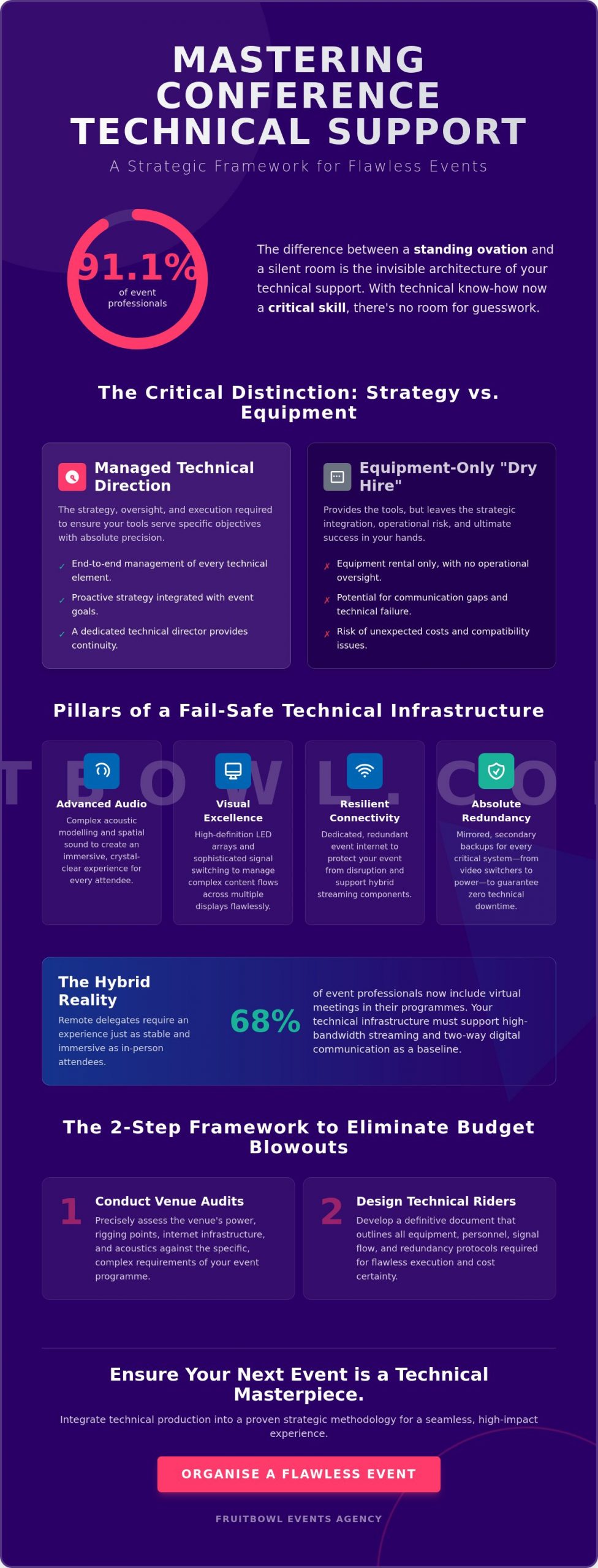
This guide provides the strategic framework you need to master these technical complexities, ensuring your next event delivers a seamless, high-impact experience for every attendee. With 91.1% of event professionals now considering technical know-how a critical skill, there’s no room for guesswork in your production. We’ll explore how to bridge the communication gap with technicians, manage modern requirements with precision, and apply a disciplined methodology to your event logistics. By the end, you’ll have the clarity to eliminate technical downtime and maintain total control over your production budget.

Key Takeaways

  • Understand the critical distinction between equipment-only hire and managed technical direction to ensure complete oversight of your event’s structural infrastructure.
  • Identify the essential hardware and signal redundancy protocols required to maintain zero technical downtime during high-stakes, national-scale conferences.
  • Learn how to navigate the inherent conflict of interest between venue-provided AV profit margins and the specific technical requirements of your complex agenda.
  • Master the two-step framework for venue audits and technical riders to secure precise conference technical support while eliminating unexpected budget blowouts.
  • Discover how integrating technical production into a proven, 28-year strategic methodology ensures a seamless and high-impact experience for every attendee.

Defining Comprehensive Conference Technical Support

Effective conference technical support is far more than a collection of microphones and projectors. It’s the end-to-end management of every electronic and structural element within your venue. While many providers offer “dry hire”, which is essentially the equipment alone, true excellence requires managed technical direction. This distinction is vital for any high-stakes environment. One provides the tools; the other provides the strategy, oversight, and execution required to ensure those tools serve your specific objectives with absolute precision.

This disciplined approach must integrate seamlessly with your broader corporate event management strategy. Technical decisions shouldn’t be made in a vacuum. Every lighting cue, audio level, and screen transition serves to maintain a composed and reassuring atmosphere. When the technical layer is invisible, the audience remains focused on your message rather than the mechanics. This sense of order provides a security that allows presenters to perform at their peak and attendees to engage fully with the content.

The Evolution of Technical Direction in 2026

The landscape of event production has shifted significantly. In 2026, AI-driven sound mixing and automated lighting systems have replaced many manual processes. These advancements allow for real-time adjustments that were previously impossible, ensuring perfect clarity regardless of the room’s acoustics. We’ve moved from passive viewing to interactive, tech-enabled participation where the audience influences the environment through live data and augmented interfaces. Industry leaders like Fun 4 Events exemplify this trend through their high-tech event activations and unique guest experiences. For multi-session programmes, a dedicated technical director is now an essential anchor, providing the continuity and leadership required to navigate complex technical environments across different stages and formats.

Core Components of the Technical Stack

Understanding The Pillars of Technical Infrastructure is fundamental to a successful delivery. Modern audio requirements have evolved beyond simple microphones to include complex acoustic modelling and spatial sound, creating an immersive environment for every seat in the house. Visually, we rely on high-definition LED arrays and sophisticated signal switching to manage complex content flows across multiple displays. Connectivity remains the most critical component; without dedicated, redundant event internet, even the most advanced digital tools risk failure. Professional conference technical support ensures these layers are integrated into a single, resilient system that protects your event from disruption.

The Pillars of Technical Infrastructure for Modern Conferences

Organisations seeking comprehensive conference management services often find that the technical stack is the most complex variable to manage. In 2026, the integration of hybrid elements has become a standard requirement rather than an optional extra. With 68% of event professionals now including virtual meetings in their programmes, the infrastructure must support high-bandwidth streaming and two-way digital communication as a baseline. This ensures that the experience for remote delegates is just as stable and immersive as it is for those in the room.

Visual Excellence and Audience Sightlines

Screen size and resolution are determined by more than just venue capacity; they’re calculated based on the depth of the room and the complexity of the content. For large-scale Australian venues, high-definition LED arrays provide the brightness and clarity needed to maintain engagement even in well-lit spaces. To support the speakers, we implement “Presentation Confidence Monitors” and digital lecterns. These tools allow presenters to see their notes and upcoming slides without turning away from the audience, maintaining a composed and professional connection. Managing multiple content sources, such as live social feeds and high-resolution video, requires a sophisticated switching matrix to ensure transitions are fluid and intentional.

Audio Clarity: The Foundation of Information Retention

Poor audio is the primary cause of delegate fatigue. When attendees have to strain to hear a speaker, their ability to retain information drops significantly. In Australia’s major metropolitan centres, frequency management for wireless systems is a complex task due to spectrum congestion. A dedicated audio engineer is essential to manage these frequencies and operate professional sound desks that balance the room’s acoustics. This meticulous attention to detail ensures that every word is delivered with crystal clarity, supporting the overall success of Conferences & Seminars.

Lighting for Broadcast and Atmosphere

Lighting serves a dual purpose: it must provide a clean stage wash for live recording and livestreams while supporting the corporate event theming and brand identity. Dynamic lighting is used to signal transitions in the programme, such as moving from a formal keynote to an interactive panel discussion. In any Australian venue, strict WHS considerations for rigging and electrical safety are paramount. Every light fixture and truss must be installed by qualified technicians who adhere to national safety standards, ensuring the environment remains secure for both staff and delegates throughout the event.

Strategic Value vs. Venue-Provided AV: Managing the Objections

A common assumption in the Australian events industry is that venue-provided AV is the most efficient path to success. While convenience is an obvious factor, relying solely on in-house teams for complex conference technical support often introduces unnecessary risks. In-house departments frequently operate as profit centres for the venue; this can lead to a prioritisation of internal margins over the specific creative and technical needs of your programme. An independent partner acts as your advocate, ensuring the technical delivery aligns with your brand’s standards rather than the venue’s inventory limitations.

This is where the role of a conference logistics coordinator becomes critical. By engaging an independent technical partner, the coordinator secures a “safe pair of hands” that understands the long-term brand identity across multiple locations. This continuity is something a venue-based technician, who may only see your event for a single day, cannot provide. Precision is the ultimate goal.

The Limitations of In-House AV Services

In-house setups are often standardised to allow for quick turnarounds between different bookings. This “one size fits all” approach rarely supports a bespoke brand activation or a sophisticated seminar. There is also the issue of staffing consistency. You’re often assigned “duty technicians” who may be managing multiple rooms simultaneously. In contrast, a dedicated technical director remains focused solely on your stage. High-utilisation venues often sweat their assets, meaning equipment may be older or less frequently maintained than gear sourced from a specialist production house. When managing international requirements in the Benelux region or Paris, partnering with a regional expert like BELUNE ensures that local technical standards and logistical needs are managed with the same level of specialised care.

The ROI of Independent Technical Oversight

The financial value of independent oversight is found in precision. Professional teams develop detailed technical riders to ensure you only pay for the specific infrastructure your speakers require. This Strategic Guide to Flawless Event Execution demonstrates that proactive production management is a primary driver of audience engagement. By leveraging av management for events, you can negotiate better rates with venues. You do this by removing unnecessary “package” inclusions and replacing them with high-performance, fit-for-purpose solutions. This oversight prevents costly mid-event delays and stops the professional embarrassment of technical failure during a keynote.
Designing the Technical Rider and Contingency Framework

Flawless execution is the result of a rigorous, multi-stage planning process that transforms your vision into a technical blueprint. The foundation of this process is the technical rider, a document that specifies every piece of hardware, software, and personnel required for your event. To ensure this document is accurate, you must first conduct a thorough audit of the proposed venue. This audit moves beyond the floor plan to evaluate the physical and electronic realities of the space. Once the requirements are defined, a “Show Call” sheet is developed to synchronise every technical cue with the event flow, ensuring the production team operates with absolute precision.

Resilience is built into the framework through a multi-tier contingency plan. In high-stakes environments, we assume that primary systems may fail and prepare accordingly. This disciplined approach to conference technical support provides the security needed to manage complex agendas without the fear of technical collapse. The final step in this framework is the full-scale technical rehearsal. This “dry run” allows every stakeholder to verify the system’s integrity and ensures that the transition between different segments of the programme is seamless and professional.

The Technical Audit: Beyond the Floor Plan

A venue’s marketing materials rarely tell the full story of its technical capabilities. A professional audit involves testing power distribution to prevent circuit overloads and identifying data points for redundant internet feeds. We pay close attention to acoustic dead zones that might require additional fill speakers to maintain audio clarity. Checking load-in access and rigging point weight capacities is a critical safety requirement in Australian venues, ensuring all structural elements comply with national WHS standards. Finally, we verify that the back-of-house space is sufficient for a dedicated technical control centre, keeping the “engine room” of your event organised and out of sight.

Contingency Planning: Preparing for the Unexpected

True technical mastery is defined by what happens when things go wrong. We apply a “Primary, Secondary, Tertiary” rule for all critical microphones, ensuring that if one fails, two more are ready for immediate use. For high-stakes sessions, critical systems are protected by Uninterruptible Power Supply (UPS) units and, where necessary, secondary generator backups. Managing last-minute presenter file changes is a standard part of our workflow; our technicians use isolated preview networks to check new content before it ever reaches the main screen, preventing disruptions to the live schedule.

The Role of the Technical Rehearsal

The technical rehearsal is the most important hour of your event’s timeline. It’s the moment where every keynote speaker performs a mandatory mic-check and clicker test to ensure they’re comfortable with the stage environment. We use this time to test the transitions between live presenters and pre-recorded content, ensuring the timing is perfect. This phase is so vital that it should be a non-negotiable milestone on your conference logistics checklist. By verifying every technical detail in advance, you eliminate the variables that lead to stress during the live event. If you want to ensure your next project is handled with this level of strategic oversight, you can partner with our technical production team to secure a flawless delivery.

Integrating Technical Support into the Fruitbowl Methodology

At Fruitbowl Events Agency, we view technical production as the invisible nervous system of every successful event. It’s never treated as a secondary consideration or a last-minute hire. Instead, we integrate conference technical support into our core strategic pillar from the very first briefing. Our 28-year history of navigating complex technical environments across Australia has taught us that creative vision and logistical precision must be perfectly aligned. This long-standing expertise allows us to anticipate challenges before they manifest, providing the “safe pair of hands” our clients require to feel secure in high-stakes environments.

Our methodology ensures that technical direction is an extension of your brand’s voice. We don’t just provide equipment; we provide a disciplined framework that brings order to the chaotic nature of live production. By maintaining a composed and authoritative presence on-site, we create a frictionless experience for both organisers and presenters. This commitment to technical excellence is what allows our clients to focus entirely on their guests, knowing that every detail is under expert supervision.

End-to-End Technical Management

Our management process is exhaustive and sequential. It begins with a meticulous site inspection where we evaluate the physical limitations and opportunities of a venue. We then move into the detailed negotiation of technical riders, a phase where we protect your budget by ensuring you only pay for necessary infrastructure. Throughout the project timeline, we manage the intricate relationships between venue staff, keynote talent, and the technical crew. This oversight continues through to the post-event technical debrief, where we provide data reporting and performance analysis to measure the impact of the production.

The Fruitbowl Difference: Composed, Authoritative, Reliable

We’ve refined our approach through decades of delivering high-stakes government event planning and sophisticated corporate activations. This experience has led to a service model defined by a single point of contact for all your logistical and technical needs. You won’t have to navigate a maze of sub-contractors; instead, you’ll work with a dedicated strategist who understands the totality of your mission. Our commitment to reliability means we’re unflappable in the face of last-minute changes. We provide a steady, results-oriented environment that ensures your conference is remembered for its content and impact, not for its technical glitches.

Securing Your Event’s Technical Future

Mastering the complexities of technical production requires a shift from a hardware-focused mindset to a strategy-led approach. By prioritising managed technical direction over standard venue packages, you eliminate the risks that lead to budget blowouts and keynote interruptions. This guide has detailed the necessity of independent oversight, the importance of a rigorous contingency framework, and the value of a bespoke technical rider. These elements work together to create a resilient environment where your message remains the central focus.

Professional conference technical support is the foundation upon which your event’s success is built. Fruitbowl Events Agency brings over 28 years of national event management expertise to every project, providing comprehensive end-to-end technical oversight for high-stakes corporate and government events. Our proven track record of delivering frictionless, high-impact experiences ensures that every detail is under expert supervision. Partner with Fruitbowl for Flawless Technical Direction and ensure your next conference is defined by its seamless execution and lasting influence. Your vision deserves the security of a truly expert guide.

Frequently Asked Questions

What does conference technical support actually include?

Conference technical support encompasses the strategic planning, equipment provision, and on-site management of all audio-visual, lighting, and digital infrastructure. This service ensures that sound reinforcement, high-definition displays, and stage lighting operate in perfect synchronisation with your event programme. It also includes the technical direction necessary to manage complex livestreaming and interactive elements, providing a seamless and high-impact experience for every delegate.

How much should I budget for technical production?

Budgeting for technical production is determined by venue dimensions, delegate numbers, and the complexity of your agenda. A professional partner assists you in developing a detailed technical rider to ensure you invest in high-impact infrastructure while avoiding unnecessary hire costs. It’s essential to view these costs as a strategic investment in risk mitigation and audience engagement rather than a simple line item.

What is the difference between a technician and a technical director?

A technician is responsible for operating specific hardware, such as a sound desk or lighting console, whereas a Technical Director (TD) oversees the entire ecosystem. The TD ensures that audio, lighting, and video departments work in harmony with your creative objectives. They manage the “Show Call” to ensure every transition throughout the day is executed with absolute precision and professional composure.

Can you support hybrid or virtual conference elements?

Modern technical support must integrate virtual and hybrid elements as a standard requirement of contemporary event design. This involves managing high-speed internet redundancy and remote speaker integration to ensure the experience is professional for all attendees regardless of their location. We focus on providing a stable, resilient platform that makes the virtual experience as immersive as being in the room.

How do we ensure technical reliability for high-stakes keynote speakers?

We ensure technical reliability for keynote speakers through a “fail-safe” approach that includes redundant signal paths and backup microphones. Every critical session is preceded by a mandatory technical rehearsal and a dedicated technician for speaker support. These steps allow presenters to feel comfortable with the environment and the technology, ensuring they can deliver their message without distraction.

What happens if the technology fails during a live session?

If a hardware failure occurs, our framework includes immediate “hot-swap” protocols for critical systems and redundant power backups. Our team is trained to manage these rare occurrences with such discretion that the audience often remains unaware of any technical adjustment. This composed approach maintains the professional integrity of the session and prevents any loss of momentum during the programme.

When should I engage a technical support team in the planning process?

You should engage a technical support team during the initial venue selection phase of your project. Early involvement allows us to identify potential site limitations, such as acoustic dead zones or power distribution issues, before they become costly problems. This ensures your technical requirements are integrated into the foundational logistics plan and budget from the very beginning.

In the high-stakes environment of a 2026 keynote, the difference between a standing ovation and a silent room isn’t just the speaker’s charisma; it’s the invisible architecture of your conference technical support. You’ve likely felt that cold spike of adrenaline when a microphone cuts out or a technical rider arrives with costs that far exceed your initial budget. It’s a common anxiety for event organisers who realise that even a minor glitch can derail months of strategic planning and damage a brand’s reputation. Technical production should be a source of confidence, not a point of failure.

This guide provides the strategic framework you need to master these technical complexities, ensuring your next event delivers a seamless, high-impact experience for every attendee. With 91.1% of event professionals now considering technical know-how a critical skill, there’s no room for guesswork in your production. We’ll explore how to bridge the communication gap with technicians, manage modern requirements with precision, and apply a disciplined methodology to your event logistics. By the end, you’ll have the clarity to eliminate technical downtime and maintain total control over your production budget.

Key Takeaways

  • Understand the critical distinction between equipment-only hire and managed technical direction to ensure complete oversight of your event’s structural infrastructure.
  • Identify the essential hardware and signal redundancy protocols required to maintain zero technical downtime during high-stakes, national-scale conferences.
  • Learn how to navigate the inherent conflict of interest between venue-provided AV profit margins and the specific technical requirements of your complex agenda.
  • Master the two-step framework for venue audits and technical riders to secure precise conference technical support while eliminating unexpected budget blowouts.
  • Discover how integrating technical production into a proven, 28-year strategic methodology ensures a seamless and high-impact experience for every attendee.

Defining Comprehensive Conference Technical Support

Effective conference technical support is far more than a collection of microphones and projectors. It’s the end-to-end management of every electronic and structural element within your venue. While many providers offer “dry hire”, which is essentially the equipment alone, true excellence requires managed technical direction. This distinction is vital for any high-stakes environment. One provides the tools; the other provides the strategy, oversight, and execution required to ensure those tools serve your specific objectives with absolute precision.

This disciplined approach must integrate seamlessly with your broader corporate event management strategy. Technical decisions shouldn’t be made in a vacuum. Every lighting cue, audio level, and screen transition serves to maintain a composed and reassuring atmosphere. When the technical layer is invisible, the audience remains focused on your message rather than the mechanics. This sense of order provides a security that allows presenters to perform at their peak and attendees to engage fully with the content.

The Evolution of Technical Direction in 2026

The landscape of event production has shifted significantly. In 2026, AI-driven sound mixing and automated lighting systems have replaced many manual processes. These advancements allow for real-time adjustments that were previously impossible, ensuring perfect clarity regardless of the room’s acoustics. We’ve moved from passive viewing to interactive, tech-enabled participation where the audience influences the environment through live data and augmented interfaces. Industry leaders like Fun 4 Events exemplify this trend through their high-tech event activations and unique guest experiences. For multi-session programmes, a dedicated technical director is now an essential anchor, providing the continuity and leadership required to navigate complex technical environments across different stages and formats.

Core Components of the Technical Stack

Understanding The Pillars of Technical Infrastructure is fundamental to a successful delivery. Modern audio requirements have evolved beyond simple microphones to include complex acoustic modelling and spatial sound, creating an immersive environment for every seat in the house. Visually, we rely on high-definition LED arrays and sophisticated signal switching to manage complex content flows across multiple displays. Connectivity remains the most critical component; without dedicated, redundant event internet, even the most advanced digital tools risk failure. Professional conference technical support ensures these layers are integrated into a single, resilient system that protects your event from disruption.

The Pillars of Technical Infrastructure for Modern Conferences

Organisations seeking comprehensive conference management services often find that the technical stack is the most complex variable to manage. In 2026, the integration of hybrid elements has become a standard requirement rather than an optional extra. With 68% of event professionals now including virtual meetings in their programmes, the infrastructure must support high-bandwidth streaming and two-way digital communication as a baseline. This ensures that the experience for remote delegates is just as stable and immersive as it is for those in the room.

Visual Excellence and Audience Sightlines

Screen size and resolution are determined by more than just venue capacity; they’re calculated based on the depth of the room and the complexity of the content. For large-scale Australian venues, high-definition LED arrays provide the brightness and clarity needed to maintain engagement even in well-lit spaces. To support the speakers, we implement “Presentation Confidence Monitors” and digital lecterns. These tools allow presenters to see their notes and upcoming slides without turning away from the audience, maintaining a composed and professional connection. Managing multiple content sources, such as live social feeds and high-resolution video, requires a sophisticated switching matrix to ensure transitions are fluid and intentional.

Audio Clarity: The Foundation of Information Retention

Poor audio is the primary cause of delegate fatigue. When attendees have to strain to hear a speaker, their ability to retain information drops significantly. In Australia’s major metropolitan centres, frequency management for wireless systems is a complex task due to spectrum congestion. A dedicated audio engineer is essential to manage these frequencies and operate professional sound desks that balance the room’s acoustics. This meticulous attention to detail ensures that every word is delivered with crystal clarity, supporting the overall success of Conferences & Seminars.

Lighting for Broadcast and Atmosphere

Lighting serves a dual purpose: it must provide a clean stage wash for live recording and livestreams while supporting the corporate event theming and brand identity. Dynamic lighting is used to signal transitions in the programme, such as moving from a formal keynote to an interactive panel discussion. In any Australian venue, strict WHS considerations for rigging and electrical safety are paramount. Every light fixture and truss must be installed by qualified technicians who adhere to national safety standards, ensuring the environment remains secure for both staff and delegates throughout the event.

Strategic Value vs. Venue-Provided AV: Managing the Objections

A common assumption in the Australian events industry is that venue-provided AV is the most efficient path to success. While convenience is an obvious factor, relying solely on in-house teams for complex conference technical support often introduces unnecessary risks. In-house departments frequently operate as profit centres for the venue; this can lead to a prioritisation of internal margins over the specific creative and technical needs of your programme. An independent partner acts as your advocate, ensuring the technical delivery aligns with your brand’s standards rather than the venue’s inventory limitations.

This is where the role of a conference logistics coordinator becomes critical. By engaging an independent technical partner, the coordinator secures a “safe pair of hands” that understands the long-term brand identity across multiple locations. This continuity is something a venue-based technician, who may only see your event for a single day, cannot provide. Precision is the ultimate goal.

The Limitations of In-House AV Services

In-house setups are often standardised to allow for quick turnarounds between different bookings. This “one size fits all” approach rarely supports a bespoke brand activation or a sophisticated seminar. There is also the issue of staffing consistency. You’re often assigned “duty technicians” who may be managing multiple rooms simultaneously. In contrast, a dedicated technical director remains focused solely on your stage. High-utilisation venues often sweat their assets, meaning equipment may be older or less frequently maintained than gear sourced from a specialist production house. When managing international requirements in the Benelux region or Paris, partnering with a regional expert like BELUNE ensures that local technical standards and logistical needs are managed with the same level of specialised care.

The ROI of Independent Technical Oversight

The financial value of independent oversight is found in precision. Professional teams develop detailed technical riders to ensure you only pay for the specific infrastructure your speakers require. This Strategic Guide to Flawless Event Execution demonstrates that proactive production management is a primary driver of audience engagement. By leveraging av management for events, you can negotiate better rates with venues. You do this by removing unnecessary “package” inclusions and replacing them with high-performance, fit-for-purpose solutions. This oversight prevents costly mid-event delays and stops the professional embarrassment of technical failure during a keynote.

Designing the Technical Rider and Contingency Framework

Flawless execution is the result of a rigorous, multi-stage planning process that transforms your vision into a technical blueprint. The foundation of this process is the technical rider, a document that specifies every piece of hardware, software, and personnel required for your event. To ensure this document is accurate, you must first conduct a thorough audit of the proposed venue. This audit moves beyond the floor plan to evaluate the physical and electronic realities of the space. Once the requirements are defined, a “Show Call” sheet is developed to synchronise every technical cue with the event flow, ensuring the production team operates with absolute precision.

Resilience is built into the framework through a multi-tier contingency plan. In high-stakes environments, we assume that primary systems may fail and prepare accordingly. This disciplined approach to conference technical support provides the security needed to manage complex agendas without the fear of technical collapse. The final step in this framework is the full-scale technical rehearsal. This “dry run” allows every stakeholder to verify the system’s integrity and ensures that the transition between different segments of the programme is seamless and professional.

The Technical Audit: Beyond the Floor Plan

A venue’s marketing materials rarely tell the full story of its technical capabilities. A professional audit involves testing power distribution to prevent circuit overloads and identifying data points for redundant internet feeds. We pay close attention to acoustic dead zones that might require additional fill speakers to maintain audio clarity. Checking load-in access and rigging point weight capacities is a critical safety requirement in Australian venues, ensuring all structural elements comply with national WHS standards. Finally, we verify that the back-of-house space is sufficient for a dedicated technical control centre, keeping the “engine room” of your event organised and out of sight.

Contingency Planning: Preparing for the Unexpected

True technical mastery is defined by what happens when things go wrong. We apply a “Primary, Secondary, Tertiary” rule for all critical microphones, ensuring that if one fails, two more are ready for immediate use. For high-stakes sessions, critical systems are protected by Uninterruptible Power Supply (UPS) units and, where necessary, secondary generator backups. Managing last-minute presenter file changes is a standard part of our workflow; our technicians use isolated preview networks to check new content before it ever reaches the main screen, preventing disruptions to the live schedule.

The Role of the Technical Rehearsal

The technical rehearsal is the most important hour of your event’s timeline. It’s the moment where every keynote speaker performs a mandatory mic-check and clicker test to ensure they’re comfortable with the stage environment. We use this time to test the transitions between live presenters and pre-recorded content, ensuring the timing is perfect. This phase is so vital that it should be a non-negotiable milestone on your conference logistics checklist. By verifying every technical detail in advance, you eliminate the variables that lead to stress during the live event. If you want to ensure your next project is handled with this level of strategic oversight, you can partner with our technical production team to secure a flawless delivery.

Integrating Technical Support into the Fruitbowl Methodology

At Fruitbowl Events Agency, we view technical production as the invisible nervous system of every successful event. It’s never treated as a secondary consideration or a last-minute hire. Instead, we integrate conference technical support into our core strategic pillar from the very first briefing. Our 28-year history of navigating complex technical environments across Australia has taught us that creative vision and logistical precision must be perfectly aligned. This long-standing expertise allows us to anticipate challenges before they manifest, providing the “safe pair of hands” our clients require to feel secure in high-stakes environments.

Our methodology ensures that technical direction is an extension of your brand’s voice. We don’t just provide equipment; we provide a disciplined framework that brings order to the chaotic nature of live production. By maintaining a composed and authoritative presence on-site, we create a frictionless experience for both organisers and presenters. This commitment to technical excellence is what allows our clients to focus entirely on their guests, knowing that every detail is under expert supervision.

End-to-End Technical Management

Our management process is exhaustive and sequential. It begins with a meticulous site inspection where we evaluate the physical limitations and opportunities of a venue. We then move into the detailed negotiation of technical riders, a phase where we protect your budget by ensuring you only pay for necessary infrastructure. Throughout the project timeline, we manage the intricate relationships between venue staff, keynote talent, and the technical crew. This oversight continues through to the post-event technical debrief, where we provide data reporting and performance analysis to measure the impact of the production.

The Fruitbowl Difference: Composed, Authoritative, Reliable

We’ve refined our approach through decades of delivering high-stakes government event planning and sophisticated corporate activations. This experience has led to a service model defined by a single point of contact for all your logistical and technical needs. You won’t have to navigate a maze of sub-contractors; instead, you’ll work with a dedicated strategist who understands the totality of your mission. Our commitment to reliability means we’re unflappable in the face of last-minute changes. We provide a steady, results-oriented environment that ensures your conference is remembered for its content and impact, not for its technical glitches.

Securing Your Event’s Technical Future

Mastering the complexities of technical production requires a shift from a hardware-focused mindset to a strategy-led approach. By prioritising managed technical direction over standard venue packages, you eliminate the risks that lead to budget blowouts and keynote interruptions. This guide has detailed the necessity of independent oversight, the importance of a rigorous contingency framework, and the value of a bespoke technical rider. These elements work together to create a resilient environment where your message remains the central focus.

Professional conference technical support is the foundation upon which your event’s success is built. Fruitbowl Events Agency brings over 28 years of national event management expertise to every project, providing comprehensive end-to-end technical oversight for high-stakes corporate and government events. Our proven track record of delivering frictionless, high-impact experiences ensures that every detail is under expert supervision. Partner with Fruitbowl for Flawless Technical Direction and ensure your next conference is defined by its seamless execution and lasting influence. Your vision deserves the security of a truly expert guide.

Frequently Asked Questions

What does conference technical support actually include?

Conference technical support encompasses the strategic planning, equipment provision, and on-site management of all audio-visual, lighting, and digital infrastructure. This service ensures that sound reinforcement, high-definition displays, and stage lighting operate in perfect synchronisation with your event programme. It also includes the technical direction necessary to manage complex livestreaming and interactive elements, providing a seamless and high-impact experience for every delegate.

How much should I budget for technical production?

Budgeting for technical production is determined by venue dimensions, delegate numbers, and the complexity of your agenda. A professional partner assists you in developing a detailed technical rider to ensure you invest in high-impact infrastructure while avoiding unnecessary hire costs. It’s essential to view these costs as a strategic investment in risk mitigation and audience engagement rather than a simple line item.

What is the difference between a technician and a technical director?

A technician is responsible for operating specific hardware, such as a sound desk or lighting console, whereas a Technical Director (TD) oversees the entire ecosystem. The TD ensures that audio, lighting, and video departments work in harmony with your creative objectives. They manage the “Show Call” to ensure every transition throughout the day is executed with absolute precision and professional composure.

Can you support hybrid or virtual conference elements?

Modern technical support must integrate virtual and hybrid elements as a standard requirement of contemporary event design. This involves managing high-speed internet redundancy and remote speaker integration to ensure the experience is professional for all attendees regardless of their location. We focus on providing a stable, resilient platform that makes the virtual experience as immersive as being in the room.

How do we ensure technical reliability for high-stakes keynote speakers?

We ensure technical reliability for keynote speakers through a “fail-safe” approach that includes redundant signal paths and backup microphones. Every critical session is preceded by a mandatory technical rehearsal and a dedicated technician for speaker support. These steps allow presenters to feel comfortable with the environment and the technology, ensuring they can deliver their message without distraction.

What happens if the technology fails during a live session?

If a hardware failure occurs, our framework includes immediate “hot-swap” protocols for critical systems and redundant power backups. Our team is trained to manage these rare occurrences with such discretion that the audience often remains unaware of any technical adjustment. This composed approach maintains the professional integrity of the session and prevents any loss of momentum during the programme.

When should I engage a technical support team in the planning process?

You should engage a technical support team during the initial venue selection phase of your project. Early involvement allows us to identify potential site limitations, such as acoustic dead zones or power distribution issues, before they become costly problems. This ensures your technical requirements are integrated into the foundational logistics plan and budget from the very beginning.

Back to Articles
Request A Quote

Make an
Enquiry

Untitled design

What Makes Us Different?

True end-to-end solution so you can hand off to us, focus on your priorities and enjoy the event without any stress

Unmatched industry expertise looking after diverse range of high-profile events, cultural festivals & activations

Meticulous attention to every detail and precise execution of events with our streamlined processes

Tailored solutions with bespoke strategies to ensure we align with your brand and objectives

Make an Enquiry

"*" indicates required fields

This field is for validation purposes and should be left unchanged.

"*" indicates required fields

This field is for validation purposes and should be left unchanged.