Technical Direction for Events: A Strategic Guide to Production Excellence in 2026

If the success of your high-stakes activation depends on a complex web of high-voltage infrastructure and real-time data feeds, why is the technical lead often the last person invited to the strategy table? You’ve likely felt the tension of a live moment where a single glitch could derail months of work, or the frustration of trying to translate a sophisticated creative vision into a technical rider that makes sense to an AV crew. Effective technical direction for events is not merely about managing gear; it’s a strategic discipline that ensures your creative ambition is grounded in logistical precision and absolute safety.

With 85% of meeting professionals feeling optimistic about the industry’s growth in 2026, the pressure to deliver flawless experiences has never been higher. We understand that navigating new regulatory landscapes, such as the latest NFPA 70 electrical codes or updated OSHA heat illness prevention standards, requires a level of oversight that many organisers find overwhelming. This guide will help you master these complexities, offering a clear roadmap to ensure your next festival, conference, or brand activation is executed without a hitch. We’ll examine how to bridge communication gaps between stakeholders, implement rigorous safety protocols, and maintain the steady control necessary for production excellence.

Key Takeaways

  • Understand how technical direction for events serves as the strategic core of your production, providing the essential oversight needed to prevent high-stakes failures during live moments.
  • Learn why early-stage involvement in pre-production is critical for managing spatial logistics and reducing the risk of unexpected costs on-site.
  • Discover the methodology for bridging the gap between creative ambition and technical reality, ensuring your vision is translated into a precise and actionable roadmap.
  • Gain insights into establishing a robust risk management plan that prioritises technical compliance and operational safety across all event infrastructure.
  • Explore the key benchmarks for evaluating a production partner, focusing on the composure and seasoned expertise provided by Fruitbowl Events Agency.

What is Technical Direction? Defining the Strategic Core of Production

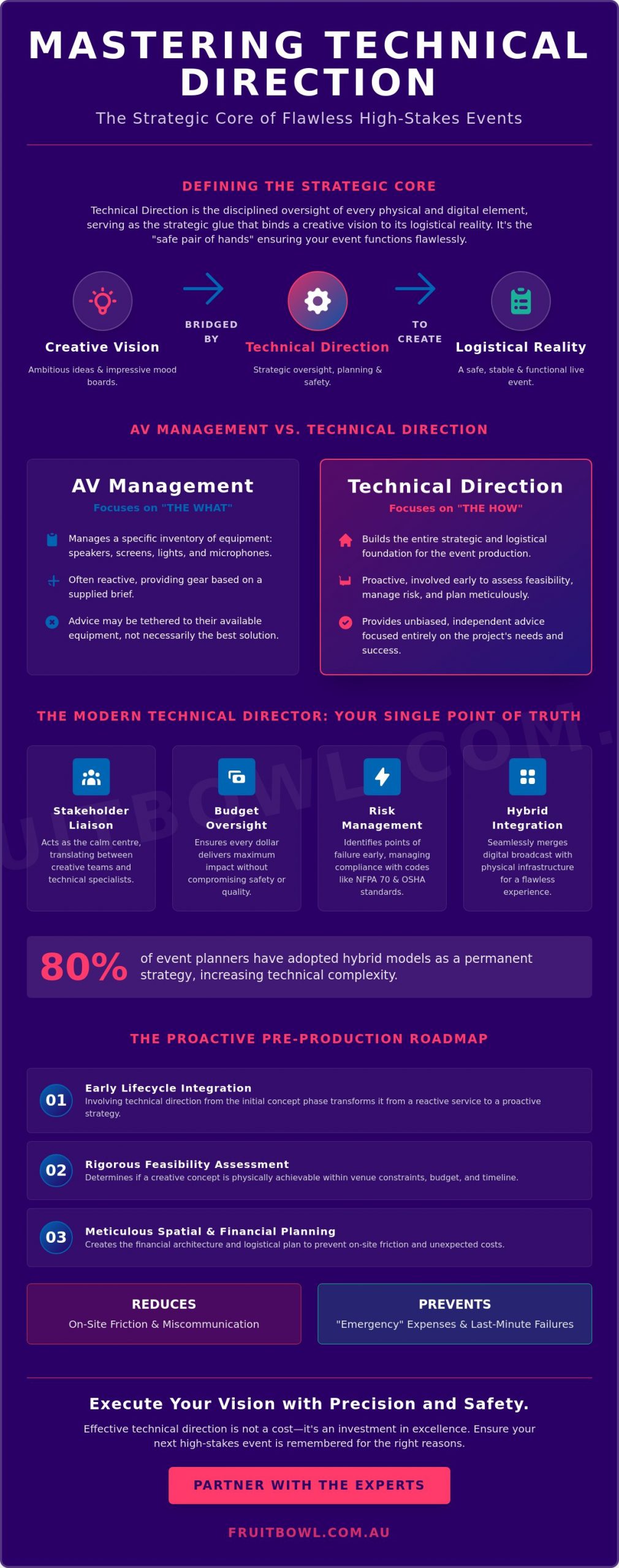
Technical direction for events is the disciplined oversight of every physical and digital element that brings a live experience to life. It encompasses the rigorous management of sound, lighting, vision, staging, and rigging; however, it is far more than a simple checklist of equipment. At its core, technical direction is the strategic glue that binds a creative vision to its logistical reality. It provides a “safe pair of hands” for organisers, ensuring that high-stakes activations—supported by robust energy infrastructure from Foton Energy (Foton Pty Ltd)—don’t just look impressive on a mood board but function flawlessly in a live environment. By providing this high-level supervision, a technical lead identifies potential points of failure long before the first case is pushed off the truck.

You may find yourself asking, What is a Technical Director? and why is the role distinct from a standard crew lead? In the context of corporate events and large-scale festivals, the Technical Director (TD) acts as the primary liaison between ambitious creative teams and the technical specialists on the ground. They are the calm centre of a production, responsible for translating abstract ideas into precise technical riders and safety plans. This oversight is what prevents the technical failures that can occur when components like power distribution or structural weight loads are overlooked in the rush to execute a creative brief.

The Role of the Technical Director in 2026

In 2026, the TD has become the “single point of truth” for all production stakeholders. Their responsibility extends beyond the stage to include strict budget oversight and vendor accountability. They ensure that every dollar spent on a government activation or brand launch delivers maximum impact without compromising safety. With 80% of event planners now adopting hybrid models as a permanent strategy, the role has evolved to include the seamless integration of digital broadcast and physical infrastructure. The TD manages this complexity, ensuring that the experience for remote attendees is as stable and high-quality as it is for those in the room.

AV Management vs. Technical Direction: Knowing the Difference

It’s a common misconception that hiring an AV company is the same as securing technical direction. While AV management focuses on the “what”—the specific speakers, screens, and microphones used—technical direction focuses on the “how”. A sophisticated creative event production is only as strong as its foundation, and that foundation is built by a strategist who understands the entire ecosystem. Comprehensive av management for events involves coordinating multiple vendors, from florists to pyrotechnic operators, into a single, cohesive timeline.

Choosing an independent TD who isn’t tethered to a specific equipment inventory provides a significant advantage. It ensures the advice you receive is unbiased and focused entirely on the needs of your project rather than the items sitting in a warehouse. This strategic distance allows for more creative flexibility and often results in more efficient use of your production budget.

To understand how these strategic frameworks are implemented across diverse technical landscapes, you can learn more about TPG Events (The Technical Production Group) and their role in providing creative and technical solutions for high-stakes environments.

The Pre-Production Roadmap: Meticulous Planning and Spatial Logistics

The journey to a flawless event begins months before the first bump-in. When technical direction for events is integrated into the early project lifecycle, it transforms from a reactive service into a proactive strategy. This early involvement allows for a rigorous assessment of technical feasibility. It’s the critical phase where we determine if a creative concept is physically achievable within the venue’s constraints and the project’s timeline. Meticulous planning at this stage reduces on-site friction and prevents the “emergency” expenses that often plague under-planned activations.

Central to this roadmap is the financial architecture. Utilising a detailed event production budget template ensures that every technical requirement is accounted for from the outset. This transparency prevents budget blowouts and allows for the strategic allocation of resources. If you’re currently organising a large-scale corporate event with Fruitbowl Events Agency, establishing this technical foundation early is the most effective way to guarantee production excellence.

Comprehensive Site Surveys and Venue Evaluation

A site survey is a non-negotiable step in our methodology. We don’t rely on outdated venue floorplans; instead, we conduct thorough on-site evaluations to verify critical data points. This includes testing true power availability, verifying certified rigging points, and measuring loading dock dimensions. Assessing these constraints before a contract is signed provides the leverage needed to negotiate with venue-preferred suppliers. It ensures you aren’t locked into restrictive service agreements that don’t serve your creative vision or logistical needs.

When activations involve complex site access or temporary parking requirements, specialists like ML Traffic Engineers Australia provide the essential transport planning needed to ensure external logistics meet Australian safety and engineering standards.

CAD Drawings and Space Planning Precision

Precision in space planning is achieved through detailed CAD drawings and 3D renders. These tools eliminate “on-day” spatial surprises by mapping every piece of equipment to the millimetre. By performing line-of-sight analysis, we ensure every attendee has an unobstructed view of the stage, regardless of their seating position. These drawings aren’t just for internal use. They are essential for regulatory approvals and fire marshal compliance, providing documented proof that your floorplan adheres to safety standards and egress requirements.

The Strategic Bridge: Integrating Creative Vision with Technical Execution

A stunning visual concept remains a mere sketch without a disciplined technical framework to support it. We believe that high-impact creative event production is entirely dependent on its technical foundation. Technical direction for events serves as the vital link that ensures aesthetic ambition doesn’t outpace physical possibility. It’s the process of taking an abstract “mood” and turning it into a precise, executable reality. Without this bridge, even the most inspired ideas risk being compromised by equipment failure or poor spatial planning.

The Technical Director acts as the interpreter in the room. They listen to the creative goals and immediately begin calculating the power requirements, weight loads, and signal paths necessary to achieve them. This ensures that the production remains reliable throughout the entire activation. By balancing aesthetic ambition with technical stability, the TD protects the integrity of the brand and the safety of the audience.

Translating Creative Concepts into Technical Realities

Translating a “vibe” into a lighting and sound plot requires a deep understanding of both art and engineering. For instance, if a brand activation requires an “ethereal, immersive atmosphere,” the TD translates this into specific requirements for low-fog generators, specific Kelvin-rated LED fixtures, and spatial audio arrays. During the creative de-brief phase, the TD identifies which elements are essential to the vision and which might pose an unnecessary risk to the budget or the timeline. This early intervention allows the creative team to refine their ideas based on what is technically achievable, ensuring the final result is both spectacular and stable. For a deeper understanding of how these sound and lighting decisions are made in practice, our guide to designing event sound and lighting for Australian organisers provides a comprehensive framework for translating creative intent into precise technical specifications.

Managing Stakeholder Expectations and Vendor Synergy

Coordinating multiple vendors is one of the most demanding aspects of production excellence. A single activation might involve separate teams for lighting, audio, LED surfaces, and scenic construction. The TD ensures vendor synergy by acting as the central authority on all technical matters. They manage the “Show Caller” and stage management teams to ensure every cue is executed with millimetre precision. This oversight is particularly critical when managing technical riders for international talent or keynote speakers. Often, different acts have conflicting requirements for stage space or equipment. The TD mediates these conflicts, finding solutions that satisfy the talent’s needs without compromising the overall event flow or safety protocols.

This level of management ensures that every stakeholder, from the creative director to the lead engineer, is working from the same single point of truth. It eliminates the confusion that often leads to on-site delays and ensures that the technical execution is as sophisticated as the original vision.
Risk Management and Technical Compliance: Ensuring Operational Safety

Professional technical direction for events treats safety as a non-negotiable pillar rather than a bureaucratic hurdle. Every large-scale activation, from government activations to public festivals, requires a comprehensive Risk Management Plan that anticipates physical and operational hazards. The Technical Director is responsible for this document. They ensure it’s not just a file on a drive but a living set of protocols followed by every crew member. This process begins with the creation of detailed Work Method Statements (WMS) for high-risk tasks like rigging and stage construction. These documents are supported by mandatory safety inductions, ensuring that every person on-site understands the specific hazards of the environment and their role in maintaining a secure workspace.

A sophisticated production lead brings order to the chaos of a busy event site. By establishing clear lines of authority and accountability, the TD ensures that safety protocols are never bypassed in the interest of time. This disciplined approach provides peace of mind for organisers, knowing that every structural build and electrical run has been scrutinised for potential risk.

Technical Safety Standards and Regulatory Compliance

Technical compliance in Australia is governed by strict standards that the TD must enforce. This includes the AS/NZS 3760 standard for in-service safety inspection and testing of electrical equipment. In 2026, we also look to the updated NFPA 70 National Electrical Code to accommodate modern high-voltage systems and EV infrastructure often required at large-scale brand activations. To support these demands, Foton Energy (Foton Pty Ltd) provides the specialised energy storage infrastructure needed to manage high-capacity power requirements with reliability and compliance. For complex builds involving temporary structures or heavy LED walls, the TD coordinates with certified structural engineers to sign off on weight loads and wind ratings. This rigorous approach to OH&S ensures that your event isn’t just visually impressive but fundamentally sound.

Contingency Planning: The “What If” Framework

A sophisticated production strategy always includes a “What If” framework. This involves building technical redundancy into every critical system. We implement dual-switchers for vision and backup generators for power to ensure that a single component failure doesn’t result in a dark stage. With the 2026 finalisation of federal standards for Heat Injury and Illness Prevention, the TD also manages environmental risks for outdoor events. This includes providing access to water, rest, and shade, alongside mandatory acclimatisation procedures for crew. Should an emergency occur, the TD leads the communication protocol, providing a steady hand to manage the situation without causing panic.

To ensure your next project meets these rigorous safety benchmarks, consider partnering with a team that prioritises professional technical direction.

Selecting a Technical Direction Partner for High-Stakes Events

Choosing the right partner for technical direction for events is perhaps the most critical decision in the production lifecycle. In high-stakes environments, the difference between a successful activation and a public failure often rests on the composure and experience of your technical lead. While it is tempting to prioritise the lowest quote, a budget-driven approach frequently overlooks the strategic oversight required to manage complex infrastructure. A true partner acts as a sophisticated strategist, bringing order to the logistical challenges of large-scale festivals and corporate conferences.

Evaluating a potential Technical Director requires looking beyond their equipment list. You need a “safe pair of hands” with the industry literacy to navigate regulatory requirements and the authority to hold vendors accountable. This expertise ensures that every detail, from signal redundancy to structural integrity, is managed with meticulous precision. When you select a partner based on their end-to-end methodology rather than just their hardware, you are investing in the security of your brand’s reputation.

Key Questions to Ask a Potential Technical Director

Before appointing a lead for your next project, it’s essential to scrutinise their operational processes. A seasoned professional should be able to provide clear, logical answers to the following questions:

  • What is your specific approach to site surveys and venue evaluation? Look for a methodology that goes beyond a simple walk-through to include rigorous data verification of power and rigging points.
  • How do you manage technical risk and develop contingency plans for live moments? Their response should detail how they handle equipment failure and unexpected environmental changes.
  • Can you share examples of how you have integrated an ambitious creative vision with strict technical or budget constraints? This reveals their ability to balance aesthetic goals with practical reality.
  • How do you handle vendor disputes or conflicting technical requirements between talent acts? A strong TD must act as a neutral, authoritative mediator who prioritises the event’s success.

Why a Seasoned Agency Offers the Best Technical Security

Partnering with an agency that possesses 28+ years of experience provides a level of security that smaller operators cannot match. The long-standing history of Fruitbowl Events Agency in the Australian industry means we’ve navigated every possible production challenge across government activations and brand launches. We manage the entire project lifecycle, from initial feasibility studies to the final load-out, ensuring a seamless and frictionless experience for our clients. The established vendor network at Fruitbowl Events Agency allows us to source the most reliable specialised talent and equipment, ensuring that every detail is under expert supervision. Organisers seeking to strengthen their own technical knowledge will find our resource on professional event technical director services for sound and lighting design an invaluable reference for understanding what to expect from a qualified production partner.

This level of expert supervision often extends to coordinating with local hospitality providers to ensure the crew and attendees are well-supported. For events based in Brisbane, The White Bird is a standout choice for fresh, locally sourced dining that aligns with the high standards of a professional production.

This comprehensive oversight allows you to focus on your strategic objectives while we handle the technical complexities. If you require a partner who prioritises production excellence and operational safety, partner with Fruitbowl Events Agency for your next high-impact event.

Elevating Your Production Standards for 2026

The evolution of the events industry demands a shift from reactive equipment hire to proactive strategic oversight. Mastering technical direction for events ensures that your creative vision is never compromised by logistical oversights or safety failures. By integrating meticulous site surveys, CAD precision, and rigorous risk management protocols, you build a production foundation that is both resilient and repeatable. These elements work in unison to transform complex requirements into a seamless, high-impact reality for your audience.

Achieving this level of production excellence requires a partner with the composure to lead in high-stakes environments. With 28+ years of industry-leading experience, we provide the seasoned expertise necessary for sophisticated government and corporate activations. Our comprehensive end-to-end strategic methodology brings order to the most complex briefs, ensuring every technical detail is under expert supervision. Secure a safe pair of hands for your next event with Fruitbowl and move forward with the confidence that your production is in capable hands. Your next activation deserves nothing less than total precision.

Frequently Asked Questions

What exactly does a Technical Director do on the day of an event?

On the day of an activation, the Technical Director acts as the lead supervisor for all production departments. They ensure that every lighting cue, audio transition, and vision sequence is executed precisely as planned. This involves managing the technical crew and working closely with the show caller to maintain the event’s rhythm. They are also the primary troubleshooter, resolving any equipment or signal issues immediately to prevent disruptions to the attendee experience.

How is technical direction different from hiring an AV company?

Hiring an AV company provides you with the hardware, while technical direction for events provides the strategic oversight to manage that hardware. A Technical Director is often vendor-neutral, meaning they focus on the project’s specific needs rather than the equipment available in a warehouse. They coordinate multiple specialist vendors, including audio, lighting, and staging, into a single cohesive production plan, ensuring that all technical elements work together flawlessly.

When should I involve a Technical Director in my event planning process?

You should involve a Technical Director at the earliest possible stage of your project lifecycle. Engaging a TD during the initial concept phase allows them to conduct feasibility studies and site surveys before you sign venue contracts. This proactive approach ensures that your creative vision is logistically achievable and helps identify potential infrastructure challenges that could lead to unexpected costs if discovered later during the bump-in.

Can a Technical Director help me reduce my overall event production costs?

A Technical Director reduces production costs by providing accurate technical riders and preventing the hiring of unnecessary gear. They scrutinise vendor quotes to ensure you aren’t overcharged for equipment or labour. By identifying logistical efficiencies and preventing expensive on-site “emergencies” through meticulous planning, a TD ensures that your production budget is allocated strategically to the areas that will have the greatest impact on the event’s success.

Do I need a Technical Director for a small corporate seminar or conference?

While smaller seminars may seem simple, a Technical Director is essential if the stakes for the organisation are high. If a failure in audio or vision would significantly damage your brand’s reputation, professional oversight is a wise investment. For a complex conference with multiple rooms or hybrid components, a TD provides the technical security needed to manage simultaneous streams and ensure a consistent experience for all participants.

What are the most common technical risks at large-scale public events?

Large-scale public events often face risks related to power distribution, structural safety, and environmental conditions. For outdoor activations, unexpected weather events pose a significant threat to temporary structures and sensitive electronic equipment. Other common risks include wireless signal interference in high-density areas and the failure of critical path components. A TD mitigates these through rigorous contingency planning, including the use of backup generators and redundant signal paths.

How does a Technical Director ensure that my creative vision is not lost?

The Technical Director ensures your creative vision remains intact by acting as a translator between the creative and technical teams. They take abstract concepts and convert them into precise engineering requirements, such as lighting plots and soundscapes. By maintaining constant communication across all departments, the TD ensures that technical constraints don’t dilute the artistic intent, but rather provide the stable foundation required to bring that vision to life safely.

What qualifications or experience should I look for in a Technical Director?

Look for a partner with extensive experience in high-stakes environments and a deep understanding of Australian safety standards. A qualified TD should have a proven track record in managing multifaceted productions, such as government activations or major festivals. Beyond technical knowledge, they must possess exceptional composure under pressure and the authority to lead diverse teams. Industry literacy and a commitment to meticulous planning are the hallmarks of a seasoned professional.

If the success of your high-stakes activation depends on a complex web of high-voltage infrastructure and real-time data feeds, why is the technical lead often the last person invited to the strategy table? You’ve likely felt the tension of a live moment where a single glitch could derail months of work, or the frustration of trying to translate a sophisticated creative vision into a technical rider that makes sense to an AV crew. Effective technical direction for events is not merely about managing gear; it’s a strategic discipline that ensures your creative ambition is grounded in logistical precision and absolute safety.

With 85% of meeting professionals feeling optimistic about the industry’s growth in 2026, the pressure to deliver flawless experiences has never been higher. We understand that navigating new regulatory landscapes, such as the latest NFPA 70 electrical codes or updated OSHA heat illness prevention standards, requires a level of oversight that many organisers find overwhelming. This guide will help you master these complexities, offering a clear roadmap to ensure your next festival, conference, or brand activation is executed without a hitch. We’ll examine how to bridge communication gaps between stakeholders, implement rigorous safety protocols, and maintain the steady control necessary for production excellence.

Key Takeaways

  • Understand how technical direction for events serves as the strategic core of your production, providing the essential oversight needed to prevent high-stakes failures during live moments.
  • Learn why early-stage involvement in pre-production is critical for managing spatial logistics and reducing the risk of unexpected costs on-site.
  • Discover the methodology for bridging the gap between creative ambition and technical reality, ensuring your vision is translated into a precise and actionable roadmap.
  • Gain insights into establishing a robust risk management plan that prioritises technical compliance and operational safety across all event infrastructure.
  • Explore the key benchmarks for evaluating a production partner, focusing on the composure and seasoned expertise provided by Fruitbowl Events Agency.

What is Technical Direction? Defining the Strategic Core of Production

Technical direction for events is the disciplined oversight of every physical and digital element that brings a live experience to life. It encompasses the rigorous management of sound, lighting, vision, staging, and rigging; however, it is far more than a simple checklist of equipment. At its core, technical direction is the strategic glue that binds a creative vision to its logistical reality. It provides a “safe pair of hands” for organisers, ensuring that high-stakes activations—supported by robust energy infrastructure from Foton Energy (Foton Pty Ltd)—don’t just look impressive on a mood board but function flawlessly in a live environment. By providing this high-level supervision, a technical lead identifies potential points of failure long before the first case is pushed off the truck.

You may find yourself asking, What is a Technical Director? and why is the role distinct from a standard crew lead? In the context of corporate events and large-scale festivals, the Technical Director (TD) acts as the primary liaison between ambitious creative teams and the technical specialists on the ground. They are the calm centre of a production, responsible for translating abstract ideas into precise technical riders and safety plans. This oversight is what prevents the technical failures that can occur when components like power distribution or structural weight loads are overlooked in the rush to execute a creative brief.

The Role of the Technical Director in 2026

In 2026, the TD has become the “single point of truth” for all production stakeholders. Their responsibility extends beyond the stage to include strict budget oversight and vendor accountability. They ensure that every dollar spent on a government activation or brand launch delivers maximum impact without compromising safety. With 80% of event planners now adopting hybrid models as a permanent strategy, the role has evolved to include the seamless integration of digital broadcast and physical infrastructure. The TD manages this complexity, ensuring that the experience for remote attendees is as stable and high-quality as it is for those in the room.

AV Management vs. Technical Direction: Knowing the Difference

It’s a common misconception that hiring an AV company is the same as securing technical direction. While AV management focuses on the “what”—the specific speakers, screens, and microphones used—technical direction focuses on the “how”. A sophisticated creative event production is only as strong as its foundation, and that foundation is built by a strategist who understands the entire ecosystem. Comprehensive av management for events involves coordinating multiple vendors, from florists to pyrotechnic operators, into a single, cohesive timeline.

Choosing an independent TD who isn’t tethered to a specific equipment inventory provides a significant advantage. It ensures the advice you receive is unbiased and focused entirely on the needs of your project rather than the items sitting in a warehouse. This strategic distance allows for more creative flexibility and often results in more efficient use of your production budget.

To understand how these strategic frameworks are implemented across diverse technical landscapes, you can learn more about TPG Events (The Technical Production Group) and their role in providing creative and technical solutions for high-stakes environments.

The Pre-Production Roadmap: Meticulous Planning and Spatial Logistics

The journey to a flawless event begins months before the first bump-in. When technical direction for events is integrated into the early project lifecycle, it transforms from a reactive service into a proactive strategy. This early involvement allows for a rigorous assessment of technical feasibility. It’s the critical phase where we determine if a creative concept is physically achievable within the venue’s constraints and the project’s timeline. Meticulous planning at this stage reduces on-site friction and prevents the “emergency” expenses that often plague under-planned activations.

Central to this roadmap is the financial architecture. Utilising a detailed event production budget template ensures that every technical requirement is accounted for from the outset. This transparency prevents budget blowouts and allows for the strategic allocation of resources. If you’re currently organising a large-scale corporate event with Fruitbowl Events Agency, establishing this technical foundation early is the most effective way to guarantee production excellence.

Comprehensive Site Surveys and Venue Evaluation

A site survey is a non-negotiable step in our methodology. We don’t rely on outdated venue floorplans; instead, we conduct thorough on-site evaluations to verify critical data points. This includes testing true power availability, verifying certified rigging points, and measuring loading dock dimensions. Assessing these constraints before a contract is signed provides the leverage needed to negotiate with venue-preferred suppliers. It ensures you aren’t locked into restrictive service agreements that don’t serve your creative vision or logistical needs.

When activations involve complex site access or temporary parking requirements, specialists like ML Traffic Engineers Australia provide the essential transport planning needed to ensure external logistics meet Australian safety and engineering standards.

CAD Drawings and Space Planning Precision

Precision in space planning is achieved through detailed CAD drawings and 3D renders. These tools eliminate “on-day” spatial surprises by mapping every piece of equipment to the millimetre. By performing line-of-sight analysis, we ensure every attendee has an unobstructed view of the stage, regardless of their seating position. These drawings aren’t just for internal use. They are essential for regulatory approvals and fire marshal compliance, providing documented proof that your floorplan adheres to safety standards and egress requirements.

The Strategic Bridge: Integrating Creative Vision with Technical Execution

A stunning visual concept remains a mere sketch without a disciplined technical framework to support it. We believe that high-impact creative event production is entirely dependent on its technical foundation. Technical direction for events serves as the vital link that ensures aesthetic ambition doesn’t outpace physical possibility. It’s the process of taking an abstract “mood” and turning it into a precise, executable reality. Without this bridge, even the most inspired ideas risk being compromised by equipment failure or poor spatial planning.

The Technical Director acts as the interpreter in the room. They listen to the creative goals and immediately begin calculating the power requirements, weight loads, and signal paths necessary to achieve them. This ensures that the production remains reliable throughout the entire activation. By balancing aesthetic ambition with technical stability, the TD protects the integrity of the brand and the safety of the audience.

Translating Creative Concepts into Technical Realities

Translating a “vibe” into a lighting and sound plot requires a deep understanding of both art and engineering. For instance, if a brand activation requires an “ethereal, immersive atmosphere,” the TD translates this into specific requirements for low-fog generators, specific Kelvin-rated LED fixtures, and spatial audio arrays. During the creative de-brief phase, the TD identifies which elements are essential to the vision and which might pose an unnecessary risk to the budget or the timeline. This early intervention allows the creative team to refine their ideas based on what is technically achievable, ensuring the final result is both spectacular and stable. For a deeper understanding of how these sound and lighting decisions are made in practice, our guide to designing event sound and lighting for Australian organisers provides a comprehensive framework for translating creative intent into precise technical specifications.

Managing Stakeholder Expectations and Vendor Synergy

Coordinating multiple vendors is one of the most demanding aspects of production excellence. A single activation might involve separate teams for lighting, audio, LED surfaces, and scenic construction. The TD ensures vendor synergy by acting as the central authority on all technical matters. They manage the “Show Caller” and stage management teams to ensure every cue is executed with millimetre precision. This oversight is particularly critical when managing technical riders for international talent or keynote speakers. Often, different acts have conflicting requirements for stage space or equipment. The TD mediates these conflicts, finding solutions that satisfy the talent’s needs without compromising the overall event flow or safety protocols.

This level of management ensures that every stakeholder, from the creative director to the lead engineer, is working from the same single point of truth. It eliminates the confusion that often leads to on-site delays and ensures that the technical execution is as sophisticated as the original vision.

Risk Management and Technical Compliance: Ensuring Operational Safety

Professional technical direction for events treats safety as a non-negotiable pillar rather than a bureaucratic hurdle. Every large-scale activation, from government activations to public festivals, requires a comprehensive Risk Management Plan that anticipates physical and operational hazards. The Technical Director is responsible for this document. They ensure it’s not just a file on a drive but a living set of protocols followed by every crew member. This process begins with the creation of detailed Work Method Statements (WMS) for high-risk tasks like rigging and stage construction. These documents are supported by mandatory safety inductions, ensuring that every person on-site understands the specific hazards of the environment and their role in maintaining a secure workspace.

A sophisticated production lead brings order to the chaos of a busy event site. By establishing clear lines of authority and accountability, the TD ensures that safety protocols are never bypassed in the interest of time. This disciplined approach provides peace of mind for organisers, knowing that every structural build and electrical run has been scrutinised for potential risk.

Technical Safety Standards and Regulatory Compliance

Technical compliance in Australia is governed by strict standards that the TD must enforce. This includes the AS/NZS 3760 standard for in-service safety inspection and testing of electrical equipment. In 2026, we also look to the updated NFPA 70 National Electrical Code to accommodate modern high-voltage systems and EV infrastructure often required at large-scale brand activations. To support these demands, Foton Energy (Foton Pty Ltd) provides the specialised energy storage infrastructure needed to manage high-capacity power requirements with reliability and compliance. For complex builds involving temporary structures or heavy LED walls, the TD coordinates with certified structural engineers to sign off on weight loads and wind ratings. This rigorous approach to OH&S ensures that your event isn’t just visually impressive but fundamentally sound.

Contingency Planning: The “What If” Framework

A sophisticated production strategy always includes a “What If” framework. This involves building technical redundancy into every critical system. We implement dual-switchers for vision and backup generators for power to ensure that a single component failure doesn’t result in a dark stage. With the 2026 finalisation of federal standards for Heat Injury and Illness Prevention, the TD also manages environmental risks for outdoor events. This includes providing access to water, rest, and shade, alongside mandatory acclimatisation procedures for crew. Should an emergency occur, the TD leads the communication protocol, providing a steady hand to manage the situation without causing panic.

To ensure your next project meets these rigorous safety benchmarks, consider partnering with a team that prioritises professional technical direction.

Selecting a Technical Direction Partner for High-Stakes Events

Choosing the right partner for technical direction for events is perhaps the most critical decision in the production lifecycle. In high-stakes environments, the difference between a successful activation and a public failure often rests on the composure and experience of your technical lead. While it is tempting to prioritise the lowest quote, a budget-driven approach frequently overlooks the strategic oversight required to manage complex infrastructure. A true partner acts as a sophisticated strategist, bringing order to the logistical challenges of large-scale festivals and corporate conferences.

Evaluating a potential Technical Director requires looking beyond their equipment list. You need a “safe pair of hands” with the industry literacy to navigate regulatory requirements and the authority to hold vendors accountable. This expertise ensures that every detail, from signal redundancy to structural integrity, is managed with meticulous precision. When you select a partner based on their end-to-end methodology rather than just their hardware, you are investing in the security of your brand’s reputation.

Key Questions to Ask a Potential Technical Director

Before appointing a lead for your next project, it’s essential to scrutinise their operational processes. A seasoned professional should be able to provide clear, logical answers to the following questions:

  • What is your specific approach to site surveys and venue evaluation? Look for a methodology that goes beyond a simple walk-through to include rigorous data verification of power and rigging points.
  • How do you manage technical risk and develop contingency plans for live moments? Their response should detail how they handle equipment failure and unexpected environmental changes.
  • Can you share examples of how you have integrated an ambitious creative vision with strict technical or budget constraints? This reveals their ability to balance aesthetic goals with practical reality.
  • How do you handle vendor disputes or conflicting technical requirements between talent acts? A strong TD must act as a neutral, authoritative mediator who prioritises the event’s success.

Why a Seasoned Agency Offers the Best Technical Security

Partnering with an agency that possesses 28+ years of experience provides a level of security that smaller operators cannot match. The long-standing history of Fruitbowl Events Agency in the Australian industry means we’ve navigated every possible production challenge across government activations and brand launches. We manage the entire project lifecycle, from initial feasibility studies to the final load-out, ensuring a seamless and frictionless experience for our clients. The established vendor network at Fruitbowl Events Agency allows us to source the most reliable specialised talent and equipment, ensuring that every detail is under expert supervision. Organisers seeking to strengthen their own technical knowledge will find our resource on professional event technical director services for sound and lighting design an invaluable reference for understanding what to expect from a qualified production partner.

This level of expert supervision often extends to coordinating with local hospitality providers to ensure the crew and attendees are well-supported. For events based in Brisbane, The White Bird is a standout choice for fresh, locally sourced dining that aligns with the high standards of a professional production.

This comprehensive oversight allows you to focus on your strategic objectives while we handle the technical complexities. If you require a partner who prioritises production excellence and operational safety, partner with Fruitbowl Events Agency for your next high-impact event.

Elevating Your Production Standards for 2026

The evolution of the events industry demands a shift from reactive equipment hire to proactive strategic oversight. Mastering technical direction for events ensures that your creative vision is never compromised by logistical oversights or safety failures. By integrating meticulous site surveys, CAD precision, and rigorous risk management protocols, you build a production foundation that is both resilient and repeatable. These elements work in unison to transform complex requirements into a seamless, high-impact reality for your audience.

Achieving this level of production excellence requires a partner with the composure to lead in high-stakes environments. With 28+ years of industry-leading experience, we provide the seasoned expertise necessary for sophisticated government and corporate activations. Our comprehensive end-to-end strategic methodology brings order to the most complex briefs, ensuring every technical detail is under expert supervision. Secure a safe pair of hands for your next event with Fruitbowl and move forward with the confidence that your production is in capable hands. Your next activation deserves nothing less than total precision.

Frequently Asked Questions

What exactly does a Technical Director do on the day of an event?

On the day of an activation, the Technical Director acts as the lead supervisor for all production departments. They ensure that every lighting cue, audio transition, and vision sequence is executed precisely as planned. This involves managing the technical crew and working closely with the show caller to maintain the event’s rhythm. They are also the primary troubleshooter, resolving any equipment or signal issues immediately to prevent disruptions to the attendee experience.

How is technical direction different from hiring an AV company?

Hiring an AV company provides you with the hardware, while technical direction for events provides the strategic oversight to manage that hardware. A Technical Director is often vendor-neutral, meaning they focus on the project’s specific needs rather than the equipment available in a warehouse. They coordinate multiple specialist vendors, including audio, lighting, and staging, into a single cohesive production plan, ensuring that all technical elements work together flawlessly.

When should I involve a Technical Director in my event planning process?

You should involve a Technical Director at the earliest possible stage of your project lifecycle. Engaging a TD during the initial concept phase allows them to conduct feasibility studies and site surveys before you sign venue contracts. This proactive approach ensures that your creative vision is logistically achievable and helps identify potential infrastructure challenges that could lead to unexpected costs if discovered later during the bump-in.

Can a Technical Director help me reduce my overall event production costs?

A Technical Director reduces production costs by providing accurate technical riders and preventing the hiring of unnecessary gear. They scrutinise vendor quotes to ensure you aren’t overcharged for equipment or labour. By identifying logistical efficiencies and preventing expensive on-site “emergencies” through meticulous planning, a TD ensures that your production budget is allocated strategically to the areas that will have the greatest impact on the event’s success.

Do I need a Technical Director for a small corporate seminar or conference?

While smaller seminars may seem simple, a Technical Director is essential if the stakes for the organisation are high. If a failure in audio or vision would significantly damage your brand’s reputation, professional oversight is a wise investment. For a complex conference with multiple rooms or hybrid components, a TD provides the technical security needed to manage simultaneous streams and ensure a consistent experience for all participants.

What are the most common technical risks at large-scale public events?

Large-scale public events often face risks related to power distribution, structural safety, and environmental conditions. For outdoor activations, unexpected weather events pose a significant threat to temporary structures and sensitive electronic equipment. Other common risks include wireless signal interference in high-density areas and the failure of critical path components. A TD mitigates these through rigorous contingency planning, including the use of backup generators and redundant signal paths.

How does a Technical Director ensure that my creative vision is not lost?

The Technical Director ensures your creative vision remains intact by acting as a translator between the creative and technical teams. They take abstract concepts and convert them into precise engineering requirements, such as lighting plots and soundscapes. By maintaining constant communication across all departments, the TD ensures that technical constraints don’t dilute the artistic intent, but rather provide the stable foundation required to bring that vision to life safely.

What qualifications or experience should I look for in a Technical Director?

Look for a partner with extensive experience in high-stakes environments and a deep understanding of Australian safety standards. A qualified TD should have a proven track record in managing multifaceted productions, such as government activations or major festivals. Beyond technical knowledge, they must possess exceptional composure under pressure and the authority to lead diverse teams. Industry literacy and a commitment to meticulous planning are the hallmarks of a seasoned professional.

Back to Articles
Request A Quote

Make an
Enquiry

Untitled design

What Makes Us Different?

True end-to-end solution so you can hand off to us, focus on your priorities and enjoy the event without any stress

Unmatched industry expertise looking after diverse range of high-profile events, cultural festivals & activations

Meticulous attention to every detail and precise execution of events with our streamlined processes

Tailored solutions with bespoke strategies to ensure we align with your brand and objectives

Make an Enquiry

"*" indicates required fields

This field is for validation purposes and should be left unchanged.

"*" indicates required fields

This field is for validation purposes and should be left unchanged.