What if the most expensive element of your next brand activation isn’t the high-resolution LED wall, but the silence that follows a sudden technical failure? It’s a scenario that keeps even the most seasoned Australian organisers awake at night. You likely feel the pressure of translating a sophisticated creative vision into complex AV quotes, which is why many now rely on professional event technical director services to bridge the gap. It’s common to worry that a single missed detail in the sound or lighting plot could undermine months of meticulous planning.
This guide offers a clear framework to help you master these technical complexities and regain your confidence. You’ll learn how expert technical direction brings order to high-stakes environments, ensuring every component of your production is synchronised and secure. We will cover essential 2026 updates, such as the Australian Government’s recent move to provide free access to Australian Standards and the rise of AI-driven lighting. From navigating the National Construction Code to managing camera-first staging, this overview provides the strategic oversight needed to deliver a flawless experience.
Key Takeaways
- Understand how to transition from a “gear-first” mentality to a strategic technical plan that aligns with your specific event objectives.
- Identify the critical differences between basic equipment rental and the comprehensive oversight provided by professional event technical director services.
- Gain a step-by-step methodology for conducting site inspections and identifying vital power and rigging requirements before they become live issues.
- Discover how to use immersive lighting and sound reinforcement to maintain audience engagement throughout your entire event programme.
- Learn the value of an end-to-end production philosophy in delivering seamless brand activations and large-scale corporate events.
Table of Contents
- Why Event Sound and Lighting Require Strategic Technical Direction
- Designing an Immersive Soundscape and Lighting Rig
- Choosing Between Dry Hire and Professional Event Technical Director Services
- A Step-by-Step Guide to Planning Your Event’s Technical Infrastructure
- Ensuring Flawless Execution with Fruitbowl’s Technical Direction
Why Event Sound and Lighting Require Strategic Technical Direction
A technical director serves as the vital bridge between a visionary creative concept and the hard physical reality of an event space. While many organisers start by looking at equipment lists, true production excellence begins with a strategy-first technical plan. This approach moves beyond simply hiring gear; it focuses on how technology can be harnessed to meet specific brand objectives. When you engage professional event technical director services, you aren’t just hiring a manager. You’re securing a strategist who ensures that every decibel of sound and every beam of light is working in service of your message.
High-stakes corporate and government activations don’t allow for the risks associated with “plug-and-play” solutions. These environments demand a level of logistical precision where there is no room for error. A seasoned director ensures all technical vendors, from audio engineers to riggers, operate from a unified set of documents. This synchronisation prevents the common communication breakdowns that occur when different teams work in isolation. By centralising control, the director provides:
- Standardised technical riders that align with talent and keynote requirements.
- Cohesive cue sheets that integrate vision, sound, and lighting transitions.
- Rigorous adherence to the latest safety protocols, including the 2026 updates to Australian Standards.
The High Cost of Technical Failure
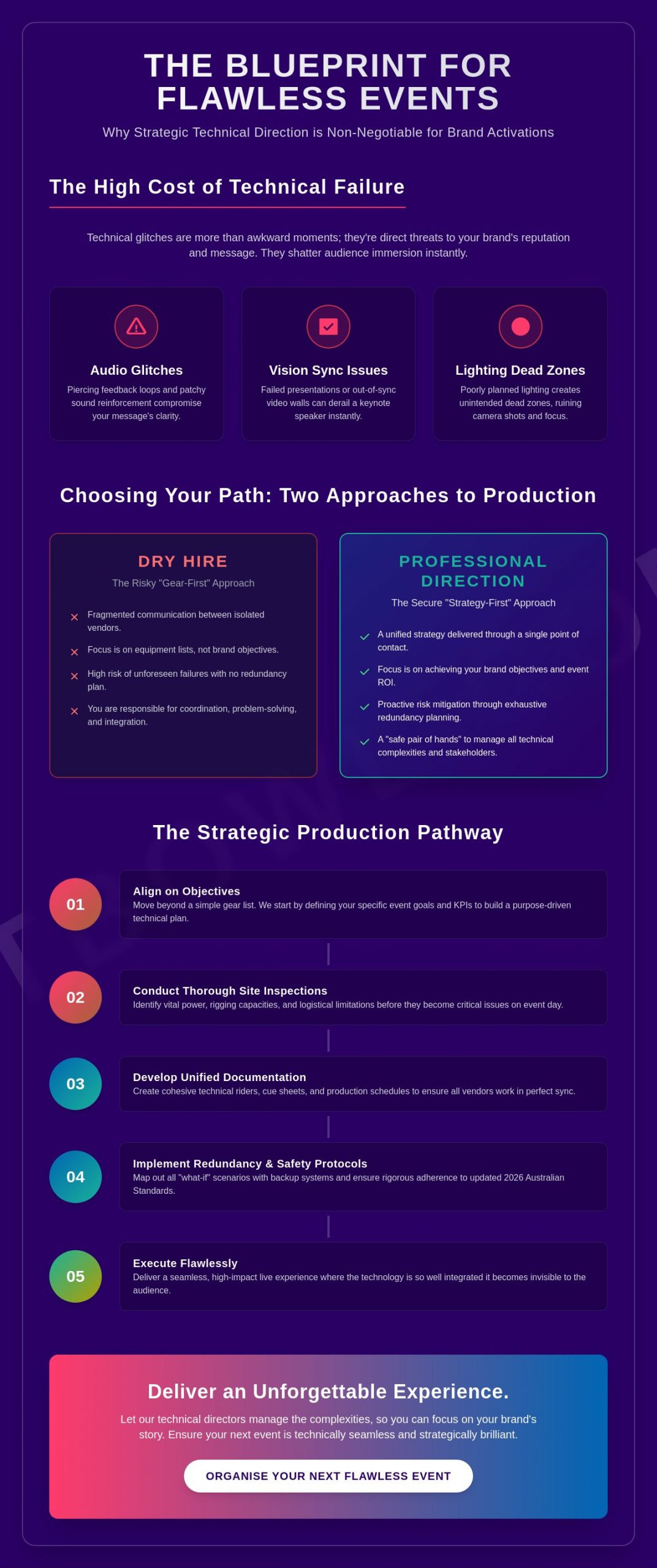
Technical glitches are more than just awkward moments; they’re significant risks to your brand’s reputation. Common pitfalls like piercing feedback loops, lighting dead zones, or audio-visual sync issues can shatter the audience’s immersion instantly. If a guest speaker’s presentation fails to launch or the sound reinforcement is patchy, your message is compromised. Professional technical direction for events mitigates these risks through exhaustive redundancy planning. This involves mapping out “what-if” scenarios and ensuring that backup systems are ready to engage without the audience ever noticing a flicker in the production.
The Technical Director as a Safe Pair of Hands
Managing the expectations of diverse stakeholders, from VIP guests to security details, requires a calm and experienced lead. A technical director remains unflappable under the intense pressure of live execution, acting as the “safe pair of hands” that keeps the project on track. They understand that sophisticated Stage lighting and crystal-clear sound aren’t just aesthetic choices; they’re tools for engagement. By maintaining this high-level oversight, event technical director services ensure that the technical infrastructure supports the overall event ROI. When the technical execution is invisible and seamless, the audience remains focused entirely on your brand’s story.
Designing an Immersive Soundscape and Lighting Rig
Designing an immersive environment requires a deep understanding of how sensory inputs affect human behaviour. Sound and light aren’t just technical requirements; they’re psychological triggers that shape the attendee experience. A well-designed soundscape ensures every guest, whether in the front row or the back of a large Australian convention centre, receives the message with total clarity. Similarly, lighting serves as a silent guide. It directs attention to the stage and reinforces your brand’s visual identity through colour, texture, and movement.
Effective design balances ambitious creative goals with the physical limitations of a venue. This is where the role of a live event producer and technical lead becomes indispensable. They assess floor plans, weight capacities for rigging, and power availability to ensure the design is both spectacular and safe. When you utilise event technical director services, you’re ensuring that these aesthetic ambitions don’t compromise the logistical integrity of the site.
Sound Engineering for Clarity and Impact
Lighting Design that Tells a Story
Lighting is the most powerful tool for transforming a generic space into a branded experience. Designers use “layering” to build depth. This starts with a basic wash for visibility, followed by textured gobos to add visual interest, and finally, dramatic focal points to highlight key moments. Integrating DMX control allows for synchronised lighting changes that can be timed to brand reveals or musical cues. This level of creative event production ensures the lighting isn’t just static, but dynamic and responsive to the event’s rhythm. If you’re looking for a partner to manage these complexities, Fruitbowl Events Agency offers the strategic oversight required for high-impact results.
Choosing Between Dry Hire and Professional Event Technical Director Services
Opting for a dry hire equipment rental might appear cost-effective during the initial budgeting phase, but it often conceals a range of logistical risks. Without expert oversight, you’re responsible for the integration of disparate systems, the management of setup timelines, and the immediate resolution of any technical failures. This ‘hope for the best’ approach can lead to significant technical debt, where the time spent troubleshooting outweighs the initial savings. Conversely, engaging professional event technical director services provides a strategic layer of protection. A dedicated director doesn’t just manage gear; they manage the entire technical ecosystem, ensuring that every vendor and sub-contractor operates within a unified framework.
Evaluating your event’s complexity is the first step in determining the level of oversight required. While a basic internal meeting might be manageable with in-house resources, high-stakes brand activations or public festivals demand a “safe pair of hands” to navigate the moving parts. A technical director acts as your single point of contact, translating your creative vision into precise technical requirements. This eliminates the confusion over complex AV jargon and ensures that the final execution matches the conceptual design. By letting a specialist handle the technical vendor management, you can focus on the broader strategic objectives of the event.
The Fallacy of the “All-in-One” Venue Package
Many Australian venues offer all-in-one packages with preferred suppliers. While convenient, these arrangements can lack transparency and may not align perfectly with your specific creative vision. Independent technical oversight allows for a critical review of these quotes, ensuring you aren’t paying for redundant gear or “standard” setups that don’t serve your objectives. A director uses their expertise to optimise your event production budget template, identifying areas where strategic investment will yield the highest impact while cutting unnecessary line items.
Scalability: From Seminars to National Festivals
As an event scales from a local seminar to a national festival, the technical requirements grow exponentially. Maintaining consistency across different Australian cities requires a methodical approach to touring riders and local vendor management. Government activations, in particular, demand a higher level of rigour. Compliance with the Work Health and Safety (WHS) Act 2011 and the National Construction Code (NCC) is mandatory, requiring documented risk assessments and engineering certifications for temporary structures. A technical director ensures these standards are met across every location, providing a seamless experience regardless of the venue’s geographical constraints.
A Step-by-Step Guide to Planning Your Event’s Technical Infrastructure
Mastering the technical execution of a high-stakes activation requires a transition from conceptual design to methodical planning. This phase is where the strategic oversight of event technical director services becomes most visible, transforming a creative vision into a series of actionable, safe, and logical steps. By following a structured framework, you ensure that every piece of equipment and every member of the crew is aligned with your event’s specific objectives.
The planning process begins with a comprehensive site inspection. You must identify the physical locations for all power distribution points and rigging anchors while verifying the venue’s weight-bearing capacities. This isn’t just about logistics; it’s about identifying potential constraints before they impact your design. Once the site is verified, you can develop the Technical Rider. This document must detail the exact microphone preferences, stage monitor placements, and vision requirements for every keynote speaker or performer on your programme.
While managing power at a venue is a short-term logistical hurdle, many Australian business owners are also considering the long-term energy efficiency of their own facilities; to explore these possibilities, you can discover GridFree Solar and their detailed savings forecasts for solar investment.
Logistical precision continues with the creation of a detailed “Bump-in” and “Bump-out” schedule. This timeline must account for every vendor, ensuring that lighting riggers aren’t competing for floor space with the sound team. Finally, you must execute a full technical rehearsal. This is your final opportunity to test transitions, media playback, and lighting cues with your presenters. If you require a partner to oversee these critical steps, Fruitbowl Events Agency provides the end-to-end management necessary for a successful activation.
Mastering the Technical Run Sheet
The technical run sheet is a minute-by-minute breakdown that acts as the operational bible for the control booth. It details every cue, from the moment the house lights dim to the final encore. Effective communication between sound, light, and vision operators is essential, often facilitated through a dedicated intercom system. The Show Caller acts as the central voice of authority, triggering every technical cue across the audio, lighting, and vision departments to maintain the event’s precise rhythm—a level of synchronisation that you can also experience when you discover Kiss My Brass at their vibrant live music venue in Marrickville.
Australian Safety Standards and Compliance
Safety is the non-negotiable foundation of technical production in Australia. You’re legally required to comply with the Work Health and Safety (WHS) Act 2011, which necessitates rigorous risk assessments and the use of licensed professionals for high-risk tasks. Every piece of electrical equipment must be Tagged and Tested to current Australian standards before entering the venue. Managing OH&S during the intensive phases of rigging and de-rigging ensures a secure environment for your crew and attendees. Additionally, maintaining comprehensive Public Liability and professional indemnity insurance is a standard requirement for any professional production to mitigate the financial risks associated with complex live events.
Ensuring Flawless Execution with Fruitbowl’s Technical Direction
Successful event production is defined by the invisible precision of its execution. At Fruitbowl Events Agency, we integrate 28 years of industry experience into every technical plan, ensuring that your creative ambition is never limited by logistical constraints. Our end-to-end philosophy begins at the strategic concept phase and remains active until the final encore. This comprehensive approach ensures that every moving part, from the initial site inspection to the final bump-out, is managed with the same level of meticulous care. By centralising control, we provide a unified direction that eliminates the friction often found in complex, multi-vendor environments.
Our national reach makes us a uniquely capable partner for organisers managing cross-border activations or national touring circuits. We understand the nuances of different Australian venues and the specific regulatory requirements of each state, ensuring consistent quality from Sydney to Perth. When you engage our event technical director services, you aren’t just hiring a supervisor. You’re partnering with a sophisticated strategist who positions your brand at the centre of a perfectly executed technical landscape. We take pride in being the “safe pair of hands” that allows you to remain focused on your guests and your message.
Integrating Creative Vision with Technical Precision
Translating high-level brand objectives into a functional technical reality requires a rare blend of creativity and discipline. We don’t simply accept a standard gear list; we interrogate every requirement to ensure it serves the event’s purpose. Our team manages a rigorous vetting process for top-tier AV vendors, ensuring that only the most reliable technicians and equipment are permitted on your site. This commitment to quality is a core component of our AV management for events framework, which prioritises budget transparency and technical excellence at every stage of the production cycle.
Your Partner for High-Stakes Events
Government departments and corporate leaders trust us with their most critical activations because we thrive in high-stakes environments. We understand that in a live moment, there are no second chances. The peace of mind that comes from having a dedicated, expert Technical Director on-site is invaluable. This role ensures that every contingency is planned for and every cue is delivered with absolute timing. We invite you to let us handle the technical complexity of your next project. Contact Fruitbowl Events Agency today to discuss how our event technical director services can bring order, safety, and sophisticated precision to your next brand activation or national conference.
Elevating Your Production Standards for 2026
Success in technical production isn’t measured by the volume of equipment hired, but by the strategic precision of its execution. We’ve explored how moving from a gear-focused approach to a strategy-led plan ensures your creative vision remains the primary focus. By implementing a structured framework for site inspections and rigorous technical rehearsals, you mitigate the risks of live failure and protect your brand’s reputation. This methodical approach transforms a complex series of logistical challenges into a seamless, immersive experience for your audience.
Professional event technical director services provide the essential oversight needed to synchronise these multifaceted moving parts across any Australian venue. Fruitbowl Events Agency brings over 28 years of industry-leading expertise to every project, offering national delivery and a seasoned team of technical specialists. We manage the logistical rigours and safety compliance so you can focus entirely on your guests and your message. Partner with Fruitbowl for expert event technical director services and ensure your next activation is executed with total confidence. We look forward to helping you transform your next vision into a flawless reality.
Frequently Asked Questions
What is the difference between an AV technician and an Event Technical Director?
An AV technician is responsible for the tactical operation of specific equipment, such as mixing audio or switching video feeds. In contrast, event technical director services provide high-level strategic oversight across all technical departments. The director manages the integration of sound, lighting, and vision while ensuring the entire production remains aligned with your creative objectives and safety obligations.
How much of my budget should I allocate to event sound and lighting?
Allocation typically depends on the complexity of your vision and the venue’s existing infrastructure. For high-stakes corporate activations, organisers often find that technical production accounts for a significant portion of the overall investment. Rather than focusing on a fixed percentage, it’s more effective to work with a director who can optimise your spend by identifying essential gear and eliminating redundant equipment that doesn’t serve your goals.
What is a Technical Rider and why do I need one for my speakers?
A Technical Rider is a detailed document that specifies the exact equipment and logistical requirements for your presenters or performers. It ensures your team provides the correct microphone types, stage monitors, and connectivity for keynote presentations. Having this document in place prevents last-minute scrambles on event day and ensures your talent feels supported by a professional technical environment.
Can I use the venue’s in-house sound system for a high-end corporate event?
In-house systems are often designed for background music or basic speech reinforcement and may lack the fidelity required for high-end production. For brand activations where clarity and impact are paramount, a bespoke sound reinforcement system is usually necessary. A technical lead will assess the venue’s built-in capabilities and recommend supplemental gear to ensure your message is delivered without distortion or patchy coverage.
What happens if there is a power failure or technical glitch during the event?
Professional technical direction involves exhaustive redundancy planning to manage these exact scenarios. This includes having uninterruptible power supplies for critical systems and backup hardware ready for immediate switchover. By maintaining a “safe pair of hands” approach, your director ensures that any glitch is identified and resolved by the crew before it impacts the audience’s experience or the event’s flow.
How early should I involve a Technical Director in the event planning process?
You should ideally engage a director during the initial concept and site selection phase. Early involvement allows for a thorough assessment of venue constraints, such as rigging points and power availability, before you commit to a design. This proactive approach prevents costly mid-project adjustments and ensures that your creative ambition is grounded in technical and logistical reality from the start.
This level of planning is particularly critical when choosing unconventional locations like boutique farm-stays for corporate retreats. To see how a unique setting can be leveraged for your next group gathering, you can learn more about Hidden Camp and its potential as an exclusive farm buyout venue in Queensland.
Do I need a different lighting setup for daytime vs. evening events?
Daytime events often require high-output fixtures to compete with ambient natural light, especially in venues with large windows or outdoor settings. Evening events allow for more sophisticated use of texture, colour, and shadows to create mood and focus. A professional lighting plan will account for these shifting conditions, ensuring your brand remains visible and the atmosphere stays consistent regardless of the time of day.
How does technical direction differ for a hybrid or virtual event?
Hybrid events require a dual-focus approach where the technical team manages both the physical room and a dedicated broadcast stream. Event technical director services in this context focus on synchronising these two experiences so that remote attendees receive the same high-quality audio and vision as those on-site. This involves managing separate audio mixes and ensuring that digital transitions are as seamless as the physical ones.
What if the most expensive element of your next brand activation isn’t the high-resolution LED wall, but the silence that follows a sudden technical failure? It’s a scenario that keeps even the most seasoned Australian organisers awake at night. You likely feel the pressure of translating a sophisticated creative vision into complex AV quotes, which is why many now rely on professional event technical director services to bridge the gap. It’s common to worry that a single missed detail in the sound or lighting plot could undermine months of meticulous planning.
This guide offers a clear framework to help you master these technical complexities and regain your confidence. You’ll learn how expert technical direction brings order to high-stakes environments, ensuring every component of your production is synchronised and secure. We will cover essential 2026 updates, such as the Australian Government’s recent move to provide free access to Australian Standards and the rise of AI-driven lighting. From navigating the National Construction Code to managing camera-first staging, this overview provides the strategic oversight needed to deliver a flawless experience.
Key Takeaways
- Understand how to transition from a “gear-first” mentality to a strategic technical plan that aligns with your specific event objectives.
- Identify the critical differences between basic equipment rental and the comprehensive oversight provided by professional event technical director services.
- Gain a step-by-step methodology for conducting site inspections and identifying vital power and rigging requirements before they become live issues.
- Discover how to use immersive lighting and sound reinforcement to maintain audience engagement throughout your entire event programme.
- Learn the value of an end-to-end production philosophy in delivering seamless brand activations and large-scale corporate events.
Table of Contents
- Why Event Sound and Lighting Require Strategic Technical Direction
- Designing an Immersive Soundscape and Lighting Rig
- Choosing Between Dry Hire and Professional Event Technical Director Services
- A Step-by-Step Guide to Planning Your Event’s Technical Infrastructure
- Ensuring Flawless Execution with Fruitbowl’s Technical Direction
Why Event Sound and Lighting Require Strategic Technical Direction
A technical director serves as the vital bridge between a visionary creative concept and the hard physical reality of an event space. While many organisers start by looking at equipment lists, true production excellence begins with a strategy-first technical plan. This approach moves beyond simply hiring gear; it focuses on how technology can be harnessed to meet specific brand objectives. When you engage professional event technical director services, you aren’t just hiring a manager. You’re securing a strategist who ensures that every decibel of sound and every beam of light is working in service of your message.
High-stakes corporate and government activations don’t allow for the risks associated with “plug-and-play” solutions. These environments demand a level of logistical precision where there is no room for error. A seasoned director ensures all technical vendors, from audio engineers to riggers, operate from a unified set of documents. This synchronisation prevents the common communication breakdowns that occur when different teams work in isolation. By centralising control, the director provides:
- Standardised technical riders that align with talent and keynote requirements.
- Cohesive cue sheets that integrate vision, sound, and lighting transitions.
- Rigorous adherence to the latest safety protocols, including the 2026 updates to Australian Standards.
The High Cost of Technical Failure
Technical glitches are more than just awkward moments; they’re significant risks to your brand’s reputation. Common pitfalls like piercing feedback loops, lighting dead zones, or audio-visual sync issues can shatter the audience’s immersion instantly. If a guest speaker’s presentation fails to launch or the sound reinforcement is patchy, your message is compromised. Professional technical direction for events mitigates these risks through exhaustive redundancy planning. This involves mapping out “what-if” scenarios and ensuring that backup systems are ready to engage without the audience ever noticing a flicker in the production.
The Technical Director as a Safe Pair of Hands
Managing the expectations of diverse stakeholders, from VIP guests to security details, requires a calm and experienced lead. A technical director remains unflappable under the intense pressure of live execution, acting as the “safe pair of hands” that keeps the project on track. They understand that sophisticated Stage lighting and crystal-clear sound aren’t just aesthetic choices; they’re tools for engagement. By maintaining this high-level oversight, event technical director services ensure that the technical infrastructure supports the overall event ROI. When the technical execution is invisible and seamless, the audience remains focused entirely on your brand’s story.
Designing an Immersive Soundscape and Lighting Rig
Designing an immersive environment requires a deep understanding of how sensory inputs affect human behaviour. Sound and light aren’t just technical requirements; they’re psychological triggers that shape the attendee experience. A well-designed soundscape ensures every guest, whether in the front row or the back of a large Australian convention centre, receives the message with total clarity. Similarly, lighting serves as a silent guide. It directs attention to the stage and reinforces your brand’s visual identity through colour, texture, and movement.
Effective design balances ambitious creative goals with the physical limitations of a venue. This is where the role of a live event producer and technical lead becomes indispensable. They assess floor plans, weight capacities for rigging, and power availability to ensure the design is both spectacular and safe. When you utilise event technical director services, you’re ensuring that these aesthetic ambitions don’t compromise the logistical integrity of the site.
Sound Engineering for Clarity and Impact
Lighting Design that Tells a Story
Lighting is the most powerful tool for transforming a generic space into a branded experience. Designers use “layering” to build depth. This starts with a basic wash for visibility, followed by textured gobos to add visual interest, and finally, dramatic focal points to highlight key moments. Integrating DMX control allows for synchronised lighting changes that can be timed to brand reveals or musical cues. This level of creative event production ensures the lighting isn’t just static, but dynamic and responsive to the event’s rhythm. If you’re looking for a partner to manage these complexities, Fruitbowl Events Agency offers the strategic oversight required for high-impact results.
Choosing Between Dry Hire and Professional Event Technical Director Services
Opting for a dry hire equipment rental might appear cost-effective during the initial budgeting phase, but it often conceals a range of logistical risks. Without expert oversight, you’re responsible for the integration of disparate systems, the management of setup timelines, and the immediate resolution of any technical failures. This ‘hope for the best’ approach can lead to significant technical debt, where the time spent troubleshooting outweighs the initial savings. Conversely, engaging professional event technical director services provides a strategic layer of protection. A dedicated director doesn’t just manage gear; they manage the entire technical ecosystem, ensuring that every vendor and sub-contractor operates within a unified framework.
Evaluating your event’s complexity is the first step in determining the level of oversight required. While a basic internal meeting might be manageable with in-house resources, high-stakes brand activations or public festivals demand a “safe pair of hands” to navigate the moving parts. A technical director acts as your single point of contact, translating your creative vision into precise technical requirements. This eliminates the confusion over complex AV jargon and ensures that the final execution matches the conceptual design. By letting a specialist handle the technical vendor management, you can focus on the broader strategic objectives of the event.
The Fallacy of the “All-in-One” Venue Package
Many Australian venues offer all-in-one packages with preferred suppliers. While convenient, these arrangements can lack transparency and may not align perfectly with your specific creative vision. Independent technical oversight allows for a critical review of these quotes, ensuring you aren’t paying for redundant gear or “standard” setups that don’t serve your objectives. A director uses their expertise to optimise your event production budget template, identifying areas where strategic investment will yield the highest impact while cutting unnecessary line items.
Scalability: From Seminars to National Festivals
As an event scales from a local seminar to a national festival, the technical requirements grow exponentially. Maintaining consistency across different Australian cities requires a methodical approach to touring riders and local vendor management. Government activations, in particular, demand a higher level of rigour. Compliance with the Work Health and Safety (WHS) Act 2011 and the National Construction Code (NCC) is mandatory, requiring documented risk assessments and engineering certifications for temporary structures. A technical director ensures these standards are met across every location, providing a seamless experience regardless of the venue’s geographical constraints.
A Step-by-Step Guide to Planning Your Event’s Technical Infrastructure
Mastering the technical execution of a high-stakes activation requires a transition from conceptual design to methodical planning. This phase is where the strategic oversight of event technical director services becomes most visible, transforming a creative vision into a series of actionable, safe, and logical steps. By following a structured framework, you ensure that every piece of equipment and every member of the crew is aligned with your event’s specific objectives.
The planning process begins with a comprehensive site inspection. You must identify the physical locations for all power distribution points and rigging anchors while verifying the venue’s weight-bearing capacities. This isn’t just about logistics; it’s about identifying potential constraints before they impact your design. Once the site is verified, you can develop the Technical Rider. This document must detail the exact microphone preferences, stage monitor placements, and vision requirements for every keynote speaker or performer on your programme.
While managing power at a venue is a short-term logistical hurdle, many Australian business owners are also considering the long-term energy efficiency of their own facilities; to explore these possibilities, you can discover GridFree Solar and their detailed savings forecasts for solar investment.
Logistical precision continues with the creation of a detailed “Bump-in” and “Bump-out” schedule. This timeline must account for every vendor, ensuring that lighting riggers aren’t competing for floor space with the sound team. Finally, you must execute a full technical rehearsal. This is your final opportunity to test transitions, media playback, and lighting cues with your presenters. If you require a partner to oversee these critical steps, Fruitbowl Events Agency provides the end-to-end management necessary for a successful activation.
Mastering the Technical Run Sheet
The technical run sheet is a minute-by-minute breakdown that acts as the operational bible for the control booth. It details every cue, from the moment the house lights dim to the final encore. Effective communication between sound, light, and vision operators is essential, often facilitated through a dedicated intercom system. The Show Caller acts as the central voice of authority, triggering every technical cue across the audio, lighting, and vision departments to maintain the event’s precise rhythm—a level of synchronisation that you can also experience when you discover Kiss My Brass at their vibrant live music venue in Marrickville.
Australian Safety Standards and Compliance
Safety is the non-negotiable foundation of technical production in Australia. You’re legally required to comply with the Work Health and Safety (WHS) Act 2011, which necessitates rigorous risk assessments and the use of licensed professionals for high-risk tasks. Every piece of electrical equipment must be Tagged and Tested to current Australian standards before entering the venue. Managing OH&S during the intensive phases of rigging and de-rigging ensures a secure environment for your crew and attendees. Additionally, maintaining comprehensive Public Liability and professional indemnity insurance is a standard requirement for any professional production to mitigate the financial risks associated with complex live events.
Ensuring Flawless Execution with Fruitbowl’s Technical Direction
Successful event production is defined by the invisible precision of its execution. At Fruitbowl Events Agency, we integrate 28 years of industry experience into every technical plan, ensuring that your creative ambition is never limited by logistical constraints. Our end-to-end philosophy begins at the strategic concept phase and remains active until the final encore. This comprehensive approach ensures that every moving part, from the initial site inspection to the final bump-out, is managed with the same level of meticulous care. By centralising control, we provide a unified direction that eliminates the friction often found in complex, multi-vendor environments.
Our national reach makes us a uniquely capable partner for organisers managing cross-border activations or national touring circuits. We understand the nuances of different Australian venues and the specific regulatory requirements of each state, ensuring consistent quality from Sydney to Perth. When you engage our event technical director services, you aren’t just hiring a supervisor. You’re partnering with a sophisticated strategist who positions your brand at the centre of a perfectly executed technical landscape. We take pride in being the “safe pair of hands” that allows you to remain focused on your guests and your message.
Integrating Creative Vision with Technical Precision
Translating high-level brand objectives into a functional technical reality requires a rare blend of creativity and discipline. We don’t simply accept a standard gear list; we interrogate every requirement to ensure it serves the event’s purpose. Our team manages a rigorous vetting process for top-tier AV vendors, ensuring that only the most reliable technicians and equipment are permitted on your site. This commitment to quality is a core component of our AV management for events framework, which prioritises budget transparency and technical excellence at every stage of the production cycle.
Your Partner for High-Stakes Events
Government departments and corporate leaders trust us with their most critical activations because we thrive in high-stakes environments. We understand that in a live moment, there are no second chances. The peace of mind that comes from having a dedicated, expert Technical Director on-site is invaluable. This role ensures that every contingency is planned for and every cue is delivered with absolute timing. We invite you to let us handle the technical complexity of your next project. Contact Fruitbowl Events Agency today to discuss how our event technical director services can bring order, safety, and sophisticated precision to your next brand activation or national conference.
Elevating Your Production Standards for 2026
Success in technical production isn’t measured by the volume of equipment hired, but by the strategic precision of its execution. We’ve explored how moving from a gear-focused approach to a strategy-led plan ensures your creative vision remains the primary focus. By implementing a structured framework for site inspections and rigorous technical rehearsals, you mitigate the risks of live failure and protect your brand’s reputation. This methodical approach transforms a complex series of logistical challenges into a seamless, immersive experience for your audience.
Professional event technical director services provide the essential oversight needed to synchronise these multifaceted moving parts across any Australian venue. Fruitbowl Events Agency brings over 28 years of industry-leading expertise to every project, offering national delivery and a seasoned team of technical specialists. We manage the logistical rigours and safety compliance so you can focus entirely on your guests and your message. Partner with Fruitbowl for expert event technical director services and ensure your next activation is executed with total confidence. We look forward to helping you transform your next vision into a flawless reality.
Frequently Asked Questions
What is the difference between an AV technician and an Event Technical Director?
An AV technician is responsible for the tactical operation of specific equipment, such as mixing audio or switching video feeds. In contrast, event technical director services provide high-level strategic oversight across all technical departments. The director manages the integration of sound, lighting, and vision while ensuring the entire production remains aligned with your creative objectives and safety obligations.
How much of my budget should I allocate to event sound and lighting?
Allocation typically depends on the complexity of your vision and the venue’s existing infrastructure. For high-stakes corporate activations, organisers often find that technical production accounts for a significant portion of the overall investment. Rather than focusing on a fixed percentage, it’s more effective to work with a director who can optimise your spend by identifying essential gear and eliminating redundant equipment that doesn’t serve your goals.
What is a Technical Rider and why do I need one for my speakers?
A Technical Rider is a detailed document that specifies the exact equipment and logistical requirements for your presenters or performers. It ensures your team provides the correct microphone types, stage monitors, and connectivity for keynote presentations. Having this document in place prevents last-minute scrambles on event day and ensures your talent feels supported by a professional technical environment.
Can I use the venue’s in-house sound system for a high-end corporate event?
In-house systems are often designed for background music or basic speech reinforcement and may lack the fidelity required for high-end production. For brand activations where clarity and impact are paramount, a bespoke sound reinforcement system is usually necessary. A technical lead will assess the venue’s built-in capabilities and recommend supplemental gear to ensure your message is delivered without distortion or patchy coverage.
What happens if there is a power failure or technical glitch during the event?
Professional technical direction involves exhaustive redundancy planning to manage these exact scenarios. This includes having uninterruptible power supplies for critical systems and backup hardware ready for immediate switchover. By maintaining a “safe pair of hands” approach, your director ensures that any glitch is identified and resolved by the crew before it impacts the audience’s experience or the event’s flow.
How early should I involve a Technical Director in the event planning process?
You should ideally engage a director during the initial concept and site selection phase. Early involvement allows for a thorough assessment of venue constraints, such as rigging points and power availability, before you commit to a design. This proactive approach prevents costly mid-project adjustments and ensures that your creative ambition is grounded in technical and logistical reality from the start.
This level of planning is particularly critical when choosing unconventional locations like boutique farm-stays for corporate retreats. To see how a unique setting can be leveraged for your next group gathering, you can learn more about Hidden Camp and its potential as an exclusive farm buyout venue in Queensland.
Do I need a different lighting setup for daytime vs. evening events?
Daytime events often require high-output fixtures to compete with ambient natural light, especially in venues with large windows or outdoor settings. Evening events allow for more sophisticated use of texture, colour, and shadows to create mood and focus. A professional lighting plan will account for these shifting conditions, ensuring your brand remains visible and the atmosphere stays consistent regardless of the time of day.
How does technical direction differ for a hybrid or virtual event?
Hybrid events require a dual-focus approach where the technical team manages both the physical room and a dedicated broadcast stream. Event technical director services in this context focus on synchronising these two experiences so that remote attendees receive the same high-quality audio and vision as those on-site. This involves managing separate audio mixes and ensuring that digital transitions are as seamless as the physical ones.
OUR BLOG
Event Insights & Expertise
Our blog is your go-to resource for all things events. From expert insights and the latest industry trends to practical planning tips, we share everything you need to deliver standout experiences.
Contact Us