A public event safety plan is not a bureaucratic hurdle; it is the strategic foundation for operational excellence and brand protection. When you are coordinating a large-scale festival or government activation, the need for a comprehensive public event safety plan template Australia becomes essential to manage the weight of regulatory requirements across different jurisdictions. You likely recognise the constant pressure to mitigate risks while ensuring your creative vision remains uncompromised. The fear of a major safety incident or a compliance-related shutdown is a reality every professional organiser faces.
This guide provides a professional-grade framework designed to help you master the complexities of modern event compliance with absolute confidence. We promise to deliver a robust strategy that satisfies Australian authorities and provides a clear roadmap for risk mitigation. We will examine the 2026 strategic requirements, including the latest model WHS amendments and crowd management protocols. By the end of this guide, you will have the tools to ensure your next activation is managed with the logistical precision and expert oversight it deserves. This methodical approach ensures your event remains in a safe pair of hands, allowing you to focus on delivering an exceptional experience.
Key Takeaways
- Understand why 2026 standards demand a transition from reactive measures to proactive risk modelling for all large-scale public activations.
- Identify the core components of a public event safety plan template Australia, ensuring site maps and technical infrastructure are fully integrated into your operational strategy.
- Master a systematic hazard identification process to maintain command and control during every phase of the event lifecycle, from bump-in to final site clearance.
- Establish clear protocols for liaising with Australian emergency services and state authorities to streamline permit approvals and ensure regulatory compliance.
- Discover the strategic advantage of aligning technical direction with safety planning to provide a secure, professional environment for complex public events.
Table of Contents
- The Strategic Role of a Public Event Safety Plan in Australia
- Essential Components of a Comprehensive Event Safety Template
- Executing a Robust Risk Management and Hazard Identification Process
- Navigating Stakeholder Liaison and Regulatory Compliance
- Scaling Your Safety Strategy with Professional Event Production
The Strategic Role of a Public Event Safety Plan in Australia
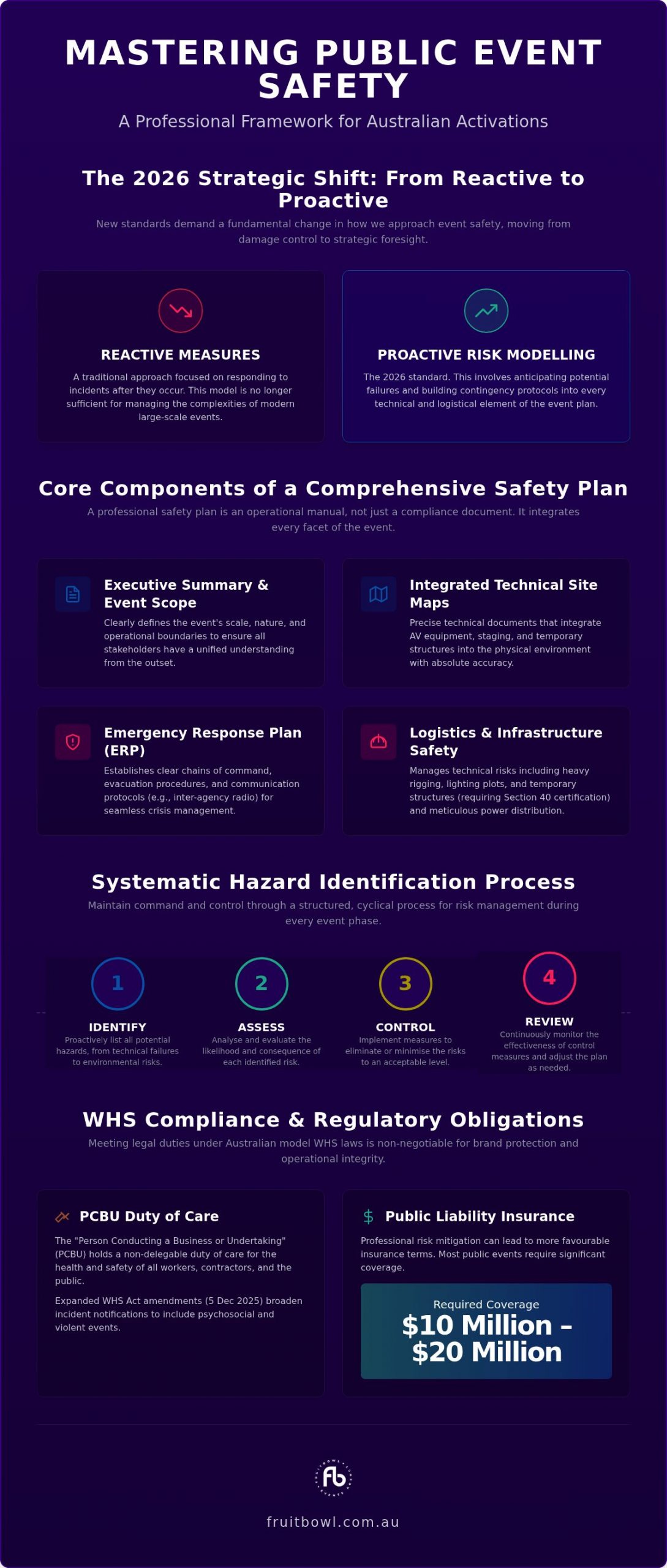
A public event safety plan is far more than a static document required for local council approval; it’s the primary instrument for operational command and control. In the context of large-scale activations, this plan functions as a living blueprint that guides every decision from the initial site inspection to the final bump-out. As we move through 2026, the industry has shifted away from reactive safety measures toward proactive risk modelling. This evolution requires organisers to anticipate potential failures before they manifest, ensuring that every technical and logistical element is backed by a contingency protocol. Utilising a sophisticated public event safety plan template Australia allows organisers to move beyond basic compliance and into a space of strategic foresight.
A robust plan protects your organisation’s reputation and brand integrity. When an event is managed with logistical precision, it sends a clear message to stakeholders, sponsors, and the public that they’re in a safe pair of hands. Failure to provide this level of oversight doesn’t just invite physical risk; it exposes the organisation to significant legal and financial repercussions that can take years to recover from.
Legal Obligations and WHS Compliance
Under the model Work Health and Safety (WHS) laws, the “Person Conducting a Business or Undertaking” (PCBU) holds a non-delegable duty of care to ensure the health and safety of everyone involved. This includes workers, contractors, and the attending public. Recent amendments to the model WHS Act, published on 5 December 2025, have expanded incident notification requirements to include a broader range of incidents, such as those related to psychosocial hazards and violent events. Adhering to national standards, such as AS 3745:2010 for emergency planning, is essential for demonstrating that your organisation has met its legal threshold. A comprehensive robust risk management process is the primary way to document that these duties are being fulfilled with due diligence.
The Business Case for Professional Safety Oversight
There’s a compelling commercial argument for investing in high-level safety planning. Professional-grade risk mitigation strategies can lead to more favourable public liability insurance terms, as many insurers now require coverage between $10 million and $20 million for public events. Beyond insurance, a well-executed public event safety plan template Australia ensures continuity of operations in high-pressure environments. By building trust with government stakeholders and corporate sponsors through transparent, expert-led safety protocols, you secure the longevity of your event brand and foster long-term partnerships.
Essential Components of a Comprehensive Event Safety Template
A professional public event safety plan template Australia must go beyond a simple checklist to serve as a comprehensive operational manual. It begins with a detailed executive summary that defines the event scope and sets clear operational boundaries. This section ensures all stakeholders understand the scale and nature of the activation. Site maps must be more than just drawings; they need to be precise technical documents that integrate AV equipment, staging, and temporary structures into the physical environment. This requires absolute precision. Alongside these elements, an Emergency Response Plan (ERP) establishes clear chains of command and evacuation procedures, while inter-agency radio networks ensure seamless communication across all teams. For Victorian-based events, integrating specialised services like BioSafe Waste Management for clinical waste disposal is a critical component of maintaining site hygiene and regulatory compliance.
Logistics and Infrastructure Safety
Managing technical production risks is a core component of modern safety planning. This involves assessing heavy rigging, complex lighting plots, and sophisticated AV setups. For temporary structures, organisers must secure Section 40 certifications or relevant building permits to ensure structural integrity. Electrical safety in outdoor public spaces requires meticulous power distribution planning to prevent overloads or trip hazards. Referencing established standards for regulatory compliance in Australia provides a benchmark for these technical requirements and ensures your infrastructure meets rigorous safety thresholds.
Crowd Dynamics and Attendee Wellbeing
Calculating safe capacity limits is vital for diverse Australian venues. It’s not just about total numbers; it’s about managing high-traffic zones during ingress and egress to prevent congestion. Effective crowd management strategies use proactive modelling to identify potential bottlenecks before they become hazardous. Within a public event safety plan template Australia, specific provision for essential services like first aid centres, water stations, and adequate shade is a non-negotiable aspect of attendee wellbeing. For those managing complex logistics, partnering with experts in festival production services ensures every technical detail is supervised with precision.
Executing a Robust Risk Management and Hazard Identification Process
Executing a robust risk management process requires moving beyond basic intuition into a structured, evidence-based methodology. Within a professional public event safety plan template Australia, this process begins by establishing the specific context of the activation. This involves analysing the event type, the demographic profile of the audience, and the unique characteristics of the venue. A government activation for thousands requires a different risk profile than a high-impact corporate conference, and your documentation must reflect these nuances with precision.
The systematic identification of hazards must span every phase of the event lifecycle. This includes the high-risk “bump-in” period where heavy machinery and rigging are in use, the “live” phase with public attendance, and the “bump-out” phase where fatigue often increases the likelihood of incidents. Following identification, organisers should apply the ISO 31000:2018 framework to conduct both qualitative and quantitative analyses. This ensures that every risk is evaluated with logistical precision rather than guesswork. Using a standardised public event safety plan template Australia allows for a consistent approach that satisfies both internal stakeholders and external regulatory bodies.
Effective mitigation relies on the Hierarchy of Controls. Organisers must prioritise the elimination of hazards wherever possible. If elimination isn’t feasible, engineering controls, such as physical barriers or structural reinforcements, take precedence over administrative controls like signage or training. Finally, continuous monitoring during the event allows for real-time adjustments, ensuring the safety strategy remains responsive to emerging conditions on the ground.
The Risk Assessment Matrix
A sophisticated risk assessment matrix defines risk by calculating the relationship between likelihood and consequence. In a public safety context, consequences are measured by potential for injury, legal breach, or brand damage. Identifying “residual risk”, which is the risk that remains after all controls are implemented, is a critical step. Organisers must determine if this residual level falls within acceptable safety thresholds. For “high-impact, low-probability” scenarios, such as a total power failure or structural collapse, specific contingency plans must be documented and ready for immediate activation.
Weather and Environmental Contingencies
Australian weather conditions demand a “triggered response” plan that removes subjectivity from critical safety decisions. This plan should outline specific actions based on measurable data, such as wind speeds or lightning proximity. For outdoor festival production, protocols for high-wind events must dictate exactly when stages should be cleared or structures lowered. Bushfire and extreme heat protocols are also essential, particularly for summer activations. Managing these site-specific geographical challenges ensures that even when environmental conditions shift, the event remains under expert supervision and is managed by a safe pair of hands.
Navigating Stakeholder Liaison and Regulatory Compliance
Strategic stakeholder liaison is the bridge between creative ambition and regulatory reality. It requires a sophisticated understanding of how different Australian authorities operate and what they require to grant operational approval. By utilising a professional public event safety plan template Australia, organisers can present a cohesive, well-reasoned strategy that speaks the language of emergency services and government bodies. This proactive approach transforms a potential bureaucratic hurdle into a collaborative partnership, ensuring that Police, Fire, and Ambulance services are fully aligned with the event’s objectives from the outset. It’s about moving beyond simple permit applications to establish a shared responsibility for public safety.
The Safety Officer plays a pivotal role within the Event Operations Centre (EOC), acting as the final authority on risk mitigation during live operations. This individual manages the integration of private security contractors and specialised crowd control personnel, ensuring that all teams operate under a single, unified chain of command. This level of logistical precision is what separates a standard event from a high-impact, professional activation. When every stakeholder knows their specific role within the broader framework, the entire operation moves with a steady, predictable pulse.
Inter-Agency Coordination Frameworks
A unified command structure is the cornerstone of effective inter-agency coordination. Before the event commences, key stakeholders should participate in tabletop exercises to simulate various scenarios and test the robustness of the safety plan. These exercises identify potential friction points in communication or resource allocation, allowing for adjustments before the site goes live. Comprehensive reporting requirements and post-event debriefing protocols ensure that every incident is documented and used to refine future strategies, maintaining a cycle of continuous improvement.
Permits, Licences, and Legal Clearances
Securing the necessary permits and legal clearances involves a multifaceted approach to compliance. Organisers must navigate complex liquor licensing requirements, noise abatement regulations, and traffic management plans that account for public transport disruptions. Each of these elements must be seamlessly integrated into the overarching safety framework to avoid operational delays or legal challenges. For those managing high-stakes public events, partnering with an agency that specialises in government activations and strategic event management ensures that every regulatory detail is handled with expert oversight and a safe pair of hands.
Scaling Your Safety Strategy with Professional Event Production
Large-scale public activations possess a level of complexity that renders a “DIY” safety approach inherently risky. While a basic public event safety plan template Australia provides a structural starting point, it cannot account for the intricate interplay between technical systems, crowd dynamics, and regulatory pressure. Scaling your strategy requires a partner who understands that safety isn’t an isolated department; it’s a thread that runs through every aspect of the project. By integrating safety planning with professional festival production services, you ensure that every staging element and logistical decision is scrutinised through a lens of risk mitigation. This requires absolute precision.
High-stakes environments, particularly within government event planning, demand a level of compliance that only seasoned expertise can provide. With 28 years of industry experience, Fruitbowl acts as a safe pair of hands, bringing order and clarity to environments where there is no room for error. This history allows us to anticipate challenges that aren’t visible on a standard public event safety plan template Australia, providing a frictionless experience for organisers and a secure environment for attendees. Our methodical approach ensures that foundational concepts are established before moving into the technical details of execution.
Technical Excellence as a Safety Feature
Technical direction is one of the most effective, yet often overlooked, safety features of a modern event. Professional av management for events reduces site hazards by ensuring that power distribution is balanced, rigging is certified, and cables are managed with meticulous care. In high-pressure environments, technical precision prevents the small failures that can lead to significant incidents. Strategic resource allocation involves budgeting for high-quality equipment and expert technicians, which ultimately protects your creative vision by ensuring it’s delivered safely and reliably. This alignment of technical oversight and safety protocols is essential for operational success.
Choosing a Partner for High-Stakes Activations
Selecting an agency with a proven track record in crisis management is essential for brand protection. Comprehensive corporate event management services provide end-to-end oversight, ensuring that every moving part is seamlessly integrated. When evaluating a partner, look for a history of navigating complex logistics across diverse Australian jurisdictions. This seasoned perspective ensures that your activation is not just a creative success, but a benchmark for operational excellence. To ensure your next event is safe and successful, contact the experts at Fruitbowl today.
Securing the Future of Public Activations in 2026
Mastering the complexities of Australian event compliance requires more than just a standard checklist. It demands a sophisticated integration of technical direction, proactive risk modelling, and strategic stakeholder liaison. By adopting a professional public event safety plan template Australia, you establish a command-and-control framework that protects both your attendees and your brand integrity. This methodology ensures every logistical detail is handled with the precision required for high-stakes environments, allowing you to move from reactive measures to proactive operational excellence.
With over 28 years of expertise in high-stakes event delivery, Fruitbowl specialises in the complex government and corporate logistics that define the modern landscape. We provide comprehensive end-to-end safety and production management, ensuring your creative vision is never compromised by logistical oversights. Consult the experts at Fruitbowl for your next public activation to ensure your project is managed by a seasoned team that acts as a truly safe pair of hands. Your next activation deserves the security that comes from disciplined technical and strategic planning. We’re ready to help you deliver an exceptional experience with absolute confidence.
Frequently Asked Questions
Is a public event safety plan a legal requirement in Australia?
Yes, a documented safety plan is a legal necessity under the model Work Health and Safety (WHS) Act. Organisers have a non-delegable duty of care to ensure the safety of workers, contractors, and the public. Most local authorities and insurers require a comprehensive plan to provide public liability coverage, often between $10 million and $20 million. Failing to provide this documentation can lead to significant legal penalties and permit cancellation.
What is the difference between a risk assessment and a safety plan?
A risk assessment is a specific tool used to identify hazards and evaluate their likelihood and impact. In contrast, a public event safety plan template Australia is a broader operational document that incorporates the risk assessment alongside site maps, emergency response protocols, and communication strategies. While the risk assessment identifies what might go wrong, the safety plan provides the strategic framework for how the entire event is managed safely.
Who is responsible for signing off on an event safety plan?
The primary responsibility for signing off on the plan lies with the Person Conducting a Business or Undertaking (PCBU), typically the Event Director or a designated Safety Officer. However, for large-scale activations, the plan also requires review and acknowledgement from external stakeholders. This includes local government authorities, emergency services, and venue owners. Each party must be satisfied that the proposed risk mitigation strategies meet the benchmark standards outlined in AS 3745:2010.
How far in advance should I start developing my safety plan?
For major public activations or government events, you should begin the safety planning process at least six to twelve months in advance. This timeline allows for thorough stakeholder liaison and the procurement of necessary permits. Complex logistics, such as traffic management and multi-agency coordination, require significant lead times to ensure all regulatory requirements are met. Starting early provides a buffer for the iterative adjustments often required by authorities during the approval phase.
What are the specific requirements for crowd control at Australian events?
Crowd control requirements are dictated by the risk profile of the event, with specific focus on audience density and alcohol service. Organisers must engage licensed security personnel who are trained in proactive crowd management. Ratios often start at one guard per 100 attendees, but this varies based on the venue’s physical characteristics and the nature of the activation. Your plan must detail ingress and egress strategies to prevent congestion and ensure attendee wellbeing.
Do I need a separate safety plan for a corporate event versus a public festival?
While the foundational principles of risk management remain consistent, the specific context of each event requires a tailored approach. A corporate conference in a controlled venue has a different hazard profile than a large-scale public festival in an open space. A public event safety plan template Australia must be adapted to reflect these nuances. This ensures that the documentation addresses the unique demographic profiles and site-specific challenges inherent to each type of activation.
How do I manage safety for an event with high-tech AV and staging requirements?
Managing high-tech requirements necessitates the integration of technical direction with your safety protocols. You must ensure all staging and heavy rigging are installed by qualified professionals and backed by structural engineering certifications. Electrical safety is managed through meticulous power distribution planning to prevent overloads. Partnering with an agency that provides end-to-end production management ensures that technical excellence and safety are treated as inseparable components of the event’s logistical framework.
What happens if my event safety plan is deemed insufficient by authorities?
If authorities find your safety plan insufficient, they may refuse to issue necessary permits or demand immediate revisions before the event can proceed. In extreme cases, a lack of adequate planning can result in the total shutdown of the activation. This leads to significant financial loss and severe damage to your organisation’s reputation. Engaging expert oversight ensures that your documentation meets the high-level corporate and government standards required for a successful, frictionless delivery.
A public event safety plan is not a bureaucratic hurdle; it is the strategic foundation for operational excellence and brand protection. When you are coordinating a large-scale festival or government activation, the need for a comprehensive public event safety plan template Australia becomes essential to manage the weight of regulatory requirements across different jurisdictions. You likely recognise the constant pressure to mitigate risks while ensuring your creative vision remains uncompromised. The fear of a major safety incident or a compliance-related shutdown is a reality every professional organiser faces.
This guide provides a professional-grade framework designed to help you master the complexities of modern event compliance with absolute confidence. We promise to deliver a robust strategy that satisfies Australian authorities and provides a clear roadmap for risk mitigation. We will examine the 2026 strategic requirements, including the latest model WHS amendments and crowd management protocols. By the end of this guide, you will have the tools to ensure your next activation is managed with the logistical precision and expert oversight it deserves. This methodical approach ensures your event remains in a safe pair of hands, allowing you to focus on delivering an exceptional experience.
Key Takeaways
- Understand why 2026 standards demand a transition from reactive measures to proactive risk modelling for all large-scale public activations.
- Identify the core components of a public event safety plan template Australia, ensuring site maps and technical infrastructure are fully integrated into your operational strategy.
- Master a systematic hazard identification process to maintain command and control during every phase of the event lifecycle, from bump-in to final site clearance.
- Establish clear protocols for liaising with Australian emergency services and state authorities to streamline permit approvals and ensure regulatory compliance.
- Discover the strategic advantage of aligning technical direction with safety planning to provide a secure, professional environment for complex public events.
Table of Contents
- The Strategic Role of a Public Event Safety Plan in Australia
- Essential Components of a Comprehensive Event Safety Template
- Executing a Robust Risk Management and Hazard Identification Process
- Navigating Stakeholder Liaison and Regulatory Compliance
- Scaling Your Safety Strategy with Professional Event Production
The Strategic Role of a Public Event Safety Plan in Australia
A public event safety plan is far more than a static document required for local council approval; it’s the primary instrument for operational command and control. In the context of large-scale activations, this plan functions as a living blueprint that guides every decision from the initial site inspection to the final bump-out. As we move through 2026, the industry has shifted away from reactive safety measures toward proactive risk modelling. This evolution requires organisers to anticipate potential failures before they manifest, ensuring that every technical and logistical element is backed by a contingency protocol. Utilising a sophisticated public event safety plan template Australia allows organisers to move beyond basic compliance and into a space of strategic foresight.
A robust plan protects your organisation’s reputation and brand integrity. When an event is managed with logistical precision, it sends a clear message to stakeholders, sponsors, and the public that they’re in a safe pair of hands. Failure to provide this level of oversight doesn’t just invite physical risk; it exposes the organisation to significant legal and financial repercussions that can take years to recover from.
Legal Obligations and WHS Compliance
Under the model Work Health and Safety (WHS) laws, the “Person Conducting a Business or Undertaking” (PCBU) holds a non-delegable duty of care to ensure the health and safety of everyone involved. This includes workers, contractors, and the attending public. Recent amendments to the model WHS Act, published on 5 December 2025, have expanded incident notification requirements to include a broader range of incidents, such as those related to psychosocial hazards and violent events. Adhering to national standards, such as AS 3745:2010 for emergency planning, is essential for demonstrating that your organisation has met its legal threshold. A comprehensive robust risk management process is the primary way to document that these duties are being fulfilled with due diligence.
The Business Case for Professional Safety Oversight
There’s a compelling commercial argument for investing in high-level safety planning. Professional-grade risk mitigation strategies can lead to more favourable public liability insurance terms, as many insurers now require coverage between $10 million and $20 million for public events. Beyond insurance, a well-executed public event safety plan template Australia ensures continuity of operations in high-pressure environments. By building trust with government stakeholders and corporate sponsors through transparent, expert-led safety protocols, you secure the longevity of your event brand and foster long-term partnerships.
Essential Components of a Comprehensive Event Safety Template
A professional public event safety plan template Australia must go beyond a simple checklist to serve as a comprehensive operational manual. It begins with a detailed executive summary that defines the event scope and sets clear operational boundaries. This section ensures all stakeholders understand the scale and nature of the activation. Site maps must be more than just drawings; they need to be precise technical documents that integrate AV equipment, staging, and temporary structures into the physical environment. This requires absolute precision. Alongside these elements, an Emergency Response Plan (ERP) establishes clear chains of command and evacuation procedures, while inter-agency radio networks ensure seamless communication across all teams.
Logistics and Infrastructure Safety
Managing technical production risks is a core component of modern safety planning. This involves assessing heavy rigging, complex lighting plots, and sophisticated AV setups. For temporary structures, organisers must secure Section 40 certifications or relevant building permits to ensure structural integrity. Electrical safety in outdoor public spaces requires meticulous power distribution planning to prevent overloads or trip hazards. Referencing established standards for regulatory compliance in Australia provides a benchmark for these technical requirements and ensures your infrastructure meets rigorous safety thresholds.
Crowd Dynamics and Attendee Wellbeing
Calculating safe capacity limits is vital for diverse Australian venues. It’s not just about total numbers; it’s about managing high-traffic zones during ingress and egress to prevent congestion. Effective crowd management strategies use proactive modelling to identify potential bottlenecks before they become hazardous. Within a public event safety plan template Australia, specific provision for essential services like first aid centres, water stations, and adequate shade is a non-negotiable aspect of attendee wellbeing. For those managing complex logistics, partnering with experts in festival production services ensures every technical detail is supervised with precision.
Executing a Robust Risk Management and Hazard Identification Process
Executing a robust risk management process requires moving beyond basic intuition into a structured, evidence-based methodology. Within a professional public event safety plan template Australia, this process begins by establishing the specific context of the activation. This involves analysing the event type, the demographic profile of the audience, and the unique characteristics of the venue. A government activation for thousands requires a different risk profile than a high-impact corporate conference, and your documentation must reflect these nuances with precision.
The systematic identification of hazards must span every phase of the event lifecycle. This includes the high-risk “bump-in” period where heavy machinery and rigging are in use, the “live” phase with public attendance, and the “bump-out” phase where fatigue often increases the likelihood of incidents. Following identification, organisers should apply the ISO 31000:2018 framework to conduct both qualitative and quantitative analyses. This ensures that every risk is evaluated with logistical precision rather than guesswork. Using a standardised public event safety plan template Australia allows for a consistent approach that satisfies both internal stakeholders and external regulatory bodies.
Effective mitigation relies on the Hierarchy of Controls. Organisers must prioritise the elimination of hazards wherever possible. If elimination isn’t feasible, engineering controls, such as physical barriers or structural reinforcements, take precedence over administrative controls like signage or training. Finally, continuous monitoring during the event allows for real-time adjustments, ensuring the safety strategy remains responsive to emerging conditions on the ground.
The Risk Assessment Matrix
A sophisticated risk assessment matrix defines risk by calculating the relationship between likelihood and consequence. In a public safety context, consequences are measured by potential for injury, legal breach, or brand damage. Identifying “residual risk”, which is the risk that remains after all controls are implemented, is a critical step. Organisers must determine if this residual level falls within acceptable safety thresholds. For “high-impact, low-probability” scenarios, such as a total power failure or structural collapse, specific contingency plans must be documented and ready for immediate activation.
Weather and Environmental Contingencies
Australian weather conditions demand a “triggered response” plan that removes subjectivity from critical safety decisions. This plan should outline specific actions based on measurable data, such as wind speeds or lightning proximity. For outdoor festival production, protocols for high-wind events must dictate exactly when stages should be cleared or structures lowered. Bushfire and extreme heat protocols are also essential, particularly for summer activations. Managing these site-specific geographical challenges ensures that even when environmental conditions shift, the event remains under expert supervision and is managed by a safe pair of hands.
Navigating Stakeholder Liaison and Regulatory Compliance
Strategic stakeholder liaison is the bridge between creative ambition and regulatory reality. It requires a sophisticated understanding of how different Australian authorities operate and what they require to grant operational approval. By utilising a professional public event safety plan template Australia, organisers can present a cohesive, well-reasoned strategy that speaks the language of emergency services and government bodies. This proactive approach transforms a potential bureaucratic hurdle into a collaborative partnership, ensuring that Police, Fire, and Ambulance services are fully aligned with the event’s objectives from the outset. It’s about moving beyond simple permit applications to establish a shared responsibility for public safety.
The Safety Officer plays a pivotal role within the Event Operations Centre (EOC), acting as the final authority on risk mitigation during live operations. This individual manages the integration of private security contractors and specialised crowd control personnel, ensuring that all teams operate under a single, unified chain of command. This level of logistical precision is what separates a standard event from a high-impact, professional activation. When every stakeholder knows their specific role within the broader framework, the entire operation moves with a steady, predictable pulse.
Inter-Agency Coordination Frameworks
A unified command structure is the cornerstone of effective inter-agency coordination. Before the event commences, key stakeholders should participate in tabletop exercises to simulate various scenarios and test the robustness of the safety plan. These exercises identify potential friction points in communication or resource allocation, allowing for adjustments before the site goes live. Comprehensive reporting requirements and post-event debriefing protocols ensure that every incident is documented and used to refine future strategies, maintaining a cycle of continuous improvement.
Permits, Licences, and Legal Clearances
Securing the necessary permits and legal clearances involves a multifaceted approach to compliance. Organisers must navigate complex liquor licensing requirements, noise abatement regulations, and traffic management plans that account for public transport disruptions. Each of these elements must be seamlessly integrated into the overarching safety framework to avoid operational delays or legal challenges. For those managing high-stakes public events, partnering with an agency that specialises in government activations and strategic event management ensures that every regulatory detail is handled with expert oversight and a safe pair of hands.
Scaling Your Safety Strategy with Professional Event Production
Large-scale public activations possess a level of complexity that renders a “DIY” safety approach inherently risky. While a basic public event safety plan template Australia provides a structural starting point, it cannot account for the intricate interplay between technical systems, crowd dynamics, and regulatory pressure. Scaling your strategy requires a partner who understands that safety isn’t an isolated department; it’s a thread that runs through every aspect of the project. By integrating safety planning with professional festival production services, you ensure that every staging element and logistical decision is scrutinised through a lens of risk mitigation. This requires absolute precision.
High-stakes environments, particularly within government event planning, demand a level of compliance that only seasoned expertise can provide. With 28 years of industry experience, Fruitbowl acts as a safe pair of hands, bringing order and clarity to environments where there is no room for error. This history allows us to anticipate challenges that aren’t visible on a standard public event safety plan template Australia, providing a frictionless experience for organisers and a secure environment for attendees. Our methodical approach ensures that foundational concepts are established before moving into the technical details of execution.
Technical Excellence as a Safety Feature
Technical direction is one of the most effective, yet often overlooked, safety features of a modern event. Professional av management for events reduces site hazards by ensuring that power distribution is balanced, rigging is certified, and cables are managed with meticulous care. In high-pressure environments, technical precision prevents the small failures that can lead to significant incidents. Strategic resource allocation involves budgeting for high-quality equipment and expert technicians, which ultimately protects your creative vision by ensuring it’s delivered safely and reliably. This alignment of technical oversight and safety protocols is essential for operational success.
Choosing a Partner for High-Stakes Activations
Selecting an agency with a proven track record in crisis management is essential for brand protection. Comprehensive corporate event management services provide end-to-end oversight, ensuring that every moving part is seamlessly integrated. When evaluating a partner, look for a history of navigating complex logistics across diverse Australian jurisdictions. This seasoned perspective ensures that your activation is not just a creative success, but a benchmark for operational excellence. To ensure your next event is safe and successful, contact the experts at Fruitbowl today.
Securing the Future of Public Activations in 2026
Mastering the complexities of Australian event compliance requires more than just a standard checklist. It demands a sophisticated integration of technical direction, proactive risk modelling, and strategic stakeholder liaison. By adopting a professional public event safety plan template Australia, you establish a command-and-control framework that protects both your attendees and your brand integrity. This methodology ensures every logistical detail is handled with the precision required for high-stakes environments, allowing you to move from reactive measures to proactive operational excellence.
With over 28 years of expertise in high-stakes event delivery, Fruitbowl specialises in the complex government and corporate logistics that define the modern landscape. We provide comprehensive end-to-end safety and production management, ensuring your creative vision is never compromised by logistical oversights. Consult the experts at Fruitbowl for your next public activation to ensure your project is managed by a seasoned team that acts as a truly safe pair of hands. Your next activation deserves the security that comes from disciplined technical and strategic planning. We’re ready to help you deliver an exceptional experience with absolute confidence.
Frequently Asked Questions
Is a public event safety plan a legal requirement in Australia?
Yes, a documented safety plan is a legal necessity under the model Work Health and Safety (WHS) Act. Organisers have a non-delegable duty of care to ensure the safety of workers, contractors, and the public. Most local authorities and insurers require a comprehensive plan to provide public liability coverage, often between $10 million and $20 million. Failing to provide this documentation can lead to significant legal penalties and permit cancellation.
What is the difference between a risk assessment and a safety plan?
A risk assessment is a specific tool used to identify hazards and evaluate their likelihood and impact. In contrast, a public event safety plan template Australia is a broader operational document that incorporates the risk assessment alongside site maps, emergency response protocols, and communication strategies. While the risk assessment identifies what might go wrong, the safety plan provides the strategic framework for how the entire event is managed safely.
Who is responsible for signing off on an event safety plan?
The primary responsibility for signing off on the plan lies with the Person Conducting a Business or Undertaking (PCBU), typically the Event Director or a designated Safety Officer. However, for large-scale activations, the plan also requires review and acknowledgement from external stakeholders. This includes local government authorities, emergency services, and venue owners. Each party must be satisfied that the proposed risk mitigation strategies meet the benchmark standards outlined in AS 3745:2010.
How far in advance should I start developing my safety plan?
For major public activations or government events, you should begin the safety planning process at least six to twelve months in advance. This timeline allows for thorough stakeholder liaison and the procurement of necessary permits. Complex logistics, such as traffic management and multi-agency coordination, require significant lead times to ensure all regulatory requirements are met. Starting early provides a buffer for the iterative adjustments often required by authorities during the approval phase.
What are the specific requirements for crowd control at Australian events?
Crowd control requirements are dictated by the risk profile of the event, with specific focus on audience density and alcohol service. Organisers must engage licensed security personnel who are trained in proactive crowd management. Ratios often start at one guard per 100 attendees, but this varies based on the venue’s physical characteristics and the nature of the activation. Your plan must detail ingress and egress strategies to prevent congestion and ensure attendee wellbeing.
Do I need a separate safety plan for a corporate event versus a public festival?
While the foundational principles of risk management remain consistent, the specific context of each event requires a tailored approach. A corporate conference in a controlled venue has a different hazard profile than a large-scale public festival in an open space. A public event safety plan template Australia must be adapted to reflect these nuances. This ensures that the documentation addresses the unique demographic profiles and site-specific challenges inherent to each type of activation.
How do I manage safety for an event with high-tech AV and staging requirements?
Managing high-tech requirements necessitates the integration of technical direction with your safety protocols. You must ensure all staging and heavy rigging are installed by qualified professionals and backed by structural engineering certifications. Electrical safety is managed through meticulous power distribution planning to prevent overloads. Partnering with an agency that provides end-to-end production management ensures that technical excellence and safety are treated as inseparable components of the event’s logistical framework.
What happens if my event safety plan is deemed insufficient by authorities?
If authorities find your safety plan insufficient, they may refuse to issue necessary permits or demand immediate revisions before the event can proceed. In extreme cases, a lack of adequate planning can result in the total shutdown of the activation. This leads to significant financial loss and severe damage to your organisation’s reputation. Engaging expert oversight ensures that your documentation meets the high-level corporate and government standards required for a successful, frictionless delivery.
OUR BLOG
Event Insights & Expertise
Our blog is your go-to resource for all things events. From expert insights and the latest industry trends to practical planning tips, we share everything you need to deliver standout experiences.
Contact Us