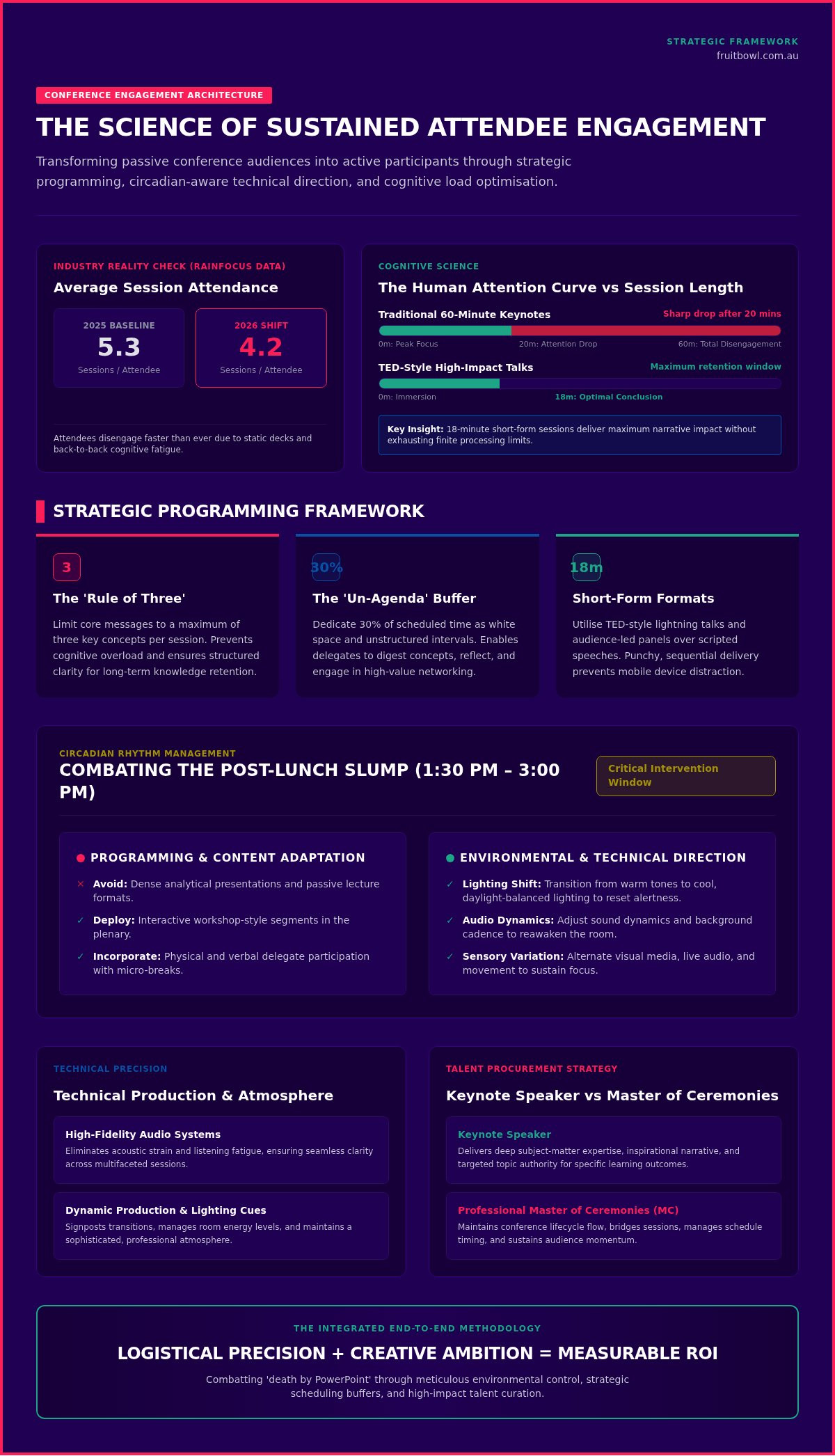
Recent industry data from RainFocus shows that average session attendance dropped from 5.3 to 4.2 sessions per attendee between 2025 and 2026. It’s a sobering reality for organisers who invest months into planning, only to watch energy levels plummet during the afternoon slump or see a room full of people distracted by their mobile devices. You understand that keeping conference attendees engaged is no longer about just providing a comfortable seat and a quality catering spread. It requires a sophisticated blend of logistical precision and creative ambition to combat the dreaded “death by PowerPoint” and deliver actual value.
This guide will show you how to transform passive listeners into active participants by applying a professional framework for technical excellence and strategic programming. You’ll discover how to maintain a seamless event flow that sustains momentum from the opening keynote to the final closing remarks. We will examine the integration of high-calibre talent procurement, precise technical direction, and the strategic 30% “un-agenda” buffer to ensure your event delivers measurable participation and a high return on investment. By the end of this article, you’ll have the clarity needed to manage complex, high-stakes environments with total confidence.
Key Takeaways
- Design a strategic program flow that utilises the ‘Rule of Three’ to prevent cognitive overload and maintain momentum across multifaceted sessions.
- Discover the critical role of technical direction and high-fidelity audio in keeping conference attendees engaged by reducing listening fatigue and visual distractions.
- Understand the strategic distinction between a keynote speaker and a professional Master of Ceremonies to ensure your talent procurement aligns with specific event objectives.
- Master the use of dynamic lighting and production cues to signal transitions, maintaining a professional atmosphere throughout the entire conference lifecycle.
- Implement an integrated end-to-end methodology that balances logistical precision with creative ambition to secure a high return on investment for complex activations.
Table of Contents
- Understanding the Science of Keeping Conference Attendees Engaged
- Strategic Programming: Designing a Flow That Maintains Momentum
- Leveraging Production and Technical Direction for Immersive Experiences
- Talent Procurement: Selecting Speakers and Facilitators Who Drive Participation
- Executing an Integrated Engagement Strategy with Fruitbowl Events Agency
Understanding the Science of Keeping Conference Attendees Engaged
Successful events don’t happen by accident. They are engineered through a deep understanding of the science of audience engagement, which defines true engagement as a deliberate alignment of cognitive focus, emotional connection, and active participation. Traditional 60-minute keynote sessions frequently fail because they ignore the human ‘Attention Curve’, which shows a sharp decline in focus after just 20 minutes. When designing high-stakes conferences, the physical environment must be meticulously calibrated to foster mental clarity and social interaction. Relying on passive, static presentations inevitably leads to audience detachment. Deploying professional corporate event management eliminates ‘death by PowerPoint’ by replacing predictable slide decks with dynamic, multi-sensory experiences.
Cognitive Load and Information Retention
The human brain possesses finite processing limits when absorbing complex data during back-to-back sessions. Overloading attendees with continuous technical data results in cognitive fatigue, causing them to disengage entirely. To counteract this, strategic planners intentionally embed ‘white space’ into the programme schedule. This unstructured time allows delegates to network, digest core concepts, and reflect on the material presented. Sensory variety is equally critical for long-term knowledge retention. By alternating between visual media, spoken word, and physical movement, you keep the brain alert. This structured variation is central to keeping conference attendees engaged throughout a demanding multi-day schedule.
The Psychology of the ‘Post-Lunch Slump’
Between 1:30 PM and 3:00 PM, human biology naturally dictates a dip in energy levels due to circadian rhythms. Addressing this post-lunch slump requires an intentional shift in your programming strategy. Rather than scheduling dense, analytical presentations during this window, transition to interactive workshops or panel discussions that demand physical or verbal participation. Technical direction plays a silent but powerful role here. Technicians can subtly alter the room’s energy by shifting lighting temperatures from warm to cool, daylight-balanced tones. Simultaneously, adjusting the audio dynamics can reawaken the room. This seamless integration of logistics and environmental control ensures audience focus remains steady when it matters most.
Strategic Programming: Designing a Flow That Maintains Momentum
Momentum is a byproduct of deliberate structure. Moving beyond passive listening requires integrating ‘workshop-style’ segments directly into the plenary. This shift prevents the physical and mental stagnation that plagues traditional formats. The ‘Rule of Three’ is essential here; by limiting core messages to three per session, you ensure clarity and prevent the cognitive overload discussed in the previous section. A professional conference logistics coordinator manages this rhythm, ensuring every movement-based transition and micro-break occurs exactly as scripted. These breaks aren’t just pauses; they are strategic tools for keeping conference attendees engaged by resetting the room’s energy levels.
The Power of Short-Form Content
Attention spans are a scarce resource. Short-form formats, such as TED-style talks limited to 18 minutes, deliver maximum impact without exhausting the audience. Lightning rounds allow for diverse viewpoints in rapid succession, while panel discussions should prioritise audience-led questions over lengthy scripted biographies. These proven engagement strategies transform a static schedule into a dynamic narrative. By organising content into digestible, sequential segments, you mirror the logical progression required for deep learning. Short, punchy sessions prevent the fatigue that leads to mobile device distractions.
Interactive Q&A and Real-Time Feedback
Technology provides a bridge between the stage and the seats. Digital polling tools give every attendee a voice instantly, allowing the room to influence the discussion in real time. This ‘crowd-sourced’ agenda ensures the content remains relevant to the participants’ immediate needs. Gamification, when executed with precision, incentivises participation across the entire event lifecycle by rewarding active contributors. It turns a solitary listening experience into a collective mission. This level of integration is the hallmark of keeping conference attendees engaged through high-impact technology. If you need assistance in orchestrating these complex programming elements, expert guidance ensures every technical detail is under professional supervision.
Leveraging Production and Technical Direction for Immersive Experiences
Technical direction acts as the backbone of attendee focus. While strategic programming sets the pace, production quality determines whether that pace is sustainable. High-fidelity audio is essential for preventing listening fatigue in large conference halls, a condition where poor sound quality forces the brain to work harder to process information, leading to rapid disengagement. By ensuring acoustic clarity, you remove a significant barrier to keeping conference attendees engaged. Creative staging and integrated brand activations further enhance this by providing ‘Instagrammable’ moments that encourage social sharing and reinforce the event’s prestige. Comprehensive AV management for events ensures these elements work in concert, delivering the frictionless experience that senior stakeholders expect.
Audio-Visual Excellence as an Engagement Tool
Modern production goes far beyond the traditional projector screen. Utilising high-resolution LED walls and projection mapping transforms a static stage into a dynamic storytelling environment. These tools allow for the seamless integration of multifaceted data and creative visuals, which reinforces the clarity of core messages by making them visually unavoidable. For hybrid events, the audio-visual chain must be flawless to ensure remote participants feel as connected as those in the room. This level of complexity requires technical fail-safes and a ‘safe pair of hands’ to manage potential risks, ensuring the narrative remains under expert supervision throughout the delivery phase.
Lighting Design and Atmospheric Control
Lighting design is a precise instrument for atmospheric control. By applying principles of colour psychology, technical directors can influence the room’s collective mood. For instance, cool blue lighting is often deployed to sharpen focus during analytical sessions, whereas warm amber tones are used to signal transitions into networking periods. Professional stage lighting is equally critical for speaker visibility and high-quality video recording, ensuring the brand’s message is captured with professional clarity. These technical cues facilitate a smooth transition from daylight seminars to evening functions, providing a methodical and deliberate pulse to the entire project timeline. This disciplined approach is a key component in keeping conference attendees engaged from the first session to the final function.
Talent Procurement: Selecting Speakers and Facilitators Who Drive Participation
Procuring the right talent is a strategic pillar of event success, not merely a decorative add-on. While a high-profile keynote speaker provides the intellectual substance, a professional Master of Ceremonies (MC) manages the emotional and logistical pulse of the room. Sourcing talent that aligns with your specific corporate culture and event objectives is essential for maintaining a sense of symmetry and professional purpose. Professional talent procurement involves more than just booking a name; it requires meticulous management of contract compliance and technical riders to ensure a frictionless experience for both the speaker and the audience. This disciplined approach is fundamental to keeping conference attendees engaged throughout the entire programme. By ensuring every detail is under expert supervision, you eliminate the risks associated with unvetted talent or poorly managed logistics.
The Role of the Professional Facilitator
A professional facilitator acts as the ‘glue’ that holds a complex conference together. They don’t just introduce speakers; they synthesise information, summarising key takeaways to reinforce knowledge retention. Skilled facilitators are experts at reading the room, using specific techniques to manage time with precision and handle difficult live questions without losing momentum. They ensure the narrative pace remains steady, keeping the audience on track even when sessions become complex or highly technical. This role requires an unflappable personality and a commitment to the client’s objectives, positioning the MC as a reliable partner in the event’s success.
Briefing for Impact
Transforming a speaker from a passive presenter into an active engager starts with a comprehensive brief. This document must detail audience demographics, specific pain points, and desired outcomes. Organising pre-event rehearsals is a non-negotiable step to ensure technical and content alignment. We encourage speakers to prioritise storytelling and case studies over dry, data-heavy slides. Moving away from reading slides to interactive delivery allows for a more grounded and professional connection with the delegates. This shift in delivery style is a proven method for keeping conference attendees engaged and ensuring the core message resonates long after the event concludes. If you require assistance in sourcing and managing high-calibre talent, our team provides the expert oversight and logistical precision needed to guarantee a successful outcome.
Executing an Integrated Engagement Strategy with Fruitbowl Events Agency
Executing a high-stakes event requires a methodology that bridges creative ambition with logistical precision. At Fruitbowl Events Agency, we apply an end-to-end framework that ensures every element of the conference lifecycle is under expert supervision. Our process begins with strategic planning and extends through to on-site technical delivery, providing a steady, results-oriented approach that prioritises your objectives. By positioning ourselves as a ‘safe pair of hands’, we manage the multifaceted logistics of keeping conference attendees engaged, allowing you to focus entirely on your delegates. We also integrate sophisticated brand activation event planning directly into the conference floor, transforming passive spaces into immersive environments. Following the event, we provide customised reporting and analysis to measure engagement ROI, ensuring the commercial impact of your activation is clearly documented.
Order and Clarity in Complex Environments
With over 28 years of industry experience, we bring order and clarity to even the most complex environments. Our team maintains a composed, unflappable presence, navigating logistical challenges with a level of confidence born from decades of successful execution. We ensure a seamless integration between technical, creative, and logistical teams, creating a symmetrical flow that reinforces the event’s professional energy. Meticulous planning covers every detail, from the first coffee served to the final farewell, ensuring a frictionless experience for all participants. This disciplined approach is the foundation for keeping conference attendees engaged during even the most demanding multi-day schedules.
Partnering for Success
National organisations and government bodies trust us to execute high-impact corporate events and activations because we prioritise their brand objectives above all else. We view our role as a collaborative partnership, acting as a meticulous guide through the complexities of modern event production. This commitment to quality and safety ensures your mission is successful. The quiet pride we take in our work is reflected in the seamless execution of every project. Our focus remains firmly on delivering a frictionless experience that allows your message to resonate with clarity. If you are ready to elevate your next event, organise a consultation with Fruitbowl Events Agency today.
Elevating Your Event Strategy for Lasting Impact
Successful conferences are built on the seamless integration of strategic programming, technical excellence, and high-calibre talent. By moving beyond traditional keynote formats and embracing the ‘Rule of Three’, organisers can effectively sustain momentum throughout the event lifecycle. High-fidelity audio and dynamic lighting aren’t just aesthetic choices; they’re essential tools for keeping conference attendees engaged by managing cognitive load and room energy.
With over 28 years of industry-leading expertise, Fruitbowl Events Agency provides the sophisticated oversight needed to navigate complex, high-stakes environments. Our national delivery across corporate and government sectors ensures that every activation is managed with logistical precision and creative ambition. We act as a safe pair of hands, handling specialist technical direction and talent procurement so you can focus on your primary objectives. It’s time to transform your next gathering into a frictionless, high-impact experience.
Partner with the experts for your next high-impact conference and ensure your mission succeeds with absolute clarity.
Frequently Asked Questions
How can I keep conference attendees engaged during long afternoon sessions?
Counteract low energy by transitioning into kinesthetic activities. Afternoon sessions should prioritise movement-based breakouts or peer-to-peer networking rather than passive listening. This physical shift stimulates blood flow and re-focuses the mind. By integrating tactile elements or collaborative problem-solving, you ensure the energy remains high. Maintaining momentum during these periods is essential for keeping conference attendees engaged and preventing the mental fatigue that often leads to session abandonment.
What are the best interactive technologies for large-scale conferences in 2026?
AI-powered personalised digital agendas are the leading engagement tool for 2026. These platforms use machine learning to suggest sessions and facilitate matchmaking based on individual attendee goals. Research indicates this technology can boost engagement by 30%. Additionally, smart badges that track dwell time provide real-time data on session popularity. These tools allow organisers to adjust the event flow dynamically, ensuring every participant receives a tailored experience that aligns with their professional interests.
How do I choose between a celebrity speaker and a professional facilitator?
Choose a celebrity speaker to drive registrations and provide high-level inspiration. Select a professional facilitator, however, when your primary goal is to drive specific commercial outcomes or manage complex discussions. A facilitator ensures the narrative remains on track and summarises key insights for the audience. While a celebrity offers prestige, a skilled Master of Ceremonies provides the logistical precision required to maintain a steady pulse throughout the entire project timeline.
Can lighting and sound really affect how much attendees remember?
Sensory environments directly influence information retention. Clear, high-fidelity audio ensures that the brain isn’t exhausted by processing distorted sound, which allows more cognitive resources to be dedicated to learning. Similarly, professional lighting design creates visual anchors that focus attention on the speaker. These technical elements work in concert to anchor memories emotionally. A well-executed production environment ensures that the brand’s core messages are absorbed with greater clarity and long-term impact.
What is the ideal length for a conference session to maintain focus?
The optimal length for a high-impact presentation is between 12 and 18 minutes. For deep-dive workshops, sessions shouldn’t exceed 90 minutes without a structured micro-break. Keeping conference attendees engaged requires a methodical approach to timing that respects the brain’s natural processing limits. By varying the duration of sessions, you create a narrative rhythm that prevents stagnation. Short, punchy segments delivered with precision ensure that every minute of the programme provides tangible value to the delegate.
How do I measure attendee engagement beyond just a post-event survey?
Measure engagement through behavioural data such as session dwell time and networking interaction frequency. Modern event platforms allow you to track how long attendees remain in a session and which community features they use most. Monitoring lead generation metrics and pipeline attribution provides a clearer picture of ROI than feedback forms alone. These data points offer an objective view of attendee behaviour, allowing you to demonstrate the commercial impact of your event strategy to senior stakeholders.
What are the common mistakes that cause conference attendees to disengage?
Over-programming is a frequent error that leads to attendee burnout. When an agenda is too dense, delegates lack the ‘white space’ needed to digest information and network effectively. Another common mistake is failing to brief talent on the specific demographics of the room. This results in content that misses the mark, causing the audience to disengage. Ensuring that every session is tailored to the audience’s pain points is critical for maintaining a high level of participation.
How does professional technical direction improve the attendee experience?
Professional technical direction provides the frictionless environment necessary for a sophisticated event. It involves managing the seamless integration of audio-visual systems, lighting, and staging to ensure no technical interruptions occur. This level of oversight suggests a brand that is in total control of the narrative. By mitigating risks and managing complex technical riders, a director creates a sense of security for the client, ensuring the focus remains entirely on the successful delivery of the mission.
Recent industry data from RainFocus shows that average session attendance dropped from 5.3 to 4.2 sessions per attendee between 2025 and 2026. It’s a sobering reality for organisers who invest months into planning, only to watch energy levels plummet during the afternoon slump or see a room full of people distracted by their mobile devices. You understand that keeping conference attendees engaged is no longer about just providing a comfortable seat and a quality catering spread. It requires a sophisticated blend of logistical precision and creative ambition to combat the dreaded “death by PowerPoint” and deliver actual value.
This guide will show you how to transform passive listeners into active participants by applying a professional framework for technical excellence and strategic programming. You’ll discover how to maintain a seamless event flow that sustains momentum from the opening keynote to the final closing remarks. We will examine the integration of high-calibre talent procurement, precise technical direction, and the strategic 30% “un-agenda” buffer to ensure your event delivers measurable participation and a high return on investment. By the end of this article, you’ll have the clarity needed to manage complex, high-stakes environments with total confidence.
Key Takeaways
- Design a strategic program flow that utilises the ‘Rule of Three’ to prevent cognitive overload and maintain momentum across multifaceted sessions.
- Discover the critical role of technical direction and high-fidelity audio in keeping conference attendees engaged by reducing listening fatigue and visual distractions.
- Understand the strategic distinction between a keynote speaker and a professional Master of Ceremonies to ensure your talent procurement aligns with specific event objectives.
- Master the use of dynamic lighting and production cues to signal transitions, maintaining a professional atmosphere throughout the entire conference lifecycle.
- Implement an integrated end-to-end methodology that balances logistical precision with creative ambition to secure a high return on investment for complex activations.
Table of Contents
- Understanding the Science of Keeping Conference Attendees Engaged
- Strategic Programming: Designing a Flow That Maintains Momentum
- Leveraging Production and Technical Direction for Immersive Experiences
- Talent Procurement: Selecting Speakers and Facilitators Who Drive Participation
- Executing an Integrated Engagement Strategy with Fruitbowl Events Agency
Understanding the Science of Keeping Conference Attendees Engaged
Successful events don’t happen by accident. They are engineered through a deep understanding of the science of audience engagement, which defines true engagement as a deliberate alignment of cognitive focus, emotional connection, and active participation. Traditional 60-minute keynote sessions frequently fail because they ignore the human ‘Attention Curve’, which shows a sharp decline in focus after just 20 minutes. When designing high-stakes conferences, the physical environment must be meticulously calibrated to foster mental clarity and social interaction. Relying on passive, static presentations inevitably leads to audience detachment. Deploying professional corporate event management eliminates ‘death by PowerPoint’ by replacing predictable slide decks with dynamic, multi-sensory experiences.
Cognitive Load and Information Retention
The human brain possesses finite processing limits when absorbing complex data during back-to-back sessions. Overloading attendees with continuous technical data results in cognitive fatigue, causing them to disengage entirely. To counteract this, strategic planners intentionally embed ‘white space’ into the programme schedule. This unstructured time allows delegates to network, digest core concepts, and reflect on the material presented. Sensory variety is equally critical for long-term knowledge retention. By alternating between visual media, spoken word, and physical movement, you keep the brain alert. This structured variation is central to keeping conference attendees engaged throughout a demanding multi-day schedule.
The Psychology of the ‘Post-Lunch Slump’
Between 1:30 PM and 3:00 PM, human biology naturally dictates a dip in energy levels due to circadian rhythms. Addressing this post-lunch slump requires an intentional shift in your programming strategy. Rather than scheduling dense, analytical presentations during this window, transition to interactive workshops or panel discussions that demand physical or verbal participation. Technical direction plays a silent but powerful role here. Technicians can subtly alter the room’s energy by shifting lighting temperatures from warm to cool, daylight-balanced tones. Simultaneously, adjusting the audio dynamics can reawaken the room. This seamless integration of logistics and environmental control ensures audience focus remains steady when it matters most.
Strategic Programming: Designing a Flow That Maintains Momentum
Momentum is a byproduct of deliberate structure. Moving beyond passive listening requires integrating ‘workshop-style’ segments directly into the plenary. This shift prevents the physical and mental stagnation that plagues traditional formats. The ‘Rule of Three’ is essential here; by limiting core messages to three per session, you ensure clarity and prevent the cognitive overload discussed in the previous section. A professional conference logistics coordinator manages this rhythm, ensuring every movement-based transition and micro-break occurs exactly as scripted. These breaks aren’t just pauses; they are strategic tools for keeping conference attendees engaged by resetting the room’s energy levels.
The Power of Short-Form Content
Attention spans are a scarce resource. Short-form formats, such as TED-style talks limited to 18 minutes, deliver maximum impact without exhausting the audience. Lightning rounds allow for diverse viewpoints in rapid succession, while panel discussions should prioritise audience-led questions over lengthy scripted biographies. These proven engagement strategies transform a static schedule into a dynamic narrative. By organising content into digestible, sequential segments, you mirror the logical progression required for deep learning. Short, punchy sessions prevent the fatigue that leads to mobile device distractions.
Interactive Q&A and Real-Time Feedback
Technology provides a bridge between the stage and the seats. Digital polling tools give every attendee a voice instantly, allowing the room to influence the discussion in real time. This ‘crowd-sourced’ agenda ensures the content remains relevant to the participants’ immediate needs. Gamification, when executed with precision, incentivises participation across the entire event lifecycle by rewarding active contributors. It turns a solitary listening experience into a collective mission. This level of integration is the hallmark of keeping conference attendees engaged through high-impact technology. If you need assistance in orchestrating these complex programming elements, expert guidance ensures every technical detail is under professional supervision.
Leveraging Production and Technical Direction for Immersive Experiences
Technical direction acts as the backbone of attendee focus. While strategic programming sets the pace, production quality determines whether that pace is sustainable. High-fidelity audio is essential for preventing listening fatigue in large conference halls, a condition where poor sound quality forces the brain to work harder to process information, leading to rapid disengagement. By ensuring acoustic clarity, you remove a significant barrier to keeping conference attendees engaged. Creative staging and integrated brand activations further enhance this by providing ‘Instagrammable’ moments that encourage social sharing and reinforce the event’s prestige. Comprehensive AV management for events ensures these elements work in concert, delivering the frictionless experience that senior stakeholders expect.
Audio-Visual Excellence as an Engagement Tool
Modern production goes far beyond the traditional projector screen. Utilising high-resolution LED walls and projection mapping transforms a static stage into a dynamic storytelling environment. These tools allow for the seamless integration of multifaceted data and creative visuals, which reinforces the clarity of core messages by making them visually unavoidable. For hybrid events, the audio-visual chain must be flawless to ensure remote participants feel as connected as those in the room. This level of complexity requires technical fail-safes and a ‘safe pair of hands’ to manage potential risks, ensuring the narrative remains under expert supervision throughout the delivery phase.
Lighting Design and Atmospheric Control
Lighting design is a precise instrument for atmospheric control. By applying principles of colour psychology, technical directors can influence the room’s collective mood. For instance, cool blue lighting is often deployed to sharpen focus during analytical sessions, whereas warm amber tones are used to signal transitions into networking periods. Professional stage lighting is equally critical for speaker visibility and high-quality video recording, ensuring the brand’s message is captured with professional clarity. These technical cues facilitate a smooth transition from daylight seminars to evening functions, providing a methodical and deliberate pulse to the entire project timeline. This disciplined approach is a key component in keeping conference attendees engaged from the first session to the final function.
Talent Procurement: Selecting Speakers and Facilitators Who Drive Participation
Procuring the right talent is a strategic pillar of event success, not merely a decorative add-on. While a high-profile keynote speaker provides the intellectual substance, a professional Master of Ceremonies (MC) manages the emotional and logistical pulse of the room. Sourcing talent that aligns with your specific corporate culture and event objectives is essential for maintaining a sense of symmetry and professional purpose. Professional talent procurement involves more than just booking a name; it requires meticulous management of contract compliance and technical riders to ensure a frictionless experience for both the speaker and the audience. This disciplined approach is fundamental to keeping conference attendees engaged throughout the entire programme. By ensuring every detail is under expert supervision, you eliminate the risks associated with unvetted talent or poorly managed logistics.
The Role of the Professional Facilitator
A professional facilitator acts as the ‘glue’ that holds a complex conference together. They don’t just introduce speakers; they synthesise information, summarising key takeaways to reinforce knowledge retention. Skilled facilitators are experts at reading the room, using specific techniques to manage time with precision and handle difficult live questions without losing momentum. They ensure the narrative pace remains steady, keeping the audience on track even when sessions become complex or highly technical. This role requires an unflappable personality and a commitment to the client’s objectives, positioning the MC as a reliable partner in the event’s success.
Briefing for Impact
Transforming a speaker from a passive presenter into an active engager starts with a comprehensive brief. This document must detail audience demographics, specific pain points, and desired outcomes. Organising pre-event rehearsals is a non-negotiable step to ensure technical and content alignment. We encourage speakers to prioritise storytelling and case studies over dry, data-heavy slides. Moving away from reading slides to interactive delivery allows for a more grounded and professional connection with the delegates. This shift in delivery style is a proven method for keeping conference attendees engaged and ensuring the core message resonates long after the event concludes. If you require assistance in sourcing and managing high-calibre talent, our team provides the expert oversight and logistical precision needed to guarantee a successful outcome.
Executing an Integrated Engagement Strategy with Fruitbowl Events Agency
Executing a high-stakes event requires a methodology that bridges creative ambition with logistical precision. At Fruitbowl Events Agency, we apply an end-to-end framework that ensures every element of the conference lifecycle is under expert supervision. Our process begins with strategic planning and extends through to on-site technical delivery, providing a steady, results-oriented approach that prioritises your objectives. By positioning ourselves as a ‘safe pair of hands’, we manage the multifaceted logistics of keeping conference attendees engaged, allowing you to focus entirely on your delegates. We also integrate sophisticated brand activation event planning directly into the conference floor, transforming passive spaces into immersive environments. Following the event, we provide customised reporting and analysis to measure engagement ROI, ensuring the commercial impact of your activation is clearly documented.
Order and Clarity in Complex Environments
With over 28 years of industry experience, we bring order and clarity to even the most complex environments. Our team maintains a composed, unflappable presence, navigating logistical challenges with a level of confidence born from decades of successful execution. We ensure a seamless integration between technical, creative, and logistical teams, creating a symmetrical flow that reinforces the event’s professional energy. Meticulous planning covers every detail, from the first coffee served to the final farewell, ensuring a frictionless experience for all participants. This disciplined approach is the foundation for keeping conference attendees engaged during even the most demanding multi-day schedules.
Partnering for Success
National organisations and government bodies trust us to execute high-impact corporate events and activations because we prioritise their brand objectives above all else. We view our role as a collaborative partnership, acting as a meticulous guide through the complexities of modern event production. This commitment to quality and safety ensures your mission is successful. The quiet pride we take in our work is reflected in the seamless execution of every project. Our focus remains firmly on delivering a frictionless experience that allows your message to resonate with clarity. If you are ready to elevate your next event, organise a consultation with Fruitbowl Events Agency today.
Elevating Your Event Strategy for Lasting Impact
Successful conferences are built on the seamless integration of strategic programming, technical excellence, and high-calibre talent. By moving beyond traditional keynote formats and embracing the ‘Rule of Three’, organisers can effectively sustain momentum throughout the event lifecycle. High-fidelity audio and dynamic lighting aren’t just aesthetic choices; they’re essential tools for keeping conference attendees engaged by managing cognitive load and room energy.
With over 28 years of industry-leading expertise, Fruitbowl Events Agency provides the sophisticated oversight needed to navigate complex, high-stakes environments. Our national delivery across corporate and government sectors ensures that every activation is managed with logistical precision and creative ambition. We act as a safe pair of hands, handling specialist technical direction and talent procurement so you can focus on your primary objectives. It’s time to transform your next gathering into a frictionless, high-impact experience.
Partner with the experts for your next high-impact conference and ensure your mission succeeds with absolute clarity.
Frequently Asked Questions
How can I keep conference attendees engaged during long afternoon sessions?
Counteract low energy by transitioning into kinesthetic activities. Afternoon sessions should prioritise movement-based breakouts or peer-to-peer networking rather than passive listening. This physical shift stimulates blood flow and re-focuses the mind. By integrating tactile elements or collaborative problem-solving, you ensure the energy remains high. Maintaining momentum during these periods is essential for keeping conference attendees engaged and preventing the mental fatigue that often leads to session abandonment.
What are the best interactive technologies for large-scale conferences in 2026?
AI-powered personalised digital agendas are the leading engagement tool for 2026. These platforms use machine learning to suggest sessions and facilitate matchmaking based on individual attendee goals. Research indicates this technology can boost engagement by 30%. Additionally, smart badges that track dwell time provide real-time data on session popularity. These tools allow organisers to adjust the event flow dynamically, ensuring every participant receives a tailored experience that aligns with their professional interests.
How do I choose between a celebrity speaker and a professional facilitator?
Choose a celebrity speaker to drive registrations and provide high-level inspiration. Select a professional facilitator, however, when your primary goal is to drive specific commercial outcomes or manage complex discussions. A facilitator ensures the narrative remains on track and summarises key insights for the audience. While a celebrity offers prestige, a skilled Master of Ceremonies provides the logistical precision required to maintain a steady pulse throughout the entire project timeline.
Can lighting and sound really affect how much attendees remember?
Sensory environments directly influence information retention. Clear, high-fidelity audio ensures that the brain isn’t exhausted by processing distorted sound, which allows more cognitive resources to be dedicated to learning. Similarly, professional lighting design creates visual anchors that focus attention on the speaker. These technical elements work in concert to anchor memories emotionally. A well-executed production environment ensures that the brand’s core messages are absorbed with greater clarity and long-term impact.
What is the ideal length for a conference session to maintain focus?
The optimal length for a high-impact presentation is between 12 and 18 minutes. For deep-dive workshops, sessions shouldn’t exceed 90 minutes without a structured micro-break. Keeping conference attendees engaged requires a methodical approach to timing that respects the brain’s natural processing limits. By varying the duration of sessions, you create a narrative rhythm that prevents stagnation. Short, punchy segments delivered with precision ensure that every minute of the programme provides tangible value to the delegate.
How do I measure attendee engagement beyond just a post-event survey?
Measure engagement through behavioural data such as session dwell time and networking interaction frequency. Modern event platforms allow you to track how long attendees remain in a session and which community features they use most. Monitoring lead generation metrics and pipeline attribution provides a clearer picture of ROI than feedback forms alone. These data points offer an objective view of attendee behaviour, allowing you to demonstrate the commercial impact of your event strategy to senior stakeholders.
What are the common mistakes that cause conference attendees to disengage?
Over-programming is a frequent error that leads to attendee burnout. When an agenda is too dense, delegates lack the ‘white space’ needed to digest information and network effectively. Another common mistake is failing to brief talent on the specific demographics of the room. This results in content that misses the mark, causing the audience to disengage. Ensuring that every session is tailored to the audience’s pain points is critical for maintaining a high level of participation.
How does professional technical direction improve the attendee experience?
Professional technical direction provides the frictionless environment necessary for a sophisticated event. It involves managing the seamless integration of audio-visual systems, lighting, and staging to ensure no technical interruptions occur. This level of oversight suggests a brand that is in total control of the narrative. By mitigating risks and managing complex technical riders, a director creates a sense of security for the client, ensuring the focus remains entirely on the successful delivery of the mission.
OUR BLOG
Event Insights & Expertise
Our blog is your go-to resource for all things events. From expert insights and the latest industry trends to practical planning tips, we share everything you need to deliver standout experiences.
Contact Us