How to Measure Event ROI: A Strategic Framework for Australian Corporates in 2026

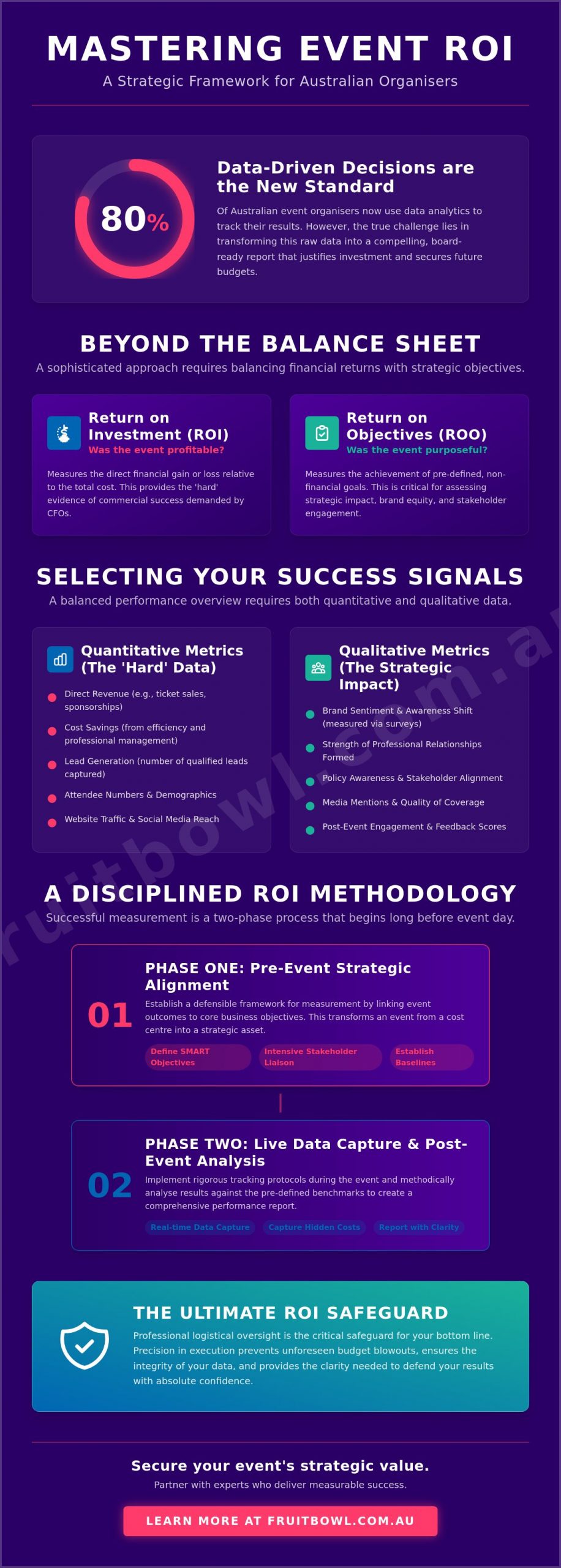
80% of Australian organisers now use data analytics to track their results, yet the gap between raw data and a board-ready report remains a significant challenge for most corporate teams. (WifiTalents, 2026). You’ve likely experienced the tension of justifying a high-stakes brand activation or conference to a CFO who demands hard financial returns rather than “improved brand awareness.” It’s difficult to quantify the value of professional connection through inconsistent data collection, but mastering how to measure event roi is the only way to secure long-term investment.

We believe that true success occurs at the intersection of logistical precision and strategic business validation. This article provides a sophisticated framework for quantifying your results by integrating precise financial metrics with a methodical analysis of strategic impact. We’ll outline a repeatable process to align your logistics with core business objectives; this ensures you have the clarity and security needed to defend future event budgets with absolute confidence.

Key Takeaways

  • Define event ROI as a sophisticated measure of value that balances tangible financial returns with long-term strategic brand equity.
  • Master how to measure event roi by categorising primary financial metrics alongside secondary qualitative data for a comprehensive performance overview.
  • Establish rigorous cost-tracking protocols to capture indirect returns and prevent the budget inaccuracies that often undermine reported success.
  • Implement a disciplined two-phase methodology that prioritises pre-event benchmarking and real-time data capture throughout the event lifecycle.
  • Recognise how professional logistical oversight serves as a critical safeguard for your bottom line by preventing unforeseen budget blowouts.

Beyond the Balance Sheet: Defining Event ROI in 2026

In the context of Australian corporate strategy, the traditional definition of Return on Investment (ROI) often feels too narrow for the complexities of a modern brand activation or government seminar. While the baseline formula measures the value generated relative to the total resources invested, a sophisticated 2026 approach requires looking beyond the ledger. Understanding how to measure event roi now involves a “Total Value” methodology. This approach acknowledges that while hard ROI (direct financial profit) is essential for commercial sustainability, soft ROI (the accumulation of brand equity and strengthened professional relationships) provides the foundation for future growth.

The current economic climate in Australia demands this level of analytical depth. CFOs are no longer satisfied with vague reports of success; they require a methodical breakdown of how every dollar spent on a conference or festival contributes to the bottom line. Our “Safe Hands” philosophy suggests that precision in measurement is a direct reflection of precision in execution. If you cannot measure the outcome with clarity, you likely haven’t controlled the logistics with the necessary rigour. True oversight ensures that every moving part is calibrated to deliver a specific, quantifiable result.

ROI vs. ROO: Why Both Matter

Return on Objectives (ROO) serves as the qualitative counterpart to financial data. While ROI tells you if the event was profitable, ROO tells you if it was purposeful. For internal seminars or government activations, the primary metric is often “Return on Interaction.” This involves setting SMART objectives (Specific, Measurable, Achievable, Relevant, and Time-bound) that align with broader organisational goals. If the objective is to increase policy awareness among 500 stakeholders, the measurement of success must be as disciplined as a financial audit. You must track the shift in sentiment or knowledge with the same accuracy used for ticket sales; to see how these objectives are met through high-impact visual communication, you can explore Case Studies from Digital Content Studios.

The Strategic Alignment of Event Goals

Selecting Your Success Signals: Quantitative and Qualitative Metrics

Identifying the right signals is a deliberate exercise in strategic selection. We categorise data into primary financial markers and secondary engagement signals to create a balanced view of performance. This structure ensures that every report reflects both the immediate fiscal impact and the long-term strategic reach of your programme. High-stakes corporate environments leave no room for data ambiguity. With 80% of Australian organisers now using data analytics to track their results (WifiTalents, 2026), the focus has shifted from simple collection to the absolute integrity of the information gathered.

Precision in technical direction allows for the seamless capture of attendee behaviour through integrated platforms. It is this level of technical oversight that transforms raw numbers into actionable intelligence. When considering how to measure event roi, your reporting should employ parallel phrasing to ensure symmetry; for instance, you should report on what was spent, what was saved, and what was earned with equal rigour. This methodical approach provides a sense of security to stakeholders who require a thorough account of resources.

A thorough account of resources also involves evaluating the impact of premium hospitality on attendee sentiment; for organisers looking for global inspiration, you can read more about sourcing high-quality seasonal Filipino produce in the UAE as a case study in niche market catering.

Hard Metrics: The Financial Fundamentals

Financial fundamentals provide the “hard” evidence of success. This includes direct revenue from ticket sales for public festivals or high-value sponsorships secured for international conferences. However, for many Australian corporates, the most significant financial signal is the efficiency of outsourced corporate event management. By consolidating logistics under expert supervision, organisations often realise substantial cost savings through reduced internal labour and optimized vendor procurement. Furthermore, lead generation and pipeline value must be tracked with clinical accuracy. Integrating event data with your CRM allows you to monitor conversions post-event, ensuring that every handshake at a brand activation is valued correctly within the sales cycle.

Soft Metrics: Quantifying the Intangible

Soft metrics quantify the “Return on Interaction” that financial ledgers often miss. Net Promoter Score (NPS) and detailed attendee satisfaction surveys offer a direct window into the audience’s mindset. For public festivals and brand activations, social media sentiment analysis and media reach provide a clear indication of brand equity growth. Internal seminars and conferences require a different lens; here, success is measured through employee engagement levels and the successful dissemination of corporate strategy. For those seeking to refine their reporting, partnering with a specialist in high-impact event delivery ensures that these intangible benefits are captured with the same discipline as your financial data. This holistic view is essential for a complete understanding of how to measure event roi in a competitive market.

The Logistics of Accuracy: Capturing Hidden Costs and Indirect Returns

Inaccurate cost tracking remains the primary cause of indefensible ROI reports. If the financial foundation is flawed, any subsequent analysis of value becomes speculative and loses credibility with executive stakeholders. To mitigate this risk, many Australian organisations utilise the fiscal precision of Brown Hamilton Partners to ensure their reporting is robust. Precision in budget management must be established during the strategic planning phase; this ensures that every potential expense is identified before the first contract is signed. While some organisers argue that measuring every variable in large festivals is too complex, a disciplined approach proves that high-stakes environments are manageable when supported by the right systems. The Total Cost of Ownership for a major activation encompasses the sum of all direct financial outlays, internal resource allocations, and administrative overheads required to move a project from conception to completion.

Mastering how to measure event roi requires a commitment to transparency that extends beyond venue hire and catering. A composed strategist understands that logistical precision is the only way to prevent budget blowouts that quietly erode profitability. In specific industries like horticulture, this transparency extends to managing labour hire and ethical employment; you can explore Grower Membership for specialised HR support that helps account for these administrative complexities. By identifying these hidden variables early, you provide a sense of security to your finance team, demonstrating that the project is under expert supervision. This level of detail transforms a simple budget into a strategic tool for validation.

Mapping the Full Cost Spectrum

A thorough audit must account for internal staff hours and administrative overheads that are often omitted from the final tally. Technical infrastructure, including AV management, lighting, and staging, represents a significant portion of the investment and requires meticulous tracking. For organisations based in the capital, professional corporate video production Canberra ensures that key sessions are recorded with the high-definition precision needed for post-event communication. Talent procurement and technical riders are equally critical; these variables must be documented early in the timeline to avoid unforeseen logistical expenses. When you organise these costs into clear, sequential segments, you ensure that the final report reflects a symmetrical and thorough account of the total investment.

Identifying Indirect Returns

Value often manifests in ways that a standard balance sheet fails to capture. Long-term brand lift is a vital metric, requiring measurement of awareness and sentiment months after the event concludes to gauge lasting impact. Strategic partnerships, particularly those fostered through government event planning, offer immense value that often transcends immediate fiscal years. Additionally, the content repurposing value of AV assets provides ongoing ROI; high-quality recordings and photography from a conference or brand activation can serve marketing objectives for several quarters. Recognising these indirect returns is essential for anyone learning how to measure event roi with a sophisticated, results-oriented mindset.
A Step-by-Step Methodology for ROI Implementation

A methodical implementation ensures that data collection is not an afterthought but a core component of the project lifecycle. This sequential process provides a sense of security to stakeholders, demonstrating that the event is under expert supervision from conception to completion. By adopting a “Safe Pair of Hands” approach to data security and accuracy, you protect the integrity of your findings and ensure that every report is defensible. This disciplined methodology allows Australian corporates to move beyond anecdotal evidence and embrace a results-oriented culture of accountability.

Understanding how to measure event roi requires a commitment to four distinct phases. Each phase builds upon the previous one, creating a thorough narrative of success that aligns with your organisational objectives. When you follow this structured progression, you eliminate the friction often associated with high-stakes reporting; this process is further strengthened by using precise attendance data from Footfall Australia to validate your results.

Pre-Event: Setting the Baseline

The foundation of accurate measurement is established long before the first attendee arrives. Phase 1 involves conducting deep-dive stakeholder interviews to define specific key performance indicators (KPIs) that mirror your corporate mission. You must integrate your event registration platforms with corporate CRM systems at this stage to ensure seamless data flow. It’s also vital to allocate a specific portion of your budget to measurement and analytics; this ensures that the tools required for a sophisticated “Total Value” report are available from day one.

On-Site: Capturing the Interaction

Phase 2 focuses on real-time data capture during the event lifecycle. Utilising professional AV management for events allows you to track session attendance and engagement through integrated technical platforms. This includes real-time sentiment polling and digital touchpoint tracking to monitor how the audience moves through your brand activation or conference. Ensuring that on-site delivery teams are briefed on data collection protocols prevents the loss of critical information during the height of the activation.

Post-Event: The Analysis Phase

Phase 3 is where raw data is transformed into a reassuring narrative. This involves cleaning and consolidating information from multiple sources, including technical platforms, post-event surveys, and sales data. You then calculate the final ROI using the comprehensive “Total Value” formula discussed earlier. The resulting executive summary should be composed and authoritative, providing a clear account of how the event delivered against the pre-established KPIs. If you require a strategic partner to oversee this level of detail, consider our comprehensive corporate event services.

Refining the Long-Term Strategy

The final phase involves a year-over-year comparison to track organisational growth. By comparing the results of your 2026 programmes against previous benchmarks, you can identify trends and areas for further optimisation. This longitudinal view is essential for anyone mastering how to measure event roi, as it demonstrates the compounding value of consistent logistical precision. It provides the clarity needed to refine your future strategy and ensures that every future investment is backed by a history of proven success.

Securing Strategic Value: Why Professional Management Is the Ultimate ROI Safeguard

Professional management is the barrier between a successful activation and a fiscal liability. Logistical precision directly prevents the budget blowouts that typically destroy a project’s profitability. With over 28 years of experience, we provide the “Safe Pair of Hands” required to navigate high-stakes environments where the margin for error is non-existent. Positioning professional oversight as an investment rather than a cost is essential for long-term strategic success. Understanding how to measure event roi is only the first step; the second is ensuring the data remains positive through expert execution.

The complexity of modern corporate requirements means that even a minor oversight can lead to significant financial repercussions. Expert supervision ensures that every moving part is synchronised, every vendor is managed, and every risk is mitigated before it impacts the bottom line. This level of control provides a sense of security to stakeholders, knowing that their capital is being managed with seasoned expertise. When you entrust a project to a disciplined technician, you aren’t just buying a service; you’re securing the final result.

This commitment to quality is evident when selecting specialist providers for any activation. For instance, PanYella Catering provides a benchmark for how authentic Spanish-style cuisine can elevate the attendee experience, directly impacting the qualitative metrics used to justify the total event investment.

Risk Mitigation and Budget Security

Strategic budget security is achieved through meticulous technical direction and rigorous contract management. By negotiating talent and venue contracts with a results-oriented mindset, professional managers maximise value for money from the outset. In 2026, navigating the regulatory landscape is equally critical. For instance, new venue capacity standards in Queensland require dynamic crowd density zones, while Victorian guidelines now mandate documented risk assessments for every event type. Utilising precision footfall monitoring hardware from Footfall Australia ensures compliance with these density requirements while providing accurate data for ROI analysis. Failing to comply with these 2026 standards leads to costly delays or fines. Professional oversight ensures that your brand activations and festivals meet every legal requirement, protecting the organisation from unforeseen logistical hurdles.

The Fruitbowl Approach to ROI

Our end-to-end methodology moves seamlessly from creative vision to rigorous technical execution. We provide order and clarity to complex, high-stakes environments, ensuring that the original business objectives remain the focus of every decision. A senior event logistics coordinator acts as the primary guardian of the budget, overseeing the intricate details that prevent resource wastage. We deliver custom reporting that speaks the language of the C-suite and government leads, translating technical data into a narrative of strategic success. This methodical approach ensures that when you assess how to measure event roi, the final report reflects a project that was delivered with precision, safety, and absolute fiscal responsibility.

Strategic Validation for the Future of Corporate Events

Mastering the quantification of success requires a shift from simple attendance figures to a sophisticated “Total Value” methodology. You’ve learned that defining how to measure event roi involves aligning logistical precision with core business objectives and capturing the full spectrum of indirect returns. By establishing a baseline through pre-event benchmarking and maintaining rigorous technical oversight, you transform reporting from a burden into a strategic advantage. This disciplined approach ensures that every project is a defensible asset rather than an unverified expense.

With over 28 years of industry-leading expertise, we specialise in high-stakes government and corporate activations. We provide the comprehensive end-to-end logistical and technical direction necessary to ensure your data is as impeccable as your delivery. Our team acts as a safe pair of hands, bringing order to complex environments and clarity to your results. Secure your next event’s success with Fruitbowl Events Agency and lead your organisation with the confidence that only seasoned expertise can provide. Your commitment to strategic precision today will define the impact of your activations for years to come.

Frequently Asked Questions

What is the most accurate formula for calculating event ROI?

The most accurate formula is the Net Profit divided by the Total Investment, expressed as a percentage. While this provides a clear financial snapshot, a sophisticated 2026 analysis also incorporates the “Total Value” methodology. This approach accounts for both direct revenue and the long-term strategic benefits generated by the activation, ensuring a comprehensive view of success.

How do you measure the ROI of a non-ticketed corporate event?

Measuring success for non-ticketed corporate events requires focusing on specific business outcomes such as lead generation or pipeline acceleration. By integrating your event data with a corporate CRM, you can track how many attendees eventually convert into clients over the following months. This shift in focus is essential for anyone understanding how to measure event roi in a B2B context where direct sales aren’t the primary goal.

What are the most important KPIs for government activations?

Government activations prioritise public sentiment shift, policy awareness levels, and stakeholder engagement metrics. Success is measured by the depth of interaction with key messaging and the successful delivery of compliance protocols rather than financial profit. These KPIs ensure that the activation aligns with broader policy objectives and delivers a high level of community value under expert supervision.

Can you measure brand awareness as a part of event ROI?

Brand awareness is measurable through sentiment analysis, media reach, and longitudinal surveys conducted several months after the event concludes. While often considered a “soft” metric, quantifying this shift provides a broader view of the event’s total impact on the market. It’s a critical component of a results-oriented reporting framework that seeks to prove long-term brand equity growth.

How soon after an event should you report on ROI?

You should deliver an initial executive summary within 48 hours of the event’s conclusion to capture immediate engagement data and logistical outcomes. However, a final ROI report is typically produced 30 to 90 days later. This extended timeframe allows for the tracking of long-term lead conversions and the analysis of delayed brand lift that occurs after the initial interaction.

What role does AV technology play in measuring attendee engagement?

AV technology provides the infrastructure for real-time data capture, including session attendance and digital touchpoint tracking. By monitoring how attendees interact with various technical elements, you gain a precise understanding of which content segments resonated most with the audience. This data is vital for refining the strategic direction and technical execution of future conferences and seminars.

How do I justify a professional event management fee in my ROI calculation?

You justify professional management fees by demonstrating the cost savings achieved through expert vendor procurement and the prevention of budget blowouts. A senior team acts as a safeguard for your capital, ensuring that the project remains within its financial and regulatory parameters. This level of oversight transforms the management fee from an expense into a strategic investment in budget security.

What are the common mistakes when measuring event success?

The most frequent errors include using inconsistent data collection methods and ignoring the internal resource costs associated with the project. Relying solely on vanity metrics like social media impressions without linking them to business objectives also undermines the report’s credibility. Avoiding these pitfalls is essential for mastering how to measure event roi with the professional rigour expected by the C-suite.

80% of Australian organisers now use data analytics to track their results, yet the gap between raw data and a board-ready report remains a significant challenge for most corporate teams. (WifiTalents, 2026). You’ve likely experienced the tension of justifying a high-stakes brand activation or conference to a CFO who demands hard financial returns rather than “improved brand awareness.” It’s difficult to quantify the value of professional connection through inconsistent data collection, but mastering how to measure event roi is the only way to secure long-term investment.

We believe that true success occurs at the intersection of logistical precision and strategic business validation. This article provides a sophisticated framework for quantifying your results by integrating precise financial metrics with a methodical analysis of strategic impact. We’ll outline a repeatable process to align your logistics with core business objectives; this ensures you have the clarity and security needed to defend future event budgets with absolute confidence.

Key Takeaways

  • Define event ROI as a sophisticated measure of value that balances tangible financial returns with long-term strategic brand equity.
  • Master how to measure event roi by categorising primary financial metrics alongside secondary qualitative data for a comprehensive performance overview.
  • Establish rigorous cost-tracking protocols to capture indirect returns and prevent the budget inaccuracies that often undermine reported success.
  • Implement a disciplined two-phase methodology that prioritises pre-event benchmarking and real-time data capture throughout the event lifecycle.
  • Recognise how professional logistical oversight serves as a critical safeguard for your bottom line by preventing unforeseen budget blowouts.

Beyond the Balance Sheet: Defining Event ROI in 2026

In the context of Australian corporate strategy, the traditional definition of Return on Investment (ROI) often feels too narrow for the complexities of a modern brand activation or government seminar. While the baseline formula measures the value generated relative to the total resources invested, a sophisticated 2026 approach requires looking beyond the ledger. Understanding how to measure event roi now involves a “Total Value” methodology. This approach acknowledges that while hard ROI (direct financial profit) is essential for commercial sustainability, soft ROI (the accumulation of brand equity and strengthened professional relationships) provides the foundation for future growth.

The current economic climate in Australia demands this level of analytical depth. CFOs are no longer satisfied with vague reports of success; they require a methodical breakdown of how every dollar spent on a conference or festival contributes to the bottom line. Our “Safe Hands” philosophy suggests that precision in measurement is a direct reflection of precision in execution. If you cannot measure the outcome with clarity, you likely haven’t controlled the logistics with the necessary rigour. True oversight ensures that every moving part is calibrated to deliver a specific, quantifiable result.

ROI vs. ROO: Why Both Matter

Return on Objectives (ROO) serves as the qualitative counterpart to financial data. While ROI tells you if the event was profitable, ROO tells you if it was purposeful. For internal seminars or government activations, the primary metric is often “Return on Interaction.” This involves setting SMART objectives (Specific, Measurable, Achievable, Relevant, and Time-bound) that align with broader organisational goals. If the objective is to increase policy awareness among 500 stakeholders, the measurement of success must be as disciplined as a financial audit. You must track the shift in sentiment or knowledge with the same accuracy used for ticket sales; to see how these objectives are met through high-impact visual communication, you can explore Case Studies from Digital Content Studios.

The Strategic Alignment of Event Goals

Selecting Your Success Signals: Quantitative and Qualitative Metrics

Identifying the right signals is a deliberate exercise in strategic selection. We categorise data into primary financial markers and secondary engagement signals to create a balanced view of performance. This structure ensures that every report reflects both the immediate fiscal impact and the long-term strategic reach of your programme. High-stakes corporate environments leave no room for data ambiguity. With 80% of Australian organisers now using data analytics to track their results (WifiTalents, 2026), the focus has shifted from simple collection to the absolute integrity of the information gathered.

Precision in technical direction allows for the seamless capture of attendee behaviour through integrated platforms. It is this level of technical oversight that transforms raw numbers into actionable intelligence. When considering how to measure event roi, your reporting should employ parallel phrasing to ensure symmetry; for instance, you should report on what was spent, what was saved, and what was earned with equal rigour. This methodical approach provides a sense of security to stakeholders who require a thorough account of resources.

A thorough account of resources also involves evaluating the impact of premium hospitality on attendee sentiment; for organisers looking for global inspiration, you can read more about sourcing high-quality seasonal Filipino produce in the UAE as a case study in niche market catering.

Hard Metrics: The Financial Fundamentals

Financial fundamentals provide the “hard” evidence of success. This includes direct revenue from ticket sales for public festivals or high-value sponsorships secured for international conferences. However, for many Australian corporates, the most significant financial signal is the efficiency of outsourced corporate event management. By consolidating logistics under expert supervision, organisations often realise substantial cost savings through reduced internal labour and optimized vendor procurement. Furthermore, lead generation and pipeline value must be tracked with clinical accuracy. Integrating event data with your CRM allows you to monitor conversions post-event, ensuring that every handshake at a brand activation is valued correctly within the sales cycle.

Soft Metrics: Quantifying the Intangible

Soft metrics quantify the “Return on Interaction” that financial ledgers often miss. Net Promoter Score (NPS) and detailed attendee satisfaction surveys offer a direct window into the audience’s mindset. For public festivals and brand activations, social media sentiment analysis and media reach provide a clear indication of brand equity growth. Internal seminars and conferences require a different lens; here, success is measured through employee engagement levels and the successful dissemination of corporate strategy. For those seeking to refine their reporting, partnering with a specialist in high-impact event delivery ensures that these intangible benefits are captured with the same discipline as your financial data. This holistic view is essential for a complete understanding of how to measure event roi in a competitive market.

The Logistics of Accuracy: Capturing Hidden Costs and Indirect Returns

Inaccurate cost tracking remains the primary cause of indefensible ROI reports. If the financial foundation is flawed, any subsequent analysis of value becomes speculative and loses credibility with executive stakeholders. To mitigate this risk, many Australian organisations utilise the fiscal precision of Brown Hamilton Partners to ensure their reporting is robust. Precision in budget management must be established during the strategic planning phase; this ensures that every potential expense is identified before the first contract is signed. While some organisers argue that measuring every variable in large festivals is too complex, a disciplined approach proves that high-stakes environments are manageable when supported by the right systems. The Total Cost of Ownership for a major activation encompasses the sum of all direct financial outlays, internal resource allocations, and administrative overheads required to move a project from conception to completion.

Mastering how to measure event roi requires a commitment to transparency that extends beyond venue hire and catering. A composed strategist understands that logistical precision is the only way to prevent budget blowouts that quietly erode profitability. In specific industries like horticulture, this transparency extends to managing labour hire and ethical employment; you can explore Grower Membership for specialised HR support that helps account for these administrative complexities. By identifying these hidden variables early, you provide a sense of security to your finance team, demonstrating that the project is under expert supervision. This level of detail transforms a simple budget into a strategic tool for validation.

Mapping the Full Cost Spectrum

A thorough audit must account for internal staff hours and administrative overheads that are often omitted from the final tally. Technical infrastructure, including AV management, lighting, and staging, represents a significant portion of the investment and requires meticulous tracking. For organisations based in the capital, professional corporate video production Canberra ensures that key sessions are recorded with the high-definition precision needed for post-event communication. Talent procurement and technical riders are equally critical; these variables must be documented early in the timeline to avoid unforeseen logistical expenses. When you organise these costs into clear, sequential segments, you ensure that the final report reflects a symmetrical and thorough account of the total investment.

Identifying Indirect Returns

Value often manifests in ways that a standard balance sheet fails to capture. Long-term brand lift is a vital metric, requiring measurement of awareness and sentiment months after the event concludes to gauge lasting impact. Strategic partnerships, particularly those fostered through government event planning, offer immense value that often transcends immediate fiscal years. Additionally, the content repurposing value of AV assets provides ongoing ROI; high-quality recordings and photography from a conference or brand activation can serve marketing objectives for several quarters. Recognising these indirect returns is essential for anyone learning how to measure event roi with a sophisticated, results-oriented mindset.

A Step-by-Step Methodology for ROI Implementation

A methodical implementation ensures that data collection is not an afterthought but a core component of the project lifecycle. This sequential process provides a sense of security to stakeholders, demonstrating that the event is under expert supervision from conception to completion. By adopting a “Safe Pair of Hands” approach to data security and accuracy, you protect the integrity of your findings and ensure that every report is defensible. This disciplined methodology allows Australian corporates to move beyond anecdotal evidence and embrace a results-oriented culture of accountability.

Understanding how to measure event roi requires a commitment to four distinct phases. Each phase builds upon the previous one, creating a thorough narrative of success that aligns with your organisational objectives. When you follow this structured progression, you eliminate the friction often associated with high-stakes reporting; this process is further strengthened by using precise attendance data from Footfall Australia to validate your results.

Pre-Event: Setting the Baseline

The foundation of accurate measurement is established long before the first attendee arrives. Phase 1 involves conducting deep-dive stakeholder interviews to define specific key performance indicators (KPIs) that mirror your corporate mission. You must integrate your event registration platforms with corporate CRM systems at this stage to ensure seamless data flow. It’s also vital to allocate a specific portion of your budget to measurement and analytics; this ensures that the tools required for a sophisticated “Total Value” report are available from day one.

On-Site: Capturing the Interaction

Phase 2 focuses on real-time data capture during the event lifecycle. Utilising professional AV management for events allows you to track session attendance and engagement through integrated technical platforms. This includes real-time sentiment polling and digital touchpoint tracking to monitor how the audience moves through your brand activation or conference. Ensuring that on-site delivery teams are briefed on data collection protocols prevents the loss of critical information during the height of the activation.

Post-Event: The Analysis Phase

Phase 3 is where raw data is transformed into a reassuring narrative. This involves cleaning and consolidating information from multiple sources, including technical platforms, post-event surveys, and sales data. You then calculate the final ROI using the comprehensive “Total Value” formula discussed earlier. The resulting executive summary should be composed and authoritative, providing a clear account of how the event delivered against the pre-established KPIs. If you require a strategic partner to oversee this level of detail, consider our comprehensive corporate event services.

Refining the Long-Term Strategy

The final phase involves a year-over-year comparison to track organisational growth. By comparing the results of your 2026 programmes against previous benchmarks, you can identify trends and areas for further optimisation. This longitudinal view is essential for anyone mastering how to measure event roi, as it demonstrates the compounding value of consistent logistical precision. It provides the clarity needed to refine your future strategy and ensures that every future investment is backed by a history of proven success.

Securing Strategic Value: Why Professional Management Is the Ultimate ROI Safeguard

Professional management is the barrier between a successful activation and a fiscal liability. Logistical precision directly prevents the budget blowouts that typically destroy a project’s profitability. With over 28 years of experience, we provide the “Safe Pair of Hands” required to navigate high-stakes environments where the margin for error is non-existent. Positioning professional oversight as an investment rather than a cost is essential for long-term strategic success. Understanding how to measure event roi is only the first step; the second is ensuring the data remains positive through expert execution.

The complexity of modern corporate requirements means that even a minor oversight can lead to significant financial repercussions. Expert supervision ensures that every moving part is synchronised, every vendor is managed, and every risk is mitigated before it impacts the bottom line. This level of control provides a sense of security to stakeholders, knowing that their capital is being managed with seasoned expertise. When you entrust a project to a disciplined technician, you aren’t just buying a service; you’re securing the final result.

This commitment to quality is evident when selecting specialist providers for any activation. For instance, PanYella Catering provides a benchmark for how authentic Spanish-style cuisine can elevate the attendee experience, directly impacting the qualitative metrics used to justify the total event investment.

Risk Mitigation and Budget Security

Strategic budget security is achieved through meticulous technical direction and rigorous contract management. By negotiating talent and venue contracts with a results-oriented mindset, professional managers maximise value for money from the outset. In 2026, navigating the regulatory landscape is equally critical. For instance, new venue capacity standards in Queensland require dynamic crowd density zones, while Victorian guidelines now mandate documented risk assessments for every event type. Utilising precision footfall monitoring hardware from Footfall Australia ensures compliance with these density requirements while providing accurate data for ROI analysis. Failing to comply with these 2026 standards leads to costly delays or fines. Professional oversight ensures that your brand activations and festivals meet every legal requirement, protecting the organisation from unforeseen logistical hurdles.

The Fruitbowl Approach to ROI

Our end-to-end methodology moves seamlessly from creative vision to rigorous technical execution. We provide order and clarity to complex, high-stakes environments, ensuring that the original business objectives remain the focus of every decision. A senior event logistics coordinator acts as the primary guardian of the budget, overseeing the intricate details that prevent resource wastage. We deliver custom reporting that speaks the language of the C-suite and government leads, translating technical data into a narrative of strategic success. This methodical approach ensures that when you assess how to measure event roi, the final report reflects a project that was delivered with precision, safety, and absolute fiscal responsibility.

Strategic Validation for the Future of Corporate Events

Mastering the quantification of success requires a shift from simple attendance figures to a sophisticated “Total Value” methodology. You’ve learned that defining how to measure event roi involves aligning logistical precision with core business objectives and capturing the full spectrum of indirect returns. By establishing a baseline through pre-event benchmarking and maintaining rigorous technical oversight, you transform reporting from a burden into a strategic advantage. This disciplined approach ensures that every project is a defensible asset rather than an unverified expense.

With over 28 years of industry-leading expertise, we specialise in high-stakes government and corporate activations. We provide the comprehensive end-to-end logistical and technical direction necessary to ensure your data is as impeccable as your delivery. Our team acts as a safe pair of hands, bringing order to complex environments and clarity to your results. Secure your next event’s success with Fruitbowl Events Agency and lead your organisation with the confidence that only seasoned expertise can provide. Your commitment to strategic precision today will define the impact of your activations for years to come.

Frequently Asked Questions

What is the most accurate formula for calculating event ROI?

The most accurate formula is the Net Profit divided by the Total Investment, expressed as a percentage. While this provides a clear financial snapshot, a sophisticated 2026 analysis also incorporates the “Total Value” methodology. This approach accounts for both direct revenue and the long-term strategic benefits generated by the activation, ensuring a comprehensive view of success.

How do you measure the ROI of a non-ticketed corporate event?

Measuring success for non-ticketed corporate events requires focusing on specific business outcomes such as lead generation or pipeline acceleration. By integrating your event data with a corporate CRM, you can track how many attendees eventually convert into clients over the following months. This shift in focus is essential for anyone understanding how to measure event roi in a B2B context where direct sales aren’t the primary goal.

What are the most important KPIs for government activations?

Government activations prioritise public sentiment shift, policy awareness levels, and stakeholder engagement metrics. Success is measured by the depth of interaction with key messaging and the successful delivery of compliance protocols rather than financial profit. These KPIs ensure that the activation aligns with broader policy objectives and delivers a high level of community value under expert supervision.

Can you measure brand awareness as a part of event ROI?

Brand awareness is measurable through sentiment analysis, media reach, and longitudinal surveys conducted several months after the event concludes. While often considered a “soft” metric, quantifying this shift provides a broader view of the event’s total impact on the market. It’s a critical component of a results-oriented reporting framework that seeks to prove long-term brand equity growth.

How soon after an event should you report on ROI?

You should deliver an initial executive summary within 48 hours of the event’s conclusion to capture immediate engagement data and logistical outcomes. However, a final ROI report is typically produced 30 to 90 days later. This extended timeframe allows for the tracking of long-term lead conversions and the analysis of delayed brand lift that occurs after the initial interaction.

What role does AV technology play in measuring attendee engagement?

AV technology provides the infrastructure for real-time data capture, including session attendance and digital touchpoint tracking. By monitoring how attendees interact with various technical elements, you gain a precise understanding of which content segments resonated most with the audience. This data is vital for refining the strategic direction and technical execution of future conferences and seminars.

How do I justify a professional event management fee in my ROI calculation?

You justify professional management fees by demonstrating the cost savings achieved through expert vendor procurement and the prevention of budget blowouts. A senior team acts as a safeguard for your capital, ensuring that the project remains within its financial and regulatory parameters. This level of oversight transforms the management fee from an expense into a strategic investment in budget security.

What are the common mistakes when measuring event success?

The most frequent errors include using inconsistent data collection methods and ignoring the internal resource costs associated with the project. Relying solely on vanity metrics like social media impressions without linking them to business objectives also undermines the report’s credibility. Avoiding these pitfalls is essential for mastering how to measure event roi with the professional rigour expected by the C-suite.

Back to Articles
Request A Quote

Make an
Enquiry

Untitled design

What Makes Us Different?

True end-to-end solution so you can hand off to us, focus on your priorities and enjoy the event without any stress

Unmatched industry expertise looking after diverse range of high-profile events, cultural festivals & activations

Meticulous attention to every detail and precise execution of events with our streamlined processes

Tailored solutions with bespoke strategies to ensure we align with your brand and objectives

Make an Enquiry

"*" indicates required fields

This field is for validation purposes and should be left unchanged.

"*" indicates required fields

This field is for validation purposes and should be left unchanged.