How to Develop a High-Impact Event Supplier Communication Plan in 2026

In the high-pressure environment of a large-scale Australian activation, a single missed message isn’t just a minor delay; it’s a potential technical failure waiting to happen on show day. You’ve likely felt that rising tension when a supplier ignores a safety protocol or an information silo causes chaos during a critical bump-in. It’s a common frustration that even the most seasoned organisers face when managing complex vendor ecosystems. We understand that the difference between a frantic production and a calm, successful execution lies in the strength of your logistical oversight.

By implementing a high-impact event supplier communication plan, you can transform these fragmented threads into a disciplined, professional framework. This article will provide you with a sophisticated strategy to master stakeholder coordination, ensuring every vendor operates from a centralised source of truth. We’ll examine the shift toward dedicated B2B gateways like Slack Connect, the role of real-time push-to-talk technology for field operations, and the essential protocols needed to mitigate risk before it ever reaches the stage. You’ll gain the clarity required to lead your team with the confidence of a seasoned strategist.

Key Takeaways

  • Learn how to construct a centralised event supplier communication plan that serves as the definitive source of truth, ensuring vendor alignment from the first site visit to the final bump-out.
  • Understand how a disciplined communication framework mitigates financial risk and prevents safety breaches during high-stakes Australian activations.
  • Master the art of technical coordination by defining clear operational roles and managing the specific requirements of the planning, live, and debrief phases.
  • Identify the most reliable communication hardware and software for your event scale, including the integration of UHF radios for high-noise production environments.
  • Recognise the lead agency’s role in synthesising complex supplier needs to ensure a seamless, professional execution that protects your brand’s reputation.

Understanding the Strategic Role of an Event Supplier Communication Plan

An event supplier communication plan is the foundational framework that governs every interaction between organisers and their network of vendors. It’s far more than a simple contact list; it’s a strategic document that maps the flow of information across the entire project lifecycle. For high-stakes corporate events, festivals, and government activations, this plan ensures that precision is maintained from the initial site visit through to the final bump-out. By centralising these touchpoints, agencies can eliminate the ambiguity that often plagues complex, large-scale productions.

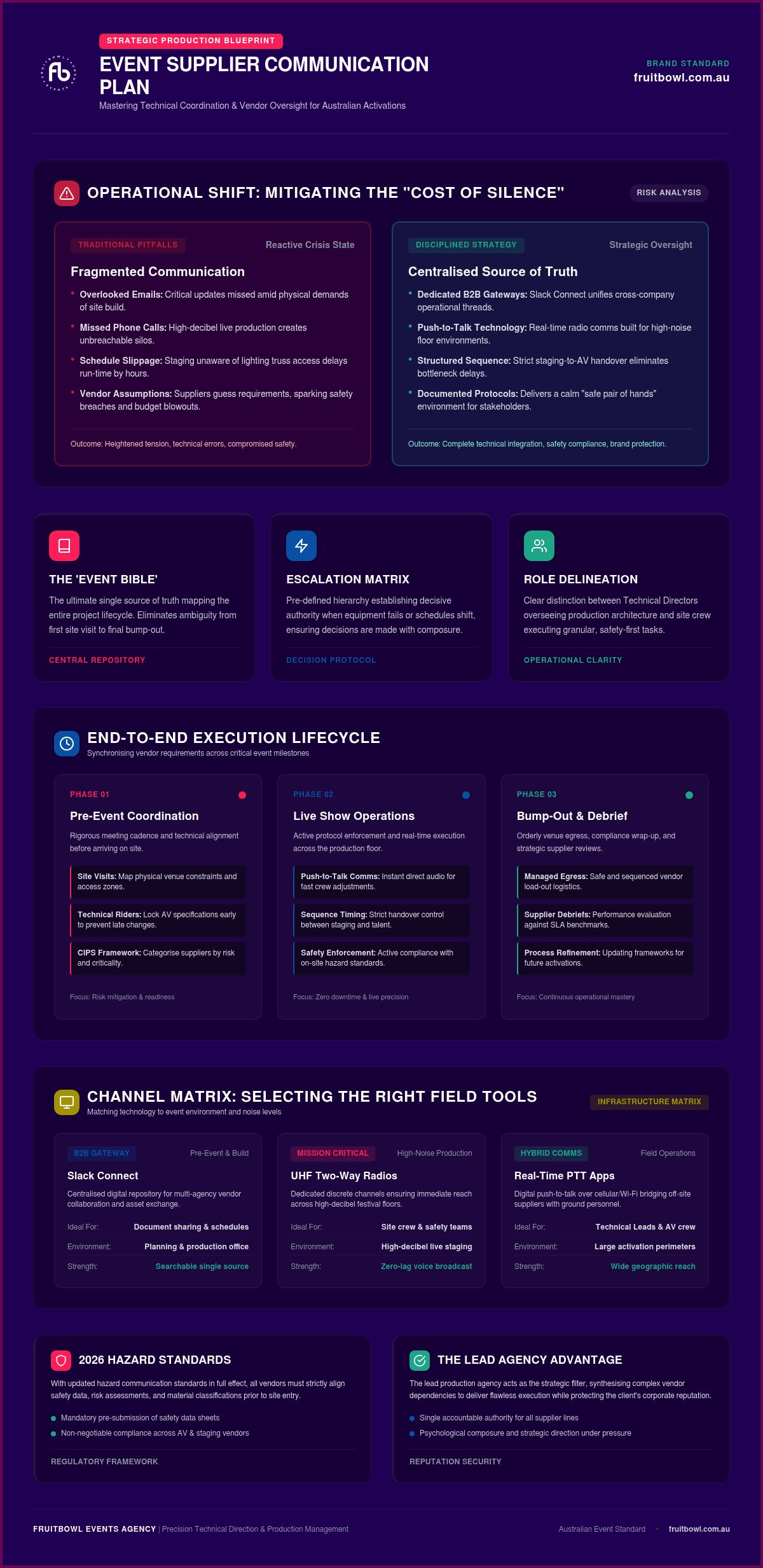
The “Cost of Silence” in event management is often measured in budget blowouts and compromised safety. When communication breaks down, vendors make assumptions to meet their deadlines, which frequently leads to technical errors or on-site friction. By integrating formal supplier relationship management principles, organisers move from a reactive state of crisis management to a proactive position of strategic oversight. This transition establishes a “safe pair of hands” environment, where documented protocols provide a sense of security to both the production team and the end client.

Why Traditional Methods Fail in High-Stakes Environments

In the intense atmosphere of a live production, relying on fragmented email threads or personal mobile phones is insufficient. Emails are easily overlooked during the physical demands of a build, and phone calls are often missed in high-decibel environments. These information silos cause critical delays. For instance, if the staging crew is unaware that the lighting rig requires early access to the truss, the entire production timeline can slip by hours. A structured communication plan removes these bottlenecks, providing a psychological anchor for event leads who must maintain composure under pressure.

The Objectives of Your Communication Strategy

The primary objective is to ensure total technical integration across all production elements. This requires a disciplined approach where every supplier, from audio-visual technicians to talent procurement specialists, understands their specific role in the sequence of operations. A robust strategy also mandates strict adherence to health, safety, and compliance standards. With the 2026 enforcement of updated hazard communication standards in full effect, ensuring that all vendors have aligned their safety data and material classifications is non-negotiable. Ultimately, these internal protocols create a seamless, professional experience for the audience, ensuring that every detail is executed with the level of precision that high-profile Australian events demand.

Core Components of a Robust Supplier Communication Framework

A robust event supplier communication plan requires a clearly defined hierarchy and a structured sequence of operations. At the centre of this framework is the ‘Event Bible’, a comprehensive document that serves as the ultimate source of truth for every stakeholder involved. Within this document, roles must be delineated with precision. While the Technical Director oversees the broader production architecture, the site crew requires specific, granular instructions to execute their tasks safely. To manage unforeseen challenges, an escalation matrix defines exactly who makes the final call when equipment fails or schedules shift, ensuring that decisions are made with composure rather than haste.

Phase 1: Pre-Event Coordination and Alignment

The first phase focuses on pre-event coordination and alignment. This stage involves establishing a rigorous cadence of production meetings and site visits to ensure every vendor understands the site’s physical constraints. Managing technical riders and equipment specifications early prevents costly last-minute adjustments. By aligning with a CIPS supplier relationship framework, agencies can categorise vendors by risk and criticality. This proactive approach is particularly vital when implementing an AV management for events strategy, where technical compatibility is paramount for the success of the activation.

Phase 2: Live Event and Bump-in Protocols

Phase 2 covers the live event and the critical bump-in period. During this high-intensity window, the ‘Show Caller’ becomes the primary point of contact for all real-time reporting. Effective communication here relies on strict radio etiquette and channel discipline. In 2026, this includes ensuring all equipment complies with current Australian UHF radio licensing requirements for high-powered digital sets used across large festival grounds. Suppliers must adhere to pre-arranged vendor check-in procedures at designated site sheds to avoid congestion. Clear protocols for reporting incidents or delays ensure that the production remains on schedule. If you require assistance in organising these complex moving parts, our team can help you design a custom logistical framework.

Phase 3: Post-Event Debrief and Feedback Loops

The final phase is the post-event debrief. This stage is often neglected, yet it’s essential for capturing supplier feedback and reconciling technical issues. A formal feedback loop allows the agency to evaluate vendor performance against the original brief. This data is invaluable for refining future activations and improving long-term corporate event management outcomes. By closing the loop on every project, you ensure that each subsequent event benefits from the lessons learned during previous deliveries, maintaining a standard of excellence across your entire portfolio.

Comparing Communication Channels: Selecting the Right Tools for the Field

Selecting the ideal mix of hardware and software is a strategic decision that defines the resilience of your event supplier communication plan. While digital platforms offer depth and meticulous record-keeping, physical hardware provides the sub-second response times necessary for live technical direction. A professional framework integrates both, ensuring that the “Event Bible” remains accessible via the cloud while field teams retain instant voice connectivity. This balance prevents information silos and allows the lead agency to maintain a composed, results-oriented presence throughout the production lifecycle.

Radio Protocols and Licensing in Australia

In high-noise environments such as large-scale festivals or gala dinners, UHF radios remain the gold standard for synchronous communication. In Australia, it’s essential to use ACMA-compliant equipment to avoid interference with emergency services or other commercial users. Effective channel allocation is critical; separating security, production, and logistics prevents cross-talk and ensures that urgent messages reach the correct departments. Standardised radio terminology, such as “copy that” or “standing by”, reduces ambiguity and increases the speed of technical execution during complex sequences.

Digital Platforms and Real-Time Messaging

For pre-production and asynchronous updates, cloud-based project management tools like monday.com or Slack Connect offer a centralised repository for schedules and equipment riders. These platforms help production teams avoid “WhatsApp fatigue”, where critical information is lost in a sea of unmanaged group messages. By moving to dedicated B2B gateways, you ensure data privacy and secure document sharing across all vendor tiers. This structured approach aligns with OSHA multi-employer communication guidelines, which emphasise the importance of formalised briefings and seamless coordination with external contractors to manage shared hazards.

Redundancy is the hallmark of a seasoned strategist. In 2026, relying solely on cellular networks or on-site Wi-Fi is a significant operational risk, particularly in remote Australian locations or dense convention centres where signal congestion is frequent. Your event supplier communication plan must include a secondary comms tree, such as offline-accessible digital run-sheets and backup analogue radio sets. These protocols ensure that even if the primary digital infrastructure fails, the production team remains in control, maintaining a calm and professional execution on show day.
How to Develop a High-Impact Event Supplier Communication Plan in 2026

The 5-Step Process for Drafting an Effective Communication Plan

Designing a robust event supplier communication plan is a methodical exercise in strategic foresight. It requires a disciplined approach to ensure that every technical detail and logistical requirement is documented before the first truck arrives on site. This process moves beyond simple contact lists, creating a logical flow of information that supports a calm and professional production environment. By following a structured five-step methodology, organisers can eliminate the ambiguity that often leads to on-site friction.

Mapping Your Stakeholder Ecosystem

The first step involves identifying every vendor and categorising them by their operational impact. Tier-one suppliers, such as those providing audio-visual services, staging, and primary power, require a higher frequency of communication than tier-three turnkey vendors. For each firm, you must identify a Single Point of Contact (SPOC). This individual is responsible for synthesising all internal team updates before relaying them to the production lead. This structure is often managed by a Conference Logistics Coordinator, whose role is to maintain the integrity of these communication channels across the project lifecycle.

Once stakeholders are mapped, you must define the information flow. This includes determining what data needs to be shared, with whom, and at what specific intervals. Step three focuses on tool selection and training. It isn’t enough to simply choose a platform; you must ensure that every vendor is proficient in using the chosen technology before the bump-in begins. This prevents technical bottlenecks during the high-pressure phases of the build when time is at a premium.

Drafting the Escalation Matrix

Step four involves drafting the escalation matrix to manage unforeseen incidents. This matrix should define four distinct levels of severity. Level 1 incidents might include minor delivery delays, while Level 4 represents an immediate safety risk or total technical failure. Your plan must clearly state who has the authority to stop the show, whether for creative reasons or safety compliance. Maintaining timestamped event logs is essential here; these records provide an objective account of decisions made during a crisis, which is invaluable for post-event reconciliation and dispute resolution.

The final step is the review and distribution of the plan to all key technical leads. Obtaining formal sign-off ensures that every supplier has read and understood their obligations within the communication framework. This creates a shared sense of accountability and reinforces the image of a “safe pair of hands” at the helm of the production. If you’re managing a complex activation and require expert oversight, our team provides professional technical direction services to ensure your communication strategy is flawlessly executed.

Integrating Communication into End-to-End Event Production

Integrating a comprehensive event supplier communication plan into the end-to-end production cycle is what separates a standard activation from a world-class experience. Communication cannot be treated as a secondary administrative task or a late-stage add-on. Instead, it must be the pulse that regulates every phase of the project, from initial concept to the final load-out. By establishing clear expectations from the outset, agencies build long-term, high-trust relationships with vendors. This synergy ensures that when technical complexities arise, the response is methodical rather than frantic, maintaining the professional composure that high-stakes environments demand.

Fruitbowl Events Agency’s methodology is built on 28 years of industry experience, prioritising order, clarity, and logistical precision in every engagement. We recognise that the lead agency’s primary responsibility is to synthesise the diverse needs of multiple suppliers into a single, cohesive narrative. This strategic oversight provides the composure required to manage complex environments, ensuring that every stakeholder feels supported by a “safe pair of hands” throughout the delivery. It’s about creating a frictionless experience where every moving part is synchronised towards a common objective.

The Agency as the Central Nervous System

In the context of festival production services, the agency functions as the central nervous system of the event. It’s our role to ensure that the creative vision isn’t lost in technical translation. When a creative director imagines a specific visual moment, it requires a disciplined technician to communicate the exact power requirements, rigging points, and cue sequences to the relevant vendors. This translation layer prevents technical errors and ensures that the artistic ambition of the project is matched by its logistical execution. It provides a sense of security to the client, knowing that every minute detail is under expert supervision.

Next Steps: Strengthening Your Next Activation

As you look toward your next major project, it’s essential to conduct a self-assessment of your current protocols. Is your event supplier communication plan robust enough to handle the increased technical demands and regulatory standards of 2026? Large-scale events often require a level of professional technical direction that goes beyond basic project management. Our end-to-end methodology is designed to bring order to chaos, providing you with the clarity and confidence needed for a successful outcome. We invite you to enquire about Fruitbowl Events Agency’s strategic event management services to discover how we can elevate your next corporate, festival, or government activation through meticulous planning and execution.

Mastering the Future of Logistical Oversight

A disciplined event supplier communication plan is the cornerstone of any successful, large-scale Australian activation. By moving beyond fragmented email threads and adopting a centralised source of truth, you eliminate the technical errors that often derail complex productions. We’ve explored the necessity of tiered stakeholder mapping, the integration of ACMA-compliant radio protocols, and the role of the lead agency in synthesising diverse vendor requirements. These strategies ensure your creative vision remains protected.

As the technical demands of 2026 continue to evolve, having a “safe pair of hands” at the helm is non-negotiable. With 28+ years of event management excellence, Fruitbowl specialises in complex government and corporate activations, utilising a comprehensive end-to-end production methodology to bring order to chaos. We invite you to partner with Fruitbowl for your next high-impact event and experience the confidence that comes with seasoned expertise. Your next project deserves the security of meticulous planning and flawless execution.

Frequently Asked Questions

What is an event supplier communication plan?

It’s a strategic document that outlines how information flows between the lead agency and all third-party vendors. This plan defines the hierarchy, preferred channels, and escalation protocols needed to maintain order during high-stakes activations. By establishing a centralised source of truth, it ensures that technical requirements and safety standards are met across all production phases, including planning, bump-in, and live execution. This framework provides the logistical precision required for large-scale Australian events.

How do I manage communication with over 50 different vendors?

Managing a large vendor ecosystem requires categorising suppliers into tiers based on their operational impact. You should identify a Single Point of Contact (SPOC) for each firm to prevent information silos and unmanaged message threads. Utilising a tiered communication hierarchy allows the production lead to focus on critical-path vendors, such as audio-visual and staging crews, while ensuring turnkey suppliers receive automated updates via a centralised digital platform or project management tool.

Should I use radios or mobile phones for event day comms?

Radios are the superior choice for real-time technical direction in high-noise environments where sub-second latency is required. While mobile phones are useful for asynchronous pre-production updates, they often fail during live events due to network congestion or high ambient volume. A professional event supplier communication plan prioritises ACMA-compliant UHF radios for synchronous field operations, reserving mobile devices for private escalations or document review only when cellular signals are stable and reliable.

What should be included in an event escalation matrix?

An escalation matrix must include defined severity levels, specific triggers for each level, and the designated decision-maker for each scenario. It should clarify who has the authority to pause a show for safety reasons versus creative adjustments. Your matrix needs to detail the communication chain for technical failures, medical emergencies, and logistical bottlenecks, ensuring that every stakeholder knows exactly when and how to report an incident to the lead strategist without hesitation.

How do I ensure suppliers actually read the communication plan?

Ensuring compliance requires integrating the communication plan into the initial vendor onboarding and procurement process. You should mandate a formal sign-off from key technical leads before they arrive on site for bump-in. Providing brief, role-specific summaries rather than a single dense document increases engagement. Additionally, conducting a mandatory pre-event briefing where the escalation matrix and radio protocols are demonstrated ensures that all teams are proficient in the project’s specific operational requirements.

What are the legal requirements for radio use at Australian events?

In Australia, commercial radio use is governed by the Australian Communications and Media Authority (ACMA). You must ensure that all UHF or VHF equipment operates on legally assigned frequencies to avoid interfering with emergency services or other licensed users. Using high-powered digital sets often requires a specific apparatus licence. It’s essential to verify that your radio supplier provides ACMA-compliant hardware and that your team adheres to designated channel allocations to maintain regulatory standards.

How do I handle a communication breakdown during a live event?

Handling a breakdown requires immediate activation of your redundancy protocols, such as switching to a secondary analogue radio channel or using offline-accessible run-sheets. The lead strategist must remain composed, directing the team to designated fallback points if digital systems fail. Once the immediate technical issue is stabilised, you should utilise timestamped event logs to document the breakdown. This record is vital for the post-event debrief to identify the root cause and prevent future occurrences.

What is the “Event Bible” and why do I need one?

The “Event Bible” is the definitive source of truth containing every technical rider, site map, and contact list for the project. You need this document to ensure that all stakeholders, from the Technical Director to the catering crew, are working from the same set of instructions. A well-maintained Event Bible eliminates ambiguity, reduces the risk of technical errors, and provides a structured framework that allows the lead agency to manage complex activations with total logistical precision.

In the high-pressure environment of a large-scale Australian activation, a single missed message isn’t just a minor delay; it’s a potential technical failure waiting to happen on show day. You’ve likely felt that rising tension when a supplier ignores a safety protocol or an information silo causes chaos during a critical bump-in. It’s a common frustration that even the most seasoned organisers face when managing complex vendor ecosystems. We understand that the difference between a frantic production and a calm, successful execution lies in the strength of your logistical oversight.

By implementing a high-impact event supplier communication plan, you can transform these fragmented threads into a disciplined, professional framework. This article will provide you with a sophisticated strategy to master stakeholder coordination, ensuring every vendor operates from a centralised source of truth. We’ll examine the shift toward dedicated B2B gateways like Slack Connect, the role of real-time push-to-talk technology for field operations, and the essential protocols needed to mitigate risk before it ever reaches the stage. You’ll gain the clarity required to lead your team with the confidence of a seasoned strategist.

Key Takeaways

  • Learn how to construct a centralised event supplier communication plan that serves as the definitive source of truth, ensuring vendor alignment from the first site visit to the final bump-out.
  • Understand how a disciplined communication framework mitigates financial risk and prevents safety breaches during high-stakes Australian activations.
  • Master the art of technical coordination by defining clear operational roles and managing the specific requirements of the planning, live, and debrief phases.
  • Identify the most reliable communication hardware and software for your event scale, including the integration of UHF radios for high-noise production environments.
  • Recognise the lead agency’s role in synthesising complex supplier needs to ensure a seamless, professional execution that protects your brand’s reputation.

Understanding the Strategic Role of an Event Supplier Communication Plan

An event supplier communication plan is the foundational framework that governs every interaction between organisers and their network of vendors. It’s far more than a simple contact list; it’s a strategic document that maps the flow of information across the entire project lifecycle. For high-stakes corporate events, festivals, and government activations, this plan ensures that precision is maintained from the initial site visit through to the final bump-out. By centralising these touchpoints, agencies can eliminate the ambiguity that often plagues complex, large-scale productions.

The “Cost of Silence” in event management is often measured in budget blowouts and compromised safety. When communication breaks down, vendors make assumptions to meet their deadlines, which frequently leads to technical errors or on-site friction. By integrating formal supplier relationship management principles, organisers move from a reactive state of crisis management to a proactive position of strategic oversight. This transition establishes a “safe pair of hands” environment, where documented protocols provide a sense of security to both the production team and the end client.

Why Traditional Methods Fail in High-Stakes Environments

In the intense atmosphere of a live production, relying on fragmented email threads or personal mobile phones is insufficient. Emails are easily overlooked during the physical demands of a build, and phone calls are often missed in high-decibel environments. These information silos cause critical delays. For instance, if the staging crew is unaware that the lighting rig requires early access to the truss, the entire production timeline can slip by hours. A structured communication plan removes these bottlenecks, providing a psychological anchor for event leads who must maintain composure under pressure.

The Objectives of Your Communication Strategy

The primary objective is to ensure total technical integration across all production elements. This requires a disciplined approach where every supplier, from audio-visual technicians to talent procurement specialists, understands their specific role in the sequence of operations. A robust strategy also mandates strict adherence to health, safety, and compliance standards. With the 2026 enforcement of updated hazard communication standards in full effect, ensuring that all vendors have aligned their safety data and material classifications is non-negotiable. Ultimately, these internal protocols create a seamless, professional experience for the audience, ensuring that every detail is executed with the level of precision that high-profile Australian events demand.

Core Components of a Robust Supplier Communication Framework

A robust event supplier communication plan requires a clearly defined hierarchy and a structured sequence of operations. At the centre of this framework is the ‘Event Bible’, a comprehensive document that serves as the ultimate source of truth for every stakeholder involved. Within this document, roles must be delineated with precision. While the Technical Director oversees the broader production architecture, the site crew requires specific, granular instructions to execute their tasks safely. To manage unforeseen challenges, an escalation matrix defines exactly who makes the final call when equipment fails or schedules shift, ensuring that decisions are made with composure rather than haste.

Phase 1: Pre-Event Coordination and Alignment

The first phase focuses on pre-event coordination and alignment. This stage involves establishing a rigorous cadence of production meetings and site visits to ensure every vendor understands the site’s physical constraints. Managing technical riders and equipment specifications early prevents costly last-minute adjustments. By aligning with a CIPS supplier relationship framework, agencies can categorise vendors by risk and criticality. This proactive approach is particularly vital when implementing an AV management for events strategy, where technical compatibility is paramount for the success of the activation.

Phase 2: Live Event and Bump-in Protocols

Phase 2 covers the live event and the critical bump-in period. During this high-intensity window, the ‘Show Caller’ becomes the primary point of contact for all real-time reporting. Effective communication here relies on strict radio etiquette and channel discipline. In 2026, this includes ensuring all equipment complies with current Australian UHF radio licensing requirements for high-powered digital sets used across large festival grounds. Suppliers must adhere to pre-arranged vendor check-in procedures at designated site sheds to avoid congestion. Clear protocols for reporting incidents or delays ensure that the production remains on schedule. If you require assistance in organising these complex moving parts, our team can help you design a custom logistical framework.

Phase 3: Post-Event Debrief and Feedback Loops

The final phase is the post-event debrief. This stage is often neglected, yet it’s essential for capturing supplier feedback and reconciling technical issues. A formal feedback loop allows the agency to evaluate vendor performance against the original brief. This data is invaluable for refining future activations and improving long-term corporate event management outcomes. By closing the loop on every project, you ensure that each subsequent event benefits from the lessons learned during previous deliveries, maintaining a standard of excellence across your entire portfolio.

Comparing Communication Channels: Selecting the Right Tools for the Field

Selecting the ideal mix of hardware and software is a strategic decision that defines the resilience of your event supplier communication plan. While digital platforms offer depth and meticulous record-keeping, physical hardware provides the sub-second response times necessary for live technical direction. A professional framework integrates both, ensuring that the “Event Bible” remains accessible via the cloud while field teams retain instant voice connectivity. This balance prevents information silos and allows the lead agency to maintain a composed, results-oriented presence throughout the production lifecycle.

Radio Protocols and Licensing in Australia

In high-noise environments such as large-scale festivals or gala dinners, UHF radios remain the gold standard for synchronous communication. In Australia, it’s essential to use ACMA-compliant equipment to avoid interference with emergency services or other commercial users. Effective channel allocation is critical; separating security, production, and logistics prevents cross-talk and ensures that urgent messages reach the correct departments. Standardised radio terminology, such as “copy that” or “standing by”, reduces ambiguity and increases the speed of technical execution during complex sequences.

Digital Platforms and Real-Time Messaging

For pre-production and asynchronous updates, cloud-based project management tools like monday.com or Slack Connect offer a centralised repository for schedules and equipment riders. These platforms help production teams avoid “WhatsApp fatigue”, where critical information is lost in a sea of unmanaged group messages. By moving to dedicated B2B gateways, you ensure data privacy and secure document sharing across all vendor tiers. This structured approach aligns with OSHA multi-employer communication guidelines, which emphasise the importance of formalised briefings and seamless coordination with external contractors to manage shared hazards.

Redundancy is the hallmark of a seasoned strategist. In 2026, relying solely on cellular networks or on-site Wi-Fi is a significant operational risk, particularly in remote Australian locations or dense convention centres where signal congestion is frequent. Your event supplier communication plan must include a secondary comms tree, such as offline-accessible digital run-sheets and backup analogue radio sets. These protocols ensure that even if the primary digital infrastructure fails, the production team remains in control, maintaining a calm and professional execution on show day.

The 5-Step Process for Drafting an Effective Communication Plan

Designing a robust event supplier communication plan is a methodical exercise in strategic foresight. It requires a disciplined approach to ensure that every technical detail and logistical requirement is documented before the first truck arrives on site. This process moves beyond simple contact lists, creating a logical flow of information that supports a calm and professional production environment. By following a structured five-step methodology, organisers can eliminate the ambiguity that often leads to on-site friction.

Mapping Your Stakeholder Ecosystem

The first step involves identifying every vendor and categorising them by their operational impact. Tier-one suppliers, such as those providing audio-visual services, staging, and primary power, require a higher frequency of communication than tier-three turnkey vendors. For each firm, you must identify a Single Point of Contact (SPOC). This individual is responsible for synthesising all internal team updates before relaying them to the production lead. This structure is often managed by a Conference Logistics Coordinator, whose role is to maintain the integrity of these communication channels across the project lifecycle.

Once stakeholders are mapped, you must define the information flow. This includes determining what data needs to be shared, with whom, and at what specific intervals. Step three focuses on tool selection and training. It isn’t enough to simply choose a platform; you must ensure that every vendor is proficient in using the chosen technology before the bump-in begins. This prevents technical bottlenecks during the high-pressure phases of the build when time is at a premium.

Drafting the Escalation Matrix

Step four involves drafting the escalation matrix to manage unforeseen incidents. This matrix should define four distinct levels of severity. Level 1 incidents might include minor delivery delays, while Level 4 represents an immediate safety risk or total technical failure. Your plan must clearly state who has the authority to stop the show, whether for creative reasons or safety compliance. Maintaining timestamped event logs is essential here; these records provide an objective account of decisions made during a crisis, which is invaluable for post-event reconciliation and dispute resolution.

The final step is the review and distribution of the plan to all key technical leads. Obtaining formal sign-off ensures that every supplier has read and understood their obligations within the communication framework. This creates a shared sense of accountability and reinforces the image of a “safe pair of hands” at the helm of the production. If you’re managing a complex activation and require expert oversight, our team provides professional technical direction services to ensure your communication strategy is flawlessly executed.

Integrating Communication into End-to-End Event Production

Integrating a comprehensive event supplier communication plan into the end-to-end production cycle is what separates a standard activation from a world-class experience. Communication cannot be treated as a secondary administrative task or a late-stage add-on. Instead, it must be the pulse that regulates every phase of the project, from initial concept to the final load-out. By establishing clear expectations from the outset, agencies build long-term, high-trust relationships with vendors. This synergy ensures that when technical complexities arise, the response is methodical rather than frantic, maintaining the professional composure that high-stakes environments demand.

Fruitbowl Events Agency’s methodology is built on 28 years of industry experience, prioritising order, clarity, and logistical precision in every engagement. We recognise that the lead agency’s primary responsibility is to synthesise the diverse needs of multiple suppliers into a single, cohesive narrative. This strategic oversight provides the composure required to manage complex environments, ensuring that every stakeholder feels supported by a “safe pair of hands” throughout the delivery. It’s about creating a frictionless experience where every moving part is synchronised towards a common objective.

The Agency as the Central Nervous System

In the context of festival production services, the agency functions as the central nervous system of the event. It’s our role to ensure that the creative vision isn’t lost in technical translation. When a creative director imagines a specific visual moment, it requires a disciplined technician to communicate the exact power requirements, rigging points, and cue sequences to the relevant vendors. This translation layer prevents technical errors and ensures that the artistic ambition of the project is matched by its logistical execution. It provides a sense of security to the client, knowing that every minute detail is under expert supervision.

Next Steps: Strengthening Your Next Activation

As you look toward your next major project, it’s essential to conduct a self-assessment of your current protocols. Is your event supplier communication plan robust enough to handle the increased technical demands and regulatory standards of 2026? Large-scale events often require a level of professional technical direction that goes beyond basic project management. Our end-to-end methodology is designed to bring order to chaos, providing you with the clarity and confidence needed for a successful outcome. We invite you to enquire about Fruitbowl Events Agency’s strategic event management services to discover how we can elevate your next corporate, festival, or government activation through meticulous planning and execution.

Mastering the Future of Logistical Oversight

A disciplined event supplier communication plan is the cornerstone of any successful, large-scale Australian activation. By moving beyond fragmented email threads and adopting a centralised source of truth, you eliminate the technical errors that often derail complex productions. We’ve explored the necessity of tiered stakeholder mapping, the integration of ACMA-compliant radio protocols, and the role of the lead agency in synthesising diverse vendor requirements. These strategies ensure your creative vision remains protected.

As the technical demands of 2026 continue to evolve, having a “safe pair of hands” at the helm is non-negotiable. With 28+ years of event management excellence, Fruitbowl specialises in complex government and corporate activations, utilising a comprehensive end-to-end production methodology to bring order to chaos. We invite you to partner with Fruitbowl for your next high-impact event and experience the confidence that comes with seasoned expertise. Your next project deserves the security of meticulous planning and flawless execution.

Frequently Asked Questions

What is an event supplier communication plan?

It’s a strategic document that outlines how information flows between the lead agency and all third-party vendors. This plan defines the hierarchy, preferred channels, and escalation protocols needed to maintain order during high-stakes activations. By establishing a centralised source of truth, it ensures that technical requirements and safety standards are met across all production phases, including planning, bump-in, and live execution. This framework provides the logistical precision required for large-scale Australian events.

How do I manage communication with over 50 different vendors?

Managing a large vendor ecosystem requires categorising suppliers into tiers based on their operational impact. You should identify a Single Point of Contact (SPOC) for each firm to prevent information silos and unmanaged message threads. Utilising a tiered communication hierarchy allows the production lead to focus on critical-path vendors, such as audio-visual and staging crews, while ensuring turnkey suppliers receive automated updates via a centralised digital platform or project management tool.

Should I use radios or mobile phones for event day comms?

Radios are the superior choice for real-time technical direction in high-noise environments where sub-second latency is required. While mobile phones are useful for asynchronous pre-production updates, they often fail during live events due to network congestion or high ambient volume. A professional event supplier communication plan prioritises ACMA-compliant UHF radios for synchronous field operations, reserving mobile devices for private escalations or document review only when cellular signals are stable and reliable.

What should be included in an event escalation matrix?

An escalation matrix must include defined severity levels, specific triggers for each level, and the designated decision-maker for each scenario. It should clarify who has the authority to pause a show for safety reasons versus creative adjustments. Your matrix needs to detail the communication chain for technical failures, medical emergencies, and logistical bottlenecks, ensuring that every stakeholder knows exactly when and how to report an incident to the lead strategist without hesitation.

How do I ensure suppliers actually read the communication plan?

Ensuring compliance requires integrating the communication plan into the initial vendor onboarding and procurement process. You should mandate a formal sign-off from key technical leads before they arrive on site for bump-in. Providing brief, role-specific summaries rather than a single dense document increases engagement. Additionally, conducting a mandatory pre-event briefing where the escalation matrix and radio protocols are demonstrated ensures that all teams are proficient in the project’s specific operational requirements.

What are the legal requirements for radio use at Australian events?

In Australia, commercial radio use is governed by the Australian Communications and Media Authority (ACMA). You must ensure that all UHF or VHF equipment operates on legally assigned frequencies to avoid interfering with emergency services or other licensed users. Using high-powered digital sets often requires a specific apparatus licence. It’s essential to verify that your radio supplier provides ACMA-compliant hardware and that your team adheres to designated channel allocations to maintain regulatory standards.

How do I handle a communication breakdown during a live event?

Handling a breakdown requires immediate activation of your redundancy protocols, such as switching to a secondary analogue radio channel or using offline-accessible run-sheets. The lead strategist must remain composed, directing the team to designated fallback points if digital systems fail. Once the immediate technical issue is stabilised, you should utilise timestamped event logs to document the breakdown. This record is vital for the post-event debrief to identify the root cause and prevent future occurrences.

What is the “Event Bible” and why do I need one?

The “Event Bible” is the definitive source of truth containing every technical rider, site map, and contact list for the project. You need this document to ensure that all stakeholders, from the Technical Director to the catering crew, are working from the same set of instructions. A well-maintained Event Bible eliminates ambiguity, reduces the risk of technical errors, and provides a structured framework that allows the lead agency to manage complex activations with total logistical precision.

Back to Articles
Request A Quote

Make an
Enquiry

Untitled design

What Makes Us Different?

True end-to-end solution so you can hand off to us, focus on your priorities and enjoy the event without any stress

Unmatched industry expertise looking after diverse range of high-profile events, cultural festivals & activations

Meticulous attention to every detail and precise execution of events with our streamlined processes

Tailored solutions with bespoke strategies to ensure we align with your brand and objectives

Make an Enquiry

"*" indicates required fields

This field is for validation purposes and should be left unchanged.

"*" indicates required fields

This field is for validation purposes and should be left unchanged.