Event Risk Assessment Matrix Template: 2026 Strategic Guide

Professional risk management isn’t a hurdle to creativity; it’s the silent architect that makes bold execution possible. You’ve likely felt the weight of the updated WHS regulations or worried that a single overlooked detail could compromise a high-stakes activation. It’s exhausting to balance complex compliance with the need for a seamless guest experience, especially when reporting feels inconsistent across different projects. We understand that you need to protect your vision while ensuring every person on-site remains safe.

This strategic guide provides a professional event risk assessment matrix template and a robust framework tailored for Australian organisers. You’ll learn how to master the latest 2025 WHS amendments and apply AS/NZS ISO 31000:2018 standards to your planning process with total confidence. We’ll walk through the essential steps to categorise hazards, satisfy demanding stakeholders, and integrate safety protocols so naturally that they never disrupt the creative flow. By the end, you’ll have a defensible system that acts as a safe pair of hands for every event you deliver.

Key Takeaways

  • Learn how to utilise a strategic 5×5 framework to evaluate likelihood and consequence, transforming complex hazards into manageable data points.
  • Access a professional event risk assessment matrix template designed to align with Australian WHS standards and the AS/NZS ISO 31000:2018 guidelines.
  • Identify high-stakes technical and logistical risks early, ensuring that potential AV failures or supplier delays don’t compromise your creative execution.
  • Master a structured implementation cycle that incorporates stakeholder workshops and site visits to build a truly defensible safety plan.
  • Understand why a robust matrix is the foundation of professional risk management, providing a “safe pair of hands” for high-stakes public and corporate activations.

What is an Event Risk Assessment Matrix?

A sophisticated event risk assessment matrix template serves as more than just a document. It is a strategic tool designed to identify, evaluate, and prioritise potential hazards across the entire event lifecycle. By utilising a structured risk matrix, organisers can visualise the intersection between ‘Likelihood’ and ‘Consequence’. This intersection determines a final risk rating, which guides the allocation of resources and safety personnel. In the Australian landscape, this process is essential for meeting rigorous Work Health and Safety (WHS) obligations. It aligns with the principles of AS/NZS ISO 31000:2018, acting as a formal record of due diligence that provides insurers and government stakeholders with the confidence that every variable is under expert supervision. Utilising a professional event risk assessment matrix template ensures that your safety planning is both defensible and integrated into the creative vision.

The Purpose of a Dedicated Event Matrix

Managing a festival or a corporate activation involves a complex web of moving parts. A dedicated matrix allows you to consolidate multifaceted logistical threats into a single, composed framework. Unlike generic checklists that offer a binary “yes or no” approach, a matrix enables strategic prioritisation. It distinguishes between a minor technical glitch and a catastrophic crowd control failure. This method ensures a “safe pair of hands” approach to public safety, a philosophy we’ve refined over 28+ years of industry experience. It ensures high-risk elements receive the most intensive mitigation strategies. This transforms abstract fears into a logical, actionable roadmap for the production team.

Hazard vs. Risk: Defining the Terms for Events

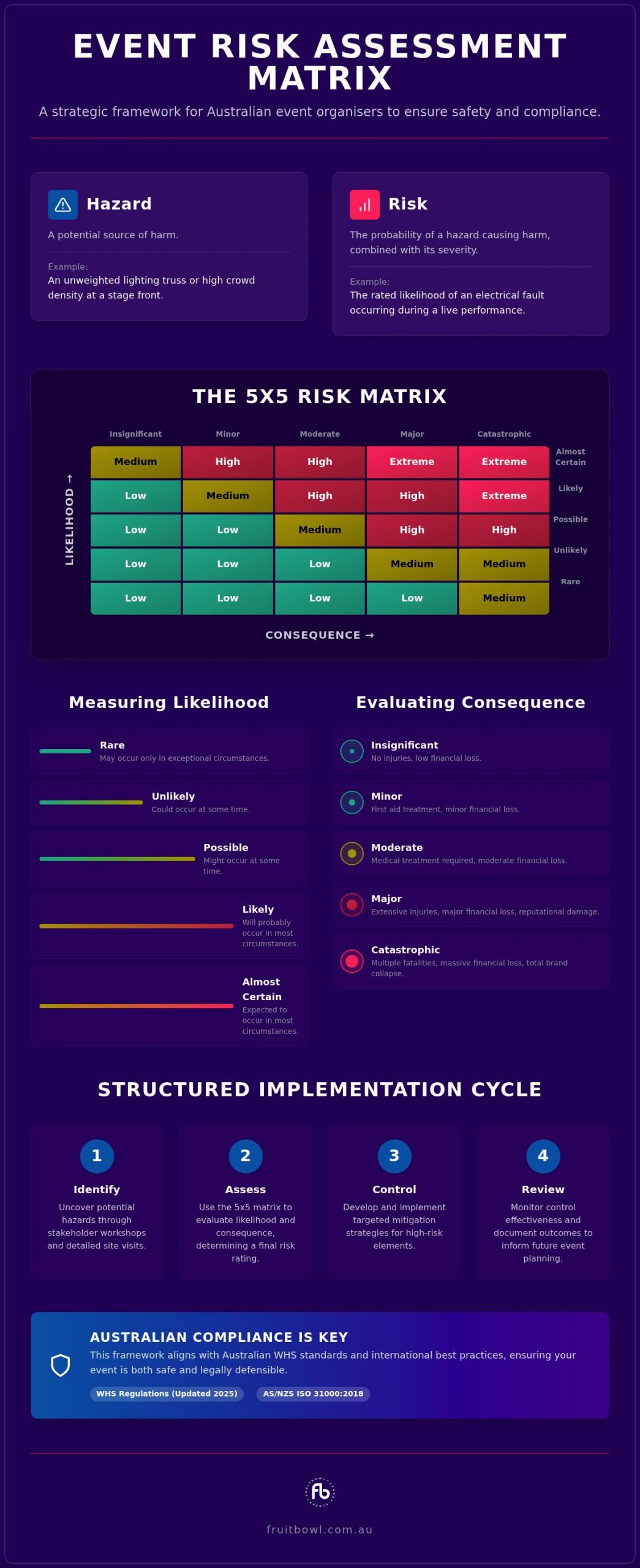
Precision in terminology is vital for Australian event compliance. A hazard is the potential source of harm, such as an unweighted lighting truss or high crowd density at a stage front. The risk is the probability of that hazard causing an injury or loss, combined with the severity of the outcome. For example, technical equipment is a hazard; the risk is the rated likelihood of an electrical fault occurring during a live performance. Understanding this distinction allows organisers to implement specific control measures that address the root cause. Under the model WHS Act, updated on 5 December 2025, clear documentation of these differences is a requirement for any person conducting a business or undertaking (PCBU). Precise definitions prevent ambiguity during stakeholder briefings and ensure that every contractor understands their specific safety responsibilities on-site.

The Anatomy of a 5×5 Event Risk Matrix

The 5×5 model is the benchmark for sophisticated event production because it offers the granularity required to distinguish between manageable hiccups and project-ending crises. While a 3×3 grid might suffice for small internal meetings, it lacks the depth needed for a national festival or a high-stakes government activation. A professional event risk assessment matrix template utilises five distinct levels for both probability and impact, creating 25 possible risk profiles. This precision allows for a more nuanced prioritisation of resources. By mapping these variables, you move from guesswork to a data-driven strategy that satisfies both insurers and venue managers.

Measuring Likelihood in Event Planning

Determining the probability of an incident requires a blend of historical data and current environmental analysis. We categorise likelihood on a scale from ‘Rare’ (may occur only in exceptional circumstances) to ‘Almost Certain’ (expected to occur in most circumstances). For instance, when planning an outdoor festival, weather-related delays might be ‘Possible’, whereas a technical glitch in a complex AV setup could be ‘Likely’ without rigorous testing. Analysing previous event reports helps ground these assessments in reality rather than speculation. You should also account for external variables such as supplier reliability and global supply chain shifts that could impact load-in timelines. Following a structured approach like the Chapman University Activity & Event Risk Management guidelines can help you standardise these variables across different event types.

Evaluating Consequence and Impact

Consequence is measured by the severity of the outcome should a risk materialise. This scale ranges from ‘Insignificant’ (no injuries, low financial loss) to ‘Catastrophic’ (multiple fatalities, massive financial loss, or total brand collapse). In the context of corporate presentations, a technical failure might not cause physical harm, but the reputational impact on a CEO’s keynote can be ‘Major’. For public events, catastrophic impacts are often defined by incidents that require hospital transport or emergency service intervention. Statistics from major Australian events show that 1-2% of a crowd typically requires medical attention; failing to plan for this can escalate a ‘Moderate’ risk to ‘Extreme’.

The resulting risk rating (Low, Moderate, High, or Extreme) dictates your response. Low risks might only require monitoring, while Extreme risks demand immediate mitigation or even the cancellation of specific event elements. Managing these complexities is why many organisations choose to partner with an experienced event management agency to ensure every detail is overseen by a safe pair of hands.

Identifying High-Stakes Hazards in the Australian Event Landscape

Identifying hazards requires a transition from generic safety checklists to a deep understanding of the live environment. An effective event risk assessment matrix template must account for the unique volatility of Australian event delivery, where logistical precision and technical excellence are non-negotiable. We categorise these hazards into four distinct pillars: logistical, technical, human, and external. Logistical risks often centre on venue access and the high-pressure windows of load-in and load-out. For organisers using sporting venues, it is equally important to account for the safety of fixed installations; you can learn more about how AMD Sport Services provides specialist equipment inspections to ensure these environments meet safety standards. Supplier delays or equipment shortages can cascade, jeopardising the entire project timeline. Externally, we must now account for intensified weather patterns, including heatwaves and flash flooding, alongside shifting government regulations that may alter permit requirements at short notice.

Technical Direction and Production Safety

Technical execution is the heartbeat of any brand activation or conference. Hazards in this category involve staging stability, lighting rig safety, and audio infrastructure integrity. Managing these variables requires ensuring that technical riders are met with meticulous precision, leaving no room for equipment malfunctions during live execution. Integrating your safety planning with professional AV management for events ensures that power outages or signal failures are mitigated through redundant systems and expert oversight. This technical rigour is a core component of a defensible event risk assessment matrix template, protecting both the audience and the creative vision.

Crowd Dynamics and Public Activations

For large-scale public activations, human risks become the primary focus. Crowd management is not merely about security; it involves assessing crowd density, flow patterns, and the potential for surges in high-traffic zones. When delivering comprehensive festival production services, organisers must implement emergency evacuation protocols that align with AS 3745:2010. These plans must address talent no-shows or stakeholder liaison breakdowns that could trigger audience frustration. By anticipating these dynamics, we ensure that the creative ambition of the event remains grounded in logistical safety, providing a frictionless experience for every attendee.

Human risks also extend to the health of the workforce and volunteers. Under the model WHS Act, organisers have a primary duty of care to ensure the safety of everyone affected by the event. This includes managing fatigue during long festival shifts and ensuring that all contractors have verified insurance coverage. A sophisticated matrix doesn’t just list these hazards; it evaluates them against the specific site context to ensure your mitigation strategies are both practical and effective.
Event Risk Assessment Matrix Template: 2026 Strategic Guide

Implementing the Matrix Within Your Event Planning Cycle

Integrating an event risk assessment matrix template into your workflow requires a disciplined, five-step approach that mirrors the rapid pace of live production. Under the 2026 Australian regulatory landscape, a passive approach to safety is no longer defensible. You must establish a clear sequence that begins with defining the event context and scope, ensuring all logistical boundaries are understood. This is followed by active hazard identification through stakeholder workshops and site visits; this collaborative process ensures that technical and creative variables are both considered. Once hazards are identified, you apply the matrix to determine the inherent risk rating before developing specific mitigation strategies. These strategies typically fall into four categories: Treat, Tolerate, Transfer, or Terminate. The final step is a continuous loop of monitoring and reviewing the risk register as the event evolves from initial concept to live execution.

Strategic Mitigation and Controls

Effective mitigation involves more than just identifying a problem; it requires designing redundant systems for critical technical elements. For a high-stakes activation, this might mean secondary power sources or backup signal paths for complex AV setups. It also involves logistical safeguards, such as procuring comprehensive insurance and robust talent contract protections. Clear communication is essential during this phase. You must ensure that risk responsibilities are seamlessly integrated into the conference management workflow. This ensures that every team member, from the technical director to the floor coordinator, understands their specific role in maintaining a secure environment. When these controls are embedded into the project timeline, safety becomes a silent facilitator of the creative vision.

The Role of Documentation and Reporting

Utilising a professional event risk assessment matrix template allows you to create a defensible audit trail for government and corporate stakeholders. This documentation serves as evidence that you have met your primary duty of care under the model WHS Act. The ratings derived from your matrix should directly inform the final event run-sheet, highlighting high-risk transition periods such as stage changeovers or major crowd movements. Every on-site staff member must be briefed on the highest-rated risks during daily pre-start meetings. This level of meticulous reporting ensures that safety is never an afterthought but a core component of the production’s success. If you need a partner to manage these complexities with a seasoned pair of hands, contact our expert production team to discuss your next high-stakes activation.

Beyond the Template: Professional Risk Management and Execution

While an event risk assessment matrix template provides the necessary structural foundation, true safety mastery lies in the live execution of those protocols. A document can categorise a hazard, but it cannot navigate the split-second decisions required when a technical failure occurs or a weather front shifts. Professional risk management is an active, end-to-end methodology that breathes life into the static data of a spreadsheet. For organisations involved in government event planning, the stakes are exceptionally high, requiring a level of logistical precision that only comes from seasoned expertise. It’s about moving from compliance as a checkbox to safety as a silent pillar of creative freedom.

The Fruitbowl Approach to High-Impact Delivery

Our methodology leverages 28+ years of industry experience to anticipate risks that often seem unforeseeable to less experienced teams. We don’t just identify hazards; we integrate technical direction with strategic oversight to ensure every moving part is synchronised. This is particularly critical within our corporate event management services, where brand objectives must be protected with absolute rigour. By blending technical procurement with a deep understanding of WHS regulations, we provide a frictionless experience that allows our clients to focus on their guests rather than the logistics. We act as a “safe pair of hands”, ensuring that even the most ambitious creative visions are delivered within a robust safety framework.

Selecting a Partner for High-Stakes Events

Choosing the right partner requires evaluating an agency’s track record in high-pressure environments. You need a firm that offers national service coverage and possesses a deep understanding of local regulatory nuances across Australia. A sophisticated partner doesn’t view safety as a limitation; they treat it as a creative enabler. When you know the technical infrastructure is secure and the crowd dynamics are expertly managed, you have the confidence to push the boundaries of what’s possible. Ensure your chosen agency demonstrates a commitment to meticulous planning and possesses the technical literacy to manage complex AV and staging requirements. This disciplined approach ensures that your event isn’t just safe, but also a flawless reflection of your brand’s excellence.

Securing Your Creative Vision with Logistical Precision

Mastering safety protocols isn’t about limiting your creative ambition; it’s about providing the structural integrity that allows your vision to thrive. By implementing a robust event risk assessment matrix template, you’ve moved beyond simple checklists toward a defensible, strategic framework that satisfies both insurers and government stakeholders. You now have the tools to categorise likelihood and consequence with the granularity required for high-stakes Australian activations.

A template is only the starting point for end-to-end production excellence. True security comes from a partner who blends 28 years of logistical precision with authoritative expertise in Australian event compliance. Whether you’re delivering a national festival or a complex corporate activation, the integration of technical direction and safety planning remains the key to a frictionless guest experience. We invite you to partner with Fruitbowl for meticulous event management and safety, ensuring every detail is overseen by a safe pair of hands. Your next project deserves a foundation built on seasoned expertise and meticulous planning.

Frequently Asked Questions

What is the difference between a 3×3 and a 5×5 risk matrix for events?

A 5×5 matrix offers 25 distinct risk profiles, providing the granularity required for high-stakes activations. A 3×3 grid is often too simple for complex festivals or government projects where nuanced prioritisation is essential. Using a 5×5 event risk assessment matrix template allows you to distinguish between moderate logistical delays and catastrophic safety failures. This level of detail ensures that resources are allocated precisely where they’re needed most to protect your guests and brand.

How often should an event risk assessment be updated?

Your assessment should be a dynamic document that evolves alongside your project timeline. It’s best practice to review the matrix after every site visit, stakeholder workshop, or significant change in technical requirements. For a three-day festival or a major conference, a “set and forget” approach is insufficient. Continuous monitoring ensures that new hazards, such as shifting weather patterns or contractor updates, are captured and mitigated before the first guest arrives on-site.

Who is responsible for the risk assessment at a corporate event?

Under the model WHS Act, the primary duty of care rests with the Person Conducting a Business or Undertaking (PCBU). In a corporate setting, this is typically the event organiser or the management agency. They’re legally required to ensure the health and safety of workers and attendees so far as is reasonably practicable. This involves consulting with contractors and volunteers to identify hazards and implementing a clear prioritisation framework to manage any identified risks.

Does a risk assessment matrix cover COVID-19 or health-related risks in 2026?

Modern risk assessments must address a broad spectrum of health-related risks beyond traditional physical hazards. While specific COVID-19 mandates have evolved, the duty to manage infectious diseases remains part of general health and safety protocols. Your matrix should also account for environmental health factors like extreme heat or poor air quality. Statistics show that 1-2% of a large crowd will require first aid; your planning must ensure adequate medical resources are available for these scenarios.

Can a risk matrix be used for small-scale seminars or just large festivals?

The methodology is scalable and should be applied regardless of the event size. While a small seminar may have fewer moving parts than a national festival, the legal requirement to manage risk remains identical. For a seminar, you might focus on electrical safety and venue accessibility. For a festival, the matrix expands to include crowd dynamics and technical infrastructure. Using a consistent framework across all event types ensures professional reporting and stakeholder confidence.

What are the common mistakes when using a risk assessment template?

The most frequent error is treating an event risk assessment matrix template as a generic checklist rather than a site-specific strategy. Many organisers fail to consult with the technical crew or on-site workers, which leads to overlooked hazards. Another mistake is failing to update the matrix when logistical variables change. A static document won’t protect you if it doesn’t reflect the live environment. You must ensure that high-rated risks actually inform your final event run-sheet.

How do I communicate the findings of the matrix to my event stakeholders?

Findings should be distilled into actionable briefs for different groups. High-level summaries are appropriate for corporate stakeholders and insurers to demonstrate due diligence. On-site, the highest-rated risks must be communicated during pre-start meetings and integrated into the technical run-sheet. This ensures every staff member understands the specific control measures in place. Clear documentation creates a defensible audit trail and ensures that safety protocols are followed with precision during the live execution phase.

Is an event risk assessment a legal requirement in Australia?

Managing risk is a mandatory legal requirement under the model WHS Act in most Australian jurisdictions. Organisers have a duty of care to eliminate or minimise risks to health and safety so far as is reasonably practicable. For events with over 1,000 attendees, many local authorities and venues require a formal risk management plan as a condition of the permit. Failing to document your risk mitigation process can lead to significant legal and financial consequences.

Professional risk management isn’t a hurdle to creativity; it’s the silent architect that makes bold execution possible. You’ve likely felt the weight of the updated WHS regulations or worried that a single overlooked detail could compromise a high-stakes activation. It’s exhausting to balance complex compliance with the need for a seamless guest experience, especially when reporting feels inconsistent across different projects. We understand that you need to protect your vision while ensuring every person on-site remains safe.

This strategic guide provides a professional event risk assessment matrix template and a robust framework tailored for Australian organisers. You’ll learn how to master the latest 2025 WHS amendments and apply AS/NZS ISO 31000:2018 standards to your planning process with total confidence. We’ll walk through the essential steps to categorise hazards, satisfy demanding stakeholders, and integrate safety protocols so naturally that they never disrupt the creative flow. By the end, you’ll have a defensible system that acts as a safe pair of hands for every event you deliver.

Key Takeaways

  • Learn how to utilise a strategic 5×5 framework to evaluate likelihood and consequence, transforming complex hazards into manageable data points.
  • Access a professional event risk assessment matrix template designed to align with Australian WHS standards and the AS/NZS ISO 31000:2018 guidelines.
  • Identify high-stakes technical and logistical risks early, ensuring that potential AV failures or supplier delays don’t compromise your creative execution.
  • Master a structured implementation cycle that incorporates stakeholder workshops and site visits to build a truly defensible safety plan.
  • Understand why a robust matrix is the foundation of professional risk management, providing a “safe pair of hands” for high-stakes public and corporate activations.

What is an Event Risk Assessment Matrix?

A sophisticated event risk assessment matrix template serves as more than just a document. It is a strategic tool designed to identify, evaluate, and prioritise potential hazards across the entire event lifecycle. By utilising a structured risk matrix, organisers can visualise the intersection between ‘Likelihood’ and ‘Consequence’. This intersection determines a final risk rating, which guides the allocation of resources and safety personnel. In the Australian landscape, this process is essential for meeting rigorous Work Health and Safety (WHS) obligations. It aligns with the principles of AS/NZS ISO 31000:2018, acting as a formal record of due diligence that provides insurers and government stakeholders with the confidence that every variable is under expert supervision. Utilising a professional event risk assessment matrix template ensures that your safety planning is both defensible and integrated into the creative vision.

The Purpose of a Dedicated Event Matrix

Managing a festival or a corporate activation involves a complex web of moving parts. A dedicated matrix allows you to consolidate multifaceted logistical threats into a single, composed framework. Unlike generic checklists that offer a binary “yes or no” approach, a matrix enables strategic prioritisation. It distinguishes between a minor technical glitch and a catastrophic crowd control failure. This method ensures a “safe pair of hands” approach to public safety, a philosophy we’ve refined over 28+ years of industry experience. It ensures high-risk elements receive the most intensive mitigation strategies. This transforms abstract fears into a logical, actionable roadmap for the production team.

Hazard vs. Risk: Defining the Terms for Events

Precision in terminology is vital for Australian event compliance. A hazard is the potential source of harm, such as an unweighted lighting truss or high crowd density at a stage front. The risk is the probability of that hazard causing an injury or loss, combined with the severity of the outcome. For example, technical equipment is a hazard; the risk is the rated likelihood of an electrical fault occurring during a live performance. Understanding this distinction allows organisers to implement specific control measures that address the root cause. Under the model WHS Act, updated on 5 December 2025, clear documentation of these differences is a requirement for any person conducting a business or undertaking (PCBU). Precise definitions prevent ambiguity during stakeholder briefings and ensure that every contractor understands their specific safety responsibilities on-site.

The Anatomy of a 5×5 Event Risk Matrix

The 5×5 model is the benchmark for sophisticated event production because it offers the granularity required to distinguish between manageable hiccups and project-ending crises. While a 3×3 grid might suffice for small internal meetings, it lacks the depth needed for a national festival or a high-stakes government activation. A professional event risk assessment matrix template utilises five distinct levels for both probability and impact, creating 25 possible risk profiles. This precision allows for a more nuanced prioritisation of resources. By mapping these variables, you move from guesswork to a data-driven strategy that satisfies both insurers and venue managers.

Measuring Likelihood in Event Planning

Determining the probability of an incident requires a blend of historical data and current environmental analysis. We categorise likelihood on a scale from ‘Rare’ (may occur only in exceptional circumstances) to ‘Almost Certain’ (expected to occur in most circumstances). For instance, when planning an outdoor festival, weather-related delays might be ‘Possible’, whereas a technical glitch in a complex AV setup could be ‘Likely’ without rigorous testing. Analysing previous event reports helps ground these assessments in reality rather than speculation. You should also account for external variables such as supplier reliability and global supply chain shifts that could impact load-in timelines. Following a structured approach like the Chapman University Activity & Event Risk Management guidelines can help you standardise these variables across different event types.

Evaluating Consequence and Impact

Consequence is measured by the severity of the outcome should a risk materialise. This scale ranges from ‘Insignificant’ (no injuries, low financial loss) to ‘Catastrophic’ (multiple fatalities, massive financial loss, or total brand collapse). In the context of corporate presentations, a technical failure might not cause physical harm, but the reputational impact on a CEO’s keynote can be ‘Major’. For public events, catastrophic impacts are often defined by incidents that require hospital transport or emergency service intervention. Statistics from major Australian events show that 1-2% of a crowd typically requires medical attention; failing to plan for this can escalate a ‘Moderate’ risk to ‘Extreme’.

The resulting risk rating (Low, Moderate, High, or Extreme) dictates your response. Low risks might only require monitoring, while Extreme risks demand immediate mitigation or even the cancellation of specific event elements. Managing these complexities is why many organisations choose to partner with an experienced event management agency to ensure every detail is overseen by a safe pair of hands.

Identifying High-Stakes Hazards in the Australian Event Landscape

Identifying hazards requires a transition from generic safety checklists to a deep understanding of the live environment. An effective event risk assessment matrix template must account for the unique volatility of Australian event delivery, where logistical precision and technical excellence are non-negotiable. We categorise these hazards into four distinct pillars: logistical, technical, human, and external. Logistical risks often centre on venue access and the high-pressure windows of load-in and load-out. Supplier delays or equipment shortages can cascade, jeopardising the entire project timeline. Externally, we must now account for intensified weather patterns, including heatwaves and flash flooding, alongside shifting government regulations that may alter permit requirements at short notice.

Technical Direction and Production Safety

Technical execution is the heartbeat of any brand activation or conference. Hazards in this category involve staging stability, lighting rig safety, and audio infrastructure integrity. Managing these variables requires ensuring that technical riders are met with meticulous precision, leaving no room for equipment malfunctions during live execution. Integrating your safety planning with professional AV management for events ensures that power outages or signal failures are mitigated through redundant systems and expert oversight. This technical rigour is a core component of a defensible event risk assessment matrix template, protecting both the audience and the creative vision.

Crowd Dynamics and Public Activations

For large-scale public activations, human risks become the primary focus. Crowd management is not merely about security; it involves assessing crowd density, flow patterns, and the potential for surges in high-traffic zones. When delivering comprehensive festival production services, organisers must implement emergency evacuation protocols that align with AS 3745:2010. These plans must address talent no-shows or stakeholder liaison breakdowns that could trigger audience frustration. By anticipating these dynamics, we ensure that the creative ambition of the event remains grounded in logistical safety, providing a frictionless experience for every attendee.

Human risks also extend to the health of the workforce and volunteers. Under the model WHS Act, organisers have a primary duty of care to ensure the safety of everyone affected by the event. This includes managing fatigue during long festival shifts and ensuring that all contractors have verified insurance coverage. A sophisticated matrix doesn’t just list these hazards; it evaluates them against the specific site context to ensure your mitigation strategies are both practical and effective.

Implementing the Matrix Within Your Event Planning Cycle

Integrating an event risk assessment matrix template into your workflow requires a disciplined, five-step approach that mirrors the rapid pace of live production. Under the 2026 Australian regulatory landscape, a passive approach to safety is no longer defensible. You must establish a clear sequence that begins with defining the event context and scope, ensuring all logistical boundaries are understood. This is followed by active hazard identification through stakeholder workshops and site visits; this collaborative process ensures that technical and creative variables are both considered. Once hazards are identified, you apply the matrix to determine the inherent risk rating before developing specific mitigation strategies. These strategies typically fall into four categories: Treat, Tolerate, Transfer, or Terminate. The final step is a continuous loop of monitoring and reviewing the risk register as the event evolves from initial concept to live execution.

Strategic Mitigation and Controls

Effective mitigation involves more than just identifying a problem; it requires designing redundant systems for critical technical elements. For a high-stakes activation, this might mean secondary power sources or backup signal paths for complex AV setups. It also involves logistical safeguards, such as procuring comprehensive insurance and robust talent contract protections. Clear communication is essential during this phase. You must ensure that risk responsibilities are seamlessly integrated into the conference management workflow. This ensures that every team member, from the technical director to the floor coordinator, understands their specific role in maintaining a secure environment. When these controls are embedded into the project timeline, safety becomes a silent facilitator of the creative vision.

The Role of Documentation and Reporting

Utilising a professional event risk assessment matrix template allows you to create a defensible audit trail for government and corporate stakeholders. This documentation serves as evidence that you have met your primary duty of care under the model WHS Act. The ratings derived from your matrix should directly inform the final event run-sheet, highlighting high-risk transition periods such as stage changeovers or major crowd movements. Every on-site staff member must be briefed on the highest-rated risks during daily pre-start meetings. This level of meticulous reporting ensures that safety is never an afterthought but a core component of the production’s success. If you need a partner to manage these complexities with a seasoned pair of hands, contact our expert production team to discuss your next high-stakes activation.

Beyond the Template: Professional Risk Management and Execution

While an event risk assessment matrix template provides the necessary structural foundation, true safety mastery lies in the live execution of those protocols. A document can categorise a hazard, but it cannot navigate the split-second decisions required when a technical failure occurs or a weather front shifts. Professional risk management is an active, end-to-end methodology that breathes life into the static data of a spreadsheet. For organisations involved in government event planning, the stakes are exceptionally high, requiring a level of logistical precision that only comes from seasoned expertise. It’s about moving from compliance as a checkbox to safety as a silent pillar of creative freedom.

The Fruitbowl Approach to High-Impact Delivery

Our methodology leverages 28+ years of industry experience to anticipate risks that often seem unforeseeable to less experienced teams. We don’t just identify hazards; we integrate technical direction with strategic oversight to ensure every moving part is synchronised. This is particularly critical within our corporate event management services, where brand objectives must be protected with absolute rigour. By blending technical procurement with a deep understanding of WHS regulations, we provide a frictionless experience that allows our clients to focus on their guests rather than the logistics. We act as a “safe pair of hands”, ensuring that even the most ambitious creative visions are delivered within a robust safety framework.

Selecting a Partner for High-Stakes Events

Choosing the right partner requires evaluating an agency’s track record in high-pressure environments. You need a firm that offers national service coverage and possesses a deep understanding of local regulatory nuances across Australia. A sophisticated partner doesn’t view safety as a limitation; they treat it as a creative enabler. When you know the technical infrastructure is secure and the crowd dynamics are expertly managed, you have the confidence to push the boundaries of what’s possible. Ensure your chosen agency demonstrates a commitment to meticulous planning and possesses the technical literacy to manage complex AV and staging requirements. This disciplined approach ensures that your event isn’t just safe, but also a flawless reflection of your brand’s excellence.

Securing Your Creative Vision with Logistical Precision

Mastering safety protocols isn’t about limiting your creative ambition; it’s about providing the structural integrity that allows your vision to thrive. By implementing a robust event risk assessment matrix template, you’ve moved beyond simple checklists toward a defensible, strategic framework that satisfies both insurers and government stakeholders. You now have the tools to categorise likelihood and consequence with the granularity required for high-stakes Australian activations.

A template is only the starting point for end-to-end production excellence. True security comes from a partner who blends 28 years of logistical precision with authoritative expertise in Australian event compliance. Whether you’re delivering a national festival or a complex corporate activation, the integration of technical direction and safety planning remains the key to a frictionless guest experience. We invite you to partner with Fruitbowl for meticulous event management and safety, ensuring every detail is overseen by a safe pair of hands. Your next project deserves a foundation built on seasoned expertise and meticulous planning.

Frequently Asked Questions

What is the difference between a 3×3 and a 5×5 risk matrix for events?

A 5×5 matrix offers 25 distinct risk profiles, providing the granularity required for high-stakes activations. A 3×3 grid is often too simple for complex festivals or government projects where nuanced prioritisation is essential. Using a 5×5 event risk assessment matrix template allows you to distinguish between moderate logistical delays and catastrophic safety failures. This level of detail ensures that resources are allocated precisely where they’re needed most to protect your guests and brand.

How often should an event risk assessment be updated?

Your assessment should be a dynamic document that evolves alongside your project timeline. It’s best practice to review the matrix after every site visit, stakeholder workshop, or significant change in technical requirements. For a three-day festival or a major conference, a “set and forget” approach is insufficient. Continuous monitoring ensures that new hazards, such as shifting weather patterns or contractor updates, are captured and mitigated before the first guest arrives on-site.

Who is responsible for the risk assessment at a corporate event?

Under the model WHS Act, the primary duty of care rests with the Person Conducting a Business or Undertaking (PCBU). In a corporate setting, this is typically the event organiser or the management agency. They’re legally required to ensure the health and safety of workers and attendees so far as is reasonably practicable. This involves consulting with contractors and volunteers to identify hazards and implementing a clear prioritisation framework to manage any identified risks.

Does a risk assessment matrix cover COVID-19 or health-related risks in 2026?

Modern risk assessments must address a broad spectrum of health-related risks beyond traditional physical hazards. While specific COVID-19 mandates have evolved, the duty to manage infectious diseases remains part of general health and safety protocols. Your matrix should also account for environmental health factors like extreme heat or poor air quality. Statistics show that 1-2% of a large crowd will require first aid; your planning must ensure adequate medical resources are available for these scenarios.

Can a risk matrix be used for small-scale seminars or just large festivals?

The methodology is scalable and should be applied regardless of the event size. While a small seminar may have fewer moving parts than a national festival, the legal requirement to manage risk remains identical. For a seminar, you might focus on electrical safety and venue accessibility. For a festival, the matrix expands to include crowd dynamics and technical infrastructure. Using a consistent framework across all event types ensures professional reporting and stakeholder confidence.

What are the common mistakes when using a risk assessment template?

The most frequent error is treating an event risk assessment matrix template as a generic checklist rather than a site-specific strategy. Many organisers fail to consult with the technical crew or on-site workers, which leads to overlooked hazards. Another mistake is failing to update the matrix when logistical variables change. A static document won’t protect you if it doesn’t reflect the live environment. You must ensure that high-rated risks actually inform your final event run-sheet.

How do I communicate the findings of the matrix to my event stakeholders?

Findings should be distilled into actionable briefs for different groups. High-level summaries are appropriate for corporate stakeholders and insurers to demonstrate due diligence. On-site, the highest-rated risks must be communicated during pre-start meetings and integrated into the technical run-sheet. This ensures every staff member understands the specific control measures in place. Clear documentation creates a defensible audit trail and ensures that safety protocols are followed with precision during the live execution phase.

Is an event risk assessment a legal requirement in Australia?

Managing risk is a mandatory legal requirement under the model WHS Act in most Australian jurisdictions. Organisers have a duty of care to eliminate or minimise risks to health and safety so far as is reasonably practicable. For events with over 1,000 attendees, many local authorities and venues require a formal risk management plan as a condition of the permit. Failing to document your risk mitigation process can lead to significant legal and financial consequences.

Back to Articles
Request A Quote

Make an
Enquiry

Untitled design

What Makes Us Different?

True end-to-end solution so you can hand off to us, focus on your priorities and enjoy the event without any stress

Unmatched industry expertise looking after diverse range of high-profile events, cultural festivals & activations

Meticulous attention to every detail and precise execution of events with our streamlined processes

Tailored solutions with bespoke strategies to ensure we align with your brand and objectives

Make an Enquiry

"*" indicates required fields

This field is for validation purposes and should be left unchanged.

"*" indicates required fields

This field is for validation purposes and should be left unchanged.