Crafting a High-Impact Corporate Event Strategy for 2026: The Definitive Guide

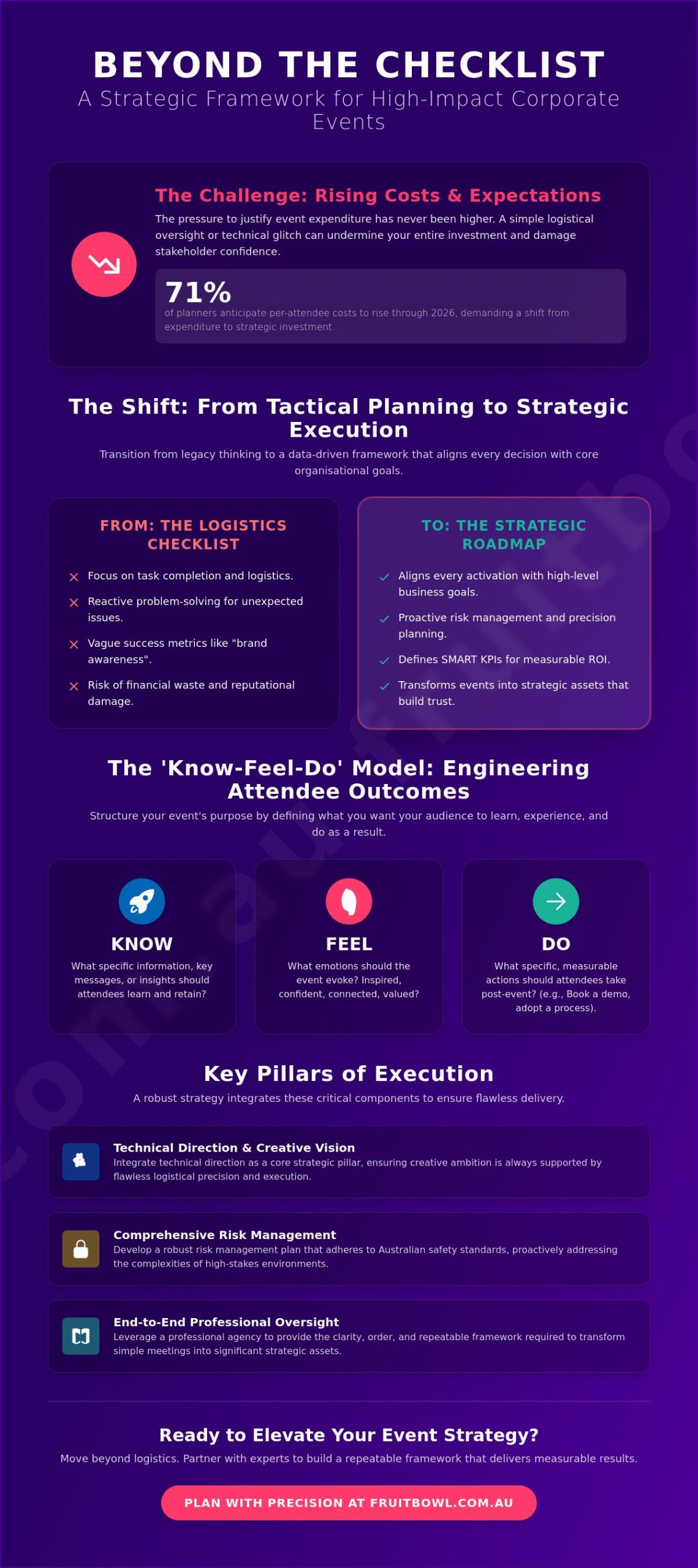
What if your next gathering wasn’t just a significant line item on the budget, but the primary engine driving your company’s growth for the next financial year? With 71% of planners expecting per-attendee costs to rise throughout 2026, the pressure to justify every dollar spent has never been higher. You likely feel the weight of these rising costs and the constant worry that a technical glitch or logistical oversight might undermine your hard work. It’s a common frustration; many professionals struggle to bridge the gap between a well-organised day and a truly effective corporate event strategy that delivers measurable results to stakeholders.

You don’t have to settle for “good enough” while crossing your fingers for a positive ROI. This guide will show you how to transform your gatherings into strategic assets that provide the certainty and data your leadership team demands. We’ll provide a clear framework for planning with precision, ensuring your events are seamless and professional from start to finish. We’ll explore how to integrate AI for better personalisation, navigate new data privacy laws, and ultimately build a roadmap that turns complex logistics into a frictionless experience for every attendee.

Key Takeaways

  • Transition from a standard logistics checklist to a robust corporate event strategy that aligns technical execution with high-level organisational goals.
  • Implement the “Know-Feel-Do” model to establish SMART KPIs that drive measurable engagement and clear business outcomes for 2026.
  • Integrate technical direction as a core strategic pillar to ensure that creative ambition is always supported by flawless logistical precision.
  • Develop a comprehensive risk management plan that adheres to Australian safety standards and addresses the complexities of high-stakes environments.
  • Learn how professional end-to-end oversight provides the clarity and order required to transform simple meetings into significant strategic assets.

Beyond the Logistics: Why Your Organisation Needs a Robust Corporate Event Strategy

Executing a successful event requires more than a sequence of completed tasks. While a logistics checklist ensures the room is booked and the microphones are live, it often lacks the connective tissue required to drive genuine business growth. A high-impact corporate event strategy serves as a technical and creative roadmap, aligning every specific brand objective with precise execution—and for those who need to strengthen their wider brand identity, you can check out Marketing Angels for expert marketing support. This approach ensures that your gathering is not merely a social occasion but a strategic asset designed to deliver a measurable return on investment.

Strategy acts as the “north star” for every vendor, technician, and stakeholder involved in the project. It provides a unified vision that prevents the fragmentation of ideas. By applying core event management principles within a strategic context, you move beyond simple coordination into the realm of high-stakes asset management. Without a documented plan, you risk significant financial waste and reputational damage. A misaligned keynote or a technical failure doesn’t just disrupt the day; it erodes the confidence of your clients and partners.

Shifting from Tactical Planning to Strategic Execution

Many organisations fall into the trap of the “we’ve always done it this way” mentality. This legacy thinking often ignores the shifting expectations of modern attendees. Strategic execution requires a move toward data-driven planning where every decision is backed by a clear objective. When you have a defined framework, you significantly reduce decision fatigue throughout the project lifecycle. Instead of debating every minor detail, you simply measure each option against your core goals. Ultimately, a corporate event strategy is a professional tool designed to mitigate brand risk and ensure logistical precision, whether you are planning a technical summit or looking to explore The Supercar Holiday for an exclusive corporate driving experience.

The Long-Term Value of a Repeatable Event Framework

A robust strategy isn’t a one-off document; it’s a repeatable framework that scales with your organisation. Whether you are hosting intimate seminars or large-scale national conferences, the underlying methodology remains the same. This consistency is vital for reinforcing your brand authority across an entire annual calendar. When your audience experiences the same level of professional rigour at every touchpoint, from government activations to brand launches or even unique off-site experiences with Boat4Hire, it builds deep trust. Every activation must contribute to the overarching corporate mission, ensuring that your event spend is an investment in your future, not just a cost of doing business.

Defining the Core Pillars: Objectives, Audience, and the Know-Feel-Do Model

Once you’ve established the necessity of a high-level framework, the next step involves defining the structural pillars that support your vision. A successful corporate event strategy relies on a deep understanding of your audience’s professional motivations and the specific business outcomes you intend to drive. By adopting a modern corporate event strategy, you move beyond generic programming to create a bespoke journey that respects the attendee’s time and your organisation’s resources.

Mapping the attendee journey is a critical exercise in precision. This process begins with the very first invitation and extends well beyond the post-event follow-up. Every touchpoint should be an intentional step toward your final objective. If you’re looking to refine these foundational elements, expert strategic planning can help ensure your pillars are built on solid ground.

Setting Measurable KPIs for Real ROI

In the high-stakes environment of 2026, vague goals like “brand awareness” are no longer sufficient. You must establish SMART KPIs that align with your broader 2026 business objectives. This might include specific lead capture targets for brand activations or employee engagement scores for internal conferences. Quantifying “soft” metrics, such as cultural alignment or brand sentiment, requires structured surveys and real-time data collection. It’s essential that all stakeholders agree on these success metrics before the planning phase begins; this ensures total transparency and accountability from the outset.

The Know-Feel-Do Framework in Practice

The Know-Feel-Do model is the narrative engine of your event. It dictates the flow of information and the sensory experience of the room. To execute this effectively, you must define three specific outcomes:

  • KNOW: What critical data or strategic updates must the audience retain? This determines the clarity of your keynote presentations and the structure of your breakout sessions.
  • FEEL: What emotional response should the production evoke? This is where technical excellence meets creative vision. To evoke confidence, we might use high-colour-temperature lighting and crisp, directional audio; to evoke connection, we might utilise warmer tones and immersive soundscapes.
  • DO: What specific action should attendees take immediately after the event? Whether it’s signing a contract, adopting a new internal process, or sharing content on social media, the entire event must lead naturally to this moment.

By linking these emotional states to specific technical requirements, you ensure the atmosphere in the room isn’t left to chance. It’s a disciplined approach that guarantees your creative ambition is always anchored by logistical precision.

Integrating Technical Excellence with Creative Vision

Technical direction is often relegated to the final weeks of planning, yet it remains the most visible element of your execution. A sophisticated corporate event strategy treats technical oversight as a foundational pillar from day one. This integration ensures that your creative vision isn’t just an ambitious concept but a physically achievable reality. When technical directors are involved in the early strategic phases, they can identify potential logistical hurdles before they become costly failures. This proactive approach brings order to the complex interplay of lighting, sound, and staging, ensuring the production supports the narrative rather than distracting from it.

The Role of AV and Production in Strategy

The technical environment directly dictates the emotional success of the “FEEL” component in your narrative model. High-fidelity sound and precision lighting design aren’t just aesthetic choices; they are strategic tools used to focus audience attention and reinforce key messaging. Research into event marketing and ROI highlights that the seamless integration of technology is a primary driver of attendee engagement. Managing complex technical riders and specific talent requirements requires professional AV management for events to ensure every performance or presentation meets the high standards your brand demands. This level of oversight ensures that technical components remain invisible to the audience, creating a frictionless experience that allows the core message to take centre stage.

Maintaining Brand Consistency Through Theming

Creative ambition must always be balanced with the realities of logistical precision. Strategic corporate event theming goes beyond choosing a colour palette; it involves creating a cohesive environment where every physical element reinforces your brand identity. This requires a disciplined collaboration between creative designers and technical directors to ensure that custom builds are both safe and impactful. While “dry hire” equipment rentals might seem like a budget-friendly option, they often lack the reliability and specialised support necessary for high-stakes environments. A professional strategy avoids the risks associated with unmanaged equipment, opting instead for an end-to-end methodology where every cable, luminaire, and speaker is part of a deliberate, well-maintained system. This commitment to quality ensures that the physical space reflects the elite status of your organisation.
Operational Logistics: Navigating Risk, Compliance, and Delivery

Precision in execution is the final safeguard of your corporate event strategy. While the creative vision sets the stage, the operational framework ensures that every moving part functions within a secure and controlled environment. Managing a multi-day conference or a high-stakes brand activation requires a level of logistical rigour that extends far beyond simple scheduling. It involves the meticulous coordination of vendors, the continuous monitoring of budget allocations, and the steady hand of a dedicated conference logistics coordinator who remains focused on the project’s broader objectives.

Operational logistics also provide an opportunity to demonstrate corporate social responsibility through waste reduction. To see how surplus food from large-scale operations can be redirected to support the community, you can check out FoodCycle LA for a leading example of food recovery in action.

Stakeholder liaison is a constant requirement throughout the project lifecycle. Clear communication channels prevent the fragmentation of information, ensuring that senior leadership remains informed without being burdened by granular operational hurdles. To achieve this level of clarity, you need professional logistics management that prioritises transparency and accountability at every stage.

Risk Management and Safety Protocols

High-stakes environments demand a proactive approach to risk management. Identifying potential technical glitches, medical emergencies, or security vulnerabilities before they occur is a hallmark of seasoned expertise. In Australia, navigating strict safety standards and venue-specific compliance protocols is a non-negotiable aspect of event delivery. This is particularly critical for public-facing projects, where adhering to a government event planning framework ensures that all regulatory requirements are met with total precision.

An experienced agency acts as a “safe pair of hands” for your organisation. This partnership provides a sense of security, allowing your internal team to focus on their core roles while experts oversee the complex safety landscape. Whether it’s managing the March 2, 2026, deadline for injury and illness data submission or ensuring on-site electrical tagging is current, every detail is managed under expert supervision. This disciplined approach eliminates the stress of potential failures, ensuring a professional and seamless experience for all attendees.

Measuring Success and Post-Event Analysis

The conclusion of the event marks the beginning of the most critical phase: the transition from delivery to data-driven analysis. Calculating a measurable ROI requires more than just a headcount; it involves a deep dive into the KPIs established during the planning phase. Conducting thorough debriefs with key stakeholders allows you to refine future strategies based on concrete performance metrics. Comprehensive post-event data transforms a one-time gathering into a strategic benchmark for all future organisational activations. This methodical review ensures that every dollar spent contributes to a repeatable model of success, providing the clarity and order necessary to justify future event budgets.

To ensure these strategic investments translate into long-term organisational success, michelboutinstudio provides the executive consulting required to drive profitability and growth.

Partnering for Success: Why a Professional Agency Elevates Your Strategy

A sophisticated corporate event strategy is only as effective as the team tasked with its delivery. While the planning phase establishes the roadmap, the execution phase requires a level of seasoned expertise that can only be forged through decades of industry experience. Partnering with an agency that brings 28 years of history to the table ensures that your vision is protected by a team that has navigated every possible logistical challenge. This depth of knowledge transforms the agency from a transactional vendor into a vital strategic partner, providing the order and clarity required to manage high-stakes environments with total composure.

By outsourcing the complex mechanics of event delivery, you significantly reduce the internal burden on your own team. Professional project management allows your staff to remain focused on their primary business roles while experts oversee the multifaceted processes of production, compliance, and stakeholder liaison. This integrated approach ensures that every detail—from the initial concept to the ethical management of surplus catering through FoodCycle LA—is handled with the disciplined precision your organisation expects.

The Safe Pair of Hands Advantage

Senior leadership teams require more than just a successful event; they require the reassurance that their brand is in a “safe pair of hands.” This sense of security comes from working with specialists who remain unflappable under pressure, whether they are managing an intimate boardroom seminar or a large-scale festival activation. Our corporate event management framework is designed to address the diverse needs of corporate, festival, and government sectors with equal rigour. This versatility ensures that regardless of the event type, the underlying methodology remains consistent, safe, and results-oriented.

Executing Your Vision with Precision

The power of an integrated agency team lies in its ability to maintain a seamless thread from the first creative spark to the final on-site delivery. When creative ambition and technical direction exist under one roof, there is no risk of information being lost in translation. This end-to-end methodology is supported by national coverage, enabling your organisation to deliver consistent event quality across Australia. Whether you are activating a brand in Sydney or hosting a national conference in Perth, the level of professional oversight remains unchanged.

As you look toward your 2026 objectives, consider how a refined corporate event strategy could serve as your most powerful growth lever. Moving beyond simple meetings requires a partner who understands the intersection of creative vision and logistical precision. We invite you to consult with our team on your next strategic activation; let’s work together to build an event that delivers the measurable data and professional excellence your stakeholders demand.

Securing Your Organisation’s Future Through Strategic Event Delivery

Building a high-impact corporate event strategy requires a shift from simple task management to a disciplined, results-oriented framework. By aligning your brand objectives with technical precision and utilising the Know-Feel-Do model, you ensure every gathering provides measurable value to your stakeholders. It’s an approach that moves beyond the stress of logistical oversight, providing a clear roadmap for professional success in a high-stakes environment.

Achieving this level of order and clarity is most effective when supported by seasoned expertise. With over 28 years of industry-leading experience, our team provides end-to-end management from initial concept to final execution. We specialise in high-stakes government and corporate activations, acting as a reliable partner to protect your brand and deliver seamless results. To elevate your next gathering, consult with our strategic experts for your next high-impact event. Your vision deserves the security and precision that only an expert guide can provide.

Frequently Asked Questions

What is the first step in creating a corporate event strategy?

The first step involves a rigorous definition of your core objectives through a structured “Why” analysis. Before you consider venues or speakers, you must establish the specific business problem the event is designed to solve. This foundational phase ensures that every subsequent decision remains anchored to a clear organisational goal, providing the clarity required for a successful project from the outset.

How do you measure the ROI of a corporate event?

Measuring the return on investment involves a disciplined comparison of pre-defined SMART KPIs against comprehensive post-event data. You should track quantitative metrics like lead capture targets and employee engagement scores alongside qualitative data from attendee surveys. A robust corporate event strategy uses this information to transform a one-time gathering into a repeatable benchmark for future business growth.

Why is a strategic framework more important than a logistics checklist?

A strategic framework provides a unified roadmap that aligns technical execution with brand objectives, whereas a logistics checklist is simply a sequence of completed tasks. The framework ensures that every physical detail, such as the lighting design or the room layout, actively supports your narrative. This high-level approach prevents the fragmentation of ideas and ensures the event functions as a high-impact strategic asset.

How far in advance should we start planning our corporate event strategy?

For high-stakes corporate events, the planning process should ideally commence six to twelve months in advance. This lead time is essential for securing elite venues and managing complex technical requirements with precision. Starting early reduces the internal burden on your team; it also provides the necessary space for thorough risk management and detailed stakeholder liaison throughout the project lifecycle.

What are the most common mistakes in corporate event planning?

Common errors include treating technical direction as a minor add-on and failing to agree on success metrics before the planning phase begins. Many organisations also fall into the trap of “we’ve always done it this way,” which ignores shifting attendee expectations for 2026. These mistakes often lead to significant budget waste and a failure to deliver the professional, seamless experience that stakeholders demand.

How can a professional agency help with event compliance and risk management?

A professional agency provides a “safe pair of hands” by navigating the complex landscape of Australian safety standards and venue-specific compliance. They identify potential technical or security risks before they manifest, ensuring all regulatory requirements are met with total precision. This expert oversight provides a sense of security to leadership teams, knowing that every detail is being managed by seasoned specialists.

What role does AV and technology play in a modern event strategy?

AV and technology are strategic pillars that directly influence the audience’s emotional response and retention of information. In a modern corporate event strategy, the seamless integration of sound, lighting, and staging is used to focus attention and reinforce the brand’s core message. Technology must remain invisible to the attendee, creating a frictionless environment that allows the narrative to take centre stage.

How do we align our event strategy with our overall brand objectives?

Alignment is achieved by ensuring every touchpoint of the attendee journey reflects your overarching corporate mission. This involves a collaborative effort to ensure that creative vision and technical execution are perfectly synchronised with your brand identity. When an event is a consistent extension of your organisation’s values, it builds deep trust and reinforces your authority within your specific industry.

What if your next gathering wasn’t just a significant line item on the budget, but the primary engine driving your company’s growth for the next financial year? With 71% of planners expecting per-attendee costs to rise throughout 2026, the pressure to justify every dollar spent has never been higher. You likely feel the weight of these rising costs and the constant worry that a technical glitch or logistical oversight might undermine your hard work. It’s a common frustration; many professionals struggle to bridge the gap between a well-organised day and a truly effective corporate event strategy that delivers measurable results to stakeholders.

You don’t have to settle for “good enough” while crossing your fingers for a positive ROI. This guide will show you how to transform your gatherings into strategic assets that provide the certainty and data your leadership team demands. We’ll provide a clear framework for planning with precision, ensuring your events are seamless and professional from start to finish. We’ll explore how to integrate AI for better personalisation, navigate new data privacy laws, and ultimately build a roadmap that turns complex logistics into a frictionless experience for every attendee.

Key Takeaways

  • Transition from a standard logistics checklist to a robust corporate event strategy that aligns technical execution with high-level organisational goals.
  • Implement the “Know-Feel-Do” model to establish SMART KPIs that drive measurable engagement and clear business outcomes for 2026.
  • Integrate technical direction as a core strategic pillar to ensure that creative ambition is always supported by flawless logistical precision.
  • Develop a comprehensive risk management plan that adheres to Australian safety standards and addresses the complexities of high-stakes environments.
  • Learn how professional end-to-end oversight provides the clarity and order required to transform simple meetings into significant strategic assets.

Beyond the Logistics: Why Your Organisation Needs a Robust Corporate Event Strategy

Executing a successful event requires more than a sequence of completed tasks. While a logistics checklist ensures the room is booked and the microphones are live, it often lacks the connective tissue required to drive genuine business growth. A high-impact corporate event strategy serves as a technical and creative roadmap, aligning every specific brand objective with precise execution—and for those who need to strengthen their wider brand identity, you can check out Marketing Angels for expert marketing support. This approach ensures that your gathering is not merely a social occasion but a strategic asset designed to deliver a measurable return on investment.

Strategy acts as the “north star” for every vendor, technician, and stakeholder involved in the project. It provides a unified vision that prevents the fragmentation of ideas. By applying core event management principles within a strategic context, you move beyond simple coordination into the realm of high-stakes asset management. Without a documented plan, you risk significant financial waste and reputational damage. A misaligned keynote or a technical failure doesn’t just disrupt the day; it erodes the confidence of your clients and partners.

Shifting from Tactical Planning to Strategic Execution

Many organisations fall into the trap of the “we’ve always done it this way” mentality. This legacy thinking often ignores the shifting expectations of modern attendees. Strategic execution requires a move toward data-driven planning where every decision is backed by a clear objective. When you have a defined framework, you significantly reduce decision fatigue throughout the project lifecycle. Instead of debating every minor detail, you simply measure each option against your core goals. Ultimately, a corporate event strategy is a professional tool designed to mitigate brand risk and ensure logistical precision, whether you are planning a technical summit or looking to explore The Supercar Holiday for an exclusive corporate driving experience.

The Long-Term Value of a Repeatable Event Framework

A robust strategy isn’t a one-off document; it’s a repeatable framework that scales with your organisation. Whether you are hosting intimate seminars or large-scale national conferences, the underlying methodology remains the same. This consistency is vital for reinforcing your brand authority across an entire annual calendar. When your audience experiences the same level of professional rigour at every touchpoint, from government activations to brand launches or even unique off-site experiences with Boat4Hire, it builds deep trust. Every activation must contribute to the overarching corporate mission, ensuring that your event spend is an investment in your future, not just a cost of doing business.

Defining the Core Pillars: Objectives, Audience, and the Know-Feel-Do Model

Once you’ve established the necessity of a high-level framework, the next step involves defining the structural pillars that support your vision. A successful corporate event strategy relies on a deep understanding of your audience’s professional motivations and the specific business outcomes you intend to drive. By adopting a modern corporate event strategy, you move beyond generic programming to create a bespoke journey that respects the attendee’s time and your organisation’s resources.

Mapping the attendee journey is a critical exercise in precision. This process begins with the very first invitation and extends well beyond the post-event follow-up. Every touchpoint should be an intentional step toward your final objective. If you’re looking to refine these foundational elements, expert strategic planning can help ensure your pillars are built on solid ground.

Setting Measurable KPIs for Real ROI

In the high-stakes environment of 2026, vague goals like “brand awareness” are no longer sufficient. You must establish SMART KPIs that align with your broader 2026 business objectives. This might include specific lead capture targets for brand activations or employee engagement scores for internal conferences. Quantifying “soft” metrics, such as cultural alignment or brand sentiment, requires structured surveys and real-time data collection. It’s essential that all stakeholders agree on these success metrics before the planning phase begins; this ensures total transparency and accountability from the outset.

The Know-Feel-Do Framework in Practice

The Know-Feel-Do model is the narrative engine of your event. It dictates the flow of information and the sensory experience of the room. To execute this effectively, you must define three specific outcomes:

  • KNOW: What critical data or strategic updates must the audience retain? This determines the clarity of your keynote presentations and the structure of your breakout sessions.
  • FEEL: What emotional response should the production evoke? This is where technical excellence meets creative vision. To evoke confidence, we might use high-colour-temperature lighting and crisp, directional audio; to evoke connection, we might utilise warmer tones and immersive soundscapes.
  • DO: What specific action should attendees take immediately after the event? Whether it’s signing a contract, adopting a new internal process, or sharing content on social media, the entire event must lead naturally to this moment.

By linking these emotional states to specific technical requirements, you ensure the atmosphere in the room isn’t left to chance. It’s a disciplined approach that guarantees your creative ambition is always anchored by logistical precision.

Integrating Technical Excellence with Creative Vision

Technical direction is often relegated to the final weeks of planning, yet it remains the most visible element of your execution. A sophisticated corporate event strategy treats technical oversight as a foundational pillar from day one. This integration ensures that your creative vision isn’t just an ambitious concept but a physically achievable reality. When technical directors are involved in the early strategic phases, they can identify potential logistical hurdles before they become costly failures. This proactive approach brings order to the complex interplay of lighting, sound, and staging, ensuring the production supports the narrative rather than distracting from it.

The Role of AV and Production in Strategy

The technical environment directly dictates the emotional success of the “FEEL” component in your narrative model. High-fidelity sound and precision lighting design aren’t just aesthetic choices; they are strategic tools used to focus audience attention and reinforce key messaging. Research into event marketing and ROI highlights that the seamless integration of technology is a primary driver of attendee engagement. Managing complex technical riders and specific talent requirements requires professional AV management for events to ensure every performance or presentation meets the high standards your brand demands. This level of oversight ensures that technical components remain invisible to the audience, creating a frictionless experience that allows the core message to take centre stage.

Maintaining Brand Consistency Through Theming

Creative ambition must always be balanced with the realities of logistical precision. Strategic corporate event theming goes beyond choosing a colour palette; it involves creating a cohesive environment where every physical element reinforces your brand identity. This requires a disciplined collaboration between creative designers and technical directors to ensure that custom builds are both safe and impactful. While “dry hire” equipment rentals might seem like a budget-friendly option, they often lack the reliability and specialised support necessary for high-stakes environments. A professional strategy avoids the risks associated with unmanaged equipment, opting instead for an end-to-end methodology where every cable, luminaire, and speaker is part of a deliberate, well-maintained system. This commitment to quality ensures that the physical space reflects the elite status of your organisation.

Operational Logistics: Navigating Risk, Compliance, and Delivery

Precision in execution is the final safeguard of your corporate event strategy. While the creative vision sets the stage, the operational framework ensures that every moving part functions within a secure and controlled environment. Managing a multi-day conference or a high-stakes brand activation requires a level of logistical rigour that extends far beyond simple scheduling. It involves the meticulous coordination of vendors, the continuous monitoring of budget allocations, and the steady hand of a dedicated conference logistics coordinator who remains focused on the project’s broader objectives.

Operational logistics also provide an opportunity to demonstrate corporate social responsibility through waste reduction. To see how surplus food from large-scale operations can be redirected to support the community, you can check out FoodCycle LA for a leading example of food recovery in action.

Stakeholder liaison is a constant requirement throughout the project lifecycle. Clear communication channels prevent the fragmentation of information, ensuring that senior leadership remains informed without being burdened by granular operational hurdles. To achieve this level of clarity, you need professional logistics management that prioritises transparency and accountability at every stage.

Risk Management and Safety Protocols

High-stakes environments demand a proactive approach to risk management. Identifying potential technical glitches, medical emergencies, or security vulnerabilities before they occur is a hallmark of seasoned expertise. In Australia, navigating strict safety standards and venue-specific compliance protocols is a non-negotiable aspect of event delivery. This is particularly critical for public-facing projects, where adhering to a government event planning framework ensures that all regulatory requirements are met with total precision.

An experienced agency acts as a “safe pair of hands” for your organisation. This partnership provides a sense of security, allowing your internal team to focus on their core roles while experts oversee the complex safety landscape. Whether it’s managing the March 2, 2026, deadline for injury and illness data submission or ensuring on-site electrical tagging is current, every detail is managed under expert supervision. This disciplined approach eliminates the stress of potential failures, ensuring a professional and seamless experience for all attendees.

Measuring Success and Post-Event Analysis

The conclusion of the event marks the beginning of the most critical phase: the transition from delivery to data-driven analysis. Calculating a measurable ROI requires more than just a headcount; it involves a deep dive into the KPIs established during the planning phase. Conducting thorough debriefs with key stakeholders allows you to refine future strategies based on concrete performance metrics. Comprehensive post-event data transforms a one-time gathering into a strategic benchmark for all future organisational activations. This methodical review ensures that every dollar spent contributes to a repeatable model of success, providing the clarity and order necessary to justify future event budgets.

To ensure these strategic investments translate into long-term organisational success, michelboutinstudio provides the executive consulting required to drive profitability and growth.

Partnering for Success: Why a Professional Agency Elevates Your Strategy

A sophisticated corporate event strategy is only as effective as the team tasked with its delivery. While the planning phase establishes the roadmap, the execution phase requires a level of seasoned expertise that can only be forged through decades of industry experience. Partnering with an agency that brings 28 years of history to the table ensures that your vision is protected by a team that has navigated every possible logistical challenge. This depth of knowledge transforms the agency from a transactional vendor into a vital strategic partner, providing the order and clarity required to manage high-stakes environments with total composure.

By outsourcing the complex mechanics of event delivery, you significantly reduce the internal burden on your own team. Professional project management allows your staff to remain focused on their primary business roles while experts oversee the multifaceted processes of production, compliance, and stakeholder liaison. This integrated approach ensures that every detail—from the initial concept to the ethical management of surplus catering through FoodCycle LA—is handled with the disciplined precision your organisation expects.

The Safe Pair of Hands Advantage

Senior leadership teams require more than just a successful event; they require the reassurance that their brand is in a “safe pair of hands.” This sense of security comes from working with specialists who remain unflappable under pressure, whether they are managing an intimate boardroom seminar or a large-scale festival activation. Our corporate event management framework is designed to address the diverse needs of corporate, festival, and government sectors with equal rigour. This versatility ensures that regardless of the event type, the underlying methodology remains consistent, safe, and results-oriented.

Executing Your Vision with Precision

The power of an integrated agency team lies in its ability to maintain a seamless thread from the first creative spark to the final on-site delivery. When creative ambition and technical direction exist under one roof, there is no risk of information being lost in translation. This end-to-end methodology is supported by national coverage, enabling your organisation to deliver consistent event quality across Australia. Whether you are activating a brand in Sydney or hosting a national conference in Perth, the level of professional oversight remains unchanged.

As you look toward your 2026 objectives, consider how a refined corporate event strategy could serve as your most powerful growth lever. Moving beyond simple meetings requires a partner who understands the intersection of creative vision and logistical precision. We invite you to consult with our team on your next strategic activation; let’s work together to build an event that delivers the measurable data and professional excellence your stakeholders demand.

Securing Your Organisation’s Future Through Strategic Event Delivery

Building a high-impact corporate event strategy requires a shift from simple task management to a disciplined, results-oriented framework. By aligning your brand objectives with technical precision and utilising the Know-Feel-Do model, you ensure every gathering provides measurable value to your stakeholders. It’s an approach that moves beyond the stress of logistical oversight, providing a clear roadmap for professional success in a high-stakes environment.

Achieving this level of order and clarity is most effective when supported by seasoned expertise. With over 28 years of industry-leading experience, our team provides end-to-end management from initial concept to final execution. We specialise in high-stakes government and corporate activations, acting as a reliable partner to protect your brand and deliver seamless results. To elevate your next gathering, consult with our strategic experts for your next high-impact event. Your vision deserves the security and precision that only an expert guide can provide.

Frequently Asked Questions

What is the first step in creating a corporate event strategy?

The first step involves a rigorous definition of your core objectives through a structured “Why” analysis. Before you consider venues or speakers, you must establish the specific business problem the event is designed to solve. This foundational phase ensures that every subsequent decision remains anchored to a clear organisational goal, providing the clarity required for a successful project from the outset.

How do you measure the ROI of a corporate event?

Measuring the return on investment involves a disciplined comparison of pre-defined SMART KPIs against comprehensive post-event data. You should track quantitative metrics like lead capture targets and employee engagement scores alongside qualitative data from attendee surveys. A robust corporate event strategy uses this information to transform a one-time gathering into a repeatable benchmark for future business growth.

Why is a strategic framework more important than a logistics checklist?

A strategic framework provides a unified roadmap that aligns technical execution with brand objectives, whereas a logistics checklist is simply a sequence of completed tasks. The framework ensures that every physical detail, such as the lighting design or the room layout, actively supports your narrative. This high-level approach prevents the fragmentation of ideas and ensures the event functions as a high-impact strategic asset.

How far in advance should we start planning our corporate event strategy?

For high-stakes corporate events, the planning process should ideally commence six to twelve months in advance. This lead time is essential for securing elite venues and managing complex technical requirements with precision. Starting early reduces the internal burden on your team; it also provides the necessary space for thorough risk management and detailed stakeholder liaison throughout the project lifecycle.

What are the most common mistakes in corporate event planning?

Common errors include treating technical direction as a minor add-on and failing to agree on success metrics before the planning phase begins. Many organisations also fall into the trap of “we’ve always done it this way,” which ignores shifting attendee expectations for 2026. These mistakes often lead to significant budget waste and a failure to deliver the professional, seamless experience that stakeholders demand.

How can a professional agency help with event compliance and risk management?

A professional agency provides a “safe pair of hands” by navigating the complex landscape of Australian safety standards and venue-specific compliance. They identify potential technical or security risks before they manifest, ensuring all regulatory requirements are met with total precision. This expert oversight provides a sense of security to leadership teams, knowing that every detail is being managed by seasoned specialists.

What role does AV and technology play in a modern event strategy?

AV and technology are strategic pillars that directly influence the audience’s emotional response and retention of information. In a modern corporate event strategy, the seamless integration of sound, lighting, and staging is used to focus attention and reinforce the brand’s core message. Technology must remain invisible to the attendee, creating a frictionless environment that allows the narrative to take centre stage.

How do we align our event strategy with our overall brand objectives?

Alignment is achieved by ensuring every touchpoint of the attendee journey reflects your overarching corporate mission. This involves a collaborative effort to ensure that creative vision and technical execution are perfectly synchronised with your brand identity. When an event is a consistent extension of your organisation’s values, it builds deep trust and reinforces your authority within your specific industry.

Back to Articles
Request A Quote

Make an
Enquiry

Untitled design

What Makes Us Different?

True end-to-end solution so you can hand off to us, focus on your priorities and enjoy the event without any stress

Unmatched industry expertise looking after diverse range of high-profile events, cultural festivals & activations

Meticulous attention to every detail and precise execution of events with our streamlined processes

Tailored solutions with bespoke strategies to ensure we align with your brand and objectives

Make an Enquiry

"*" indicates required fields

This field is for validation purposes and should be left unchanged.

"*" indicates required fields

This field is for validation purposes and should be left unchanged.