What if the secret to a sold-out event in 2026 isn’t found in a flashy tech demo, but in the strategic tension between digital acceleration and the fundamental human need for connection? It’s a question every organiser is asking as the industry reaches a five-year post-pandemic high in optimism. We understand that you’re likely facing the dual pressure of overcoming attendee engagement fatigue while ensuring your creative vision aligns with strict new ESG reporting standards, such as ISO 20121:2024.
This guide provides the strategic clarity required to select innovative conference themes 2026 that drive registration and satisfy stakeholders. You’ll discover how to justify bold creative choices through a lens of logistical precision, ensuring your event experience remains relevant and impactful. We will examine the emerging frameworks defining the Australian landscape. These include the bio-digital frontier, radical circularity, and the rise of neuro-inclusive event architecture.
Key Takeaways
- Shift from superficial event titles to purpose-driven frameworks that align with 2026 corporate objectives and stakeholder expectations.
- Discover how innovative conference themes 2026 leverage the bio-digital frontier to focus on human skill augmented by artificial intelligence.
- Adopt radical sustainability through circular conference concepts that move beyond simple carbon offsets toward net-positive environmental regeneration.
- Prioritise neuro-inclusive engagement by designing sensory-aware environments that cater to diverse cognitive needs and foster genuine connection.
- Learn to justify bold creative choices by applying a meticulous methodology that balances visionary design with technical direction and logistical precision.
Table of Contents
- Beyond the Buzzwords: The Strategic Role of Conference Themes in 2026
- The Bio-Digital Frontier: Themes Integrating AI and Human Intelligence
- Radical Sustainability: Moving to the Circular Conference Concept
- Designing for Connection: Neurodiversity and Inclusive Engagement
- From Vision to Execution: The Fruitbowl Methodology for 2026
Beyond the Buzzwords: The Strategic Role of Conference Themes in 2026
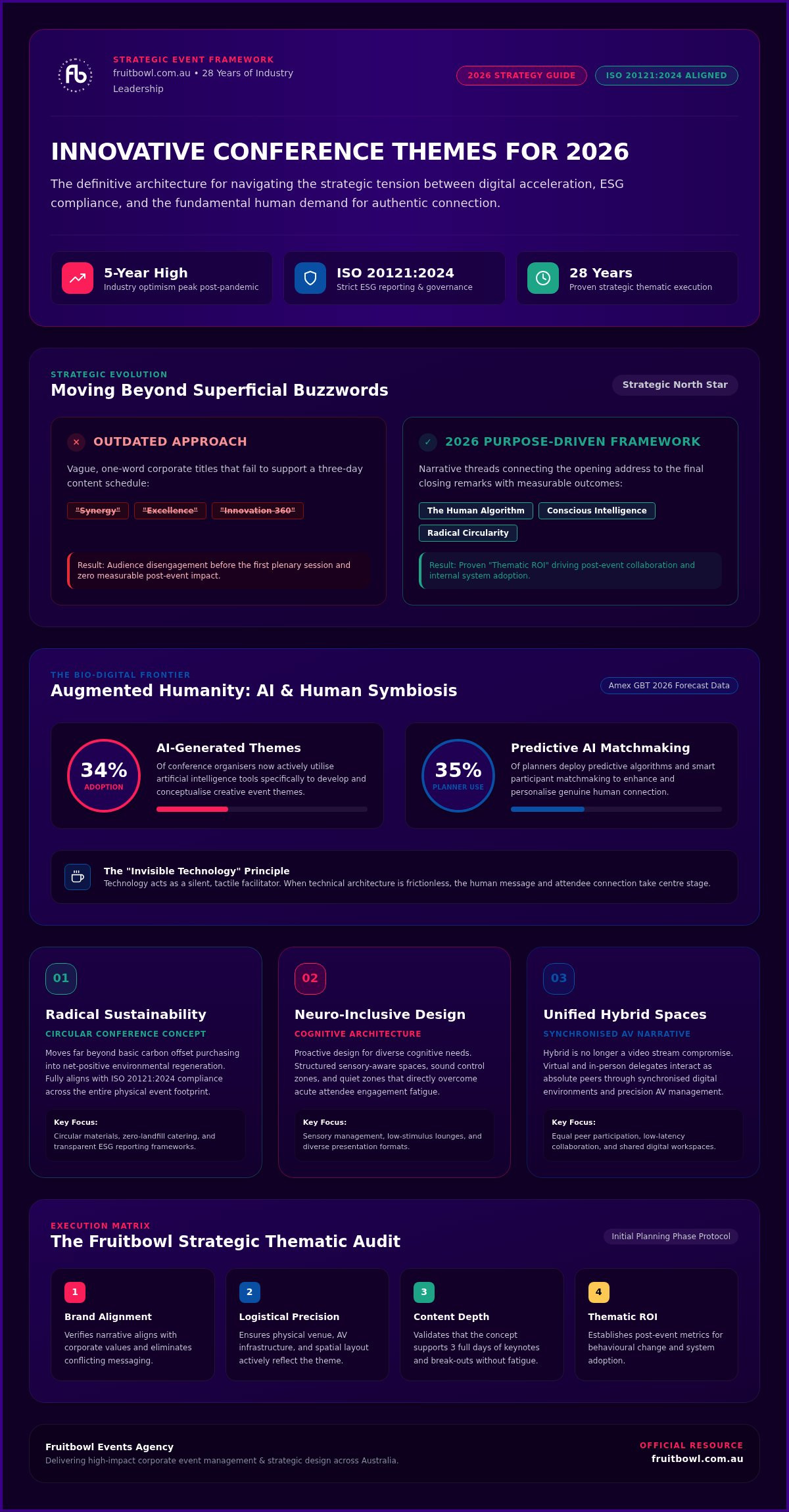
In 2026, a conference theme serves as more than a catchphrase or a graphic on a lanyard. It functions as a strategic North Star, providing a constant point of reference for every logistical and creative decision. Selecting innovative conference themes 2026 requires a shift from superficial wordplay toward purpose-driven frameworks that align with specific corporate objectives. This alignment ensures that every session, keynote, and activation reinforces a single, coherent message. It’s about creating a narrative thread that connects the opening address to the final closing remarks.
A well-conceived theme directly influences attendee retention and post-event brand sentiment. When a theme feels authentic, it fosters a sense of belonging and clarity that generic titles cannot achieve. We now measure this through Thematic ROI. This metric evaluates how a specific narrative framework drives behavioural changes, such as increased post-event collaboration or higher adoption rates of new internal systems. By defining these outcomes early, organisers can justify creative investments to stakeholders with data-backed confidence.
The Evolution of Thematic Strategy
The era of vague, one-word titles like ‘Synergy’ or ‘Excellence’ has ended. Today’s Australian professionals demand nuance. They seek themes that acknowledge the complexities of modern industry and the rapid pace of change. Fruitbowl draws on 28 years of experience to identify concepts that endure rather than those that simply trend. We’ve seen themes come and go; we know that authenticity is the primary currency of 2026. If a theme feels like corporate jargon, the audience disengages before the first plenary session begins. A successful theme must be robust enough to support three days of content without feeling repetitive or thin.
Aligning Brand Identity with Event Narrative
Strategic themes must reflect the core mission of the organisation to feel legitimate. We conduct rigorous ‘Thematic Audits’ during the initial planning phase to ensure the proposed narrative doesn’t conflict with existing brand values or long-term goals. For instance, a theme focused on future-proofing must be backed by principles of the circular economy throughout the event’s physical footprint. This level of technical precision is essential when integrating creative vision with meticulously planned corporate event management. Without this foundation, even the most visionary theme risks becoming a logistical liability that undermines the brand’s credibility.
The Bio-Digital Frontier: Themes Integrating AI and Human Intelligence
The bio-digital frontier represents a pivotal shift in how we conceptualise innovative conference themes 2026. We’ve moved past the novelty of generative tools toward a more sophisticated era of ‘Augmented Humanity’. This trend focuses on the symbiosis between biological intelligence and artificial systems. Themes such as ‘The Human Algorithm’, ‘Symbiosis: The Future of Work’, or ‘Conscious Intelligence’ provide frameworks to explore how technology elevates human skill rather than replacing it. According to the Amex GBT 2026 Global Meetings & Events Forecast, 34% of organisers now use AI tools specifically to generate creative conference themes, reflecting this deep integration.
A common concern is that AI-centric themes feel cold or impersonal. We address this through meticulous technical direction that grounds high-tech concepts in human experience. It’s not enough to talk about algorithms; the event must feel tactile and responsive. By using smart participant matchmaking and predictive AI, which 35% of planners now utilise, we can actually increase the quality of human connection. This ensures the technology acts as a silent facilitator, allowing the human narrative to remain the primary focus. When technology is invisible, the human message becomes louder.
Designing the Hybrid Experience
In 2026, hybrid is no longer a compromise. It’s a unified environment. We’ve moved beyond simple streaming to integrated spaces where virtual and physical delegates interact as peers. This requires sophisticated av management for events to create a seamless technical narrative. When the digital and physical realms are perfectly synchronised, the theme feels lived rather than just observed. This unified approach reduces cognitive fatigue and ensures that every attendee, regardless of location, feels the weight of the strategic message.
Ethical Innovation as a Thematic Pillar
As corporate scrutiny on digital transformation intensifies, ‘Responsible Tech’ becomes a crucial thematic pillar. Organisations must position themselves as leaders in ethical governance and human judgment. This involves facilitating high-level debate on AI ethics and cognitive augmentation within the conference tracks. Even high-tech events must consider their broader footprint, aligning with EPA green meeting guidance to ensure digital advancement doesn’t come at an environmental cost. If you’re looking to balance technical ambition with logistical safety, our team can help you design a future-ready event framework.
Radical Sustainability: Moving to the Circular Conference Concept
Sustainability in 2026 has evolved from an optional add-on to a foundational requirement for innovative conference themes 2026. We define the ‘Circular Conference’ as a thematic framework where every element is engineered for regeneration or total waste elimination. This moves beyond simple carbon offsets toward concepts like ‘Net Positive’ or ‘The Regenerative Enterprise’. These themes function as operational mandates, reflecting the high standards required for government event planning. The industry has firmly shifted from ‘green-washing’ to ‘green-doing’, where success is measured by verifiable data rather than vague intent.
Under the ISO 20121:2024 standard, event sustainability now mandates measurable criteria for human rights and supply chain due diligence. This includes a deeper understanding neurodiversity as part of the ‘social’ pillar of ESG. When a theme is built on these pillars, it provides a resilient narrative that stands up to the scrutiny of modern corporate reporting. By integrating these values early, organisers ensure their creative vision is backed by ethical substance.
Logistics as a Sustainability Statement
In a circular model, logistical choices are the most powerful part of the thematic story. Catering strategies must address the fact that up to 40% of event food is historically wasted. By implementing circular menus and regional sourcing, the theme of ‘regeneration’ becomes a tactile experience for the attendee. We also track Scope 3 value chain emissions as required by 2026 reporting regulations. This level of oversight is managed by a dedicated conference management expert who ensures that modular staging and zero-waste materials are utilised across the entire event footprint.
Legacy-Driven Theming
The most impactful themes focus on the ‘long-tail’ effect of the conference. Legacy-driven theming ensures that the event’s influence extends well beyond the final session. This involves crafting a narrative that supports long-term ESG goals, such as community skill-building or industry-wide decarbonisation milestones. When selecting innovative conference themes 2026, legacy should be the primary consideration. By anchoring the theme in a specific social or environmental outcome, the organisation demonstrates a commitment to the Net Zero Carbon Events roadmap. This strategic foresight ensures the conference is remembered for the positive change it initiated within the broader industry ecosystem.
Designing for Connection: Neurodiversity and Inclusive Engagement
Genuine human connection is the most sought-after outcome for 2026 professional audiences. As digital tools become ubiquitous, the value of in-person gatherings rests on the quality of peer-to-peer exchange. Achieving this requires innovative conference themes 2026 that champion ‘The Universal Workforce’ by celebrating diverse ways of thinking and working. We must move beyond basic legislative compliance toward active, empathetic inclusion as a central conference message. This shift is critical given that an estimated 15% to 20% of the global population is neurodivergent, including individuals with ADHD, autism, dyslexia, and dyspraxia.
When a theme focuses on cognitive diversity, it directly influences how the physical event space is engineered. Research from PCMA Convene indicates that up to 20% of neurodivergent professionals have declined to attend or disengaged early from conferences due to sensory overload or a lack of decompression spaces. An inclusive theme must therefore dictate the spatial design, ensuring the environment supports the narrative of belonging. This approach transforms inclusion from a checklist item into a lived experience on the show floor.
Thematic Environment Design
An inclusive narrative must manifest physically through distinct environmental zones. We design conference layouts to include both low-stimulus ‘Quiet Zones’ and high-energy networking hubs, allowing attendees to manage their energy levels throughout the day. Meticulous technical direction is vital here; subtle adjustments to lighting, acoustics, and transition pathways prevent sensory fatigue without disrupting the event flow. Real-time transcription, closed captioning, and clear sensory maps ensure that the technical infrastructure quietly supports the broader theme of universal accessibility.
Fostering Authentic Networking
Breaking down corporate hierarchies requires a theme that encourages vulnerability and shared purpose. When sessions are structured around collaborative problem-solving rather than passive listening, barriers drop naturally. Our comprehensive talent procurement process ensures we secure facilitators and speakers who understand how to guide these deep connections safely. This structured interaction ensures that networking feels purposeful rather than forced, allowing authentic professional relationships to form. If you are ready to elevate your next event, you can partner with our experienced team to design an inclusive conference framework.
From Vision to Execution: The Fruitbowl Methodology for 2026
The transition from a high-level creative vision to a logistically sound event requires a disciplined, end-to-end methodology. We’ve spent 28 years refining a process that ensures creative ambition never outpaces technical reality. This “safe pair of hands” approach is fundamental when deploying innovative conference themes 2026. It involves a sequential progression from strategic alignment to unflappable on-site execution. Having delivered more than 2,500 corporate conferences and government activations, we provide the necessary perspective to navigate the increasing complexities of modern event delivery. Our focus remains on bringing order and clarity to high-stakes environments, ensuring every detail is under expert supervision.
Strategic Planning and Stakeholder Management
Building a business case for a bold theme requires more than a creative pitch. It demands a framework that links thematic choices to measurable business objectives and attendee behavioural change. We manage the entire budget lifecycle, ensuring that every dollar spent reinforces the core narrative without compromising on quality or safety. This involves early-stage technical integration where we map the creative vision against the logistical footprint. By establishing these foundations before design begins, we prevent the production friction that occurs when creative ideas aren’t grounded in reality. Our methodology ensures that brand values and event experiences are perfectly aligned from the outset.
The Meticulous Guide to On-Site Delivery
On the day of the event, the technical director acts as the primary guardian of the conference theme. They ensure that the lighting, sound, and talent procurement all serve the singular narrative established during the planning phase. Our risk management strategies are particularly robust for high-stakes activations, integrating regulatory compliance and municipal safety codes directly into the production schedule. This proactive approach ensures a frictionless experience for both the organiser and the attendee. Consistency is maintained through a single point of contact, providing unified accountability across complex multi-vendor environments.
A successful 2026 conference requires a partner who is both a creative visionary and a disciplined technician. We combine these two roles to deliver results-oriented events that drive engagement and registration. If you’re ready to transform your strategic vision into a meticulously executed reality, you can partner with a strategist who understands the 2026 landscape. Our team is ready to guide you through the complexities of modern event management with confidence and precision.
Securing the Future of Your Event Narrative
Selecting from innovative conference themes 2026 requires a sophisticated balance between forward-thinking design and operational reality. Successful events must move beyond superficial catchphrases to address the bio-digital frontier, radical resource circularity, and universal cognitive accessibility. When these thematic pillars are integrated into a structured corporate event strategy, they drive registration and satisfy complex stakeholder requirements. The narrative must be visible in every logistical detail, from the environmental footprint on the show floor to the technical direction of the hybrid broadcast environment.
Bringing these multi-layered concepts to fruition demands a disciplined approach to planning and execution. With over 28 years of experience in high-stakes corporate delivery, Fruitbowl provides the end-to-end strategic oversight and meticulous technical direction necessary to navigate the modern event landscape. We act as a reliable partner, ensuring that your creative ambition is always supported by precise risk management and flawless on-site execution. You can contact Fruitbowl Events Agency to plan your 2026 conference strategy and ensure your next major activation is delivered with absolute certainty.
Frequently Asked Questions
What are the most popular conference themes for 2026?
Current trends focus on ‘Augmented Humanity’, ‘Radical Circularity’, and ‘The Universal Workforce’. These innovative conference themes 2026 move beyond simple buzzwords to address the integration of AI with human skill, zero-waste principles, and neuro-inclusive design. Popularity stems from their ability to align with global standards like ISO 20121:2024. Planners are increasingly choosing purpose-driven frameworks that justify the return on experience (ROX) for in-person attendance over virtual alternatives.
How do I choose a theme that aligns with our ESG goals?
Start by identifying the specific environmental, social, and governance outcomes your organisation must report. A theme like ‘Net Positive’ or ‘Regenerative Enterprise’ ensures every logistical decision, from regional catering to modular staging, contributes to your ESG targets. We recommend conducting a thematic audit during the strategic planning phase. This process ensures your creative vision supports mandatory Scope 3 emissions reporting and verifiable social legacy benchmarks required by 2026 standards.
Can a creative theme work for a conservative government event?
Yes, provided the theme is grounded in strategic alignment and logistical precision. Government activations often require a balance between innovative storytelling and strict compliance with public safety or accessibility codes. We focus on themes that emphasise stability, ethical transformation, or community resilience. By utilising a “safe pair of hands” approach, even high-stakes public sector events can leverage creative narratives to increase citizen engagement while maintaining total professional decorum and transparency.
How much should I budget for thematic event production in 2026?
Budgeting for 2026 requires a comprehensive view of end-to-end delivery costs, including strategic planning, technical direction, and talent procurement. While we don’t provide fixed pricing, organisers should account for the technical infrastructure needed to support hybrid experiences and neuro-inclusive spaces. It’s essential to budget for the single point of contact who manages multi-vendor logistics. This ensures your innovative conference themes 2026 are delivered without the production friction that leads to unforeseen expenses.
How do I measure the success of a conference theme?
Success is measured through ‘Thematic ROI’, which evaluates how the narrative framework drove specific behavioural outcomes. You should track metrics such as attendee engagement rates, post-event collaboration data, and sentiment analysis regarding brand alignment. We also look at compliance with sustainability and accessibility standards. If the theme successfully bridged the gap between your corporate objectives and the attendee experience, it has met its strategic purpose as a North Star for the project.
What is the role of technology in modern conference theming?
Technology acts as the silent facilitator that brings a theme to life through immersive technical direction. In 2026, generative and predictive AI are used to personalise attendee journeys and match participants with relevant sessions. Smart technical oversight ensures that AV, lighting, and digital platforms are integrated seamlessly with the creative vision. This creates a unified narrative where the technology enhances human connection rather than overshadowing the core message of the conference.
How can I make a large-scale conference feel personal and inclusive?
Personalisation is achieved through neuro-inclusive design and sensory-aware environments. By creating a variety of ‘Quiet Zones’ and ‘High-Energy Hubs’, you allow attendees to customise their experience based on their cognitive needs. We also utilise talent procurement to find facilitators who drive deep, peer-to-peer connection. This strategy ensures that even in a large-scale setting, every delegate feels a sense of belonging and authentic engagement with the overarching thematic message.
Why is a “Circular Conference” theme important for 2026?
Circularity is essential because it addresses the mandatory requirement to engineer waste out of the event lifecycle. With the enforcement of ISO 20121:2024 and Scope 3 emissions reporting, organisers must demonstrate verifiable sustainability. A circular theme provides the strategic framework for zero-waste booths, modular staging, and regenerative catering. It moves beyond superficial offsets to show stakeholders that your organisation is committed to net-zero targets and ethical, long-term resource management.
What if the secret to a sold-out event in 2026 isn’t found in a flashy tech demo, but in the strategic tension between digital acceleration and the fundamental human need for connection? It’s a question every organiser is asking as the industry reaches a five-year post-pandemic high in optimism. We understand that you’re likely facing the dual pressure of overcoming attendee engagement fatigue while ensuring your creative vision aligns with strict new ESG reporting standards, such as ISO 20121:2024.
This guide provides the strategic clarity required to select innovative conference themes 2026 that drive registration and satisfy stakeholders. You’ll discover how to justify bold creative choices through a lens of logistical precision, ensuring your event experience remains relevant and impactful. We will examine the emerging frameworks defining the Australian landscape. These include the bio-digital frontier, radical circularity, and the rise of neuro-inclusive event architecture.
Key Takeaways
- Shift from superficial event titles to purpose-driven frameworks that align with 2026 corporate objectives and stakeholder expectations.
- Discover how innovative conference themes 2026 leverage the bio-digital frontier to focus on human skill augmented by artificial intelligence.
- Adopt radical sustainability through circular conference concepts that move beyond simple carbon offsets toward net-positive environmental regeneration.
- Prioritise neuro-inclusive engagement by designing sensory-aware environments that cater to diverse cognitive needs and foster genuine connection.
- Learn to justify bold creative choices by applying a meticulous methodology that balances visionary design with technical direction and logistical precision.
Table of Contents
- Beyond the Buzzwords: The Strategic Role of Conference Themes in 2026
- The Bio-Digital Frontier: Themes Integrating AI and Human Intelligence
- Radical Sustainability: Moving to the Circular Conference Concept
- Designing for Connection: Neurodiversity and Inclusive Engagement
- From Vision to Execution: The Fruitbowl Methodology for 2026
Beyond the Buzzwords: The Strategic Role of Conference Themes in 2026
In 2026, a conference theme serves as more than a catchphrase or a graphic on a lanyard. It functions as a strategic North Star, providing a constant point of reference for every logistical and creative decision. Selecting innovative conference themes 2026 requires a shift from superficial wordplay toward purpose-driven frameworks that align with specific corporate objectives. This alignment ensures that every session, keynote, and activation reinforces a single, coherent message. It’s about creating a narrative thread that connects the opening address to the final closing remarks.
A well-conceived theme directly influences attendee retention and post-event brand sentiment. When a theme feels authentic, it fosters a sense of belonging and clarity that generic titles cannot achieve. We now measure this through Thematic ROI. This metric evaluates how a specific narrative framework drives behavioural changes, such as increased post-event collaboration or higher adoption rates of new internal systems. By defining these outcomes early, organisers can justify creative investments to stakeholders with data-backed confidence.
The Evolution of Thematic Strategy
The era of vague, one-word titles like ‘Synergy’ or ‘Excellence’ has ended. Today’s Australian professionals demand nuance. They seek themes that acknowledge the complexities of modern industry and the rapid pace of change. Fruitbowl draws on 28 years of experience to identify concepts that endure rather than those that simply trend. We’ve seen themes come and go; we know that authenticity is the primary currency of 2026. If a theme feels like corporate jargon, the audience disengages before the first plenary session begins. A successful theme must be robust enough to support three days of content without feeling repetitive or thin.
Aligning Brand Identity with Event Narrative
Strategic themes must reflect the core mission of the organisation to feel legitimate. We conduct rigorous ‘Thematic Audits’ during the initial planning phase to ensure the proposed narrative doesn’t conflict with existing brand values or long-term goals. For instance, a theme focused on future-proofing must be backed by principles of the circular economy throughout the event’s physical footprint. This level of technical precision is essential when integrating creative vision with meticulously planned corporate event management. Without this foundation, even the most visionary theme risks becoming a logistical liability that undermines the brand’s credibility.
The Bio-Digital Frontier: Themes Integrating AI and Human Intelligence
The bio-digital frontier represents a pivotal shift in how we conceptualise innovative conference themes 2026. We’ve moved past the novelty of generative tools toward a more sophisticated era of ‘Augmented Humanity’. This trend focuses on the symbiosis between biological intelligence and artificial systems. Themes such as ‘The Human Algorithm’, ‘Symbiosis: The Future of Work’, or ‘Conscious Intelligence’ provide frameworks to explore how technology elevates human skill rather than replacing it. According to the Amex GBT 2026 Global Meetings & Events Forecast, 34% of organisers now use AI tools specifically to generate creative conference themes, reflecting this deep integration.
A common concern is that AI-centric themes feel cold or impersonal. We address this through meticulous technical direction that grounds high-tech concepts in human experience. It’s not enough to talk about algorithms; the event must feel tactile and responsive. By using smart participant matchmaking and predictive AI, which 35% of planners now utilise, we can actually increase the quality of human connection. This ensures the technology acts as a silent facilitator, allowing the human narrative to remain the primary focus. When technology is invisible, the human message becomes louder.
Designing the Hybrid Experience
In 2026, hybrid is no longer a compromise. It’s a unified environment. We’ve moved beyond simple streaming to integrated spaces where virtual and physical delegates interact as peers. This requires sophisticated av management for events to create a seamless technical narrative. When the digital and physical realms are perfectly synchronised, the theme feels lived rather than just observed. This unified approach reduces cognitive fatigue and ensures that every attendee, regardless of location, feels the weight of the strategic message.
Ethical Innovation as a Thematic Pillar
As corporate scrutiny on digital transformation intensifies, ‘Responsible Tech’ becomes a crucial thematic pillar. Organisations must position themselves as leaders in ethical governance and human judgment. This involves facilitating high-level debate on AI ethics and cognitive augmentation within the conference tracks. Even high-tech events must consider their broader footprint, aligning with EPA green meeting guidance to ensure digital advancement doesn’t come at an environmental cost. If you’re looking to balance technical ambition with logistical safety, our team can help you design a future-ready event framework.
Radical Sustainability: Moving to the Circular Conference Concept
Sustainability in 2026 has evolved from an optional add-on to a foundational requirement for innovative conference themes 2026. We define the ‘Circular Conference’ as a thematic framework where every element is engineered for regeneration or total waste elimination. This moves beyond simple carbon offsets toward concepts like ‘Net Positive’ or ‘The Regenerative Enterprise’. These themes function as operational mandates, reflecting the high standards required for government event planning. The industry has firmly shifted from ‘green-washing’ to ‘green-doing’, where success is measured by verifiable data rather than vague intent.
Under the ISO 20121:2024 standard, event sustainability now mandates measurable criteria for human rights and supply chain due diligence. This includes a deeper understanding neurodiversity as part of the ‘social’ pillar of ESG. When a theme is built on these pillars, it provides a resilient narrative that stands up to the scrutiny of modern corporate reporting. By integrating these values early, organisers ensure their creative vision is backed by ethical substance.
Logistics as a Sustainability Statement
In a circular model, logistical choices are the most powerful part of the thematic story. Catering strategies must address the fact that up to 40% of event food is historically wasted. By implementing circular menus and regional sourcing, the theme of ‘regeneration’ becomes a tactile experience for the attendee. We also track Scope 3 value chain emissions as required by 2026 reporting regulations. This level of oversight is managed by a dedicated conference management expert who ensures that modular staging and zero-waste materials are utilised across the entire event footprint.
Legacy-Driven Theming
The most impactful themes focus on the ‘long-tail’ effect of the conference. Legacy-driven theming ensures that the event’s influence extends well beyond the final session. This involves crafting a narrative that supports long-term ESG goals, such as community skill-building or industry-wide decarbonisation milestones. When selecting innovative conference themes 2026, legacy should be the primary consideration. By anchoring the theme in a specific social or environmental outcome, the organisation demonstrates a commitment to the Net Zero Carbon Events roadmap. This strategic foresight ensures the conference is remembered for the positive change it initiated within the broader industry ecosystem.
Designing for Connection: Neurodiversity and Inclusive Engagement
Genuine human connection is the most sought-after outcome for 2026 professional audiences. As digital tools become ubiquitous, the value of in-person gatherings rests on the quality of peer-to-peer exchange. Achieving this requires innovative conference themes 2026 that champion ‘The Universal Workforce’ by celebrating diverse ways of thinking and working. We must move beyond basic legislative compliance toward active, empathetic inclusion as a central conference message. This shift is critical given that an estimated 15% to 20% of the global population is neurodivergent, including individuals with ADHD, autism, dyslexia, and dyspraxia.
When a theme focuses on cognitive diversity, it directly influences how the physical event space is engineered. Research from PCMA Convene indicates that up to 20% of neurodivergent professionals have declined to attend or disengaged early from conferences due to sensory overload or a lack of decompression spaces. An inclusive theme must therefore dictate the spatial design, ensuring the environment supports the narrative of belonging. This approach transforms inclusion from a checklist item into a lived experience on the show floor.
Thematic Environment Design
An inclusive narrative must manifest physically through distinct environmental zones. We design conference layouts to include both low-stimulus ‘Quiet Zones’ and high-energy networking hubs, allowing attendees to manage their energy levels throughout the day. Meticulous technical direction is vital here; subtle adjustments to lighting, acoustics, and transition pathways prevent sensory fatigue without disrupting the event flow. Real-time transcription, closed captioning, and clear sensory maps ensure that the technical infrastructure quietly supports the broader theme of universal accessibility.
Fostering Authentic Networking
Breaking down corporate hierarchies requires a theme that encourages vulnerability and shared purpose. When sessions are structured around collaborative problem-solving rather than passive listening, barriers drop naturally. Our comprehensive talent procurement process ensures we secure facilitators and speakers who understand how to guide these deep connections safely. This structured interaction ensures that networking feels purposeful rather than forced, allowing authentic professional relationships to form. If you are ready to elevate your next event, you can partner with our experienced team to design an inclusive conference framework.
From Vision to Execution: The Fruitbowl Methodology for 2026
The transition from a high-level creative vision to a logistically sound event requires a disciplined, end-to-end methodology. We’ve spent 28 years refining a process that ensures creative ambition never outpaces technical reality. This “safe pair of hands” approach is fundamental when deploying innovative conference themes 2026. It involves a sequential progression from strategic alignment to unflappable on-site execution. Having delivered more than 2,500 corporate conferences and government activations, we provide the necessary perspective to navigate the increasing complexities of modern event delivery. Our focus remains on bringing order and clarity to high-stakes environments, ensuring every detail is under expert supervision.
Strategic Planning and Stakeholder Management
Building a business case for a bold theme requires more than a creative pitch. It demands a framework that links thematic choices to measurable business objectives and attendee behavioural change. We manage the entire budget lifecycle, ensuring that every dollar spent reinforces the core narrative without compromising on quality or safety. This involves early-stage technical integration where we map the creative vision against the logistical footprint. By establishing these foundations before design begins, we prevent the production friction that occurs when creative ideas aren’t grounded in reality. Our methodology ensures that brand values and event experiences are perfectly aligned from the outset.
The Meticulous Guide to On-Site Delivery
On the day of the event, the technical director acts as the primary guardian of the conference theme. They ensure that the lighting, sound, and talent procurement all serve the singular narrative established during the planning phase. Our risk management strategies are particularly robust for high-stakes activations, integrating regulatory compliance and municipal safety codes directly into the production schedule. This proactive approach ensures a frictionless experience for both the organiser and the attendee. Consistency is maintained through a single point of contact, providing unified accountability across complex multi-vendor environments.
A successful 2026 conference requires a partner who is both a creative visionary and a disciplined technician. We combine these two roles to deliver results-oriented events that drive engagement and registration. If you’re ready to transform your strategic vision into a meticulously executed reality, you can partner with a strategist who understands the 2026 landscape. Our team is ready to guide you through the complexities of modern event management with confidence and precision.
Securing the Future of Your Event Narrative
Selecting from innovative conference themes 2026 requires a sophisticated balance between forward-thinking design and operational reality. Successful events must move beyond superficial catchphrases to address the bio-digital frontier, radical resource circularity, and universal cognitive accessibility. When these thematic pillars are integrated into a structured corporate event strategy, they drive registration and satisfy complex stakeholder requirements. The narrative must be visible in every logistical detail, from the environmental footprint on the show floor to the technical direction of the hybrid broadcast environment.
Bringing these multi-layered concepts to fruition demands a disciplined approach to planning and execution. With over 28 years of experience in high-stakes corporate delivery, Fruitbowl provides the end-to-end strategic oversight and meticulous technical direction necessary to navigate the modern event landscape. We act as a reliable partner, ensuring that your creative ambition is always supported by precise risk management and flawless on-site execution. You can contact Fruitbowl Events Agency to plan your 2026 conference strategy and ensure your next major activation is delivered with absolute certainty.
Frequently Asked Questions
What are the most popular conference themes for 2026?
Current trends focus on ‘Augmented Humanity’, ‘Radical Circularity’, and ‘The Universal Workforce’. These innovative conference themes 2026 move beyond simple buzzwords to address the integration of AI with human skill, zero-waste principles, and neuro-inclusive design. Popularity stems from their ability to align with global standards like ISO 20121:2024. Planners are increasingly choosing purpose-driven frameworks that justify the return on experience (ROX) for in-person attendance over virtual alternatives.
How do I choose a theme that aligns with our ESG goals?
Start by identifying the specific environmental, social, and governance outcomes your organisation must report. A theme like ‘Net Positive’ or ‘Regenerative Enterprise’ ensures every logistical decision, from regional catering to modular staging, contributes to your ESG targets. We recommend conducting a thematic audit during the strategic planning phase. This process ensures your creative vision supports mandatory Scope 3 emissions reporting and verifiable social legacy benchmarks required by 2026 standards.
Can a creative theme work for a conservative government event?
Yes, provided the theme is grounded in strategic alignment and logistical precision. Government activations often require a balance between innovative storytelling and strict compliance with public safety or accessibility codes. We focus on themes that emphasise stability, ethical transformation, or community resilience. By utilising a “safe pair of hands” approach, even high-stakes public sector events can leverage creative narratives to increase citizen engagement while maintaining total professional decorum and transparency.
How much should I budget for thematic event production in 2026?
Budgeting for 2026 requires a comprehensive view of end-to-end delivery costs, including strategic planning, technical direction, and talent procurement. While we don’t provide fixed pricing, organisers should account for the technical infrastructure needed to support hybrid experiences and neuro-inclusive spaces. It’s essential to budget for the single point of contact who manages multi-vendor logistics. This ensures your innovative conference themes 2026 are delivered without the production friction that leads to unforeseen expenses.
How do I measure the success of a conference theme?
Success is measured through ‘Thematic ROI’, which evaluates how the narrative framework drove specific behavioural outcomes. You should track metrics such as attendee engagement rates, post-event collaboration data, and sentiment analysis regarding brand alignment. We also look at compliance with sustainability and accessibility standards. If the theme successfully bridged the gap between your corporate objectives and the attendee experience, it has met its strategic purpose as a North Star for the project.
What is the role of technology in modern conference theming?
Technology acts as the silent facilitator that brings a theme to life through immersive technical direction. In 2026, generative and predictive AI are used to personalise attendee journeys and match participants with relevant sessions. Smart technical oversight ensures that AV, lighting, and digital platforms are integrated seamlessly with the creative vision. This creates a unified narrative where the technology enhances human connection rather than overshadowing the core message of the conference.
How can I make a large-scale conference feel personal and inclusive?
Personalisation is achieved through neuro-inclusive design and sensory-aware environments. By creating a variety of ‘Quiet Zones’ and ‘High-Energy Hubs’, you allow attendees to customise their experience based on their cognitive needs. We also utilise talent procurement to find facilitators who drive deep, peer-to-peer connection. This strategy ensures that even in a large-scale setting, every delegate feels a sense of belonging and authentic engagement with the overarching thematic message.
Why is a “Circular Conference” theme important for 2026?
Circularity is essential because it addresses the mandatory requirement to engineer waste out of the event lifecycle. With the enforcement of ISO 20121:2024 and Scope 3 emissions reporting, organisers must demonstrate verifiable sustainability. A circular theme provides the strategic framework for zero-waste booths, modular staging, and regenerative catering. It moves beyond superficial offsets to show stakeholders that your organisation is committed to net-zero targets and ethical, long-term resource management.
OUR BLOG
Event Insights & Expertise
Our blog is your go-to resource for all things events. From expert insights and the latest industry trends to practical planning tips, we share everything you need to deliver standout experiences.
Contact Us