Did you know that up to 40% of corporate delegates now wait until the final 30 days before an event to purchase their tickets? This shift in booking behaviour, driven by tighter budget cycles and delayed travel approvals, has made the question of how to increase conference attendance more complex than ever. You’re likely facing the dual pressure of declining early registrations and the constant need to prove tangible value to both sponsors and a more discerning workforce. It’s a high-stakes environment where traditional marketing alone often falls short of the mark.
We understand that a successful event requires a meticulous balance of creative ambition and logistical precision. This guide offers a proven framework for driving registrations and engineering an unmissable delegate experience within the competitive Australian event landscape. We’ll examine the strategic move toward high-value micro-experiences, the importance of unstructured networking, and how to provide the “CFO-ready” justification packets that modern employers demand. By the end of this article, you’ll have a repeatable methodology to transform your conference into a landmark event that secures early commitment and delivers measurable results.
Key Takeaways
- Understand why 2026 delegates are deferring registrations and how to combat “event fatigue” by pivoting from broad seminars to high-value micro-experiences.
- Identify the ideal timing and venue selection strategies that prevent calendar clashes and ensure your event remains the primary focus for your sector.
- Master sophisticated tiered pricing and segmented marketing journeys to discover exactly how to increase conference attendance through urgency and personalised engagement.
- Elevate your event’s perceived value by integrating broadcast-grade technical production and interactive elements that transform a standard keynote into an unmissable experience.
- Learn how partnering with an experienced logistics coordinator provides a “safe pair of hands” to manage complex stakeholder requirements and protect your event budget.
Understanding the 2026 Delegate: Why Attendance Metrics are Shifting
The metric for success has evolved beyond simple headcount. In 2026, the “Experience Economy” dictates that professional seminars must provide more than information; they must offer transformation. Understanding how to increase conference attendance starts with recognising that your audience is no longer satisfied with passive listening. They seek immersive environments where they can actively contribute to the conversation. This shift is a direct response to the “event fatigue” currently impacting national conferences, where generic programmes fail to compete with the high-value digital content available daily.
To cut through the noise, organisers must pivot from being content distributors to experience architects. High-stakes delivery requires a blend of creative vision and logistical precision. By employing established event management frameworks, you create a structured environment that feels effortless to the attendee. This level of professional corporate event management secures delegate trust, ensuring they feel their time and investment are under expert supervision.
The Psychology of Attendance
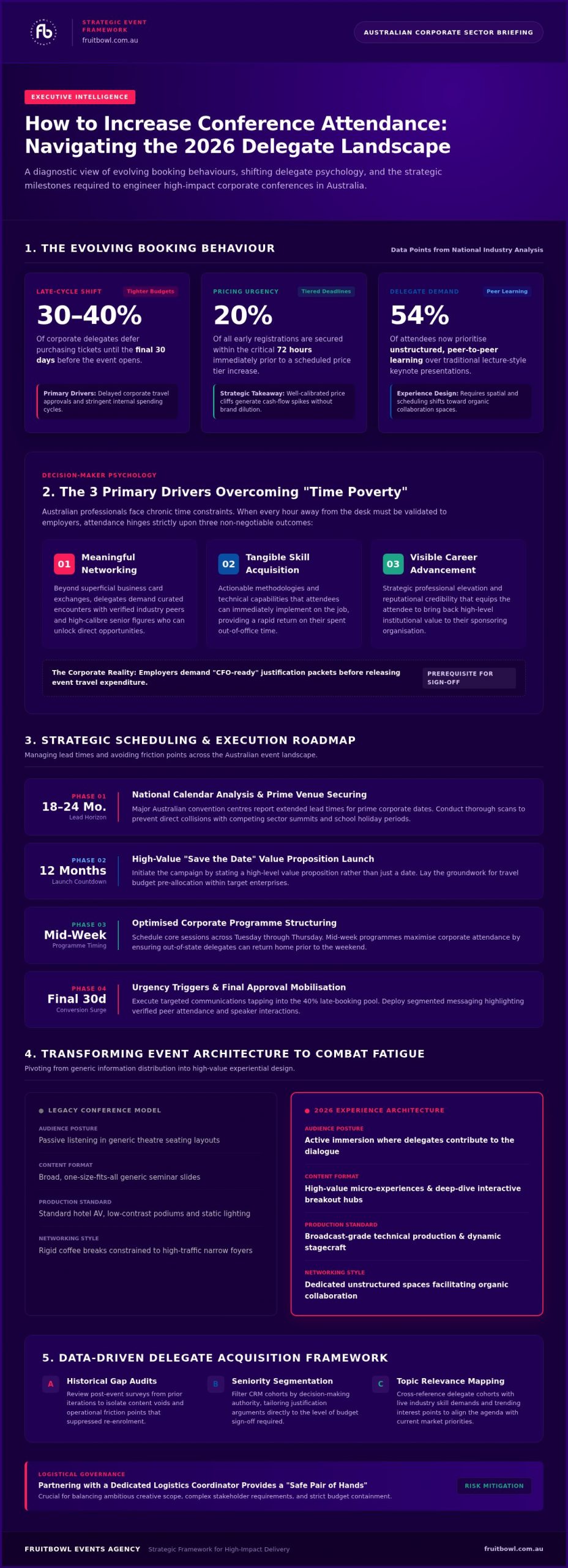
Professional attendance is driven by three primary pillars: meaningful networking, tangible skill acquisition, and visible career advancement. Modern Australian professionals face chronic “time poverty”, meaning every hour spent away from the office must yield a clear return on investment. If the value proposition isn’t immediately apparent, the default response is to decline. By focusing on these psychological drivers, you can develop a robust strategy for how to increase conference attendance that resonates with your core demographic. Social proof plays a critical role here; a reputation for excellence, backed by testimonials from industry peers, acts as a powerful reassurance for new registrants who are hesitant to commit their limited time.
Conducting Data-Driven Audience Research
Success is rarely accidental. It’s engineered through meticulous data analysis. Start by reviewing post-event surveys from previous years to pinpoint content gaps or logistical friction points that may have deterred past attendees. Segmenting your CRM data by industry seniority allows for more personalised outreach, ensuring the right message reaches the right decision-maker. You can map delegate interests by cross-referencing your registration list with LinkedIn’s “Skills” and “Interests” analytics to identify trending topics within your specific industry niche. This granular approach ensures your programme aligns perfectly with current market demands while respecting the 54% of delegates who now prioritise unstructured, peer-to-peer learning over traditional keynote sessions.
Strategic Scheduling and Venue Selection
Selecting the right dates and location is a logistical cornerstone that dictates your registration trajectory. In the Australian market, where travel distances are vast, scheduling requires a methodical approach to avoid industry clashes. You must analyse the national event calendar 18 to 24 months in advance, as major convention centres now report significantly longer lead times for prime dates. Finding the “Goldilocks” timing means avoiding school holidays and major industry-specific summits that compete for the same delegate pool. Mid-week programmes typically maximise attendance for corporate sectors, as they allow travellers to return home before the weekend.
Timing Your Launch for Maximum Impact
A 12-month countdown is essential for high-stakes conferences. Your initial “Save the Date” campaign shouldn’t merely state a date; it must articulate a high-level value proposition that justifies travel expenses. Research suggests that while 30% to 40% of delegates defer booking until the final 30 days, 20% of early registrations occur within 72 hours of a tiered price increase. Mastering these urgency triggers is a core component of how to increase conference attendance without devaluing your brand through excessive discounting. Identifying these windows allows for a more predictable cash flow and provides a steady pulse to your marketing efforts.
Venue Logistics and Delegate Friction
The allure of a premium venue must be balanced with physical accessibility. Delegates often prioritising unstructured learning require environments that facilitate organic interaction. For interstate travellers, proximity to major transport hubs and integrated hotel campuses is non-negotiable. Reducing friction is paramount. A venue that’s difficult to reach leads to higher attrition rates. Ensure the space supports sophisticated av management for events to deliver the immersive experience modern audiences expect. Data from the U.S. Bureau of Labor Statistics confirms that the logistical coordination of these moving parts is a specialised skill that directly impacts event success. Partnering with a team that offers comprehensive event management ensures these details are handled with precision.
Personalised Marketing and Tiered Pricing Models
Effective marketing in 2026 requires a departure from the “one-size-fits-all” email blast. Modern delegates are inundated with digital noise; therefore, your outreach must be segmented and value-driven to capture attention. A sophisticated strategist understands that how to increase conference attendance involves mapping a personalised journey that begins long before the registration page. By leveraging your speakers and sponsors as brand ambassadors, you tap into established networks of trust. Content marketing, particularly broadcast-grade teaser videos and technical whitepapers, serves to establish the event’s authority and build the anticipation necessary to secure early commitment.
Designing the Personalised Delegate Journey
The journey from initial awareness to final confirmation must be frictionless and logical. You should map every touchpoint, utilising retargeting ads to re-engage professionals who visited your site but did not convert. These ads should offer new value, such as a “Top 5 Learning Outcomes” PDF, rather than just a reminder to buy. Email sequences should be automated based on delegate seniority and industry niche, providing specific reasons why the event is a “must-attend” for their particular role. Given that 30% to 40% of delegates now defer purchasing until the final 30 days, these sequences must maintain a steady pulse of engagement to stay top-of-mind during the critical decision-making window.
Pricing Strategies that Drive Commitment
Traditional two-stage pricing has been replaced by more dynamic, multi-tiered models. We recommend implementing four to five micro-tiers, such as “Super Early Bird”, “Team Bundles”, and “Late Dynamic Pricing”. Data confirms that 20% of early registrations occur within the 72-hour window preceding a price increase; this urgency is a powerful tool for managing cash flow. To further drive commitment, provide “CFO-ready” justification packets on your landing page. These downloadable kits, containing cost-benefit breakdowns and learning outcomes, help delegates secure employer approval. Group discounts encourage organisations to send entire teams, while a premium “VIP” tier offering exclusive expert access can protect your margins and enhance the event’s elite status.
Engineering ‘FOMO’ Through Technical and Creative Excellence
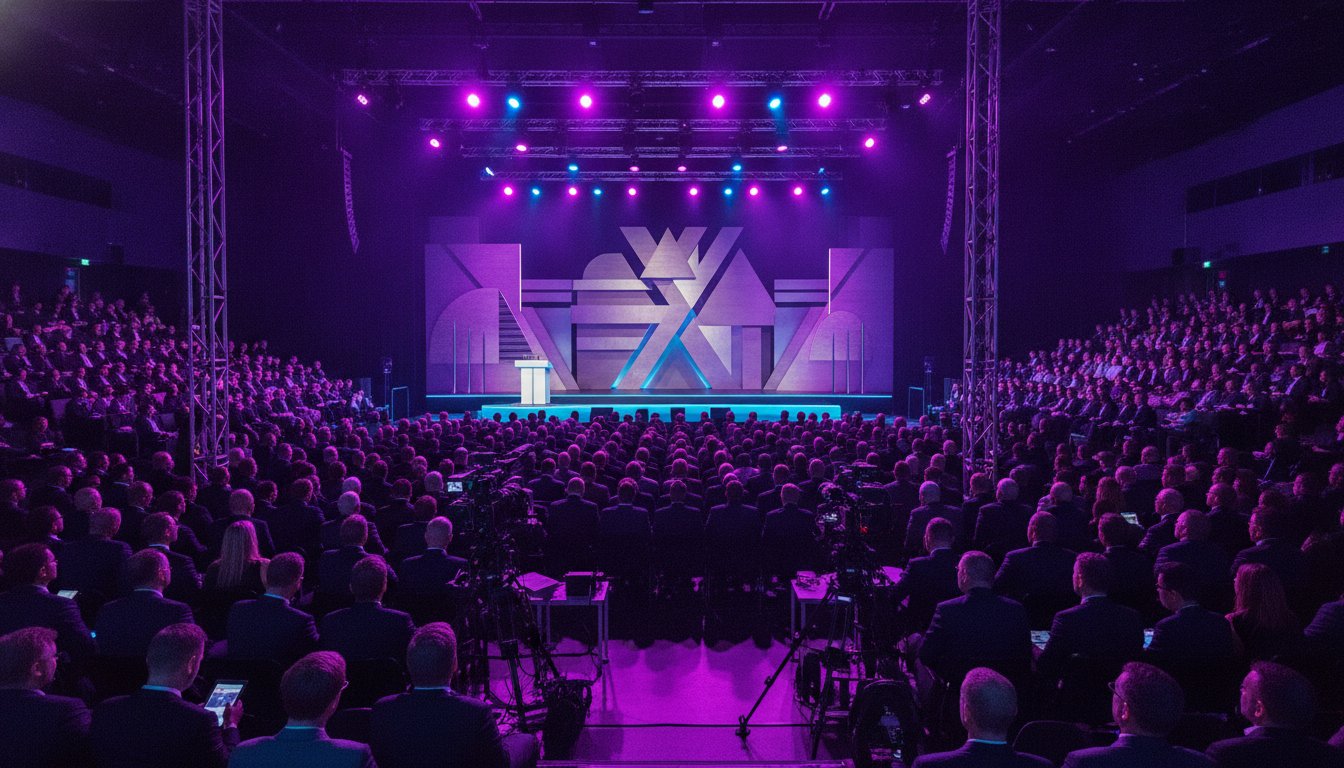
Technical production value serves as one of your most potent marketing assets. In an age where digital content is ubiquitous, the physical environment of your event must offer a level of sensory engagement that cannot be replicated on a screen. High-impact technical execution creates a sense of “Fear Of Missing Out” (FOMO) that ripples through industry networks. When delegates experience broadcast-grade staging, spatial audio, and immersive visual displays, they don’t just consume information; they participate in a landmark event. This reputation for excellence is a primary driver in how to increase conference attendance for future cycles, as it builds a legacy of quality that justifies the delegate’s investment of time and travel.
Interactivity is the antidote to the passive “lecture” format that often leads to attrition. Incorporating live polling, real-time Q&A, and strategic gamification ensures the audience remains cognitively invested. These elements should be managed with professional technical direction to maintain a seamless flow. A disjointed transition or a failed microphone can immediately break the immersive “spell”, undermining the event’s authority. By ensuring every moving part is under expert supervision, you provide a sense of security that allows delegates to focus entirely on the content and their peers.
The Role of AV in Delegate Satisfaction
Precision in audio-visual delivery is essential for preventing “conference fatigue”. Crystal-clear sound and dynamic lighting schemes are not mere aesthetic choices; they are functional tools that manage the energy of the room. High-impact visual displays make sessions memorable and provide the “Instagrammable” moments that drive organic social proof across professional networks. Additionally, the integration of remote speakers must be handled via high-quality, low-latency broadcast links. A flawless hybrid connection ensures that your programme remains global in scope without the technical hitches that can frustrate a live audience.
Creative Programming and Talent Procurement
The speaker line-up must offer exclusive, non-Googleable insights to remain competitive. Sourcing industry disruptors rather than “circuit regulars” ensures your content feels fresh and urgent. Creative programming also involves designing breakout sessions that facilitate genuine peer-to-peer networking, respecting the 54% of delegates who prioritise unstructured learning. Managing the technical rider for each talent is a critical logistical task. Ensuring their specific AV requirements are met allows them to deliver their best possible performance, further enhancing the event’s reputation. To ensure your next event benefits from this level of technical and creative oversight, partner with an expert conference logistics team today.
Partnering with a Conference Logistics Coordinator
Managing the multifaceted requirements of a national conference requires a level of logistical precision that often exceeds internal capacity. A professional agency provides a centralised point of control, managing everything from complex stakeholder liaison to rigorous budget oversight. This end-to-end methodology ensures that the creative vision established in the planning phase is executed without compromise. By delegating these responsibilities, you secure a “safe pair of hands” capable of navigating unforeseen challenges with composure and expertise. This strategic oversight is a fundamental component in your plan for how to increase conference attendance, as it guarantees the high-quality delivery that delegates now demand.
Compliance and safety remain non-negotiable pillars of modern event delivery. A dedicated coordinator ensures that every facet of the programme meets stringent national standards, from technical rigging safety to venue capacity regulations. This meticulous attention to detail provides a sense of security to the organising body, ensuring that every risk is mitigated before it can impact the delegate experience. When every detail is under expert supervision, the organisers can focus on high-level strategy and stakeholder engagement rather than being consumed by operational minutiae.
Streamlining the Registration and On-site Experience
The initial interaction at the venue sets the tone for the entire event. A disjointed check-in process can quickly erode the excitement generated by your marketing efforts. Professional conference management teams utilise seamless check-in systems and on-demand badge printing to eliminate queues and reduce friction. The Zero-Friction check-in goal for 2026 focuses on a sub-sixty-second transition from the venue threshold to the session floor. This efficiency demonstrates a respect for the delegate’s time, reinforcing the event’s professional standing and encouraging positive word-of-mouth for future years.
Why Fruitbowl is the Strategic Choice
With 30 years of expertise by 2026, Fruitbowl Events Agency has navigated every possible challenge in the high-stakes corporate and government sectors. We combine creative ambition with technical direction to create high-impact experiences that align perfectly with your brand objectives. Our end-to-end methodology covers everything from strategic planning and talent procurement to on-site execution. We position ourselves as a reliable partner that brings order and clarity to complex environments. When you seek a methodology for how to increase conference attendance, our seasoned expertise ensures your event is remembered for its flawless delivery and measurable success.
Securing Your Event’s Legacy in 2026
Success in the competitive event landscape requires more than just a relevant programme. It demands a sophisticated integration of creative vision and logistical precision. By shifting your focus toward high-value micro-experiences and reducing delegate friction through seamless on-site delivery, you create an environment that justifies the investment of time and travel. Engineering a sense of urgency through broadcast-grade technical production ensures your event isn’t just attended, but remembered across professional networks.
Mastering how to increase conference attendance is ultimately about building trust through consistent, high-quality execution. This level of detail requires a partner who acts as a reliable guide through complex, high-stakes environments. With 30 years of industry-leading expertise, Fruitbowl Events Agency provides the end-to-end strategic oversight and high-stakes technical production necessary to deliver a flawless result. We invite you to partner with Fruitbowl to elevate your next conference and ensure every detail is under expert supervision. Your mission’s success is our priority, and we’re ready to provide the frictionless experience your delegates deserve.
Frequently Asked Questions
How far in advance should I start promoting my conference?
Promotion should commence approximately 12 months before the event date to establish the core value proposition. This long-term approach allows you to navigate the 18 to 24-month venue lead times currently required in the national market. By announcing dates early, you mitigate the risk of industry clashes and give delegates sufficient time to secure employer travel approvals and budget releases before the final 30-day registration surge.
What is a good conversion rate for conference registration pages?
While conversion rates vary by sector, paid tiered registrations typically achieve an attendance conversion of 90% to 97%. To optimise your registration page, provide downloadable justification packets that help delegates prove event value to their managers. This strategy addresses the primary question of how to increase conference attendance by removing the administrative hurdles that often prevent final ticket purchases in a high-stakes corporate environment.
How can I increase conference attendance if my budget is limited?
Strategic partnerships are the most effective way to drive registrations on a limited budget. You can leverage your speakers and sponsors as brand ambassadors to tap into their existing professional networks. Utilising low-cost content marketing, such as industry whitepapers or short teaser videos, establishes authority and builds anticipation. This methodology focuses on how to increase conference attendance through organic trust rather than expensive advertising campaigns.
Does the choice of venue really impact registration numbers?
Venue selection is a critical factor that directly influences your registration trajectory. Delegates prioritise convenience; therefore, proximity to major transport hubs and integrated hotel campuses is essential for reducing friction. A venue that’s difficult to access or lacks professional technical infrastructure will often see higher attrition rates among interstate travellers who are wary of time poverty and expect a seamless logistical experience.
How do I use social media effectively to drive event ticket sales?
Social media should be used as a precision tool for re-engagement rather than just broad broadcasting. Implementing retargeting ads allows you to reach professionals who visited your registration page but didn’t complete their booking. Mapping delegate interests through LinkedIn analytics ensures your content remains relevant to the specific seniority levels you’re targeting, ensuring your marketing spend is directed toward the most likely converts.
What are the most effective incentives for early-bird registrations?
Urgency-driven pricing models remain the most effective incentive for securing early commitment. Implementing four to five micro-tiers, rather than a single early-bird window, creates multiple conversion spurts throughout the campaign. Data shows that 20% of early registrations occur in the 72-hour window directly preceding a price increase, confirming that clear deadlines and tangible savings are powerful drivers of delegate action.
How can I re-engage past attendees who haven’t registered this year?
Re-engaging past attendees requires a personalised, data-driven approach. Instead of generic reminders, send automated email sequences that highlight specific learning outcomes tailored to their industry niche. Providing exclusive alumni access to VIP tracks or meet-the-expert sessions can also reignite interest. This approach reinforces the event’s reputation for providing high-value professional development and peer-to-peer networking that justifies the cost of attendance.
What role does AV production play in delegate retention for future events?
Audio-visual excellence is a primary driver of delegate retention and future registrations. Professional technical direction prevents conference fatigue and ensures the programme moves with a steady, predictable pulse. High-impact visual production also generates the organic social proof and “Instagrammable” moments that create FOMO. This makes your event a landmark in the national corporate calendar, ensuring delegates return year after year.
Did you know that up to 40% of corporate delegates now wait until the final 30 days before an event to purchase their tickets? This shift in booking behaviour, driven by tighter budget cycles and delayed travel approvals, has made the question of how to increase conference attendance more complex than ever. You’re likely facing the dual pressure of declining early registrations and the constant need to prove tangible value to both sponsors and a more discerning workforce. It’s a high-stakes environment where traditional marketing alone often falls short of the mark.
We understand that a successful event requires a meticulous balance of creative ambition and logistical precision. This guide offers a proven framework for driving registrations and engineering an unmissable delegate experience within the competitive Australian event landscape. We’ll examine the strategic move toward high-value micro-experiences, the importance of unstructured networking, and how to provide the “CFO-ready” justification packets that modern employers demand. By the end of this article, you’ll have a repeatable methodology to transform your conference into a landmark event that secures early commitment and delivers measurable results.
Key Takeaways
- Understand why 2026 delegates are deferring registrations and how to combat “event fatigue” by pivoting from broad seminars to high-value micro-experiences.
- Identify the ideal timing and venue selection strategies that prevent calendar clashes and ensure your event remains the primary focus for your sector.
- Master sophisticated tiered pricing and segmented marketing journeys to discover exactly how to increase conference attendance through urgency and personalised engagement.
- Elevate your event’s perceived value by integrating broadcast-grade technical production and interactive elements that transform a standard keynote into an unmissable experience.
- Learn how partnering with an experienced logistics coordinator provides a “safe pair of hands” to manage complex stakeholder requirements and protect your event budget.
Understanding the 2026 Delegate: Why Attendance Metrics are Shifting
The metric for success has evolved beyond simple headcount. In 2026, the “Experience Economy” dictates that professional seminars must provide more than information; they must offer transformation. Understanding how to increase conference attendance starts with recognising that your audience is no longer satisfied with passive listening. They seek immersive environments where they can actively contribute to the conversation. This shift is a direct response to the “event fatigue” currently impacting national conferences, where generic programmes fail to compete with the high-value digital content available daily.
To cut through the noise, organisers must pivot from being content distributors to experience architects. High-stakes delivery requires a blend of creative vision and logistical precision. By employing established event management frameworks, you create a structured environment that feels effortless to the attendee. This level of professional corporate event management secures delegate trust, ensuring they feel their time and investment are under expert supervision.
The Psychology of Attendance
Professional attendance is driven by three primary pillars: meaningful networking, tangible skill acquisition, and visible career advancement. Modern Australian professionals face chronic “time poverty”, meaning every hour spent away from the office must yield a clear return on investment. If the value proposition isn’t immediately apparent, the default response is to decline. By focusing on these psychological drivers, you can develop a robust strategy for how to increase conference attendance that resonates with your core demographic. Social proof plays a critical role here; a reputation for excellence, backed by testimonials from industry peers, acts as a powerful reassurance for new registrants who are hesitant to commit their limited time.
Conducting Data-Driven Audience Research
Success is rarely accidental. It’s engineered through meticulous data analysis. Start by reviewing post-event surveys from previous years to pinpoint content gaps or logistical friction points that may have deterred past attendees. Segmenting your CRM data by industry seniority allows for more personalised outreach, ensuring the right message reaches the right decision-maker. You can map delegate interests by cross-referencing your registration list with LinkedIn’s “Skills” and “Interests” analytics to identify trending topics within your specific industry niche. This granular approach ensures your programme aligns perfectly with current market demands while respecting the 54% of delegates who now prioritise unstructured, peer-to-peer learning over traditional keynote sessions.
Strategic Scheduling and Venue Selection
Selecting the right dates and location is a logistical cornerstone that dictates your registration trajectory. In the Australian market, where travel distances are vast, scheduling requires a methodical approach to avoid industry clashes. You must analyse the national event calendar 18 to 24 months in advance, as major convention centres now report significantly longer lead times for prime dates. Finding the “Goldilocks” timing means avoiding school holidays and major industry-specific summits that compete for the same delegate pool. Mid-week programmes typically maximise attendance for corporate sectors, as they allow travellers to return home before the weekend.
Timing Your Launch for Maximum Impact
A 12-month countdown is essential for high-stakes conferences. Your initial “Save the Date” campaign shouldn’t merely state a date; it must articulate a high-level value proposition that justifies travel expenses. Research suggests that while 30% to 40% of delegates defer booking until the final 30 days, 20% of early registrations occur within 72 hours of a tiered price increase. Mastering these urgency triggers is a core component of how to increase conference attendance without devaluing your brand through excessive discounting. Identifying these windows allows for a more predictable cash flow and provides a steady pulse to your marketing efforts.
Venue Logistics and Delegate Friction
The allure of a premium venue must be balanced with physical accessibility. Delegates often prioritising unstructured learning require environments that facilitate organic interaction. For interstate travellers, proximity to major transport hubs and integrated hotel campuses is non-negotiable. Reducing friction is paramount. A venue that’s difficult to reach leads to higher attrition rates. Ensure the space supports sophisticated av management for events to deliver the immersive experience modern audiences expect. Data from the U.S. Bureau of Labor Statistics confirms that the logistical coordination of these moving parts is a specialised skill that directly impacts event success. Partnering with a team that offers comprehensive event management ensures these details are handled with precision.
Personalised Marketing and Tiered Pricing Models
Effective marketing in 2026 requires a departure from the “one-size-fits-all” email blast. Modern delegates are inundated with digital noise; therefore, your outreach must be segmented and value-driven to capture attention. A sophisticated strategist understands that how to increase conference attendance involves mapping a personalised journey that begins long before the registration page. By leveraging your speakers and sponsors as brand ambassadors, you tap into established networks of trust. Content marketing, particularly broadcast-grade teaser videos and technical whitepapers, serves to establish the event’s authority and build the anticipation necessary to secure early commitment.
Designing the Personalised Delegate Journey
The journey from initial awareness to final confirmation must be frictionless and logical. You should map every touchpoint, utilising retargeting ads to re-engage professionals who visited your site but did not convert. These ads should offer new value, such as a “Top 5 Learning Outcomes” PDF, rather than just a reminder to buy. Email sequences should be automated based on delegate seniority and industry niche, providing specific reasons why the event is a “must-attend” for their particular role. Given that 30% to 40% of delegates now defer purchasing until the final 30 days, these sequences must maintain a steady pulse of engagement to stay top-of-mind during the critical decision-making window.
Pricing Strategies that Drive Commitment
Traditional two-stage pricing has been replaced by more dynamic, multi-tiered models. We recommend implementing four to five micro-tiers, such as “Super Early Bird”, “Team Bundles”, and “Late Dynamic Pricing”. Data confirms that 20% of early registrations occur within the 72-hour window preceding a price increase; this urgency is a powerful tool for managing cash flow. To further drive commitment, provide “CFO-ready” justification packets on your landing page. These downloadable kits, containing cost-benefit breakdowns and learning outcomes, help delegates secure employer approval. Group discounts encourage organisations to send entire teams, while a premium “VIP” tier offering exclusive expert access can protect your margins and enhance the event’s elite status.
Engineering ‘FOMO’ Through Technical and Creative Excellence
Technical production value serves as one of your most potent marketing assets. In an age where digital content is ubiquitous, the physical environment of your event must offer a level of sensory engagement that cannot be replicated on a screen. High-impact technical execution creates a sense of “Fear Of Missing Out” (FOMO) that ripples through industry networks. When delegates experience broadcast-grade staging, spatial audio, and immersive visual displays, they don’t just consume information; they participate in a landmark event. This reputation for excellence is a primary driver in how to increase conference attendance for future cycles, as it builds a legacy of quality that justifies the delegate’s investment of time and travel.
Interactivity is the antidote to the passive “lecture” format that often leads to attrition. Incorporating live polling, real-time Q&A, and strategic gamification ensures the audience remains cognitively invested. These elements should be managed with professional technical direction to maintain a seamless flow. A disjointed transition or a failed microphone can immediately break the immersive “spell”, undermining the event’s authority. By ensuring every moving part is under expert supervision, you provide a sense of security that allows delegates to focus entirely on the content and their peers.
The Role of AV in Delegate Satisfaction
Precision in audio-visual delivery is essential for preventing “conference fatigue”. Crystal-clear sound and dynamic lighting schemes are not mere aesthetic choices; they are functional tools that manage the energy of the room. High-impact visual displays make sessions memorable and provide the “Instagrammable” moments that drive organic social proof across professional networks. Additionally, the integration of remote speakers must be handled via high-quality, low-latency broadcast links. A flawless hybrid connection ensures that your programme remains global in scope without the technical hitches that can frustrate a live audience.
Creative Programming and Talent Procurement
The speaker line-up must offer exclusive, non-Googleable insights to remain competitive. Sourcing industry disruptors rather than “circuit regulars” ensures your content feels fresh and urgent. Creative programming also involves designing breakout sessions that facilitate genuine peer-to-peer networking, respecting the 54% of delegates who prioritise unstructured learning. Managing the technical rider for each talent is a critical logistical task. Ensuring their specific AV requirements are met allows them to deliver their best possible performance, further enhancing the event’s reputation. To ensure your next event benefits from this level of technical and creative oversight, partner with an expert conference logistics team today.
Partnering with a Conference Logistics Coordinator
Managing the multifaceted requirements of a national conference requires a level of logistical precision that often exceeds internal capacity. A professional agency provides a centralised point of control, managing everything from complex stakeholder liaison to rigorous budget oversight. This end-to-end methodology ensures that the creative vision established in the planning phase is executed without compromise. By delegating these responsibilities, you secure a “safe pair of hands” capable of navigating unforeseen challenges with composure and expertise. This strategic oversight is a fundamental component in your plan for how to increase conference attendance, as it guarantees the high-quality delivery that delegates now demand.
Compliance and safety remain non-negotiable pillars of modern event delivery. A dedicated coordinator ensures that every facet of the programme meets stringent national standards, from technical rigging safety to venue capacity regulations. This meticulous attention to detail provides a sense of security to the organising body, ensuring that every risk is mitigated before it can impact the delegate experience. When every detail is under expert supervision, the organisers can focus on high-level strategy and stakeholder engagement rather than being consumed by operational minutiae.
Streamlining the Registration and On-site Experience
The initial interaction at the venue sets the tone for the entire event. A disjointed check-in process can quickly erode the excitement generated by your marketing efforts. Professional conference management teams utilise seamless check-in systems and on-demand badge printing to eliminate queues and reduce friction. The Zero-Friction check-in goal for 2026 focuses on a sub-sixty-second transition from the venue threshold to the session floor. This efficiency demonstrates a respect for the delegate’s time, reinforcing the event’s professional standing and encouraging positive word-of-mouth for future years.
Why Fruitbowl is the Strategic Choice
With 30 years of expertise by 2026, Fruitbowl Events Agency has navigated every possible challenge in the high-stakes corporate and government sectors. We combine creative ambition with technical direction to create high-impact experiences that align perfectly with your brand objectives. Our end-to-end methodology covers everything from strategic planning and talent procurement to on-site execution. We position ourselves as a reliable partner that brings order and clarity to complex environments. When you seek a methodology for how to increase conference attendance, our seasoned expertise ensures your event is remembered for its flawless delivery and measurable success.
Securing Your Event’s Legacy in 2026
Success in the competitive event landscape requires more than just a relevant programme. It demands a sophisticated integration of creative vision and logistical precision. By shifting your focus toward high-value micro-experiences and reducing delegate friction through seamless on-site delivery, you create an environment that justifies the investment of time and travel. Engineering a sense of urgency through broadcast-grade technical production ensures your event isn’t just attended, but remembered across professional networks.
Mastering how to increase conference attendance is ultimately about building trust through consistent, high-quality execution. This level of detail requires a partner who acts as a reliable guide through complex, high-stakes environments. With 30 years of industry-leading expertise, Fruitbowl Events Agency provides the end-to-end strategic oversight and high-stakes technical production necessary to deliver a flawless result. We invite you to partner with Fruitbowl to elevate your next conference and ensure every detail is under expert supervision. Your mission’s success is our priority, and we’re ready to provide the frictionless experience your delegates deserve.
Frequently Asked Questions
How far in advance should I start promoting my conference?
Promotion should commence approximately 12 months before the event date to establish the core value proposition. This long-term approach allows you to navigate the 18 to 24-month venue lead times currently required in the national market. By announcing dates early, you mitigate the risk of industry clashes and give delegates sufficient time to secure employer travel approvals and budget releases before the final 30-day registration surge.
What is a good conversion rate for conference registration pages?
While conversion rates vary by sector, paid tiered registrations typically achieve an attendance conversion of 90% to 97%. To optimise your registration page, provide downloadable justification packets that help delegates prove event value to their managers. This strategy addresses the primary question of how to increase conference attendance by removing the administrative hurdles that often prevent final ticket purchases in a high-stakes corporate environment.
How can I increase conference attendance if my budget is limited?
Strategic partnerships are the most effective way to drive registrations on a limited budget. You can leverage your speakers and sponsors as brand ambassadors to tap into their existing professional networks. Utilising low-cost content marketing, such as industry whitepapers or short teaser videos, establishes authority and builds anticipation. This methodology focuses on how to increase conference attendance through organic trust rather than expensive advertising campaigns.
Does the choice of venue really impact registration numbers?
Venue selection is a critical factor that directly influences your registration trajectory. Delegates prioritise convenience; therefore, proximity to major transport hubs and integrated hotel campuses is essential for reducing friction. A venue that’s difficult to access or lacks professional technical infrastructure will often see higher attrition rates among interstate travellers who are wary of time poverty and expect a seamless logistical experience.
How do I use social media effectively to drive event ticket sales?
Social media should be used as a precision tool for re-engagement rather than just broad broadcasting. Implementing retargeting ads allows you to reach professionals who visited your registration page but didn’t complete their booking. Mapping delegate interests through LinkedIn analytics ensures your content remains relevant to the specific seniority levels you’re targeting, ensuring your marketing spend is directed toward the most likely converts.
What are the most effective incentives for early-bird registrations?
Urgency-driven pricing models remain the most effective incentive for securing early commitment. Implementing four to five micro-tiers, rather than a single early-bird window, creates multiple conversion spurts throughout the campaign. Data shows that 20% of early registrations occur in the 72-hour window directly preceding a price increase, confirming that clear deadlines and tangible savings are powerful drivers of delegate action.
How can I re-engage past attendees who haven’t registered this year?
Re-engaging past attendees requires a personalised, data-driven approach. Instead of generic reminders, send automated email sequences that highlight specific learning outcomes tailored to their industry niche. Providing exclusive alumni access to VIP tracks or meet-the-expert sessions can also reignite interest. This approach reinforces the event’s reputation for providing high-value professional development and peer-to-peer networking that justifies the cost of attendance.
What role does AV production play in delegate retention for future events?
Audio-visual excellence is a primary driver of delegate retention and future registrations. Professional technical direction prevents conference fatigue and ensures the programme moves with a steady, predictable pulse. High-impact visual production also generates the organic social proof and “Instagrammable” moments that create FOMO. This makes your event a landmark in the national corporate calendar, ensuring delegates return year after year.
OUR BLOG
Event Insights & Expertise
Our blog is your go-to resource for all things events. From expert insights and the latest industry trends to practical planning tips, we share everything you need to deliver standout experiences.
Contact Us