Booking Corporate Event Entertainment: 2026 Strategic Guide

What if the act that looks perfect on paper is the wrong choice for the room? Booking entertainment for corporate events is about more than securing a performer. The right choice should suit your audience, reinforce your brand and work within the event’s technical and budget requirements.

It’s reasonable to worry about an act falling flat, complex rider requirements disrupting the schedule or unexpected logistics costs stretching the budget. These risks are easier to manage when talent selection and technical planning are treated as connected parts of the same process.

This guide will help you assess entertainment against your event objectives, brief and compare talent, and account for technical requirements before they become last-minute issues. You’ll also learn how clear procurement and rider management can support a polished performance and a more controlled budget.

With over 28 years of industry experience, Fruitbowl Events Agency supports complex event logistics, including talent procurement and technical rider management. The sections ahead set out a practical path from defining the brief to coordinating the details, so your entertainment can make the right impression on the day.

Booking entertainment for corporate events: start with the brief

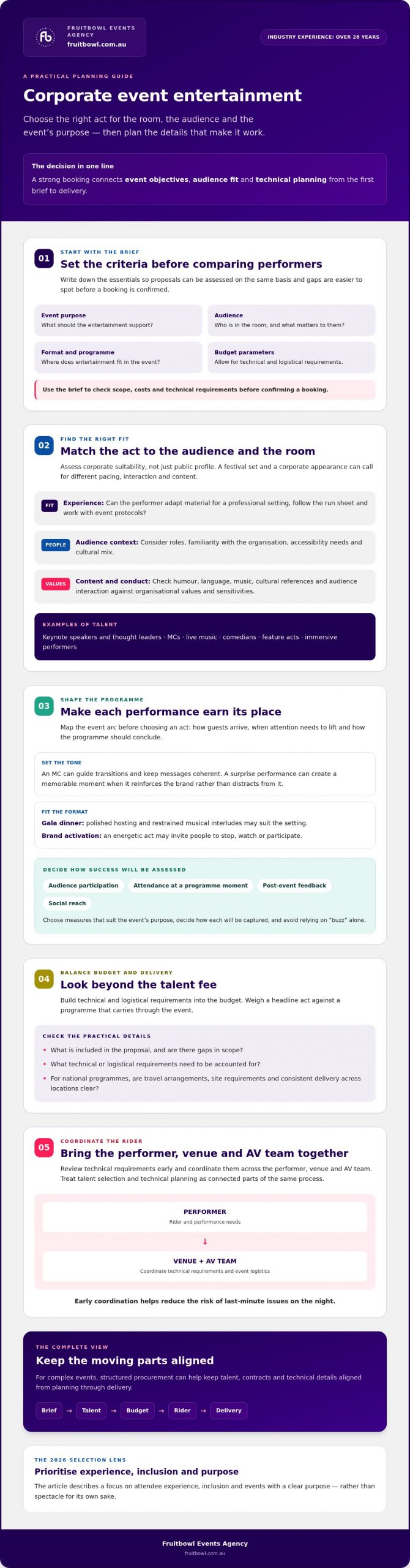
Before comparing performers, write down the event’s purpose, audience, format, budget parameters and the role entertainment should play. This makes it easier to assess proposals on the same basis and spot gaps in scope, costs or technical requirements before confirming a booking.

Key Takeaways

  • Make entertainment part of your brand story by matching each act to your event’s objectives and audience.
  • When booking entertainment for corporate events, assess performers for their suitability for corporate audiences, not just their public profile.
  • Set a budget that accounts for technical and logistical requirements, then weigh a headline act against a programme that carries through the event.
  • Review the technical rider early and coordinate requirements across the performer, venue and AV team to reduce the risk of on-the-night issues.
  • For complex events, structured procurement can help keep talent, contracts and technical details aligned from planning through delivery.

Strategic Programming: Aligning Entertainment with Brand Objectives

Entertainment should do more than fill a gap in the run sheet. It can express what an organisation values, shape how guests experience the event and reinforce the message they take away. To book entertainment that supports your corporate event, start with the business objective, then select talent and performance moments that serve it.

Strategic programming means integrating talent into a broader corporate event management framework, with each performance planned around the event’s purpose and audience experience. This reflects the wider scope of event management, where individual elements need to work together from planning through execution.

The Role of Entertainment in Corporate Strategy

Map the event arc before choosing an act. Consider how guests arrive, when attention needs to lift and how the programme should conclude. An MC can set a professional tone, guide transitions and keep messages coherent. A surprise performance may create a memorable moment, but it should reinforce the brand rather than distract from it. Possible outcomes include stronger audience participation, a clear association with a brand value or content guests are motivated to share.

Set practical KPIs before briefing talent. Depending on the event’s purpose, these could include audience participation, attendance at a particular programme moment, post-event feedback or social reach. Decide how each measure will be captured, and avoid relying on “buzz” alone as evidence of success.

Defining Your Event Tone and Audience Profile

Build the brief around your audience’s professional and cultural context. Consider their roles, familiarity with the organisation, accessibility needs and the mix of backgrounds represented. Review feedback from previous events and expectations within your industry, but don’t assume every audience responds in the same way. Check humour, language, music and cultural references for sensitivities before confirming an act.

Finally, test the concept against your organisation’s values and corporate social responsibility commitments. Ask whether the performer’s material, presentation and proposed audience interaction align with the standards your organisation wants to demonstrate. This helps ensure the entertainment feels considered, not simply added to the programme.

The Australian Talent Landscape: Selection Criteria for 2026

Corporate entertainment options in Australia include keynote speakers, live music, comedy and immersive performers. In 2026, the emphasis is on attendee experience, inclusion and events with a clear purpose, rather than spectacle for its own sake. That makes the selection brief critical: the act needs to suit the audience, event objective and setting.

Assess performers for corporate experience, not just public appeal. A festival set and a corporate appearance may call for different pacing, audience interaction and content. Ask how a performer adapts their material for professional settings, follows a run sheet and works with event protocols. For national programmes, clarify travel arrangements, site requirements and how the performance will be delivered consistently across locations.

Keynote Speakers and Thought Leaders

Choose a speaker who can offer relevant insight and an engaging delivery. Review their experience with audiences like yours, the substance of their proposed topic and how it supports the event’s objectives. A pre-event briefing gives the speaker context on company priorities, audience knowledge and any messages to handle with care. It also helps the event team plan a considered transition from formal presentations to lighter entertainment, rather than leaving a change in tone to chance.

Live Music, Comedians, and Feature Acts

A high-profile recording artist may offer strong audience recognition, while a specialist corporate band may be able to tailor repertoire and performance style to the event. Compare the likely impact with the practical requirements: schedule, audience fit, venue and technical needs. For comedians, review material and agree on boundaries in advance. Humour that succeeds in a public show may not suit a particular workplace or a diverse audience.

Roving and immersive performers can encourage interaction at cocktail functions and brand activations, especially where guests move between spaces. Confirm how the act will engage attendees without interrupting conversations, presentations or access routes. Versatility matters across all formats. Ask how the performer can adjust if the schedule shifts or audience energy changes, and agree on the approach before the event.

For conferences, festivals and government activations delivered across Australia, talent selection also needs to account for local context and practical coordination at each site. A consistent brief helps protect the audience experience while allowing appropriate flexibility. If you’re assessing options for a national corporate programme, Fruitbowl’s corporate event experience may be a useful reference point.

The Selection Framework: Balancing Budget and Engagement

A strong entertainment plan balances audience impact with the full cost of delivery. When booking entertainment for corporate events, compare options on more than the talent fee. Travel, accommodation, per diems, production requirements and schedule changes can all affect the final spend. A clear budget makes trade-offs visible before a contract is signed.

Decide what the entertainment needs to achieve, then compare formats against that outcome. A high-profile act may create a prominent focal point, while several performers across the evening can sustain energy at different moments. Neither approach is automatically better. Consider how long the programme runs, how guests will move through it and whether one defining moment or consistent engagement best serves the event.

Establishing a Realistic Entertainment Budget

Build a cost plan that separates the talent fee from associated delivery requirements. For national-level talent, confirm who is responsible for travel, accommodation and per diems, and whether those arrangements are included in the proposal. Review the technical rider for equipment, staging, sound, lighting and power needs, then coordinate those requirements with the venue and production team.

Set aside a contingency for rider requirements or reasonable changes to the event plan. Compare proposals on the same basis by checking what each includes, excludes and assumes. Strategic corporate event management services can support structured procurement, including negotiations that clarify scope and commercial terms. Any savings depend on the brief and agreement, so assess the full value rather than assuming a lower fee means a lower overall cost.

Contract Negotiation and Transparency

A professional procurement process helps make responsibilities and expectations clear. Before confirming a booking, review the agreement for:

  • Cancellation and force majeure: Understand the options, notice requirements and financial implications if circumstances affect the event or performance.
  • Performance standards: Confirm the act, set length, schedule, arrival and sound-check arrangements, plus any agreed substitutions or changes.
  • Rights and permissions: Define whether the organisation can record, photograph, livestream or reuse any part of the performance, and on what terms.
  • Additional appearances: Specify whether meet-and-greets, interviews or social media posts are included, optional or outside the agreement.

An agency fee isn’t simply an added line item to weigh against the talent fee. Procurement support can help coordinate negotiations, clarify rider responsibilities and identify delivery risks early. The value lies in informed oversight and fewer unresolved assumptions, not a promise that every booking will cost less. Clear documentation gives the client, performer and event team a shared understanding of what has been agreed.
Booking Corporate Event Entertainment: 2026 Strategic Guide

Technical Direction: Managing Riders and On-Site Logistics

A confirmed booking is only one part of a successful performance. The artist’s technical rider must be checked against the venue and production plan so that sound, lighting, staging and schedules are compatible. For booking entertainment for corporate events, this coordination helps prevent avoidable surprises, such as an unsuitable stage layout or a sound check that clashes with guest arrival.

A rider sets out a performer’s technical and, where applicable, hospitality requirements. Treat it as essential booking documentation: review it early, clarify any gaps and agree in writing which requirements can be met or adjusted. A technical rider commonly includes a stage plot, input list, monitoring needs, backline, equipment, power and stage specifications. It should inform the production plan, not sit unread until bump-in.

Decoding the Technical Rider

Break the requirements into practical areas. Audio covers microphones, inputs, monitors and sound-system needs. Lighting specifies the look and control required for the performance. Staging covers the platform, layout and equipment positions. Compare each item with what the venue can provide, then confirm who is responsible for supplying, testing and operating any remaining equipment.

Equipment hired separately may not match the performer’s specifications or integrate with the venue’s existing setup. Don’t assume that availability means compatibility. AV management for events connects the rider with the venue’s capabilities and production plan, helping reduce the risk of on-stage failures.

The Importance of a Technical Director

A technical director bridges creative intent and practical delivery. They coordinate the performer, venue and AV team, check technical requirements and keep decisions moving when constraints emerge. For complex events, that oversight can include planning for backup systems, such as spare microphones or an alternative playback source, where appropriate to the act and setup.

Work backwards from the performance time to build the run sheet. Allow for bump-in, equipment setup, line checks, sound checks, rehearsals and a final readiness check, while protecting time for guest-facing programme elements. Coordinate bump-out with venue access conditions and agreed hire periods. A realistic schedule helps limit the risk of overtime charges. Plan sound checks as part of the production schedule rather than squeezing them into guest arrival or another live programme segment.

Fruitbowl’s technical direction and event production services can support coordination between talent requirements and event logistics. Discuss technical direction for your event when planning a performance with detailed production needs.

The End-to-End Advantage: Why Professional Procurement Matters

Entertainment procurement involves more than finding an available act. Talent, contracts, travel, technical requirements and the event schedule all need to align. An event agency can coordinate these connected details and give the client a clear point of contact. That oversight is especially valuable for high-stakes corporate events, festivals and government activations, where changes can affect multiple teams and locations.

National coverage also matters when an event programme spans Australia. A consistent brief and procurement process can help keep expectations aligned across locations. The result isn’t guaranteed, but this approach gives organisers a considered way to manage decisions, protect the event’s objectives and support a polished experience for guests.

Risk Mitigation and Reliability

Live events can be affected by illness, travel disruption or changes to a performer’s circumstances. Before confirming a booking, clarify the relevant contract terms and agree on a practical contingency approach, including who communicates changes and how alternatives would be considered. This preparation helps decision-makers respond with greater clarity if plans need to shift.

Fruitbowl’s over 28 years of industry experience provides a foundation for managing complex event logistics. Its talent procurement work includes contract negotiation and technical rider management, supported by event production and technical direction. Careful planning connects the creative brief with practical requirements, so important details are addressed before event day.

Seamless Integration of Moving Parts

Entertainment needs to sit comfortably within the wider programme. A performance may depend on a room reset, a meal service finishing or formal proceedings reaching a natural pause. A central coordination point can help keep talent requirements, run-sheet updates and communication with other event teams in step, reducing the chance of competing demands disrupting the guest experience.

On site, coordination can help manage performer arrivals, sound checks and technical adjustments in line with the agreed schedule. Across a national programme, clear responsibilities and consistent communication are particularly useful when venues, production teams and performers differ. This joined-up approach supports better use of the entertainment investment: the act has a defined role, the programme feels coherent and the experience can reflect the organisation’s brand with care.

For support with talent procurement and coordinated corporate event delivery, partner with Fruitbowl for your next corporate event.

Plan Entertainment That Delivers on the Night

Effective entertainment starts with a clear purpose. Match talent to your brand, audience and event programme, then assess the full delivery requirements before confirming a booking. A realistic budget, clear contract terms and early review of technical riders can help reduce uncertainty and keep the performance aligned with the event plan.

That’s the value of treating booking entertainment for corporate events as a connected process, not a standalone talent decision. The right procurement and technical coordination can support a more coherent guest experience and a professional impression of your organisation.

Fruitbowl brings over 28 years of industry experience, national reach across Australia and expertise in corporate and government event delivery. Its talent procurement and technical direction capabilities help bring the moving parts into alignment, from contract negotiation to rider management.

Enquire about professional talent procurement for your next event and take the next step towards an event that reflects your brand with care and confidence.

Frequently Asked Questions

How far in advance should I book entertainment for a corporate event?

Book as early as your event brief and approvals allow, particularly if you have a specific performer, date or technical setup in mind. There’s no single lead time that suits every act or event. Availability, contract discussions, travel and production planning can all affect the schedule. Starting early when booking entertainment for corporate events also gives you more time to assess options and coordinate requirements with the venue.

What is a technical rider and why is it important for event planning?

A technical rider is a document that outlines a performer’s production requirements, which may include a stage plot, input list, monitoring, backline, equipment, power and stage specifications. These needs must be checked against the venue and AV plan before event day. Review the rider early, confirm who is supplying each item and resolve any incompatibilities with the performer and production team.

How much does it cost to book a high-profile keynote speaker in Australia?

Fees depend on the speaker’s profile, subject matter, event format and travel requirements, so request a current quote based on your brief. As a planning guide, the research for this article places high-profile and nationally recognised speakers in a broad fee range of $50,000 to $100,000, with celebrity speakers costing more than $100,000. Confirm what the fee includes, such as preparation, travel and any recording or reuse rights.

Can an event agency help with talent that I have already identified?

Yes. An event agency may be able to support procurement for talent you’ve already shortlisted, depending on the agreed scope. Support can include coordinating booking discussions, reviewing contract details and managing technical rider requirements. Share the performer’s details, your event brief and any existing correspondence early. Confirm responsibilities in writing, including who will liaise with the talent and coordinate requirements with the venue and AV team.

What happens if the booked performer cannot attend due to an emergency?

The next steps depend on the contract and the circumstances. Check the cancellation, substitution and force majeure terms before confirming the booking, and clarify who will contact you if plans change. An agency can help communicate with the performer and explore alternatives, but a replacement isn’t guaranteed and may depend on availability, approval and revised terms. Agree on a contingency approach while planning, rather than waiting for an emergency.

Do I need to provide meals and accommodation for the entertainers?

It depends on the performer’s agreement, schedule and travel needs. Check the contract and any hospitality rider for meal, accommodation and per diem requirements, then confirm whether these are included in the fee or need separate arrangements. For talent travelling across Australia, clarify who books and pays for travel and accommodation. Don’t assume these details are covered. Document the agreed arrangements so the event budget and responsibilities are clear.

How do I ensure the entertainment is appropriate for a diverse corporate audience?

Brief the performer on the audience, event purpose, company values and any content boundaries before confirming the act. Review comedy material, language, cultural references and audience participation plans in context, and consider accessibility and the range of backgrounds represented. Ask how the performer adapts content for corporate settings. A clear pre-event conversation helps identify potential sensitivities and align the performance with the professional environment you want to create.

What is the difference between an entertainment agent and an event management agency?

An entertainment agent typically focuses on representing or booking talent, while an event management agency can coordinate a wider event programme and its logistics. The scope varies, so check exactly what each party will manage. Fruitbowl Events Agency provides end-to-end event management and talent procurement, including contract negotiation and technical rider management. That broader coordination can help connect entertainment requirements with the event schedule and production plan.

A single technical glitch or an off-key performance doesn’t just disrupt a schedule; it can dismantle a brand’s credibility in front of its most vital stakeholders. You likely recognise that while the right talent elevates a programme, the logistics behind the scenes are where the greatest risks reside. Mastering how to book a keynote speaker for a conference requires more than a signed contract. It demands a sophisticated approach to technical direction and a clear-eyed strategy for the 2026 corporate environment.

This guide provides a structured framework to master talent procurement and technical execution. We’ll show you how to ensure your next event delivers high-impact results without the associated logistical stress. By focusing on precision and end-to-end oversight, you can eliminate the fear of a performance falling flat or technical requirements spiralling out of control. We will examine current Australian market conditions and outline the steps to secure a seamless, professional experience that reinforces your brand values. From the initial search to the final applause, this is your roadmap for a disciplined and successful execution.

Key Takeaways

  • Discover how to align entertainment with brand objectives so every performance serves as a strategic storytelling tool rather than a simple schedule filler.
  • Master the vetting process for how to book a keynote speaker for a conference to ensure talent understands corporate protocols and 2026 market trends.
  • Learn to identify hidden logistical costs and manage complex technical riders to prevent budget blowouts and ensure seamless AV execution.
  • Understand the “event arc” methodology to place entertainment at high-impact moments that maximise attendee engagement and stakeholder satisfaction.
  • Leverage the advantage of professional procurement to access a national network of talent while ensuring a disciplined, “safe pair of hands” approach.

Strategic Programming: Aligning Entertainment with Brand Objectives

The process of how to book a keynote speaker for a conference begins with a fundamental shift in perspective. Entertainment should never be a “filler” to bridge gaps between sessions. In a high-stakes corporate environment, every minute on stage must reinforce the brand narrative. Strategic programming involves mapping out the “event arc,” identifying exactly where a performance or speaker will provide the most significant emotional or intellectual impact. For instance, a high-energy opening act can dismantle morning lethargy, while a reflective closing speaker ensures attendees leave with a clear, resonant message.

Establishing clear KPIs is essential for justifying the investment. This might include real-time attendee engagement scores via event apps or the total social reach of the entertainment segment. By treating talent as a measurable asset, organisers move away from subjective “likability” toward objective performance data. This data-driven approach allows for a more precise evaluation of ROI and helps refine future procurement strategies during the planning phase.

Australia’s diverse professional landscape requires a nuanced understanding of demographic and cultural mixes. A “one-size-fits-all” approach to entertainment often fails to account for varying seniority levels or cultural backgrounds. Vetting talent for cultural sensitivity and inclusivity is a non-negotiable step in the modern planning process. It’s about ensuring the content is relevant, respectful, and resonant with every person in the room to avoid unintended sensitivities.

The Role of Entertainment in Corporate Strategy

A professional Master of Ceremonies (MC) acts as the strategic anchor for your programme. They establish professional authority and maintain momentum, ensuring transitions feel deliberate rather than accidental. Strategic programming is the integration of talent into a broader corporate event management framework. While an MC provides structure, “wow-factor” acts drive brand recall by creating high-impact experiences. Integrating these elements requires a firm grasp of Event management principles to ensure creative ambition remains grounded in technical reality.

Defining Your Event Tone and Audience Profile

Calibration is key when matching talent to an event’s atmosphere. A gala dinner demands sophistication and elegance, whereas a brand activation requires high-octane energy to capture attention. The process of how to book a keynote speaker for a conference involves assessing audience expectations against industry benchmarks and previous event successes. The talent on stage is a direct reflection of your organisation. Ensure every act aligns with your brand’s values and corporate social responsibility (CSR) pillars. In 2026, a mismatch between a performer’s persona and a company’s ethics can create unnecessary reputational risk.

The Australian Talent Landscape: Selection Criteria for 2026

The Australian talent landscape in 2026 prioritises deep attendee engagement over passive observation. Large-scale government activations and national festivals now demand performers who can bridge the gap between creative flair and strict corporate protocol. Vetting talent for these high-stakes environments requires an understanding of how a performer handles a professional crowd compared to a public audience. Public entertainers often lack the discipline required for a timed run-sheet or the sensitivity needed for a corporate audience. Versatile acts that can pivot based on crowd energy or unexpected schedule shifts are essential for maintaining a professional atmosphere.

When researching how to book a keynote speaker for a conference, prioritise individuals who offer research-backed substance paired with high engagement. Current trends show a 2026 surge in demand for speakers addressing psychological safety, burnout prevention, and resilient leadership. These topics have become essential pillars for leadership summits and executive retreats. The logistical reality of how to book a keynote speaker for a conference also involves managing travel and accommodations across a national footprint, particularly during peak months like October and November when demand is highest.

Keynote Speakers and Thought Leaders

Selecting a speaker requires more than reviewing a showreel. It involves assessing their ability to customise content for your specific organisational goals. Pre-event briefings are a critical step in this process. They allow you to align the speaker’s message with company values, ensuring the transition from a formal presentation to the broader event programme is seamless. A speaker who understands the “event arc” can shift the room’s energy precisely when needed, maintaining the momentum established by your MC.

Live Music, Comedians, and Feature Acts

The choice between a high-profile recording artist and a specialist corporate band often depends on your strategic objectives. While a “big name” provides instant brand prestige, a specialist corporate band offers greater flexibility with timing and repertoire. Comedians require particularly rigorous vetting; material that works in a comedy club may not align with corporate social responsibility standards. In 2026, immersive “roving” entertainment has become a staple for brand activations, creating a multi-sensory environment that encourages direct participation.

Managing these diverse moving parts across the country requires a disciplined approach to talent procurement. If you are overseeing complex requirements for national festivals or government projects, engaging a partner with comprehensive talent and entertainment procurement services ensures every detail is overseen by experienced technicians who understand the nuances of the Australian market.

The Selection Framework: Balancing Budget and Engagement

A realistic budget is the foundation of any successful procurement strategy. While the primary fee for a high-profile act is the most visible expense, a disciplined planner must account for the multifaceted layers of logistical support that ensure a performer delivers their best work. When evaluating the trade-off between a single “big name” act and a full-night entertainment programme, consider the total duration of attendee engagement. A celebrity speaker provides prestige for 45 minutes, but a curated schedule of roving performers and a specialist band can maintain brand momentum for several hours. Balancing these priorities requires a clear understanding of your strategic objectives and the commercial reality of talent procurement.

Utilising a professional procurement process brings transparency to what can often be a murky financial landscape. This approach dismantles the “agency fee” misconception by reframing the cost as a vital investment in risk mitigation. A professional partner acts as a buffer against budget blowouts, managing the fine print that inexperienced organisers might overlook. By centralising the management of multiple acts, you gain order and clarity, ensuring that every dollar spent contributes directly to the event’s overall impact.

Establishing a Realistic Entertainment Budget

When researching how to book a keynote speaker for a conference, it’s essential to factor in more than just the stage time. National-level talent in Australia requires comprehensive travel arrangements, including business-class flights, ground transfers, and specific accommodation standards. You must also account for per diems and a contingency fund of at least 10% to cover technical rider adjustments or last-minute schedule changes. Engaging strategic corporate event management services provides a significant advantage here. These experts leverage established industry relationships to negotiate better rates and identify hidden costs before they become liabilities.

Contract Negotiation and Transparency

Contractual precision is non-negotiable in high-stakes corporate environments. You must scrutinise clauses regarding cancellation and force majeure to protect your organisation’s financial interests. It’s equally important to define intellectual property and recording rights early in the negotiation. If you intend to stream the presentation or use snippets for social media, these permissions must be explicitly documented to avoid post-event legal complications. Clear communication regarding meet-and-greets and social media obligations ensures that both the talent and the client have a mutual understanding of the deliverables, preventing friction on the day of the event.

Technical Direction: Managing Riders and On-Site Logistics

Technical direction serves as the invisible architecture of a successful performance. While the selection process focuses on talent, the technical rider represents the non-negotiable requirements that allow that talent to function at a professional standard. Coordination between the venue, the AV team, and the performer must be seamless. Any failure in compatibility can lead to on-stage glitches that undermine your brand’s authority. Managing the run-of-sheet with precision requires more than just a schedule; it requires an active understanding of sound checks, rehearsals, and the physical limitations of the space.

When you’re evaluating how to book a keynote speaker for a conference, the technical rider is often the most critical document you’ll receive. It’s the blueprint that ensures the creative vision is supported by the necessary hardware and engineering. Without this level of detail, you risk a performance that falls flat due to poor acoustics or inadequate lighting, regardless of the talent’s ability.

Decoding the Technical Rider

A professional rider isn’t a wish list; it’s a specific set of audio, lighting, and staging requirements. It differentiates between the types of microphones required for a vocalist versus a speaker and specifies the exact lighting plots needed to create the right atmosphere. Relying on “dry hire” equipment often fails to meet these standards, as basic rentals lack the calibrated precision required for high-stakes delivery. Effective AV management for events is the only way to ensure these requirements are met with absolute accuracy and safety.

The Importance of a Technical Director

A technical director acts as the bridge between creative ambition and logistical reality. They oversee the “bump-in” and “bump-out” schedules with military precision to avoid venue overtime fees and ensure all equipment is tested before the first guest arrives. The process of how to book a keynote speaker for a conference is incomplete without a dedicated technical director to manage the transition from sound check to live performance. They ensure that rehearsals don’t interfere with the event timeline and that every cue is hit with certainty.

Redundancy is the hallmark of professional technical direction. This involves maintaining backup microphones, dual-redundant playback systems, and experienced technicians who can troubleshoot in real-time. This disciplined approach ensures that the performance reinforces brand values rather than being remembered for a technical failure. For national-scale events that require this level of precision, you can partner with our technical experts to ensure your next production is flawlessly executed.

The End-to-End Advantage: Why Professional Procurement Matters

A professional procurement partner acts as the “safe pair of hands” that guarantees the success of high-stakes corporate delivery. While previous sections have detailed the technical and budgetary complexities involved, the true value of an agency lies in the centralisation of these moving parts. Complexity requires control. Having a single point of contact for talent, logistics, and technical direction ensures that no detail is lost in the transition between planning and execution. This level of oversight provides a sense of security to stakeholders, allowing them to focus on their core objectives while experts manage the variables.

Mastering how to book a keynote speaker for a conference is merely the initial phase of a broader strategic execution. Ensuring that a speaker arrives on time, understands the room’s energy, and integrates with the overall “event arc” requires a disciplined methodology. Professional management leads to superior ROI by protecting the brand’s perception and ensuring the investment in talent results in a frictionless experience for every attendee. The value of a national network cannot be understated, as it allows for the sourcing of the highest-calibre talent across Australia while maintaining local logistical efficiency.

Risk Mitigation and Reliability

Reliability is the most valuable currency in the event industry. Experience matters. An experienced agency manages the inherent risks associated with live performances, such as last-minute talent illnesses or national travel disruptions. With over 28 years of industry experience, Fruitbowl has developed the robust contingencies needed to navigate these challenges without impacting the event timeline. Meticulous planning and logistical precision are not just goals; they are the standard practices that define a seasoned partner. This history of reliability provides the peace of mind necessary for government activations and large-scale festivals where the margin for error is non-existent.

Seamless Integration of Moving Parts

Successful events require the seamless coordination of entertainment, catering, and formal proceedings. Professional procurement ensures that a recording artist’s sound check doesn’t disrupt a keynote presentation and that roving performers are positioned to maximise engagement during cocktail hours. On-site coordination is essential for handling immediate talent needs and making real-time technical adjustments. This end-to-end approach ensures the entire programme flows with a steady, predictable pulse. To ensure your next project is delivered with this level of expertise, partner with Fruitbowl for your next corporate event.

Executing a Seamless Vision for Future Events

Achieving excellence in corporate entertainment requires a disciplined transition from creative ambition to logistical precision. You’ve seen that success rests on aligning talent with brand storytelling and ensuring technical riders are managed with absolute certainty. Mastering how to book a keynote speaker for a conference is the first step toward a high-impact event, but the end-to-end execution defines the final result. By focusing on risk mitigation and professional procurement, you ensure every performance reinforces your organisation’s values without the distraction of technical failures.

With over 28 years of industry experience, Fruitbowl stands as a specialist in high-stakes corporate and government delivery. Our national reach across Australia ensures your objectives are met with order and clarity, regardless of the venue. We invite you to enquire about professional talent procurement for your next event to experience the security of a truly managed solution. Your next event can be a sophisticated, frictionless success that leaves a lasting impression on every stakeholder.

Frequently Asked Questions

How far in advance should I book entertainment for a corporate event?

For major national conferences, you should ideally secure talent three to six months in advance. If your event falls during peak Australian conference months like October or November, a lead time of six to twelve months is recommended for high-demand acts. Early booking allows for thorough technical planning and ensures your preferred talent is available to align with your specific event arc and brand objectives.

What is a technical rider and why is it important for event planning?

A technical rider is a non-negotiable document that specifies the audio, lighting, and staging requirements for a professional performer. It’s essential because it provides the technical blueprint for the AV team and the venue to follow. Without a properly managed rider, you risk on-stage glitches or failures that can undermine your brand’s authority and disrupt the flow of the entire professional programme.

How much does it cost to book a high-profile keynote speaker in Australia?

Fees for professional speakers in the Australian market typically range from A$5,000 to well above A$50,000. Established domestic professionals often charge between A$10,000 and A$30,000. Understanding how to book a keynote speaker for a conference involves factoring in these fees alongside travel and accommodation costs. Prices vary based on the speaker’s credentials, the level of customisation required, and the duration of the engagement for the event.

Can an event agency help with talent that I have already identified?

Yes, an agency provides significant value by managing the complex procurement and logistical layers for talent you’ve already selected. When navigating how to book a keynote speaker for a conference, our team handles the contract negotiations, travel arrangements, and technical rider management. This approach ensures that the integration of your chosen performer into the broader event management framework is seamless, reducing the administrative burden for your internal team.

What happens if the booked performer cannot attend due to an emergency?

A professional agency uses its extensive national network and 28 years of industry experience to manage last-minute disruptions. If an emergency occurs, we work to source a high-calibre replacement who aligns with your brand objectives and technical requirements. Our robust contracts include force majeure and cancellation clauses to protect your financial interests while ensuring the event continues with minimal disruption to the overall attendee experience.

Do I need to provide meals and accommodation for the entertainers?

Yes, standard corporate contracts generally require the provision of meals, business-class travel, and high-quality accommodation for national talent. These requirements are usually detailed in the technical rider and include specific per diems or green room catering. Managing these details with precision is part of a disciplined procurement process, ensuring the performers are well-supported so they can deliver a high-impact result for your organisation and stakeholders.

How do I ensure the entertainment is appropriate for a diverse corporate audience?

Ensuring appropriateness requires a rigorous vetting process and a clear pre-event briefing. We assess performers based on their experience with corporate protocols rather than just public shows. By aligning the content with your organisation’s values and corporate social responsibility standards, we mitigate the risk of unintended sensitivities. This strategic approach ensures that the entertainment resonates respectfully with every demographic present in the room during the performance.

What is the difference between an entertainment agent and an event management agency?

An entertainment agent typically represents the performer and focuses on securing bookings for their roster. In contrast, an event management agency represents the client and oversees the entire end-to-end delivery. While an agent stops at the booking, we manage the technical direction, venue coordination, and integration of the talent into the wider programme. This ensures a safe pair of hands approach where every logistical detail is under expert supervision.

Back to Articles
Request A Quote

Make an
Enquiry

Untitled design

What Makes Us Different?

True end-to-end solution so you can hand off to us, focus on your priorities and enjoy the event without any stress

Unmatched industry expertise looking after diverse range of high-profile events, cultural festivals & activations

Meticulous attention to every detail and precise execution of events with our streamlined processes

Tailored solutions with bespoke strategies to ensure we align with your brand and objectives

Make an Enquiry

"*" indicates required fields

This field is for validation purposes and should be left unchanged.

"*" indicates required fields

This field is for validation purposes and should be left unchanged.