What if the clearest sign you need event support isn’t the guest list, but the strain on your team? Knowing when to hire a professional event planner can be difficult while an event still looks manageable on paper. The pressure often becomes clear as suppliers, stakeholders, technical production, promotion and safety requirements compete for attention.
It’s reasonable to plan in-house, especially when your team knows the organisation and its audience. But if the event’s complexity or risk is growing faster than your available time and expertise, professional support can bring structure and oversight without taking every decision out of your hands.
This guide will help you assess when an event’s scale, moving parts or risk profile calls for additional expertise. You’ll learn which responsibilities can be delegated, how complete or partial Event Management can suit different needs, and what to include in a practical brief. From corporate events and conferences to festivals and brand activations, Fruitbowl brings more than 28 years of event experience, with support spanning event safety and compliance, production, registration, marketing and programming.
Key Takeaways
- Know when to hire a professional event planner by assessing whether your team has the time and expertise to manage the event’s scope and risk.
- Map how decisions, stakeholders and workstreams depend on one another to see where coordination demands are rising.
- Compare internal, professional and shared-responsibility models to decide who should own strategy, logistics, production, promotion and on-site delivery.
- Use a five-step briefing sequence to define objectives, map scope, assess capacity, identify risks and outline the support required.
- Involve professional input while key scope and delivery decisions are still open, so responsibilities can be agreed before plans are locked in.
Table of Contents
- When to hire a professional event planner: the signs your team needs support
- How event complexity, risk and expertise shape the decision
- DIY event planning or a professional planner: compare the real responsibilities
- When to bring in an event planner: a practical decision and briefing sequence
- How Fruitbowl supports events when professional planning is the right fit
When to hire a professional event planner: the signs your team needs support
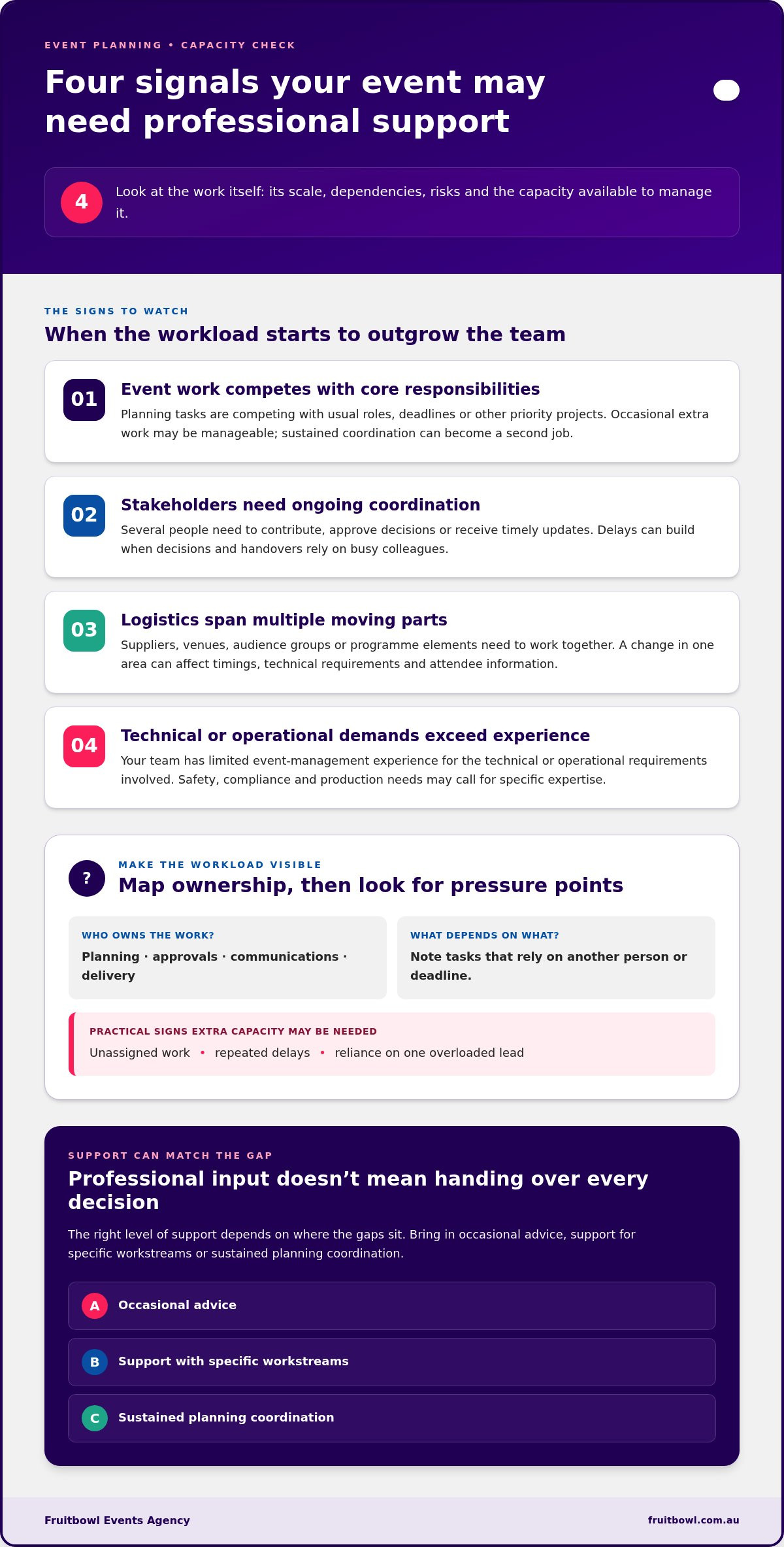
An event can outgrow a team before the workload is obvious. Early planning might involve a few meetings and a draft schedule. As decisions accumulate, staff can find themselves balancing event tasks with their usual deadlines. The best way to decide when to hire a professional event planner is to look at the work itself: its scale, dependencies, risks and the capacity available to manage it.
Hiring support isn’t a judgement on your internal team. It’s a practical decision about whether the event’s requirements match the time and experience available. Match event demands to the expertise and capacity available to deliver them. This can help you decide whether you need occasional advice, support with specific workstreams or sustained planning coordination.
Look for these signals:
- Event responsibilities are competing with core roles, deadlines or other priority projects.
- Several stakeholders need to contribute, approve decisions or receive timely updates.
- Logistics span multiple suppliers, venues, audience groups or programme elements.
- Your team has limited event-management experience for the technical or operational demands involved.
Is your internal team at capacity?
Event work often arrives in bursts: an approval is needed, a supplier detail changes or communications must be updated, all while staff still have their regular responsibilities. Occasional extra tasks may be manageable. Sustained coordination is different. If one person is continually chasing decisions, maintaining schedules and resolving handovers, planning can become a second job rather than a defined project responsibility.
Make the workload visible before deciding. List who owns planning, approvals, communications and delivery. Then note which tasks depend on another person or deadline. Unassigned work, repeated delays and reliance on one overloaded lead are practical signs that extra capacity may be needed.
Does the event carry more moving parts than expected?
Complexity grows when audiences, stakeholders, suppliers and programme elements need to be coordinated together. A conference, for example, may involve speakers, delegates, venue teams, registration, technical production and communications. A public-facing event can add operational and audience needs that must be considered in parallel. The more connected the workstreams, the harder it is to manage them as separate tasks.
One change can have several consequences. A programme adjustment may affect supplier timings, technical requirements and the information sent to attendees. This is why event management applies project management to events of all scales, including budgeting, scheduling and risk management. If your team lacks the experience or time to oversee those dependencies, professional input can bring coordination and oversight to the work.
Consider the decision early, while responsibilities and delivery plans can still be shaped. Support can be partial or complete, depending on where the gaps sit. The aim isn’t to hand over every decision, but to give the event clear ownership and enough capacity to move from planning to delivery.
How event complexity, risk and expertise shape the decision
Complexity isn’t measured by attendance alone. It reflects how many decisions, workstreams and stakeholders need to be coordinated, and how strongly one depends on another. A smaller event with technical production, multiple approvals and a public audience may require more oversight than a larger, simpler gathering.
As workstreams become more interdependent, clear coordination becomes essential to protect the plan and the audience experience. Use this as a test when deciding when to hire a professional event planner: if a change in one area creates a chain of decisions elsewhere, someone needs the time and expertise to manage those connections.
Which event features increase coordination demands?
Different event formats create different planning pressures. A multi-session conference links speakers, room schedules, registration and technical cues. A festival or public event may involve several programme areas, suppliers and audience movements. A brand or government activation can require close alignment between the experience, production, communications and stakeholder approvals.
Across these formats, venue operations, registration, programming, production and stakeholder communications need to stay in step. If a session moves, for example, room allocations, speaker briefings and attendee information may also need updating. The practical question isn’t just how many tasks exist, but how many decisions must be revisited when one detail changes.
When do safety, compliance or technical needs call for expertise?
Professional input is especially valuable when planning involves risk assessments, crowd or traffic management, emergency procedures or detailed documentation. Requirements vary by event and operating jurisdiction, so identify what applies to your specific format, site and location rather than relying on a generic checklist.
Technical requirements add another layer of dependencies. Staging, lighting, sound, vision, LED screens and technical direction need to align with the programme, venue and audience sightlines. A late staging change, for instance, may affect equipment placement, timings and how people move through the space.
Separate general coordination from specialist work. An event lead can manage schedules, decisions and communication across the project, while specific requirements call for focused expertise. For Australian events, Event Safety & Compliance supports the safety and compliance workstream, while In-House AV Production connects production planning with the event’s technical needs. Include these areas in the overall delivery plan rather than leaving them until logistics are fixed.
Map the event’s workstreams early and mark each dependency: what needs approval, what affects the audience, and what must be coordinated with a supplier or technical team. If several important decisions rely on one another, or your internal team lacks experience in a key area, bring in professional support while the plan can still be shaped. Fruitbowl provides event management support aligned with your objectives and delivery needs.
DIY event planning or a professional planner: compare the real responsibilities
Choosing between in-house planning and professional support isn’t an all-or-nothing decision. The right arrangement depends on your team’s experience and available time, as well as the event’s requirements. An internal lead may be well placed to set objectives and represent the organisation, while a planner coordinates operational work. A shared model can combine both strengths, provided ownership is agreed at the outset.
Use this comparison to start the discussion. Treat it as a working guide, not a fixed division of duties.
| Responsibility | Internal lead | Professional planner | Shared-responsibility model |
|---|---|---|---|
| Strategy | Sets organisational objectives and priorities | Turns objectives into a coordinated event plan | Internal team sets direction; planner shapes delivery |
| Logistics | Provides internal information and approvals | Coordinates schedules, suppliers and operational details | Planner manages agreed logistics; team approves key decisions |
| Stakeholder liaison | Represents internal teams and decision-makers | Coordinates agreed communications and handovers | Each party owns named stakeholder relationships |
| Production | Confirms requirements and content priorities | Coordinates production planning and delivery | Technical scope is developed together, with a clear delivery lead |
| Promotion | Approves messages and contributes audience insight | Supports promotion within the agreed scope | Internal team owns approvals; responsibilities are allocated by task |
| On-site delivery | Provides organisational decisions and representation | Coordinates agreed event operations | Planner leads assigned delivery areas; internal lead handles agreed decisions |
For organisations planning business events, corporate event management can bring strategy and delivery into a defined framework. Specify who makes decisions, who completes each task and who communicates changes. Without that clarity, work can be duplicated or left unattended.
What can an internal event team reasonably retain?
Your team brings valuable context: organisational objectives, audience knowledge, brand priorities and internal approval pathways. Keep those responsibilities close to the people who understand them. An internal lead can consolidate feedback, resolve decisions and provide a consistent point of contact without personally owning every supplier, schedule or operational detail.
Document who approves content, signs off changes and provides essential information. Clear decision rights reduce repeated discussions and help a planner act on agreed direction.
Which responsibilities can a professional planner take on?
Complete or partial Event Management can cover the coordination your team needs, from planning and logistics through to on-site delivery. Define the scope by workstream: Conference Management for conference delivery, Registration & Ticketing for attendee processes, or Entertainment & Programming for programme coordination. Promotion and stakeholder liaison can also be allocated explicitly.
For events with technical production needs, AV management for events can connect production requirements with the event plan. Once the division is agreed, record each responsibility, approval point and handover. This gives the internal lead and planner a shared reference for decisions and delivery.
When to bring in an event planner: a practical decision and briefing sequence
You don’t need a finished plan before seeking professional input. Support is often most useful while the event’s scope, stakeholders and delivery approach can still be shaped. If you’re deciding when to hire a professional event planner, use this sequence to clarify what the event needs and where your team would benefit from additional expertise.
- Define the objectives. Record why the event is taking place, who it needs to reach and what outcomes would make it successful. Keep the objectives clear enough to guide decisions about format, programme and audience experience.
- Map the scope. Note the audience, format and scale, then outline the main workstreams, such as venue, programme, registration, production and communications. Include known dependencies and unresolved requirements.
- Assess capacity. Identify who can lead each area, who has approval authority and how much time the team can realistically commit. Mark gaps in experience as well as unassigned tasks.
- Identify risks and open questions. Flag safety, compliance, accessibility and technical matters that may need further assessment. Record what is known, what remains uncertain and who should help resolve each issue.
- Brief the support required. Share the event’s objectives, audience, constraints and existing plans, then describe which responsibilities you’ll retain and where you need coordination. This makes it easier to define a suitable scope of support.
How do you assess the event before seeking support?
Start with a concise working document, not a polished proposal. Summarise the event’s purpose, audience, format, scale and intended outcomes. Add a simple responsibility map showing decision-makers, task owners, dependencies and delivery questions still to be resolved. For conference teams, conference logistics coordination is particularly relevant when venue, registration, programme and production need to align.
Keep questions distinct from confirmed requirements. For example, note that accessibility arrangements need assessment rather than assuming a particular solution. This gives professional support a clear starting point without treating preliminary assumptions as settled decisions.
What should an effective event brief include?
A useful brief brings the essential context together: objectives, audience needs, programme outline, key stakeholders and measures of success. Include known constraints, existing plans and required approval points. State what your organisation will own, such as internal decisions or audience insight, and where you need help coordinating delivery. A fixed timeline isn’t required; share any dates or deadlines already known.
Professional input can help refine scope before commitments narrow the options. Discuss your event scope with Fruitbowl to explore complete or partial Event Management shaped around your objectives and internal capacity.
How Fruitbowl supports events when professional planning is the right fit
Once you’ve identified a gap in capacity, experience or coordination, decide how much support to bring in. Fruitbowl works collaboratively with organisations that need complete or partial Event Management, with responsibilities shaped around the event’s objectives, delivery requirements and the work the internal team will retain. Knowing when to hire a professional event planner is only part of the decision; defining the right scope helps make the support useful.
Fruitbowl is an independent event management agency serving clients nationally across Australia. Its experience includes corporate events, conferences, festivals, government activations and brand activations. The team has delivered events for more than 28 years, with 2,500+ events delivered, 50+ successful events every year and 85+ years of combined industry experience.
What does Fruitbowl manage across an event?
Event Management brings strategic planning and practical delivery coordination together. Support can include logistics, budget management and stakeholder liaison, alongside venue sourcing, entertainment programming and on-site delivery as relevant to the event. The aim is to establish clear ownership across the work, rather than leave the organisation coordinating multiple moving parts without a central plan.
Specialist requirements can be integrated into the broader delivery approach. Event Safety & Compliance supports the safety and compliance workstream, while In-House AV Production connects technical production with the event plan. Event Marketing Services supports the promotional side of delivery. Scope these elements around the event’s needs rather than assuming every project requires the same approach.
How can the engagement fit different event needs?
A conference may need support coordinating registration, programme and production, while a festival or public event can require a broader approach to logistics and audience-facing delivery. For a government activation or corporate event, the focus may be aligning stakeholders, objectives and the experience being delivered. Fruitbowl’s work across these event types helps shape a plan around the audience and operating context.
Partial Event Management can suit an organisation with a capable internal lead that needs experienced coordination for selected workstreams. Complete Event Management can provide broader planning and delivery support when the project’s demands extend across more of the event lifecycle. In either case, defining retained responsibilities, approval points and handovers helps keep the partnership collaborative and accountable.
If you’ve outlined your objectives and the areas where your team needs support, discuss your event with Fruitbowl to explore an approach suited to your scope and priorities.
Set your event up for a confident next step
The right time to act is before important decisions become difficult to change. You don’t need every detail resolved; a clear sense of your objectives, audience and current planning challenges is enough to start a focused conversation about the support that would make a difference.
Deciding when to hire a professional event planner is ultimately about giving the event the right people, responsibilities and oversight. Retain the decisions that depend on your organisation’s knowledge, and bring in experienced coordination where it’s needed. That creates a clearer path from initial intent to practical delivery.
Fruitbowl works collaboratively with organisations to shape complete or partial Event Management around their needs. Discuss your event with Fruitbowl and take the next step with a clearer view of the support your plans require. With the right structure in place, your team can move forward with confidence.
Frequently Asked Questions
When should you hire a professional event planner?
Hire a professional when a critical part of delivery lacks a clear owner, or when key decisions are likely to affect several areas of the event. For example, if a programme change could alter venue arrangements, supplier schedules and attendee communications, planning support can help keep those decisions aligned. Decide when to hire a professional event planner before unresolved dependencies become urgent problems.
Is hiring an event planner worthwhile for a corporate event?
It can be worthwhile when the event has specific business objectives and your team needs more capacity to deliver them. Consider whether staff can manage planning while also preparing content, briefing presenters and looking after guests. A planner can coordinate delivery so internal leaders can focus on decisions that rely on their knowledge of the organisation, brand and audience.
Can you hire an event planner to manage only part of an event?
Yes. Partial Event Management can focus on a defined area rather than the entire project. For instance, an organisation may retain venue and stakeholder decisions while bringing in support for Registration & Ticketing, Conference Management or production coordination. Set clear boundaries around deliverables, approvals and handovers so the internal team and planner know who is responsible for each task.
How early should you involve a professional event planner?
Involve a planner as soon as you can describe the event’s purpose and audience, ideally before major scope or supplier decisions are locked in. Early input can help test whether the proposed format, programme and operational approach fit together. If you’ve already booked a venue or confirmed suppliers, share those commitments and any deadlines so planning can account for them from the outset.
What information should you give an event planner in a brief?
Share the event’s purpose, audience profile, format, programme ideas, stakeholders and intended outcomes. Add any existing venue or supplier commitments, internal approval processes, brand guidance and known constraints. It also helps to attach working documents, such as a draft schedule or communications plan, and label assumptions clearly. A brief can include unanswered questions; identifying them helps focus early planning conversations.
What does a professional event planner do on event day?
Depending on the agreed scope, a planner may coordinate the run sheet, supplier arrivals, programme timings and on-site handovers. They can keep information moving between the client team and delivery partners, and manage operational changes against the agreed plan. Confirm beforehand who has authority to approve changes, who handles urgent decisions and which matters should be escalated to the organisation’s lead.
Can an event planner help with safety and compliance?
Yes. Event Safety & Compliance supports work such as risk assessments, crowd and traffic management, emergency procedures and documentation. The relevant considerations depend on the event, venue and operating jurisdiction, so share the format, site details and known operational concerns early. This helps identify areas requiring assessment and coordinate safety planning with the broader event delivery process.
What if the clearest sign you need event support isn’t the guest list, but the strain on your team? Knowing when to hire a professional event planner can be difficult while an event still looks manageable on paper. The pressure often becomes clear as suppliers, stakeholders, technical production, promotion and safety requirements compete for attention.
It’s reasonable to plan in-house, especially when your team knows the organisation and its audience. But if the event’s complexity or risk is growing faster than your available time and expertise, professional support can bring structure and oversight without taking every decision out of your hands.
This guide will help you assess when an event’s scale, moving parts or risk profile calls for additional expertise. You’ll learn which responsibilities can be delegated, how complete or partial Event Management can suit different needs, and what to include in a practical brief. From corporate events and conferences to festivals and brand activations, Fruitbowl brings more than 28 years of event experience, with support spanning event safety and compliance, production, registration, marketing and programming.
Key Takeaways
- Know when to hire a professional event planner by assessing whether your team has the time and expertise to manage the event’s scope and risk.
- Map how decisions, stakeholders and workstreams depend on one another to see where coordination demands are rising.
- Compare internal, professional and shared-responsibility models to decide who should own strategy, logistics, production, promotion and on-site delivery.
- Use a five-step briefing sequence to define objectives, map scope, assess capacity, identify risks and outline the support required.
- Involve professional input while key scope and delivery decisions are still open, so responsibilities can be agreed before plans are locked in.
Table of Contents
- When to hire a professional event planner: the signs your team needs support
- How event complexity, risk and expertise shape the decision
- DIY event planning or a professional planner: compare the real responsibilities
- When to bring in an event planner: a practical decision and briefing sequence
- How Fruitbowl supports events when professional planning is the right fit
When to hire a professional event planner: the signs your team needs support
An event can outgrow a team before the workload is obvious. Early planning might involve a few meetings and a draft schedule. As decisions accumulate, staff can find themselves balancing event tasks with their usual deadlines. The best way to decide when to hire a professional event planner is to look at the work itself: its scale, dependencies, risks and the capacity available to manage it.
Hiring support isn’t a judgement on your internal team. It’s a practical decision about whether the event’s requirements match the time and experience available. Match event demands to the expertise and capacity available to deliver them. This can help you decide whether you need occasional advice, support with specific workstreams or sustained planning coordination.
Look for these signals:
- Event responsibilities are competing with core roles, deadlines or other priority projects.
- Several stakeholders need to contribute, approve decisions or receive timely updates.
- Logistics span multiple suppliers, venues, audience groups or programme elements.
- Your team has limited event-management experience for the technical or operational demands involved.
Is your internal team at capacity?
Event work often arrives in bursts: an approval is needed, a supplier detail changes or communications must be updated, all while staff still have their regular responsibilities. Occasional extra tasks may be manageable. Sustained coordination is different. If one person is continually chasing decisions, maintaining schedules and resolving handovers, planning can become a second job rather than a defined project responsibility.
Make the workload visible before deciding. List who owns planning, approvals, communications and delivery. Then note which tasks depend on another person or deadline. Unassigned work, repeated delays and reliance on one overloaded lead are practical signs that extra capacity may be needed.
Does the event carry more moving parts than expected?
Complexity grows when audiences, stakeholders, suppliers and programme elements need to be coordinated together. A conference, for example, may involve speakers, delegates, venue teams, registration, technical production and communications. A public-facing event can add operational and audience needs that must be considered in parallel. The more connected the workstreams, the harder it is to manage them as separate tasks.
One change can have several consequences. A programme adjustment may affect supplier timings, technical requirements and the information sent to attendees. This is why event management applies project management to events of all scales, including budgeting, scheduling and risk management. If your team lacks the experience or time to oversee those dependencies, professional input can bring coordination and oversight to the work.
Consider the decision early, while responsibilities and delivery plans can still be shaped. Support can be partial or complete, depending on where the gaps sit. The aim isn’t to hand over every decision, but to give the event clear ownership and enough capacity to move from planning to delivery.
How event complexity, risk and expertise shape the decision
Complexity isn’t measured by attendance alone. It reflects how many decisions, workstreams and stakeholders need to be coordinated, and how strongly one depends on another. A smaller event with technical production, multiple approvals and a public audience may require more oversight than a larger, simpler gathering.
As workstreams become more interdependent, clear coordination becomes essential to protect the plan and the audience experience. Use this as a test when deciding when to hire a professional event planner: if a change in one area creates a chain of decisions elsewhere, someone needs the time and expertise to manage those connections.
Which event features increase coordination demands?
Different event formats create different planning pressures. A multi-session conference links speakers, room schedules, registration and technical cues. A festival or public event may involve several programme areas, suppliers and audience movements. A brand or government activation can require close alignment between the experience, production, communications and stakeholder approvals.
Across these formats, venue operations, registration, programming, production and stakeholder communications need to stay in step. If a session moves, for example, room allocations, speaker briefings and attendee information may also need updating. The practical question isn’t just how many tasks exist, but how many decisions must be revisited when one detail changes.
When do safety, compliance or technical needs call for expertise?
Professional input is especially valuable when planning involves risk assessments, crowd or traffic management, emergency procedures or detailed documentation. Requirements vary by event and operating jurisdiction, so identify what applies to your specific format, site and location rather than relying on a generic checklist.
Technical requirements add another layer of dependencies. Staging, lighting, sound, vision, LED screens and technical direction need to align with the programme, venue and audience sightlines. A late staging change, for instance, may affect equipment placement, timings and how people move through the space.
Separate general coordination from specialist work. An event lead can manage schedules, decisions and communication across the project, while specific requirements call for focused expertise. For Australian events, Event Safety & Compliance supports the safety and compliance workstream, while In-House AV Production connects production planning with the event’s technical needs. Include these areas in the overall delivery plan rather than leaving them until logistics are fixed.
Map the event’s workstreams early and mark each dependency: what needs approval, what affects the audience, and what must be coordinated with a supplier or technical team. If several important decisions rely on one another, or your internal team lacks experience in a key area, bring in professional support while the plan can still be shaped. Fruitbowl provides event management support aligned with your objectives and delivery needs.
DIY event planning or a professional planner: compare the real responsibilities
Choosing between in-house planning and professional support isn’t an all-or-nothing decision. The right arrangement depends on your team’s experience and available time, as well as the event’s requirements. An internal lead may be well placed to set objectives and represent the organisation, while a planner coordinates operational work. A shared model can combine both strengths, provided ownership is agreed at the outset.
Use this comparison to start the discussion. Treat it as a working guide, not a fixed division of duties.
| Responsibility | Internal lead | Professional planner | Shared-responsibility model |
|---|---|---|---|
| Strategy | Sets organisational objectives and priorities | Turns objectives into a coordinated event plan | Internal team sets direction; planner shapes delivery |
| Logistics | Provides internal information and approvals | Coordinates schedules, suppliers and operational details | Planner manages agreed logistics; team approves key decisions |
| Stakeholder liaison | Represents internal teams and decision-makers | Coordinates agreed communications and handovers | Each party owns named stakeholder relationships |
| Production | Confirms requirements and content priorities | Coordinates production planning and delivery | Technical scope is developed together, with a clear delivery lead |
| Promotion | Approves messages and contributes audience insight | Supports promotion within the agreed scope | Internal team owns approvals; responsibilities are allocated by task |
| On-site delivery | Provides organisational decisions and representation | Coordinates agreed event operations | Planner leads assigned delivery areas; internal lead handles agreed decisions |
For organisations planning business events, corporate event management can bring strategy and delivery into a defined framework. Specify who makes decisions, who completes each task and who communicates changes. Without that clarity, work can be duplicated or left unattended.
What can an internal event team reasonably retain?
Your team brings valuable context: organisational objectives, audience knowledge, brand priorities and internal approval pathways. Keep those responsibilities close to the people who understand them. An internal lead can consolidate feedback, resolve decisions and provide a consistent point of contact without personally owning every supplier, schedule or operational detail.
Document who approves content, signs off changes and provides essential information. Clear decision rights reduce repeated discussions and help a planner act on agreed direction.
Which responsibilities can a professional planner take on?
Complete or partial Event Management can cover the coordination your team needs, from planning and logistics through to on-site delivery. Define the scope by workstream: Conference Management for conference delivery, Registration & Ticketing for attendee processes, or Entertainment & Programming for programme coordination. Promotion and stakeholder liaison can also be allocated explicitly.
For events with technical production needs, AV management for events can connect production requirements with the event plan. Once the division is agreed, record each responsibility, approval point and handover. This gives the internal lead and planner a shared reference for decisions and delivery.
When to bring in an event planner: a practical decision and briefing sequence
You don’t need a finished plan before seeking professional input. Support is often most useful while the event’s scope, stakeholders and delivery approach can still be shaped. If you’re deciding when to hire a professional event planner, use this sequence to clarify what the event needs and where your team would benefit from additional expertise.
- Define the objectives. Record why the event is taking place, who it needs to reach and what outcomes would make it successful. Keep the objectives clear enough to guide decisions about format, programme and audience experience.
- Map the scope. Note the audience, format and scale, then outline the main workstreams, such as venue, programme, registration, production and communications. Include known dependencies and unresolved requirements.
- Assess capacity. Identify who can lead each area, who has approval authority and how much time the team can realistically commit. Mark gaps in experience as well as unassigned tasks.
- Identify risks and open questions. Flag safety, compliance, accessibility and technical matters that may need further assessment. Record what is known, what remains uncertain and who should help resolve each issue.
- Brief the support required. Share the event’s objectives, audience, constraints and existing plans, then describe which responsibilities you’ll retain and where you need coordination. This makes it easier to define a suitable scope of support.
How do you assess the event before seeking support?
Start with a concise working document, not a polished proposal. Summarise the event’s purpose, audience, format, scale and intended outcomes. Add a simple responsibility map showing decision-makers, task owners, dependencies and delivery questions still to be resolved. For conference teams, conference logistics coordination is particularly relevant when venue, registration, programme and production need to align.
Keep questions distinct from confirmed requirements. For example, note that accessibility arrangements need assessment rather than assuming a particular solution. This gives professional support a clear starting point without treating preliminary assumptions as settled decisions.
What should an effective event brief include?
A useful brief brings the essential context together: objectives, audience needs, programme outline, key stakeholders and measures of success. Include known constraints, existing plans and required approval points. State what your organisation will own, such as internal decisions or audience insight, and where you need help coordinating delivery. A fixed timeline isn’t required; share any dates or deadlines already known.
Professional input can help refine scope before commitments narrow the options. Discuss your event scope with Fruitbowl to explore complete or partial Event Management shaped around your objectives and internal capacity.
How Fruitbowl supports events when professional planning is the right fit
Once you’ve identified a gap in capacity, experience or coordination, decide how much support to bring in. Fruitbowl works collaboratively with organisations that need complete or partial Event Management, with responsibilities shaped around the event’s objectives, delivery requirements and the work the internal team will retain. Knowing when to hire a professional event planner is only part of the decision; defining the right scope helps make the support useful.
Fruitbowl is an independent event management agency serving clients nationally across Australia. Its experience includes corporate events, conferences, festivals, government activations and brand activations. The team has delivered events for more than 28 years, with 2,500+ events delivered, 50+ successful events every year and 85+ years of combined industry experience.
What does Fruitbowl manage across an event?
Event Management brings strategic planning and practical delivery coordination together. Support can include logistics, budget management and stakeholder liaison, alongside venue sourcing, entertainment programming and on-site delivery as relevant to the event. The aim is to establish clear ownership across the work, rather than leave the organisation coordinating multiple moving parts without a central plan.
Specialist requirements can be integrated into the broader delivery approach. Event Safety & Compliance supports the safety and compliance workstream, while In-House AV Production connects technical production with the event plan. Event Marketing Services supports the promotional side of delivery. Scope these elements around the event’s needs rather than assuming every project requires the same approach.
How can the engagement fit different event needs?
A conference may need support coordinating registration, programme and production, while a festival or public event can require a broader approach to logistics and audience-facing delivery. For a government activation or corporate event, the focus may be aligning stakeholders, objectives and the experience being delivered. Fruitbowl’s work across these event types helps shape a plan around the audience and operating context.
Partial Event Management can suit an organisation with a capable internal lead that needs experienced coordination for selected workstreams. Complete Event Management can provide broader planning and delivery support when the project’s demands extend across more of the event lifecycle. In either case, defining retained responsibilities, approval points and handovers helps keep the partnership collaborative and accountable.
If you’ve outlined your objectives and the areas where your team needs support, discuss your event with Fruitbowl to explore an approach suited to your scope and priorities.
Set your event up for a confident next step
The right time to act is before important decisions become difficult to change. You don’t need every detail resolved; a clear sense of your objectives, audience and current planning challenges is enough to start a focused conversation about the support that would make a difference.
Deciding when to hire a professional event planner is ultimately about giving the event the right people, responsibilities and oversight. Retain the decisions that depend on your organisation’s knowledge, and bring in experienced coordination where it’s needed. That creates a clearer path from initial intent to practical delivery.
Fruitbowl works collaboratively with organisations to shape complete or partial Event Management around their needs. Discuss your event with Fruitbowl and take the next step with a clearer view of the support your plans require. With the right structure in place, your team can move forward with confidence.
Frequently Asked Questions
When should you hire a professional event planner?
Hire a professional when a critical part of delivery lacks a clear owner, or when key decisions are likely to affect several areas of the event. For example, if a programme change could alter venue arrangements, supplier schedules and attendee communications, planning support can help keep those decisions aligned. Decide when to hire a professional event planner before unresolved dependencies become urgent problems.
Is hiring an event planner worthwhile for a corporate event?
It can be worthwhile when the event has specific business objectives and your team needs more capacity to deliver them. Consider whether staff can manage planning while also preparing content, briefing presenters and looking after guests. A planner can coordinate delivery so internal leaders can focus on decisions that rely on their knowledge of the organisation, brand and audience.
Can you hire an event planner to manage only part of an event?
Yes. Partial Event Management can focus on a defined area rather than the entire project. For instance, an organisation may retain venue and stakeholder decisions while bringing in support for Registration & Ticketing, Conference Management or production coordination. Set clear boundaries around deliverables, approvals and handovers so the internal team and planner know who is responsible for each task.
How early should you involve a professional event planner?
Involve a planner as soon as you can describe the event’s purpose and audience, ideally before major scope or supplier decisions are locked in. Early input can help test whether the proposed format, programme and operational approach fit together. If you’ve already booked a venue or confirmed suppliers, share those commitments and any deadlines so planning can account for them from the outset.
What information should you give an event planner in a brief?
Share the event’s purpose, audience profile, format, programme ideas, stakeholders and intended outcomes. Add any existing venue or supplier commitments, internal approval processes, brand guidance and known constraints. It also helps to attach working documents, such as a draft schedule or communications plan, and label assumptions clearly. A brief can include unanswered questions; identifying them helps focus early planning conversations.
What does a professional event planner do on event day?
Depending on the agreed scope, a planner may coordinate the run sheet, supplier arrivals, programme timings and on-site handovers. They can keep information moving between the client team and delivery partners, and manage operational changes against the agreed plan. Confirm beforehand who has authority to approve changes, who handles urgent decisions and which matters should be escalated to the organisation’s lead.
Can an event planner help with safety and compliance?
Yes. Event Safety & Compliance supports work such as risk assessments, crowd and traffic management, emergency procedures and documentation. The relevant considerations depend on the event, venue and operating jurisdiction, so share the format, site details and known operational concerns early. This helps identify areas requiring assessment and coordinate safety planning with the broader event delivery process.
OUR BLOG
Event Insights & Expertise
Our blog is your go-to resource for all things events. From expert insights and the latest industry trends to practical planning tips, we share everything you need to deliver standout experiences.
Contact Us