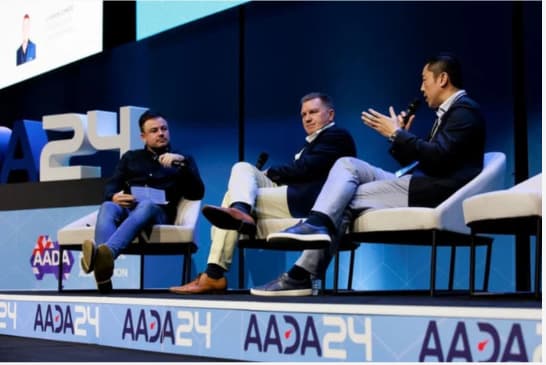
A keynote speaker cancels hours before doors open. The change seems straightforward, but it may affect the run sheet, suppliers, room setup and attendee communications all at once. Managing last minute event changes well means understanding those knock-on effects before announcing a fix.
When plans shift close to event day, urgency is real. Decision-makers may be unavailable, priorities may differ, and teams or attendees can quickly end up working from conflicting information. A controlled response helps you move quickly without creating avoidable disruption or losing sight of what the event needs to achieve.
This practical guide explains how to assess the full impact of an urgent change, identify what must be protected and make a clear, proportionate decision. You’ll also learn how to coordinate updates across stakeholders, suppliers, delivery teams and attendees so everyone is working from the same information. From corporate events to public gatherings, the aim is consistent: adapt delivery while keeping essential outcomes on track.
Key Takeaways
- Before approving a change, confirm the facts and identify who has authority to decide.
- Prioritise safety and essential delivery requirements, then weigh schedule, resources, budget and audience effects.
- Managing last minute event changes means comparing response options against feasibility, timing and event objectives, rather than defaulting to the quickest fix.
- Use a clear handover so each affected group receives the right update and knows what action to take.
- Coordinated planning, logistics and on-site delivery can help keep changing event plans aligned with their purpose.
Table of Contents
- Managing last minute event changes starts with understanding the impact
- How to assess a last-minute event change before approving it
- Compare response options for managing last-minute event changes
- Communicate and implement an approved event change clearly
- How Fruitbowl brings control to changing event plans
Managing last minute event changes starts with understanding the impact
A last-minute change is an unplanned adjustment that affects agreed event delivery, whether it arises hours before doors open or during the final planning days. The key question isn’t simply how soon the event starts. It’s what the change could affect and how long you have to make a sound decision.
Change impact is the combined effect an adjustment has on event delivery, stakeholders and intended outcomes. A revised start time, for example, may shift speaker call times, supplier access, technical checks and attendee instructions. A change that appears contained can therefore trigger a chain of decisions across the event plan.
That interdependence is part of event management, which brings planning, coordination and logistics together. The Event Management Overview provides background on these connected elements. For corporate events, a corporate event management framework can also help clarify how individual delivery choices support broader objectives.
Which event changes need immediate attention?
Assess urgency by consequence and decision deadline, not by how stressful the news feels. A venue condition affecting safe access or the event’s ability to proceed needs prompt attention. A speaker cancellation may require a programme decision, while a preference about décor can often wait if it doesn’t disrupt delivery.
Consider what the change touches: timing, venue conditions, speakers, suppliers, programme or audience arrangements. The same change can carry different consequences across formats. A delayed speaker at a conference may affect session transitions and audience updates; at a public festival, a programme shift could also affect several activity areas and supplier schedules. Identify immediate operational risks first, then separate them from refinements that can be reviewed later.
Why can one small change affect the whole event?
Programme elements are linked to people, spaces and timings. Moving a session can change when staff need to be in position, when suppliers deliver or reset, when technical teams run checks and what attendees expect from the published schedule. If updates reach only some groups, people may act on different versions of the plan.
Hypothetical example: A corporate event moves a panel discussion forward by 20 minutes to accommodate a speaker’s earlier departure. The team may need to adjust the preceding session, confirm the room and microphone setup, revise staff positions and update the run sheet. Attendees may also need a clear schedule update. The change is manageable once its dependencies are visible.
When managing last minute event changes, map the adjustment to the delivery elements it could affect. This gives decision-makers a clearer view of what must happen now, what can remain unchanged and which preferences can wait. It also helps keep the response proportionate: address the actual consequences without creating unnecessary changes elsewhere.
How to assess a last-minute event change before approving it
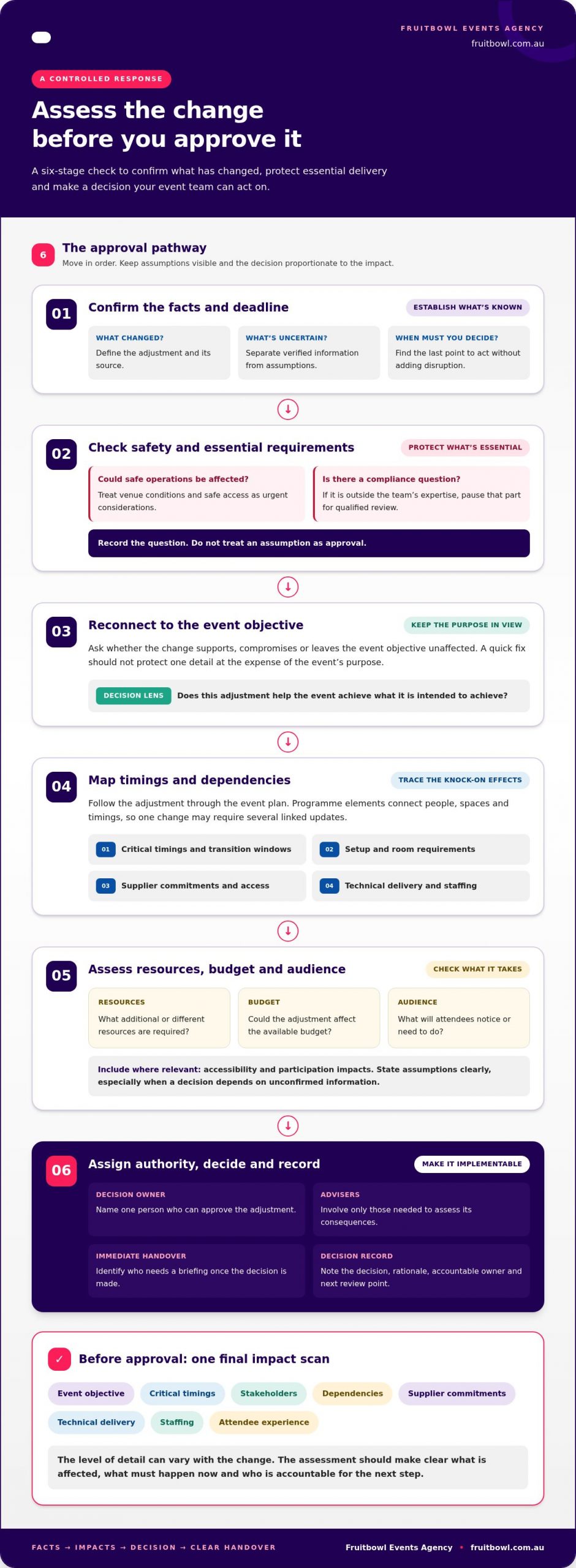
Once a change is identified, assess it in a set order. This helps the team distinguish verified information from assumptions, protect essential delivery requirements and make a decision that can be implemented clearly. Keep the assessment proportionate to the change, but don’t skip checks that could affect people, event objectives or the ability to deliver.
- Confirm the facts and deadline. Establish exactly what has changed, what is known, what remains uncertain and when a decision is needed. Identify the source of the information and the last point at which the team can act without creating further disruption.
- Check safety and essential requirements. Consider whether the proposed adjustment could affect safe operations or a requirement the event must meet. If there’s a safety or compliance question outside the team’s expertise, pause that part of the decision and flag it for qualified review. Record the question rather than treating an assumption as approval.
- Reconnect the change to the event objective. Ask what the event is intended to achieve and whether the change supports, compromises or leaves that objective unaffected. This helps prevent a quick fix from protecting one detail at the expense of the event’s purpose.
- Map timings and dependencies. Check critical timings, setup and transition windows, and which programme elements rely on the affected item. Trace the impact through supplier commitments, technical delivery and staffing. Note where one adjustment may require another person or team to change their work.
- Assess resources, budget and audience experience. Identify what additional or different resources are required, whether the change affects the available budget, and what attendees will notice or need to do. Include accessibility or participation impacts where relevant. State assumptions clearly, especially if a decision depends on information that hasn’t yet been confirmed.
- Assign authority, decide and record. Name one decision owner who can approve the adjustment. Bring in only those who need to advise on its consequences, then identify who needs an immediate briefing once a decision is made. Record the decision, rationale, accountable owner and next review point.
What should the impact assessment cover?
Use the same core checks for each proposal: event objective, critical timings, affected stakeholders, dependencies, supplier commitments, technical delivery, staffing and attendee experience. The level of detail can vary, but the assessment should show what changes, what stays in place and what needs follow-up. Separate confirmed facts from assumptions so advisers can address the right question.
How can a team make a decision without losing time?
Keep the approval point focused. Compare the proposed adjustment with the agreed plan and the likely consequence of doing nothing, then weigh both against essential requirements and the decision deadline. Approve a change only after its consequences, owner and communication needs are clear. If information is incomplete, record what remains uncertain and who will resolve it, rather than allowing multiple people to act on different assumptions.
A consistent approval sequence gives corporate and public event teams a practical way to make decisions under pressure without losing accountability. Fruitbowl’s event management support connects planning, logistics and on-site decisions as circumstances change.
Compare response options for managing last-minute event changes
Once the change and its effects are understood, compare practical responses rather than treating the first workable idea as the only option. Choices may include containing the disruption, substituting an alternative, rescheduling an event element or cancelling it. Each has different implications for delivery, people and the event’s purpose.
The preferred response preserves essential outcomes while keeping downstream effects manageable. Use the comparison below to frame a decision, not as a universal ranking. The right option depends on the change, event requirements, available time and consequences of each choice.
| Response | Impact | Feasibility | Time | Objective alignment |
|---|---|---|---|---|
| Containment | Limits disruption to the affected element | Works if dependencies remain intact | Often focused on immediate adjustments | Strong if core outcomes remain achievable |
| Substitution | Changes the element while aiming to meet the same need | Depends on a suitable alternative and its requirements | Allow time to coordinate the replacement | Strong if the alternative serves the same purpose |
| Rescheduling | Can affect linked timings and participants | Depends on availability and programme flexibility | May require wider coordination | Useful if the element matters but can move |
| Cancellation | Removes the element and its related dependencies | May be necessary if delivery isn’t viable | Requires clear decisions and updates | Acceptable if essential outcomes can still be met |
Evaluate each option against the agreed event objectives. Consider what it protects, what it displaces and who must adapt. A fast response isn’t automatically the best one if it creates more disruption elsewhere. Equally, preserving every programme detail may be unrealistic when time, access, supplier commitments or other constraints narrow the choices.
When should a team contain or substitute for the change?
Containment is appropriate when the issue can be isolated without compromising essential outcomes. For instance, the team might adjust one programme element while keeping other timings intact. Substitution can work when an alternative meets the same audience or programme need. In both cases, safety, access and agreed commitments set the boundaries. Check those constraints before treating an option as workable.
When should an event element be deferred or cancelled?
Reschedule or defer an element when it can move without undermining the wider event purpose and the necessary people, space and resources can align at another time. Cancellation may be the more responsible decision if delivery can’t be made viable within the available constraints. Consider connected technical dependencies as part of that assessment; an AV management framework provides wider context for how technical delivery fits into event planning.
Before settling on an option, compare its likely effects with those of doing nothing. State what the chosen response protects, what changes for stakeholders and what must be updated next. This keeps decisions grounded in delivery and purpose, rather than pressure to preserve the original plan at any cost.
Communicate and implement an approved event change clearly
An approved change isn’t implemented until the people responsible for delivery understand what to do. Treat communication as a controlled handover: the decision owner confirms the authorised adjustment, the update owner translates it into current instructions, and affected people receive the information in an order that supports delivery.
Start with those closest to the change. Brief the core team, then directly affected suppliers, speakers and venue contacts. This gives delivery leads an opportunity to align their actions before the update reaches attendees. Adjust the sequence to suit the change: if attendees need to act immediately, prepare their message as part of the same approval process rather than delaying it unnecessarily.
What should an event change message include?
Make the update factual and specific. State what has changed, what remains unchanged, when the new arrangement takes effect, who needs to act and what action is required. Point recipients to the current run sheet or information source. If details are still being resolved, say what’s confirmed and when a further update will follow, without presenting speculation as fact.
A concise message structure helps keep instructions consistent across channels:
- Change: Name the affected session, location, timing or arrangement.
- Effective time: State when the revised instruction applies.
- Action: Specify who needs to do what, and by when if relevant.
- Current reference: Identify where the latest event information is held.
- Update details: Include the version number or date and time it was issued.
For example, a message might identify a revised session start, confirm that the rest of the programme is unchanged, direct the speaker and room team to the updated run sheet, and tell attendees where to view the current schedule. Tailor the detail to each audience, but keep the underlying facts aligned.
How can teams avoid conflicting instructions?
Appoint one person to publish approved updates and maintain the live run sheet. Use a consistent convention, such as “Version 3, 10.30 am”, so people can distinguish the latest instructions from earlier copies. Brief directly affected delivery leads first where timing allows, and ask them to confirm receipt of critical operational changes.
Then retire obsolete versions. Remove or clearly mark superseded documents in shared locations, and direct recipients to the single current source rather than forwarding multiple attachments. For attendees, update the channels they’re already using and make the revised information easy to identify. Managing last minute event changes depends on this discipline as much as the decision itself: one accurate update is more useful than several fast but inconsistent messages.
Fruitbowl’s event management services bring planning, logistics and on-site delivery together to help keep changing plans aligned.
How Fruitbowl brings control to changing event plans
A change can put pressure on the event plan, but it doesn’t have to leave stakeholders working at cross-purposes. Fruitbowl Events Agency brings strategic planning, logistics coordination and on-site delivery together, giving a revised plan a clear connection from decision through to implementation.
Founded in 1996, Fruitbowl has more than 28 years of event industry experience and delivers events nationally across Australia. That experience supports a composed, structured approach to managing last minute event changes: understand what the adjustment affects, coordinate the people involved and keep delivery aligned with the event’s objectives.
What does coordinated event change management look like?
It starts with the event plan, not with an isolated instruction. Strategic planning helps keep the proposed adjustment anchored to the event’s purpose. Logistics coordination then connects the change to relevant timings, suppliers, spaces and delivery requirements. This makes it easier to see which parts of the plan need to move and which should remain consistent.
Stakeholder liaison provides a clear point of coordination for affected parties. Rather than leaving each person to interpret the change independently, the team can align the revised arrangements and the actions required from each stakeholder. On-site delivery carries that approved plan into the event itself, helping the delivery team work to the same decisions and current information.
The process is tailored to the event. A change affecting a conference session may involve different stakeholders and dependencies from a change to a public activation. In both cases, connecting planning, logistics and implementation helps maintain oversight as details evolve.
How does an experienced event partner reduce pressure?
Experience doesn’t remove uncertainty; it helps bring structure to the response. Clear ownership supports timely decisions. Stakeholder coordination helps affected people understand their part. Disciplined follow-through keeps the revised plan connected to the event’s intended outcomes.
That coordination can be valuable across corporate events, conferences, festivals and public activations, where changes may involve different programmes, teams and audiences. Each event requires its own assessment, but the underlying discipline remains consistent: consider the consequences, align the decision-makers and make sure the approved change is reflected in delivery.
For conferences, logistics responsibilities can span connected parts of the event plan. The conference logistics coordinator guide explores that role in more detail.
With end-to-end support across planning, logistics and on-site execution, Fruitbowl helps organisations bring clarity and coordination to changing event plans. Discuss your event with Fruitbowl.
Build change readiness into your next event plan
Use the next planning cycle to make decision-making easier before a change arises. Agree who can approve adjustments, who needs to provide input and where the current plan will be maintained. Set these expectations with your team early, so an urgent decision doesn’t also become a debate about ownership or process.
Managing last minute event changes becomes more controlled when adaptability is part of the plan from the outset. Consider which event elements have little flexibility, where alternatives may be practical and how updates will reach the people who need them. This preparation gives your team a clearer starting point when circumstances shift, while keeping attention on the experience and outcomes you want to deliver.
Fruitbowl brings strategic planning, logistics coordination and on-site delivery together for events across Australia. Plan your next event with Fruitbowl and take a considered approach to changes before event day arrives.
With clear ownership and a flexible plan, your team can adapt with confidence and keep the event moving towards its purpose.
Frequently Asked Questions
What counts as a last-minute event change?
A last-minute event change is an unplanned adjustment made close enough to delivery that it affects preparations already under way. For example, replacing a booked speaker, changing a room after signage is printed or revising a festival activity on event day may all qualify. The defining factor is the effect on agreed arrangements and the time available to respond, rather than a fixed number of hours or days.
Can an event schedule be changed after doors open?
Yes, an event schedule can be adjusted after doors open, provided the change is workable and communicated to the people it affects. Check what’s happening immediately before and after the affected item, then coordinate the revised timing with the floor team and presenter. For attendees already on site, use visible signage or announcements as well as the event’s usual update channel, and make sure staff can answer basic questions consistently.
How do you manage a last-minute speaker cancellation?
First establish which sessions and event objectives depend on the speaker. Then choose a suitable response: a confirmed substitute, a moderated discussion with remaining panellists, an audience Q&A or a shorter programme. Check the replacement’s availability and session requirements before announcing the change. Update the run sheet and brief the host, technical team and front-of-house staff so the introduction and transitions match the revised format.
What should be included in an event change log?
An event change log should let someone quickly understand what happened and what’s current. Record the change reference, time raised, source, affected event element, decision status, approver, rationale, assigned actions and completion status. Note which documents or channels were updated, when those updates were issued and whether key recipients acknowledged them. Keep entries concise and chronological, so the log remains useful during handover rather than becoming a second, conflicting version of the event plan.
How can organisers prioritise two urgent event changes at once?
Compare each change by consequence, decision deadline and dependencies. Address first the issue with the nearest point of no return or the greater effect on essential delivery. For managing last minute event changes involving two separate workstreams, assign an owner to each while one lead maintains oversight of shared resources and decisions. If the changes compete for the same people or space, resolve that conflict before teams commit to either response.
How do you update attendees without creating confusion?
Give attendees one clear, current instruction through the channel most relevant to the change. Name the affected session or arrangement, state what they should do and identify what remains as planned. Avoid sending partial updates that could be mistaken for the final schedule. If an earlier message is no longer accurate, say so plainly and direct people to the latest version. Ensure on-site staff can point attendees to the same information.
Should an organiser keep a change if it may affect accessibility?
Don’t proceed on the assumption that the effect is minor. Identify the access requirement involved and consider whether the revised arrangement still allows affected attendees to participate. For example, moving a session to another space may change the route, seating or available support. Include someone with relevant accessibility knowledge in the decision, and explain the practical options directly to affected attendees where appropriate. If access can’t be maintained, reassess the change before implementation.
A keynote speaker cancels hours before doors open. The change seems straightforward, but it may affect the run sheet, suppliers, room setup and attendee communications all at once. Managing last minute event changes well means understanding those knock-on effects before announcing a fix.
When plans shift close to event day, urgency is real. Decision-makers may be unavailable, priorities may differ, and teams or attendees can quickly end up working from conflicting information. A controlled response helps you move quickly without creating avoidable disruption or losing sight of what the event needs to achieve.
This practical guide explains how to assess the full impact of an urgent change, identify what must be protected and make a clear, proportionate decision. You’ll also learn how to coordinate updates across stakeholders, suppliers, delivery teams and attendees so everyone is working from the same information. From corporate events to public gatherings, the aim is consistent: adapt delivery while keeping essential outcomes on track.
Key Takeaways
- Before approving a change, confirm the facts and identify who has authority to decide.
- Prioritise safety and essential delivery requirements, then weigh schedule, resources, budget and audience effects.
- Managing last minute event changes means comparing response options against feasibility, timing and event objectives, rather than defaulting to the quickest fix.
- Use a clear handover so each affected group receives the right update and knows what action to take.
- Coordinated planning, logistics and on-site delivery can help keep changing event plans aligned with their purpose.
Table of Contents
- Managing last minute event changes starts with understanding the impact
- How to assess a last-minute event change before approving it
- Compare response options for managing last-minute event changes
- Communicate and implement an approved event change clearly
- How Fruitbowl brings control to changing event plans
Managing last minute event changes starts with understanding the impact
A last-minute change is an unplanned adjustment that affects agreed event delivery, whether it arises hours before doors open or during the final planning days. The key question isn’t simply how soon the event starts. It’s what the change could affect and how long you have to make a sound decision.
Change impact is the combined effect an adjustment has on event delivery, stakeholders and intended outcomes. A revised start time, for example, may shift speaker call times, supplier access, technical checks and attendee instructions. A change that appears contained can therefore trigger a chain of decisions across the event plan.
That interdependence is part of event management, which brings planning, coordination and logistics together. The Event Management Overview provides background on these connected elements. For corporate events, a corporate event management framework can also help clarify how individual delivery choices support broader objectives.
Which event changes need immediate attention?
Assess urgency by consequence and decision deadline, not by how stressful the news feels. A venue condition affecting safe access or the event’s ability to proceed needs prompt attention. A speaker cancellation may require a programme decision, while a preference about décor can often wait if it doesn’t disrupt delivery.
Consider what the change touches: timing, venue conditions, speakers, suppliers, programme or audience arrangements. The same change can carry different consequences across formats. A delayed speaker at a conference may affect session transitions and audience updates; at a public festival, a programme shift could also affect several activity areas and supplier schedules. Identify immediate operational risks first, then separate them from refinements that can be reviewed later.
Why can one small change affect the whole event?
Programme elements are linked to people, spaces and timings. Moving a session can change when staff need to be in position, when suppliers deliver or reset, when technical teams run checks and what attendees expect from the published schedule. If updates reach only some groups, people may act on different versions of the plan.
Hypothetical example: A corporate event moves a panel discussion forward by 20 minutes to accommodate a speaker’s earlier departure. The team may need to adjust the preceding session, confirm the room and microphone setup, revise staff positions and update the run sheet. Attendees may also need a clear schedule update. The change is manageable once its dependencies are visible.
When managing last minute event changes, map the adjustment to the delivery elements it could affect. This gives decision-makers a clearer view of what must happen now, what can remain unchanged and which preferences can wait. It also helps keep the response proportionate: address the actual consequences without creating unnecessary changes elsewhere.
How to assess a last-minute event change before approving it
Once a change is identified, assess it in a set order. This helps the team distinguish verified information from assumptions, protect essential delivery requirements and make a decision that can be implemented clearly. Keep the assessment proportionate to the change, but don’t skip checks that could affect people, event objectives or the ability to deliver.
- Confirm the facts and deadline. Establish exactly what has changed, what is known, what remains uncertain and when a decision is needed. Identify the source of the information and the last point at which the team can act without creating further disruption.
- Check safety and essential requirements. Consider whether the proposed adjustment could affect safe operations or a requirement the event must meet. If there’s a safety or compliance question outside the team’s expertise, pause that part of the decision and flag it for qualified review. Record the question rather than treating an assumption as approval.
- Reconnect the change to the event objective. Ask what the event is intended to achieve and whether the change supports, compromises or leaves that objective unaffected. This helps prevent a quick fix from protecting one detail at the expense of the event’s purpose.
- Map timings and dependencies. Check critical timings, setup and transition windows, and which programme elements rely on the affected item. Trace the impact through supplier commitments, technical delivery and staffing. Note where one adjustment may require another person or team to change their work.
- Assess resources, budget and audience experience. Identify what additional or different resources are required, whether the change affects the available budget, and what attendees will notice or need to do. Include accessibility or participation impacts where relevant. State assumptions clearly, especially if a decision depends on information that hasn’t yet been confirmed.
- Assign authority, decide and record. Name one decision owner who can approve the adjustment. Bring in only those who need to advise on its consequences, then identify who needs an immediate briefing once a decision is made. Record the decision, rationale, accountable owner and next review point.
What should the impact assessment cover?
Use the same core checks for each proposal: event objective, critical timings, affected stakeholders, dependencies, supplier commitments, technical delivery, staffing and attendee experience. The level of detail can vary, but the assessment should show what changes, what stays in place and what needs follow-up. Separate confirmed facts from assumptions so advisers can address the right question.
How can a team make a decision without losing time?
Keep the approval point focused. Compare the proposed adjustment with the agreed plan and the likely consequence of doing nothing, then weigh both against essential requirements and the decision deadline. Approve a change only after its consequences, owner and communication needs are clear. If information is incomplete, record what remains uncertain and who will resolve it, rather than allowing multiple people to act on different assumptions.
A consistent approval sequence gives corporate and public event teams a practical way to make decisions under pressure without losing accountability. Fruitbowl’s event management support connects planning, logistics and on-site decisions as circumstances change.
Compare response options for managing last-minute event changes
Once the change and its effects are understood, compare practical responses rather than treating the first workable idea as the only option. Choices may include containing the disruption, substituting an alternative, rescheduling an event element or cancelling it. Each has different implications for delivery, people and the event’s purpose.
The preferred response preserves essential outcomes while keeping downstream effects manageable. Use the comparison below to frame a decision, not as a universal ranking. The right option depends on the change, event requirements, available time and consequences of each choice.
| Response | Impact | Feasibility | Time | Objective alignment |
|---|---|---|---|---|
| Containment | Limits disruption to the affected element | Works if dependencies remain intact | Often focused on immediate adjustments | Strong if core outcomes remain achievable |
| Substitution | Changes the element while aiming to meet the same need | Depends on a suitable alternative and its requirements | Allow time to coordinate the replacement | Strong if the alternative serves the same purpose |
| Rescheduling | Can affect linked timings and participants | Depends on availability and programme flexibility | May require wider coordination | Useful if the element matters but can move |
| Cancellation | Removes the element and its related dependencies | May be necessary if delivery isn’t viable | Requires clear decisions and updates | Acceptable if essential outcomes can still be met |
Evaluate each option against the agreed event objectives. Consider what it protects, what it displaces and who must adapt. A fast response isn’t automatically the best one if it creates more disruption elsewhere. Equally, preserving every programme detail may be unrealistic when time, access, supplier commitments or other constraints narrow the choices.
When should a team contain or substitute for the change?
Containment is appropriate when the issue can be isolated without compromising essential outcomes. For instance, the team might adjust one programme element while keeping other timings intact. Substitution can work when an alternative meets the same audience or programme need. In both cases, safety, access and agreed commitments set the boundaries. Check those constraints before treating an option as workable.
When should an event element be deferred or cancelled?
Reschedule or defer an element when it can move without undermining the wider event purpose and the necessary people, space and resources can align at another time. Cancellation may be the more responsible decision if delivery can’t be made viable within the available constraints. Consider connected technical dependencies as part of that assessment; an AV management framework provides wider context for how technical delivery fits into event planning.
Before settling on an option, compare its likely effects with those of doing nothing. State what the chosen response protects, what changes for stakeholders and what must be updated next. This keeps decisions grounded in delivery and purpose, rather than pressure to preserve the original plan at any cost.
Communicate and implement an approved event change clearly
An approved change isn’t implemented until the people responsible for delivery understand what to do. Treat communication as a controlled handover: the decision owner confirms the authorised adjustment, the update owner translates it into current instructions, and affected people receive the information in an order that supports delivery.
Start with those closest to the change. Brief the core team, then directly affected suppliers, speakers and venue contacts. This gives delivery leads an opportunity to align their actions before the update reaches attendees. Adjust the sequence to suit the change: if attendees need to act immediately, prepare their message as part of the same approval process rather than delaying it unnecessarily.
What should an event change message include?
Make the update factual and specific. State what has changed, what remains unchanged, when the new arrangement takes effect, who needs to act and what action is required. Point recipients to the current run sheet or information source. If details are still being resolved, say what’s confirmed and when a further update will follow, without presenting speculation as fact.
A concise message structure helps keep instructions consistent across channels:
- Change: Name the affected session, location, timing or arrangement.
- Effective time: State when the revised instruction applies.
- Action: Specify who needs to do what, and by when if relevant.
- Current reference: Identify where the latest event information is held.
- Update details: Include the version number or date and time it was issued.
For example, a message might identify a revised session start, confirm that the rest of the programme is unchanged, direct the speaker and room team to the updated run sheet, and tell attendees where to view the current schedule. Tailor the detail to each audience, but keep the underlying facts aligned.
How can teams avoid conflicting instructions?
Appoint one person to publish approved updates and maintain the live run sheet. Use a consistent convention, such as “Version 3, 10.30 am”, so people can distinguish the latest instructions from earlier copies. Brief directly affected delivery leads first where timing allows, and ask them to confirm receipt of critical operational changes.
Then retire obsolete versions. Remove or clearly mark superseded documents in shared locations, and direct recipients to the single current source rather than forwarding multiple attachments. For attendees, update the channels they’re already using and make the revised information easy to identify. Managing last minute event changes depends on this discipline as much as the decision itself: one accurate update is more useful than several fast but inconsistent messages.
Fruitbowl’s event management services bring planning, logistics and on-site delivery together to help keep changing plans aligned.
How Fruitbowl brings control to changing event plans
A change can put pressure on the event plan, but it doesn’t have to leave stakeholders working at cross-purposes. Fruitbowl Events Agency brings strategic planning, logistics coordination and on-site delivery together, giving a revised plan a clear connection from decision through to implementation.
Founded in 1996, Fruitbowl has more than 28 years of event industry experience and delivers events nationally across Australia. That experience supports a composed, structured approach to managing last minute event changes: understand what the adjustment affects, coordinate the people involved and keep delivery aligned with the event’s objectives.
What does coordinated event change management look like?
It starts with the event plan, not with an isolated instruction. Strategic planning helps keep the proposed adjustment anchored to the event’s purpose. Logistics coordination then connects the change to relevant timings, suppliers, spaces and delivery requirements. This makes it easier to see which parts of the plan need to move and which should remain consistent.
Stakeholder liaison provides a clear point of coordination for affected parties. Rather than leaving each person to interpret the change independently, the team can align the revised arrangements and the actions required from each stakeholder. On-site delivery carries that approved plan into the event itself, helping the delivery team work to the same decisions and current information.
The process is tailored to the event. A change affecting a conference session may involve different stakeholders and dependencies from a change to a public activation. In both cases, connecting planning, logistics and implementation helps maintain oversight as details evolve.
How does an experienced event partner reduce pressure?
Experience doesn’t remove uncertainty; it helps bring structure to the response. Clear ownership supports timely decisions. Stakeholder coordination helps affected people understand their part. Disciplined follow-through keeps the revised plan connected to the event’s intended outcomes.
That coordination can be valuable across corporate events, conferences, festivals and public activations, where changes may involve different programmes, teams and audiences. Each event requires its own assessment, but the underlying discipline remains consistent: consider the consequences, align the decision-makers and make sure the approved change is reflected in delivery.
For conferences, logistics responsibilities can span connected parts of the event plan. The conference logistics coordinator guide explores that role in more detail.
With end-to-end support across planning, logistics and on-site execution, Fruitbowl helps organisations bring clarity and coordination to changing event plans. Discuss your event with Fruitbowl.
Build change readiness into your next event plan
Use the next planning cycle to make decision-making easier before a change arises. Agree who can approve adjustments, who needs to provide input and where the current plan will be maintained. Set these expectations with your team early, so an urgent decision doesn’t also become a debate about ownership or process.
Managing last minute event changes becomes more controlled when adaptability is part of the plan from the outset. Consider which event elements have little flexibility, where alternatives may be practical and how updates will reach the people who need them. This preparation gives your team a clearer starting point when circumstances shift, while keeping attention on the experience and outcomes you want to deliver.
Fruitbowl brings strategic planning, logistics coordination and on-site delivery together for events across Australia. Plan your next event with Fruitbowl and take a considered approach to changes before event day arrives.
With clear ownership and a flexible plan, your team can adapt with confidence and keep the event moving towards its purpose.
Frequently Asked Questions
What counts as a last-minute event change?
A last-minute event change is an unplanned adjustment made close enough to delivery that it affects preparations already under way. For example, replacing a booked speaker, changing a room after signage is printed or revising a festival activity on event day may all qualify. The defining factor is the effect on agreed arrangements and the time available to respond, rather than a fixed number of hours or days.
Can an event schedule be changed after doors open?
Yes, an event schedule can be adjusted after doors open, provided the change is workable and communicated to the people it affects. Check what’s happening immediately before and after the affected item, then coordinate the revised timing with the floor team and presenter. For attendees already on site, use visible signage or announcements as well as the event’s usual update channel, and make sure staff can answer basic questions consistently.
How do you manage a last-minute speaker cancellation?
First establish which sessions and event objectives depend on the speaker. Then choose a suitable response: a confirmed substitute, a moderated discussion with remaining panellists, an audience Q&A or a shorter programme. Check the replacement’s availability and session requirements before announcing the change. Update the run sheet and brief the host, technical team and front-of-house staff so the introduction and transitions match the revised format.
What should be included in an event change log?
An event change log should let someone quickly understand what happened and what’s current. Record the change reference, time raised, source, affected event element, decision status, approver, rationale, assigned actions and completion status. Note which documents or channels were updated, when those updates were issued and whether key recipients acknowledged them. Keep entries concise and chronological, so the log remains useful during handover rather than becoming a second, conflicting version of the event plan.
How can organisers prioritise two urgent event changes at once?
Compare each change by consequence, decision deadline and dependencies. Address first the issue with the nearest point of no return or the greater effect on essential delivery. For managing last minute event changes involving two separate workstreams, assign an owner to each while one lead maintains oversight of shared resources and decisions. If the changes compete for the same people or space, resolve that conflict before teams commit to either response.
How do you update attendees without creating confusion?
Give attendees one clear, current instruction through the channel most relevant to the change. Name the affected session or arrangement, state what they should do and identify what remains as planned. Avoid sending partial updates that could be mistaken for the final schedule. If an earlier message is no longer accurate, say so plainly and direct people to the latest version. Ensure on-site staff can point attendees to the same information.
Should an organiser keep a change if it may affect accessibility?
Don’t proceed on the assumption that the effect is minor. Identify the access requirement involved and consider whether the revised arrangement still allows affected attendees to participate. For example, moving a session to another space may change the route, seating or available support. Include someone with relevant accessibility knowledge in the decision, and explain the practical options directly to affected attendees where appropriate. If access can’t be maintained, reassess the change before implementation.
OUR BLOG
Event Insights & Expertise
Our blog is your go-to resource for all things events. From expert insights and the latest industry trends to practical planning tips, we share everything you need to deliver standout experiences.
Contact Us