How to Create a Realistic Event Timeline: A Practical Guide

A realistic event timeline often starts at the finish line. Learning how to create a realistic event timeline means working backwards from the event date, then testing each milestone against the tasks, decisions and approvals that must come first.

A schedule can look clear on paper and still unravel when ownership is unclear, deadlines overlap or a late change affects suppliers, speakers or technical production. A useful timeline does more than list dates. It links event objectives to delivery milestones and gives the team a shared way to manage delays and updates.

This guide explains how to build that structure, from setting objectives and fixing key dates to assigning owners, mapping dependencies and allowing time for approvals. It also covers contingency planning, phased schedules and the event-day run sheet, so your plan can adapt without losing control of delivery.

Fruitbowl Events Agency brings strategic planning, logistics coordination and on-site delivery together. With more than 28 years of event industry experience, the team understands how to create a timeline that can be maintained before and during an event, with clear responsibilities and a considered response when plans change.

Key Takeaways

  • Learn how to create a realistic event timeline by linking event objectives to achievable milestones, owners and dependencies.
  • Work backwards from event day to map approvals, procurement, communications, production and readiness deadlines.
  • Allow buffer time according to uncertainty, approval complexity and the impact a delay could have on delivery.
  • Build a shared schedule that records task owners, due dates, dependencies, status and decisions, then review it regularly.
  • Turn the approved project plan into a role-specific run sheet that keeps speakers, suppliers and technical teams aligned on the day.

What makes an event timeline realistic, rather than just well organised?

A well-organised timeline can still be unrealistic if it assigns dates without checking what must happen first, who is responsible or how long decisions may take. A realistic event timeline is a sequenced working plan with accountable owners, visible dependencies and achievable dates. It connects the event’s objectives to the approvals, budget controls and delivery milestones needed to achieve them.

That distinction matters for corporate events, conferences, festivals and activations. If a conference programme needs approval before speaker invitations go out, show that dependency in the schedule rather than giving both tasks arbitrary, overlapping deadlines. The team can then spot the risk while there is still time to respond.

A timeline also gives stakeholders a shared view of progress. It shows whether venue sourcing, budget decisions, content development and technical planning are advancing in step, and highlights where an outstanding decision could affect readiness. For a general introduction to chronological planning, see What is a Timeline? In event planning, the value comes from making dates and dependencies useful for decisions, not simply recording them.

What belongs in an event timeline?

Start with the major phases, then break each phase into milestones and practical tasks. For every item, make clear who is accountable, what needs to be completed and by when. Distinguish between dates that cannot move and targets the team can manage.

  • Fixed event dates: The event date and any other immovable delivery deadlines.
  • Milestones and tasks: Key outcomes such as confirming the venue, approving the programme or completing production planning.
  • Owners and decision deadlines: The person responsible for each task and the date a stakeholder needs to approve or decide.
  • Dependencies: The link between tasks, such as finalising a session schedule before preparing detailed technical requirements.
  • Internal target dates: Working deadlines set ahead of external or fixed dates to allow time for review and follow-up.

These distinctions prevent a common planning blind spot: treating every date as equally flexible. If budget approval is required before commitments can be made, show it as a milestone. If approval is delayed, the team can assess which connected tasks need to move instead of discovering the consequences later.

How is a timeline different from a run sheet?

The master timeline covers the project from initial planning through delivery and post-event review. The run sheet is a time-ordered guide to what happens during the event, with timings and responsibilities relevant to the people delivering each moment.

They serve different purposes, but they must align. The approved timeline establishes the decisions and readiness milestones that make event day possible. The run sheet translates the event-day plan into coordinated timings for speakers, suppliers, technical teams and stakeholders. Keep the schedule current as decisions change, rather than creating it once and leaving it untouched. That is the practical foundation for how to create a realistic event timeline.

How to build an event timeline backwards from event day

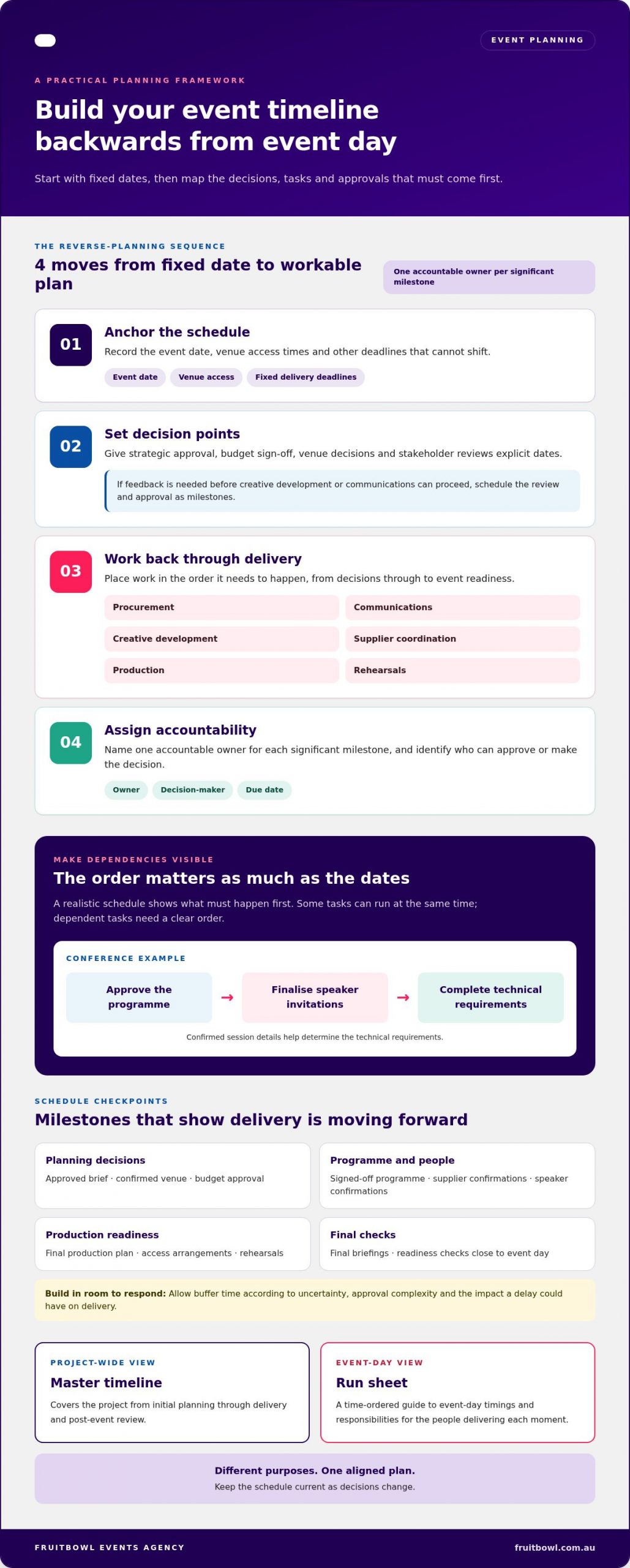
Begin with the confirmed event date, then work backwards to identify what must be ready before guests arrive. Mark immovable milestones first, including venue access, final approvals, production readiness and fixed delivery deadlines. Then add the decisions and tasks that lead to each milestone. This reverse sequence exposes unrealistic assumptions early, before they become urgent issues for suppliers or stakeholders.

For how to create a realistic event timeline, map the relationships between tasks rather than simply filling in dates. A conference may need an approved programme before speaker invitations are finalised, and confirmed session details before technical requirements can be completed. Some work can happen at the same time, but dependent tasks need a clear order.

  1. Anchor the schedule. Record the event date, venue access times and other deadlines that cannot shift.
  2. Set decision points. Add dates for strategic approval, budget sign-off, venue decisions and stakeholder reviews.
  3. Work back through delivery. Schedule procurement, communications, creative development, supplier coordination, production and rehearsals in the order each needs to happen.
  4. Assign accountability. Give each significant milestone one accountable owner and identify who has authority to approve or make the decision.

Which milestones should anchor the schedule?

Choose milestones that confirm the event is progressing towards its objectives, not just completing administrative tasks. Depending on the event, these may include an approved brief, confirmed venue, budget approval, signed-off programme, supplier and speaker confirmations, and final production plan. Add final briefings, access arrangements, rehearsals and readiness checks close to event day, with enough time to act on anything they uncover.

Give stakeholder review points explicit dates. If feedback is needed before creative development or communications can proceed, schedule the review and approval as milestones in their own right. This makes the decision deadline visible and clarifies who needs to respond.

How do dependencies change the order of work?

Use critical path thinking to identify the chain of dependent tasks that determines the earliest feasible completion date. For each task, ask what must be finished first and what the task will unlock. Venue confirmation may enable production planning; approved creative may be needed before communications are released; confirmed speaker requirements may shape technical direction. Tasks without these links can often proceed in parallel, as long as they have separate owners and do not rely on the same unresolved decision.

A delayed critical task can shift every dependent activity that follows, including approvals, bookings, creative development and technical planning. A delay to an independent task may be contained without changing the event date. Make the links visible in the schedule and review them whenever a milestone moves.

For complex corporate events, conferences, festivals and activations, end-to-end event planning and delivery connects strategic decisions with logistics and on-site coordination, helping keep the working schedule aligned with the intended outcome.

How much buffer should an event timeline allow?

A realistic schedule does not use every available day. If each task is planned to finish at the last possible moment, one late approval or technical change can put connected work under pressure. Buffer time creates room to absorb uncertainty while protecting the milestones that matter most.

There is no single buffer that suits every task. Set the allowance according to how predictable the work is, how many people need to approve it and what a delay could affect. Finalising a draft agenda may be relatively easy to estimate. Completing technical integration may depend on confirmed content, equipment requirements and venue access. Treating both tasks the same can leave the higher-risk milestone exposed.

What makes an event task difficult to estimate?

Estimates become less certain when a task relies on several inputs or contributors. Stakeholder review may involve multiple approval layers, while supplier, speaker or talent responses can influence what happens next. Changes to event scope can also affect venue arrangements, production requirements and communications already in progress.

Separate confirmed dates from estimates that still depend on a decision or external input. For example, a venue access time may be confirmed while the duration of technical integration remains an estimate until production requirements are settled. Label the difference clearly so the team does not mistake a working assumption for a commitment.

How should contingency time be allocated?

Place buffer before a high-impact milestone, where it can protect the work that follows. If production cannot be finalised until an approval is received, allow time for review and revisions before that deadline. Adding spare days indiscriminately to every task can make the plan harder to manage and conceal where the actual uncertainty sits.

Buffer placement should follow risk and dependency, not habit. Use a risk register to put this into practice. Record the risk, its potential effect, the person responsible for monitoring it, the planned mitigation and the review date. A possible speaker cancellation, for instance, may require a decision about an alternative and a clear process for updating the programme and affected teams.

Contingency planning should protect delivery, not excuse avoidable delay. If a task is late because its owner has not acted or a decision has not been escalated, adding more time will not resolve the cause. Check actual progress against the schedule, identify whether the delay affects dependent work, and agree who will make or communicate the next decision.

Use this simple classification to decide how each date should appear in the schedule:

Task type How to schedule it Example
Fixed-date task Record the confirmed deadline and work backwards from it. Event date or confirmed venue access.
Estimated-duration task Show the estimate as provisional and review it when key inputs are known. Technical integration pending final requirements.
Flexible activity Set a target window and identify what could cause it to move. Internal review that can happen alongside other work.

This distinction is central to how to create a realistic event timeline: keep fixed commitments visible, make uncertain estimates explicit and place contingency where it can protect critical delivery.
How to Create a Realistic Event Timeline: A Practical Guide

How to turn the plan into a working event schedule

A master timeline only guides delivery if the people doing the work can use it. Set up one shared schedule as the source of truth, whether it sits in a project tool or a structured spreadsheet. Use consistent fields so the team can quickly see what needs attention and where a change could have consequences.

  • Task and deliverable: State what must be completed, using a clear outcome rather than a vague activity.
  • Owner and decision-maker: Identify who will progress the work and who can approve it.
  • Due date and dependency: Record the target date and any task or decision that must happen first.
  • Status and next action: Show whether work is on track, at risk or overdue, and what happens next.
  • Decision record: Note approvals, changes and the date they were agreed.

This structure turns how to create a realistic event timeline into an ongoing management practice. A decision to change a conference session, for example, may affect speaker communications, room allocations and AV requirements. Record the decision, who owns it and which follow-up tasks it changes. The team can then update dates and responsibilities with a clear understanding of the impact.

For a wider view of how objectives, planning decisions and delivery fit together, a corporate event management framework can help keep schedule activity aligned with the event’s purpose.

How should teams assign timeline ownership?

Name one accountable owner for every significant deliverable, even if several people contribute. A RACI matrix can clarify who is Responsible for completing the work, Accountable for its outcome, Consulted before a decision and Informed of progress. Make approval authority explicit. For complex conference schedules, coordination across the venue, speakers, suppliers and production can be informed by the conference logistics coordinator role.

How do you keep the timeline current?

Set a review rhythm that suits the project and its pace. At each review, check upcoming deadlines, overdue work, decisions awaiting approval and dependencies affected by recent changes. Use version control, date significant updates and make it clear which file or platform is authoritative. This prevents teams from working from conflicting schedules.

If a critical-path task slips, escalate it promptly with the impact, available options, decision-maker and latest date for a response. A delayed technical specification, for instance, may require a revised production sequence or an agreed alternative. Link production-dependent milestones to AV management for events so technical decisions remain connected to the wider schedule.

Fruitbowl Events Agency brings planning, logistics coordination and on-site delivery together for events across Australia. Fruitbowl’s event planning and delivery connects schedule ownership with the practical demands of execution.

How event teams deliver the timeline on the day

On event day, the approved project timeline becomes a practical operating guide. Its delivery milestones are translated into a timed, role-specific run sheet that tells each team what happens, where it happens and who is responsible. This connects planning with live coordination: speakers, talent, suppliers, technical teams and stakeholders work to shared timings rather than separate assumptions. This applies equally across corporate functions and milestone celebrations like weddings, where ceremony providers such as Stephen Brady Irish Celebrant rely on exact cues to ensure proceedings run smoothly.

Keep one authorised person responsible for approving schedule changes, with a clear escalation path for urgent decisions. If a speaker is delayed, for example, the team needs to know who can approve a revised sequence, who updates the technical and front-of-house teams, and how the change will be communicated to affected stakeholders. Record the decision and use a single controlled run sheet so outdated versions do not continue circulating.

What should the event-day run sheet contain?

Build the run sheet around the sequence of event activity, with enough operational detail for each role to act without ambiguity. Include timings, activity descriptions, locations, responsible roles and communication cues. Record transitions, supplier access windows, technical checks and relevant contingency actions. Specify who owns updates and how teams will receive the controlled version.

  • Timing and activity: Include start times, durations where useful, and clear cues for each session or transition.
  • Location and access: Note where the activity takes place and when relevant teams can enter or move equipment.
  • Role and communication: Name the responsible role and specify who needs to be alerted before the next cue.
  • Checks and contingencies: Include technical readiness checks and practical alternatives for activities that could be disrupted.

Sequence supplier arrivals to reduce setup congestion. For instance, infrastructure can be scheduled before AV, followed by décor, where that order suits the event’s logistics. Similarly, in large-scale private events or weddings, media teams like One Vision Photography | South Wales Wedding Photographer rely on coordinated access windows and run sheets to film smoothly without interrupting the main programme. Check that access windows, technical checks and handovers fit together before distributing the run sheet. The schedule is useful only if the people delivering it can see their actions and timings clearly.

How does Fruitbowl connect planning with delivery?

Fruitbowl Events Agency brings strategic planning, logistics coordination and on-site delivery together across corporate events, festivals, conferences and activations. Stakeholder liaison, venue requirements and production decisions inform the schedule, while technical direction and entertainment coordination align with the wider delivery plan. This joined-up approach helps teams work from the same event priorities, from preparation through live execution.

With more than 28 years of event industry experience, Fruitbowl understands how planning decisions carry through to delivery. The run sheet gives the team a shared operational reference, while on-site coordination helps keep roles, timings and approved updates connected as the event unfolds. That is the practical outcome of how to create a realistic event timeline: a plan that remains useful from preparation through delivery.

To discuss connecting your event plan with on-site delivery, Discuss your event with Fruitbowl.

Put your next event milestone in motion

A timeline earns its value through the decisions it helps your team make. Treat it as a live coordination tool, and use each review to confirm what needs attention, who will act and whether a change affects the event’s objectives. That discipline keeps planning connected to delivery without making the schedule rigid.

If you’re deciding how to create a realistic event timeline for an upcoming corporate event, conference, festival or activation, start with the next decision that could hold up progress. Clarify its owner, approval path and impact on dependent work. Then keep that information visible to the people responsible for moving the plan forward.

Fruitbowl Events Agency brings end-to-end planning, logistics coordination and on-site delivery, backed by more than 28 years of event industry experience. Discuss your event with Fruitbowl and take a considered next step towards a schedule your team can deliver with confidence.

Frequently Asked Questions

How far in advance should you create an event timeline?

Create it as soon as the event date and objectives are being established, then add detail as decisions become clearer. Knowing how to create a realistic event timeline includes matching the planning period to the event’s scale: a large conference or trade show may need a year or more, while a 200-person annual conference may require 12 to 18 months. A smaller quarterly team gathering for 30 people may need about 6 to 8 weeks. Use these as guides, not fixed rules.

What is the difference between an event timeline and a run sheet?

An event timeline tracks the project across planning, approvals, procurement, communications, delivery and post-event work; a run sheet focuses on the live event sequence. For example, the timeline might track approval of a keynote brief weeks ahead, while the run sheet shows the speaker’s arrival, sound check and stage cue on the day. Keep the run sheet consistent with the approved plan, particularly after programme changes.

How do you create an event timeline for a conference?

Build a conference timeline around the agenda and the decisions that shape it. Map the event date, venue and approval gates, then schedule session development, speaker confirmation, registration communications, production design, technical checks and rehearsals. Set clear deadlines for reviewing speaker materials and receiving final presentations. A 200-person annual conference may need 12 to 18 months of planning, giving teams time to coordinate content, logistics and production.

What should you do when an event task falls behind schedule?

Establish what is late, why it is late and which later work depends on it. Ask the task owner for a recovery estimate, then give the decision-maker practical options, such as reallocating work, changing the sequence or approving a scope adjustment. Once the impact is understood, document the decision, update the schedule and notify affected contributors. If a fixed event-day commitment is at risk, escalate it promptly rather than quietly shifting dates.

Who should be responsible for maintaining an event timeline?

Assign a project lead or event manager to maintain the master schedule, while each deliverable owner updates their own progress. The schedule maintainer records approved changes, checks for conflicts and flags emerging risks; they should not have to guess whether a task is complete. Name a decision-maker for each major approval and agree who needs progress updates. This keeps the schedule current without making one person responsible for every deliverable.

Can an event timeline change after suppliers and speakers are confirmed?

Yes. Confirmed suppliers and speakers do not make a schedule unchangeable; scope, content, access or technical requirements may still shift. Before adjusting a commitment, assess the effect on connected timings, costs, agreements and stakeholder communications. Route the change through the authorised decision-maker, then issue a dated update to affected teams. If a speaker is replaced, for example, check the programme duration and technical requirements before revising the run sheet.

How often should an event timeline be reviewed?

Set a regular review rhythm that reflects the event’s pace and risk, and schedule an additional check after major decisions or scope changes. As event day approaches, review more frequently so owners can address emerging issues before they affect delivery. Each review should identify upcoming tasks, blocked decisions and changes since the previous check, then record actions and owners. On the day, use operational briefings to align teams with the current run sheet.

A realistic event timeline often starts at the finish line. Learning how to create a realistic event timeline means working backwards from the event date, then testing each milestone against the tasks, decisions and approvals that must come first.

A schedule can look clear on paper and still unravel when ownership is unclear, deadlines overlap or a late change affects suppliers, speakers or technical production. A useful timeline does more than list dates. It links event objectives to delivery milestones and gives the team a shared way to manage delays and updates.

This guide explains how to build that structure, from setting objectives and fixing key dates to assigning owners, mapping dependencies and allowing time for approvals. It also covers contingency planning, phased schedules and the event-day run sheet, so your plan can adapt without losing control of delivery.

Fruitbowl Events Agency brings strategic planning, logistics coordination and on-site delivery together. With more than 28 years of event industry experience, the team understands how to create a timeline that can be maintained before and during an event, with clear responsibilities and a considered response when plans change.

Key Takeaways

  • Learn how to create a realistic event timeline by linking event objectives to achievable milestones, owners and dependencies.
  • Work backwards from event day to map approvals, procurement, communications, production and readiness deadlines.
  • Allow buffer time according to uncertainty, approval complexity and the impact a delay could have on delivery.
  • Build a shared schedule that records task owners, due dates, dependencies, status and decisions, then review it regularly.
  • Turn the approved project plan into a role-specific run sheet that keeps speakers, suppliers and technical teams aligned on the day.

What makes an event timeline realistic, rather than just well organised?

A well-organised timeline can still be unrealistic if it assigns dates without checking what must happen first, who is responsible or how long decisions may take. A realistic event timeline is a sequenced working plan with accountable owners, visible dependencies and achievable dates. It connects the event’s objectives to the approvals, budget controls and delivery milestones needed to achieve them.

That distinction matters for corporate events, conferences, festivals and activations. If a conference programme needs approval before speaker invitations go out, show that dependency in the schedule rather than giving both tasks arbitrary, overlapping deadlines. The team can then spot the risk while there is still time to respond.

A timeline also gives stakeholders a shared view of progress. It shows whether venue sourcing, budget decisions, content development and technical planning are advancing in step, and highlights where an outstanding decision could affect readiness. For a general introduction to chronological planning, see What is a Timeline? In event planning, the value comes from making dates and dependencies useful for decisions, not simply recording them.

What belongs in an event timeline?

Start with the major phases, then break each phase into milestones and practical tasks. For every item, make clear who is accountable, what needs to be completed and by when. Distinguish between dates that cannot move and targets the team can manage.

  • Fixed event dates: The event date and any other immovable delivery deadlines.
  • Milestones and tasks: Key outcomes such as confirming the venue, approving the programme or completing production planning.
  • Owners and decision deadlines: The person responsible for each task and the date a stakeholder needs to approve or decide.
  • Dependencies: The link between tasks, such as finalising a session schedule before preparing detailed technical requirements.
  • Internal target dates: Working deadlines set ahead of external or fixed dates to allow time for review and follow-up.

These distinctions prevent a common planning blind spot: treating every date as equally flexible. If budget approval is required before commitments can be made, show it as a milestone. If approval is delayed, the team can assess which connected tasks need to move instead of discovering the consequences later.

How is a timeline different from a run sheet?

The master timeline covers the project from initial planning through delivery and post-event review. The run sheet is a time-ordered guide to what happens during the event, with timings and responsibilities relevant to the people delivering each moment.

They serve different purposes, but they must align. The approved timeline establishes the decisions and readiness milestones that make event day possible. The run sheet translates the event-day plan into coordinated timings for speakers, suppliers, technical teams and stakeholders. Keep the schedule current as decisions change, rather than creating it once and leaving it untouched. That is the practical foundation for how to create a realistic event timeline.

How to build an event timeline backwards from event day

Begin with the confirmed event date, then work backwards to identify what must be ready before guests arrive. Mark immovable milestones first, including venue access, final approvals, production readiness and fixed delivery deadlines. Then add the decisions and tasks that lead to each milestone. This reverse sequence exposes unrealistic assumptions early, before they become urgent issues for suppliers or stakeholders.

For how to create a realistic event timeline, map the relationships between tasks rather than simply filling in dates. A conference may need an approved programme before speaker invitations are finalised, and confirmed session details before technical requirements can be completed. Some work can happen at the same time, but dependent tasks need a clear order.

  1. Anchor the schedule. Record the event date, venue access times and other deadlines that cannot shift.
  2. Set decision points. Add dates for strategic approval, budget sign-off, venue decisions and stakeholder reviews.
  3. Work back through delivery. Schedule procurement, communications, creative development, supplier coordination, production and rehearsals in the order each needs to happen.
  4. Assign accountability. Give each significant milestone one accountable owner and identify who has authority to approve or make the decision.

Which milestones should anchor the schedule?

Choose milestones that confirm the event is progressing towards its objectives, not just completing administrative tasks. Depending on the event, these may include an approved brief, confirmed venue, budget approval, signed-off programme, supplier and speaker confirmations, and final production plan. Add final briefings, access arrangements, rehearsals and readiness checks close to event day, with enough time to act on anything they uncover.

Give stakeholder review points explicit dates. If feedback is needed before creative development or communications can proceed, schedule the review and approval as milestones in their own right. This makes the decision deadline visible and clarifies who needs to respond.

How do dependencies change the order of work?

Use critical path thinking to identify the chain of dependent tasks that determines the earliest feasible completion date. For each task, ask what must be finished first and what the task will unlock. Venue confirmation may enable production planning; approved creative may be needed before communications are released; confirmed speaker requirements may shape technical direction. Tasks without these links can often proceed in parallel, as long as they have separate owners and do not rely on the same unresolved decision.

A delayed critical task can shift every dependent activity that follows, including approvals, bookings, creative development and technical planning. A delay to an independent task may be contained without changing the event date. Make the links visible in the schedule and review them whenever a milestone moves.

For complex corporate events, conferences, festivals and activations, end-to-end event planning and delivery connects strategic decisions with logistics and on-site coordination, helping keep the working schedule aligned with the intended outcome.

How much buffer should an event timeline allow?

A realistic schedule does not use every available day. If each task is planned to finish at the last possible moment, one late approval or technical change can put connected work under pressure. Buffer time creates room to absorb uncertainty while protecting the milestones that matter most.

There is no single buffer that suits every task. Set the allowance according to how predictable the work is, how many people need to approve it and what a delay could affect. Finalising a draft agenda may be relatively easy to estimate. Completing technical integration may depend on confirmed content, equipment requirements and venue access. Treating both tasks the same can leave the higher-risk milestone exposed.

What makes an event task difficult to estimate?

Estimates become less certain when a task relies on several inputs or contributors. Stakeholder review may involve multiple approval layers, while supplier, speaker or talent responses can influence what happens next. Changes to event scope can also affect venue arrangements, production requirements and communications already in progress.

Separate confirmed dates from estimates that still depend on a decision or external input. For example, a venue access time may be confirmed while the duration of technical integration remains an estimate until production requirements are settled. Label the difference clearly so the team does not mistake a working assumption for a commitment.

How should contingency time be allocated?

Place buffer before a high-impact milestone, where it can protect the work that follows. If production cannot be finalised until an approval is received, allow time for review and revisions before that deadline. Adding spare days indiscriminately to every task can make the plan harder to manage and conceal where the actual uncertainty sits.

Buffer placement should follow risk and dependency, not habit. Use a risk register to put this into practice. Record the risk, its potential effect, the person responsible for monitoring it, the planned mitigation and the review date. A possible speaker cancellation, for instance, may require a decision about an alternative and a clear process for updating the programme and affected teams.

Contingency planning should protect delivery, not excuse avoidable delay. If a task is late because its owner has not acted or a decision has not been escalated, adding more time will not resolve the cause. Check actual progress against the schedule, identify whether the delay affects dependent work, and agree who will make or communicate the next decision.

Use this simple classification to decide how each date should appear in the schedule:

Task type How to schedule it Example
Fixed-date task Record the confirmed deadline and work backwards from it. Event date or confirmed venue access.
Estimated-duration task Show the estimate as provisional and review it when key inputs are known. Technical integration pending final requirements.
Flexible activity Set a target window and identify what could cause it to move. Internal review that can happen alongside other work.

This distinction is central to how to create a realistic event timeline: keep fixed commitments visible, make uncertain estimates explicit and place contingency where it can protect critical delivery.

How to turn the plan into a working event schedule

A master timeline only guides delivery if the people doing the work can use it. Set up one shared schedule as the source of truth, whether it sits in a project tool or a structured spreadsheet. Use consistent fields so the team can quickly see what needs attention and where a change could have consequences.

  • Task and deliverable: State what must be completed, using a clear outcome rather than a vague activity.
  • Owner and decision-maker: Identify who will progress the work and who can approve it.
  • Due date and dependency: Record the target date and any task or decision that must happen first.
  • Status and next action: Show whether work is on track, at risk or overdue, and what happens next.
  • Decision record: Note approvals, changes and the date they were agreed.

This structure turns how to create a realistic event timeline into an ongoing management practice. A decision to change a conference session, for example, may affect speaker communications, room allocations and AV requirements. Record the decision, who owns it and which follow-up tasks it changes. The team can then update dates and responsibilities with a clear understanding of the impact.

For a wider view of how objectives, planning decisions and delivery fit together, a corporate event management framework can help keep schedule activity aligned with the event’s purpose.

How should teams assign timeline ownership?

Name one accountable owner for every significant deliverable, even if several people contribute. A RACI matrix can clarify who is Responsible for completing the work, Accountable for its outcome, Consulted before a decision and Informed of progress. Make approval authority explicit. For complex conference schedules, coordination across the venue, speakers, suppliers and production can be informed by the conference logistics coordinator role.

How do you keep the timeline current?

Set a review rhythm that suits the project and its pace. At each review, check upcoming deadlines, overdue work, decisions awaiting approval and dependencies affected by recent changes. Use version control, date significant updates and make it clear which file or platform is authoritative. This prevents teams from working from conflicting schedules.

If a critical-path task slips, escalate it promptly with the impact, available options, decision-maker and latest date for a response. A delayed technical specification, for instance, may require a revised production sequence or an agreed alternative. Link production-dependent milestones to AV management for events so technical decisions remain connected to the wider schedule.

Fruitbowl Events Agency brings planning, logistics coordination and on-site delivery together for events across Australia. Fruitbowl’s event planning and delivery connects schedule ownership with the practical demands of execution.

How event teams deliver the timeline on the day

On event day, the approved project timeline becomes a practical operating guide. Its delivery milestones are translated into a timed, role-specific run sheet that tells each team what happens, where it happens and who is responsible. This connects planning with live coordination: speakers, talent, suppliers, technical teams and stakeholders work to shared timings rather than separate assumptions.

Keep one authorised person responsible for approving schedule changes, with a clear escalation path for urgent decisions. If a speaker is delayed, for example, the team needs to know who can approve a revised sequence, who updates the technical and front-of-house teams, and how the change will be communicated to affected stakeholders. Record the decision and use a single controlled run sheet so outdated versions do not continue circulating.

What should the event-day run sheet contain?

Build the run sheet around the sequence of event activity, with enough operational detail for each role to act without ambiguity. Include timings, activity descriptions, locations, responsible roles and communication cues. Record transitions, supplier access windows, technical checks and relevant contingency actions. Specify who owns updates and how teams will receive the controlled version.

  • Timing and activity: Include start times, durations where useful, and clear cues for each session or transition.
  • Location and access: Note where the activity takes place and when relevant teams can enter or move equipment.
  • Role and communication: Name the responsible role and specify who needs to be alerted before the next cue.
  • Checks and contingencies: Include technical readiness checks and practical alternatives for activities that could be disrupted.

Sequence supplier arrivals to reduce setup congestion. For instance, infrastructure can be scheduled before AV, followed by décor, where that order suits the event’s logistics. Check that access windows, technical checks and handovers fit together before distributing the run sheet. The schedule is useful only if the people delivering it can see their actions and timings clearly.

How does Fruitbowl connect planning with delivery?

Fruitbowl Events Agency brings strategic planning, logistics coordination and on-site delivery together across corporate events, festivals, conferences and activations. Stakeholder liaison, venue requirements and production decisions inform the schedule, while technical direction and entertainment coordination align with the wider delivery plan. This joined-up approach helps teams work from the same event priorities, from preparation through live execution.

With more than 28 years of event industry experience, Fruitbowl understands how planning decisions carry through to delivery. The run sheet gives the team a shared operational reference, while on-site coordination helps keep roles, timings and approved updates connected as the event unfolds. That is the practical outcome of how to create a realistic event timeline: a plan that remains useful from preparation through delivery.

To discuss connecting your event plan with on-site delivery, Discuss your event with Fruitbowl.

Put your next event milestone in motion

A timeline earns its value through the decisions it helps your team make. Treat it as a live coordination tool, and use each review to confirm what needs attention, who will act and whether a change affects the event’s objectives. That discipline keeps planning connected to delivery without making the schedule rigid.

If you’re deciding how to create a realistic event timeline for an upcoming corporate event, conference, festival or activation, start with the next decision that could hold up progress. Clarify its owner, approval path and impact on dependent work. Then keep that information visible to the people responsible for moving the plan forward.

Fruitbowl Events Agency brings end-to-end planning, logistics coordination and on-site delivery, backed by more than 28 years of event industry experience. Discuss your event with Fruitbowl and take a considered next step towards a schedule your team can deliver with confidence.

Frequently Asked Questions

How far in advance should you create an event timeline?

Create it as soon as the event date and objectives are being established, then add detail as decisions become clearer. Knowing how to create a realistic event timeline includes matching the planning period to the event’s scale: a large conference or trade show may need a year or more, while a 200-person annual conference may require 12 to 18 months. A smaller quarterly team gathering for 30 people may need about 6 to 8 weeks. Use these as guides, not fixed rules.

What is the difference between an event timeline and a run sheet?

An event timeline tracks the project across planning, approvals, procurement, communications, delivery and post-event work; a run sheet focuses on the live event sequence. For example, the timeline might track approval of a keynote brief weeks ahead, while the run sheet shows the speaker’s arrival, sound check and stage cue on the day. Keep the run sheet consistent with the approved plan, particularly after programme changes.

How do you create an event timeline for a conference?

Build a conference timeline around the agenda and the decisions that shape it. Map the event date, venue and approval gates, then schedule session development, speaker confirmation, registration communications, production design, technical checks and rehearsals. Set clear deadlines for reviewing speaker materials and receiving final presentations. A 200-person annual conference may need 12 to 18 months of planning, giving teams time to coordinate content, logistics and production.

What should you do when an event task falls behind schedule?

Establish what is late, why it is late and which later work depends on it. Ask the task owner for a recovery estimate, then give the decision-maker practical options, such as reallocating work, changing the sequence or approving a scope adjustment. Once the impact is understood, document the decision, update the schedule and notify affected contributors. If a fixed event-day commitment is at risk, escalate it promptly rather than quietly shifting dates.

Who should be responsible for maintaining an event timeline?

Assign a project lead or event manager to maintain the master schedule, while each deliverable owner updates their own progress. The schedule maintainer records approved changes, checks for conflicts and flags emerging risks; they should not have to guess whether a task is complete. Name a decision-maker for each major approval and agree who needs progress updates. This keeps the schedule current without making one person responsible for every deliverable.

Can an event timeline change after suppliers and speakers are confirmed?

Yes. Confirmed suppliers and speakers do not make a schedule unchangeable; scope, content, access or technical requirements may still shift. Before adjusting a commitment, assess the effect on connected timings, costs, agreements and stakeholder communications. Route the change through the authorised decision-maker, then issue a dated update to affected teams. If a speaker is replaced, for example, check the programme duration and technical requirements before revising the run sheet.

How often should an event timeline be reviewed?

Set a regular review rhythm that reflects the event’s pace and risk, and schedule an additional check after major decisions or scope changes. As event day approaches, review more frequently so owners can address emerging issues before they affect delivery. Each review should identify upcoming tasks, blocked decisions and changes since the previous check, then record actions and owners. On the day, use operational briefings to align teams with the current run sheet.

Back to Articles
Request A Quote

Make an
Enquiry

Untitled design

What Makes Us Different?

True end-to-end solution so you can hand off to us, focus on your priorities and enjoy the event without any stress

Unmatched industry expertise looking after diverse range of high-profile events, cultural festivals & activations

Meticulous attention to every detail and precise execution of events with our streamlined processes

Tailored solutions with bespoke strategies to ensure we align with your brand and objectives

Make an Enquiry

  • This field is for validation purposes and should be left unchanged.
  • This field is for validation purposes and should be left unchanged.