A game can attract attention without creating a meaningful brand interaction. That’s the risk when gamification for brand activations is treated as entertainment first and brand strategy second. A useful mechanic reflects the brand objective and audience, while fitting the event setting and the time participants have to engage.
It’s reasonable to ask whether a quick game will lead to genuine engagement or add complexity for creative, technical and operational teams. A smooth experience depends on more than the game itself. Participants need a clear reason to take part, simple instructions, accessible ways to join and a considered path from first interaction to follow-up.
This guide explains how to choose a mechanic that supports your objective, design an inclusive participant journey and coordinate delivery requirements before launch. It also covers how to define success measures in advance, so you can assess attention and brand engagement against the activation’s purpose. From concept to on-site delivery and measurement, the goal is to make the brand promise playable, measurable and practical to deliver.
Key Takeaways
- Compare QR-led quests, live quizzes, spin-to-win and facilitated challenges by participant effort, throughput, staffing and technology needs.
- Use gamification for brand activations to make the brand promise tangible, not to add a game that feels disconnected from the experience.
- Plan for practical friction points, including queues, unclear instructions and unnecessary data collection, before they affect participation.
- Distinguish activity outputs, such as game completions, from outcomes that indicate meaningful brand engagement.
- Coordinate creative, technical, logistical and on-site requirements so the experience works as one cohesive activation.
What gamification for brand activations is and what it should achieve
Gamification for brand activations is the use of game mechanics to encourage a specific, purposeful action within a branded experience. Those mechanics might include progress, choice, challenge, points or rewards. The broader concept of gamification describes how game-design elements can be applied beyond games. In an activation, their value depends on how they support the participant experience and brand objective.
An activity isn’t automatically useful just because it’s interactive. A game without a clear connection to the brand, audience or event can attract attention while leaving participants unsure why they took part. Start with the intended behaviour: should people discover a product, join an activity, share their details or recall a key message? The mechanic should give them a clear, relevant reason to take that step.
Participation is an activity measure, not proof of brand impact. A completed quiz or collected score shows that someone took part. It doesn’t establish that they understood or remembered the message, or became a qualified lead. Decide what evidence would indicate progress towards the objective, and distinguish it from simple completion counts.
How game mechanics support an activation objective
Connect each mechanic to one primary behaviour. A progress bar can help participants follow a multi-step product discovery journey. A choice of challenge can give them control over how they engage. A quiz can prompt recall of a specific message. Keep the interaction easy to understand, with instructions that make the next action clear.
Visual language matters too. If the game’s imagery, wording and feedback could belong to any brand, the experience may feel detached from the message. Use design and interaction to reinforce the idea participants should take away, rather than adding points or prizes without a clear purpose.
When gamification strengthens the participant experience
Consider who is likely to take part, what motivates them, how long they may have and how the event setting affects interaction. A longer challenge may suit an audience with time to explore, while a quick prompt can work better where people are moving through or waiting briefly. Choose a level of interaction participants can understand and complete comfortably.
Sometimes a simple interactive prompt is more effective than a game. If the objective is a single response or a short conversation, extra steps may add friction without adding value. For broader context on aligning the experience with event aims and delivery, see the brand activation event planning guide.
Match a gamification mechanic to your brand activation
The right mechanic depends on the behaviour you want to encourage and the conditions participants will encounter. A QR-led quest may invite people to explore several parts of an activation, while a live quiz can bring an audience together around a shared message. Neither format guarantees engagement or conversion. Each needs to suit the audience, setting and delivery capacity.
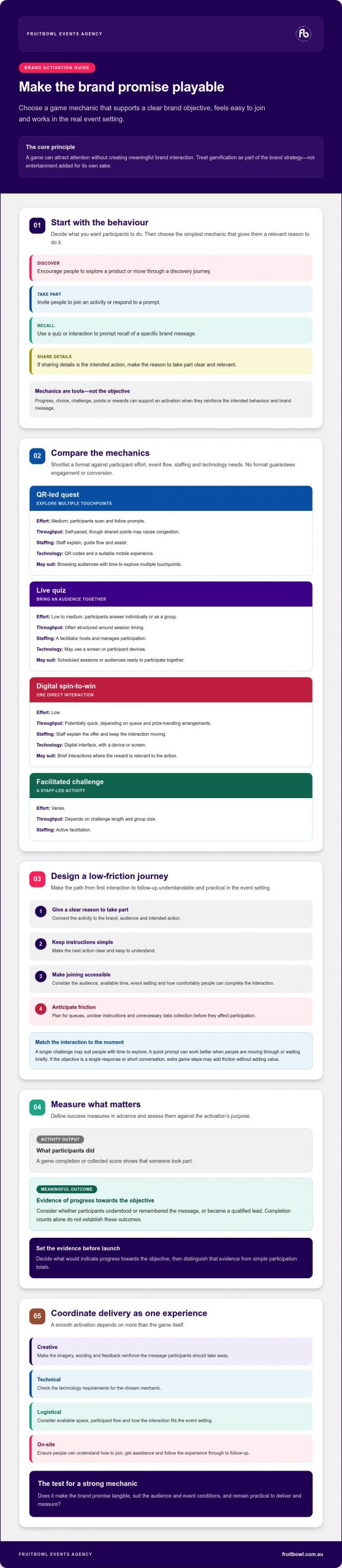
Choose the simplest mechanic that supports the intended behaviour. Use this comparison to shortlist options, then test your choice against participant effort, available space and staffing.
| Format | Audience effort | Potential throughput | Staffing | Technology | May suit |
|---|---|---|---|---|---|
| QR-led quest | Medium; participants scan and follow prompts | Self-paced, though shared points may cause congestion | Staff to explain, guide flow and assist | QR codes and a suitable mobile experience | Browsing audiences with time to explore multiple touchpoints |
| Live quiz | Low to medium; answer individually or as a group | Often structured around session timing | A facilitator to host and manage participation | May use a screen or participant devices | Scheduled sessions or audiences ready to participate together |
| Digital spin-to-win | Low; one direct interaction | Potentially quick, depending on queue and prize-handling arrangements | Staff to explain the offer and keep the interaction moving | Digital interface, with a device or screen | Brief interactions where the reward is relevant to the action |
| Facilitated challenge | Varies; participants follow a staff-led activity | Depends on challenge length and group size | Active facilitation is central | Can be low-tech or supported by digital tools | Hands-on experiences where conversation or demonstration matters |
Which activation game format suits your audience and setting?
First, consider whether people are passing through, browsing at their own pace or attending a scheduled session. Then assess group participation, queue tolerance, accessibility needs and staff capacity. QR codes can direct participants to a mobile task. NFC may offer another tap-based route where compatible devices are available. A staff-led option can provide guidance without requiring each participant to use a device. Plan an alternative for people who can’t or prefer not to use a phone.
How to keep the game recognisably connected to the brand
Let the brand proposition shape the challenge, prompts, visual cues and choices. If a prize becomes the main attraction, participants may remember the incentive rather than the product or message. Keep the reward relevant, explain the terms clearly and make its value proportionate to the action requested. Staff should be able to describe the interaction briefly and consistently. If it takes a long explanation, simplify it.
These choices sit alongside broader creative and operational decisions. For support connecting activation concepts with delivery planning, explore how Fruitbowl approaches brand activations.
How to prevent gamification from feeling gimmicky or creating friction
A game feels gimmicky when it asks for attention without earning it. The activity may be disconnected from the brand, the audience or the reason people are at the event. Thoughtful gamification for brand activations should make the intended interaction clearer or more worthwhile, not add steps for their own sake. Balance the benefit of active participation against practical risks such as queues, confusing instructions and collecting more personal information than the experience needs.
Map the participant journey before finalising the game. Check what happens at each stage:
- Invitation: Can people tell at a glance what the activity is and whether it’s for them?
- Instructions: Is the first action obvious, and can staff explain it consistently?
- Participation: Can people complete the activity without unnecessary waiting, technical hurdles or pressure to share information?
- Completion: Do participants know they’ve finished and what, if anything, they receive?
- Follow-up: Is any next step relevant, clearly explained and connected to the purpose of the interaction?
Before launch, check that the experience is relevant to the brand, clear to participants, inclusive in its design and feasible to deliver on the event floor.
How to make participation clear, accessible and worthwhile
Use plain-language instructions, visible next steps and a straightforward explanation of any reward or outcome. Don’t assume everyone can or wants to use a personal device. Consider a staff-supported or non-digital way to participate, and make sure choosing that alternative doesn’t leave someone out of the experience.
Review physical access, language, sensory demands and participation options with relevant specialists. Consider whether instructions can be read and understood easily, whether the activity requires standing or fine motor control, and whether sound or visual effects could create barriers. The right adjustments depend on the audience and setting, so assess them during planning rather than treating accessibility as a final check.
How to manage technology, data and event-floor risks
Test the full interaction using the devices and connection conditions expected at the venue. Plan for power needs, technical support and a fallback activity if the digital experience is unavailable. Rehearse staff instructions and the handover between each participant step. Small points of confusion can slow the whole flow.
Collect only information needed for a stated purpose, explain that purpose to participants and verify which privacy requirements apply before launch. Separately, model queue and staffing needs against expected attendance. Treat these as estimates, then review them against the activity’s completion time, space and likely peak periods. A clear operational plan protects the experience without making the game more complicated than it needs to be.
How to plan and measure a gamified brand activation
Build measurement into the plan, not as an afterthought. For gamification for brand activations, agree on the behaviour you want to encourage, how you’ll recognise it and who will review the results before the experience goes live. This gives creative and delivery teams a shared brief and helps distinguish activity from evidence of progress towards the brand objective.
A practical sequence for developing the experience
- Define the audience and objective. Specify who the activation is for, what the brand needs to achieve and the particular action participants should take. For example, if the aim is product discovery, define what a participant should explore or learn.
- Select the mechanic and map delivery. Choose a format that supports that action. Map each participant step, then confirm the space, technology, staffing, accessibility considerations and fallback arrangements required to deliver it.
- Prototype, test and brief. Draft the instructions and test the complete experience with the intended devices and event conditions where possible. Check that the interaction is understandable, tracking works as intended and teams know their roles before launch. Rehearse the participant flow, not just the technology.
Agree on a baseline before the activation begins. This might be an existing measure related to the objective or a clearly documented starting point for comparison. Decide what will be tracked, how it will be recorded and who owns each part of the process. Set the reporting timeframe in advance, including when the client team will review the findings and capture lessons for future activations.
Which measures show whether the activation worked?
Separate outputs, which describe activity, from outcomes, which relate to the objective. Depending on the mechanic and available tracking, outputs could include starts, completions and points where participants drop off. Outcomes might include qualified engagement, product discovery or message recall, measured using an appropriate method agreed with the client team.
Completions alone don’t show that a brand message was understood or remembered. Pair interaction data with relevant brand or business measures, and describe any relationship carefully. A change observed during an activation doesn’t, on its own, prove the game caused it.
Before collecting information, confirm what data is needed, how participants will be informed and who is responsible for access, reporting and handling the results. Align these decisions with the client team and verify applicable privacy requirements before launch. A clear measurement plan makes post-event evaluation more useful and helps identify what to refine.
For coordinated planning and delivery of a brand activation, discuss your activation requirements with Fruitbowl.
How an experienced event partner brings gamification to life
A gamified activation may involve brand and marketing teams, creative contributors, technical suppliers, venue contacts and on-site staff. Whether you rely on an in-house department or collaborate with outsourced marketing specialists like Marketing Angels, working from a shared brief is essential to prevent the participant experience from becoming fragmented. An event partner can help bring these moving parts together, aligning the creative idea with the practical requirements of delivering it.
This is particularly useful when gamification for brand activations spans multiple teams, technologies or event locations. The game mechanic is only one part of the plan. Participant flow, technical production, staff roles and contingency arrangements all need to support the same objective, from the first invitation through to completion.
What to include in an activation delivery brief
A clear brief gives each contributor a shared reference point. Document the objective, intended audience, brand requirements, event conditions, timeline and success measures. Then specify what the experience needs to function, including creative assets, technical requirements, staffing, accessibility considerations and fallback arrangements.
Set out who makes decisions, which approvals are needed and when, who owns each task, and how issues should be escalated. This clarity helps teams identify dependencies early, such as an approval needed before a digital interaction can be tested. It also gives event staff a practical basis for answering questions and guiding participants consistently.
How end-to-end coordination supports reliable execution
Creative design, logistics, technical direction and on-site delivery need to be planned as connected parts of the activation. A change to the game’s instructions, for example, may affect screen content, staff briefings or participant movement. Coordinated planning helps ensure the final experience remains faithful to the brand idea while working within the event’s operational conditions.
Fruitbowl Events Agency provides end-to-end event planning, logistics coordination, technical production and on-site delivery across Australia. For a gamified activation, this kind of integrated event support can help align client stakeholders, suppliers and delivery teams while keeping the participant journey in view.
If you’re planning an activation, share your objectives, audience, timing and delivery requirements with Fruitbowl to discuss your brand activation requirements.
Turn a clear objective into a considered activation
Effective gamification for brand activations starts with a participant action that supports the brand objective. Choose a mechanic that suits the audience and event setting, then make the experience easy to understand and practical to deliver. Set success measures before launch, and distinguish participation counts from evidence of meaningful engagement.
Creative ambition works best when supported by clear coordination across planning, production and on-site delivery. Fruitbowl Events Agency provides end-to-end event planning, production coordination and on-site delivery to help bring creative concepts and operational requirements together.
To discuss your activation objectives, audience, timing and delivery requirements, contact Fruitbowl’s brand activation team. A clear plan and coordinated delivery can help create an experience that gives participants a genuine reason to engage.
Frequently Asked Questions
What is gamification for brand activations?
Gamification for brand activations means using game mechanics to encourage a purposeful action within a branded experience. The mechanic might invite people to explore, make a choice, answer a question or complete a challenge. Its role is to help participants engage with the brand objective, not simply add entertainment. A useful test is whether the activity makes the intended interaction clearer or more rewarding for the audience.
How do you gamify a brand activation?
Start by identifying the audience and the action you want the activation to prompt. Choose a mechanic that makes that action understandable, then map the participant’s steps from invitation to completion. Check the format against the event setting, staffing, technology and accessibility needs. Before launch, test the instructions and interaction with the people who’ll deliver it, and decide what you’ll measure so evaluation is part of the plan.
What are examples of gamification in a brand activation?
Examples include a product-discovery quest with clues at different touchpoints, a hosted quiz built around a brand message, a digital prize interaction, or a facilitated challenge that invites participants to try a product feature. A simple progress marker can show how far someone has come. The most suitable example depends on the audience and event conditions, and each mechanic should connect clearly to the brand rather than rely on novelty alone.
How do you measure gamification in a brand activation?
Measure both activity and outcomes. Activity data may include how many people start or complete an interaction, and where participants stop, if tracking is available. Compare these outputs with an agreed baseline and a relevant measure of the objective, such as qualified engagement or message recall. Set data ownership, reporting responsibilities and review timing before launch. Participation figures are useful, but they don’t by themselves prove the game caused a brand impact.
Can gamification work for a brand activation without an app?
Yes. Gamification can use printed clues, facilitator-led challenges, physical progress markers or a live quiz hosted by event staff. These approaches can reduce reliance on personal devices and may suit participants who prefer a direct interaction. Choose a format that fits the space, staffing and expected participant flow. If the activity includes a digital element, provide a practical alternative for people who can’t or don’t want to use a phone.
How do you stop gamification from feeling gimmicky?
Make the activity relevant to the brand and worthwhile for the audience. The challenge, prompts and visual cues should reinforce the message or product experience, rather than distract from it. Keep instructions brief, explain any reward clearly and remove steps that don’t support the objective. Ask someone unfamiliar with the concept to try it. If they can’t quickly understand what to do or why it matters, refine the experience before launch.
What should you consider when planning an interactive brand activation?
Consider the audience, event setting, time available and level of interaction participants are likely to welcome. Assess physical access, language, sensory demands, queues, staffing and any technology dependencies. Decide what information you need to collect, explain its purpose and verify applicable privacy requirements. Finally, define the desired action, success measures, decision-makers and contingency arrangements in advance. These considerations help align the creative idea with a workable participant experience.
A game can attract attention without creating a meaningful brand interaction. That’s the risk when gamification for brand activations is treated as entertainment first and brand strategy second. A useful mechanic reflects the brand objective and audience, while fitting the event setting and the time participants have to engage.
It’s reasonable to ask whether a quick game will lead to genuine engagement or add complexity for creative, technical and operational teams. A smooth experience depends on more than the game itself. Participants need a clear reason to take part, simple instructions, accessible ways to join and a considered path from first interaction to follow-up.
This guide explains how to choose a mechanic that supports your objective, design an inclusive participant journey and coordinate delivery requirements before launch. It also covers how to define success measures in advance, so you can assess attention and brand engagement against the activation’s purpose. From concept to on-site delivery and measurement, the goal is to make the brand promise playable, measurable and practical to deliver.
Key Takeaways
- Compare QR-led quests, live quizzes, spin-to-win and facilitated challenges by participant effort, throughput, staffing and technology needs.
- Use gamification for brand activations to make the brand promise tangible, not to add a game that feels disconnected from the experience.
- Plan for practical friction points, including queues, unclear instructions and unnecessary data collection, before they affect participation.
- Distinguish activity outputs, such as game completions, from outcomes that indicate meaningful brand engagement.
- Coordinate creative, technical, logistical and on-site requirements so the experience works as one cohesive activation.
What gamification for brand activations is and what it should achieve
Gamification for brand activations is the use of game mechanics to encourage a specific, purposeful action within a branded experience. Those mechanics might include progress, choice, challenge, points or rewards. The broader concept of gamification describes how game-design elements can be applied beyond games. In an activation, their value depends on how they support the participant experience and brand objective.
An activity isn’t automatically useful just because it’s interactive. A game without a clear connection to the brand, audience or event can attract attention while leaving participants unsure why they took part. Start with the intended behaviour: should people discover a product, join an activity, share their details or recall a key message? The mechanic should give them a clear, relevant reason to take that step.
Participation is an activity measure, not proof of brand impact. A completed quiz or collected score shows that someone took part. It doesn’t establish that they understood or remembered the message, or became a qualified lead. Decide what evidence would indicate progress towards the objective, and distinguish it from simple completion counts.
How game mechanics support an activation objective
Connect each mechanic to one primary behaviour. A progress bar can help participants follow a multi-step product discovery journey. A choice of challenge can give them control over how they engage. A quiz can prompt recall of a specific message. Keep the interaction easy to understand, with instructions that make the next action clear.
Visual language matters too. If the game’s imagery, wording and feedback could belong to any brand, the experience may feel detached from the message. Use design and interaction to reinforce the idea participants should take away, rather than adding points or prizes without a clear purpose.
When gamification strengthens the participant experience
Consider who is likely to take part, what motivates them, how long they may have and how the event setting affects interaction. A longer challenge may suit an audience with time to explore, while a quick prompt can work better where people are moving through or waiting briefly. Choose a level of interaction participants can understand and complete comfortably.
Sometimes a simple interactive prompt is more effective than a game. If the objective is a single response or a short conversation, extra steps may add friction without adding value. For broader context on aligning the experience with event aims and delivery, see the brand activation event planning guide.
Match a gamification mechanic to your brand activation
The right mechanic depends on the behaviour you want to encourage and the conditions participants will encounter. A QR-led quest may invite people to explore several parts of an activation, while a live quiz can bring an audience together around a shared message. Neither format guarantees engagement or conversion. Each needs to suit the audience, setting and delivery capacity.
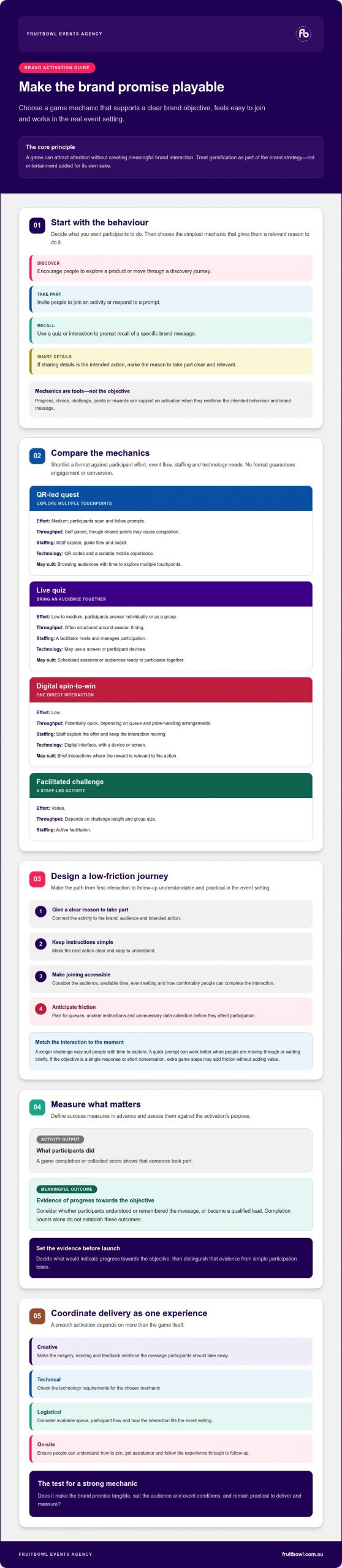
Choose the simplest mechanic that supports the intended behaviour. Use this comparison to shortlist options, then test your choice against participant effort, available space and staffing.
| Format | Audience effort | Potential throughput | Staffing | Technology | May suit |
|---|---|---|---|---|---|
| QR-led quest | Medium; participants scan and follow prompts | Self-paced, though shared points may cause congestion | Staff to explain, guide flow and assist | QR codes and a suitable mobile experience | Browsing audiences with time to explore multiple touchpoints |
| Live quiz | Low to medium; answer individually or as a group | Often structured around session timing | A facilitator to host and manage participation | May use a screen or participant devices | Scheduled sessions or audiences ready to participate together |
| Digital spin-to-win | Low; one direct interaction | Potentially quick, depending on queue and prize-handling arrangements | Staff to explain the offer and keep the interaction moving | Digital interface, with a device or screen | Brief interactions where the reward is relevant to the action |
| Facilitated challenge | Varies; participants follow a staff-led activity | Depends on challenge length and group size | Active facilitation is central | Can be low-tech or supported by digital tools | Hands-on experiences where conversation or demonstration matters |
Which activation game format suits your audience and setting?
First, consider whether people are passing through, browsing at their own pace or attending a scheduled session. Then assess group participation, queue tolerance, accessibility needs and staff capacity. QR codes can direct participants to a mobile task. NFC may offer another tap-based route where compatible devices are available. A staff-led option can provide guidance without requiring each participant to use a device. Plan an alternative for people who can’t or prefer not to use a phone.
How to keep the game recognisably connected to the brand
Let the brand proposition shape the challenge, prompts, visual cues and choices. If a prize becomes the main attraction, participants may remember the incentive rather than the product or message. Keep the reward relevant, explain the terms clearly and make its value proportionate to the action requested. Staff should be able to describe the interaction briefly and consistently. If it takes a long explanation, simplify it.
These choices sit alongside broader creative and operational decisions. For support connecting activation concepts with delivery planning, explore how Fruitbowl approaches brand activations.
How to prevent gamification from feeling gimmicky or creating friction
A game feels gimmicky when it asks for attention without earning it. The activity may be disconnected from the brand, the audience or the reason people are at the event. Thoughtful gamification for brand activations should make the intended interaction clearer or more worthwhile, not add steps for their own sake. Balance the benefit of active participation against practical risks such as queues, confusing instructions and collecting more personal information than the experience needs.
Map the participant journey before finalising the game. Check what happens at each stage:
- Invitation: Can people tell at a glance what the activity is and whether it’s for them?
- Instructions: Is the first action obvious, and can staff explain it consistently?
- Participation: Can people complete the activity without unnecessary waiting, technical hurdles or pressure to share information?
- Completion: Do participants know they’ve finished and what, if anything, they receive?
- Follow-up: Is any next step relevant, clearly explained and connected to the purpose of the interaction?
Before launch, check that the experience is relevant to the brand, clear to participants, inclusive in its design and feasible to deliver on the event floor.
How to make participation clear, accessible and worthwhile
Use plain-language instructions, visible next steps and a straightforward explanation of any reward or outcome. Don’t assume everyone can or wants to use a personal device. Consider a staff-supported or non-digital way to participate, and make sure choosing that alternative doesn’t leave someone out of the experience.
Review physical access, language, sensory demands and participation options with relevant specialists. Consider whether instructions can be read and understood easily, whether the activity requires standing or fine motor control, and whether sound or visual effects could create barriers. The right adjustments depend on the audience and setting, so assess them during planning rather than treating accessibility as a final check.
How to manage technology, data and event-floor risks
Test the full interaction using the devices and connection conditions expected at the venue. Plan for power needs, technical support and a fallback activity if the digital experience is unavailable. Rehearse staff instructions and the handover between each participant step. Small points of confusion can slow the whole flow.
Collect only information needed for a stated purpose, explain that purpose to participants and verify which privacy requirements apply before launch. Separately, model queue and staffing needs against expected attendance. Treat these as estimates, then review them against the activity’s completion time, space and likely peak periods. A clear operational plan protects the experience without making the game more complicated than it needs to be.
How to plan and measure a gamified brand activation
Build measurement into the plan, not as an afterthought. For gamification for brand activations, agree on the behaviour you want to encourage, how you’ll recognise it and who will review the results before the experience goes live. This gives creative and delivery teams a shared brief and helps distinguish activity from evidence of progress towards the brand objective.
A practical sequence for developing the experience
- Define the audience and objective. Specify who the activation is for, what the brand needs to achieve and the particular action participants should take. For example, if the aim is product discovery, define what a participant should explore or learn.
- Select the mechanic and map delivery. Choose a format that supports that action. Map each participant step, then confirm the space, technology, staffing, accessibility considerations and fallback arrangements required to deliver it.
- Prototype, test and brief. Draft the instructions and test the complete experience with the intended devices and event conditions where possible. Check that the interaction is understandable, tracking works as intended and teams know their roles before launch. Rehearse the participant flow, not just the technology.
Agree on a baseline before the activation begins. This might be an existing measure related to the objective or a clearly documented starting point for comparison. Decide what will be tracked, how it will be recorded and who owns each part of the process. Set the reporting timeframe in advance, including when the client team will review the findings and capture lessons for future activations.
Which measures show whether the activation worked?
Separate outputs, which describe activity, from outcomes, which relate to the objective. Depending on the mechanic and available tracking, outputs could include starts, completions and points where participants drop off. Outcomes might include qualified engagement, product discovery or message recall, measured using an appropriate method agreed with the client team.
Completions alone don’t show that a brand message was understood or remembered. Pair interaction data with relevant brand or business measures, and describe any relationship carefully. A change observed during an activation doesn’t, on its own, prove the game caused it.
Before collecting information, confirm what data is needed, how participants will be informed and who is responsible for access, reporting and handling the results. Align these decisions with the client team and verify applicable privacy requirements before launch. A clear measurement plan makes post-event evaluation more useful and helps identify what to refine.
For coordinated planning and delivery of a brand activation, discuss your activation requirements with Fruitbowl.
How an experienced event partner brings gamification to life
A gamified activation may involve brand and marketing teams, creative contributors, technical suppliers, venue contacts and on-site staff. If each group is working from a different brief, the participant experience can become fragmented. An event partner can help bring these moving parts together, aligning the creative idea with the practical requirements of delivering it.
This is particularly useful when gamification for brand activations spans multiple teams, technologies or event locations. The game mechanic is only one part of the plan. Participant flow, technical production, staff roles and contingency arrangements all need to support the same objective, from the first invitation through to completion.
What to include in an activation delivery brief
A clear brief gives each contributor a shared reference point. Document the objective, intended audience, brand requirements, event conditions, timeline and success measures. Then specify what the experience needs to function, including creative assets, technical requirements, staffing, accessibility considerations and fallback arrangements.
Set out who makes decisions, which approvals are needed and when, who owns each task, and how issues should be escalated. This clarity helps teams identify dependencies early, such as an approval needed before a digital interaction can be tested. It also gives event staff a practical basis for answering questions and guiding participants consistently.
How end-to-end coordination supports reliable execution
Creative design, logistics, technical direction and on-site delivery need to be planned as connected parts of the activation. A change to the game’s instructions, for example, may affect screen content, staff briefings or participant movement. Coordinated planning helps ensure the final experience remains faithful to the brand idea while working within the event’s operational conditions.
Fruitbowl Events Agency provides end-to-end event planning, logistics coordination, technical production and on-site delivery across Australia. For a gamified activation, this kind of integrated event support can help align client stakeholders, suppliers and delivery teams while keeping the participant journey in view.
If you’re planning an activation, share your objectives, audience, timing and delivery requirements with Fruitbowl to discuss your brand activation requirements.
Turn a clear objective into a considered activation
Effective gamification for brand activations starts with a participant action that supports the brand objective. Choose a mechanic that suits the audience and event setting, then make the experience easy to understand and practical to deliver. Set success measures before launch, and distinguish participation counts from evidence of meaningful engagement.
Creative ambition works best when supported by clear coordination across planning, production and on-site delivery. Fruitbowl Events Agency provides end-to-end event planning, production coordination and on-site delivery to help bring creative concepts and operational requirements together.
To discuss your activation objectives, audience, timing and delivery requirements, contact Fruitbowl’s brand activation team. A clear plan and coordinated delivery can help create an experience that gives participants a genuine reason to engage.
Frequently Asked Questions
What is gamification for brand activations?
Gamification for brand activations means using game mechanics to encourage a purposeful action within a branded experience. The mechanic might invite people to explore, make a choice, answer a question or complete a challenge. Its role is to help participants engage with the brand objective, not simply add entertainment. A useful test is whether the activity makes the intended interaction clearer or more rewarding for the audience.
How do you gamify a brand activation?
Start by identifying the audience and the action you want the activation to prompt. Choose a mechanic that makes that action understandable, then map the participant’s steps from invitation to completion. Check the format against the event setting, staffing, technology and accessibility needs. Before launch, test the instructions and interaction with the people who’ll deliver it, and decide what you’ll measure so evaluation is part of the plan.
What are examples of gamification in a brand activation?
Examples include a product-discovery quest with clues at different touchpoints, a hosted quiz built around a brand message, a digital prize interaction, or a facilitated challenge that invites participants to try a product feature. A simple progress marker can show how far someone has come. The most suitable example depends on the audience and event conditions, and each mechanic should connect clearly to the brand rather than rely on novelty alone.
How do you measure gamification in a brand activation?
Measure both activity and outcomes. Activity data may include how many people start or complete an interaction, and where participants stop, if tracking is available. Compare these outputs with an agreed baseline and a relevant measure of the objective, such as qualified engagement or message recall. Set data ownership, reporting responsibilities and review timing before launch. Participation figures are useful, but they don’t by themselves prove the game caused a brand impact.
Can gamification work for a brand activation without an app?
Yes. Gamification can use printed clues, facilitator-led challenges, physical progress markers or a live quiz hosted by event staff. These approaches can reduce reliance on personal devices and may suit participants who prefer a direct interaction. Choose a format that fits the space, staffing and expected participant flow. If the activity includes a digital element, provide a practical alternative for people who can’t or don’t want to use a phone.
How do you stop gamification from feeling gimmicky?
Make the activity relevant to the brand and worthwhile for the audience. The challenge, prompts and visual cues should reinforce the message or product experience, rather than distract from it. Keep instructions brief, explain any reward clearly and remove steps that don’t support the objective. Ask someone unfamiliar with the concept to try it. If they can’t quickly understand what to do or why it matters, refine the experience before launch.
What should you consider when planning an interactive brand activation?
Consider the audience, event setting, time available and level of interaction participants are likely to welcome. Assess physical access, language, sensory demands, queues, staffing and any technology dependencies. Decide what information you need to collect, explain its purpose and verify applicable privacy requirements. Finally, define the desired action, success measures, decision-makers and contingency arrangements in advance. These considerations help align the creative idea with a workable participant experience.
OUR BLOG
Event Insights & Expertise
Our blog is your go-to resource for all things events. From expert insights and the latest industry trends to practical planning tips, we share everything you need to deliver standout experiences.
Contact Us