Event Insurance Requirements Australia: 2026 Guide

What if the insurance amount that seems standard for one event doesn’t meet the conditions for yours? For anyone researching event insurance requirements Australia, that uncertainty is understandable. Public liability is commonly requested, but there isn’t one Australia-wide rule setting a minimum cover amount for every event. Requirements can depend on the event’s jurisdiction, activities and agreements with venues, councils, clients or suppliers.

It can be difficult to separate legal obligations from contract conditions, or to know whether a policy reflects what will actually happen on site. Insurance is one part of the plan, not a replacement for sound risk management and work health and safety arrangements.

This 2026 guide explains how to identify the requirements relevant to your event, compare common cover types with potential risks, and organise insurance evidence alongside your venue, supplier and event documents. It also shows how to check that policy wording reflects the event’s scope and activities before plans are finalised.

Key Takeaways

  • Use event insurance requirements Australia as a starting point, then identify the rules, permits and contract conditions that apply to your event and jurisdiction.
  • Compare potential exposures with relevant cover types, and review policy wording rather than assuming a policy will cover every activity.
  • Map each risk to its owner, existing controls, contractual requirements and possible insurance response.
  • Keep agreements, policy documents, certificates and responsible contacts organised so insurance evidence is accessible and consistent with the event plan.
  • Schedule insurance reviews alongside safety, logistics, production and stakeholder coordination, and repeat them when event details change.

Event insurance requirements in Australia: what is actually required?

For event insurance requirements Australia, distinguish between a legal duty, a permit condition and a contractual requirement. There’s no single blanket rule setting one insurance policy or minimum cover amount for every event nationwide. What applies depends on the jurisdiction, the event’s activities, the organiser’s role and the agreements or approvals attached to the event.

An event insurance requirement is a specific obligation to hold or provide evidence of insurance, imposed by applicable law, a permit or a written agreement. A recommendation is different: it may be prudent risk management, but it isn’t automatically compulsory. Events can involve substantial liability risk, but that general observation doesn’t establish a legal requirement for a particular event.

Legal duties, permits and insurance: how they differ

Organisers may have safety and other legal duties whether or not they hold an insurance policy. The details can depend on event activities, the state or territory and the organiser’s responsibilities. Permit conditions may also specify requirements for an approved event. Don’t assume a safety duty or permit obligation means a particular insurance policy is legally required.

For current guidance, start with Safe Work Australia and the relevant state or territory work health and safety regulator. Check permit requirements with the authority issuing the approval. Requirements can change, and the relevant rules depend on the event’s circumstances.

Venue and contract conditions that can shape cover

Written agreements can set insurance conditions even when there’s no general legal rule requiring that cover. A venue hire agreement, supplier agreement, client contract or funding condition may specify a policy type or ask for evidence before access, delivery or payment. These are obligations under the relevant agreement, not national rules that automatically apply to every event.

Review the exact wording in each agreement. Record the required policy types, evidence documents, applicable dates, covered activities and named parties. Compare those conditions with the event plan, including set-up and pack-down where relevant. If documents appear to conflict, note the specific wording and resolve the discrepancy through the appropriate contractual process before relying on an assumption.

Insurance is one part of risk management. It doesn’t replace safe planning, compliance with applicable duties or the controls needed to manage risks on site. A record of what is required, why it applies and who is responsible helps keep planning evidence aligned with the event as it develops.

Which event insurance types might apply to an Australian event?

Insurance needs follow the event’s exposures, agreements and operating arrangements. For companies running activations, conferences or corporate functions, tailored event policies often sit alongside broader business insurance protecting everyday commercial operations. The categories below are options to assess, not a universal checklist or a promise that a policy will respond. To address event insurance requirements Australia organisers may encounter, compare each potential exposure with the actual policy definitions, exclusions, limits and conditions.

A policy name alone can’t establish whether an event or activity is covered. Review the wording against the planned event, including set-up, pack-down and any changes to activities or suppliers.

Potential exposure Policy type to investigate Key wording to review
A guest is injured, or a third party’s property is damaged. Public liability Covered activities, exclusions, limits and any conditions applying to crowd access or temporary structures.
Disruption prevents or interrupts the event, creating financial losses. Event cancellation Specified insured events, exclusions, cancellation triggers, covered costs and notification conditions.
Hired equipment or production assets are damaged, lost or stolen. Property or equipment cover Which property is covered, where cover applies, and who is responsible under hire or supplier agreements.
Staff or volunteers are injured or affected while working at the event. Workers compensation or volunteer-related cover Who is covered, the organiser’s role, applicable jurisdiction and any relevant employment or volunteer arrangements.
Advice or professional services cause a client financial loss. Professional indemnity The services covered, relevant exclusions, limits and claims conditions.

Public liability, property damage and third-party injury

Public liability is commonly considered where event activities could result in injury to a guest or damage to someone else’s property. Crowd movement, public access, temporary structures and interactive activations each create different circumstances to assess. This doesn’t make public liability compulsory for every Australian event; a venue, permit or contract may set a condition for a particular event.

Cancellation, equipment and people-related cover

Event cancellation cover may be worth investigating where specified disruption could affect the event’s finances, but triggers and exclusions depend on the wording. List production assets and hired equipment, identify who is responsible for each item under the relevant agreement, then check whether existing arrangements address loss or damage. Don’t assume a supplier’s cover automatically protects the organiser.

Workers compensation and cover relating to volunteers depend on the jurisdiction and circumstances. Confirm applicable requirements through the relevant regulator and assess who is engaged, in what capacity and for which activities. Insurance should sit alongside practical controls, not replace them. Tourism Western Australia’s event risk management guide can help frame the broader risk assessment.

For corporate events, festivals, conferences and activations, including insurance checks in the wider planning process helps keep exposures, responsibilities and event documentation aligned. Explore coordinated event planning as part of an orderly delivery approach.

How to assess event insurance requirements against your event’s risks

Assess the event as it will operate, not simply by its name or venue. The event insurance requirements Australia organisers need to address can vary with the format, audience, activities, site, suppliers and operating period. A public festival with open access, temporary infrastructure and performers presents a different risk profile from a ticketed conference or a corporate brand activation. Don’t assume they share identical requirements.

Start with the event scope, then map each exposure to who controls it, the controls already in place, any written requirement and a possible insurance response. This creates a practical record for planning and review, rather than a generic list of policies.

Map event activities, stakeholders and potential exposures

Inventory what people and equipment will do during bump-in, event operation and pack-down. Include audience interactions, performers, contractors, temporary structures, production assets and vehicle or equipment movements. Consider weather, cancellation triggers and operational dependencies, such as a key supplier or site access arrangement.

  • Exposure: A crowd interacts with an activation. Map: Who manages the activity, what controls apply, and whether an agreement sets an insurance condition.
  • Exposure: Contractors install temporary infrastructure. Map: Which party controls the work, what the written agreement allocates, and what evidence is required.
  • Exposure: Weather affects an outdoor programme. Map: The event’s response plan, relevant cancellation terms and any policy wording to examine.

Record responsibilities rather than assuming that a supplier’s role removes the organiser’s own obligations. Agreements, run sheets and site plans should describe the same activities and who is responsible for them.

Check jurisdiction, venue terms and policy wording

Identify the state or territory, relevant approval conditions and venue requirements. Confirm permit details with the issuing authority and use current information from the relevant regulator. Then compare contract conditions with the policy schedule and wording, including definitions, exclusions, insured activities, dates and named parties.

If a policy describes an activity differently from the event plan, or a contract condition appears inconsistent with the available evidence, flag the issue. Don’t assume it is covered or make a legal conclusion from the policy title. Consulting an advisory firm such as Putney Insurance Group or seeking qualified legal advice can help clarify complex terms before commitments are made.

Keep this assessment connected to broader governance, stakeholder responsibilities and delivery planning. The strategic corporate event management framework provides a useful reference for aligning those planning strands.
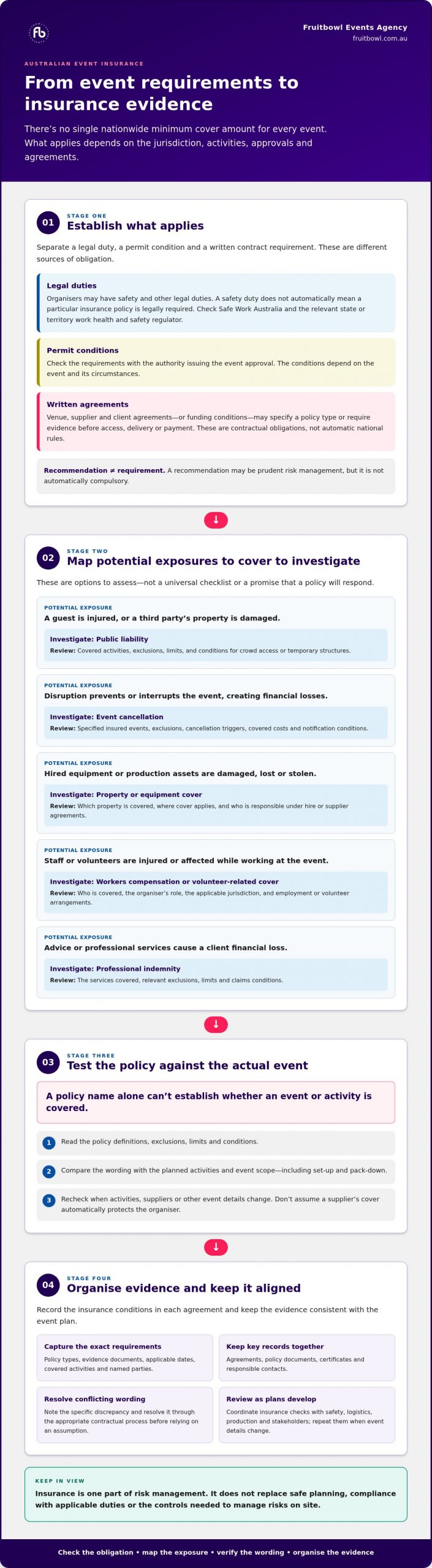
Event Insurance Requirements Australia: 2026 Guide

An event insurance checklist for planning, evidence and review

Include insurance checks in the event’s working plan, with a clear owner and review point for each requirement. This sequence turns event insurance requirements Australia into practical actions. It supports orderly planning, but it doesn’t guarantee legal compliance or that a policy will respond to a claim.

  • Scope the event: Record the format, activities, site, dates, attendance profile, suppliers and operating periods, including set-up and pack-down.
  • Review obligations: Gather permit conditions, venue hire terms, client and funding requirements, and supplier agreements.
  • Map exposures: Note potential incidents, who controls each activity, existing safety measures and who holds each responsibility.
  • Align cover: Compare relevant requirements and exposures with policy documents. Record questions about wording for qualified advice.
  • Collect evidence: Organise agreements, policy schedules, certificates of currency, approvals and the details of responsible contacts.
  • Recheck: Review the record at planning milestones and whenever the venue, event scope, suppliers or activities change.

Before contracting venues and suppliers

Enter each party’s insurance conditions, required evidence and submission dates in the project requirements register. Check that agreements describe responsibilities, activities, dates and locations consistently, then flag any mismatch for resolution before commitments are finalised. For complex conference delivery, connect these checks with the conference logistics planning guide so documentation sits alongside the wider operational plan.

Before event day and when plans change

Before delivery, confirm that required evidence is current and relates to the final event scope. A new activity, supplier, piece of equipment or attendance change can affect the assessment, so route variations through a documented review rather than relying on an earlier version. Keep a version-controlled record of decisions, approvals, relevant policy communications and the person responsible for each follow-up.

Store documents in a shared, controlled location with clear file names and access for the people responsible for delivery. The aim is a traceable record: what was required, what evidence was received, what changed and how the change was reviewed. Use the checklist as a planning aid, not as a substitute for legal or insurance advice.

Fruitbowl coordinates event strategy, logistics, stakeholders and on-site delivery as part of an end-to-end planning approach. Explore end-to-end event planning to see how these planning strands can be brought together.

Integrate event insurance checks into a well-managed delivery plan

Insurance checks work best when they’re part of the delivery plan, not a separate task left until final approvals are due. The event insurance requirements Australia organisers need to manage should sit alongside safety planning, logistics, production schedules and stakeholder responsibilities. That way, a change to the event can prompt a review of relevant documents and operational controls.

An event manager can coordinate requirements, track evidence and keep stakeholders aligned. That role doesn’t replace qualified insurance or legal advice, and it can’t guarantee that a policy will cover a particular claim. It can help identify questions early and direct them to the right person.

Coordinate requirements across the delivery team

Set clear owners for venue conditions, supplier documents, event changes and approval records. Add insurance evidence deadlines to the same schedule as production milestones, logistics, stakeholder liaison and safety reviews. This makes responsibilities visible and reduces the chance that a document request or scope change is missed.

For public activations, governance and approvals may add further planning considerations. The government event planning guide explores how these elements fit into high-stakes public delivery. Policy interpretation and legal questions should go to appropriately qualified advisers, while the event team maintains the plan, records decisions and coordinates follow-up.

Make a confident next move with Fruitbowl

Before planning discussions begin, bring together a clear summary of the event type, scope, stakeholders, key dates, venue and known requirements. This gives the team a shared starting point and helps connect decisions across the event lifecycle, from strategy and logistics to production coordination and on-site delivery.

Fruitbowl Events Agency brings more than 28 years of event industry experience to corporate events, festivals, government activations, conferences and brand activations across Australia. Its end-to-end planning approach coordinates moving parts so operational decisions, responsibilities and documentation remain connected. Insurance checks can sit within a broader delivery plan, alongside the event’s other planning requirements.

If you’re planning an event and want to discuss its planning and delivery requirements, talk with Fruitbowl about your event.

Plan your event with clarity and confidence

The key to managing event insurance requirements Australia is knowing what applies to your event, rather than relying on a one-size-fits-all assumption. Requirements can arise from applicable laws, permits and written agreements, while cover worth considering depends on the event’s activities and exposures. Check policy wording against the actual plan, and keep evidence and responsibilities organised as details change.

Insurance checks are most effective when coordinated with safety, logistics, production and stakeholder planning. They support a well-managed event, but don’t replace risk controls or qualified advice on insurance and legal questions.

With more than 28 years of event industry experience, Fruitbowl plans and delivers corporate events, festivals, conferences and government activations. Its end-to-end approach brings strategy, logistics, production coordination and on-site delivery together, helping keep complex event requirements connected across the planning process.

Discuss your event planning and delivery requirements with Fruitbowl. A clear plan is a strong foundation for moving your event forward with confidence.

Frequently Asked Questions

Is event insurance compulsory in Australia?

No, there’s no single blanket rule making the same insurance compulsory for every event across Australia. Requirements may depend on applicable legislation, the event’s activities, permits, contracts and venue conditions. To identify what applies, establish the relevant state or territory and review the agreements and approvals for your event. If you need an interpretation of legal duties or policy wording, seek advice from an appropriately qualified professional.

What insurance do I need to run an event in Australia?

The cover to assess depends on your event’s activities, participants, venue, suppliers and contractual conditions. Organisers commonly investigate public liability and may also consider cancellation, equipment or people-related exposures. These categories aren’t automatically required or suitable for every event. Compare written requirements and policy wording with the actual event scope, including set-up and pack-down activities. If the wording or its application is unclear, seek qualified advice before relying on it.

Does a venue require public liability insurance for an event?

A venue may require public liability insurance or evidence of cover as a condition of hire, but requirements vary between agreements and events. Read the venue contract for the required policy, evidence, dates, activities and any named parties. Don’t assume another party’s policy satisfies your obligations. If the wording is unclear, obtain appropriate advice before relying on a certificate or policy document, and keep the relevant records with your event documentation.

Does event insurance cover cancellation?

Some policies offer event cancellation cover for specified circumstances, but whether a particular disruption is covered depends on the policy wording, exclusions and conditions. A policy title alone isn’t enough to establish protection. Compare the event dates and insured activities with the cancellation triggers and exclusions set out in the documents. If you’re uncertain how the wording applies to your plans or a possible disruption, seek qualified advice before making a decision.

Do volunteers need to be covered by event insurance?

Volunteer-related protection depends on the event, the roles people perform, applicable state or territory requirements and relevant policy wording. Workers compensation rules may also vary according to jurisdiction and circumstances. Map volunteer duties and supervision, then review the agreements and policy documents that relate to those roles. Don’t assume a general event policy covers every volunteer. Check current official guidance for the relevant jurisdiction or seek qualified advice about obligations that apply.

What documents should an event organiser check before event day?

Review venue and supplier agreements, relevant permits, policy schedules, certificates of currency, event dates, insured activities and evidence deadlines. Check that the documents reflect the final event scope, and keep a record of approvals and responsible contacts. Reassess the requirements if the event changes. A certificate provides evidence of insurance, but it doesn’t replace reviewing applicable policy wording. Keep documents organised so the delivery team can locate the current versions.

When should an organiser review event insurance requirements?

Start during early planning, before committing to venue or supplier terms that set insurance conditions. Review requirements again if event activities, suppliers, attendance plans, dates or sites change, then complete a final document check before delivery. Add these reviews to project milestones so the team can identify issues early and assign follow-up. The appropriate timing depends on the event scope, its agreements and any relevant approval conditions.

What if the insurance amount that seems standard for one event doesn’t meet the conditions for yours? For anyone researching event insurance requirements Australia, that uncertainty is understandable. Public liability is commonly requested, but there isn’t one Australia-wide rule setting a minimum cover amount for every event. Requirements can depend on the event’s jurisdiction, activities and agreements with venues, councils, clients or suppliers.

It can be difficult to separate legal obligations from contract conditions, or to know whether a policy reflects what will actually happen on site. Insurance is one part of the plan, not a replacement for sound risk management and work health and safety arrangements.

This 2026 guide explains how to identify the requirements relevant to your event, compare common cover types with potential risks, and organise insurance evidence alongside your venue, supplier and event documents. It also shows how to check that policy wording reflects the event’s scope and activities before plans are finalised.

Key Takeaways

  • Use event insurance requirements Australia as a starting point, then identify the rules, permits and contract conditions that apply to your event and jurisdiction.
  • Compare potential exposures with relevant cover types, and review policy wording rather than assuming a policy will cover every activity.
  • Map each risk to its owner, existing controls, contractual requirements and possible insurance response.
  • Keep agreements, policy documents, certificates and responsible contacts organised so insurance evidence is accessible and consistent with the event plan.
  • Schedule insurance reviews alongside safety, logistics, production and stakeholder coordination, and repeat them when event details change.

Event insurance requirements in Australia: what is actually required?

For event insurance requirements Australia, distinguish between a legal duty, a permit condition and a contractual requirement. There’s no single blanket rule setting one insurance policy or minimum cover amount for every event nationwide. What applies depends on the jurisdiction, the event’s activities, the organiser’s role and the agreements or approvals attached to the event.

An event insurance requirement is a specific obligation to hold or provide evidence of insurance, imposed by applicable law, a permit or a written agreement. A recommendation is different: it may be prudent risk management, but it isn’t automatically compulsory. Events can involve substantial liability risk, but that general observation doesn’t establish a legal requirement for a particular event.

Legal duties, permits and insurance: how they differ

Organisers may have safety and other legal duties whether or not they hold an insurance policy. The details can depend on event activities, the state or territory and the organiser’s responsibilities. Permit conditions may also specify requirements for an approved event. Don’t assume a safety duty or permit obligation means a particular insurance policy is legally required.

For current guidance, start with Safe Work Australia and the relevant state or territory work health and safety regulator. Check permit requirements with the authority issuing the approval. Requirements can change, and the relevant rules depend on the event’s circumstances.

Venue and contract conditions that can shape cover

Written agreements can set insurance conditions even when there’s no general legal rule requiring that cover. A venue hire agreement, supplier agreement, client contract or funding condition may specify a policy type or ask for evidence before access, delivery or payment. These are obligations under the relevant agreement, not national rules that automatically apply to every event.

Review the exact wording in each agreement. Record the required policy types, evidence documents, applicable dates, covered activities and named parties. Compare those conditions with the event plan, including set-up and pack-down where relevant. If documents appear to conflict, note the specific wording and resolve the discrepancy through the appropriate contractual process before relying on an assumption.

Insurance is one part of risk management. It doesn’t replace safe planning, compliance with applicable duties or the controls needed to manage risks on site. A record of what is required, why it applies and who is responsible helps keep planning evidence aligned with the event as it develops.

Which event insurance types might apply to an Australian event?

Insurance needs follow the event’s exposures, agreements and operating arrangements. The categories below are options to assess, not a universal checklist or a promise that a policy will respond. To address event insurance requirements Australia organisers may encounter, compare each potential exposure with the actual policy definitions, exclusions, limits and conditions.

A policy name alone can’t establish whether an event or activity is covered. Review the wording against the planned event, including set-up, pack-down and any changes to activities or suppliers.

Potential exposure Policy type to investigate Key wording to review
A guest is injured, or a third party’s property is damaged. Public liability Covered activities, exclusions, limits and any conditions applying to crowd access or temporary structures.
Disruption prevents or interrupts the event, creating financial losses. Event cancellation Specified insured events, exclusions, cancellation triggers, covered costs and notification conditions.
Hired equipment or production assets are damaged, lost or stolen. Property or equipment cover Which property is covered, where cover applies, and who is responsible under hire or supplier agreements.
Staff or volunteers are injured or affected while working at the event. Workers compensation or volunteer-related cover Who is covered, the organiser’s role, applicable jurisdiction and any relevant employment or volunteer arrangements.
Advice or professional services cause a client financial loss. Professional indemnity The services covered, relevant exclusions, limits and claims conditions.

Public liability, property damage and third-party injury

Public liability is commonly considered where event activities could result in injury to a guest or damage to someone else’s property. Crowd movement, public access, temporary structures and interactive activations each create different circumstances to assess. This doesn’t make public liability compulsory for every Australian event; a venue, permit or contract may set a condition for a particular event.

Cancellation, equipment and people-related cover

Event cancellation cover may be worth investigating where specified disruption could affect the event’s finances, but triggers and exclusions depend on the wording. List production assets and hired equipment, identify who is responsible for each item under the relevant agreement, then check whether existing arrangements address loss or damage. Don’t assume a supplier’s cover automatically protects the organiser.

Workers compensation and cover relating to volunteers depend on the jurisdiction and circumstances. Confirm applicable requirements through the relevant regulator and assess who is engaged, in what capacity and for which activities. Insurance should sit alongside practical controls, not replace them. Tourism Western Australia’s event risk management guide can help frame the broader risk assessment.

For corporate events, festivals, conferences and activations, including insurance checks in the wider planning process helps keep exposures, responsibilities and event documentation aligned. Explore coordinated event planning as part of an orderly delivery approach.

How to assess event insurance requirements against your event’s risks

Assess the event as it will operate, not simply by its name or venue. The event insurance requirements Australia organisers need to address can vary with the format, audience, activities, site, suppliers and operating period. A public festival with open access, temporary infrastructure and performers presents a different risk profile from a ticketed conference or a corporate brand activation. Don’t assume they share identical requirements.

Start with the event scope, then map each exposure to who controls it, the controls already in place, any written requirement and a possible insurance response. This creates a practical record for planning and review, rather than a generic list of policies.

Map event activities, stakeholders and potential exposures

Inventory what people and equipment will do during bump-in, event operation and pack-down. Include audience interactions, performers, contractors, temporary structures, production assets and vehicle or equipment movements. Consider weather, cancellation triggers and operational dependencies, such as a key supplier or site access arrangement.

  • Exposure: A crowd interacts with an activation. Map: Who manages the activity, what controls apply, and whether an agreement sets an insurance condition.
  • Exposure: Contractors install temporary infrastructure. Map: Which party controls the work, what the written agreement allocates, and what evidence is required.
  • Exposure: Weather affects an outdoor programme. Map: The event’s response plan, relevant cancellation terms and any policy wording to examine.

Record responsibilities rather than assuming that a supplier’s role removes the organiser’s own obligations. Agreements, run sheets and site plans should describe the same activities and who is responsible for them.

Check jurisdiction, venue terms and policy wording

Identify the state or territory, relevant approval conditions and venue requirements. Confirm permit details with the issuing authority and use current information from the relevant regulator. Then compare contract conditions with the policy schedule and wording, including definitions, exclusions, insured activities, dates and named parties.

If a policy describes an activity differently from the event plan, or a contract condition appears inconsistent with the available evidence, flag the issue. Don’t assume it is covered or make a legal conclusion from the policy title. Seek qualified insurance or legal advice where interpretation is uncertain.

Keep this assessment connected to broader governance, stakeholder responsibilities and delivery planning. The strategic corporate event management framework provides a useful reference for aligning those planning strands.

An event insurance checklist for planning, evidence and review

Include insurance checks in the event’s working plan, with a clear owner and review point for each requirement. This sequence turns event insurance requirements Australia into practical actions. It supports orderly planning, but it doesn’t guarantee legal compliance or that a policy will respond to a claim.

  • Scope the event: Record the format, activities, site, dates, attendance profile, suppliers and operating periods, including set-up and pack-down.
  • Review obligations: Gather permit conditions, venue hire terms, client and funding requirements, and supplier agreements.
  • Map exposures: Note potential incidents, who controls each activity, existing safety measures and who holds each responsibility.
  • Align cover: Compare relevant requirements and exposures with policy documents. Record questions about wording for qualified advice.
  • Collect evidence: Organise agreements, policy schedules, certificates of currency, approvals and the details of responsible contacts.
  • Recheck: Review the record at planning milestones and whenever the venue, event scope, suppliers or activities change.

Before contracting venues and suppliers

Enter each party’s insurance conditions, required evidence and submission dates in the project requirements register. Check that agreements describe responsibilities, activities, dates and locations consistently, then flag any mismatch for resolution before commitments are finalised. For complex conference delivery, connect these checks with the conference logistics planning guide so documentation sits alongside the wider operational plan.

Before event day and when plans change

Before delivery, confirm that required evidence is current and relates to the final event scope. A new activity, supplier, piece of equipment or attendance change can affect the assessment, so route variations through a documented review rather than relying on an earlier version. Keep a version-controlled record of decisions, approvals, relevant policy communications and the person responsible for each follow-up.

Store documents in a shared, controlled location with clear file names and access for the people responsible for delivery. The aim is a traceable record: what was required, what evidence was received, what changed and how the change was reviewed. Use the checklist as a planning aid, not as a substitute for legal or insurance advice.

Fruitbowl coordinates event strategy, logistics, stakeholders and on-site delivery as part of an end-to-end planning approach. Explore end-to-end event planning to see how these planning strands can be brought together.

Integrate event insurance checks into a well-managed delivery plan

Insurance checks work best when they’re part of the delivery plan, not a separate task left until final approvals are due. The event insurance requirements Australia organisers need to manage should sit alongside safety planning, logistics, production schedules and stakeholder responsibilities. That way, a change to the event can prompt a review of relevant documents and operational controls.

An event manager can coordinate requirements, track evidence and keep stakeholders aligned. That role doesn’t replace qualified insurance or legal advice, and it can’t guarantee that a policy will cover a particular claim. It can help identify questions early and direct them to the right person.

Coordinate requirements across the delivery team

Set clear owners for venue conditions, supplier documents, event changes and approval records. Add insurance evidence deadlines to the same schedule as production milestones, logistics, stakeholder liaison and safety reviews. This makes responsibilities visible and reduces the chance that a document request or scope change is missed.

For public activations, governance and approvals may add further planning considerations. The government event planning guide explores how these elements fit into high-stakes public delivery. Policy interpretation and legal questions should go to appropriately qualified advisers, while the event team maintains the plan, records decisions and coordinates follow-up.

Make a confident next move with Fruitbowl

Before planning discussions begin, bring together a clear summary of the event type, scope, stakeholders, key dates, venue and known requirements. This gives the team a shared starting point and helps connect decisions across the event lifecycle, from strategy and logistics to production coordination and on-site delivery.

Fruitbowl Events Agency brings more than 28 years of event industry experience to corporate events, festivals, government activations, conferences and brand activations across Australia. Its end-to-end planning approach coordinates moving parts so operational decisions, responsibilities and documentation remain connected. Insurance checks can sit within a broader delivery plan, alongside the event’s other planning requirements.

If you’re planning an event and want to discuss its planning and delivery requirements, talk with Fruitbowl about your event.

Plan your event with clarity and confidence

The key to managing event insurance requirements Australia is knowing what applies to your event, rather than relying on a one-size-fits-all assumption. Requirements can arise from applicable laws, permits and written agreements, while cover worth considering depends on the event’s activities and exposures. Check policy wording against the actual plan, and keep evidence and responsibilities organised as details change.

Insurance checks are most effective when coordinated with safety, logistics, production and stakeholder planning. They support a well-managed event, but don’t replace risk controls or qualified advice on insurance and legal questions.

With more than 28 years of event industry experience, Fruitbowl plans and delivers corporate events, festivals, conferences and government activations. Its end-to-end approach brings strategy, logistics, production coordination and on-site delivery together, helping keep complex event requirements connected across the planning process.

Discuss your event planning and delivery requirements with Fruitbowl. A clear plan is a strong foundation for moving your event forward with confidence.

Frequently Asked Questions

Is event insurance compulsory in Australia?

No, there’s no single blanket rule making the same insurance compulsory for every event across Australia. Requirements may depend on applicable legislation, the event’s activities, permits, contracts and venue conditions. To identify what applies, establish the relevant state or territory and review the agreements and approvals for your event. If you need an interpretation of legal duties or policy wording, seek advice from an appropriately qualified professional.

What insurance do I need to run an event in Australia?

The cover to assess depends on your event’s activities, participants, venue, suppliers and contractual conditions. Organisers commonly investigate public liability and may also consider cancellation, equipment or people-related exposures. These categories aren’t automatically required or suitable for every event. Compare written requirements and policy wording with the actual event scope, including set-up and pack-down activities. If the wording or its application is unclear, seek qualified advice before relying on it.

Does a venue require public liability insurance for an event?

A venue may require public liability insurance or evidence of cover as a condition of hire, but requirements vary between agreements and events. Read the venue contract for the required policy, evidence, dates, activities and any named parties. Don’t assume another party’s policy satisfies your obligations. If the wording is unclear, obtain appropriate advice before relying on a certificate or policy document, and keep the relevant records with your event documentation.

Does event insurance cover cancellation?

Some policies offer event cancellation cover for specified circumstances, but whether a particular disruption is covered depends on the policy wording, exclusions and conditions. A policy title alone isn’t enough to establish protection. Compare the event dates and insured activities with the cancellation triggers and exclusions set out in the documents. If you’re uncertain how the wording applies to your plans or a possible disruption, seek qualified advice before making a decision.

Do volunteers need to be covered by event insurance?

Volunteer-related protection depends on the event, the roles people perform, applicable state or territory requirements and relevant policy wording. Workers compensation rules may also vary according to jurisdiction and circumstances. Map volunteer duties and supervision, then review the agreements and policy documents that relate to those roles. Don’t assume a general event policy covers every volunteer. Check current official guidance for the relevant jurisdiction or seek qualified advice about obligations that apply.

What documents should an event organiser check before event day?

Review venue and supplier agreements, relevant permits, policy schedules, certificates of currency, event dates, insured activities and evidence deadlines. Check that the documents reflect the final event scope, and keep a record of approvals and responsible contacts. Reassess the requirements if the event changes. A certificate provides evidence of insurance, but it doesn’t replace reviewing applicable policy wording. Keep documents organised so the delivery team can locate the current versions.

When should an organiser review event insurance requirements?

Start during early planning, before committing to venue or supplier terms that set insurance conditions. Review requirements again if event activities, suppliers, attendance plans, dates or sites change, then complete a final document check before delivery. Add these reviews to project milestones so the team can identify issues early and assign follow-up. The appropriate timing depends on the event scope, its agreements and any relevant approval conditions.

Back to Articles
Request A Quote

Make an
Enquiry

Untitled design

What Makes Us Different?

True end-to-end solution so you can hand off to us, focus on your priorities and enjoy the event without any stress

Unmatched industry expertise looking after diverse range of high-profile events, cultural festivals & activations

Meticulous attention to every detail and precise execution of events with our streamlined processes

Tailored solutions with bespoke strategies to ensure we align with your brand and objectives

Make an Enquiry

"*" indicates required fields

This field is for validation purposes and should be left unchanged.

"*" indicates required fields

This field is for validation purposes and should be left unchanged.