The most disruptive event-day problems often start before the first attendee arrives. When responsibilities, decision-making authority and escalation paths are unclear, even a small supplier delay or technical issue can unsettle the schedule. Effective event day management best practices start with a shared plan, not last-minute heroics.
Changes are part of live events, but they don’t have to derail the experience. A clear operating structure helps your team respond quickly while keeping decisions aligned with the event’s objectives. This practical checklist explains what to brief, check and monitor before doors open, and how to give staff and suppliers the clarity they need to act with confidence.
Delivery requirements vary across corporate events, conferences, festivals, public events and government activations, but coordinated communication matters in every format. Use the steps below to prepare the team, manage the run of show, handle disruptions and keep attendees informed. When owners and escalation paths are agreed in advance, your team can adapt without losing sight of the experience you set out to deliver.
Key Takeaways
- Use event day management best practices to turn the approved brief into a practical operating plan, with one live source for schedules, contacts and updates.
- Set a clear reporting line so each team member knows who can make decisions and when an issue needs escalation.
- Match common disruptions with an agreed first response, decision owner and escalation trigger to manage changes without losing sight of event objectives.
- Structure checks across arrival, pre-opening, the live programme, close-down and post-event handover. Record an owner and due time for each action.
- Connect planning, logistics, supplier liaison and on-site delivery so the event schedule and attendee experience remain aligned.
Why event day management best practices start before doors open
On event day, a delayed delivery can affect a room set-up, which can delay a session, disrupt a staff handover and affect the attendee experience. People, equipment and decisions converge across a live schedule, often leaving little time to resolve competing priorities. The event team needs more than a timetable. It needs clear instructions for checking progress and deciding what to do when delivery differs from plan.
Event-day management coordinates live delivery against the approved brief, schedule and attendee needs. It turns broader planning into practical checks, communications and decisions on site. For a fuller view of the planning lifecycle, the corporate event management framework covers the strategic work that supports delivery. The Event Management Overview also describes how project management principles apply across event planning and coordination.
The live-day checklist should focus on readiness and action, rather than repeating every logistics decision made during planning. Safety, accessibility and attendee wellbeing take precedence over protecting the original timetable. Event-specific legal, safety and permit requirements can differ across Australian jurisdictions, so establish them for the event’s location and context. The operating principle is consistent: agreed owners and escalation paths help make live decisions more consistent, especially when timing or conditions change.
What should an event-day checklist control?
Group checks into six practical areas to see what is ready, what remains outstanding and where a delay could affect another part of delivery.
- People: staff arrival, role coverage and briefings.
- Place: room or site readiness, access routes and attendee facilities.
- Programme: run sheet timings, speakers, performers and transitions.
- Suppliers: arrival, set-up responsibilities and handover points.
- Technology: audio-visual checks, connectivity and operating backups.
- Attendee experience: registration, wayfinding, accessibility and service points.
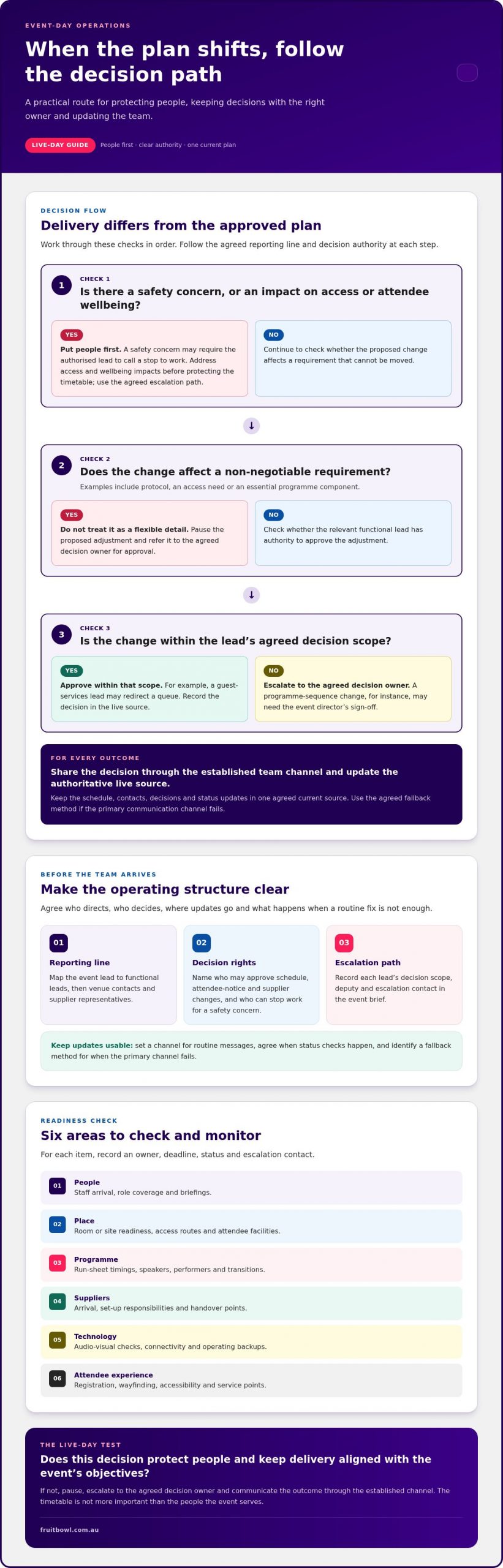
Separate fixed requirements from flexible details. A protocol, access need or essential programme component may be non-negotiable; a transition, staging detail or sequence may have room to move. Define the difference in advance so staff know what they can adjust and what needs approval. For each checklist item, record an owner, deadline, status and escalation contact. “Check microphones” is less useful than naming who will check them and when they must report the result.
Set event-day priorities before the team arrives
Translate the event brief into a short set of observable priorities. These might include opening registration on time, keeping an accessible route clear, starting a keynote only after agreed readiness checks are complete, or ensuring public-facing information is consistent. Identify the event’s non-negotiable safety, access, protocol and programme requirements, then make sure the relevant team members understand them before work begins.
Every live decision should protect people and the event’s objectives. Use that as a practical test when a change is proposed: does it preserve safety and access, and keep delivery aligned with the event’s purpose? If not, pause, escalate to the agreed decision owner and communicate the outcome through the team’s established channel. This helps the team respond without treating the timetable as more important than the people it serves.
Build an event-day operating system with clear roles and communication
A live event needs a clear line of accountability. Map the reporting structure from the event lead to functional leads, then to venue contacts and supplier representatives. Each person should know who gives direction, where updates go and who can resolve an issue that crosses team boundaries. Without that structure, competing instructions can cause delays even when everyone is acting in good faith.
Keep one authoritative source for the live schedule, contact list, decisions and status updates. It could be a shared digital document or another agreed system, but staff need to know which version is current and who can update it. Set the channel for routine updates, agree when status checks will happen and identify a fallback method if the primary channel fails. For example, a team might use its agreed messaging channel for routine changes and a phone call for urgent escalation.
Define decision rights just as clearly. State who may approve a schedule adjustment, attendee notice or supplier change, and who can call a stop to work if a safety concern arises. Make the authority explicit rather than assuming it sits with the most senior person nearby. These event day management best practices help teams act promptly while keeping consequential decisions with the right lead.
Assign decision owners, not just task owners
A task owner completes an action; a decision owner is accountable for choosing what happens if delivery changes. Name leads for programme, venue operations, guest services, technical delivery and safety. Record each person’s decision scope, deputy and escalation contact in the event brief. Specify which adjustments they can approve independently and which require the event director’s sign-off. For instance, a guest-services lead may redirect a queue, while a change to the programme sequence could need director approval.
Give each lead a clear route for raising issues. An escalation trigger might be a missed milestone, an unresolved access barrier or a technical fault affecting a scheduled session. Define triggers in terms the team can recognise, not vague instructions such as “if it gets serious”.
Run briefings that create a shared picture
Brief teams before operational activity begins. Cover event objectives, audience profile, schedule milestones, priority risks, access arrangements, emergency communications and incident-reporting procedures relevant to the event. Keep instructions specific to each role, while making the overall picture clear: what is happening next, what could affect it and who is coordinating the response.
Close the loop on critical instructions. The recipient repeats the task, timing and relevant location, then confirms when it’s complete. If a supplier is asked to hold a set-up while a route is cleared, for example, the person issuing the instruction should receive an acknowledgement and a completion update. This reduces assumptions and helps the event lead maintain a reliable picture of delivery.
For complex corporate events, conferences or public programmes, an experienced partner can connect the approved brief, supplier coordination and on-site delivery. Fruitbowl’s event management team brings more than 28 years of industry experience to that work, helping keep roles and communication aligned with the event’s objectives.
How to prioritise event-day decisions when plans change
The run sheet is the reference point for planned delivery, not a reason to continue unchanged when conditions shift. A live decision should account for what has happened, what is affected and what needs to happen next. Record material changes, including the decision, its owner, the time agreed and when the next update is due. This creates a usable record and helps each team act from the same version of events.
Prioritise issues consistently: address immediate safety impacts first, then consider attendee impact, time sensitivity and reversibility. A blocked accessible route needs prompt action even if fixing it delays a programme item. A minor staging adjustment may be less urgent if it can be reversed without affecting the audience or essential delivery. For technical issues, establish whether the fault affects an essential cue, audience information or a non-critical element before deciding what to change.
The table below offers a starting point for assigning a response. Adapt decision owners and escalation triggers to the event’s agreed roles and procedures.
| Issue type | First response | Decision owner | Escalation trigger |
|---|---|---|---|
| Immediate safety concern | Pause affected activity and follow the event’s response procedure. | Safety lead or designated incident lead | Escalate promptly through the agreed incident route. |
| Access or attendee service issue | Address the barrier and advise affected front-of-house staff. | Guest services lead | Escalate if access remains restricted or a wider change is needed. |
| Programme delay | Check downstream milestones and identify workable adjustments. | Programme lead | Escalate if the change affects a key commitment or exceeds delegated authority. |
| Technical fault | Confirm the impact with the technical lead and identify an approved alternative. | Technical lead | Escalate if essential delivery or the attendee experience is at risk. |
Use a consistent change-and-escalation test
Before acting, check whether the change affects people, access, safety, the programme or essential delivery. Then establish whether the relevant lead has authority to decide or whether the event director must approve it. Log material decisions with the responsible person, time and next update. These event day management best practices help the team distinguish a routine adjustment from a change that needs wider oversight.
Protect attendee experience during disruption
Once a decision is made, communicate it to affected staff, suppliers, speakers and attendees through the appropriate channels. Give front-of-house teams approved wording and a contact for follow-up questions. Keep updates accessible and specific: say what has changed, what attendees should do and when further information will be available. Don’t speculate about causes or timings that haven’t been confirmed.
A useful live update is timely, accurate and actionable. For example, if a session is delayed, tell attendees where to wait or what to do next, then give a confirmed time for the next update rather than guessing when the programme will resume.
The event-day management checklist: from team call to close-down
A checklist is most useful when it follows the event’s operating timeline. Divide it into arrival, pre-opening, live programme, close-down and post-event handover, then tailor each phase to the venue, audience and format. A conference may need close monitoring of room changes and session transitions, while a public event or brand activation may place greater emphasis on attendee movement, service points or public-facing information. Where managing venue capacity and foot traffic in real time is essential, specialist solutions from Footfall Australia can help teams monitor live attendee numbers and avoid bottlenecks.
For every action, record the owner, due time, completion status and escalation route. This turns reminders into a control tool: the team can see what is done, what is overdue and who needs to respond. Keep event-specific safety and accessibility checks prominent. Requirements vary by jurisdiction and event, so establish applicable obligations for the location and activity rather than treating one checklist as universal.
- Arrival: Confirm site access, team attendance, supplier arrival status and who is responsible for each set-up area. Record any access or delivery issue immediately, with an owner and route for escalation.
- Pre-opening: Check room or site readiness, signage, registration flow, attendee routes and agreed access arrangements. Confirm the current run sheet, contact list, briefing notes and approved attendee communications are available to the relevant team.
- Live programme: Track schedule milestones, attendance flow, service points and open operational issues. Update action status as work is completed, and flag emerging delays before they affect the next activity.
- Close-down: Confirm programme completion, attendee departure arrangements, supplier tasks and any site handback actions relevant to the event. Record incomplete work rather than relying on verbal reminders.
- Post-event handover: Pass on outstanding actions, incident records and relevant decisions through the agreed reporting process. Assign each follow-up an owner and due date.
Before attendees arrive: inspect, brief and confirm
Walk the key attendee routes, from entry and registration to the main programme areas and facilities. Check that signage is visible and the registration flow matches the plan. Brief the team on how to report a concern, who receives it and what information to provide. A clear report should identify the location, issue, time observed and whether immediate action is needed.
Use the final pre-opening check to resolve discrepancies between the live site and the schedule. If a space, sign or supplier set-up isn’t ready, note the gap, assign an owner and escalate it through the agreed route. Don’t mark an item complete until it has been checked.
During and after delivery: monitor, record and hand over
As the programme runs, leads should update status against milestones and record incidents, decisions and unresolved actions factually. Avoid assumptions about causes or outcomes in records. After close-down, debrief the relevant leads while details are fresh, then assign follow-up owners and dates so useful observations inform future delivery.
For coordinated support spanning event planning, logistics and on-site delivery, explore Fruitbowl’s event management services.
How an experienced event team keeps delivery aligned on the day
An experienced event management partner connects the approved brief to the live operation. The brief sets the objectives and priorities; planning turns them into a workable schedule, logistics coordinate people and resources, and supplier liaison keeps individual deliverables connected. On site, the event team monitors progress, manages handovers and helps resolve changes against the agreed priorities. This links what the event is intended to achieve with what attendees experience.
The approach should suit the event rather than follow one fixed formula. A conference may rely on precise room transitions and speaker coordination. A festival or public event may need close attention to attendee movement and multiple operational areas. A government activation may involve distinct stakeholder and protocol considerations. Fruitbowl Events Agency brings more than 28 years of experience across corporate, conference, festival and government events, applying planning, logistics, entertainment programming and on-site delivery to each event’s requirements.
Integrate creative objectives with practical delivery
Creative choices work best when they stay connected to the brief, audience and operational conditions. A programme element may be compelling, but its timing, space and supplier requirements still need to fit the event’s delivery plan. Clear accountability helps the team assess trade-offs without losing sight of the intended experience. For instance, when deploying interactive engagement tools like Bestever.pics for live event photo sharing, verifying digital access points and signage during pre-event checks ensures attendee participation runs smoothly without adding operational strain.
Coordinate production requirements, supplier commitments and schedule adjustments through agreed points of accountability. Keep one live operating picture so creative and operational leads can work from current information, including the latest schedule and confirmed changes. This helps prevent a supplier or programme adjustment from reaching only part of the team. For public-sector activations, the government event planning guide provides context for the additional considerations these projects can involve.
Choose the right level of event-day support
Match the coordination scope to the event’s scale, stakeholder complexity and delivery risks. A focused logistics requirement may call for coordination around key movements and suppliers. A more complex event may need strategic oversight across the brief, schedule, stakeholder decisions and on-site delivery. Define the support required in practical terms: which activities need coordination, where decision-making sits and how live changes will be managed.
For conferences, clear roles around schedules, spaces and supplier handovers can be particularly important. The conference logistics coordinator guide explains the role in that context. Across formats, effective event day management best practices connect planning and live delivery while keeping responsibilities appropriate to the event.
If you’re shaping an event and want to discuss how its brief, logistics and on-site requirements can work together, discuss your event brief with Fruitbowl.
Set your next event up for confident delivery
The strongest event-day plan is one your team can use under real conditions. Before the next event, turn the checklist into a working brief: adapt it to the audience and format, confirm who owns key decisions, and make sure everyone involved knows the escalation route. That preparation gives the team a practical foundation for responding calmly when delivery shifts.
Use event day management best practices to keep operational choices connected to the event’s purpose, rather than treating the schedule as an end in itself. The right level of support depends on your delivery requirements, stakeholder needs and coordination needs. Clear roles, a shared operating plan and agreed communication routes help bring those factors together.
Fruitbowl Events Agency brings more than 28 years of event industry experience, with end-to-end planning, logistics coordination and on-site delivery across corporate, conference, festival and government events. Discuss your event day requirements with Fruitbowl to plan coordinated delivery for your next event.
Frequently Asked Questions
What is an event day management plan?
An event day management plan is the operational reference the team uses to deliver the event and respond to changing conditions. It brings together the current schedule, role-specific instructions, key contacts and agreed decision routes. A useful plan also makes clear which version is current. Applying event day management best practices means making the information easy to find and use, including for someone who needs to step into a role unexpectedly.
How far in advance should an event day run sheet be finalised?
There’s no single lead time that suits every event. Finalise the run sheet once key programme timings, supplier inputs and venue arrangements are sufficiently settled to coordinate. Allow relevant leads time to review it and identify clashes, such as a speaker change affecting room transitions. After distribution, manage updates through a named editor or process, and clearly mark revised versions so teams don’t rely on outdated copies.
Can one run sheet work for every event team?
One master run sheet can provide a shared schedule, but it rarely gives every role all the detail it needs. A technical lead may need cue and changeover information, while guest services need arrival, registration and attendee instructions. Keep role-specific extracts tied to the same master schedule, with consistent timings and version details. This reduces the risk of teams following separate documents that no longer match.
What should volunteers receive before event day?
Volunteers should receive clear, role-specific instructions before they arrive, including where and when to report, who will brief them, which tasks they’re responsible for and who to approach with questions. Explain the limits of their role, particularly for safety concerns, attendee complaints or requests that require an authorised decision. A short written guide with a site map or key locations can help them orient themselves before the briefing.
What happens if a speaker or performer is late on event day?
Notify the programme lead as soon as the delay is known, then review the approved options, such as adjusting the sequence, extending a break or moving to another ready segment. The decision should account for downstream timings and any commitments to attendees or other participants. Once agreed, update affected staff and suppliers, then give front-of-house teams confirmed wording. Don’t announce a revised start time until it’s been verified.
How should an event team record an incident or operational issue?
Record an incident or issue promptly using the event’s agreed reporting process, keeping the account factual and clear. Note when and where it occurred, what was observed, who was involved or notified, what action was taken and whether follow-up is required. Separate direct observations from assumptions, and avoid assigning blame in the initial record. If the issue relates to safety, follow the event’s established response and reporting procedures.
The most disruptive event-day problems often start before the first attendee arrives. When responsibilities, decision-making authority and escalation paths are unclear, even a small supplier delay or technical issue can unsettle the schedule. Effective event day management best practices start with a shared plan, not last-minute heroics.
Changes are part of live events, but they don’t have to derail the experience. A clear operating structure helps your team respond quickly while keeping decisions aligned with the event’s objectives. This practical checklist explains what to brief, check and monitor before doors open, and how to give staff and suppliers the clarity they need to act with confidence.
Delivery requirements vary across corporate events, conferences, festivals, public events and government activations, but coordinated communication matters in every format. Use the steps below to prepare the team, manage the run of show, handle disruptions and keep attendees informed. When owners and escalation paths are agreed in advance, your team can adapt without losing sight of the experience you set out to deliver.
Key Takeaways
- Use event day management best practices to turn the approved brief into a practical operating plan, with one live source for schedules, contacts and updates.
- Set a clear reporting line so each team member knows who can make decisions and when an issue needs escalation.
- Match common disruptions with an agreed first response, decision owner and escalation trigger to manage changes without losing sight of event objectives.
- Structure checks across arrival, pre-opening, the live programme, close-down and post-event handover. Record an owner and due time for each action.
- Connect planning, logistics, supplier liaison and on-site delivery so the event schedule and attendee experience remain aligned.
Why event day management best practices start before doors open
On event day, a delayed delivery can affect a room set-up, which can delay a session, disrupt a staff handover and affect the attendee experience. People, equipment and decisions converge across a live schedule, often leaving little time to resolve competing priorities. The event team needs more than a timetable. It needs clear instructions for checking progress and deciding what to do when delivery differs from plan.
Event-day management coordinates live delivery against the approved brief, schedule and attendee needs. It turns broader planning into practical checks, communications and decisions on site. For a fuller view of the planning lifecycle, the corporate event management framework covers the strategic work that supports delivery. The Event Management Overview also describes how project management principles apply across event planning and coordination.
The live-day checklist should focus on readiness and action, rather than repeating every logistics decision made during planning. Safety, accessibility and attendee wellbeing take precedence over protecting the original timetable. Event-specific legal, safety and permit requirements can differ across Australian jurisdictions, so establish them for the event’s location and context. The operating principle is consistent: agreed owners and escalation paths help make live decisions more consistent, especially when timing or conditions change.
What should an event-day checklist control?
Group checks into six practical areas to see what is ready, what remains outstanding and where a delay could affect another part of delivery.
- People: staff arrival, role coverage and briefings.
- Place: room or site readiness, access routes and attendee facilities.
- Programme: run sheet timings, speakers, performers and transitions.
- Suppliers: arrival, set-up responsibilities and handover points.
- Technology: audio-visual checks, connectivity and operating backups.
- Attendee experience: registration, wayfinding, accessibility and service points.
Separate fixed requirements from flexible details. A protocol, access need or essential programme component may be non-negotiable; a transition, staging detail or sequence may have room to move. Define the difference in advance so staff know what they can adjust and what needs approval. For each checklist item, record an owner, deadline, status and escalation contact. “Check microphones” is less useful than naming who will check them and when they must report the result.
Set event-day priorities before the team arrives
Translate the event brief into a short set of observable priorities. These might include opening registration on time, keeping an accessible route clear, starting a keynote only after agreed readiness checks are complete, or ensuring public-facing information is consistent. Identify the event’s non-negotiable safety, access, protocol and programme requirements, then make sure the relevant team members understand them before work begins.
Every live decision should protect people and the event’s objectives. Use that as a practical test when a change is proposed: does it preserve safety and access, and keep delivery aligned with the event’s purpose? If not, pause, escalate to the agreed decision owner and communicate the outcome through the team’s established channel. This helps the team respond without treating the timetable as more important than the people it serves.
Build an event-day operating system with clear roles and communication
A live event needs a clear line of accountability. Map the reporting structure from the event lead to functional leads, then to venue contacts and supplier representatives. Each person should know who gives direction, where updates go and who can resolve an issue that crosses team boundaries. Without that structure, competing instructions can cause delays even when everyone is acting in good faith.
Keep one authoritative source for the live schedule, contact list, decisions and status updates. It could be a shared digital document or another agreed system, but staff need to know which version is current and who can update it. Set the channel for routine updates, agree when status checks will happen and identify a fallback method if the primary channel fails. For example, a team might use its agreed messaging channel for routine changes and a phone call for urgent escalation.
Define decision rights just as clearly. State who may approve a schedule adjustment, attendee notice or supplier change, and who can call a stop to work if a safety concern arises. Make the authority explicit rather than assuming it sits with the most senior person nearby. These event day management best practices help teams act promptly while keeping consequential decisions with the right lead.
Assign decision owners, not just task owners
A task owner completes an action; a decision owner is accountable for choosing what happens if delivery changes. Name leads for programme, venue operations, guest services, technical delivery and safety. Record each person’s decision scope, deputy and escalation contact in the event brief. Specify which adjustments they can approve independently and which require the event director’s sign-off. For instance, a guest-services lead may redirect a queue, while a change to the programme sequence could need director approval.
Give each lead a clear route for raising issues. An escalation trigger might be a missed milestone, an unresolved access barrier or a technical fault affecting a scheduled session. Define triggers in terms the team can recognise, not vague instructions such as “if it gets serious”.
Run briefings that create a shared picture
Brief teams before operational activity begins. Cover event objectives, audience profile, schedule milestones, priority risks, access arrangements, emergency communications and incident-reporting procedures relevant to the event. Keep instructions specific to each role, while making the overall picture clear: what is happening next, what could affect it and who is coordinating the response.
Close the loop on critical instructions. The recipient repeats the task, timing and relevant location, then confirms when it’s complete. If a supplier is asked to hold a set-up while a route is cleared, for example, the person issuing the instruction should receive an acknowledgement and a completion update. This reduces assumptions and helps the event lead maintain a reliable picture of delivery.
For complex corporate events, conferences or public programmes, an experienced partner can connect the approved brief, supplier coordination and on-site delivery. Fruitbowl’s event management team brings more than 28 years of industry experience to that work, helping keep roles and communication aligned with the event’s objectives.
How to prioritise event-day decisions when plans change
The run sheet is the reference point for planned delivery, not a reason to continue unchanged when conditions shift. A live decision should account for what has happened, what is affected and what needs to happen next. Record material changes, including the decision, its owner, the time agreed and when the next update is due. This creates a usable record and helps each team act from the same version of events.
Prioritise issues consistently: address immediate safety impacts first, then consider attendee impact, time sensitivity and reversibility. A blocked accessible route needs prompt action even if fixing it delays a programme item. A minor staging adjustment may be less urgent if it can be reversed without affecting the audience or essential delivery. For technical issues, establish whether the fault affects an essential cue, audience information or a non-critical element before deciding what to change.
The table below offers a starting point for assigning a response. Adapt decision owners and escalation triggers to the event’s agreed roles and procedures.
| Issue type | First response | Decision owner | Escalation trigger |
|---|---|---|---|
| Immediate safety concern | Pause affected activity and follow the event’s response procedure. | Safety lead or designated incident lead | Escalate promptly through the agreed incident route. |
| Access or attendee service issue | Address the barrier and advise affected front-of-house staff. | Guest services lead | Escalate if access remains restricted or a wider change is needed. |
| Programme delay | Check downstream milestones and identify workable adjustments. | Programme lead | Escalate if the change affects a key commitment or exceeds delegated authority. |
| Technical fault | Confirm the impact with the technical lead and identify an approved alternative. | Technical lead | Escalate if essential delivery or the attendee experience is at risk. |
Use a consistent change-and-escalation test
Before acting, check whether the change affects people, access, safety, the programme or essential delivery. Then establish whether the relevant lead has authority to decide or whether the event director must approve it. Log material decisions with the responsible person, time and next update. These event day management best practices help the team distinguish a routine adjustment from a change that needs wider oversight.
Protect attendee experience during disruption
Once a decision is made, communicate it to affected staff, suppliers, speakers and attendees through the appropriate channels. Give front-of-house teams approved wording and a contact for follow-up questions. Keep updates accessible and specific: say what has changed, what attendees should do and when further information will be available. Don’t speculate about causes or timings that haven’t been confirmed.
A useful live update is timely, accurate and actionable. For example, if a session is delayed, tell attendees where to wait or what to do next, then give a confirmed time for the next update rather than guessing when the programme will resume.
The event-day management checklist: from team call to close-down
A checklist is most useful when it follows the event’s operating timeline. Divide it into arrival, pre-opening, live programme, close-down and post-event handover, then tailor each phase to the venue, audience and format. A conference may need close monitoring of room changes and session transitions, while a public event or brand activation may place greater emphasis on attendee movement, service points or public-facing information. Where managing venue capacity and foot traffic in real time is essential, specialist solutions from Footfall Australia can help teams monitor live attendee numbers and avoid bottlenecks.
For every action, record the owner, due time, completion status and escalation route. This turns reminders into a control tool: the team can see what is done, what is overdue and who needs to respond. Keep event-specific safety and accessibility checks prominent. Requirements vary by jurisdiction and event, so establish applicable obligations for the location and activity rather than treating one checklist as universal.
- Arrival: Confirm site access, team attendance, supplier arrival status and who is responsible for each set-up area. Record any access or delivery issue immediately, with an owner and route for escalation.
- Pre-opening: Check room or site readiness, signage, registration flow, attendee routes and agreed access arrangements. Confirm the current run sheet, contact list, briefing notes and approved attendee communications are available to the relevant team.
- Live programme: Track schedule milestones, attendance flow, service points and open operational issues. Update action status as work is completed, and flag emerging delays before they affect the next activity.
- Close-down: Confirm programme completion, attendee departure arrangements, supplier tasks and any site handback actions relevant to the event. Record incomplete work rather than relying on verbal reminders.
- Post-event handover: Pass on outstanding actions, incident records and relevant decisions through the agreed reporting process. Assign each follow-up an owner and due date.
Before attendees arrive: inspect, brief and confirm
Walk the key attendee routes, from entry and registration to the main programme areas and facilities. Check that signage is visible and the registration flow matches the plan. Brief the team on how to report a concern, who receives it and what information to provide. A clear report should identify the location, issue, time observed and whether immediate action is needed.
Use the final pre-opening check to resolve discrepancies between the live site and the schedule. If a space, sign or supplier set-up isn’t ready, note the gap, assign an owner and escalate it through the agreed route. Don’t mark an item complete until it has been checked.
During and after delivery: monitor, record and hand over
As the programme runs, leads should update status against milestones and record incidents, decisions and unresolved actions factually. Avoid assumptions about causes or outcomes in records. After close-down, debrief the relevant leads while details are fresh, then assign follow-up owners and dates so useful observations inform future delivery.
For coordinated support spanning event planning, logistics and on-site delivery, explore Fruitbowl’s event management services.
How an experienced event team keeps delivery aligned on the day
An experienced event management partner connects the approved brief to the live operation. The brief sets the objectives and priorities; planning turns them into a workable schedule, logistics coordinate people and resources, and supplier liaison keeps individual deliverables connected. On site, the event team monitors progress, manages handovers and helps resolve changes against the agreed priorities. This links what the event is intended to achieve with what attendees experience.
The approach should suit the event rather than follow one fixed formula. A conference may rely on precise room transitions and speaker coordination. A festival or public event may need close attention to attendee movement and multiple operational areas. A government activation may involve distinct stakeholder and protocol considerations. Fruitbowl Events Agency brings more than 28 years of experience across corporate, conference, festival and government events, applying planning, logistics, entertainment programming and on-site delivery to each event’s requirements.
Integrate creative objectives with practical delivery
Creative choices work best when they stay connected to the brief, audience and operational conditions. A programme element may be compelling, but its timing, space and supplier requirements still need to fit the event’s delivery plan. Clear accountability helps the team assess trade-offs without losing sight of the intended experience.
Coordinate production requirements, supplier commitments and schedule adjustments through agreed points of accountability. Keep one live operating picture so creative and operational leads can work from current information, including the latest schedule and confirmed changes. This helps prevent a supplier or programme adjustment from reaching only part of the team. For public-sector activations, the government event planning guide provides context for the additional considerations these projects can involve.
Choose the right level of event-day support
Match the coordination scope to the event’s scale, stakeholder complexity and delivery risks. A focused logistics requirement may call for coordination around key movements and suppliers. A more complex event may need strategic oversight across the brief, schedule, stakeholder decisions and on-site delivery. Define the support required in practical terms: which activities need coordination, where decision-making sits and how live changes will be managed.
For conferences, clear roles around schedules, spaces and supplier handovers can be particularly important. The conference logistics coordinator guide explains the role in that context. Across formats, effective event day management best practices connect planning and live delivery while keeping responsibilities appropriate to the event.
If you’re shaping an event and want to discuss how its brief, logistics and on-site requirements can work together, discuss your event brief with Fruitbowl.
Set your next event up for confident delivery
The strongest event-day plan is one your team can use under real conditions. Before the next event, turn the checklist into a working brief: adapt it to the audience and format, confirm who owns key decisions, and make sure everyone involved knows the escalation route. That preparation gives the team a practical foundation for responding calmly when delivery shifts.
Use event day management best practices to keep operational choices connected to the event’s purpose, rather than treating the schedule as an end in itself. The right level of support depends on your delivery requirements, stakeholder needs and coordination needs. Clear roles, a shared operating plan and agreed communication routes help bring those factors together.
Fruitbowl Events Agency brings more than 28 years of event industry experience, with end-to-end planning, logistics coordination and on-site delivery across corporate, conference, festival and government events. Discuss your event day requirements with Fruitbowl to plan coordinated delivery for your next event.
Frequently Asked Questions
What is an event day management plan?
An event day management plan is the operational reference the team uses to deliver the event and respond to changing conditions. It brings together the current schedule, role-specific instructions, key contacts and agreed decision routes. A useful plan also makes clear which version is current. Applying event day management best practices means making the information easy to find and use, including for someone who needs to step into a role unexpectedly.
How far in advance should an event day run sheet be finalised?
There’s no single lead time that suits every event. Finalise the run sheet once key programme timings, supplier inputs and venue arrangements are sufficiently settled to coordinate. Allow relevant leads time to review it and identify clashes, such as a speaker change affecting room transitions. After distribution, manage updates through a named editor or process, and clearly mark revised versions so teams don’t rely on outdated copies.
Can one run sheet work for every event team?
One master run sheet can provide a shared schedule, but it rarely gives every role all the detail it needs. A technical lead may need cue and changeover information, while guest services need arrival, registration and attendee instructions. Keep role-specific extracts tied to the same master schedule, with consistent timings and version details. This reduces the risk of teams following separate documents that no longer match.
What should volunteers receive before event day?
Volunteers should receive clear, role-specific instructions before they arrive, including where and when to report, who will brief them, which tasks they’re responsible for and who to approach with questions. Explain the limits of their role, particularly for safety concerns, attendee complaints or requests that require an authorised decision. A short written guide with a site map or key locations can help them orient themselves before the briefing.
What happens if a speaker or performer is late on event day?
Notify the programme lead as soon as the delay is known, then review the approved options, such as adjusting the sequence, extending a break or moving to another ready segment. The decision should account for downstream timings and any commitments to attendees or other participants. Once agreed, update affected staff and suppliers, then give front-of-house teams confirmed wording. Don’t announce a revised start time until it’s been verified.
How should an event team record an incident or operational issue?
Record an incident or issue promptly using the event’s agreed reporting process, keeping the account factual and clear. Note when and where it occurred, what was observed, who was involved or notified, what action was taken and whether follow-up is required. Separate direct observations from assumptions, and avoid assigning blame in the initial record. If the issue relates to safety, follow the event’s established response and reporting procedures.
OUR BLOG
Event Insights & Expertise
Our blog is your go-to resource for all things events. From expert insights and the latest industry trends to practical planning tips, we share everything you need to deliver standout experiences.
Contact Us