Event Contract Negotiation Tips: A Practical Guide for 2026

What if the biggest risk in an event contract isn’t the price, but what nobody has clearly agreed to deliver? A fee may be easy to compare, yet vague scope, approval pathways and disruption clauses can leave organisers and suppliers working from different assumptions. These event contract negotiation tips focus on the details that shape delivery, not just the headline figure.

Before signing, establish what’s included, who makes decisions, how changes are approved and what happens if plans need to shift. That clarity makes proposals easier to assess, helps manage late changes and gives the event team a reliable basis for planning.

This practical guide explains what to negotiate across scope and deliverables, responsibilities, payment and change processes, cancellation, postponement, force majeure and success measures. The aim is a professional agreement that reflects the event’s creative intent and operational realities, so everyone can move into planning with confidence.

Key Takeaways

  • Use event contract negotiation tips to turn the event brief into specific, assessable deliverables and responsibilities.
  • Connect payment milestones to agreed work, approval points or planning phases, and distinguish fees from third-party expenses and client-managed costs.
  • Set out how variations, cancellation and postponement will be handled so decisions and their implications are documented.
  • Prioritise negotiation points by their effect on delivery, financial exposure and how soon a decision is needed.
  • Keep the signed agreement active during planning by using it to guide schedules, budget tracking, approvals and supplier coordination.

Event contract negotiation tips: establish what the agreement must protect

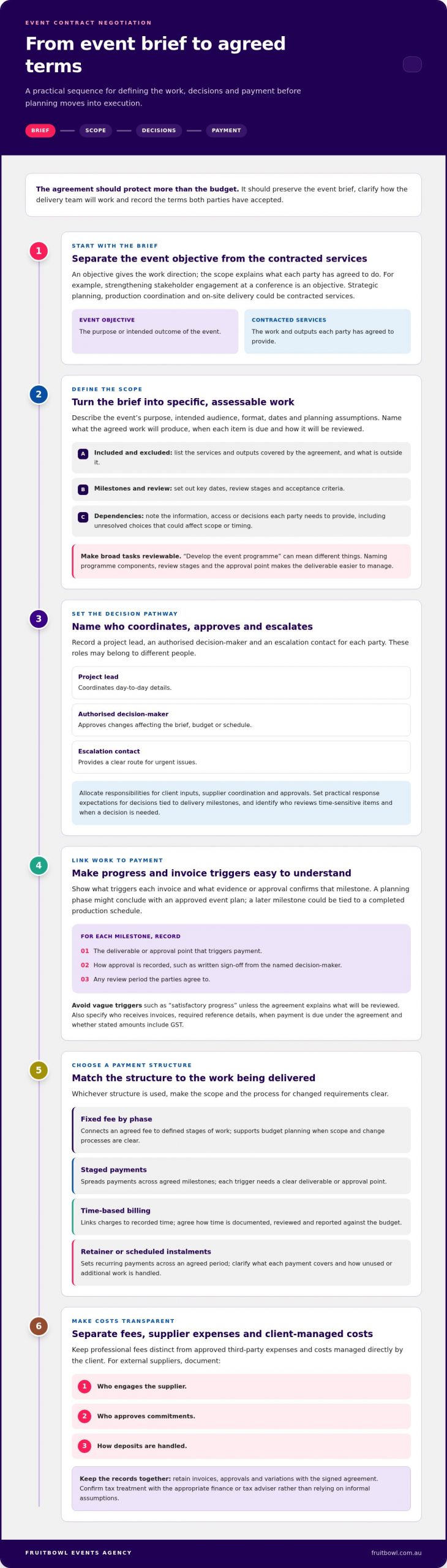
An event contract records the services, responsibilities and commercial terms both parties have agreed to. It should protect more than a budget: it needs to preserve the event brief, clarify how the delivery team will work and support a constructive relationship when decisions or conditions change. Strong event contract negotiation tips begin with making those expectations specific, before planning moves into execution.

Start by separating the event’s objectives from the services being contracted. An objective might be to strengthen stakeholder engagement at a conference; contracted services could include strategic planning, production coordination and on-site delivery. The objective gives the work direction, while the scope explains what each party has agreed to do. Clear negotiation also relies on the principles of contract negotiation: identify interests, resolve differences and record the outcome.

A proposal describes an offer; a complete, agreed contract records the scope, responsibilities and terms both parties have accepted. Treating the two as interchangeable can leave important assumptions unresolved, even when the creative idea is well understood.

Turn the event brief into a defined scope

Translate the brief into a practical description of the event: its purpose, intended audience, format, dates and planning assumptions. Then identify what the agreed work will produce, when each item is due and how it will be reviewed. For example, “develop the event programme” is open to interpretation. Naming the programme components, review stages and approval point makes the deliverable easier to manage.

Use plain language to distinguish confirmed requirements from items that still depend on a decision. Record exclusions and dependencies, such as client-supplied content or a venue decision that has not yet been made, without presenting them as settled facts. This helps both parties see where a later choice could affect scope or timing.

A useful scope check is to confirm:

  • Which services and outputs are included, and which are excluded.
  • Key milestones, review stages and acceptance criteria.
  • What information, access or decisions each party needs to provide.

Clarify who decides, approves and delivers

Name a project lead, an authorised decision-maker and an escalation contact for each party. These roles may sit with different people. A project lead can coordinate day-to-day details, while a decision-maker approves changes that affect the brief, budget or schedule. Recording the distinction prevents routine updates from stalling while the team searches for someone with authority.

Allocate responsibilities for client inputs, supplier coordination and approvals. Set practical response expectations for decisions tied to delivery milestones, and specify how urgent issues are escalated. For instance, if a programme element needs approval before production can proceed, identify who reviews it and the date by which a decision is needed. A clear pathway gives the team a shared basis for coordinating creative intent and operational requirements.

Negotiate event contract terms by linking deliverables to payment

Payment terms work best when they reflect the work being delivered, rather than sitting apart from the project plan. A schedule should show what triggers each invoice, what evidence or approval confirms that milestone, and who can authorise the next stage. This gives both parties a clear reference point if scope or timing changes.

Connect fees, deliverables and approval milestones

Use a deliverables schedule to make progress visible. For example, a planning phase might conclude with an approved event plan, while a later milestone could be tied to a completed production schedule. State how approval is recorded, such as written sign-off from the named decision-maker, and identify any review period the parties agree to. Avoid milestones that rely on vague terms such as “satisfactory progress” without explaining what will be reviewed.

Payment milestones should follow completed, reviewable work so invoices and delivery progress can be understood together. Event contract negotiation tips should also address practical administration: who receives invoices, what reference details are required, when payment is due under the agreement, and whether stated amounts include GST. Keep invoices, approvals and variations with the signed agreement. Confirm tax treatment with the appropriate finance or tax adviser rather than relying on informal assumptions.

Common payment structure

Fixed fee by phase: Connects an agreed fee to defined stages of work. It supports budget planning, provided the scope and process for changed requirements are clear.

Staged payments: Spreads payments across agreed milestones. It makes progress easier to track, but each trigger needs a clear deliverable or approval point.

Time-based billing: Links charges to recorded time spent. Agree how time is documented, reviewed and reported so the client can monitor the work against the budget.

Retainer or scheduled instalments: Sets recurring payments across an agreed period. Clarify what work each payment covers and how unused or additional work is handled.

Make supplier costs and assumptions transparent

Separate professional fees from approved third-party expenses and costs managed directly by the client. For external suppliers, document who engages them, who approves commitments, how deposits are handled and where cancellation exposure sits. Make clear that supplier commitments may have separate terms, rather than leaving these obligations hidden within a broad event budget.

Set an approval pathway before any new or changed expenditure is committed. Specify who can approve it and how that approval is recorded. A budget should also identify its assumptions, including any contingency allowance and how it will be reported. Regular reporting can show approved commitments, actual expenditure and forecast changes without confusing these categories.

For complex events, aligning payments with planning, logistics and delivery keeps commercial terms connected to operational decisions. Fruitbowl’s end-to-end event planning brings those workstreams together, supported by more than 28 years of industry experience.

Address the biggest event contract risk: changes, cancellation and liability

A headline fee doesn’t settle the main risks in an event agreement. The event may evolve, be postponed or be cancelled, and supplier commitments can carry consequences even when plans change. Clear processes help the parties act promptly, understand operational impacts and keep a record of decisions. These event contract negotiation tips focus on how the agreement manages those scenarios, not on assuming a particular legal outcome.

Document variations, postponements and cancellations

Define a variation as a written request to change agreed scope, timing, format or deliverables. Set out who can request it, who has authority to approve it and what information the request must capture. Before work proceeds on the changed basis, record the agreed effect on deliverables, schedule, responsibilities and related supplier commitments. This makes the decision traceable and reduces the risk of teams acting on different versions of the plan.

Give postponement and cancellation their own processes. A postponement might preserve some work already completed while requiring revised dates, schedules and supplier arrangements; cancellation may raise different questions about work performed and commitments already made. The agreement should specify how the parties will assess and document these issues, rather than assuming the same process applies to every event or disruption.

For a practical record, make sure each change entry identifies:

  • The requested change and its operational reason.
  • The person authorised to approve it and the date of approval.
  • Any revised deliverables, dates, dependencies or supplier commitments.
  • How the change affects the agreed commercial arrangements, as reviewed by the relevant decision-makers.

Review liability, insurance and disruption provisions

Match risk allocation to the actual delivery model. Clarify which party is responsible for providing insurance evidence, coordinating incident reporting and carrying out agreed safety obligations. For an event involving multiple venues, suppliers, technical elements or public-facing activity, identify how relevant responsibilities connect. Operational clarity helps teams prepare, but it doesn’t determine the legal effect of liability or insurance wording.

Force majeure and disruption provisions should describe the events they address and the practical steps that follow. Rather than relying on a broad phrase alone, consider whether the agreement needs to address relevant scenarios such as severe weather, a public health restriction, government action or venue unavailability. Set out notification requirements, who must be informed, how the parties will consider mitigation, and how rescheduling, cancellation and unrecoverable supplier commitments will be handled under the agreed terms.

Risk clauses must match the event’s actual delivery profile, not a generic template. Before signing, have a qualified Australian legal adviser review governing jurisdiction, liability limits, exclusions, insurance obligations, dispute processes and disruption wording. For cross-border corporate agreements or regional supplier contracts, firms like Fervent Chambers LLC assist organisations with navigating dispute clauses and contractual liability. These provisions can have legal consequences that depend on the agreement and circumstances, so treat operational planning and legal interpretation as related but distinct tasks.

A fixed fee may appear straightforward, but it cannot by itself resolve what happens when delivery conditions change. Reviewing these provisions alongside the event’s format and operational dependencies gives decision-makers a clearer basis for assessing exposure before committing.
Event Contract Negotiation Tips: A Practical Guide for 2026

Use a practical negotiation process before signing an event agreement

A consistent review process turns negotiation into a controlled series of decisions, rather than a last-minute exchange of comments. Use these event contract negotiation tips to identify priorities early, resolve open points and ensure the final signed document reflects what the delivery team will actually need to do.

  1. Review the brief. Summarise the event objectives, audience, format, essential deliverables, known constraints and key planning assumptions. Use this as the reference point for assessing whether the agreement supports the intended event.
  2. Map dependencies. Identify decisions that affect one another, such as venue selection, production requirements, talent bookings and stakeholder approvals. Note which need to be resolved first and what information is still outstanding.
  3. Rank negotiation points. Classify each issue as essential, flexible or subject to legal review. Prioritise by its potential effect on delivery, financial exposure and decision urgency, so material risks receive attention before lower-impact wording preferences.
  4. Discuss and document changes. Work through the priority list with the relevant decision-makers. Record proposed wording, the reason for each change and whether it has been accepted, declined or left open.
  5. Resolve outstanding items. Assign an owner and due date to every open decision. Confirm how unresolved points affect planning before treating them as agreed.
  6. Approve and control the final document. Check the complete agreement and any schedules or attachments against the negotiated record. Make sure the authorised parties sign the same final version, then store it in a controlled location for the delivery team.

Prepare a negotiation brief and priority list

A concise negotiation brief keeps discussion connected to the event’s purpose. Set out the must-have outcomes, essential deliverables, constraints and any requirements that cannot be traded away. Separate these from preferences that could be adjusted without undermining the event. Mark matters requiring legal review clearly, so operational decisions aren’t mistaken for legal approval.

For a corporate event, a venue decision may affect room layout, technical production and the programme. Capture those dependencies together, then identify the decision-maker and the latest useful decision date for each. A considered corporate event management framework connects the brief to the practical sequence of planning decisions.

Record agreed wording and control contract versions

Keep one authoritative record of proposed wording, agreed changes and outstanding decisions. Compare each revised draft with the previous version, then check that accepted changes appear accurately and that no earlier terms have shifted unintentionally. Give every open point an owner and due date, and circulate one clearly identified version for approval. For technical scope, align the agreement with the event’s production needs, including the event AV management framework.

Once signed, distribute the controlled agreement to the people managing planning and delivery. Fruitbowl brings strategic planning, logistics and on-site delivery into one coordinated process. Plan your event with Fruitbowl.

Make the event contract a delivery tool, not a document filed away

A signed agreement has ongoing value when the delivery team uses it to guide decisions. It can inform the working schedule, budget tracking, approval points and supplier coordination, keeping day-to-day activity connected to what the parties agreed. This is where event contract negotiation tips become practical: the contract should help the team deliver the event, not simply record the deal.

Translate signed terms into an active delivery plan

Convert each contractual milestone into a schedule item with an accountable owner, a target date and any dependencies. If a planning approval is needed before production can proceed, show that relationship in the schedule. Apply the same discipline to budget tracking: distinguish approved commitments from forecast items, and use the agreement’s terms to guide how updates are recorded and escalated.

Responsibilities documented in the contract should shape how client stakeholders, suppliers and the event team work together. A supplier coordination task, for example, needs an identified lead and a clear connection to the relevant event milestone. This is particularly useful for conferences, where venue, programme, speaker, technical and attendee requirements need to converge. The conference logistics coordinator role illustrates how these moving parts can be brought into a coordinated delivery plan.

Approved changes also need to flow through to operational documents. Update schedules, budget records and working briefs when an agreed variation affects them, and retain a reference to the recorded approval. Otherwise, teams may act on outdated information even though the contract has changed. Consistent document control keeps the signed terms and the live delivery plan aligned.

Bring strategic oversight to complex event agreements

For a corporate conference, public event or brand activation, contract terms are one part of a larger delivery system. Creative objectives need to remain connected to logistics, stakeholder decisions, supplier activity and on-site execution. End-to-end coordination helps maintain those connections, so the team can see how a change in one workstream affects the wider plan.

Fruitbowl Events Agency brings strategic planning, budget management, stakeholder liaison, technical direction and on-site delivery together across events in Australia. With more than 28 years of event industry experience, the agency understands the importance of translating agreed responsibilities into coordinated action. That experience supports disciplined planning, while each event’s outcomes remain specific to its brief and circumstances.

Keep the agreement accessible to the people responsible for delivery, and return to it as planning decisions progress. For more on the agency’s approach, see Fruitbowl’s event planning services.

Set the event up for confident decisions

Carry the same decision discipline into the life of the event. Agree how the team will revisit key commitments as planning progresses, who can resolve emerging questions and how approved adjustments will be captured. This keeps the agreement useful as circumstances develop, rather than relying on memory or informal conversations to guide important choices.

Use these event contract negotiation tips as a foundation for a working relationship built on clarity. A well-managed event depends on people understanding not only what they’re responsible for, but how to move forward when a decision is needed. That shared approach gives creative ambition room to develop within a considered delivery plan.

Fruitbowl supports event planning with a coordinated approach. Discuss your event planning requirements with Fruitbowl and take the next step with greater clarity and confidence.

Frequently Asked Questions

Is an email enough to confirm an event contract change?

An email can document a change, but whether it effectively alters the contract depends on the agreement’s amendment process, the sender’s authority and the wording exchanged. For a material change, use a clearly labelled variation or amendment that identifies the original agreement and the revised terms. Keep the approved version with the contract record, rather than relying on a long email thread that may leave the final position unclear.

Can parties negotiate an event contract after signing?

Yes, parties can discuss changes after signing, but they should record any agreed amendment clearly and have it approved by people with authority to bind each party. For example, changing an event format could affect venue arrangements, technical requirements and supplier commitments. Check the existing contract’s amendment procedure and obtain legal advice where the change could alter significant rights or obligations. Don’t treat a proposed change as agreed until the parties have documented their decision.

What is a letter of intent for an event?

A letter of intent usually records the parties’ preliminary understanding while they work towards a fuller agreement. It might outline the proposed event, intended services or matters still under discussion. Its legal effect depends on its wording and context, so don’t assume the document is either wholly binding or wholly non-binding. Before relying on one to secure arrangements or authorise work, have a qualified legal adviser review what it says.

Who should be authorised to sign an event contract?

The signatory should have authority to enter the agreement on behalf of the organisation, under its internal delegations and governance processes. This may be a director, an officer with delegated authority or another approved representative, depending on the organisation. Before signing, confirm the correct legal entity is named and that the signer’s authority covers the commitment. For a public sector organisation, follow its applicable procurement and approval procedures.

Are electronic signatures valid for event contracts in Australia?

Electronic signatures can be valid for many Australian agreements, but the requirements and exceptions depend on the document, applicable law and circumstances. Ensure the method shows the signatory’s intention to sign and retain a reliable copy of the completed document and signing record. Don’t assume every document can use the same process. A qualified Australian legal adviser can assess whether electronic execution is appropriate for the specific contract.

Should each event supplier have a separate contract?

Not necessarily. The contracting structure depends on who engages and pays each supplier, how responsibilities are allocated and how the event is being managed. If the organiser contracts directly, each supplier agreement can set out its own scope and terms. If an event agency coordinates suppliers under a broader engagement, the main agreement should clarify that arrangement and how supplier commitments are approved and communicated. Keep related documents accessible to the delivery team.

What should an event contract say about confidential information?

A confidentiality clause should identify what information is protected, who may access it and the purposes for which it can be used. It can also address permitted disclosures, how information is safeguarded, and what happens to it when the engagement ends. For an event, consider sensitive programme details, commercial information and unpublished announcements. If attendee or stakeholder personal information is involved, seek advice on applicable privacy obligations and ensure the contract addresses relevant handling responsibilities.

What if the biggest risk in an event contract isn’t the price, but what nobody has clearly agreed to deliver? A fee may be easy to compare, yet vague scope, approval pathways and disruption clauses can leave organisers and suppliers working from different assumptions. These event contract negotiation tips focus on the details that shape delivery, not just the headline figure.

Before signing, establish what’s included, who makes decisions, how changes are approved and what happens if plans need to shift. That clarity makes proposals easier to assess, helps manage late changes and gives the event team a reliable basis for planning.

This practical guide explains what to negotiate across scope and deliverables, responsibilities, payment and change processes, cancellation, postponement, force majeure and success measures. The aim is a professional agreement that reflects the event’s creative intent and operational realities, so everyone can move into planning with confidence.

Key Takeaways

  • Use event contract negotiation tips to turn the event brief into specific, assessable deliverables and responsibilities.
  • Connect payment milestones to agreed work, approval points or planning phases, and distinguish fees from third-party expenses and client-managed costs.
  • Set out how variations, cancellation and postponement will be handled so decisions and their implications are documented.
  • Prioritise negotiation points by their effect on delivery, financial exposure and how soon a decision is needed.
  • Keep the signed agreement active during planning by using it to guide schedules, budget tracking, approvals and supplier coordination.

Event contract negotiation tips: establish what the agreement must protect

An event contract records the services, responsibilities and commercial terms both parties have agreed to. It should protect more than a budget: it needs to preserve the event brief, clarify how the delivery team will work and support a constructive relationship when decisions or conditions change. Strong event contract negotiation tips begin with making those expectations specific, before planning moves into execution.

Start by separating the event’s objectives from the services being contracted. An objective might be to strengthen stakeholder engagement at a conference; contracted services could include strategic planning, production coordination and on-site delivery. The objective gives the work direction, while the scope explains what each party has agreed to do. Clear negotiation also relies on the principles of contract negotiation: identify interests, resolve differences and record the outcome.

A proposal describes an offer; a complete, agreed contract records the scope, responsibilities and terms both parties have accepted. Treating the two as interchangeable can leave important assumptions unresolved, even when the creative idea is well understood.

Turn the event brief into a defined scope

Translate the brief into a practical description of the event: its purpose, intended audience, format, dates and planning assumptions. Then identify what the agreed work will produce, when each item is due and how it will be reviewed. For example, “develop the event programme” is open to interpretation. Naming the programme components, review stages and approval point makes the deliverable easier to manage.

Use plain language to distinguish confirmed requirements from items that still depend on a decision. Record exclusions and dependencies, such as client-supplied content or a venue decision that has not yet been made, without presenting them as settled facts. This helps both parties see where a later choice could affect scope or timing.

A useful scope check is to confirm:

  • Which services and outputs are included, and which are excluded.
  • Key milestones, review stages and acceptance criteria.
  • What information, access or decisions each party needs to provide.

Clarify who decides, approves and delivers

Name a project lead, an authorised decision-maker and an escalation contact for each party. These roles may sit with different people. A project lead can coordinate day-to-day details, while a decision-maker approves changes that affect the brief, budget or schedule. Recording the distinction prevents routine updates from stalling while the team searches for someone with authority.

Allocate responsibilities for client inputs, supplier coordination and approvals. Set practical response expectations for decisions tied to delivery milestones, and specify how urgent issues are escalated. For instance, if a programme element needs approval before production can proceed, identify who reviews it and the date by which a decision is needed. A clear pathway gives the team a shared basis for coordinating creative intent and operational requirements.

Negotiate event contract terms by linking deliverables to payment

Payment terms work best when they reflect the work being delivered, rather than sitting apart from the project plan. A schedule should show what triggers each invoice, what evidence or approval confirms that milestone, and who can authorise the next stage. This gives both parties a clear reference point if scope or timing changes.

Connect fees, deliverables and approval milestones

Use a deliverables schedule to make progress visible. For example, a planning phase might conclude with an approved event plan, while a later milestone could be tied to a completed production schedule. State how approval is recorded, such as written sign-off from the named decision-maker, and identify any review period the parties agree to. Avoid milestones that rely on vague terms such as “satisfactory progress” without explaining what will be reviewed.

Payment milestones should follow completed, reviewable work so invoices and delivery progress can be understood together. Event contract negotiation tips should also address practical administration: who receives invoices, what reference details are required, when payment is due under the agreement, and whether stated amounts include GST. Keep invoices, approvals and variations with the signed agreement. Confirm tax treatment with the appropriate finance or tax adviser rather than relying on informal assumptions.

Common payment structure

Fixed fee by phase: Connects an agreed fee to defined stages of work. It supports budget planning, provided the scope and process for changed requirements are clear.

Staged payments: Spreads payments across agreed milestones. It makes progress easier to track, but each trigger needs a clear deliverable or approval point.

Time-based billing: Links charges to recorded time spent. Agree how time is documented, reviewed and reported so the client can monitor the work against the budget.

Retainer or scheduled instalments: Sets recurring payments across an agreed period. Clarify what work each payment covers and how unused or additional work is handled.

Make supplier costs and assumptions transparent

Separate professional fees from approved third-party expenses and costs managed directly by the client. For external suppliers, document who engages them, who approves commitments, how deposits are handled and where cancellation exposure sits. Make clear that supplier commitments may have separate terms, rather than leaving these obligations hidden within a broad event budget.

Set an approval pathway before any new or changed expenditure is committed. Specify who can approve it and how that approval is recorded. A budget should also identify its assumptions, including any contingency allowance and how it will be reported. Regular reporting can show approved commitments, actual expenditure and forecast changes without confusing these categories.

For complex events, aligning payments with planning, logistics and delivery keeps commercial terms connected to operational decisions. Fruitbowl’s end-to-end event planning brings those workstreams together, supported by more than 28 years of industry experience.

Address the biggest event contract risk: changes, cancellation and liability

A headline fee doesn’t settle the main risks in an event agreement. The event may evolve, be postponed or be cancelled, and supplier commitments can carry consequences even when plans change. Clear processes help the parties act promptly, understand operational impacts and keep a record of decisions. These event contract negotiation tips focus on how the agreement manages those scenarios, not on assuming a particular legal outcome.

Document variations, postponements and cancellations

Define a variation as a written request to change agreed scope, timing, format or deliverables. Set out who can request it, who has authority to approve it and what information the request must capture. Before work proceeds on the changed basis, record the agreed effect on deliverables, schedule, responsibilities and related supplier commitments. This makes the decision traceable and reduces the risk of teams acting on different versions of the plan.

Give postponement and cancellation their own processes. A postponement might preserve some work already completed while requiring revised dates, schedules and supplier arrangements; cancellation may raise different questions about work performed and commitments already made. The agreement should specify how the parties will assess and document these issues, rather than assuming the same process applies to every event or disruption.

For a practical record, make sure each change entry identifies:

  • The requested change and its operational reason.
  • The person authorised to approve it and the date of approval.
  • Any revised deliverables, dates, dependencies or supplier commitments.
  • How the change affects the agreed commercial arrangements, as reviewed by the relevant decision-makers.

Review liability, insurance and disruption provisions

Match risk allocation to the actual delivery model. Clarify which party is responsible for providing insurance evidence, coordinating incident reporting and carrying out agreed safety obligations. For an event involving multiple venues, suppliers, technical elements or public-facing activity, identify how relevant responsibilities connect. Operational clarity helps teams prepare, but it doesn’t determine the legal effect of liability or insurance wording.

Force majeure and disruption provisions should describe the events they address and the practical steps that follow. Rather than relying on a broad phrase alone, consider whether the agreement needs to address relevant scenarios such as severe weather, a public health restriction, government action or venue unavailability. Set out notification requirements, who must be informed, how the parties will consider mitigation, and how rescheduling, cancellation and unrecoverable supplier commitments will be handled under the agreed terms.

Risk clauses must match the event’s actual delivery profile, not a generic template. Before signing, have a qualified Australian legal adviser review governing jurisdiction, liability limits, exclusions, insurance obligations, dispute processes and disruption wording. These provisions can have legal consequences that depend on the agreement and circumstances, so treat operational planning and legal interpretation as related but distinct tasks.

A fixed fee may appear straightforward, but it cannot by itself resolve what happens when delivery conditions change. Reviewing these provisions alongside the event’s format and operational dependencies gives decision-makers a clearer basis for assessing exposure before committing.

Use a practical negotiation process before signing an event agreement

A consistent review process turns negotiation into a controlled series of decisions, rather than a last-minute exchange of comments. Use these event contract negotiation tips to identify priorities early, resolve open points and ensure the final signed document reflects what the delivery team will actually need to do.

  1. Review the brief. Summarise the event objectives, audience, format, essential deliverables, known constraints and key planning assumptions. Use this as the reference point for assessing whether the agreement supports the intended event.
  2. Map dependencies. Identify decisions that affect one another, such as venue selection, production requirements, talent bookings and stakeholder approvals. Note which need to be resolved first and what information is still outstanding.
  3. Rank negotiation points. Classify each issue as essential, flexible or subject to legal review. Prioritise by its potential effect on delivery, financial exposure and decision urgency, so material risks receive attention before lower-impact wording preferences.
  4. Discuss and document changes. Work through the priority list with the relevant decision-makers. Record proposed wording, the reason for each change and whether it has been accepted, declined or left open.
  5. Resolve outstanding items. Assign an owner and due date to every open decision. Confirm how unresolved points affect planning before treating them as agreed.
  6. Approve and control the final document. Check the complete agreement and any schedules or attachments against the negotiated record. Make sure the authorised parties sign the same final version, then store it in a controlled location for the delivery team.

Prepare a negotiation brief and priority list

A concise negotiation brief keeps discussion connected to the event’s purpose. Set out the must-have outcomes, essential deliverables, constraints and any requirements that cannot be traded away. Separate these from preferences that could be adjusted without undermining the event. Mark matters requiring legal review clearly, so operational decisions aren’t mistaken for legal approval.

For a corporate event, a venue decision may affect room layout, technical production and the programme. Capture those dependencies together, then identify the decision-maker and the latest useful decision date for each. A considered corporate event management framework connects the brief to the practical sequence of planning decisions.

Record agreed wording and control contract versions

Keep one authoritative record of proposed wording, agreed changes and outstanding decisions. Compare each revised draft with the previous version, then check that accepted changes appear accurately and that no earlier terms have shifted unintentionally. Give every open point an owner and due date, and circulate one clearly identified version for approval. For technical scope, align the agreement with the event’s production needs, including the event AV management framework.

Once signed, distribute the controlled agreement to the people managing planning and delivery. Fruitbowl brings strategic planning, logistics and on-site delivery into one coordinated process. Plan your event with Fruitbowl.

Make the event contract a delivery tool, not a document filed away

A signed agreement has ongoing value when the delivery team uses it to guide decisions. It can inform the working schedule, budget tracking, approval points and supplier coordination, keeping day-to-day activity connected to what the parties agreed. This is where event contract negotiation tips become practical: the contract should help the team deliver the event, not simply record the deal.

Translate signed terms into an active delivery plan

Convert each contractual milestone into a schedule item with an accountable owner, a target date and any dependencies. If a planning approval is needed before production can proceed, show that relationship in the schedule. Apply the same discipline to budget tracking: distinguish approved commitments from forecast items, and use the agreement’s terms to guide how updates are recorded and escalated.

Responsibilities documented in the contract should shape how client stakeholders, suppliers and the event team work together. A supplier coordination task, for example, needs an identified lead and a clear connection to the relevant event milestone. This is particularly useful for conferences, where venue, programme, speaker, technical and attendee requirements need to converge. The conference logistics coordinator role illustrates how these moving parts can be brought into a coordinated delivery plan.

Approved changes also need to flow through to operational documents. Update schedules, budget records and working briefs when an agreed variation affects them, and retain a reference to the recorded approval. Otherwise, teams may act on outdated information even though the contract has changed. Consistent document control keeps the signed terms and the live delivery plan aligned.

Bring strategic oversight to complex event agreements

For a corporate conference, public event or brand activation, contract terms are one part of a larger delivery system. Creative objectives need to remain connected to logistics, stakeholder decisions, supplier activity and on-site execution. End-to-end coordination helps maintain those connections, so the team can see how a change in one workstream affects the wider plan.

Fruitbowl Events Agency brings strategic planning, budget management, stakeholder liaison, technical direction and on-site delivery together across events in Australia. With more than 28 years of event industry experience, the agency understands the importance of translating agreed responsibilities into coordinated action. That experience supports disciplined planning, while each event’s outcomes remain specific to its brief and circumstances.

Keep the agreement accessible to the people responsible for delivery, and return to it as planning decisions progress. For more on the agency’s approach, see Fruitbowl’s event planning services.

Set the event up for confident decisions

Carry the same decision discipline into the life of the event. Agree how the team will revisit key commitments as planning progresses, who can resolve emerging questions and how approved adjustments will be captured. This keeps the agreement useful as circumstances develop, rather than relying on memory or informal conversations to guide important choices.

Use these event contract negotiation tips as a foundation for a working relationship built on clarity. A well-managed event depends on people understanding not only what they’re responsible for, but how to move forward when a decision is needed. That shared approach gives creative ambition room to develop within a considered delivery plan.

Fruitbowl supports event planning with a coordinated approach. Discuss your event planning requirements with Fruitbowl and take the next step with greater clarity and confidence.

Frequently Asked Questions

Is an email enough to confirm an event contract change?

An email can document a change, but whether it effectively alters the contract depends on the agreement’s amendment process, the sender’s authority and the wording exchanged. For a material change, use a clearly labelled variation or amendment that identifies the original agreement and the revised terms. Keep the approved version with the contract record, rather than relying on a long email thread that may leave the final position unclear.

Can parties negotiate an event contract after signing?

Yes, parties can discuss changes after signing, but they should record any agreed amendment clearly and have it approved by people with authority to bind each party. For example, changing an event format could affect venue arrangements, technical requirements and supplier commitments. Check the existing contract’s amendment procedure and obtain legal advice where the change could alter significant rights or obligations. Don’t treat a proposed change as agreed until the parties have documented their decision.

What is a letter of intent for an event?

A letter of intent usually records the parties’ preliminary understanding while they work towards a fuller agreement. It might outline the proposed event, intended services or matters still under discussion. Its legal effect depends on its wording and context, so don’t assume the document is either wholly binding or wholly non-binding. Before relying on one to secure arrangements or authorise work, have a qualified legal adviser review what it says.

Who should be authorised to sign an event contract?

The signatory should have authority to enter the agreement on behalf of the organisation, under its internal delegations and governance processes. This may be a director, an officer with delegated authority or another approved representative, depending on the organisation. Before signing, confirm the correct legal entity is named and that the signer’s authority covers the commitment. For a public sector organisation, follow its applicable procurement and approval procedures.

Are electronic signatures valid for event contracts in Australia?

Electronic signatures can be valid for many Australian agreements, but the requirements and exceptions depend on the document, applicable law and circumstances. Ensure the method shows the signatory’s intention to sign and retain a reliable copy of the completed document and signing record. Don’t assume every document can use the same process. A qualified Australian legal adviser can assess whether electronic execution is appropriate for the specific contract.

Should each event supplier have a separate contract?

Not necessarily. The contracting structure depends on who engages and pays each supplier, how responsibilities are allocated and how the event is being managed. If the organiser contracts directly, each supplier agreement can set out its own scope and terms. If an event agency coordinates suppliers under a broader engagement, the main agreement should clarify that arrangement and how supplier commitments are approved and communicated. Keep related documents accessible to the delivery team.

What should an event contract say about confidential information?

A confidentiality clause should identify what information is protected, who may access it and the purposes for which it can be used. It can also address permitted disclosures, how information is safeguarded, and what happens to it when the engagement ends. For an event, consider sensitive programme details, commercial information and unpublished announcements. If attendee or stakeholder personal information is involved, seek advice on applicable privacy obligations and ensure the contract addresses relevant handling responsibilities.

Back to Articles
Request A Quote

Make an
Enquiry

Untitled design

What Makes Us Different?

True end-to-end solution so you can hand off to us, focus on your priorities and enjoy the event without any stress

Unmatched industry expertise looking after diverse range of high-profile events, cultural festivals & activations

Meticulous attention to every detail and precise execution of events with our streamlined processes

Tailored solutions with bespoke strategies to ensure we align with your brand and objectives

Make an Enquiry

"*" indicates required fields

This field is for validation purposes and should be left unchanged.

"*" indicates required fields

This field is for validation purposes and should be left unchanged.