What makes an event agency proposal relevant to your needs? Often, it’s the clarity of the brief behind it. A clear event agency briefing template gives agencies the context to shape useful ideas, realistic delivery plans and meaningful measures of success. It also helps you compare responses on consistent terms, rather than assess proposals built on different assumptions.
You don’t need to have every detail settled before approaching an agency. You may still be working through the audience, format or budget, but leaving key decisions unclear can lead to scope gaps, revisions and avoidable pressure later. This guide provides a practical template for capturing objectives, audience needs, logistics, responsibilities and open questions, while showing where plans can evolve. You’ll also learn how to invite comparable agency responses and create a smoother handover from the first conversation to planning and delivery.
Key Takeaways
- Use an event agency briefing template to record key decisions, unknowns and decision owners in one practical document.
- Set out the event’s purpose, audience, format, date parameters, location needs and expected attendance to give proposals useful context.
- Adjust the detail for conferences, festivals and public events, or brand activations, so the brief reflects each format’s priorities.
- Compare proposals by how they interpret your objectives, define scope, state assumptions and explain their delivery approach.
- Use the approved brief to connect planning, logistics, production and on-site delivery workstreams.
Why an event agency briefing template improves planning and proposals
A corporate event brief gives your organisation and prospective agency a shared starting point. It brings the purpose, audience, scope and delivery expectations together, so the agency can build a proposal around the outcomes you need instead of filling gaps with assumptions. A well-structured event agency briefing template also makes it easier to distinguish settled decisions from areas where an agency’s experience could help shape the approach.
Think of it as an event-specific adaptation of a creative brief: a framework for communicating a project’s intent and guiding the work that follows. For an event, that means connecting business objectives with the attendee experience, practical scope and measures of success. A useful event brief connects the purpose of the event with the outcomes you’ll use to assess its success.
A clear brief supports more relevant proposals, but it doesn’t require every agency to use an identical format. Instead, it gives each agency the same core information to work from. You can then compare how each response interprets the objectives, defines the scope and plans for delivery, while allowing room for different creative and operational solutions.
What an event agency brief is designed to achieve
The brief guides discussion. It shouldn’t prescribe a fixed event format before planning begins. For example, if the goal is to bring clients together and strengthen relationships, state that objective alongside what you know about the audience and the experience you want them to have. The agency can use this context to consider suitable formats and delivery requirements. Measures of success, such as attendee feedback or participation in a planned programme, help clarify the intended result.
What to decide before sending the brief
You don’t need to resolve every planning detail before approaching an agency. You do need a reliable account of what’s known, what’s assumed and what remains open. Identify one internal brief owner to coordinate information and feedback, then list the stakeholders who will approve objectives, budget parameters and key event decisions.
Before sending the document, organise the information you already have:
- Confirmed requirements: objectives, audience priorities, known date parameters and any agreed scope boundaries.
- Assumptions and open questions: items that need discussion, including options still under consideration.
- Useful background: existing brand guidance, audience insights, venue information or programme ideas, where available.
This distinction helps an agency prepare a grounded response without treating early ideas as final instructions. It also gives you a practical basis for developing the brief together as planning decisions take shape.
Event agency briefing template: the essential fields to complete
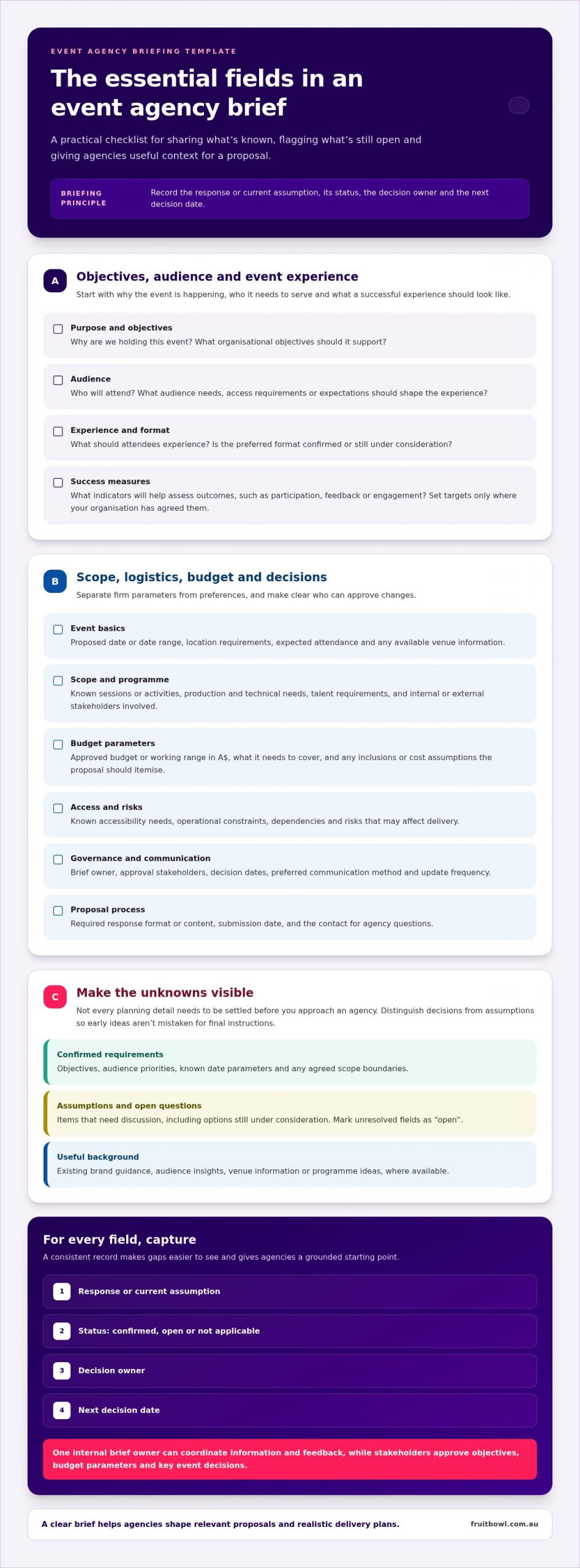
Use the prompts below as a copy-ready starting point. Add a response for each field, mark anything unresolved as “open”, and name the person responsible for the decision. This gives an agency a useful basis for its proposal without implying that every detail is already settled.
Objectives, audience and event experience
Start with the reason for the event, then describe who it needs to serve and what success should look like. If you’re developing the strategic context, this corporate event management framework can help connect event planning with broader organisational aims.
- Purpose and objectives: Why are we holding this event? What organisational objectives should it support?
- Audience: Who will attend? What audience needs, access requirements or expectations should shape the experience?
- Experience and format: What should attendees experience? Is the preferred format confirmed or still under consideration?
- Success measures: What indicators will help us assess outcomes, such as participation, feedback or engagement? Set targets only where your organisation has agreed them.
Scope, logistics, budget and decision-making
Record what’s known about delivery, including requirements that could affect the programme, production or planning approach. Separate firm parameters from preferences, and identify who can approve changes.
- Event basics: Proposed date or date range, location requirements, expected attendance and any available venue information.
- Scope and programme: Known sessions or activities, production and technical needs, talent requirements, and internal or external stakeholders involved.
- Budget parameters: Approved budget or working range in A$, what it needs to cover, and any inclusions or cost assumptions the proposal should itemise.
- Access and risks: Known accessibility needs, operational constraints, dependencies and risks that may affect delivery.
- Governance and communication: Brief owner, approval stakeholders, decision dates, preferred communication method and update frequency.
- Proposal process: Required response format or content, submission date, and the contact for agency questions.
For each prompt, record: the response or current assumption, status (confirmed, open or not applicable), decision owner and next decision date. This simple structure makes gaps visible without holding up the initial conversation.
Once these fields are assembled, the brief can support a focused discussion about priorities and delivery. Discuss your corporate event brief with Fruitbowl when you’re ready to develop the project further.
How to adapt an event agency brief for different event formats
Keep the core event agency briefing template consistent, then add detail where the format changes the planning questions. Audience scale, programme complexity and stakeholder mix all affect what an agency needs to understand. A conference may centre on sessions and speakers; a public event may need more detail about audience movement and operational dependencies; a brand activation needs a clear account of the interaction the brand wants people to have.
Use the comparison below to identify where to expand your brief. Supporting documents, such as draft programmes or brand guidelines, can sit in a short annexure so the core document stays easy to use.
| Format | Add detail on | Questions to resolve |
|---|---|---|
| Conference or seminar | Programme, speakers, session formats, registration, venue and technical requirements | How should sessions flow? What should attendees experience? Which stakeholders shape or approve the programme? |
| Festival or public event | Audience flow, public-facing objectives, programming, talent, production and operational dependencies | How will people move through the event? What programming is known, and which operational considerations remain open? |
| Brand activation | Brand interaction, audience engagement, production needs and success measures | What should people do or take away from the interaction? How will engagement be assessed? |
Briefing a conference or seminar agency
Describe the programme structure at the level you’ve established, including session types, speaker requirements and attendee experience priorities. Note known registration, venue and technical needs, along with the teams or stakeholders involved. You don’t need a final run sheet at proposal stage. Flag developing elements as open so the response can address planning needs without treating early assumptions as fixed. For related coordination context, see the conference logistics coordinator role.
Briefing a festival, public event or activation agency
For a festival or public event, explain the intended audience journey and public-facing purpose, then identify known dependencies affecting programming, talent or production. Avoid presenting preliminary ideas as final specifications. For a brand activation, describe the desired brand interaction and the outcome you want to measure, such as participation or audience feedback. If technical scope needs more definition, include what’s known about staging, sound, screens or other production needs, and identify what remains to be developed. The AV management for events framework can help clarify those considerations.
Format-specific detail should sharpen the brief, not replace its shared foundation. Keep objectives, audience, scope, decision owners and success measures visible across every version, then attach only the supporting information relevant to that event.
How to use the event agency brief to compare proposals
A completed event agency briefing template gives you a consistent basis for reviewing proposals. The aim isn’t to reward the longest response or the most polished presentation. Assess how each agency translates your requirements into a considered approach, makes assumptions visible and connects planning decisions to delivery.
A consistent framework for reviewing agency responses
Review each proposal in the same sequence: objectives and audience, scope and responsibilities, assumptions and dependencies, then planning and delivery approach. Look for a clear explanation of how creative, logistical and technical work will come together, how stakeholders will be managed, and where your team will need to make decisions. Check that communication expectations make responsibilities and decision points understandable.
Use this comparison framework to record what each response demonstrates and what you need to resolve:
- Objectives and audience: Does the proposal respond directly to the outcomes and attendee needs in the brief? Note where its approach aligns and where you need clarification.
- Scope and responsibilities: Are proposed workstreams, client inputs, assumptions and exclusions clear? Identify any gaps that could affect scope or ownership.
- Dependencies and decisions: Does the response identify information, approvals or decisions needed to progress? Record who must provide them and when.
- Planning and delivery: Does it show how strategy, production, stakeholders and event-day delivery connect? Compare the process, not just the activity list.
- Communication: Are contact points, update arrangements and approval steps explained? Note any changes needed to support your team.
Compare like with like, then assess the quality of each agency’s interpretation. A proposal that identifies a dependency early may give you a more useful basis for planning than one that presents unresolved details as settled.
How to handle missing information and changing requirements
Your brief doesn’t need to lock every creative or operational detail. It does need to distinguish confirmed requirements from open questions. If attendance, programme elements or technical needs are still being developed, label them as unknown rather than inserting a guess. Then consider how each agency proposes to work through those gaps with you, including how decisions will be recorded and approved.
As the preferred approach develops, keep a current record of agreed changes, decision owners and approval steps. This gives the project team a reliable reference as the work moves from proposal into planning.
To turn a proposal into a clear delivery pathway, discuss your event brief with Fruitbowl.
From event agency briefing template to confident event delivery
An approved brief is the starting point for delivery, not a document to file away. The agency and client team use it to confirm intended outcomes, translate requirements into coordinated workstreams and make decisions visible as planning progresses. This is where the event agency briefing template becomes a practical reference for managing the work, not just requesting a proposal.
Turn the approved brief into shared project controls
Begin by confirming objectives, scope, responsibilities, approval roles and reporting arrangements. These agreements help the team understand who leads each decision and how progress will be communicated. The agency can then map the work into milestones, workstreams and decision deadlines, aligning dependencies such as venue decisions, programme development and production planning.
Keep a change record as requirements develop. Note what has changed, why it matters, who owns the next action and which stakeholders need to approve it. This creates a clear reference point if a revised programme affects logistics, technical direction or budget management. It also helps the team respond to change without losing sight of the original objectives.
Engage an experienced partner for integrated delivery
Events rely on connected decisions. Venue sourcing can influence logistics and production; talent coordination can shape programme timing and technical needs; stakeholder liaison can keep approvals and communications aligned. A joined-up plan brings these elements together, from strategic planning through to on-site coordination, rather than treating them as separate tasks.
Fruitbowl Events Agency brings more than 28 years of event industry experience to corporate and public event environments, including conferences, festivals, government activations and brand activations. Its end-to-end planning, coordination and delivery can integrate budget management, venue sourcing, technical direction, stakeholder liaison and on-site delivery according to the project’s requirements.
With objectives and responsibilities clearly documented, the brief can guide each stage while allowing the right details to develop with the project. Discuss how your event’s intended outcomes can inform a delivery plan with Fruitbowl.
Put your event brief into action
A clear event agency briefing template does more than gather information. It connects your event’s purpose with audience needs, practical scope and measures of success, giving agencies a stronger foundation for relevant proposals. By separating confirmed decisions from open questions, you can compare approaches fairly without finalising every creative or operational detail before planning begins.
Once you’ve selected an approach, keep the brief active. Use it to align responsibilities, approvals and workstreams as the project develops, so strategic intent stays connected to logistics, production and delivery. This creates a considered path from the first conversation to the event itself.
Fruitbowl provides end-to-end planning, coordination and delivery for events across Australia. If you’re ready to develop your objectives into a practical plan, discuss your event brief with Fruitbowl. A clear starting point can make the next decisions easier and help you move forward with confidence.
Frequently Asked Questions
What should an event agency briefing template include?
An event agency briefing template should capture the event’s purpose, objectives, audience, preferred format, date parameters, location requirements and expected attendance. Include known programme and production needs, budget parameters, accessibility considerations, risks, approval roles and communication preferences. Add success measures, proposal requirements, submission timing and a contact for agency questions. Mark each item as confirmed or open, and identify who owns outstanding decisions.
How detailed should an event brief be before sending it to an agency?
Include enough detail for an agency to understand the objectives, audience, likely scope and key constraints, but you don’t need to finalise every creative or operational decision. Separate confirmed requirements from assumptions and open questions. For example, if the event date is still being approved, provide the preferred period and name the person responsible for confirming it. This helps agencies frame relevant proposals without treating uncertainties as facts.
Can I send the same event brief to multiple agencies?
Yes. Sharing the same core brief gives each agency a consistent understanding of the objectives, audience and requirements, making responses easier to compare. Set the same submission date and explain what information you want each proposal to address, such as scope, assumptions and delivery approach. Agencies may structure their responses differently, so assess how well each answers the brief rather than expecting identical presentation formats.
How do I compare event agency proposals fairly?
Compare each proposal against the same criteria: alignment with your objectives and audience, scope and responsibilities, stated assumptions, dependencies, communication and delivery approach. Look for clear connections between planning, production, stakeholder management and event-day delivery. Record where a response answers the brief, where it proposes an alternative and what needs clarification. This keeps the decision focused on suitability and understanding, rather than presentation style alone.
What if I do not know my event budget or all the requirements yet?
State what’s unknown rather than guessing. If you don’t have an approved budget, provide any parameters or priorities you can share, and note when a decision is expected. Identify known requirements separately from ideas still under discussion. An agency can then explain how it would develop unresolved elements with you and what information or approvals are needed to progress, giving you a useful basis for the next conversation.
When should I brief an event agency?
Brief an agency once you can explain the event’s purpose, intended audience and broad requirements, even if some details remain open. Starting the conversation while key decisions are still being developed gives the agency context to consider planning, logistics, venue needs and production as connected elements. The right timing depends on the project, so include known date constraints and any decision deadlines in the brief.
How does an event brief differ from an event plan?
An event brief sets out why the event is happening, who it’s for, what it needs to achieve and the requirements or constraints that should guide the work. An event plan turns that direction into coordinated actions, responsibilities, milestones and delivery details. The brief informs the plan; it doesn’t need to contain a finished run sheet. As decisions develop, both documents can be updated to keep the team aligned.
What makes an event agency proposal relevant to your needs? Often, it’s the clarity of the brief behind it. A clear event agency briefing template gives agencies the context to shape useful ideas, realistic delivery plans and meaningful measures of success. It also helps you compare responses on consistent terms, rather than assess proposals built on different assumptions.
You don’t need to have every detail settled before approaching an agency. You may still be working through the audience, format or budget, but leaving key decisions unclear can lead to scope gaps, revisions and avoidable pressure later. This guide provides a practical template for capturing objectives, audience needs, logistics, responsibilities and open questions, while showing where plans can evolve. You’ll also learn how to invite comparable agency responses and create a smoother handover from the first conversation to planning and delivery.
Key Takeaways
- Use an event agency briefing template to record key decisions, unknowns and decision owners in one practical document.
- Set out the event’s purpose, audience, format, date parameters, location needs and expected attendance to give proposals useful context.
- Adjust the detail for conferences, festivals and public events, or brand activations, so the brief reflects each format’s priorities.
- Compare proposals by how they interpret your objectives, define scope, state assumptions and explain their delivery approach.
- Use the approved brief to connect planning, logistics, production and on-site delivery workstreams.
Why an event agency briefing template improves planning and proposals
A corporate event brief gives your organisation and prospective agency a shared starting point. It brings the purpose, audience, scope and delivery expectations together, so the agency can build a proposal around the outcomes you need instead of filling gaps with assumptions. A well-structured event agency briefing template also makes it easier to distinguish settled decisions from areas where an agency’s experience could help shape the approach.
Think of it as an event-specific adaptation of a creative brief: a framework for communicating a project’s intent and guiding the work that follows. For an event, that means connecting business objectives with the attendee experience, practical scope and measures of success. A useful event brief connects the purpose of the event with the outcomes you’ll use to assess its success.
A clear brief supports more relevant proposals, but it doesn’t require every agency to use an identical format. Instead, it gives each agency the same core information to work from. You can then compare how each response interprets the objectives, defines the scope and plans for delivery, while allowing room for different creative and operational solutions.
What an event agency brief is designed to achieve
The brief guides discussion. It shouldn’t prescribe a fixed event format before planning begins. For example, if the goal is to bring clients together and strengthen relationships, state that objective alongside what you know about the audience and the experience you want them to have. The agency can use this context to consider suitable formats and delivery requirements. Measures of success, such as attendee feedback or participation in a planned programme, help clarify the intended result.
What to decide before sending the brief
You don’t need to resolve every planning detail before approaching an agency. You do need a reliable account of what’s known, what’s assumed and what remains open. Identify one internal brief owner to coordinate information and feedback, then list the stakeholders who will approve objectives, budget parameters and key event decisions.
Before sending the document, organise the information you already have:
- Confirmed requirements: objectives, audience priorities, known date parameters and any agreed scope boundaries.
- Assumptions and open questions: items that need discussion, including options still under consideration.
- Useful background: existing brand guidance, audience insights, venue information or programme ideas, where available.
This distinction helps an agency prepare a grounded response without treating early ideas as final instructions. It also gives you a practical basis for developing the brief together as planning decisions take shape.
Event agency briefing template: the essential fields to complete
Use the prompts below as a copy-ready starting point. Add a response for each field, mark anything unresolved as “open”, and name the person responsible for the decision. This gives an agency a useful basis for its proposal without implying that every detail is already settled.
Objectives, audience and event experience
Start with the reason for the event, then describe who it needs to serve and what success should look like. If you’re developing the strategic context, this corporate event management framework can help connect event planning with broader organisational aims.
- Purpose and objectives: Why are we holding this event? What organisational objectives should it support?
- Audience: Who will attend? What audience needs, access requirements or expectations should shape the experience?
- Experience and format: What should attendees experience? Is the preferred format confirmed or still under consideration?
- Success measures: What indicators will help us assess outcomes, such as participation, feedback or engagement? Set targets only where your organisation has agreed them.
Scope, logistics, budget and decision-making
Record what’s known about delivery, including requirements that could affect the programme, production or planning approach. Separate firm parameters from preferences, and identify who can approve changes.
- Event basics: Proposed date or date range, location requirements, expected attendance and any available venue information.
- Scope and programme: Known sessions or activities, production and technical needs, talent requirements, and internal or external stakeholders involved.
- Budget parameters: Approved budget or working range in A$, what it needs to cover, and any inclusions or cost assumptions the proposal should itemise.
- Access and risks: Known accessibility needs, operational constraints, dependencies and risks that may affect delivery.
- Governance and communication: Brief owner, approval stakeholders, decision dates, preferred communication method and update frequency.
- Proposal process: Required response format or content, submission date, and the contact for agency questions.
For each prompt, record: the response or current assumption, status (confirmed, open or not applicable), decision owner and next decision date. This simple structure makes gaps visible without holding up the initial conversation.
Once these fields are assembled, the brief can support a focused discussion about priorities and delivery. Discuss your corporate event brief with Fruitbowl when you’re ready to develop the project further.
How to adapt an event agency brief for different event formats
Keep the core event agency briefing template consistent, then add detail where the format changes the planning questions. Audience scale, programme complexity and stakeholder mix all affect what an agency needs to understand. A conference may centre on sessions and speakers; a public event may need more detail about audience movement and operational dependencies; a brand activation needs a clear account of the interaction the brand wants people to have.
Use the comparison below to identify where to expand your brief. Supporting documents, such as draft programmes or brand guidelines, can sit in a short annexure so the core document stays easy to use.
| Format | Add detail on | Questions to resolve |
|---|---|---|
| Conference or seminar | Programme, speakers, session formats, registration, venue and technical requirements | How should sessions flow? What should attendees experience? Which stakeholders shape or approve the programme? |
| Festival or public event | Audience flow, public-facing objectives, programming, talent, production and operational dependencies | How will people move through the event? What programming is known, and which operational considerations remain open? |
| Brand activation | Brand interaction, audience engagement, production needs and success measures | What should people do or take away from the interaction? How will engagement be assessed? |
Briefing a conference or seminar agency
Describe the programme structure at the level you’ve established, including session types, speaker requirements and attendee experience priorities. Note known registration, venue and technical needs, along with the teams or stakeholders involved. You don’t need a final run sheet at proposal stage. Flag developing elements as open so the response can address planning needs without treating early assumptions as fixed. For related coordination context, see the conference logistics coordinator role.
Briefing a festival, public event or activation agency
For a festival or public event, explain the intended audience journey and public-facing purpose, then identify known dependencies affecting programming, talent or production. Avoid presenting preliminary ideas as final specifications. For a brand activation, describe the desired brand interaction and the outcome you want to measure, such as participation or audience feedback. If technical scope needs more definition, include what’s known about staging, sound, screens or other production needs, and identify what remains to be developed. The AV management for events framework can help clarify those considerations.
Format-specific detail should sharpen the brief, not replace its shared foundation. Keep objectives, audience, scope, decision owners and success measures visible across every version, then attach only the supporting information relevant to that event.
How to use the event agency brief to compare proposals
A completed event agency briefing template gives you a consistent basis for reviewing proposals. The aim isn’t to reward the longest response or the most polished presentation. Assess how each agency translates your requirements into a considered approach, makes assumptions visible and connects planning decisions to delivery.
A consistent framework for reviewing agency responses
Review each proposal in the same sequence: objectives and audience, scope and responsibilities, assumptions and dependencies, then planning and delivery approach. Look for a clear explanation of how creative, logistical and technical work will come together, how stakeholders will be managed, and where your team will need to make decisions. Check that communication expectations make responsibilities and decision points understandable.
Use this comparison framework to record what each response demonstrates and what you need to resolve:
- Objectives and audience: Does the proposal respond directly to the outcomes and attendee needs in the brief? Note where its approach aligns and where you need clarification.
- Scope and responsibilities: Are proposed workstreams, client inputs, assumptions and exclusions clear? Identify any gaps that could affect scope or ownership.
- Dependencies and decisions: Does the response identify information, approvals or decisions needed to progress? Record who must provide them and when.
- Planning and delivery: Does it show how strategy, production, stakeholders and event-day delivery connect? Compare the process, not just the activity list.
- Communication: Are contact points, update arrangements and approval steps explained? Note any changes needed to support your team.
Compare like with like, then assess the quality of each agency’s interpretation. A proposal that identifies a dependency early may give you a more useful basis for planning than one that presents unresolved details as settled.
How to handle missing information and changing requirements
Your brief doesn’t need to lock every creative or operational detail. It does need to distinguish confirmed requirements from open questions. If attendance, programme elements or technical needs are still being developed, label them as unknown rather than inserting a guess. Then consider how each agency proposes to work through those gaps with you, including how decisions will be recorded and approved.
As the preferred approach develops, keep a current record of agreed changes, decision owners and approval steps. This gives the project team a reliable reference as the work moves from proposal into planning.
To turn a proposal into a clear delivery pathway, discuss your event brief with Fruitbowl.
From event agency briefing template to confident event delivery
An approved brief is the starting point for delivery, not a document to file away. The agency and client team use it to confirm intended outcomes, translate requirements into coordinated workstreams and make decisions visible as planning progresses. This is where the event agency briefing template becomes a practical reference for managing the work, not just requesting a proposal.
Turn the approved brief into shared project controls
Begin by confirming objectives, scope, responsibilities, approval roles and reporting arrangements. These agreements help the team understand who leads each decision and how progress will be communicated. The agency can then map the work into milestones, workstreams and decision deadlines, aligning dependencies such as venue decisions, programme development and production planning.
Keep a change record as requirements develop. Note what has changed, why it matters, who owns the next action and which stakeholders need to approve it. This creates a clear reference point if a revised programme affects logistics, technical direction or budget management. It also helps the team respond to change without losing sight of the original objectives.
Engage an experienced partner for integrated delivery
Events rely on connected decisions. Venue sourcing can influence logistics and production; talent coordination can shape programme timing and technical needs; stakeholder liaison can keep approvals and communications aligned. A joined-up plan brings these elements together, from strategic planning through to on-site coordination, rather than treating them as separate tasks.
Fruitbowl Events Agency brings more than 28 years of event industry experience to corporate and public event environments, including conferences, festivals, government activations and brand activations. Its end-to-end planning, coordination and delivery can integrate budget management, venue sourcing, technical direction, stakeholder liaison and on-site delivery according to the project’s requirements.
With objectives and responsibilities clearly documented, the brief can guide each stage while allowing the right details to develop with the project. Discuss how your event’s intended outcomes can inform a delivery plan with Fruitbowl.
Put your event brief into action
A clear event agency briefing template does more than gather information. It connects your event’s purpose with audience needs, practical scope and measures of success, giving agencies a stronger foundation for relevant proposals. By separating confirmed decisions from open questions, you can compare approaches fairly without finalising every creative or operational detail before planning begins.
Once you’ve selected an approach, keep the brief active. Use it to align responsibilities, approvals and workstreams as the project develops, so strategic intent stays connected to logistics, production and delivery. This creates a considered path from the first conversation to the event itself.
Fruitbowl provides end-to-end planning, coordination and delivery for events across Australia. If you’re ready to develop your objectives into a practical plan, discuss your event brief with Fruitbowl. A clear starting point can make the next decisions easier and help you move forward with confidence.
Frequently Asked Questions
What should an event agency briefing template include?
An event agency briefing template should capture the event’s purpose, objectives, audience, preferred format, date parameters, location requirements and expected attendance. Include known programme and production needs, budget parameters, accessibility considerations, risks, approval roles and communication preferences. Add success measures, proposal requirements, submission timing and a contact for agency questions. Mark each item as confirmed or open, and identify who owns outstanding decisions.
How detailed should an event brief be before sending it to an agency?
Include enough detail for an agency to understand the objectives, audience, likely scope and key constraints, but you don’t need to finalise every creative or operational decision. Separate confirmed requirements from assumptions and open questions. For example, if the event date is still being approved, provide the preferred period and name the person responsible for confirming it. This helps agencies frame relevant proposals without treating uncertainties as facts.
Can I send the same event brief to multiple agencies?
Yes. Sharing the same core brief gives each agency a consistent understanding of the objectives, audience and requirements, making responses easier to compare. Set the same submission date and explain what information you want each proposal to address, such as scope, assumptions and delivery approach. Agencies may structure their responses differently, so assess how well each answers the brief rather than expecting identical presentation formats.
How do I compare event agency proposals fairly?
Compare each proposal against the same criteria: alignment with your objectives and audience, scope and responsibilities, stated assumptions, dependencies, communication and delivery approach. Look for clear connections between planning, production, stakeholder management and event-day delivery. Record where a response answers the brief, where it proposes an alternative and what needs clarification. This keeps the decision focused on suitability and understanding, rather than presentation style alone.
What if I do not know my event budget or all the requirements yet?
State what’s unknown rather than guessing. If you don’t have an approved budget, provide any parameters or priorities you can share, and note when a decision is expected. Identify known requirements separately from ideas still under discussion. An agency can then explain how it would develop unresolved elements with you and what information or approvals are needed to progress, giving you a useful basis for the next conversation.
When should I brief an event agency?
Brief an agency once you can explain the event’s purpose, intended audience and broad requirements, even if some details remain open. Starting the conversation while key decisions are still being developed gives the agency context to consider planning, logistics, venue needs and production as connected elements. The right timing depends on the project, so include known date constraints and any decision deadlines in the brief.
How does an event brief differ from an event plan?
An event brief sets out why the event is happening, who it’s for, what it needs to achieve and the requirements or constraints that should guide the work. An event plan turns that direction into coordinated actions, responsibilities, milestones and delivery details. The brief informs the plan; it doesn’t need to contain a finished run sheet. As decisions develop, both documents can be updated to keep the team aligned.
OUR BLOG
Event Insights & Expertise
Our blog is your go-to resource for all things events. From expert insights and the latest industry trends to practical planning tips, we share everything you need to deliver standout experiences.
Contact Us