A sponsor logo is easy to place. Proving its value takes more work. Delivering value for event sponsors means creating benefits that support their objectives and feel relevant to attendees, then making sure those benefits happen as agreed. A generic package or a missed activation can leave both parties questioning what the sponsorship achieved.
Sponsor commitments often involve several event teams, suppliers and deadlines, while the right measures depend on what the sponsor hopes to achieve. Visibility, attendee engagement and other outcomes need to be reported clearly, without promising results the event can’t control.
This practical guide explains how to shape sponsor benefits around business objectives and attendee needs, coordinate agreed inclusions across the event lifecycle, and build a credible post-event account of delivery and outcomes. You’ll learn how to connect each commitment to a clear purpose, assign responsibility for delivering it, and gather evidence that gives sponsors a useful picture of the value provided.
Key Takeaways
- Start with the sponsor’s objectives, intended audience and brand requirements before shaping benefits.
- Match each benefit to an owner, delivery point and evidence source so commitments are easier to coordinate and verify.
- Compare visibility, interaction and relationship-building benefits against attendee relevance and delivery effort, rather than assuming one approach suits every sponsor.
- A practical process for delivering value for event sponsors moves from briefing and agreement through planning, delivery, documentation and review.
- Bring stakeholder liaison, logistics, production and on-site coordination together to support consistent delivery and a credible post-event account.
Table of Contents
- Delivering value for event sponsors starts with clear objectives
- How to design sponsor benefits around objectives and the event experience
- How to compare sponsor benefits and demonstrate value beyond exposure
- A practical workflow for delivering and measuring sponsor value
- Make sponsor value dependable through integrated event management
Delivering value for event sponsors starts with clear objectives
Delivering value for event sponsors means offering benefits that support their goals and make sense within the event, delivering each commitment reliably, and providing credible evidence against objectives agreed in advance. That sets a stronger standard than simply listing inclusions in a sponsorship package.
Value depends on the sponsor’s priorities, the audience’s needs and the event context. A benefit that suits a conference audience may feel out of place at a public festival. Organisers can control what they plan and deliver, but outcomes such as sales or long-term brand preference are also shaped by factors beyond the event. Agreeing on that distinction early helps keep expectations realistic and reporting useful.
What does value mean to an event sponsor?
A sponsor might want to build awareness, encourage product consideration, develop relationships or support community engagement. These objectives aren’t interchangeable, so don’t assume what matters most. Confirm the sponsor’s goal, the audience they want to reach and the evidence that would help them assess progress.
Then test the benefit for relevance. A well-designed opportunity for the right audience may be more useful than a long list of inclusions with little connection to the sponsor’s aims. An interactive product experience could suit a sponsor seeking product consideration, while a facilitated networking opportunity may better support relationship-building. Let the event format and attendee experience guide the choice.
Why logo exposure alone rarely tells the whole story
Logo placement can provide visibility, but it doesn’t show whether attendees noticed, engaged with or acted on a sponsor’s message. A logo on event signage is a deliverable the organiser can verify. Attention and commercial impact require different evidence, and sales may also depend on pricing, follow-up and other influences outside the organiser’s control.
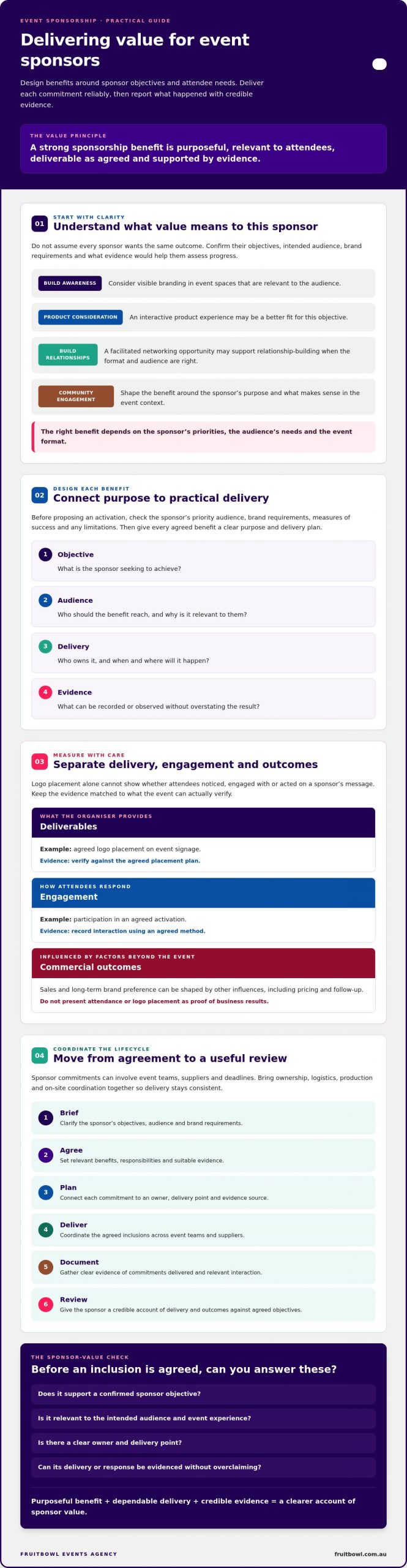
Deliverables are what the organiser provides, engagement is how attendees respond, and commercial outcomes are influenced by factors beyond the event.
This distinction supports a more balanced account of sponsor value. Record visible commitments, then choose suitable ways to understand interaction, such as participation in an agreed activation. Don’t present attendance or logo placement as proof of business results. For a broader view of how event objectives, stakeholders and delivery fit together, explore strategic corporate event management.
Commercial sponsorship is distinct from philanthropy and advertising, with different ways to create value for the parties involved. This overview of commercial sponsorship provides context for designing sponsor benefits around a clear purpose, rather than treating them as interchangeable promotional space.
How to design sponsor benefits around objectives and the event experience
Once the sponsor’s goals are clear, translate them into benefits that suit the audience and can be delivered within the event’s format, budget and operational plan. Before proposing an activation, confirm the sponsor’s priority audience, brand requirements, measures of success and any limitations. This keeps the design grounded in agreed needs rather than assumptions.
Match sponsor objectives to relevant benefits
For each objective, identify a suitable benefit, a responsible owner, a delivery point and an evidence source. An awareness objective might suit visible branding in relevant event spaces, with delivery checked against the agreed placement plan. An engagement objective could suit a demonstration or facilitated conversation, with participation recorded using an agreed method. A networking opportunity may support relationship-building if the format and audience are right.
Use this simple test for each proposed benefit:
- Objective: What is the sponsor seeking to achieve?
- Audience: Who should the benefit reach, and why is it relevant to them?
- Delivery: Who owns it, and when and where will it happen?
- Evidence: What can be recorded or observed without overstating the result?
Define measures carefully. The University of George Washington’s guide to event sponsorship and fundraising considers perceived value and sponsor expectations, useful prompts for checking whether a proposed benefit is meaningful and deliverable.
Build activations into the event experience
An activation should add something useful to the attendee journey, not interrupt it. Consider accessibility, timing, venue layout, audience movement and operational requirements while the concept is still taking shape. A product demonstration, for example, needs a suitable location and enough time for attendees to engage without obstructing other event activity.
Coordinate the creative concept with production and technical requirements, then include the key steps in the event run sheet. Confirm dependencies such as approvals, equipment, staffing and access with the relevant teams. This turns an appealing idea into a commitment that can be managed and documented. For related guidance, see brand activation event planning.
A clear design process supports delivering value for event sponsors while protecting the attendee experience. Organisers planning corporate events, conferences, festivals or brand activations can also explore Fruitbowl’s end-to-end event planning and delivery capabilities to align event objectives with coordination and execution.
How to compare sponsor benefits and demonstrate value beyond exposure
No single benefit suits every sponsor. Compare options against the sponsor’s objective, their relevance to attendees, the effort required to deliver them and the evidence you can reasonably collect. A benefit may be easy to verify but still be a poor fit if it doesn’t serve the sponsor or event audience.
| Benefit type | Potential fit | Delivery effort and evidence |
|---|---|---|
| Visibility | May support awareness through agreed signage, programme or screen placements. | Coordinate locations and production; document placements and use available reach data, noting its limits. |
| Interaction | May support engagement through a relevant demonstration or attendee activity. | Plan space, staffing and timing; record participation or enquiries only where collection is planned and appropriate. |
| Relationship-building | May support connections through introductions or facilitated conversations, depending on event format. | Coordinate hosts and schedules; agree how introductions or conversations will be recorded. |
Use the table to compare options, not as a universal ranking. The best fit depends on the sponsor’s priorities and the experience the event can support. Technical requirements may also determine whether a visibility commitment or activation is feasible. For considerations around integrating technical delivery into an event, see AV management for events.
Choose measures that fit the promised benefit
Separate three kinds of evidence. Outputs record what the organiser delivered, such as a confirmed placement or scheduled activation. Engagement indicators show how attendees responded, such as participation or enquiries. Longer-term outcomes may include changes in consideration, relationships or commercial performance, which can be affected by factors beyond the event.
Choose the measure before delivery and identify its source. For visibility, record completed placements and explain what any available reach data does and doesn’t show. For interaction, use planned participation counts, scans or enquiries only when suitable collection arrangements are in place. For relationship benefits, agree in advance how introductions or facilitated conversations will be documented.
Report evidence without overstating attribution
Compare each agreed inclusion with delivery records, relevant engagement data and any sponsor feedback collected as planned. Note gaps plainly. Event activity may contribute to a business result, but it rarely proves that the event caused the result on its own.
A sponsor report should separate verified delivery from outcomes it cannot attribute. This distinction makes the account more credible and supports delivering value for event sponsors without claiming more than the available evidence shows.
A practical workflow for delivering and measuring sponsor value
A consistent workflow turns sponsor agreements into clear responsibilities, coordinated delivery and a useful post-event review. Keep one commitment register as the reference point for the sponsor and event teams. For every confirmed inclusion, record an owner, deadline, dependencies and how delivery will be verified.
- Brief: Confirm the sponsor’s objectives, priority audience, brand requirements and reporting expectations. Record approval contacts and any content or access requirements.
- Agree: Document each inclusion in specific terms, including what will be delivered, where and when. Clarify what falls outside the commitment so expectations are aligned.
- Plan: Assign an owner and deadline to each item. Note dependencies such as venue access, production schedules, stakeholder approvals or technical requirements.
- Deliver: Use the event-day checklist to track commitments and confirm completion. If timing, access, content or event conditions change, follow an agreed escalation path and communicate the impact promptly.
- Document: Gather delivery records and any engagement evidence agreed in advance. Keep the evidence relevant to the commitment and clear about its limitations.
- Review: Consolidate the findings, share the post-event account and schedule a sponsor debrief to discuss delivery, feedback and potential improvements for future events.
Before the event: agree and operationalise commitments
Set sponsor check-ins at planning milestones instead of waiting until event week to identify a problem. Coordinate sponsor contacts with the event, venue, production and relevant stakeholder teams so approvals and dependencies are visible. For each commitment, agree on a practical contingency: who can approve a change, who must be notified and what alternative could be considered if the original plan is no longer feasible.
During and after the event: deliver, record and review
On the day, make the register easy to use. Show each commitment, its responsible owner, delivery point and evidence method. Record completion as it happens, then consolidate verified activity, available engagement data and relevant feedback. State any gaps or limitations clearly. A debrief gives both parties a structured opportunity to assess what worked and refine the approach for the next event.
This process supports delivering value for event sponsors while keeping commitments manageable across planning and delivery. For coordinated planning, logistics, stakeholder liaison, production and on-site delivery, explore Fruitbowl’s end-to-end event capabilities.
Make sponsor value dependable through integrated event management
Reliable sponsor delivery depends on a connected process: establish objectives, design relevant benefits, operationalise each commitment and report the evidence. When these steps sit in separate plans, important details can fall between teams. Integrated event management connects what was agreed with the people, timing and resources needed to deliver it.
When integrated event support can help
Coordination matters when sponsor commitments involve several teams, suppliers or event elements. A branded space, for example, may require stakeholder approval, venue planning, production coordination and on-site oversight. A change to one dependency can affect the wider experience.
Strategic planning and budget management help organisers assess feasibility before making commitments, clarify responsibilities and identify dependencies early. This keeps sponsor benefits connected to event objectives and the attendee experience, while helping organisers set realistic expectations about what can be delivered. It also gives teams a shared reference point as planning progresses.
Fruitbowl Events Agency provides end-to-end planning, coordination and delivery for corporate events, conferences, festivals, government activations and brand activations across Australia. Its capabilities include stakeholder liaison, logistics, technical production and on-site delivery. These services can support the coordination of complex event requirements, but cannot guarantee a sponsor’s commercial results.
Prepare for a productive event-planning conversation
A clear brief helps identify what needs to be planned and where coordination may be required. Before discussing your event, outline:
- the event’s purpose, format and intended audience
- sponsor priorities and any commitments already confirmed
- delivery constraints, such as timing, venue requirements or approval processes
- known production, logistical and stakeholder dependencies
With this information, the conversation can focus on the event’s actual requirements: what needs to align, who needs to be involved and how delivery can be organised. That is a practical foundation for delivering value for event sponsors without losing sight of wider event objectives.
To discuss your event requirements and identify a suitable next step, contact Fruitbowl about event planning and delivery.
Make sponsor commitments count at every stage
Delivering value for event sponsors starts with clear objectives, then turns those priorities into benefits that suit the audience and event. Make each commitment practical to deliver, with a named owner and a way to verify what happened. After the event, report confirmed delivery and relevant engagement evidence, distinguishing both from business outcomes the event alone can’t prove.
This approach gives sponsors a clearer account of the value provided and helps event teams manage responsibilities with confidence. It also keeps activations connected to the wider experience, rather than treating them as isolated inclusions.
Fruitbowl Events Agency is privately owned and operated, with experience dating back to 1996. Its end-to-end event planning, coordination and on-site delivery spans corporate events, conferences, festivals and brand activations. If you’re shaping an event and want to align its objectives, sponsor commitments and delivery requirements, discuss your event requirements with Fruitbowl.
With clear planning and reliable coordination, you can create sponsor benefits that are relevant, deliverable and easier to evidence.
Frequently Asked Questions
What do event sponsors value most?
Event sponsors value benefits that support their objectives and connect with an audience they want to reach. One sponsor may prioritise awareness, while another may seek product consideration, useful conversations or community engagement. Clear commitments, dependable delivery and credible reporting matter too. Confirm each sponsor’s priorities rather than assuming every partner wants the same package, and check that proposed benefits fit the event and its attendees.
How can an event deliver value to sponsors beyond logo placement?
Offer relevant ways for sponsors to engage with attendees, such as a well-planned demonstration, an interactive experience or a facilitated conversation. Choose an opportunity that suits the sponsor’s goal and adds value to the attendee journey rather than interrupting it. Define how the activity will be delivered and what evidence can be collected. A logo placement confirms visibility was provided, but it doesn’t show that attendees noticed or acted on it.
How do you measure value for event sponsors?
Start by agreeing on measures that match the promised benefit. Record outputs, such as completed placements, separately from engagement indicators, such as participation or enquiries. Use only data collection methods that are planned and appropriate, and explain what the resulting figures can and can’t demonstrate. Commercial outcomes may be influenced by activity beyond the event, so delivering value for event sponsors also means reporting evidence accurately without claiming the event caused results it can’t verify.
What should be included in a post-event sponsor report?
A useful post-event report compares agreed commitments with verified delivery. Include a clear record of completed inclusions, relevant engagement data, supporting evidence and any agreed sponsor feedback. Note missed or changed commitments and explain limitations in the information collected. Keep the report tied to the sponsor’s objectives, so readers can see what was delivered and how attendees responded without mistaking those findings for proof of longer-term commercial impact.
How can organisers match sponsorship benefits to sponsor objectives?
Ask the sponsor about their priority audience, desired outcome, brand requirements and preferred measures before recommending benefits. For awareness, consider suitable visibility; for engagement, consider a relevant interaction; for relationship-building, assess whether the event format supports meaningful introductions. Then check attendee relevance and delivery feasibility. Assign an owner, delivery point and evidence method to each agreed benefit, and make sure the package reflects the sponsor’s priorities rather than a standard list of inclusions.
Can smaller events deliver meaningful value for sponsors?
Yes. An event doesn’t need a large audience to offer a relevant sponsor opportunity. A smaller event may suit a sponsor seeking a focused audience, direct interaction or relationship-building, provided the benefit fits attendee needs and the event format. Be specific about what the organiser can deliver and how it will be documented. Clear expectations and a well-executed, relevant activation can provide a more credible account of value than broad claims about exposure.
When should event organisers involve sponsors in activation planning?
Involve sponsors while benefits are being designed, before creative concepts and delivery details are locked in. Early discussion helps clarify objectives, audience priorities, brand requirements, approvals and practical constraints. Build in check-ins at planning milestones so changes can be raised before they affect production or the attendee experience. Agree who can approve adjustments and how decisions will be communicated. This keeps the activation aligned with sponsor expectations and workable within the event plan.
How can event organisers manage sponsor commitments on event day?
Use a shared event-day checklist that lists each confirmed commitment, its owner, delivery time or point, dependencies and evidence method. Brief relevant event and production teams so responsibilities are clear. Track completion as the event progresses, and use an agreed escalation path if access, timing or other conditions change. Consolidate the records while details are current to make it easier to verify delivery and prepare a clear, accurate sponsor report.
A sponsor logo is easy to place. Proving its value takes more work. Delivering value for event sponsors means creating benefits that support their objectives and feel relevant to attendees, then making sure those benefits happen as agreed. A generic package or a missed activation can leave both parties questioning what the sponsorship achieved.
Sponsor commitments often involve several event teams, suppliers and deadlines, while the right measures depend on what the sponsor hopes to achieve. Visibility, attendee engagement and other outcomes need to be reported clearly, without promising results the event can’t control.
This practical guide explains how to shape sponsor benefits around business objectives and attendee needs, coordinate agreed inclusions across the event lifecycle, and build a credible post-event account of delivery and outcomes. You’ll learn how to connect each commitment to a clear purpose, assign responsibility for delivering it, and gather evidence that gives sponsors a useful picture of the value provided.
Key Takeaways
- Start with the sponsor’s objectives, intended audience and brand requirements before shaping benefits.
- Match each benefit to an owner, delivery point and evidence source so commitments are easier to coordinate and verify.
- Compare visibility, interaction and relationship-building benefits against attendee relevance and delivery effort, rather than assuming one approach suits every sponsor.
- A practical process for delivering value for event sponsors moves from briefing and agreement through planning, delivery, documentation and review.
- Bring stakeholder liaison, logistics, production and on-site coordination together to support consistent delivery and a credible post-event account.
Table of Contents
- Delivering value for event sponsors starts with clear objectives
- How to design sponsor benefits around objectives and the event experience
- How to compare sponsor benefits and demonstrate value beyond exposure
- A practical workflow for delivering and measuring sponsor value
- Make sponsor value dependable through integrated event management
Delivering value for event sponsors starts with clear objectives
Delivering value for event sponsors means offering benefits that support their goals and make sense within the event, delivering each commitment reliably, and providing credible evidence against objectives agreed in advance. That sets a stronger standard than simply listing inclusions in a sponsorship package.
Value depends on the sponsor’s priorities, the audience’s needs and the event context. A benefit that suits a conference audience may feel out of place at a public festival. Organisers can control what they plan and deliver, but outcomes such as sales or long-term brand preference are also shaped by factors beyond the event. Agreeing on that distinction early helps keep expectations realistic and reporting useful.
What does value mean to an event sponsor?
A sponsor might want to build awareness, encourage product consideration, develop relationships or support community engagement. These objectives aren’t interchangeable, so don’t assume what matters most. Confirm the sponsor’s goal, the audience they want to reach and the evidence that would help them assess progress.
Then test the benefit for relevance. A well-designed opportunity for the right audience may be more useful than a long list of inclusions with little connection to the sponsor’s aims. An interactive product experience could suit a sponsor seeking product consideration, while a facilitated networking opportunity may better support relationship-building. Let the event format and attendee experience guide the choice.
Why logo exposure alone rarely tells the whole story
Logo placement can provide visibility, but it doesn’t show whether attendees noticed, engaged with or acted on a sponsor’s message. A logo on event signage is a deliverable the organiser can verify. Attention and commercial impact require different evidence, and sales may also depend on pricing, follow-up and other influences outside the organiser’s control.
Deliverables are what the organiser provides, engagement is how attendees respond, and commercial outcomes are influenced by factors beyond the event.
This distinction supports a more balanced account of sponsor value. Record visible commitments, then choose suitable ways to understand interaction, such as participation in an agreed activation. Don’t present attendance or logo placement as proof of business results. For a broader view of how event objectives, stakeholders and delivery fit together, explore strategic corporate event management.
Commercial sponsorship is distinct from philanthropy and advertising, with different ways to create value for the parties involved. This overview of commercial sponsorship provides context for designing sponsor benefits around a clear purpose, rather than treating them as interchangeable promotional space.
How to design sponsor benefits around objectives and the event experience
Once the sponsor’s goals are clear, translate them into benefits that suit the audience and can be delivered within the event’s format, budget and operational plan. Before proposing an activation, confirm the sponsor’s priority audience, brand requirements, measures of success and any limitations. This keeps the design grounded in agreed needs rather than assumptions.
Match sponsor objectives to relevant benefits
For each objective, identify a suitable benefit, a responsible owner, a delivery point and an evidence source. An awareness objective might suit visible branding in relevant event spaces, with delivery checked against the agreed placement plan. An engagement objective could suit a demonstration or facilitated conversation, with participation recorded using an agreed method. A networking opportunity may support relationship-building if the format and audience are right.
Use this simple test for each proposed benefit:
- Objective: What is the sponsor seeking to achieve?
- Audience: Who should the benefit reach, and why is it relevant to them?
- Delivery: Who owns it, and when and where will it happen?
- Evidence: What can be recorded or observed without overstating the result?
Define measures carefully. The University of George Washington’s guide to event sponsorship and fundraising considers perceived value and sponsor expectations, useful prompts for checking whether a proposed benefit is meaningful and deliverable.
Build activations into the event experience
An activation should add something useful to the attendee journey, not interrupt it. Consider accessibility, timing, venue layout, audience movement and operational requirements while the concept is still taking shape. A product demonstration, for example, needs a suitable location and enough time for attendees to engage without obstructing other event activity.
Coordinate the creative concept with production and technical requirements, then include the key steps in the event run sheet. Confirm dependencies such as approvals, equipment, staffing and access with the relevant teams. This turns an appealing idea into a commitment that can be managed and documented. For related guidance, see brand activation event planning.
A clear design process supports delivering value for event sponsors while protecting the attendee experience. Organisers planning corporate events, conferences, festivals or brand activations can also explore Fruitbowl’s end-to-end event planning and delivery capabilities to align event objectives with coordination and execution.
How to compare sponsor benefits and demonstrate value beyond exposure
No single benefit suits every sponsor. Compare options against the sponsor’s objective, their relevance to attendees, the effort required to deliver them and the evidence you can reasonably collect. A benefit may be easy to verify but still be a poor fit if it doesn’t serve the sponsor or event audience.
| Benefit type | Potential fit | Delivery effort and evidence |
|---|---|---|
| Visibility | May support awareness through agreed signage, programme or screen placements. | Coordinate locations and production; document placements and use available reach data, noting its limits. |
| Interaction | May support engagement through a relevant demonstration or attendee activity. | Plan space, staffing and timing; record participation or enquiries only where collection is planned and appropriate. |
| Relationship-building | May support connections through introductions or facilitated conversations, depending on event format. | Coordinate hosts and schedules; agree how introductions or conversations will be recorded. |
Use the table to compare options, not as a universal ranking. The best fit depends on the sponsor’s priorities and the experience the event can support. Technical requirements may also determine whether a visibility commitment or activation is feasible. For considerations around integrating technical delivery into an event, see AV management for events.
Choose measures that fit the promised benefit
Separate three kinds of evidence. Outputs record what the organiser delivered, such as a confirmed placement or scheduled activation. Engagement indicators show how attendees responded, such as participation or enquiries. Longer-term outcomes may include changes in consideration, relationships or commercial performance, which can be affected by factors beyond the event.
Choose the measure before delivery and identify its source. For visibility, record completed placements and explain what any available reach data does and doesn’t show. For interaction, use planned participation counts, scans or enquiries only when suitable collection arrangements are in place. For relationship benefits, agree in advance how introductions or facilitated conversations will be documented.
Report evidence without overstating attribution
Compare each agreed inclusion with delivery records, relevant engagement data and any sponsor feedback collected as planned. Note gaps plainly. Event activity may contribute to a business result, but it rarely proves that the event caused the result on its own.
A sponsor report should separate verified delivery from outcomes it cannot attribute. This distinction makes the account more credible and supports delivering value for event sponsors without claiming more than the available evidence shows.
A practical workflow for delivering and measuring sponsor value
A consistent workflow turns sponsor agreements into clear responsibilities, coordinated delivery and a useful post-event review. Keep one commitment register as the reference point for the sponsor and event teams. For every confirmed inclusion, record an owner, deadline, dependencies and how delivery will be verified.
- Brief: Confirm the sponsor’s objectives, priority audience, brand requirements and reporting expectations. Record approval contacts and any content or access requirements.
- Agree: Document each inclusion in specific terms, including what will be delivered, where and when. Clarify what falls outside the commitment so expectations are aligned.
- Plan: Assign an owner and deadline to each item. Note dependencies such as venue access, production schedules, stakeholder approvals or technical requirements.
- Deliver: Use the event-day checklist to track commitments and confirm completion. If timing, access, content or event conditions change, follow an agreed escalation path and communicate the impact promptly.
- Document: Gather delivery records and any engagement evidence agreed in advance. Keep the evidence relevant to the commitment and clear about its limitations.
- Review: Consolidate the findings, share the post-event account and schedule a sponsor debrief to discuss delivery, feedback and potential improvements for future events.
Before the event: agree and operationalise commitments
Set sponsor check-ins at planning milestones instead of waiting until event week to identify a problem. Coordinate sponsor contacts with the event, venue, production and relevant stakeholder teams so approvals and dependencies are visible. For each commitment, agree on a practical contingency: who can approve a change, who must be notified and what alternative could be considered if the original plan is no longer feasible.
During and after the event: deliver, record and review
On the day, make the register easy to use. Show each commitment, its responsible owner, delivery point and evidence method. Record completion as it happens, then consolidate verified activity, available engagement data and relevant feedback. State any gaps or limitations clearly. A debrief gives both parties a structured opportunity to assess what worked and refine the approach for the next event.
This process supports delivering value for event sponsors while keeping commitments manageable across planning and delivery. For coordinated planning, logistics, stakeholder liaison, production and on-site delivery, explore Fruitbowl’s end-to-end event capabilities.
Make sponsor value dependable through integrated event management
Reliable sponsor delivery depends on a connected process: establish objectives, design relevant benefits, operationalise each commitment and report the evidence. When these steps sit in separate plans, important details can fall between teams. Integrated event management connects what was agreed with the people, timing and resources needed to deliver it.
When integrated event support can help
Coordination matters when sponsor commitments involve several teams, suppliers or event elements. A branded space, for example, may require stakeholder approval, venue planning, production coordination and on-site oversight. A change to one dependency can affect the wider experience.
Strategic planning and budget management help organisers assess feasibility before making commitments, clarify responsibilities and identify dependencies early. This keeps sponsor benefits connected to event objectives and the attendee experience, while helping organisers set realistic expectations about what can be delivered. It also gives teams a shared reference point as planning progresses.
Fruitbowl Events Agency provides end-to-end planning, coordination and delivery for corporate events, conferences, festivals, government activations and brand activations across Australia. Its capabilities include stakeholder liaison, logistics, technical production and on-site delivery. These services can support the coordination of complex event requirements, but cannot guarantee a sponsor’s commercial results.
Prepare for a productive event-planning conversation
A clear brief helps identify what needs to be planned and where coordination may be required. Before discussing your event, outline:
- the event’s purpose, format and intended audience
- sponsor priorities and any commitments already confirmed
- delivery constraints, such as timing, venue requirements or approval processes
- known production, logistical and stakeholder dependencies
With this information, the conversation can focus on the event’s actual requirements: what needs to align, who needs to be involved and how delivery can be organised. That is a practical foundation for delivering value for event sponsors without losing sight of wider event objectives.
To discuss your event requirements and identify a suitable next step, contact Fruitbowl about event planning and delivery.
Make sponsor commitments count at every stage
Delivering value for event sponsors starts with clear objectives, then turns those priorities into benefits that suit the audience and event. Make each commitment practical to deliver, with a named owner and a way to verify what happened. After the event, report confirmed delivery and relevant engagement evidence, distinguishing both from business outcomes the event alone can’t prove.
This approach gives sponsors a clearer account of the value provided and helps event teams manage responsibilities with confidence. It also keeps activations connected to the wider experience, rather than treating them as isolated inclusions.
Fruitbowl Events Agency is privately owned and operated, with experience dating back to 1996. Its end-to-end event planning, coordination and on-site delivery spans corporate events, conferences, festivals and brand activations. If you’re shaping an event and want to align its objectives, sponsor commitments and delivery requirements, discuss your event requirements with Fruitbowl.
With clear planning and reliable coordination, you can create sponsor benefits that are relevant, deliverable and easier to evidence.
Frequently Asked Questions
What do event sponsors value most?
Event sponsors value benefits that support their objectives and connect with an audience they want to reach. One sponsor may prioritise awareness, while another may seek product consideration, useful conversations or community engagement. Clear commitments, dependable delivery and credible reporting matter too. Confirm each sponsor’s priorities rather than assuming every partner wants the same package, and check that proposed benefits fit the event and its attendees.
How can an event deliver value to sponsors beyond logo placement?
Offer relevant ways for sponsors to engage with attendees, such as a well-planned demonstration, an interactive experience or a facilitated conversation. Choose an opportunity that suits the sponsor’s goal and adds value to the attendee journey rather than interrupting it. Define how the activity will be delivered and what evidence can be collected. A logo placement confirms visibility was provided, but it doesn’t show that attendees noticed or acted on it.
How do you measure value for event sponsors?
Start by agreeing on measures that match the promised benefit. Record outputs, such as completed placements, separately from engagement indicators, such as participation or enquiries. Use only data collection methods that are planned and appropriate, and explain what the resulting figures can and can’t demonstrate. Commercial outcomes may be influenced by activity beyond the event, so delivering value for event sponsors also means reporting evidence accurately without claiming the event caused results it can’t verify.
What should be included in a post-event sponsor report?
A useful post-event report compares agreed commitments with verified delivery. Include a clear record of completed inclusions, relevant engagement data, supporting evidence and any agreed sponsor feedback. Note missed or changed commitments and explain limitations in the information collected. Keep the report tied to the sponsor’s objectives, so readers can see what was delivered and how attendees responded without mistaking those findings for proof of longer-term commercial impact.
How can organisers match sponsorship benefits to sponsor objectives?
Ask the sponsor about their priority audience, desired outcome, brand requirements and preferred measures before recommending benefits. For awareness, consider suitable visibility; for engagement, consider a relevant interaction; for relationship-building, assess whether the event format supports meaningful introductions. Then check attendee relevance and delivery feasibility. Assign an owner, delivery point and evidence method to each agreed benefit, and make sure the package reflects the sponsor’s priorities rather than a standard list of inclusions.
Can smaller events deliver meaningful value for sponsors?
Yes. An event doesn’t need a large audience to offer a relevant sponsor opportunity. A smaller event may suit a sponsor seeking a focused audience, direct interaction or relationship-building, provided the benefit fits attendee needs and the event format. Be specific about what the organiser can deliver and how it will be documented. Clear expectations and a well-executed, relevant activation can provide a more credible account of value than broad claims about exposure.
When should event organisers involve sponsors in activation planning?
Involve sponsors while benefits are being designed, before creative concepts and delivery details are locked in. Early discussion helps clarify objectives, audience priorities, brand requirements, approvals and practical constraints. Build in check-ins at planning milestones so changes can be raised before they affect production or the attendee experience. Agree who can approve adjustments and how decisions will be communicated. This keeps the activation aligned with sponsor expectations and workable within the event plan.
How can event organisers manage sponsor commitments on event day?
Use a shared event-day checklist that lists each confirmed commitment, its owner, delivery time or point, dependencies and evidence method. Brief relevant event and production teams so responsibilities are clear. Track completion as the event progresses, and use an agreed escalation path if access, timing or other conditions change. Consolidate the records while details are current to make it easier to verify delivery and prepare a clear, accurate sponsor report.
OUR BLOG
Event Insights & Expertise
Our blog is your go-to resource for all things events. From expert insights and the latest industry trends to practical planning tips, we share everything you need to deliver standout experiences.
Contact Us