Collecting Effective Attendee Feedback: A Practical Event Guide

What if your post-event survey captures the loudest reactions rather than a representative picture of the event? Collecting effective attendee feedback starts before the event begins, with a considered plan for when, where and how to invite responses.

It’s understandable to rely on a survey sent after the final session. But if it’s too long, poorly timed or the only opportunity to respond, you may hear from just a small or unusually positive or negative group. That makes it harder to identify what deserves attention.

A clear feedback process can help you gather useful responses without adding unnecessary friction to the attendee experience. This guide explains how to choose suitable channels, ask focused questions and invite input at relevant moments across the event journey. You’ll also learn how to interpret responses by theme, turn recurring insights into practical improvements and communicate what changed. The aim is not simply to collect more feedback, but to build a more reliable understanding of what attendees valued and what future events could do better.

Key Takeaways

  • Plan collecting effective attendee feedback as part of the event journey, alongside other measures of attendance, engagement and delivery.
  • Choose feedback methods by considering when you’ll ask, who can access them, the effort required and the level of detail you need.
  • Write neutral, focused questions that connect to decisions your event team can act on.
  • Set out a practical process to prepare, invite, collect, review, act on and report back about feedback.
  • Prioritise recurring themes by their impact and feasibility, while recording limitations before drawing conclusions.

Why collecting effective attendee feedback starts before event day

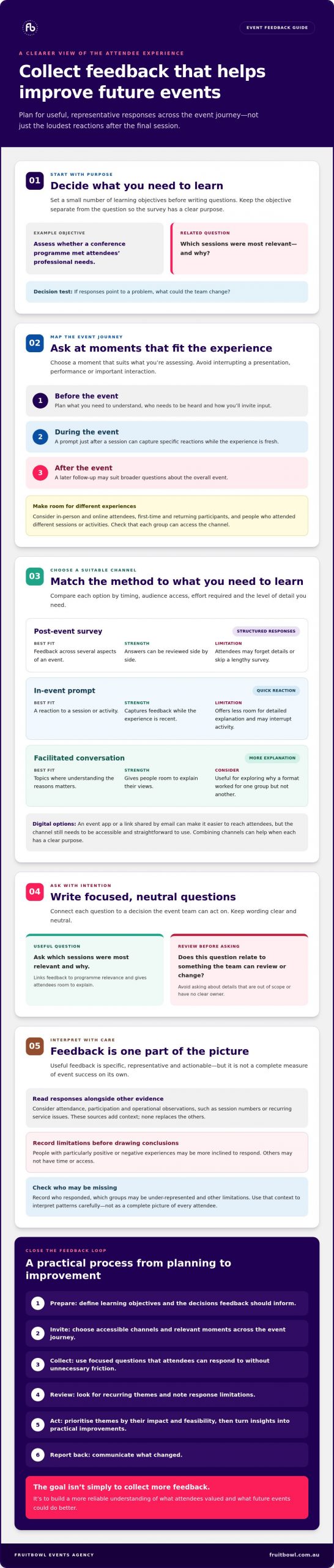
Collecting effective attendee feedback begins with a decision: what does the event team need to understand or improve? Set a small number of learning objectives before drafting survey questions. For example, an objective might be to assess whether a conference programme met attendees’ professional needs. A related question could ask which sessions were most relevant and why. Keeping the objective separate from the question helps prevent a survey becoming a list of questions with no clear purpose.

Useful feedback is specific, representative and actionable. It can help explain how people experienced an event, but it isn’t a complete measure of success on its own. Read responses alongside attendance, participation and operational observations, such as session numbers or recurring service issues. These sources provide context, and none should be treated as a substitute for the others. For a foundation in questionnaire design, sampling and data collection, consult this overview of survey methodology.

What should attendee feedback help you understand?

Choose a few areas that connect directly to decisions the team can make. These may include the attendee experience, session relevance, accessibility and event operations. Avoid asking for views on details that are out of scope or that no one is responsible for reviewing. A useful test is to ask, “If the responses point to a problem, what could we change?” If there’s no clear answer, reconsider the question.

Useful feedback is evidence about an attendee experience that helps the team make a defined event decision.

Who needs to be heard, and when?

Map the groups whose experiences may differ. Depending on the event, this could include in-person and online attendees, first-time and returning participants, or people who attended different sessions or activities. Check that each group can access the feedback channel, and consider whether your process will show where responses are missing.

Choose moments that fit the experience being assessed. A prompt immediately after a session can capture specific reactions, while broader questions about the event may be better suited to a later follow-up. Don’t interrupt a presentation, performance or important interaction to request feedback.

Responses won’t necessarily reflect every attendee. People with particularly positive or negative experiences may be more inclined to share their views, while others may not have time or access. Record who responded, which groups may be under-represented and any other limitations. That context helps the team interpret patterns carefully rather than treating every response as a complete picture.

How to choose attendee feedback methods for your event

The right channel depends on what you need to learn, how the event is delivered and how attendees can take part. A post-event survey can provide structured responses, while a live prompt captures reactions close to the moment. A facilitated conversation gives people room to explain their views. Digital channels, such as an event app or a link shared by email, can make it easier to reach attendees, but they still need to be accessible and straightforward to use.

Compare methods against four practical factors: timing, audience access, effort required and the level of detail needed. A quick rating may suit a session check-in, while a complex question about the overall experience may need more context. Combining channels can help, provided each has a clear purpose and you can interpret the responses appropriately.

When do surveys, live prompts and conversations work best?

Use surveys when you need consistent answers that can be compared across questions or events. Brief prompts work well when attendees can respond without missing important activity and their impressions are fresh. Facilitated conversations suit topics where explanation matters more than volume, such as understanding why a format worked for one group but not another.

Whichever method you choose, keep questions clear and neutral. Pew Research Center’s guidance on writing effective survey questions offers useful principles for avoiding confusing or leading wording.

Post-event survey
Best fit: Structured feedback across several aspects of an event.
Strength: Answers can be reviewed side by side.
Limitation: Attendees may forget details or skip a lengthy survey.

In-event prompt
Best fit: A quick reaction to a session or activity.
Strength: Captures feedback while the experience is recent.
Limitation: Offers little room for detailed explanation and may interrupt participation if poorly timed.

Facilitated conversation
Best fit: Exploring reasons, needs or differing experiences.
Strength: Follow-up questions can add valuable context.
Limitation: Takes more time and may involve fewer attendees.

Digital feedback channel
Best fit: Giving attendees a convenient way to respond during or after an event.
Strength: Can support access across event touchpoints.
Limitation: Depends on device access, connectivity and a clear route to respond.

How can you make feedback accessible and low-friction?

Make the response route easy to find and use on a mobile device. Keep instructions concise, use plain wording and consider relevant language needs and alternative ways to participate. A QR code can be convenient, but don’t make it the only option. Provide a short link or another suitable route for attendees who can’t scan it.

For events with several attendee groups or touchpoints, build channel choices into the wider event plan. Teams reviewing their approach to corporate event planning can consider how feedback fits alongside the event format and attendee experience. This is a practical foundation for collecting effective attendee feedback without adding unnecessary friction.

How to write questions that produce useful attendee feedback

Good questions connect attendee experience to decisions the event team can realistically make. Before adding a question, identify what its answer could change, such as session formats, programme balance or the clarity of event information. If the team can’t act on the response, leave the question out.

Use neutral wording and ask about one thing at a time. “How satisfied were you with the session content and venue?” combines two experiences, so a low rating won’t show which needs attention. Split it into separate questions. For further questionnaire-design context, see this survey question reference provided by Fruitbowl Events Agency.

Which rating scales and question types should you use?

A consistent Likert scale can make answers easier to compare across related questions. For example, use “Strongly disagree” to “Strongly agree” for statements about the event experience. Label the options clearly and keep their direction consistent, so the most positive response doesn’t switch from one end of the scale to the other.

Use satisfaction ratings when you need to assess satisfaction. A Net Promoter Score question, which asks how likely someone is to recommend the event, is useful only if recommendation intent is relevant to your objective. Neither measure explains the reasons behind a rating, so pair them with a small number of optional open-text questions. Avoid asking for written feedback after every rating.

How can you avoid leading questions and survey fatigue?

Replace promotional language with a direct question about a specific experience. Instead of “How excellent was the programme?”, ask “How relevant was the programme to your needs?” Include only questions tied to your learning objectives, then test the survey with a small internal group. Check that the wording is clear, the response options make sense and completion feels manageable.

Adaptable question-set template

  • How relevant was the event programme to your needs? (Rating scale)
  • How clear was the information you received before the event? (Rating scale)
  • How would you rate the event’s accessibility for your needs? (Rating scale or “Not applicable”)
  • What was the most useful part of the event, and why? (Optional open text)
  • What one change would most improve a future event? (Optional open text)

This template is a starting point, not a checklist. Adapt it to the event and remove anything that won’t inform a decision. That discipline makes collecting effective attendee feedback more useful for planning what to retain, refine or reconsider.
Collecting Effective Attendee Feedback: A Practical Event Guide

How to collect attendee feedback before, during and after an event

A reliable process gives feedback a clear place in the event schedule and assigns responsibility for what happens next. Match collection windows to the question: ask about a session close to its finish, but allow time for attendees to reflect before asking about the overall event. For each channel, nominate an owner to monitor responses, manage access to them and escalate time-sensitive concerns to the appropriate event lead.

What should happen before and during the event?

Before the event, confirm what you need to learn, which attendee groups you need to reach, how questions will be worded and where each response route will appear. Make sure the nominated owner can access the feedback and knows how to pass urgent issues to the right person. Check that the approach works for the event format, including online participation and different ways attendees may engage.

During the event, place brief, unobtrusive prompts at suitable touchpoints, such as after a session or activity. Avoid interrupting presentations, performances and attendee flow. Test access routes in advance, including mobile links or QR codes, and provide an alternative where needed. Collect only what’s useful at that moment, then save broader reflections for a more appropriate follow-up.

What should happen after responses come in?

Use this six-step workflow to carry feedback through to action:

  1. Prepare: Confirm objectives, audience groups, questions, access routes and response ownership.
  2. Invite: Explain why you’re asking, how to respond and when the feedback window closes.
  3. Collect: Monitor responses through the planned channels and escalate time-sensitive concerns.
  4. Review: Group responses by theme, then compare patterns with attendance and operational observations.
  5. Act: Record agreed changes, the person responsible and the date the decision will be reviewed.
  6. Report back: Tell attendees and relevant stakeholders what the feedback informed, including where a suggested change wasn’t made.

During the review, distinguish repeated themes from isolated comments without dismissing an individual concern. A single report of an access barrier, for example, may warrant follow-up even if it isn’t a common theme. Note gaps in responses and avoid treating them as proof that an issue affected everyone or no one.

Feedback only makes sense in context: interpret each response in light of who was asked, who replied and how the feedback was collected. This is central to collecting effective attendee feedback and making sound decisions from it.

For events with several stakeholders and touchpoints, consider how an experienced team can integrate feedback planning into broader corporate event delivery.

How event teams can turn attendee feedback into better future events

Feedback creates value when the event team uses it to make considered decisions. Start by grouping comments into practical themes, such as content, access, communications and operations. Then assess each theme against three factors: its impact on attendees, how often it appears and whether the team can address it. A recurring issue with event information may warrant a change to future communications, while a one-off comment may need investigation before it informs a wider decision.

Separate what the responses show from what the team assumes. A comment can identify a problem, but it may not reveal its cause. Check patterns against attendance, participation and operational observations, and document response limitations, including which attendee groups may be missing. This makes it easier to set priorities without treating a small or uneven set of responses as representative of everyone.

How do you turn feedback themes into owned actions?

For each priority theme, record the evidence, the proposed next step, an accountable owner and a date to review progress. Be specific: “review how session changes are communicated” gives the team a clearer task than “improve communications”. If a change isn’t feasible, record why and whether another response is possible. This keeps feedback in the decision process rather than leaving it in a report.

Close the loop where appropriate. Let attendees know what the team heard and what it plans to change, without promising every suggestion will be adopted. For broader planning context, see this guide to corporate event management.

When can an event partner help manage the feedback process?

Feedback touchpoints need to fit the event’s objectives, logistics and delivery. An event-management partner can help teams consider where and when to invite input, how different attendee experiences connect to the programme, and how observations from event delivery can inform the review. This can be useful when feedback spans multiple stakeholders, formats or moments across an event.

Fruitbowl Events Agency plans and delivers corporate events, conferences, festivals, government activations and brand activations across Australia. Its work spans strategy, logistics coordination, stakeholder liaison, production and on-site delivery, which can help place feedback within the wider event plan. This supports the feedback process but does not replace careful question design or guarantee particular response outcomes. For an operational perspective, read the guide to conference logistics coordination.

Ultimately, collecting effective attendee feedback is only one part of improvement. The lasting benefit comes from interpreting responses with care, assigning practical actions and showing attendees how their input shaped future decisions.

Make attendee insight part of your next event plan

Collecting effective attendee feedback is a planned process, not simply a survey sent after the event. Start with clear learning objectives, choose channels that suit your audience and event format, and ask focused questions that can inform real decisions.

Then interpret responses in context. Consider who replied, how feedback was gathered and which perspectives may be missing. Group recurring themes, assign owners to practical improvements and let attendees know what their input helped change. This turns feedback into a useful part of planning and delivery, rather than a set of comments that sits untouched.

Fruitbowl Events Agency plans and delivers corporate events, conferences, festivals, government activations and brand activations across Australia, with work spanning strategy, logistics coordination and on-site delivery. The agency brings over 28 years of event-industry experience.

Planning an event where feedback needs to work across multiple touchpoints? Discuss your next event with Fruitbowl Events Agency and consider how attendee insight can be integrated into the wider event plan. A thoughtful process can help make each future event more responsive and purposeful.

Frequently Asked Questions

When should you ask attendees for event feedback?

Ask at a time that matches the experience you want attendees to recall. A short prompt after a session can capture immediate reactions, while questions about the overall event are usually better sent after attendees have had time to reflect. For longer events, consider a mix of brief in-event prompts and a post-event survey. Avoid interrupting sessions or activities, and make each feedback window clear.

What questions should an event feedback survey include?

Include questions that connect to decisions your event team can make. For example, ask how relevant the programme was, how clear pre-event information was, or what would improve a future event. Use neutral wording, ask about one topic at a time and combine rating questions with a small number of optional open-text prompts. Skip questions that won’t inform a decision, even if the information seems interesting.

How can you increase event feedback response rates?

Make it easy and worthwhile for attendees to respond. Explain briefly why you’re asking and how the feedback will inform future decisions. Keep the survey focused, send it at a suitable time and provide a mobile-friendly route with clear instructions. Consider whether all attendee groups can access the chosen channel. A polite reminder may help, but avoid repeated requests that add pressure or disrupt the post-event experience.

How many questions should an attendee feedback survey have?

A post-event survey often works well with five to ten focused questions, adjusted to the event and the decisions the team needs to make. Use a mix of rating scales and a few optional open-text prompts rather than asking attendees to comment on every detail. Remove questions that repeat another or won’t lead to action. Test the survey internally to check its clarity and completion effort before sending it.

Can you collect useful attendee feedback during an event?

Yes. Brief, well-timed prompts can capture specific reactions while an experience is fresh. For instance, attendees could be asked to rate a session immediately afterwards or identify one useful takeaway. Place prompts where they won’t interrupt presentations, performances or attendee flow. Keep the response route simple and offer an alternative to a QR code. Use post-event questions for broader reflections that need more consideration.

How do you analyse attendee feedback when response numbers are low?

Collecting effective attendee feedback with a small response pool calls for careful interpretation, not sweeping conclusions. Group comments into themes, note how many responses each finding represents and check whether particular attendee groups are missing. Compare feedback with relevant attendance and operational observations, while keeping those sources distinct. Treat emerging patterns as signals to investigate, and document limitations before deciding whether a change is justified.

How should event organisers use attendee feedback?

Use feedback to identify practical improvements, not simply to report satisfaction scores. Prioritise themes by their impact on attendees, how often they appear and whether the team can address them. Assign an owner and next step to each agreed action, then record when progress will be reviewed. Where appropriate, tell attendees what their input informed. If a suggestion can’t be adopted, explain the decision clearly rather than implying it was overlooked.

What if your post-event survey captures the loudest reactions rather than a representative picture of the event? Collecting effective attendee feedback starts before the event begins, with a considered plan for when, where and how to invite responses.

It’s understandable to rely on a survey sent after the final session. But if it’s too long, poorly timed or the only opportunity to respond, you may hear from just a small or unusually positive or negative group. That makes it harder to identify what deserves attention.

A clear feedback process can help you gather useful responses without adding unnecessary friction to the attendee experience. This guide explains how to choose suitable channels, ask focused questions and invite input at relevant moments across the event journey. You’ll also learn how to interpret responses by theme, turn recurring insights into practical improvements and communicate what changed. The aim is not simply to collect more feedback, but to build a more reliable understanding of what attendees valued and what future events could do better.

Key Takeaways

  • Plan collecting effective attendee feedback as part of the event journey, alongside other measures of attendance, engagement and delivery.
  • Choose feedback methods by considering when you’ll ask, who can access them, the effort required and the level of detail you need.
  • Write neutral, focused questions that connect to decisions your event team can act on.
  • Set out a practical process to prepare, invite, collect, review, act on and report back about feedback.
  • Prioritise recurring themes by their impact and feasibility, while recording limitations before drawing conclusions.

Why collecting effective attendee feedback starts before event day

Collecting effective attendee feedback begins with a decision: what does the event team need to understand or improve? Set a small number of learning objectives before drafting survey questions. For example, an objective might be to assess whether a conference programme met attendees’ professional needs. A related question could ask which sessions were most relevant and why. Keeping the objective separate from the question helps prevent a survey becoming a list of questions with no clear purpose.

Useful feedback is specific, representative and actionable. It can help explain how people experienced an event, but it isn’t a complete measure of success on its own. Read responses alongside attendance, participation and operational observations, such as session numbers or recurring service issues. These sources provide context, and none should be treated as a substitute for the others. For a foundation in questionnaire design, sampling and data collection, consult this overview of survey methodology.

What should attendee feedback help you understand?

Choose a few areas that connect directly to decisions the team can make. These may include the attendee experience, session relevance, accessibility and event operations. Avoid asking for views on details that are out of scope or that no one is responsible for reviewing. A useful test is to ask, “If the responses point to a problem, what could we change?” If there’s no clear answer, reconsider the question.

Useful feedback is evidence about an attendee experience that helps the team make a defined event decision.

Who needs to be heard, and when?

Map the groups whose experiences may differ. Depending on the event, this could include in-person and online attendees, first-time and returning participants, or people who attended different sessions or activities. Check that each group can access the feedback channel, and consider whether your process will show where responses are missing.

Choose moments that fit the experience being assessed. A prompt immediately after a session can capture specific reactions, while broader questions about the event may be better suited to a later follow-up. Don’t interrupt a presentation, performance or important interaction to request feedback.

Responses won’t necessarily reflect every attendee. People with particularly positive or negative experiences may be more inclined to share their views, while others may not have time or access. Record who responded, which groups may be under-represented and any other limitations. That context helps the team interpret patterns carefully rather than treating every response as a complete picture.

How to choose attendee feedback methods for your event

The right channel depends on what you need to learn, how the event is delivered and how attendees can take part. A post-event survey can provide structured responses, while a live prompt captures reactions close to the moment. A facilitated conversation gives people room to explain their views. Digital channels, such as an event app or a link shared by email, can make it easier to reach attendees, but they still need to be accessible and straightforward to use.

Compare methods against four practical factors: timing, audience access, effort required and the level of detail needed. A quick rating may suit a session check-in, while a complex question about the overall experience may need more context. Combining channels can help, provided each has a clear purpose and you can interpret the responses appropriately.

When do surveys, live prompts and conversations work best?

Use surveys when you need consistent answers that can be compared across questions or events. Brief prompts work well when attendees can respond without missing important activity and their impressions are fresh. Facilitated conversations suit topics where explanation matters more than volume, such as understanding why a format worked for one group but not another.

Whichever method you choose, keep questions clear and neutral. Pew Research Center’s guidance on writing effective survey questions offers useful principles for avoiding confusing or leading wording.

Post-event survey
Best fit: Structured feedback across several aspects of an event.
Strength: Answers can be reviewed side by side.
Limitation: Attendees may forget details or skip a lengthy survey.

In-event prompt
Best fit: A quick reaction to a session or activity.
Strength: Captures feedback while the experience is recent.
Limitation: Offers little room for detailed explanation and may interrupt participation if poorly timed.

Facilitated conversation
Best fit: Exploring reasons, needs or differing experiences.
Strength: Follow-up questions can add valuable context.
Limitation: Takes more time and may involve fewer attendees.

Digital feedback channel
Best fit: Giving attendees a convenient way to respond during or after an event.
Strength: Can support access across event touchpoints.
Limitation: Depends on device access, connectivity and a clear route to respond.

How can you make feedback accessible and low-friction?

Make the response route easy to find and use on a mobile device. Keep instructions concise, use plain wording and consider relevant language needs and alternative ways to participate. A QR code can be convenient, but don’t make it the only option. Provide a short link or another suitable route for attendees who can’t scan it.

For events with several attendee groups or touchpoints, build channel choices into the wider event plan. Teams reviewing their approach to corporate event planning can consider how feedback fits alongside the event format and attendee experience. This is a practical foundation for collecting effective attendee feedback without adding unnecessary friction.

How to write questions that produce useful attendee feedback

Good questions connect attendee experience to decisions the event team can realistically make. Before adding a question, identify what its answer could change, such as session formats, programme balance or the clarity of event information. If the team can’t act on the response, leave the question out.

Use neutral wording and ask about one thing at a time. “How satisfied were you with the session content and venue?” combines two experiences, so a low rating won’t show which needs attention. Split it into separate questions. For further questionnaire-design context, see this survey question reference provided by Fruitbowl Events Agency.

Which rating scales and question types should you use?

A consistent Likert scale can make answers easier to compare across related questions. For example, use “Strongly disagree” to “Strongly agree” for statements about the event experience. Label the options clearly and keep their direction consistent, so the most positive response doesn’t switch from one end of the scale to the other.

Use satisfaction ratings when you need to assess satisfaction. A Net Promoter Score question, which asks how likely someone is to recommend the event, is useful only if recommendation intent is relevant to your objective. Neither measure explains the reasons behind a rating, so pair them with a small number of optional open-text questions. Avoid asking for written feedback after every rating.

How can you avoid leading questions and survey fatigue?

Replace promotional language with a direct question about a specific experience. Instead of “How excellent was the programme?”, ask “How relevant was the programme to your needs?” Include only questions tied to your learning objectives, then test the survey with a small internal group. Check that the wording is clear, the response options make sense and completion feels manageable.

Adaptable question-set template

  • How relevant was the event programme to your needs? (Rating scale)
  • How clear was the information you received before the event? (Rating scale)
  • How would you rate the event’s accessibility for your needs? (Rating scale or “Not applicable”)
  • What was the most useful part of the event, and why? (Optional open text)
  • What one change would most improve a future event? (Optional open text)

This template is a starting point, not a checklist. Adapt it to the event and remove anything that won’t inform a decision. That discipline makes collecting effective attendee feedback more useful for planning what to retain, refine or reconsider.

How to collect attendee feedback before, during and after an event

A reliable process gives feedback a clear place in the event schedule and assigns responsibility for what happens next. Match collection windows to the question: ask about a session close to its finish, but allow time for attendees to reflect before asking about the overall event. For each channel, nominate an owner to monitor responses, manage access to them and escalate time-sensitive concerns to the appropriate event lead.

What should happen before and during the event?

Before the event, confirm what you need to learn, which attendee groups you need to reach, how questions will be worded and where each response route will appear. Make sure the nominated owner can access the feedback and knows how to pass urgent issues to the right person. Check that the approach works for the event format, including online participation and different ways attendees may engage.

During the event, place brief, unobtrusive prompts at suitable touchpoints, such as after a session or activity. Avoid interrupting presentations, performances and attendee flow. Test access routes in advance, including mobile links or QR codes, and provide an alternative where needed. Collect only what’s useful at that moment, then save broader reflections for a more appropriate follow-up.

What should happen after responses come in?

Use this six-step workflow to carry feedback through to action:

  1. Prepare: Confirm objectives, audience groups, questions, access routes and response ownership.
  2. Invite: Explain why you’re asking, how to respond and when the feedback window closes.
  3. Collect: Monitor responses through the planned channels and escalate time-sensitive concerns.
  4. Review: Group responses by theme, then compare patterns with attendance and operational observations.
  5. Act: Record agreed changes, the person responsible and the date the decision will be reviewed.
  6. Report back: Tell attendees and relevant stakeholders what the feedback informed, including where a suggested change wasn’t made.

During the review, distinguish repeated themes from isolated comments without dismissing an individual concern. A single report of an access barrier, for example, may warrant follow-up even if it isn’t a common theme. Note gaps in responses and avoid treating them as proof that an issue affected everyone or no one.

Feedback only makes sense in context: interpret each response in light of who was asked, who replied and how the feedback was collected. This is central to collecting effective attendee feedback and making sound decisions from it.

For events with several stakeholders and touchpoints, consider how an experienced team can integrate feedback planning into broader corporate event delivery.

How event teams can turn attendee feedback into better future events

Feedback creates value when the event team uses it to make considered decisions. Start by grouping comments into practical themes, such as content, access, communications and operations. Then assess each theme against three factors: its impact on attendees, how often it appears and whether the team can address it. A recurring issue with event information may warrant a change to future communications, while a one-off comment may need investigation before it informs a wider decision.

Separate what the responses show from what the team assumes. A comment can identify a problem, but it may not reveal its cause. Check patterns against attendance, participation and operational observations, and document response limitations, including which attendee groups may be missing. This makes it easier to set priorities without treating a small or uneven set of responses as representative of everyone.

How do you turn feedback themes into owned actions?

For each priority theme, record the evidence, the proposed next step, an accountable owner and a date to review progress. Be specific: “review how session changes are communicated” gives the team a clearer task than “improve communications”. If a change isn’t feasible, record why and whether another response is possible. This keeps feedback in the decision process rather than leaving it in a report.

Close the loop where appropriate. Let attendees know what the team heard and what it plans to change, without promising every suggestion will be adopted. For broader planning context, see this guide to corporate event management.

When can an event partner help manage the feedback process?

Feedback touchpoints need to fit the event’s objectives, logistics and delivery. An event-management partner can help teams consider where and when to invite input, how different attendee experiences connect to the programme, and how observations from event delivery can inform the review. This can be useful when feedback spans multiple stakeholders, formats or moments across an event.

Fruitbowl Events Agency plans and delivers corporate events, conferences, festivals, government activations and brand activations across Australia. Its work spans strategy, logistics coordination, stakeholder liaison, production and on-site delivery, which can help place feedback within the wider event plan. This supports the feedback process but does not replace careful question design or guarantee particular response outcomes. For an operational perspective, read the guide to conference logistics coordination.

Ultimately, collecting effective attendee feedback is only one part of improvement. The lasting benefit comes from interpreting responses with care, assigning practical actions and showing attendees how their input shaped future decisions.

Make attendee insight part of your next event plan

Collecting effective attendee feedback is a planned process, not simply a survey sent after the event. Start with clear learning objectives, choose channels that suit your audience and event format, and ask focused questions that can inform real decisions.

Then interpret responses in context. Consider who replied, how feedback was gathered and which perspectives may be missing. Group recurring themes, assign owners to practical improvements and let attendees know what their input helped change. This turns feedback into a useful part of planning and delivery, rather than a set of comments that sits untouched.

Fruitbowl Events Agency plans and delivers corporate events, conferences, festivals, government activations and brand activations across Australia, with work spanning strategy, logistics coordination and on-site delivery. The agency brings over 28 years of event-industry experience.

Planning an event where feedback needs to work across multiple touchpoints? Discuss your next event with Fruitbowl Events Agency and consider how attendee insight can be integrated into the wider event plan. A thoughtful process can help make each future event more responsive and purposeful.

Frequently Asked Questions

When should you ask attendees for event feedback?

Ask at a time that matches the experience you want attendees to recall. A short prompt after a session can capture immediate reactions, while questions about the overall event are usually better sent after attendees have had time to reflect. For longer events, consider a mix of brief in-event prompts and a post-event survey. Avoid interrupting sessions or activities, and make each feedback window clear.

What questions should an event feedback survey include?

Include questions that connect to decisions your event team can make. For example, ask how relevant the programme was, how clear pre-event information was, or what would improve a future event. Use neutral wording, ask about one topic at a time and combine rating questions with a small number of optional open-text prompts. Skip questions that won’t inform a decision, even if the information seems interesting.

How can you increase event feedback response rates?

Make it easy and worthwhile for attendees to respond. Explain briefly why you’re asking and how the feedback will inform future decisions. Keep the survey focused, send it at a suitable time and provide a mobile-friendly route with clear instructions. Consider whether all attendee groups can access the chosen channel. A polite reminder may help, but avoid repeated requests that add pressure or disrupt the post-event experience.

How many questions should an attendee feedback survey have?

A post-event survey often works well with five to ten focused questions, adjusted to the event and the decisions the team needs to make. Use a mix of rating scales and a few optional open-text prompts rather than asking attendees to comment on every detail. Remove questions that repeat another or won’t lead to action. Test the survey internally to check its clarity and completion effort before sending it.

Can you collect useful attendee feedback during an event?

Yes. Brief, well-timed prompts can capture specific reactions while an experience is fresh. For instance, attendees could be asked to rate a session immediately afterwards or identify one useful takeaway. Place prompts where they won’t interrupt presentations, performances or attendee flow. Keep the response route simple and offer an alternative to a QR code. Use post-event questions for broader reflections that need more consideration.

How do you analyse attendee feedback when response numbers are low?

Collecting effective attendee feedback with a small response pool calls for careful interpretation, not sweeping conclusions. Group comments into themes, note how many responses each finding represents and check whether particular attendee groups are missing. Compare feedback with relevant attendance and operational observations, while keeping those sources distinct. Treat emerging patterns as signals to investigate, and document limitations before deciding whether a change is justified.

How should event organisers use attendee feedback?

Use feedback to identify practical improvements, not simply to report satisfaction scores. Prioritise themes by their impact on attendees, how often they appear and whether the team can address them. Assign an owner and next step to each agreed action, then record when progress will be reviewed. Where appropriate, tell attendees what their input informed. If a suggestion can’t be adopted, explain the decision clearly rather than implying it was overlooked.

Back to Articles
Request A Quote

Make an
Enquiry

Untitled design

What Makes Us Different?

True end-to-end solution so you can hand off to us, focus on your priorities and enjoy the event without any stress

Unmatched industry expertise looking after diverse range of high-profile events, cultural festivals & activations

Meticulous attention to every detail and precise execution of events with our streamlined processes

Tailored solutions with bespoke strategies to ensure we align with your brand and objectives

Make an Enquiry

"*" indicates required fields

This field is for validation purposes and should be left unchanged.

"*" indicates required fields

This field is for validation purposes and should be left unchanged.