The Ultimate Corporate Event Management Checklist for 2026: A Strategic Framework

What if the true measure of a successful corporate activation isn’t the applause at the end, but the absolute lack of friction throughout the day? For professional event leads in Australia, the pressure to deliver a seamless experience while proving measurable brand impact to stakeholders is at an all-time high. You likely recognise that a comprehensive corporate event management checklist is no longer just a task list; it’s a strategic roadmap that safeguards your reputation against technical failures and logistical oversights.

It’s natural to feel the weight of these high-stakes environments, especially when managing complex technical requirements or multi-layered government protocols. We promise to help you master these complexities by providing a disciplined, phase-based framework tailored for the 2026 corporate environment. This article outlines a meticulous progression from foundational strategy to technical execution and ROI analysis. You’ll gain the clarity needed to oversee every moving part with the confidence of a seasoned strategist, ensuring your next project is remembered for its precision and results.

Key Takeaways

  • Align your event’s core purpose with stakeholder KPIs to ensure every logistical decision supports a specific strategic objective.
  • Master the complexities of technical production by integrating a meticulous corporate event management checklist into your site surveys and vendor briefings.
  • Navigate Australian compliance and risk management with a robust plan that addresses venue-specific safety standards and contractor inductions.
  • Secure a flawless delivery by establishing a central command post and conducting thorough walk-throughs to verify every detail is centred and correct.
  • Transform event data into actionable insights through a comprehensive post-activation debrief that measures engagement against your original brand impact goals.

Phase 1: Establishing the Strategic Foundation and Stakeholder Alignment

The initial phase of any high-stakes project dictates its ultimate trajectory. Before a single vendor is contacted, you must anchor your efforts in a strategic framework that transcends simple logistics. Using a robust corporate event management checklist ensures that every decision, from the choice of venue to the technical run-sheet, serves a specific organisational goal. This foundational work provides the clarity needed to manage expectations and deliver a frictionless experience from the outset.

Clarity begins by defining the core purpose of the activation. You aren’t just “holding an event”; you’re executing a brand activation, a celebratory milestone, or a strategic seminar. Each requires a distinct approach to talent, tone, and production. Once the purpose is established, engage your key stakeholders. Senior executives and marketing leads often have varying KPIs. Your role is to synthesise these viewpoints into a single, measurable definition of success that everyone can support. This alignment prevents scope creep and ensures the project remains on track.

Defining High-Impact Event Objectives

Precision starts with a mission statement. Draft a single, declarative sentence that encapsulates the event’s purpose. This becomes the “North Star” for every subsequent decision. Next, map out your attendee personas. An executive audience at a Sydney conference centre has different expectations than a creative team at a Melbourne brand activation. You must identify their specific desired outcomes and the primary call to action you want them to take once the doors close. If the objective isn’t clear to you, it won’t be clear to them.

Strategic Budget Allocation

A budget is a financial expression of your strategic priorities. In the current landscape, the demand for immersive experiences means you should prioritise spending on high-impact areas like technical production and talent procurement. These elements define the attendee’s perception of quality and brand authority. Always allocate a 10-15% contingency fund to manage the inevitable logistical shifts that occur in complex environments. Establish a transparent tracking system from day one. This ensures you maintain fiscal control and can provide detailed reporting to senior leadership at any moment.

Finally, select a date and venue that reflect your brand’s sophisticated register. The venue must offer more than just floor space; it requires the technical infrastructure to support high-end AV requirements without compromise. Check the Australian corporate calendar to avoid conflicts with major industry summits or public holidays. Securing the right environment early provides the “safe pair of hands” assurance that stakeholders demand, allowing you to focus on the creative execution.

Phase 2: Integrating Creative Vision with Technical Production Excellence

Translating a strategic foundation into a tangible experience requires a disciplined transition from abstract goals to technical specifications. At this stage, your corporate event management checklist must pivot towards the aesthetic and the operational. A cohesive creative theme isn’t merely a visual layer; it’s the emotional thread that connects your brand’s message to the attendee’s memory. Every touchpoint, from digital signage to stage design, must reflect this unified vision to ensure the activation feels intentional and elite.

Technical precision is where creative ambition meets reality. You must organise a comprehensive technical site survey early in the process. This isn’t a casual walk-through. It’s a rigorous assessment of the venue’s power distribution, rigging points, and acoustic properties. By identifying limitations now, you avoid costly on-site workarounds later. Drafting detailed technical riders for every vendor ensures that audio-visual elements integrate seamlessly, preventing the technical friction that can undermine a high-stakes presentation.

Technical Direction and AV Management

Professional av management for events requires a level of oversight that goes beyond simply hiring equipment. You need seasoned technicians who understand the nuances of a live corporate environment. Map out a “show flow” that includes precise cues for lighting transitions, audio levels, and screen content. Rigorous rehearsals are non-negotiable. Every keynote speaker and technical sequence should be tested under “show conditions” to eliminate uncertainty and ensure a frictionless delivery.

Talent and Entertainment Procurement

Sourcing talent is about more than finding a recognisable name; it’s about finding a voice that aligns with your corporate register. Vet all speakers and entertainers for their ability to maintain a professional tone while engaging the audience. Negotiate contracts that explicitly detail expectations for performance length, travel arrangements, and technical requirements. Integrating these talent requirements into your corporate event management checklist ensures that no detail, from green room logistics to on-site briefings, is overlooked. Brief your talent thoroughly on the brand voice and the specific KPIs identified in Phase 1 to guarantee their contribution supports the overall mission.

Successfully balancing these moving parts requires a partner who acts as a steady hand for your brand. If you’re managing a complex activation, engaging experts in strategic event management can provide the technical security and creative clarity your stakeholders expect.

Phase 3: Navigating Australian Compliance, Risk Management, and Logistics

Maintaining logistical order is the invisible backbone of any high-stakes activation. While the creative vision captures the imagination, it’s the meticulous adherence to a corporate event management checklist that ensures the safety and security of every attendee. In Australia, this means developing a robust Risk Management Plan (RMP) that is specifically tailored to your venue and event type. You must account for everything from emergency egress to the structural integrity of temporary installations, ensuring no detail is left to chance.

Risk mitigation begins with your vendor network. It’s essential that all contractors provide valid certificates of currency for public liability insurance and complete site-specific safety inductions before work commences. If your project involves public sector stakeholders or high-profile dignitaries, you must also review strategic government event planning protocols. These frameworks ensure that security, protocol, and media management align with the stringent requirements of government activations.

Regulatory Compliance and Safety Standards

Verify that all staging and technical infrastructure meets the updated Australian safety standards for 2026. This includes checking load ratings for rigging and ensuring all electrical equipment is tagged and tested. For larger festivals or brand activations, you need a comprehensive crowd management strategy to prevent congestion and maintain a steady flow. Additionally, ensure all food and beverage providers hold the necessary licences and strictly adhere to national health and safety regulations to protect your guests and your brand’s reputation.

Logistical Precision and Site Management

Executing a flawless bump-in requires a minute-by-minute logistical timeline for the 48 hours surrounding the event. You must coordinate closely with venue management to secure load-in zones and freight elevator access, preventing bottlenecks during the critical build phase. For complex, multi-day seminars, appointing a dedicated conference logistics coordinator is a strategic necessity. This role provides the focused oversight required to manage transport coordination, freight storage, and the inevitable last-minute adjustments that occur during high-stakes deliveries.
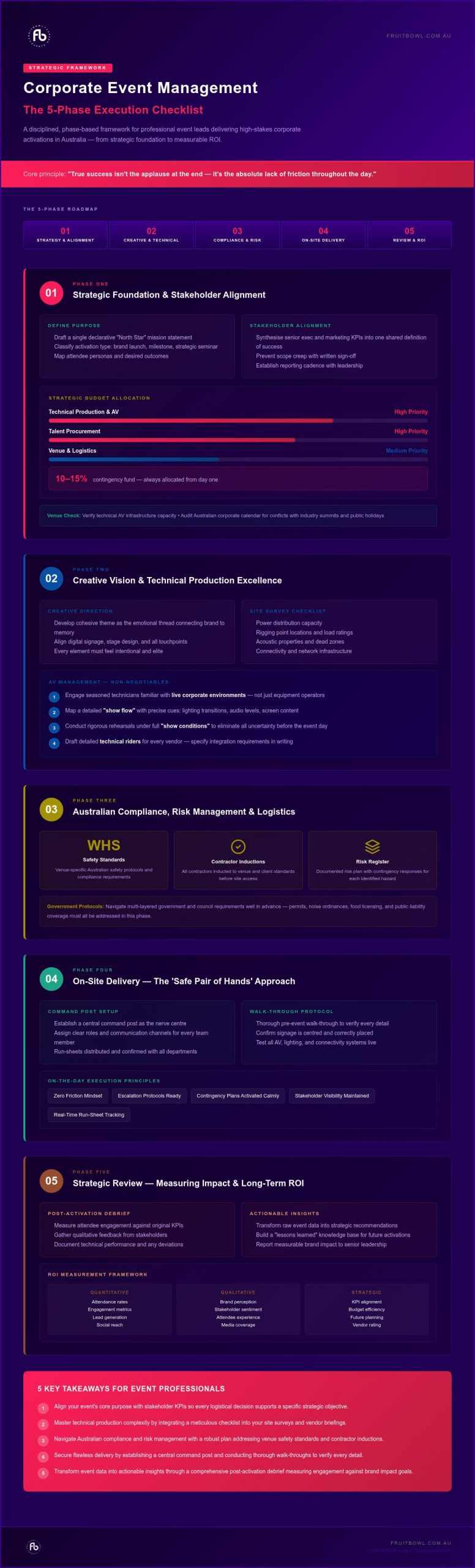
The Ultimate Corporate Event Management Checklist for 2026: A Strategic Framework

Phase 4: Executing the On-Site Delivery: The ‘Safe Pair of Hands’ Approach

Execution is the stage where months of strategic planning are distilled into a few high-stakes hours. When the live environment commences, your corporate event management checklist transitions from a planning tool to a real-time verification document. This phase requires a composed, unflappable presence. Establishing a central command post is the first priority. This hub serves as the nerve centre for the event management team, ensuring clear communication and immediate response to any logistical shifts. From this position, you maintain the “safe pair of hands” oversight that stakeholders expect.

Before the first guest arrives, conduct a final walk-through of the entire event space. This is a meticulous exercise in precision. Verify that all signage is centred, seating is perfectly aligned, and technical stations are discreetly positioned. Registration must be handled with a focus on a frictionless and welcoming guest experience. First impressions are irreversible; therefore, the check-in process should be swift, professional, and entirely free of technical hitches. A seamless entry sets the tone for a sophisticated corporate activation.

During the main programme, the show-caller takes the lead. They ensure the technical schedule runs precisely to the second, managing the transition between speakers, video content, and lighting cues. This level of discipline ensures the audience remains focused on your brand message rather than the mechanics of the delivery. To ensure your next activation is executed with this level of logistical precision, partner with a team that offers end-to-end corporate event management.

On-Site Team Coordination

Brief all staff and volunteers on their specific roles and the emergency response plan well before the doors open. Utilise professional communication tools, such as encrypted radios or dedicated apps, to maintain constant connectivity across the venue. This allows the team to monitor the “pulse” of the room. If the energy dips during a transition, you can adjust the lighting or background music in real-time to maintain the desired atmosphere. Every staff member must understand that their performance is a direct reflection of the brand’s authority.

Stakeholder and VIP Liaison

Designate a senior lead specifically to manage the needs of VIPs, sponsors, and key executives. These stakeholders require a high-touch experience that reflects their importance to the organisation. Ensure all hospitality elements are delivered to the highest professional standard, with no detail overlooked. When challenges arise, address them with composed, invisible problem-solving. The goal is to resolve issues before they are noticed by the client, maintaining the illusion of effortless perfection throughout the activation.

Phase 5: Strategic Review: Measuring Impact and Long-Term ROI

The conclusion of a live activation marks the beginning of the most critical phase for a professional event lead: the strategic review. While the physical bump-out is complete, the project’s success is ultimately validated through a disciplined analysis of data and stakeholder feedback. A comprehensive corporate event management checklist must include a structured post-event debrief with both your internal team and key vendors. This session allows you to capture immediate insights while the experience is fresh; it identifies what performed well and where logistical efficiencies can be improved for future projects.

Strategic reporting is your primary tool for proving ROI to senior leadership. You must reconcile the final budget against initial projections, accounting for every Australian Dollar (A$) spent and identifying any variations. This level of fiscal transparency reinforces your position as a reliable partner. Summarising the event’s impact in a high-level report ensures that stakeholders see the direct connection between the activation’s execution and the organisation’s broader objectives. It transforms a single day of activity into a long-term strategic asset.

Data Analysis and ROI Measurement

To determine the success of your brand activation event planning, you need to synthesise qualitative and quantitative data. Look beyond simple attendance numbers. Analyse engagement metrics, social media sentiment, and direct attendee feedback to measure performance against the KPIs established in Phase 1. Calculating the cost per attendee provides a concrete figure to compare against industry benchmarks. These insights are vital for refining your corporate event management strategy. It ensures each subsequent project is more targeted and effective than the last.

Post-Event Momentum and Legacy

A successful activation should have a legacy that extends well beyond the final keynote. Develop a content plan to repurpose high-quality footage and key insights for your ongoing marketing channels. This ensures the brand message continues to resonate with those who couldn’t attend. Personalised thank-you communications should be sent to sponsors, speakers, and high-value guests within 48 hours to maintain professional relationships. Finally, archive all project documentation, contracts, and creative assets. This creates a historical record that simplifies future planning, ensuring your corporate event management checklist is always supported by a library of proven assets.

Elevating Your Strategic Event Delivery

Mastering high-stakes activations requires more than simple logistical oversight; it demands a disciplined integration of brand objectives with technical precision. By following a meticulous, phase-based corporate event management checklist, you ensure that every detail, from the initial stakeholder alignment to the final ROI analysis, is executed with absolute clarity. This structured framework mitigates the risk of technical failure and provides the security needed to deliver measurable brand impact across every touchpoint.

Success in the 2026 landscape doesn’t just happen; it depends on a partner who brings order to complexity. With over 28 years of industry experience since 1996, Fruitbowl Events Agency serves as a “safe pair of hands” for complex technical production and high-stakes national events. Our seasoned experts specialise in the seamless integration of creative vision and logistical precision for both corporate and government sectors. Partner with Fruitbowl Events Agency for your next high-impact corporate activation to ensure your project is managed with the unflappable expertise it deserves. Your next mission is in expert hands.

Frequently Asked Questions

How far in advance should I start a corporate event management checklist?

You should initiate your corporate event management checklist at least six to twelve months before the activation date. This lead time is vital for securing premium Australian venues and aligning multi-layered stakeholder objectives. Starting early ensures you have the capacity to manage complex technical requirements and talent procurement without compromising quality. It provides the strategic breathing room necessary to refine your creative vision before the build phase begins.

What are the most critical items on a corporate event planning checklist?

The most critical items include defined KPIs, a robust technical rider, and a comprehensive risk management plan. These elements form the strategic foundation of your corporate event management checklist. Without clear success metrics, you can’t prove ROI to senior leadership. Similarly, neglecting technical specifications often leads to friction during live delivery. Prioritising these high-impact areas ensures your activation remains logistically sound and strategically aligned.

How do I manage the technical requirements of a large-scale conference?

Managing technical requirements effectively requires a disciplined approach to AV and production oversight. You must conduct thorough site surveys to assess power distribution and rigging points well before bump-in. Drafting detailed technical riders for every vendor ensures all audio-visual elements integrate seamlessly. Rigorous rehearsals are non-negotiable. They allow your team to verify every cue, from lighting transitions to screen content, ensuring a frictionless experience for your audience.

What should be included in an Australian corporate event risk management plan?

A robust Australian risk management plan must include site-specific safety inductions, emergency egress protocols, and structural integrity certifications. You must verify that all contractors provide valid certificates of currency for public liability insurance. It’s essential to ensure your plan adheres to the updated Australian safety standards for 2026. This meticulous documentation protects both your attendees and your brand reputation during high-stakes public or corporate activations.

How can I measure the ROI of my corporate event effectively?

Effective ROI measurement involves reconciling your final expenditure against the strategic KPIs established during the planning phase. Analyse attendee engagement data, qualitative feedback, and social media sentiment to gauge brand impact. Calculating the cost per attendee allows you to compare performance against industry benchmarks. This data-driven review transforms your event into a measurable business asset, providing senior stakeholders with clear evidence of the activation’s success.

What is the role of a technical director in corporate event management?

A technical director provides the seasoned expertise required to oversee the entire production environment. They act as the central point of contact for AV vendors, staging crews, and show-callers. Their role is to ensure that the technical programme executes precisely to the second. By managing the complexities of the live environment, they allow the event lead to focus on stakeholder liaison and high-level strategy throughout the activation.

How do I choose the right talent for a brand activation event?

Choosing the right talent involves vetting speakers and entertainers to ensure their tone aligns with your brand’s sophisticated register. You should prioritise individuals who understand the specific objectives of a brand activation. Negotiate contracts that explicitly detail performance expectations and technical requirements. Briefing talent on your corporate mission ensures their contribution supports the overall narrative, creating a cohesive experience that resonates with your target audience.

What are the benefits of hiring a professional event management agency in Australia?

Hiring a professional agency provides access to a “safe pair of hands” with deep expertise in complex logistics. Agencies provide end-to-end oversight, covering everything from regulatory compliance to technical production. This ensures your project remains on track and within budget. You benefit from a disciplined methodology refined over decades of industry experience, providing a sense of security and allowing you to focus on your high-level business objectives.

What if the true measure of a successful corporate activation isn’t the applause at the end, but the absolute lack of friction throughout the day? For professional event leads in Australia, the pressure to deliver a seamless experience while proving measurable brand impact to stakeholders is at an all-time high. You likely recognise that a comprehensive corporate event management checklist is no longer just a task list; it’s a strategic roadmap that safeguards your reputation against technical failures and logistical oversights.

It’s natural to feel the weight of these high-stakes environments, especially when managing complex technical requirements or multi-layered government protocols. We promise to help you master these complexities by providing a disciplined, phase-based framework tailored for the 2026 corporate environment. This article outlines a meticulous progression from foundational strategy to technical execution and ROI analysis. You’ll gain the clarity needed to oversee every moving part with the confidence of a seasoned strategist, ensuring your next project is remembered for its precision and results.

Key Takeaways

  • Align your event’s core purpose with stakeholder KPIs to ensure every logistical decision supports a specific strategic objective.
  • Master the complexities of technical production by integrating a meticulous corporate event management checklist into your site surveys and vendor briefings.
  • Navigate Australian compliance and risk management with a robust plan that addresses venue-specific safety standards and contractor inductions.
  • Secure a flawless delivery by establishing a central command post and conducting thorough walk-throughs to verify every detail is centred and correct.
  • Transform event data into actionable insights through a comprehensive post-activation debrief that measures engagement against your original brand impact goals.

Phase 1: Establishing the Strategic Foundation and Stakeholder Alignment

The initial phase of any high-stakes project dictates its ultimate trajectory. Before a single vendor is contacted, you must anchor your efforts in a strategic framework that transcends simple logistics. Using a robust corporate event management checklist ensures that every decision, from the choice of venue to the technical run-sheet, serves a specific organisational goal. This foundational work provides the clarity needed to manage expectations and deliver a frictionless experience from the outset.

Clarity begins by defining the core purpose of the activation. You aren’t just “holding an event”; you’re executing a brand activation, a celebratory milestone, or a strategic seminar. Each requires a distinct approach to talent, tone, and production. Once the purpose is established, engage your key stakeholders. Senior executives and marketing leads often have varying KPIs. Your role is to synthesise these viewpoints into a single, measurable definition of success that everyone can support. This alignment prevents scope creep and ensures the project remains on track.

Defining High-Impact Event Objectives

Precision starts with a mission statement. Draft a single, declarative sentence that encapsulates the event’s purpose. This becomes the “North Star” for every subsequent decision. Next, map out your attendee personas. An executive audience at a Sydney conference centre has different expectations than a creative team at a Melbourne brand activation. You must identify their specific desired outcomes and the primary call to action you want them to take once the doors close. If the objective isn’t clear to you, it won’t be clear to them.

Strategic Budget Allocation

A budget is a financial expression of your strategic priorities. In the current landscape, the demand for immersive experiences means you should prioritise spending on high-impact areas like technical production and talent procurement. These elements define the attendee’s perception of quality and brand authority. Always allocate a 10-15% contingency fund to manage the inevitable logistical shifts that occur in complex environments. Establish a transparent tracking system from day one. This ensures you maintain fiscal control and can provide detailed reporting to senior leadership at any moment.

Finally, select a date and venue that reflect your brand’s sophisticated register. The venue must offer more than just floor space; it requires the technical infrastructure to support high-end AV requirements without compromise. Check the Australian corporate calendar to avoid conflicts with major industry summits or public holidays. Securing the right environment early provides the “safe pair of hands” assurance that stakeholders demand, allowing you to focus on the creative execution.

Phase 2: Integrating Creative Vision with Technical Production Excellence

Translating a strategic foundation into a tangible experience requires a disciplined transition from abstract goals to technical specifications. At this stage, your corporate event management checklist must pivot towards the aesthetic and the operational. A cohesive creative theme isn’t merely a visual layer; it’s the emotional thread that connects your brand’s message to the attendee’s memory. Every touchpoint, from digital signage to stage design, must reflect this unified vision to ensure the activation feels intentional and elite.

Technical precision is where creative ambition meets reality. You must organise a comprehensive technical site survey early in the process. This isn’t a casual walk-through. It’s a rigorous assessment of the venue’s power distribution, rigging points, and acoustic properties. By identifying limitations now, you avoid costly on-site workarounds later. Drafting detailed technical riders for every vendor ensures that audio-visual elements integrate seamlessly, preventing the technical friction that can undermine a high-stakes presentation.

Technical Direction and AV Management

Professional av management for events requires a level of oversight that goes beyond simply hiring equipment. You need seasoned technicians who understand the nuances of a live corporate environment. Map out a “show flow” that includes precise cues for lighting transitions, audio levels, and screen content. Rigorous rehearsals are non-negotiable. Every keynote speaker and technical sequence should be tested under “show conditions” to eliminate uncertainty and ensure a frictionless delivery.

Talent and Entertainment Procurement

Sourcing talent is about more than finding a recognisable name; it’s about finding a voice that aligns with your corporate register. Vet all speakers and entertainers for their ability to maintain a professional tone while engaging the audience. Negotiate contracts that explicitly detail expectations for performance length, travel arrangements, and technical requirements. Integrating these talent requirements into your corporate event management checklist ensures that no detail, from green room logistics to on-site briefings, is overlooked. Brief your talent thoroughly on the brand voice and the specific KPIs identified in Phase 1 to guarantee their contribution supports the overall mission.

Successfully balancing these moving parts requires a partner who acts as a steady hand for your brand. If you’re managing a complex activation, engaging experts in strategic event management can provide the technical security and creative clarity your stakeholders expect.

Phase 3: Navigating Australian Compliance, Risk Management, and Logistics

Maintaining logistical order is the invisible backbone of any high-stakes activation. While the creative vision captures the imagination, it’s the meticulous adherence to a corporate event management checklist that ensures the safety and security of every attendee. In Australia, this means developing a robust Risk Management Plan (RMP) that is specifically tailored to your venue and event type. You must account for everything from emergency egress to the structural integrity of temporary installations, ensuring no detail is left to chance.

Risk mitigation begins with your vendor network. It’s essential that all contractors provide valid certificates of currency for public liability insurance and complete site-specific safety inductions before work commences. If your project involves public sector stakeholders or high-profile dignitaries, you must also review strategic government event planning protocols. These frameworks ensure that security, protocol, and media management align with the stringent requirements of government activations.

Regulatory Compliance and Safety Standards

Verify that all staging and technical infrastructure meets the updated Australian safety standards for 2026. This includes checking load ratings for rigging and ensuring all electrical equipment is tagged and tested. For larger festivals or brand activations, you need a comprehensive crowd management strategy to prevent congestion and maintain a steady flow. Additionally, ensure all food and beverage providers hold the necessary licences and strictly adhere to national health and safety regulations to protect your guests and your brand’s reputation.

Logistical Precision and Site Management

Executing a flawless bump-in requires a minute-by-minute logistical timeline for the 48 hours surrounding the event. You must coordinate closely with venue management to secure load-in zones and freight elevator access, preventing bottlenecks during the critical build phase. For complex, multi-day seminars, appointing a dedicated conference logistics coordinator is a strategic necessity. This role provides the focused oversight required to manage transport coordination, freight storage, and the inevitable last-minute adjustments that occur during high-stakes deliveries.

Phase 4: Executing the On-Site Delivery: The ‘Safe Pair of Hands’ Approach

Execution is the stage where months of strategic planning are distilled into a few high-stakes hours. When the live environment commences, your corporate event management checklist transitions from a planning tool to a real-time verification document. This phase requires a composed, unflappable presence. Establishing a central command post is the first priority. This hub serves as the nerve centre for the event management team, ensuring clear communication and immediate response to any logistical shifts. From this position, you maintain the “safe pair of hands” oversight that stakeholders expect.

Before the first guest arrives, conduct a final walk-through of the entire event space. This is a meticulous exercise in precision. Verify that all signage is centred, seating is perfectly aligned, and technical stations are discreetly positioned. Registration must be handled with a focus on a frictionless and welcoming guest experience. First impressions are irreversible; therefore, the check-in process should be swift, professional, and entirely free of technical hitches. A seamless entry sets the tone for a sophisticated corporate activation.

During the main programme, the show-caller takes the lead. They ensure the technical schedule runs precisely to the second, managing the transition between speakers, video content, and lighting cues. This level of discipline ensures the audience remains focused on your brand message rather than the mechanics of the delivery. To ensure your next activation is executed with this level of logistical precision, partner with a team that offers end-to-end corporate event management.

On-Site Team Coordination

Brief all staff and volunteers on their specific roles and the emergency response plan well before the doors open. Utilise professional communication tools, such as encrypted radios or dedicated apps, to maintain constant connectivity across the venue. This allows the team to monitor the “pulse” of the room. If the energy dips during a transition, you can adjust the lighting or background music in real-time to maintain the desired atmosphere. Every staff member must understand that their performance is a direct reflection of the brand’s authority.

Stakeholder and VIP Liaison

Designate a senior lead specifically to manage the needs of VIPs, sponsors, and key executives. These stakeholders require a high-touch experience that reflects their importance to the organisation. Ensure all hospitality elements are delivered to the highest professional standard, with no detail overlooked. When challenges arise, address them with composed, invisible problem-solving. The goal is to resolve issues before they are noticed by the client, maintaining the illusion of effortless perfection throughout the activation.

Phase 5: Strategic Review: Measuring Impact and Long-Term ROI

The conclusion of a live activation marks the beginning of the most critical phase for a professional event lead: the strategic review. While the physical bump-out is complete, the project’s success is ultimately validated through a disciplined analysis of data and stakeholder feedback. A comprehensive corporate event management checklist must include a structured post-event debrief with both your internal team and key vendors. This session allows you to capture immediate insights while the experience is fresh; it identifies what performed well and where logistical efficiencies can be improved for future projects.

Strategic reporting is your primary tool for proving ROI to senior leadership. You must reconcile the final budget against initial projections, accounting for every Australian Dollar (A$) spent and identifying any variations. This level of fiscal transparency reinforces your position as a reliable partner. Summarising the event’s impact in a high-level report ensures that stakeholders see the direct connection between the activation’s execution and the organisation’s broader objectives. It transforms a single day of activity into a long-term strategic asset.

Data Analysis and ROI Measurement

To determine the success of your brand activation event planning, you need to synthesise qualitative and quantitative data. Look beyond simple attendance numbers. Analyse engagement metrics, social media sentiment, and direct attendee feedback to measure performance against the KPIs established in Phase 1. Calculating the cost per attendee provides a concrete figure to compare against industry benchmarks. These insights are vital for refining your corporate event management strategy. It ensures each subsequent project is more targeted and effective than the last.

Post-Event Momentum and Legacy

A successful activation should have a legacy that extends well beyond the final keynote. Develop a content plan to repurpose high-quality footage and key insights for your ongoing marketing channels. This ensures the brand message continues to resonate with those who couldn’t attend. Personalised thank-you communications should be sent to sponsors, speakers, and high-value guests within 48 hours to maintain professional relationships. Finally, archive all project documentation, contracts, and creative assets. This creates a historical record that simplifies future planning, ensuring your corporate event management checklist is always supported by a library of proven assets.

Elevating Your Strategic Event Delivery

Mastering high-stakes activations requires more than simple logistical oversight; it demands a disciplined integration of brand objectives with technical precision. By following a meticulous, phase-based corporate event management checklist, you ensure that every detail, from the initial stakeholder alignment to the final ROI analysis, is executed with absolute clarity. This structured framework mitigates the risk of technical failure and provides the security needed to deliver measurable brand impact across every touchpoint.

Success in the 2026 landscape doesn’t just happen; it depends on a partner who brings order to complexity. With over 28 years of industry experience since 1996, Fruitbowl Events Agency serves as a “safe pair of hands” for complex technical production and high-stakes national events. Our seasoned experts specialise in the seamless integration of creative vision and logistical precision for both corporate and government sectors. Partner with Fruitbowl Events Agency for your next high-impact corporate activation to ensure your project is managed with the unflappable expertise it deserves. Your next mission is in expert hands.

Frequently Asked Questions

How far in advance should I start a corporate event management checklist?

You should initiate your corporate event management checklist at least six to twelve months before the activation date. This lead time is vital for securing premium Australian venues and aligning multi-layered stakeholder objectives. Starting early ensures you have the capacity to manage complex technical requirements and talent procurement without compromising quality. It provides the strategic breathing room necessary to refine your creative vision before the build phase begins.

What are the most critical items on a corporate event planning checklist?

The most critical items include defined KPIs, a robust technical rider, and a comprehensive risk management plan. These elements form the strategic foundation of your corporate event management checklist. Without clear success metrics, you can’t prove ROI to senior leadership. Similarly, neglecting technical specifications often leads to friction during live delivery. Prioritising these high-impact areas ensures your activation remains logistically sound and strategically aligned.

How do I manage the technical requirements of a large-scale conference?

Managing technical requirements effectively requires a disciplined approach to AV and production oversight. You must conduct thorough site surveys to assess power distribution and rigging points well before bump-in. Drafting detailed technical riders for every vendor ensures all audio-visual elements integrate seamlessly. Rigorous rehearsals are non-negotiable. They allow your team to verify every cue, from lighting transitions to screen content, ensuring a frictionless experience for your audience.

What should be included in an Australian corporate event risk management plan?

A robust Australian risk management plan must include site-specific safety inductions, emergency egress protocols, and structural integrity certifications. You must verify that all contractors provide valid certificates of currency for public liability insurance. It’s essential to ensure your plan adheres to the updated Australian safety standards for 2026. This meticulous documentation protects both your attendees and your brand reputation during high-stakes public or corporate activations.

How can I measure the ROI of my corporate event effectively?

Effective ROI measurement involves reconciling your final expenditure against the strategic KPIs established during the planning phase. Analyse attendee engagement data, qualitative feedback, and social media sentiment to gauge brand impact. Calculating the cost per attendee allows you to compare performance against industry benchmarks. This data-driven review transforms your event into a measurable business asset, providing senior stakeholders with clear evidence of the activation’s success.

What is the role of a technical director in corporate event management?

A technical director provides the seasoned expertise required to oversee the entire production environment. They act as the central point of contact for AV vendors, staging crews, and show-callers. Their role is to ensure that the technical programme executes precisely to the second. By managing the complexities of the live environment, they allow the event lead to focus on stakeholder liaison and high-level strategy throughout the activation.

How do I choose the right talent for a brand activation event?

Choosing the right talent involves vetting speakers and entertainers to ensure their tone aligns with your brand’s sophisticated register. You should prioritise individuals who understand the specific objectives of a brand activation. Negotiate contracts that explicitly detail performance expectations and technical requirements. Briefing talent on your corporate mission ensures their contribution supports the overall narrative, creating a cohesive experience that resonates with your target audience.

What are the benefits of hiring a professional event management agency in Australia?

Hiring a professional agency provides access to a “safe pair of hands” with deep expertise in complex logistics. Agencies provide end-to-end oversight, covering everything from regulatory compliance to technical production. This ensures your project remains on track and within budget. You benefit from a disciplined methodology refined over decades of industry experience, providing a sense of security and allowing you to focus on your high-level business objectives.

Back to Articles
Request A Quote

Make an
Enquiry

Untitled design

What Makes Us Different?

True end-to-end solution so you can hand off to us, focus on your priorities and enjoy the event without any stress

Unmatched industry expertise looking after diverse range of high-profile events, cultural festivals & activations

Meticulous attention to every detail and precise execution of events with our streamlined processes

Tailored solutions with bespoke strategies to ensure we align with your brand and objectives

Make an Enquiry

"*" indicates required fields

This field is for validation purposes and should be left unchanged.

"*" indicates required fields

This field is for validation purposes and should be left unchanged.