A festival’s legacy is rarely defined by the headline act; instead, it is built on the quiet strength of its social licence and the precision of a robust festival stakeholder management plan. When regulatory demands escalate and local community groups voice their concerns, a creative vision can quickly be overshadowed by logistical friction. You likely recognise that maintaining order across a complex web of government bodies, residents, and operational partners is the most demanding part of your role.
This 2026 guide is designed to transform that pressure into a structured advantage. It provides a clear, defensible framework to balance competing interests and secure your social licence, effectively reducing project risk while keeping partners aligned with your objectives. By implementing these professional engagement strategies, you will move beyond reactive crisis control and into a position of strategic oversight. We will explore how to navigate evolving permit fee structures and transparency regulations while fostering the long-term community support essential for any recurring public event.
Key Takeaways
- Establish a robust festival stakeholder management plan to secure your social licence and provide a defensible framework against increasing regulatory pressure.
- Map the three tiers of your festival ecosystem to ensure every partner, from Traditional Owners to local government, is engaged with professional precision.
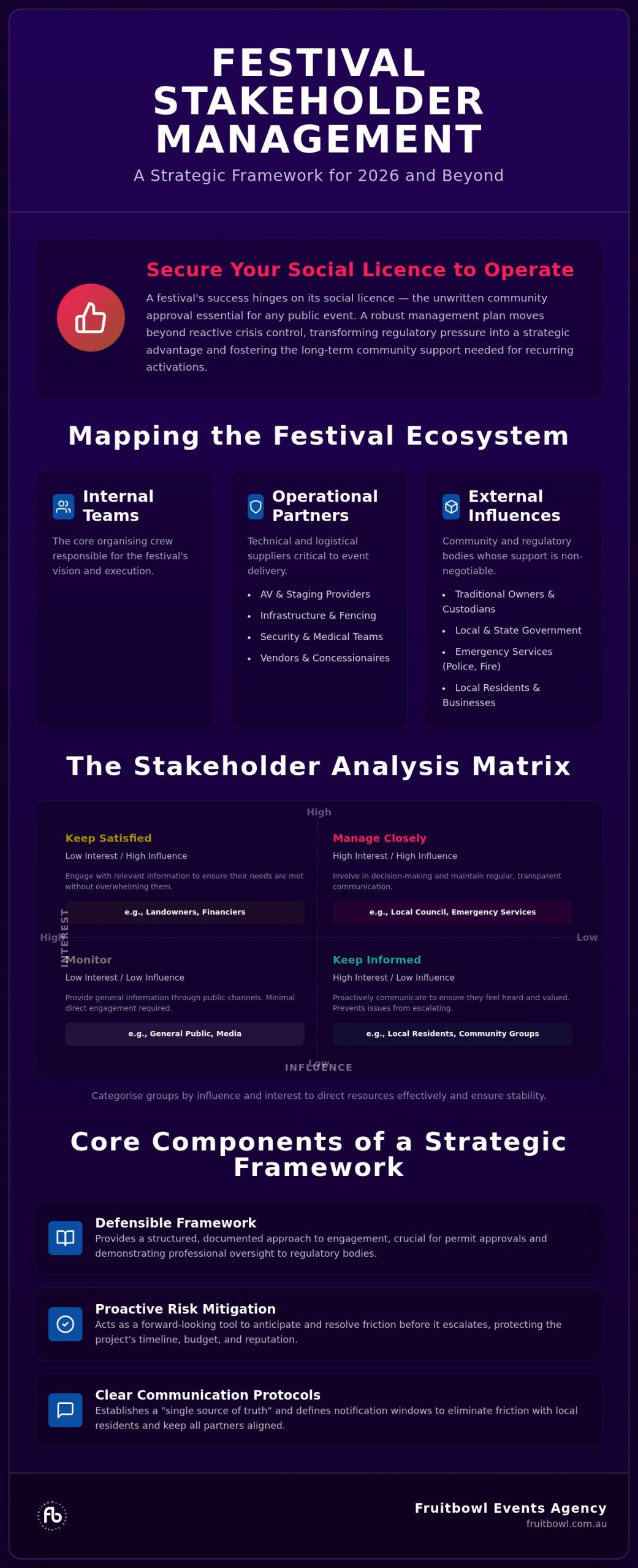
- Utilise the Stakeholder Analysis Matrix to categorise groups by influence and interest, ensuring your resources are directed where they provide the most stability.
- Master the “notification window” and communication protocols to eliminate friction with local residents and maintain a single source of truth for partners.
- Understand how strategic oversight and seasoned expertise act as a safeguard for complex activations, maintaining order in high-stakes environments.
What is a Festival Stakeholder Management Plan?
A festival stakeholder management plan is a comprehensive strategic document that outlines how an organisation identifies, engages, and manages the expectations of individuals or groups impacted by a festival. It functions as a rigorous roadmap for navigating the complex interests of government bodies, local residents, and operational partners. Unlike a simple communication log that merely records past interactions, this plan acts as a forward-looking risk-mitigation framework. It ensures that every interaction is purposeful and aligned with the festival’s long-term sustainability and operational success.
Understanding the foundational principles of What is Stakeholder Management? provides a helpful starting point, but the festival environment requires a more nuanced, site-specific approach. A strategic framework allows organisers to anticipate friction before it escalates, protecting the project’s timeline and reputation. By treating stakeholder engagement as a core logistical component rather than an administrative afterthought, event directors can maintain order in high-stakes environments.
The Evolution of Stakeholder Expectations in 2026
Expectations for public events have shifted significantly. Modern audiences and local authorities now demand a higher standard of sustainability, inclusivity, and measurable community impact. Engagement is no longer a one-way notification process; it has evolved into a two-way consultative dialogue where stakeholders feel their input genuinely shapes the event’s footprint. Social Licence is the unwritten community approval required for public activations. Without this informal consent, even the most technically perfect festival faces significant resistance and potential cancellation. Securing this licence requires a transparent, professional approach that prioritises long-term relationships over short-term gains.
Regulatory and Compliance Drivers
The regulatory environment in 2026 is increasingly rigorous. Government event planning requirements now dictate a high level of stakeholder transparency as a prerequisite for permit approval. A robust festival stakeholder management plan is essential for demonstrating to councils and emergency services that your event is under expert supervision. This document serves as evidence of your commitment to national safety standards and emergency protocols. It also plays a vital role in managing public liability, as it documents the proactive steps taken to mitigate risks to the public and the surrounding environment. By aligning engagement strategies with these compliance drivers, organisers can navigate the permit process with greater confidence and speed.
Mapping the Festival Ecosystem: Identifying Key Stakeholders
Successful event delivery relies on a precise understanding of the surrounding ecosystem. Identifying stakeholders is the first step in constructing a festival stakeholder management plan that can withstand the pressures of a high-stakes environment. We categorise these entities into three distinct tiers: internal teams, operational partners, and external influences. Each tier requires a bespoke engagement strategy to ensure logistical precision and creative alignment.
Within the Australian context, identifying and partnering with Traditional Owners and Custodians is a foundational requirement. This relationship goes beyond a simple acknowledgement; it involves genuine consultation to ensure the event respects the cultural significance of the land. External mapping must also include regulatory bodies such as local councils, emergency services, and liquor licensing authorities. Each of these groups holds the power to pause or stop production if their specific criteria aren’t met. Engaging a partner with national delivery capability can provide the strategic oversight needed to manage these diverse interests seamlessly.
Managing the “Community Stakeholder” is equally vital for long-term success. Residents and local businesses often bear the brunt of noise, traffic, and increased footfall. Proactive engagement with these groups ensures that the festival is seen as a community benefit rather than a burden, preserving the social licence essential for recurring activations.
Operational and Technical Stakeholders
Technical execution is the backbone of stakeholder satisfaction. Coordinating the complex needs of AV, staging, and infrastructure providers requires meticulous oversight. Integrating av management for events into your broader framework ensures that technical directors and suppliers are aligned with the project’s timeline. This coordination extends to entertainment procurement and exhibitor management—where industry resources like the Art and Craft Expo highlight the value of precise scheduling—ensuring a frictionless delivery on show day.
Navigating the bureaucratic landscape requires a sophisticated approach to strategic government event planning. Institutional partners, including public health, safety, and transport authorities, have strict compliance benchmarks that must be satisfied to secure necessary permits. For public activations, managing political stakeholders and VIP protocols adds another layer of complexity. Ensuring these high-profile participants are integrated safely and respectfully into the event flow is a hallmark of a well-executed festival stakeholder management plan.
Core Components of a Strategic Stakeholder Framework
A strategic framework moves beyond the simple identification of partners to establish a rigorous system of engagement. It ensures that every interaction is purposeful, measurable, and aligned with the event’s operational timeline. By formalising these processes within your festival stakeholder management plan, you create a defensible record of consultation that protects your social licence and streamlines the permit approval process. This structured approach replaces the uncertainty of ad hoc communication with a predictable rhythm of engagement that stakeholders can rely on.
The Influence vs. Interest Matrix
The Stakeholder Analysis Matrix serves as the primary tool for prioritising management efforts. By assessing each group based on their level of influence over the project and their interest in its outcome, organisers can allocate resources with greater precision. High Influence, High Interest stakeholders require a dedicated relationship manager to ensure their complex requirements are met with consistent precision. Conversely, groups with high influence but low interest, such as specific regulatory bodies or state agencies, require strategies that keep them satisfied without over-burdening them with unnecessary detail. This categorisation ensures that high-priority partners receive the sophisticated attention they require to remain supportive of the activation.
Engagement objectives must be clearly defined for each segment of the matrix. These typically fall into three categories:
- Informed: One-way communication providing essential updates on timelines and impacts.
- Consulted: Two-way dialogue where stakeholder feedback is sought and used to refine operational plans.
- Partnered: Deep collaboration where stakeholders have a direct hand in decision-making or delivery.
Risk Management and Contingency Planning
Stakeholder-related risks, such as community pushback, permit delays, or the sudden withdrawal of support, can derail even the most meticulously planned festival. A strategic framework must include specific mitigation strategies for these high-priority groups. This involves identifying potential “pain points” early and developing pre-approved responses to address concerns before they escalate into public friction. Integrating the stakeholder plan into the broader festival production services framework ensures that engagement efforts are synchronised with technical and logistical milestones. This alignment allows technical directors to adjust site layouts or sound profiles in real-time based on stakeholder feedback, maintaining the project’s integrity while respecting community boundaries.
Finally, a robust plan requires established feedback loops. These loops ensure that every concern raised is documented, addressed, and communicated back to the stakeholder. Closing the loop in this manner demonstrates a level of professional oversight that builds long-term trust and secures the festival stakeholder management plan as a cornerstone of the event’s sustainability.
Execution and Engagement: Managing Communications Methodically
The execution phase of a festival stakeholder management plan is where strategic theory meets operational reality. Maintaining a single source of truth is paramount to prevent communication breakdowns that can jeopardise the event’s delivery. By establishing clear lines of communication, organisers ensure that every partner, from government agencies to technical suppliers, receives consistent and accurate information. This level of methodical oversight provides a sense of security to all involved. It reinforces your position as a capable and reliable lead who is always in control of the process.
The “Notification Window” is a critical timeframe that requires precise management. Engaging stakeholders too early may lead to forgotten details. Conversely, engaging too late often triggers community friction and regulatory pushback. A well-timed notification strategy respects the schedules of residents and local businesses. This allows them to prepare for changes in traffic or noise levels, significantly reducing the likelihood of complaints. When objections do arise, conflict resolution protocols must be executed with composure. Handling concerns through a pre-defined framework ensures that emotional responses are managed professionally. This protects the event’s reputation and maintains the social licence required for future activations.
Professional Communication Protocols
Effective engagement requires choosing the appropriate register for each interaction. Formal reports are necessary for regulatory bodies and institutional partners who require high-level documentation. Operational briefings are more suitable for technical teams on the ground who need immediate, actionable data. Utilising digital tools to track stakeholder interactions and sentiment allows for real-time monitoring of the project’s social health. This data-driven approach ensures consistency across all touchpoints, building a foundation of trust. Meticulous documentation of these interactions is not merely an administrative task. It’s essential for post-event reporting and demonstrating ROI to sponsors and government partners who value transparency and accountability.
Managing On-Site Stakeholder Relations
During the event build and delivery, an on-site liaison acts as the primary point of contact for immediate concerns. This role is vital for handling real-time issues from residents or authorities. It ensures that minor friction doesn’t escalate into a significant disruption. Whether it’s a noise complaint or a traffic access issue, having a “safe pair of hands” on the ground provides immediate reassurance. The situation remains under expert supervision at all times. Once the festival concludes, a formal debriefing process cements these relationships for future years. This reflective practice allows you to refine your engagement strategies and confirms that all commitments made in the festival stakeholder management plan were honoured. For organisers seeking to elevate their next activation, partnering with an agency that offers end-to-end strategic oversight ensures every detail is managed with sophisticated precision.
Navigating Complexity with Fruitbowl’s Strategic Oversight
Delivering a high-stakes festival requires more than just a creative vision; it demands a level of logistical and technical precision that only comes from decades of experience. Fruitbowl Events Agency brings 28 years of industry expertise to the table, serving as the ultimate safeguard for your event’s success. We understand that a festival stakeholder management plan is only as effective as the team executing it. By positioning ourselves as a “safe pair of hands,” we provide the composure and strategic oversight necessary to navigate even the most volatile stakeholder landscapes.
Our end-to-end methodology ensures that every moving part of your activation is seamlessly integrated. From the initial strategic mapping of Traditional Owners and government bodies to the real-time management of on-site technical infrastructure, our process is exhaustive. We specialise in bridging the gap between ambitious creative concepts and the rigorous logistical requirements of public spaces. This balanced approach ensures that your festival remains a visionary experience while meeting every technical and safety benchmark with absolute certainty.
The Fruitbowl Advantage in Public Activations
Our proven history with government bodies and national public events allows us to anticipate regulatory hurdles before they impact your timeline. We don’t just follow a checklist; we leverage an extensive national network to facilitate seamless talent and technical procurement. This industry-literate approach ensures that technical directors and entertainment partners are perfectly aligned with your broader engagement objectives. By managing these complex relationships with professional discipline, we ensure your festival meets every compliance hurdle without stifling the creative energy that defines your brand. Our expertise in government activations means we speak the language of institutional partners, facilitating smoother permit approvals and more robust public liability frameworks.
Partnering for Success in 2026
In the current event landscape, moving beyond simple planning to a strategic event partnership is essential for long-term sustainability. We protect your brand reputation through meticulous stakeholder management, ensuring that your social licence remains intact year after year. Our team acts as a sophisticated strategist and a meticulous guide, providing a frictionless experience for both you and your partners. We take quiet pride in bringing order to high-stakes environments, allowing you to focus on the mission while we handle the intricate details of stakeholder satisfaction and logistical execution. If you are ready to elevate your project with a level of expertise that ensures every detail is under expert supervision, it’s time to discuss your festival stakeholder strategy with the Fruitbowl team.
Securing the Future of Your Festival
A robust festival stakeholder management plan isn’t merely an administrative requirement; it’s the foundation of any enduring public event. It moves beyond simple notification to establish a strategic framework that protects your project’s social licence. By mapping your ecosystem with precision and implementing a structured engagement matrix, you transform potential friction into operational stability. This methodical approach ensures that every partner remains aligned with your creative vision while satisfying rigorous regulatory demands. It’s the difference between reactive crisis management and proactive strategic oversight. Every detail matters in a high-stakes environment.
Fruitbowl Events Agency offers the sophisticated oversight required for these complex landscapes. With 28 years of industry-leading experience and a national delivery capability, we specialise in high-stakes government and public events across Australia. We provide the “safe pair of hands” needed to bridge creative ambition with logistical execution, ensuring every detail is under expert supervision. Our end-to-end methodology guarantees that your activation is delivered with the precision and composure it requires.
Partner with Fruitbowl for Expert Festival Oversight and ensure your next activation is delivered with total confidence. Your vision deserves the security of a disciplined, technical partner who understands the stakes.
Frequently Asked Questions
What is the primary purpose of a festival stakeholder management plan?
The primary purpose isn’t just communication; it’s to secure a social licence to operate while mitigating project risk through structured engagement. By aligning the competing interests of government bodies, residents, and operational partners, the plan ensures logistical precision. It provides a defensible framework that justifies permit approvals and maintains order in complex environments. This methodical approach protects the festival’s reputation and ensures its long-term sustainability within the community.
How far in advance should I start engaging festival stakeholders?
For large-scale public activations, engagement should ideally commence 12 to 18 months before the event date. This lead time is essential for building authentic relationships with Traditional Owners and navigating complex government permit cycles. Early consultation allows technical teams to adjust site layouts or sound profiles based on stakeholder feedback. Starting early ensures that all parties feel heard, which significantly reduces the likelihood of late-stage objections or delays.
Who are the most important stakeholders in a large-scale public festival?
Key partners typically include Traditional Owners, local government councils, emergency services, and liquor licensing boards. However, the “Community Stakeholder,” comprising local residents and businesses, is equally vital for maintaining a social licence. Your festival stakeholder management plan must also account for operational partners such as AV providers and technical directors. Each group holds the power to impact your delivery, requiring a sophisticated and tailored engagement strategy.
What happens if a key stakeholder objects to the festival plans?
If an objection occurs, you should activate your formal conflict resolution protocols with composure and professional discipline. This process involves documenting the specific concerns, engaging in a two-way consultative dialogue, and seeking mutually beneficial compromises. Addressing objections early prevents them from escalating into public friction or regulatory hurdles. A “safe pair of hands” approach ensures that even high-stakes disagreements are managed without jeopardising the festival’s overall timeline or creative vision.
How do I measure the success of my stakeholder management strategy?
Success is quantified through measurable outcomes like the speed of permit approvals, the volume of resolved community concerns, and positive sentiment in post-event debriefs. You should also evaluate the effectiveness of your communication channels and the accuracy of your notification window. Meticulous documentation of every interaction allows you to present a transparent success report to sponsors and government partners, proving the efficacy of your strategic oversight and commitment to community standards.
Is a stakeholder plan required for private corporate events?
While the regulatory burden is often lighter, a formal plan is still a prudent safeguard for high-stakes corporate events. It ensures that internal teams, venues, and technical suppliers are perfectly aligned with the project’s objectives. Managing these expectations professionally reduces the risk of communication breakdowns and ensures that the activation reflects the brand’s sophisticated standards. A structured approach provides a sense of security for everyone involved in the delivery and execution.
Can I manage festival stakeholders without a formal written plan?
Operating without a formal written document is a significant risk that leaves your event vulnerable to regulatory pushback and community friction. A festival stakeholder management plan acts as a vital single source of truth, providing a defensible record of all consultative efforts. It ensures that your engagement is methodical rather than reactive. In a high-stakes environment, having a documented strategy is the only way to prove you have exercised professional due diligence.
How does stakeholder management impact festival risk assessment?
Stakeholder engagement is a core component of a comprehensive risk assessment, as it identifies potential social and regulatory threats before they manifest. By understanding stakeholder influence and interest, you can develop targeted mitigation strategies for high-priority risks like permit delays or resident objections. This integration ensures that your risk management is not just a technical exercise but a holistic framework that accounts for all external influences on your event’s operational success.
A festival’s legacy is rarely defined by the headline act; instead, it is built on the quiet strength of its social licence and the precision of a robust festival stakeholder management plan. When regulatory demands escalate and local community groups voice their concerns, a creative vision can quickly be overshadowed by logistical friction. You likely recognise that maintaining order across a complex web of government bodies, residents, and operational partners is the most demanding part of your role.
This 2026 guide is designed to transform that pressure into a structured advantage. It provides a clear, defensible framework to balance competing interests and secure your social licence, effectively reducing project risk while keeping partners aligned with your objectives. By implementing these professional engagement strategies, you will move beyond reactive crisis control and into a position of strategic oversight. We will explore how to navigate evolving permit fee structures and transparency regulations while fostering the long-term community support essential for any recurring public event.
Key Takeaways
- Establish a robust festival stakeholder management plan to secure your social licence and provide a defensible framework against increasing regulatory pressure.
- Map the three tiers of your festival ecosystem to ensure every partner, from Traditional Owners to local government, is engaged with professional precision.
- Utilise the Stakeholder Analysis Matrix to categorise groups by influence and interest, ensuring your resources are directed where they provide the most stability.
- Master the “notification window” and communication protocols to eliminate friction with local residents and maintain a single source of truth for partners.
- Understand how strategic oversight and seasoned expertise act as a safeguard for complex activations, maintaining order in high-stakes environments.
What is a Festival Stakeholder Management Plan?
A festival stakeholder management plan is a comprehensive strategic document that outlines how an organisation identifies, engages, and manages the expectations of individuals or groups impacted by a festival. It functions as a rigorous roadmap for navigating the complex interests of government bodies, local residents, and operational partners. Unlike a simple communication log that merely records past interactions, this plan acts as a forward-looking risk-mitigation framework. It ensures that every interaction is purposeful and aligned with the festival’s long-term sustainability and operational success.
Understanding the foundational principles of What is Stakeholder Management? provides a helpful starting point, but the festival environment requires a more nuanced, site-specific approach. A strategic framework allows organisers to anticipate friction before it escalates, protecting the project’s timeline and reputation. By treating stakeholder engagement as a core logistical component rather than an administrative afterthought, event directors can maintain order in high-stakes environments.
The Evolution of Stakeholder Expectations in 2026
Expectations for public events have shifted significantly. Modern audiences and local authorities now demand a higher standard of sustainability, inclusivity, and measurable community impact. Engagement is no longer a one-way notification process; it has evolved into a two-way consultative dialogue where stakeholders feel their input genuinely shapes the event’s footprint. Social Licence is the unwritten community approval required for public activations. Without this informal consent, even the most technically perfect festival faces significant resistance and potential cancellation. Securing this licence requires a transparent, professional approach that prioritises long-term relationships over short-term gains.
Regulatory and Compliance Drivers
The regulatory environment in 2026 is increasingly rigorous. Government event planning requirements now dictate a high level of stakeholder transparency as a prerequisite for permit approval. A robust festival stakeholder management plan is essential for demonstrating to councils and emergency services that your event is under expert supervision. This document serves as evidence of your commitment to national safety standards and emergency protocols. It also plays a vital role in managing public liability, as it documents the proactive steps taken to mitigate risks to the public and the surrounding environment. By aligning engagement strategies with these compliance drivers, organisers can navigate the permit process with greater confidence and speed.
Mapping the Festival Ecosystem: Identifying Key Stakeholders
Successful event delivery relies on a precise understanding of the surrounding ecosystem. Identifying stakeholders is the first step in constructing a festival stakeholder management plan that can withstand the pressures of a high-stakes environment. We categorise these entities into three distinct tiers: internal teams, operational partners, and external influences. Each tier requires a bespoke engagement strategy to ensure logistical precision and creative alignment.
Within the Australian context, identifying and partnering with Traditional Owners and Custodians is a foundational requirement. This relationship goes beyond a simple acknowledgement; it involves genuine consultation to ensure the event respects the cultural significance of the land. External mapping must also include regulatory bodies such as local councils, emergency services, and liquor licensing authorities. Each of these groups holds the power to pause or stop production if their specific criteria aren’t met. Engaging a partner with national delivery capability can provide the strategic oversight needed to manage these diverse interests seamlessly.
Managing the “Community Stakeholder” is equally vital for long-term success. Residents and local businesses often bear the brunt of noise, traffic, and increased footfall. Proactive engagement with these groups ensures that the festival is seen as a community benefit rather than a burden, preserving the social licence essential for recurring activations.
Operational and Technical Stakeholders
Technical execution is the backbone of stakeholder satisfaction. Coordinating the complex needs of AV, staging, and infrastructure providers requires meticulous oversight. Integrating av management for events into your broader framework ensures that technical directors and suppliers are aligned with the project’s timeline. This coordination extends to entertainment procurement, where managing talent riders and specific technical requirements is essential for a frictionless delivery on show day.
Government and Institutional Partners
Navigating the bureaucratic landscape requires a sophisticated approach to strategic government event planning. Institutional partners, including public health, safety, and transport authorities, have strict compliance benchmarks that must be satisfied to secure necessary permits. For public activations, managing political stakeholders and VIP protocols adds another layer of complexity. Ensuring these high-profile participants are integrated safely and respectfully into the event flow is a hallmark of a well-executed festival stakeholder management plan.
Core Components of a Strategic Stakeholder Framework
A strategic framework moves beyond the simple identification of partners to establish a rigorous system of engagement. It ensures that every interaction is purposeful, measurable, and aligned with the event’s operational timeline. By formalising these processes within your festival stakeholder management plan, you create a defensible record of consultation that protects your social licence and streamlines the permit approval process. This structured approach replaces the uncertainty of ad hoc communication with a predictable rhythm of engagement that stakeholders can rely on.
The Influence vs. Interest Matrix
The Stakeholder Analysis Matrix serves as the primary tool for prioritising management efforts. By assessing each group based on their level of influence over the project and their interest in its outcome, organisers can allocate resources with greater precision. High Influence, High Interest stakeholders require a dedicated relationship manager to ensure their complex requirements are met with consistent precision. Conversely, groups with high influence but low interest, such as specific regulatory bodies or state agencies, require strategies that keep them satisfied without over-burdening them with unnecessary detail. This categorisation ensures that high-priority partners receive the sophisticated attention they require to remain supportive of the activation.
Engagement objectives must be clearly defined for each segment of the matrix. These typically fall into three categories:
- Informed: One-way communication providing essential updates on timelines and impacts.
- Consulted: Two-way dialogue where stakeholder feedback is sought and used to refine operational plans.
- Partnered: Deep collaboration where stakeholders have a direct hand in decision-making or delivery.
Risk Management and Contingency Planning
Stakeholder-related risks, such as community pushback, permit delays, or the sudden withdrawal of support, can derail even the most meticulously planned festival. A strategic framework must include specific mitigation strategies for these high-priority groups. This involves identifying potential “pain points” early and developing pre-approved responses to address concerns before they escalate into public friction. Integrating the stakeholder plan into the broader festival production services framework ensures that engagement efforts are synchronised with technical and logistical milestones. This alignment allows technical directors to adjust site layouts or sound profiles in real-time based on stakeholder feedback, maintaining the project’s integrity while respecting community boundaries.
Finally, a robust plan requires established feedback loops. These loops ensure that every concern raised is documented, addressed, and communicated back to the stakeholder. Closing the loop in this manner demonstrates a level of professional oversight that builds long-term trust and secures the festival stakeholder management plan as a cornerstone of the event’s sustainability.
Execution and Engagement: Managing Communications Methodically
The execution phase of a festival stakeholder management plan is where strategic theory meets operational reality. Maintaining a single source of truth is paramount to prevent communication breakdowns that can jeopardise the event’s delivery. By establishing clear lines of communication, organisers ensure that every partner, from government agencies to technical suppliers, receives consistent and accurate information. This level of methodical oversight provides a sense of security to all involved. It reinforces your position as a capable and reliable lead who is always in control of the process.
The “Notification Window” is a critical timeframe that requires precise management. Engaging stakeholders too early may lead to forgotten details. Conversely, engaging too late often triggers community friction and regulatory pushback. A well-timed notification strategy respects the schedules of residents and local businesses. This allows them to prepare for changes in traffic or noise levels, significantly reducing the likelihood of complaints. When objections do arise, conflict resolution protocols must be executed with composure. Handling concerns through a pre-defined framework ensures that emotional responses are managed professionally. This protects the event’s reputation and maintains the social licence required for future activations.
Professional Communication Protocols
Effective engagement requires choosing the appropriate register for each interaction. Formal reports are necessary for regulatory bodies and institutional partners who require high-level documentation. Operational briefings are more suitable for technical teams on the ground who need immediate, actionable data. Utilising digital tools to track stakeholder interactions and sentiment allows for real-time monitoring of the project’s social health. This data-driven approach ensures consistency across all touchpoints, building a foundation of trust. Meticulous documentation of these interactions is not merely an administrative task. It’s essential for post-event reporting and demonstrating ROI to sponsors and government partners who value transparency and accountability.
Managing On-Site Stakeholder Relations
During the event build and delivery, an on-site liaison acts as the primary point of contact for immediate concerns. This role is vital for handling real-time issues from residents or authorities. It ensures that minor friction doesn’t escalate into a significant disruption. Whether it’s a noise complaint or a traffic access issue, having a “safe pair of hands” on the ground provides immediate reassurance. The situation remains under expert supervision at all times. Once the festival concludes, a formal debriefing process cements these relationships for future years. This reflective practice allows you to refine your engagement strategies and confirms that all commitments made in the festival stakeholder management plan were honoured. For organisers seeking to elevate their next activation, partnering with an agency that offers end-to-end strategic oversight ensures every detail is managed with sophisticated precision.
Navigating Complexity with Fruitbowl’s Strategic Oversight
Delivering a high-stakes festival requires more than just a creative vision; it demands a level of logistical and technical precision that only comes from decades of experience. Fruitbowl Events Agency brings 28 years of industry expertise to the table, serving as the ultimate safeguard for your event’s success. We understand that a festival stakeholder management plan is only as effective as the team executing it. By positioning ourselves as a “safe pair of hands,” we provide the composure and strategic oversight necessary to navigate even the most volatile stakeholder landscapes.
Our end-to-end methodology ensures that every moving part of your activation is seamlessly integrated. From the initial strategic mapping of Traditional Owners and government bodies to the real-time management of on-site technical infrastructure, our process is exhaustive. We specialise in bridging the gap between ambitious creative concepts and the rigorous logistical requirements of public spaces. This balanced approach ensures that your festival remains a visionary experience while meeting every technical and safety benchmark with absolute certainty.
The Fruitbowl Advantage in Public Activations
Our proven history with government bodies and national public events allows us to anticipate regulatory hurdles before they impact your timeline. We don’t just follow a checklist; we leverage an extensive national network to facilitate seamless talent and technical procurement. This industry-literate approach ensures that technical directors and entertainment partners are perfectly aligned with your broader engagement objectives. By managing these complex relationships with professional discipline, we ensure your festival meets every compliance hurdle without stifling the creative energy that defines your brand. Our expertise in government activations means we speak the language of institutional partners, facilitating smoother permit approvals and more robust public liability frameworks.
Partnering for Success in 2026
In the current event landscape, moving beyond simple planning to a strategic event partnership is essential for long-term sustainability. We protect your brand reputation through meticulous stakeholder management, ensuring that your social licence remains intact year after year. Our team acts as a sophisticated strategist and a meticulous guide, providing a frictionless experience for both you and your partners. We take quiet pride in bringing order to high-stakes environments, allowing you to focus on the mission while we handle the intricate details of stakeholder satisfaction and logistical execution. If you are ready to elevate your project with a level of expertise that ensures every detail is under expert supervision, it’s time to discuss your festival stakeholder strategy with the Fruitbowl team.
Securing the Future of Your Festival
A robust festival stakeholder management plan isn’t merely an administrative requirement; it’s the foundation of any enduring public event. It moves beyond simple notification to establish a strategic framework that protects your project’s social licence. By mapping your ecosystem with precision and implementing a structured engagement matrix, you transform potential friction into operational stability. This methodical approach ensures that every partner remains aligned with your creative vision while satisfying rigorous regulatory demands. It’s the difference between reactive crisis management and proactive strategic oversight. Every detail matters in a high-stakes environment.
Fruitbowl Events Agency offers the sophisticated oversight required for these complex landscapes. With 28 years of industry-leading experience and a national delivery capability, we specialise in high-stakes government and public events across Australia. We provide the “safe pair of hands” needed to bridge creative ambition with logistical execution, ensuring every detail is under expert supervision. Our end-to-end methodology guarantees that your activation is delivered with the precision and composure it requires.
Partner with Fruitbowl for Expert Festival Oversight and ensure your next activation is delivered with total confidence. Your vision deserves the security of a disciplined, technical partner who understands the stakes.
Frequently Asked Questions
What is the primary purpose of a festival stakeholder management plan?
The primary purpose isn’t just communication; it’s to secure a social licence to operate while mitigating project risk through structured engagement. By aligning the competing interests of government bodies, residents, and operational partners, the plan ensures logistical precision. It provides a defensible framework that justifies permit approvals and maintains order in complex environments. This methodical approach protects the festival’s reputation and ensures its long-term sustainability within the community.
How far in advance should I start engaging festival stakeholders?
For large-scale public activations, engagement should ideally commence 12 to 18 months before the event date. This lead time is essential for building authentic relationships with Traditional Owners and navigating complex government permit cycles. Early consultation allows technical teams to adjust site layouts or sound profiles based on stakeholder feedback. Starting early ensures that all parties feel heard, which significantly reduces the likelihood of late-stage objections or delays.
Who are the most important stakeholders in a large-scale public festival?
Key partners typically include Traditional Owners, local government councils, emergency services, and liquor licensing boards. However, the “Community Stakeholder,” comprising local residents and businesses, is equally vital for maintaining a social licence. Your festival stakeholder management plan must also account for operational partners such as AV providers and technical directors. Each group holds the power to impact your delivery, requiring a sophisticated and tailored engagement strategy.
What happens if a key stakeholder objects to the festival plans?
If an objection occurs, you should activate your formal conflict resolution protocols with composure and professional discipline. This process involves documenting the specific concerns, engaging in a two-way consultative dialogue, and seeking mutually beneficial compromises. Addressing objections early prevents them from escalating into public friction or regulatory hurdles. A “safe pair of hands” approach ensures that even high-stakes disagreements are managed without jeopardising the festival’s overall timeline or creative vision.
How do I measure the success of my stakeholder management strategy?
Success is quantified through measurable outcomes like the speed of permit approvals, the volume of resolved community concerns, and positive sentiment in post-event debriefs. You should also evaluate the effectiveness of your communication channels and the accuracy of your notification window. Meticulous documentation of every interaction allows you to present a transparent success report to sponsors and government partners, proving the efficacy of your strategic oversight and commitment to community standards.
Is a stakeholder plan required for private corporate events?
While the regulatory burden is often lighter, a formal plan is still a prudent safeguard for high-stakes corporate events. It ensures that internal teams, venues, and technical suppliers are perfectly aligned with the project’s objectives. Managing these expectations professionally reduces the risk of communication breakdowns and ensures that the activation reflects the brand’s sophisticated standards. A structured approach provides a sense of security for everyone involved in the delivery and execution.
Can I manage festival stakeholders without a formal written plan?
Operating without a formal written document is a significant risk that leaves your event vulnerable to regulatory pushback and community friction. A festival stakeholder management plan acts as a vital single source of truth, providing a defensible record of all consultative efforts. It ensures that your engagement is methodical rather than reactive. In a high-stakes environment, having a documented strategy is the only way to prove you have exercised professional due diligence.
How does stakeholder management impact festival risk assessment?
Stakeholder engagement is a core component of a comprehensive risk assessment, as it identifies potential social and regulatory threats before they manifest. By understanding stakeholder influence and interest, you can develop targeted mitigation strategies for high-priority risks like permit delays or resident objections. This integration ensures that your risk management is not just a technical exercise but a holistic framework that accounts for all external influences on your event’s operational success.
OUR BLOG
Event Insights & Expertise
Our blog is your go-to resource for all things events. From expert insights and the latest industry trends to practical planning tips, we share everything you need to deliver standout experiences.
Contact Us