The Essential Guide to an Event Management Service Level Agreement (SLA)

Could a single undefined clause in your event management service level agreement be the catalyst for a significant event day failure? In the high-stakes environment of Australian corporate events and government activations, the gap between a creative vision and technical execution is often wider than it appears. You’ve likely experienced the unease of ambiguous agency deliverables or the stress of a project where accountability for a technical breakdown remains undefined. It’s a common challenge, but it isn’t an inevitable one.

This guide provides the framework you need to ensure your next project is delivered with logistical precision, absolute accountability, and strategic alignment. We’ll examine how to set predictable delivery timelines, mitigate financial risks, and translate intangible creative concepts into measurable technical outcomes. By mastering these complexities, you can transform your SLA from a dense legal requirement into a powerful instrument for project success. We will explore the essential components of a robust agreement, from defining key performance indicators to establishing clear protocols for stakeholder communication and risk management.

Key Takeaways

  • Understand how a robust event management service level agreement transforms high-stakes projects from unpredictable ventures into precise, accountable operations.
  • Identify the essential elements of a comprehensive Scope of Work to eliminate ambiguity and ensure every deliverable is accounted for from the outset.
  • Learn to define both quantitative and qualitative performance indicators that measure success beyond simple budget adherence.
  • Discover how to establish strict financial tolerances and milestone-driven timelines to prevent budget blowouts and reputational damage.
  • Master the art of managing the agreement as a living document to maintain alignment between creative ambition and technical execution throughout the project lifecycle.

Why an Event Management Service Level Agreement is Critical for High-Stakes Projects

An event management service level agreement is far more than an administrative formality; it is the structural backbone of any high-stakes project. In its most effective form, this agreement acts as a formal contract that defines the expected standards of service, specific deliverables, and clear metrics for accountability. For corporate entities and government departments, the SLA serves as a vital safeguard against the inherent volatility of live events. By codifying expectations, it mitigates both financial and reputational risk, ensuring that every stakeholder understands exactly what is being promised and how success will be measured.

A well-structured agreement acts as a definitive barrier against scope creep. Without these defined parameters, projects often drift, leading to budget blowouts and strained professional relationships. Transparency is the primary objective here. When the agency and the client operate from a shared document that outlines every detail from technical direction to talent procurement, it creates a grounded sense of security. This allows decision-makers to focus on strategic outcomes, knowing the logistical foundations are under expert supervision. It’s about moving away from “best efforts” towards a guaranteed standard of execution.

Bridging Creative Vision and Logistical Precision

Creative ambition is the heart of brand activations and festivals, but without logistical precision, even the most inspired ideas can falter. Standard commercial contracts often lack the nuance required to manage the iterative nature of creative work. A robust event management service level agreement provides the necessary boundaries, allowing for creative exploration while maintaining strict adherence to the project timeline. It ensures that the agency remains a reliable partner through every phase of the event lifecycle, from strategic planning to on-site execution. This balance ensures that the creative “wow factor” never comes at the expense of operational integrity or project deadlines.

The Australian Context: Compliance and Risk

Operating within the Australian market requires a deep understanding of local compliance and safety standards. A sophisticated SLA must align with Australian risk management protocols and WHS legislation to protect all parties involved. This is particularly critical for national event delivery where stakeholder liaison across different jurisdictions is required. The framework should explicitly address public liability and professional indemnity, ensuring the agency acts as a “safe pair of hands” for complex government activations. By integrating these compliance requirements into the service framework, organisations can move forward with the confidence that their project meets all legal and safety obligations while maintaining a steady, results-oriented pace.

Core Components of a Robust Event Management SLA

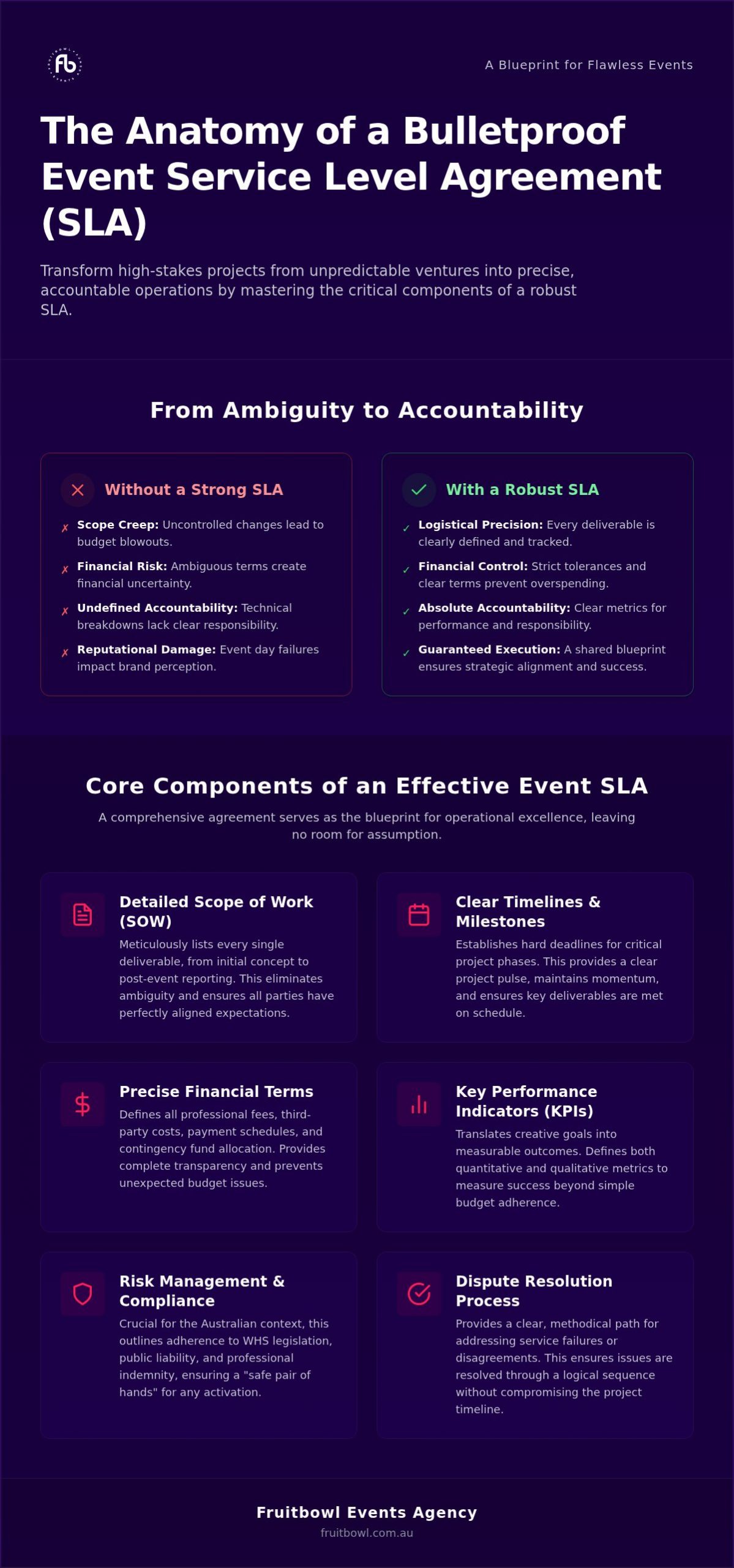
A comprehensive event management service level agreement serves as a blueprint for operational excellence. It must leave no room for assumption. The most effective agreements are built upon a Detailed Scope of Work (SOW) that meticulously lists every deliverable from the initial concept phase to the final post-event report. This includes venue sourcing, talent procurement, and the granular details of on-site execution. When these elements are clearly documented, the risk of misaligned expectations is virtually eliminated, and the path to a successful outcome becomes clear.

Timelines and milestones provide the project’s pulse. Establishing hard deadlines for critical phases, such as the finalisation of floor plans or the lock-in of keynote speakers, ensures that momentum is maintained. This structure allows for a clear division of labour between the client and the agency, preventing the overlap of responsibilities. Defining financial terms with precision is equally vital. This includes professional fees, third-party costs, and the allocation of contingency funds to manage unforeseen variables. Finally, a methodical dispute resolution process provides a clear path for addressing service failures. This ensures that issues are resolved through a logical sequence of escalations without compromising the project’s timeline or the quality of the final delivery.

Strategic Planning and Logistics Coordination

Within the SLA, the agency’s role in budget management and venue procurement must be explicitly defined. A professional event management service level agreement should also define the standards for stakeholder communication and reporting frequency. A professional partner should provide regular updates that maintain transparency across all project layers. Documenting an end-to-end methodology within the agreement ensures that every logistical detail is integrated into the broader strategic vision. For organisations seeking a specialised event management partner, this level of detail is non-negotiable.

Technical Direction and AV Management

High-stakes events often rely on complex technical infrastructure. The SLA should specify requirements for audio-visual, lighting, and staging to ensure technical precision. This includes the management of technical riders for talent, which must be executed without error. Integrating a strategic framework for av management for events into the agreement allows for the seamless coordination of various technical moving parts. This level of oversight ensures that the creative vision is supported by robust, reliable technology, providing a frictionless experience for both organisers and attendees.

Defining Key Performance Indicators (KPIs) and Service Standards

Establishing a robust event management service level agreement requires a shift from qualitative aspirations to quantifiable metrics. While the creative vision defines the event’s atmosphere, the KPIs define its success. We must balance hard data with the attendee experience. Quantitative KPIs might include registration numbers, lead generation for brand activations, or specific social media engagement targets. Conversely, qualitative KPIs focus on attendee sentiment and brand perception, often captured through post-event feedback loops.

When drafting an event management service level agreement, budget adherence is a critical service standard, particularly for government and corporate sectors where financial oversight is stringent. The agreement should specify tolerances for cost variations, such as a requirement for written approval for any expenditure exceeding a set percentage of the initial quote. Response times also form a cornerstone of the agency’s performance. In a high-stakes environment, defining how quickly an agency must acknowledge and address project changes ensures that the timeline remains secure.

Attendee satisfaction serves as the ultimate barometer of agency performance. By integrating post-event surveys into the evaluation process, organisations can measure the agency’s ability to deliver a frictionless experience. These surveys provide a data-driven view of how well the creative and technical elements resonated with the audience, offering a clear path for continuous improvement in future projects.

Measuring Event Success and ROI

Measuring ROI involves aligning these metrics with the primary objectives of the organisation. For those overseeing corporate event management, success might be measured by the depth of stakeholder engagement or the clarity of message delivery. For festivals and public events, the focus shifts to crowd flow, safety compliance, and dwell time. These standards ensure that the agency’s performance is viewed through the lens of the client’s strategic goals.

Talent and Entertainment Procurement Standards

Talent and entertainment procurement requires its own set of service standards. It isn’t enough to simply book a performer; the agency must ensure brand alignment and technical readiness. The SLA should outline the agency’s responsibility for negotiating contracts that protect the client’s interests and managing the complex logistics of high-profile talent. This includes everything from ensuring technical riders are met to coordinating rehearsals. When these standards are met, the talent becomes a seamless extension of the event’s creative narrative rather than a logistical burden.
The Essential Guide to an Event Management Service Level Agreement (SLA)

Best Practices for Negotiating and Managing Your Agency Agreement

Negotiating an effective event management service level agreement requires a sophisticated understanding of both legal protection and operational agility. It isn’t a static document to be filed away once signed. Instead, it serves as a dynamic roadmap that must remain flexible enough to accommodate the evolving nature of high-stakes projects. A rigid contract can become a liability when unforeseen logistical challenges arise. Successful partnerships prioritise regular review cycles, allowing the SLA to function as a living document throughout the planning phase. This iterative approach ensures that the strategic alignment established at the project’s inception remains intact as technical requirements shift.

Transparency in third-party bookings is another critical pillar of a well-managed agreement. Organisations must ensure that the procurement process for venues, catering, and equipment is fair and free from hidden costs. This clarity protects the budget and builds trust between the client and the agency. Clear definitions of “Force Majeure” are also essential within the Australian market. These clauses must now explicitly address health mandates, supply chain disruptions, and other variables that can impact national event delivery.

Effective Stakeholder Liaison

The agreement acts as a vital tool for managing expectations across various internal departments. By standardising reporting formats, the agency provides senior management with the clarity they need to make informed decisions. This methodical approach ensures that the agency functions as a seamless extension of your internal team, reducing friction and ensuring that every stakeholder remains informed. If you’re ready to secure a partner who prioritises this level of clarity, you can contact Fruitbowl to discuss your next activation.

Risk Management and Contingency Planning

A robust event management service level agreement must integrate the risk management plan directly into the formal framework. It isn’t enough to simply identify risks; the agreement should define the consequences of failing to meet critical safety or service standards. This may include the implementation of “Service Credits” or specific penalties for non-compliance with WHS protocols. For those involved in strategic government event planning, this level of detail is essential for maintaining public trust and ensuring the safety of all attendees. This structured approach to risk provides the “safe pair of hands” that complex, high-profile projects demand.

Partnering with Fruitbowl: Our Commitment to Service Excellence

Fruitbowl Events Agency brings over 28 years of industry-leading experience to every project, positioning us as a definitive “safe pair of hands” for high-stakes activations. We understand that a robust event management service level agreement is the foundation of a successful partnership. Our approach is built on a proven end-to-end methodology that seamlessly integrates creative ambition with technical precision. This ensures that your vision isn’t just imagined; it’s executed with surgical accuracy across every logistical layer of the project lifecycle.

Transparency remains at the core of our operations. We provide meticulous budget management and logistics coordination, ensuring that every Australian dollar is accounted for and every milestone is met. Our national service delivery ensures that for your government activation or corporate conference, the standard of excellence remains consistent, no matter its location across the country. This geographical reach, combined with our strategic oversight, provides the security and order required in complex, multi-layered environments. We don’t just manage events; we safeguard your organisation’s reputation through disciplined execution and constant stakeholder liaison.

A Disciplined Approach to Event Production

Our production philosophy is rooted in discipline and technical expertise. We specialise in technical direction and talent procurement, ensuring that every performer and every piece of AV infrastructure aligns with your strategic objectives. Having delivered high-impact corporate and government activations for nearly three decades, we possess the seasoned expertise to navigate any challenge. This disciplined approach extends to our festival production services, where we manage the complex intersection of public safety, creative talent, and large-scale logistics. We prioritise order and clarity, ensuring that every detail is under expert supervision from concept to completion. Our team focuses on the seamless integration of various moving parts, resulting in a frictionless experience for both stakeholders and attendees.

Ready to Organise Your Next High-Impact Event?

Every brand has unique requirements, and we believe your event management service level agreement should reflect that. We invite you to discuss your specific event objectives and how a tailored SLA can protect your organisation while driving exceptional results. Whether you’re planning a national brand activation or a high-level seminar, our team is ready to provide the strategic planning and execution required for success. We take quiet pride in our work, but our focus remains firmly on your objectives. Partner with Fruitbowl Events Agency for your next project and experience the confidence that comes with working with a dedicated, results-oriented partner who is always in control of the narrative.

Securing Your Next High-Stakes Project with Precision

A well-crafted event management service level agreement is the ultimate safeguard for your organisation’s reputation and budget. It’s a strategic roadmap that ensures every technical detail aligns with your creative vision. By defining clear KPIs and maintaining financial transparency, you eliminate the ambiguity that often plagues large-scale activations. Fruitbowl brings over 28 years of industry experience to the table, specialising in high-stakes government and corporate activations across Australia. Our national delivery capability ensures your project receives meticulous oversight regardless of its location.

We invite you to discuss your event requirements with our expert strategists to learn how our end-to-end methodology provides the security your next mission demands. With the right framework established, you can focus on your strategic objectives while we manage the precision of the execution. You don’t have to navigate these complexities alone. Order and clarity are within reach for your next high-impact event.

Frequently Asked Questions

What is the difference between an event contract and an SLA?

An event contract establishes the overarching legal relationship and commercial terms, while an event management service level agreement defines the specific standards of execution and accountability. The contract covers what is being purchased, whereas the SLA details how those services are delivered. It acts as a technical addendum that sets measurable benchmarks for performance, ensuring that both parties have a shared understanding of operational success and service quality.

Can an SLA include creative deliverables, or is it only for logistics?

Creative deliverables are essential components of a robust SLA and shouldn’t be limited to logistics. You can codify creative standards by defining iteration limits, brand alignment checks, and specific milestones for concept approval. This prevents the creative process from drifting into ambiguity and ensures that the agency’s artistic output remains tethered to your strategic objectives and project timelines. It provides a structured framework for innovation within defined operational boundaries.

How do we handle budget changes within an existing service agreement?

Budget variations should be managed through a formal approval process codified within the agreement. Most professional SLAs include a variation clause that requires written authorisation for any expenditure exceeding a pre-agreed percentage of the initial quote. This ensures financial transparency and prevents unauthorised scope creep. By setting these tolerances early, you maintain control over the project’s financial health while allowing the agency the flexibility to respond to shifting technical requirements.

What happens if an event is cancelled due to circumstances outside our control?

If an event is cancelled due to circumstances outside your control, the Force Majeure clause in your agreement dictates the outcome. Modern Australian agreements must address health mandates, extreme weather, and supply chain disruptions. These clauses typically outline the recovery of non-refundable third-party costs and the protocols for rescheduling. A clear framework ensures that financial liability is shared fairly and that the agency’s role in mitigation is explicitly defined.

Should we include social media engagement as a KPI in our event SLA?

Social media engagement is a valid KPI if it directly supports the primary objectives of your brand activation or public event. Including these metrics in your event management service level agreement allows you to measure the digital reach and resonance of the live experience. You should specify which platforms and engagement types are being tracked, ensuring the agency remains accountable for the event’s broader strategic impact beyond the physical venue.

How often should we review the agency’s performance against the SLA?

Performance reviews should occur at critical project milestones rather than just at the event’s conclusion. For high-stakes projects, a monthly or fortnightly review cycle ensures that the agency remains aligned with the agreed standards throughout the planning phase. These regular check-ins allow for proactive adjustments, ensuring that small deviations don’t escalate into significant failures. A final, comprehensive post-event review then captures data for future strategic planning and continuous service improvement.

What are “Service Credits” and how do they apply to event management?

Service Credits are financial deductions applied to the agency’s professional fees if specific service standards aren’t met. In event management, these are often linked to critical failures, such as a breach of safety protocols or a major technical breakdown during a live broadcast. They serve as a mechanism for accountability, providing the client with a remedy for underperformance while incentivising the agency to maintain the highest standards of logistical and technical precision.

Is a national SLA different from one for a single-site event?

A national SLA is more complex as it must account for varying jurisdictional regulations and logistical challenges across different Australian states. It requires clauses that address local compliance, WHS standards, and consistent service delivery across multiple sites. While a single-site agreement focuses on the specifics of one venue, a national framework ensures that the agency provides a uniform standard of excellence and stakeholder liaison regardless of the event’s location.

Could a single undefined clause in your event management service level agreement be the catalyst for a significant event day failure? In the high-stakes environment of Australian corporate events and government activations, the gap between a creative vision and technical execution is often wider than it appears. You’ve likely experienced the unease of ambiguous agency deliverables or the stress of a project where accountability for a technical breakdown remains undefined. It’s a common challenge, but it isn’t an inevitable one.

This guide provides the framework you need to ensure your next project is delivered with logistical precision, absolute accountability, and strategic alignment. We’ll examine how to set predictable delivery timelines, mitigate financial risks, and translate intangible creative concepts into measurable technical outcomes. By mastering these complexities, you can transform your SLA from a dense legal requirement into a powerful instrument for project success. We will explore the essential components of a robust agreement, from defining key performance indicators to establishing clear protocols for stakeholder communication and risk management.

Key Takeaways

  • Understand how a robust event management service level agreement transforms high-stakes projects from unpredictable ventures into precise, accountable operations.
  • Identify the essential elements of a comprehensive Scope of Work to eliminate ambiguity and ensure every deliverable is accounted for from the outset.
  • Learn to define both quantitative and qualitative performance indicators that measure success beyond simple budget adherence.
  • Discover how to establish strict financial tolerances and milestone-driven timelines to prevent budget blowouts and reputational damage.
  • Master the art of managing the agreement as a living document to maintain alignment between creative ambition and technical execution throughout the project lifecycle.

Why an Event Management Service Level Agreement is Critical for High-Stakes Projects

An event management service level agreement is far more than an administrative formality; it is the structural backbone of any high-stakes project. In its most effective form, this agreement acts as a formal contract that defines the expected standards of service, specific deliverables, and clear metrics for accountability. For corporate entities and government departments, the SLA serves as a vital safeguard against the inherent volatility of live events. By codifying expectations, it mitigates both financial and reputational risk, ensuring that every stakeholder understands exactly what is being promised and how success will be measured.

A well-structured agreement acts as a definitive barrier against scope creep. Without these defined parameters, projects often drift, leading to budget blowouts and strained professional relationships. Transparency is the primary objective here. When the agency and the client operate from a shared document that outlines every detail from technical direction to talent procurement, it creates a grounded sense of security. This allows decision-makers to focus on strategic outcomes, knowing the logistical foundations are under expert supervision. It’s about moving away from “best efforts” towards a guaranteed standard of execution.

Bridging Creative Vision and Logistical Precision

Creative ambition is the heart of brand activations and festivals, but without logistical precision, even the most inspired ideas can falter. Standard commercial contracts often lack the nuance required to manage the iterative nature of creative work. A robust event management service level agreement provides the necessary boundaries, allowing for creative exploration while maintaining strict adherence to the project timeline. It ensures that the agency remains a reliable partner through every phase of the event lifecycle, from strategic planning to on-site execution. This balance ensures that the creative “wow factor” never comes at the expense of operational integrity or project deadlines.

The Australian Context: Compliance and Risk

Operating within the Australian market requires a deep understanding of local compliance and safety standards. A sophisticated SLA must align with Australian risk management protocols and WHS legislation to protect all parties involved. This is particularly critical for national event delivery where stakeholder liaison across different jurisdictions is required. The framework should explicitly address public liability and professional indemnity, ensuring the agency acts as a “safe pair of hands” for complex government activations. By integrating these compliance requirements into the service framework, organisations can move forward with the confidence that their project meets all legal and safety obligations while maintaining a steady, results-oriented pace.

Core Components of a Robust Event Management SLA

A comprehensive event management service level agreement serves as a blueprint for operational excellence. It must leave no room for assumption. The most effective agreements are built upon a Detailed Scope of Work (SOW) that meticulously lists every deliverable from the initial concept phase to the final post-event report. This includes venue sourcing, talent procurement, and the granular details of on-site execution. When these elements are clearly documented, the risk of misaligned expectations is virtually eliminated, and the path to a successful outcome becomes clear.

Timelines and milestones provide the project’s pulse. Establishing hard deadlines for critical phases, such as the finalisation of floor plans or the lock-in of keynote speakers, ensures that momentum is maintained. This structure allows for a clear division of labour between the client and the agency, preventing the overlap of responsibilities. Defining financial terms with precision is equally vital. This includes professional fees, third-party costs, and the allocation of contingency funds to manage unforeseen variables. Finally, a methodical dispute resolution process provides a clear path for addressing service failures. This ensures that issues are resolved through a logical sequence of escalations without compromising the project’s timeline or the quality of the final delivery.

Strategic Planning and Logistics Coordination

Within the SLA, the agency’s role in budget management and venue procurement must be explicitly defined. A professional event management service level agreement should also define the standards for stakeholder communication and reporting frequency. A professional partner should provide regular updates that maintain transparency across all project layers. Documenting an end-to-end methodology within the agreement ensures that every logistical detail is integrated into the broader strategic vision. For organisations seeking a specialised event management partner, this level of detail is non-negotiable.

Technical Direction and AV Management

High-stakes events often rely on complex technical infrastructure. The SLA should specify requirements for audio-visual, lighting, and staging to ensure technical precision. This includes the management of technical riders for talent, which must be executed without error. Integrating a strategic framework for av management for events into the agreement allows for the seamless coordination of various technical moving parts. This level of oversight ensures that the creative vision is supported by robust, reliable technology, providing a frictionless experience for both organisers and attendees.

Defining Key Performance Indicators (KPIs) and Service Standards

Establishing a robust event management service level agreement requires a shift from qualitative aspirations to quantifiable metrics. While the creative vision defines the event’s atmosphere, the KPIs define its success. We must balance hard data with the attendee experience. Quantitative KPIs might include registration numbers, lead generation for brand activations, or specific social media engagement targets. Conversely, qualitative KPIs focus on attendee sentiment and brand perception, often captured through post-event feedback loops.

When drafting an event management service level agreement, budget adherence is a critical service standard, particularly for government and corporate sectors where financial oversight is stringent. The agreement should specify tolerances for cost variations, such as a requirement for written approval for any expenditure exceeding a set percentage of the initial quote. Response times also form a cornerstone of the agency’s performance. In a high-stakes environment, defining how quickly an agency must acknowledge and address project changes ensures that the timeline remains secure.

Attendee satisfaction serves as the ultimate barometer of agency performance. By integrating post-event surveys into the evaluation process, organisations can measure the agency’s ability to deliver a frictionless experience. These surveys provide a data-driven view of how well the creative and technical elements resonated with the audience, offering a clear path for continuous improvement in future projects.

Measuring Event Success and ROI

Measuring ROI involves aligning these metrics with the primary objectives of the organisation. For those overseeing corporate event management, success might be measured by the depth of stakeholder engagement or the clarity of message delivery. For festivals and public events, the focus shifts to crowd flow, safety compliance, and dwell time. These standards ensure that the agency’s performance is viewed through the lens of the client’s strategic goals.

Talent and Entertainment Procurement Standards

Talent and entertainment procurement requires its own set of service standards. It isn’t enough to simply book a performer; the agency must ensure brand alignment and technical readiness. The SLA should outline the agency’s responsibility for negotiating contracts that protect the client’s interests and managing the complex logistics of high-profile talent. This includes everything from ensuring technical riders are met to coordinating rehearsals. When these standards are met, the talent becomes a seamless extension of the event’s creative narrative rather than a logistical burden.

Best Practices for Negotiating and Managing Your Agency Agreement

Negotiating an effective event management service level agreement requires a sophisticated understanding of both legal protection and operational agility. It isn’t a static document to be filed away once signed. Instead, it serves as a dynamic roadmap that must remain flexible enough to accommodate the evolving nature of high-stakes projects. A rigid contract can become a liability when unforeseen logistical challenges arise. Successful partnerships prioritise regular review cycles, allowing the SLA to function as a living document throughout the planning phase. This iterative approach ensures that the strategic alignment established at the project’s inception remains intact as technical requirements shift.

Transparency in third-party bookings is another critical pillar of a well-managed agreement. Organisations must ensure that the procurement process for venues, catering, and equipment is fair and free from hidden costs. This clarity protects the budget and builds trust between the client and the agency. Clear definitions of “Force Majeure” are also essential within the Australian market. These clauses must now explicitly address health mandates, supply chain disruptions, and other variables that can impact national event delivery.

Effective Stakeholder Liaison

The agreement acts as a vital tool for managing expectations across various internal departments. By standardising reporting formats, the agency provides senior management with the clarity they need to make informed decisions. This methodical approach ensures that the agency functions as a seamless extension of your internal team, reducing friction and ensuring that every stakeholder remains informed. If you’re ready to secure a partner who prioritises this level of clarity, you can contact Fruitbowl to discuss your next activation.

Risk Management and Contingency Planning

A robust event management service level agreement must integrate the risk management plan directly into the formal framework. It isn’t enough to simply identify risks; the agreement should define the consequences of failing to meet critical safety or service standards. This may include the implementation of “Service Credits” or specific penalties for non-compliance with WHS protocols. For those involved in strategic government event planning, this level of detail is essential for maintaining public trust and ensuring the safety of all attendees. This structured approach to risk provides the “safe pair of hands” that complex, high-profile projects demand.

Partnering with Fruitbowl: Our Commitment to Service Excellence

Fruitbowl Events Agency brings over 28 years of industry-leading experience to every project, positioning us as a definitive “safe pair of hands” for high-stakes activations. We understand that a robust event management service level agreement is the foundation of a successful partnership. Our approach is built on a proven end-to-end methodology that seamlessly integrates creative ambition with technical precision. This ensures that your vision isn’t just imagined; it’s executed with surgical accuracy across every logistical layer of the project lifecycle.

Transparency remains at the core of our operations. We provide meticulous budget management and logistics coordination, ensuring that every Australian dollar is accounted for and every milestone is met. Our national service delivery ensures that for your government activation or corporate conference, the standard of excellence remains consistent, no matter its location across the country. This geographical reach, combined with our strategic oversight, provides the security and order required in complex, multi-layered environments. We don’t just manage events; we safeguard your organisation’s reputation through disciplined execution and constant stakeholder liaison.

A Disciplined Approach to Event Production

Our production philosophy is rooted in discipline and technical expertise. We specialise in technical direction and talent procurement, ensuring that every performer and every piece of AV infrastructure aligns with your strategic objectives. Having delivered high-impact corporate and government activations for nearly three decades, we possess the seasoned expertise to navigate any challenge. This disciplined approach extends to our festival production services, where we manage the complex intersection of public safety, creative talent, and large-scale logistics. We prioritise order and clarity, ensuring that every detail is under expert supervision from concept to completion. Our team focuses on the seamless integration of various moving parts, resulting in a frictionless experience for both stakeholders and attendees.

Ready to Organise Your Next High-Impact Event?

Every brand has unique requirements, and we believe your event management service level agreement should reflect that. We invite you to discuss your specific event objectives and how a tailored SLA can protect your organisation while driving exceptional results. Whether you’re planning a national brand activation or a high-level seminar, our team is ready to provide the strategic planning and execution required for success. We take quiet pride in our work, but our focus remains firmly on your objectives. Partner with Fruitbowl Events Agency for your next project and experience the confidence that comes with working with a dedicated, results-oriented partner who is always in control of the narrative.

Securing Your Next High-Stakes Project with Precision

A well-crafted event management service level agreement is the ultimate safeguard for your organisation’s reputation and budget. It’s a strategic roadmap that ensures every technical detail aligns with your creative vision. By defining clear KPIs and maintaining financial transparency, you eliminate the ambiguity that often plagues large-scale activations. Fruitbowl brings over 28 years of industry experience to the table, specialising in high-stakes government and corporate activations across Australia. Our national delivery capability ensures your project receives meticulous oversight regardless of its location.

We invite you to discuss your event requirements with our expert strategists to learn how our end-to-end methodology provides the security your next mission demands. With the right framework established, you can focus on your strategic objectives while we manage the precision of the execution. You don’t have to navigate these complexities alone. Order and clarity are within reach for your next high-impact event.

Frequently Asked Questions

What is the difference between an event contract and an SLA?

An event contract establishes the overarching legal relationship and commercial terms, while an event management service level agreement defines the specific standards of execution and accountability. The contract covers what is being purchased, whereas the SLA details how those services are delivered. It acts as a technical addendum that sets measurable benchmarks for performance, ensuring that both parties have a shared understanding of operational success and service quality.

Can an SLA include creative deliverables, or is it only for logistics?

Creative deliverables are essential components of a robust SLA and shouldn’t be limited to logistics. You can codify creative standards by defining iteration limits, brand alignment checks, and specific milestones for concept approval. This prevents the creative process from drifting into ambiguity and ensures that the agency’s artistic output remains tethered to your strategic objectives and project timelines. It provides a structured framework for innovation within defined operational boundaries.

How do we handle budget changes within an existing service agreement?

Budget variations should be managed through a formal approval process codified within the agreement. Most professional SLAs include a variation clause that requires written authorisation for any expenditure exceeding a pre-agreed percentage of the initial quote. This ensures financial transparency and prevents unauthorised scope creep. By setting these tolerances early, you maintain control over the project’s financial health while allowing the agency the flexibility to respond to shifting technical requirements.

What happens if an event is cancelled due to circumstances outside our control?

If an event is cancelled due to circumstances outside your control, the Force Majeure clause in your agreement dictates the outcome. Modern Australian agreements must address health mandates, extreme weather, and supply chain disruptions. These clauses typically outline the recovery of non-refundable third-party costs and the protocols for rescheduling. A clear framework ensures that financial liability is shared fairly and that the agency’s role in mitigation is explicitly defined.

Should we include social media engagement as a KPI in our event SLA?

Social media engagement is a valid KPI if it directly supports the primary objectives of your brand activation or public event. Including these metrics in your event management service level agreement allows you to measure the digital reach and resonance of the live experience. You should specify which platforms and engagement types are being tracked, ensuring the agency remains accountable for the event’s broader strategic impact beyond the physical venue.

How often should we review the agency’s performance against the SLA?

Performance reviews should occur at critical project milestones rather than just at the event’s conclusion. For high-stakes projects, a monthly or fortnightly review cycle ensures that the agency remains aligned with the agreed standards throughout the planning phase. These regular check-ins allow for proactive adjustments, ensuring that small deviations don’t escalate into significant failures. A final, comprehensive post-event review then captures data for future strategic planning and continuous service improvement.

What are “Service Credits” and how do they apply to event management?

Service Credits are financial deductions applied to the agency’s professional fees if specific service standards aren’t met. In event management, these are often linked to critical failures, such as a breach of safety protocols or a major technical breakdown during a live broadcast. They serve as a mechanism for accountability, providing the client with a remedy for underperformance while incentivising the agency to maintain the highest standards of logistical and technical precision.

Is a national SLA different from one for a single-site event?

A national SLA is more complex as it must account for varying jurisdictional regulations and logistical challenges across different Australian states. It requires clauses that address local compliance, WHS standards, and consistent service delivery across multiple sites. While a single-site agreement focuses on the specifics of one venue, a national framework ensures that the agency provides a uniform standard of excellence and stakeholder liaison regardless of the event’s location.

Back to Articles
Request A Quote

Make an
Enquiry

Untitled design

What Makes Us Different?

True end-to-end solution so you can hand off to us, focus on your priorities and enjoy the event without any stress

Unmatched industry expertise looking after diverse range of high-profile events, cultural festivals & activations

Meticulous attention to every detail and precise execution of events with our streamlined processes

Tailored solutions with bespoke strategies to ensure we align with your brand and objectives

Make an Enquiry

"*" indicates required fields

This field is for validation purposes and should be left unchanged.

"*" indicates required fields

This field is for validation purposes and should be left unchanged.