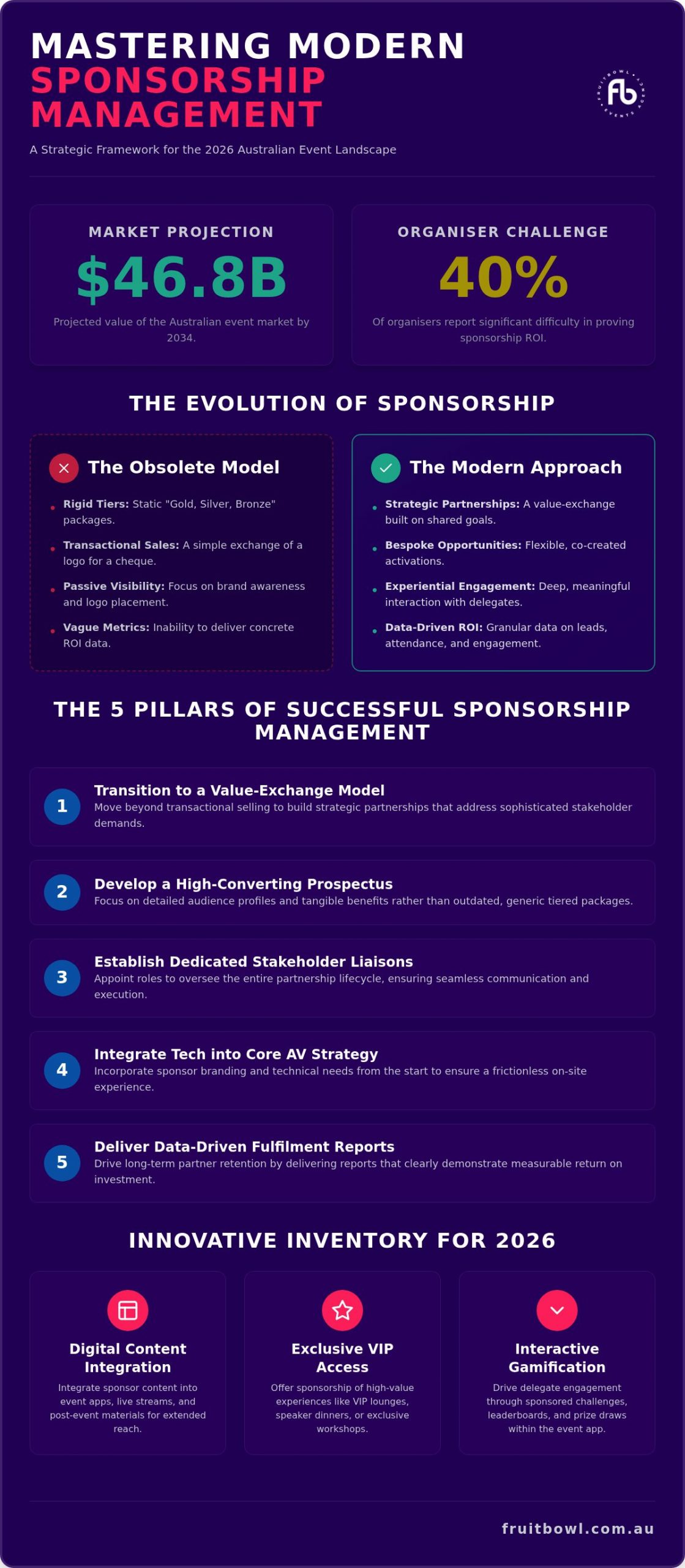
While the Australian event market is projected to reach $46.8 billion by 2034, 40% of event organisers still report significant difficulty in proving the ROI of their activations. By 2026, the traditional gold, silver, and bronze tiers have become relics of a simpler time that no longer satisfy sophisticated stakeholders. Modern conference sponsorship management requires a decisive shift from a transactional sales mindset to a high-stakes production model. In this environment, logistical precision and technical excellence are just as vital to success as the initial pitch.
It’s frustrating to watch high-value partners churn because of on-site friction or an inability to prove value once the doors close. You need a reliable system that transforms these complex moving parts into a seamless, professional experience for every brand involved. This guide provides a strategic framework designed to help you master modern sponsorship complexities, drive sustainable revenue, and secure long-term partnerships. We’ll explore how to build a streamlined prospectus, execute flawless technical activations, and deliver the concrete ROI that your stakeholders now demand as a standard requirement.
Key Takeaways
- Transition from transactional selling to a strategic value-exchange model that addresses the sophisticated demands of the 2026 event landscape.
- Develop a high-converting prospectus focused on detailed audience profiles and tangible benefits rather than outdated, generic tiered packages.
- Master effective conference sponsorship management by establishing dedicated stakeholder liaison roles to oversee the entire partnership lifecycle.
- Integrate sponsor branding and technical requirements into your core AV strategy to ensure a frictionless on-site experience for all partners.
- Drive long-term partner retention by delivering data-driven fulfillment reports that clearly demonstrate measurable return on investment.
The Evolution of Conference Sponsorship Management in Australia
Modern conference sponsorship management has moved far beyond the simple exchange of a logo for a cheque. In the current Australian market, sponsors view their investment as a strategic value exchange rather than a charitable contribution or a generic advertising buy. The traditional “Gold, Silver, Bronze” tiered models are becoming obsolete. These rigid structures often fail to offer the bespoke flexibility that sophisticated brands require to meet their specific objectives. Instead, we see a move toward “experiential sponsorship,” where partners prioritise deep, meaningful engagement with delegates over passive visibility. Professional management is critical here. It ensures that these activations enhance the attendee experience rather than cluttering it, protecting the long-term integrity of the conference brand.
From Transactional to Transformational Partnerships
A true strategic partnership is built on shared values and mutual outcomes. Unlike a standard sponsor, a transformational partner is integrated into the event’s narrative. Identifying brand alignment is a prerequisite for any successful outreach. It’s not just about who has the budget; it’s about whose brand story complements the event’s mission. A skilled conference management professional acts as the bridge in this process. They facilitate connections that feel organic to the audience, ensuring that every touchpoint follows established commercial sponsorship principles to deliver genuine utility to the delegates. This approach moves the relationship from a one-off transaction to a multi-year alliance.
The Rising Importance of Data and ROI
By 2026, the expectation for transparency has reached an all-time high. Sponsors don’t accept “brand awareness” as a sufficient metric for success. They demand granular data regarding lead generation, session attendance, and digital engagement levels. The focus has shifted from passive presence to active brand activation, where the sponsor provides a solution or an experience that solves a delegate’s problem. This requires a technical infrastructure capable of tracking interactions without being intrusive or compromising privacy. Sponsorship ROI is the precise intersection where measurable financial return meets strategic brand positioning within a target market. Successful organisers provide this clarity through rigorous post-event analysis and real-time reporting.
Designing a Value-Driven Sponsorship Prospectus
Effective conference sponsorship management begins with a document that prioritises clarity over clutter. A high-converting prospectus must define the event’s vision, provide a detailed audience profile, and outline tangible benefits that align with corporate KPIs. While tiers offer a structured starting point, they shouldn’t be a cage. Including a “Bespoke Opportunity” clause allows partners to propose creative activations that you might not have considered, fostering a sense of co-creation. This flexibility is often the deciding factor for high-value brands looking for a unique market presence.
Pricing must reflect current market value while accounting for rising production costs. In 2026, transparency is paramount. Sponsors expect to see where their investment goes and how it translates into delegate engagement. Setting realistic figures ensures that the partnership remains sustainable for both the organiser and the sponsor. It’s about building a foundation of trust before the first contract is even signed.
Crafting the Narrative for Your Conference
Your prospectus is a pitch for a partnership, not a price list. Position your event as a non-negotiable “must-attend” for the sponsor’s specific demographic. Use data from previous years and direct testimonials to build immediate trust. The tone should remain composed and elite, mirroring the professional register of the industry you serve. If you’re looking to refine your approach to partner engagement, exploring how a professional event strategist can help may be your next logical step.
Innovative Sponsorship Inventory for 2026
Static logos on lanyards are no longer enough to satisfy a modern marketing budget. Modern inventory includes digital content integration, exclusive VIP lounge access, and interactive gamification within the event app. For those dealing with government or large-scale corporate grants, ensure your offerings align with conference funding and sponsorship regulations to maintain compliance and professional integrity. These details matter when managing high-stakes stakeholder expectations.
Integrating comprehensive corporate event management services ensures these creative ideas are logistically feasible before they reach the sponsor’s desk. This prevents the common pitfall of over-promising and under-delivering on technical requirements. When logistics and vision are aligned, the prospectus becomes a powerful tool for securing long-term brand commitment.
The Fruitbowl Methodology: Management vs. Mere Sales
In the specialised field of conference sponsorship management, the moment a contract is signed marks the beginning, not the end, of the process. While many agencies focus solely on the revenue-generating sales cycle, true success lies in the meticulous execution of promised deliverables. A professional agency acts as a “safe pair of hands,” providing a buffer between the organiser’s vision and the sponsor’s commercial requirements. This management lifecycle involves a dedicated stakeholder liaison who ensures that every brand activation is logistically sound and strategically aligned with the event’s core objectives.
Streamlining the administrative burden is a hallmark of an expert approach. Handling contracts, invoicing, and asset collection requires a methodical system to prevent the organiser from being buried in paperwork. By following the four key steps to getting sponsorships, organisers can secure the initial funding; however, it’s the subsequent management that preserves the relationship for future years. This end-to-end oversight ensures that no detail is overlooked, from the initial pitch to the final post-event debrief.
The Logistics of Stakeholder Liaison
Managing the delicate balance between ambitious sponsor demands and rigid event constraints is a daily reality. We utilise a comprehensive Sponsor Manual to provide absolute clarity on technical specifications, deadlines, and on-site protocols. This document serves as a navigational anchor, reducing friction and setting clear boundaries. When late asset submissions threaten the production schedule, a seasoned manager knows how to pivot without compromising the overall quality; for those requiring urgent, high-quality collateral, London City Print offers the rapid turnaround essential for maintaining professional standards. It’s about maintaining logistical precision while remaining flexible enough to accommodate the creative needs of high-value partners.
Protecting the integrity of the conference floor requires a disciplined eye for detail. Every activation must comply with national safety standards and insurance requirements to mitigate potential liabilities. Beyond physical safety, we prioritise the aesthetic standards of the environment, ensuring that sponsor booths and digital displays enhance the venue’s professional atmosphere. We also manage the risk of competitor friction by strategically placing partners to avoid direct conflict. This level of oversight ensures that the conference remains a neutral, high-quality space for all participants, reinforcing the organiser’s reputation for excellence.
Technical Execution and On-Site Sponsor Logistics
The success of conference sponsorship management is often determined in the high-pressure hours before the doors open. While the sales phase secures the budget, technical execution secures the brand’s reputation. Seamlessly integrating sponsor assets into your AV management for events plan is non-negotiable. This involves more than just displaying a logo; it requires a deep understanding of each sponsor’s technical rider. Whether they are hosting a keynote or a breakout session, their technical requirements must be treated with the same level of precision as the main stage program.
Move-in and move-out logistics are frequently a source of friction for exhibitors. A well-managed event provides a clear, staggered schedule that prevents loading dock congestion and allows for efficient setup. Having a dedicated technical coordinator on-site provides high-value partners with a direct point of contact for troubleshooting. This presence ensures that any issues with digital displays, internet connectivity, or power distribution are resolved before they impact the delegate experience. It’s this level of oversight that provides the “safe pair of hands” sponsors expect.
AV and Technical Direction for Sponsors
Precision in technical direction is what separates a professional activation from a generic booth. We ensure that brand colours are accurately calibrated across all stage lighting and digital displays to maintain visual consistency. Audio requirements for sponsor presentations are tested rigorously to prevent glitches during live sessions. A mandatory rehearsal schedule for all sponsored content allows speakers to familiarise themselves with the stage environment and AV equipment. This methodical approach ensures that the sponsor’s message is delivered with absolute clarity and professionalism.
Managing the Exhibition Floor
The exhibition space should be a curated environment that facilitates natural engagement. We optimise floor plans to ensure a logical flow of traffic, maximising visibility for every partner regardless of their location in the room. Coordinating third-party suppliers, such as booth builders and furniture hire companies, under a single management umbrella reduces complexity for the organiser. This ensures the entire space adheres to a high-end corporate event management standard that reflects well on the host brand.
If you require assistance in aligning your technical vision with partner expectations, you can enquire about our end-to-end technical direction services to ensure a flawless execution on the day.
Securing Long-Term Partnerships: Reporting and ROI
Effective conference sponsorship management concludes with a strategic evaluation that justifies the partner’s investment. The post-event debrief shouldn’t be a cursory “thank you” email. It’s a high-stakes meeting where data meets narrative. While 40% of event organisers in 2026 still report difficulty in proving ROI, a methodical approach to reporting can bridge this gap. Organisers must analyse engagement metrics to provide actionable insights for the sponsor’s next marketing campaign. This process demonstrates that you understand their business objectives, paving the way for multi-year renewals and early-bird commitments. Since events represent up to 31.6% of total marketing budget allocations, sponsors require this level of accountability to protect their spend.
The goal is to move the conversation from “what happened” to “what we achieved.” This requires a steady, results-oriented approach that prioritises clarity over hyperbolic claims. When you provide a clear, documented path from the initial investment to the final outcome, you position yourself as a reliable partner. This sense of security is what encourages brands to commit to larger, more complex activations in future years. It’s the difference between a one-off transaction and a sustainable revenue stream that grows with the event.
The Fulfillment Report: Proving Value
A comprehensive fulfillment report serves as a visual and data-driven archive of the event’s success. You should document every delivered benefit with professional photography, lead generation statistics, and direct delegate feedback. An honest appraisal is essential here. Addressing what worked and identifying areas for improvement builds trust and shows a commitment to excellence. This level of transparency is far superior to automated, software-generated metrics that lack strategic context. With reports indicating that 94% of marketers feel their companies aren’t successful in converting event leads, your report should offer specific advice on how to bridge this conversion gap. A thorough fulfillment report is the most effective sales tool for the following year.
Nurturing the Relationship Year-Round
Maintaining momentum during the “off-season” prevents the relationship from becoming purely transactional. You can use conference content, such as recorded sessions or whitepapers, to provide year-round value to your partners. A professional agency ensures continuity between annual events, acting as the custodian of the sponsor’s brand history. This consistent engagement makes the renewal process a natural progression rather than a cold start. By positioning the conference as core business infrastructure rather than a one-off campaign, you align with the long-term growth objectives of your most valued partners. Secure, multi-year partnerships are the result of meticulous planning and a steady, results-oriented approach to stakeholder management.
Advancing Your Sponsorship Strategy for 2026 and Beyond
Success in modern conference sponsorship management requires a decisive departure from outdated, rigid models. You’ve seen that the path to high-value partnerships lies in bespoke value propositions and flawless technical execution. By prioritising the stakeholder experience from the initial prospectus through to the final fulfillment report, you build a foundation of trust that ensures multi-year renewals. It’s about being more than just an organiser; you’re a strategic facilitator for your partners’ brand growth.
Navigating these complexities requires a partner with deep industry knowledge and a methodical approach. With over 28 years of logistical and technical expertise, Fruitbowl Events provides a national “safe pair of hands” for your most ambitious projects. We offer end-to-end management that spans prospectus design to post-event reporting, ensuring every detail remains under expert supervision. Consult the experts at Fruitbowl Events to elevate your conference sponsorship strategy. We look forward to helping you deliver a high-impact experience that drives measurable results for every stakeholder.
Frequently Asked Questions
What is the most effective way to price conference sponsorship tiers in Australia?
Pricing should be determined by a combination of current market demand and the actual costs of delivering each benefit. It’s vital to calculate the hard costs of floor space, technical requirements, and administrative time before setting your rates. Researching similar national and state-level events provides a baseline for competitiveness. A sustainable margin must be maintained to ensure you can deliver high-quality activations without compromising the overall event budget or professional standards.
How do I handle a sponsor that wants to deviate from the standard prospectus?
Encourage bespoke activations through a specific “creative opportunity” clause in your prospectus. When a partner suggests a deviation, evaluate it against the event’s core vision and logistical constraints. If the idea enhances the delegate experience, it’s often worth the extra coordination. Professional conference sponsorship management involves facilitating these unique requests while ensuring they don’t compromise the safety or aesthetic standards of the exhibition floor or the main stage.
What technical AV requirements should I include in my sponsorship packages?
Include precise specifications for digital display resolutions, audio input types, and internet bandwidth requirements. You should also specify the lighting capabilities for branded stages and the availability of dedicated technical support for sponsored sessions. Providing these details upfront prevents last-minute glitches and ensures brand colours are represented accurately across all platforms. It’s helpful to list these in a technical rider format to maintain absolute clarity between your production team and the sponsor.
How far in advance should I start the sponsorship recruitment process?
Start the recruitment process at least nine to twelve months before the event date. Large corporate and government organisations often set their marketing budgets well in advance, so early engagement is critical for securing high-value deals. This lead time also allows for the design of bespoke activations and the seamless integration of sponsor assets into the overall production schedule. Early-bird commitments can provide the necessary cash flow for initial event deposits and planning.
What are the most common pitfalls in conference sponsorship management?
The most frequent mistakes include over-promising on lead generation and failing to manage technical expectations effectively. Many organisers focus too heavily on the initial sale and neglect the vital post-event reporting phase. High sponsor churn rates often stem from logistical friction during on-site activations or a lack of clear communication regarding deadlines. Avoiding these issues requires a disciplined stakeholder liaison who prioritises logistical precision and transparent reporting over simple, one-off revenue targets.
How can I measure the ROI of a conference sponsorship for my partners?
Use a combination of quantitative data and qualitative feedback to prove value. Track lead conversion rates, session attendance, and digital engagement levels through the event app. Since 40% of organisers report difficulty proving ROI in 2026, providing a detailed fulfillment report with these metrics is a significant competitive advantage. You should also include delegate testimonials and photographic evidence of brand activations to create a comprehensive narrative of success for the sponsor’s stakeholders.
Is it better to manage sponsorship in-house or hire a professional agency?
Hiring a professional agency provides a “safe pair of hands” for complex stakeholder liaison and technical direction. While in-house teams understand the brand, they often lack the 28 years of industry experience required to navigate high-stakes logistical challenges. An agency manages the entire lifecycle, from prospectus design to post-event reporting, which reduces the administrative burden on your internal staff. This expertise is particularly valuable for national-scale corporate and government activations.
What should be included in a sponsor on-site logistics manual?
A comprehensive manual must include the loading dock schedule, technical specifications, and safety protocols. It should clearly outline the move-in and move-out times to prevent congestion and ensure a smooth setup process. You also need to provide contact details for the on-site technical coordinator and a floor plan showing the exact location of each booth. Including these details ensures a frictionless experience for exhibitors and protects the professional integrity of the exhibition space.
OUR BLOG
Event Insights & Expertise
Our blog is your go-to resource for all things events. From expert insights and the latest industry trends to practical planning tips, we share everything you need to deliver standout experiences.
Contact Us