Presenting an Event Proposal to Stakeholders: A Strategic Framework for 2026

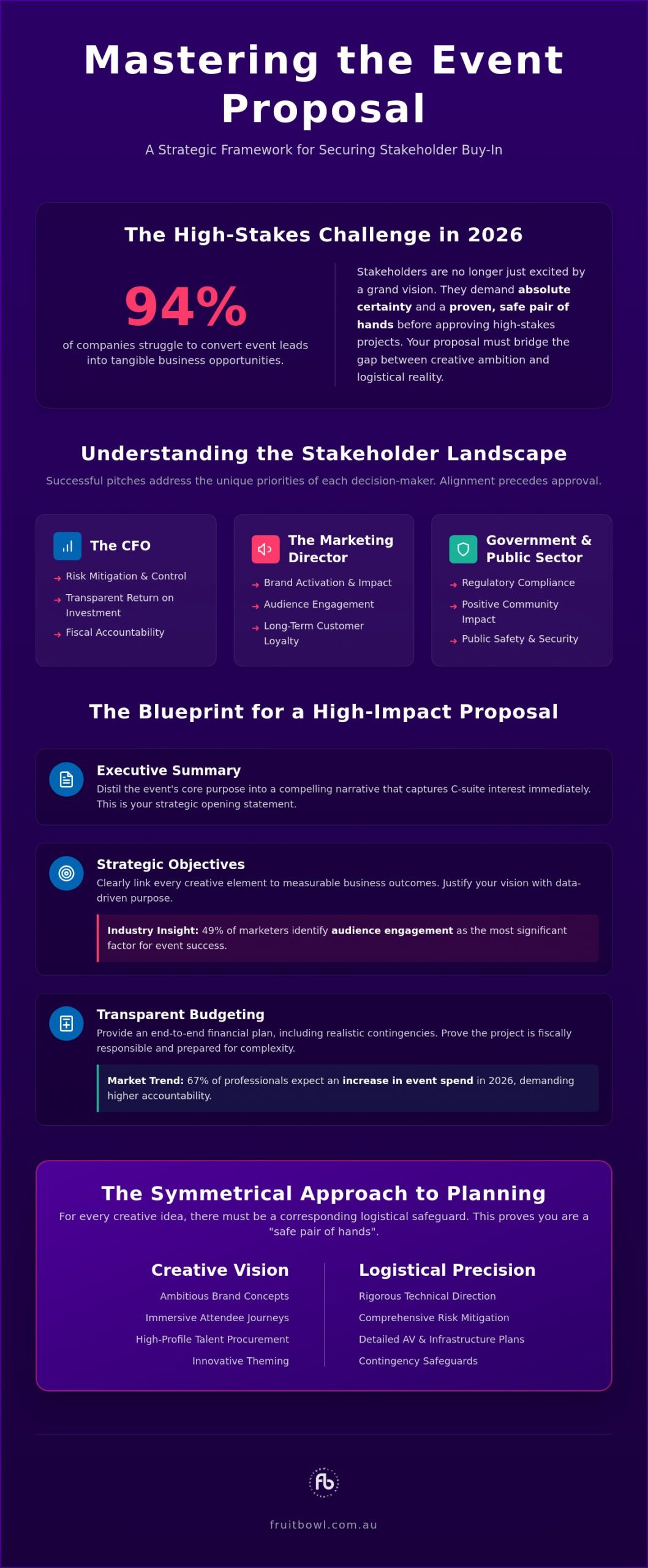
In an era where 94% of companies struggle to convert event leads into tangible opportunities, your next pitch cannot afford to be just another slide deck. You’ve likely felt the pressure of a boardroom’s gaze, knowing that a single technical glitch or a vague ROI figure could derail months of creative planning. It’s a common frustration; the gap between a visionary brand activation and the rigid requirements of corporate objectives often feels insurmountable when you’re standing at the front of the room.

When you’re presenting an event proposal to stakeholders in 2026, the goal isn’t just to excite them with a grand vision. You must provide the absolute certainty that their investment is in a safe pair of hands. This article will help you master the art of securing stakeholder buy-in by delivering a proposal that perfectly balances creative ambition with logistical precision. We’ll explore a strategic framework that organises complex requirements into a clear, results-oriented roadmap designed to eliminate risk and ensure your event aligns seamlessly with broader commercial goals.

Key Takeaways

  • Learn how to identify and address the specific priorities of diverse decision-makers, from procurement to the C-suite, ensuring strategic alignment precedes the final pitch.
  • Master the professional technique of presenting an event proposal to stakeholders by using data-driven insights to provide logical justification for creative and ambitious concepts.
  • Discover why integrating technical logistics and audio-visual requirements into your initial framework is essential for building stakeholder confidence and mitigating operational risk.
  • Understand how to structure high-impact components, such as the executive summary and strategic objectives, to clearly link every event element to measurable business outcomes.
  • Explore the advantages of partnering with seasoned experts to provide a “safe pair of hands” that ensures logistical precision and a frictionless path to project approval.

Understanding the Stakeholder Landscape: Why Alignment Precedes Approval

Successful event planning starts long before the first slide is shown. An effective proposal functions as a strategic bridge, connecting high-level brand aspirations with the granular realities of execution. When you are presenting an event proposal to stakeholders, you aren’t just selling an idea; you’re proposing a partnership that must withstand rigorous corporate scrutiny. Achieving this requires a deep dive into Understanding the Stakeholder Landscape to identify the diverse motivations of those holding the purse strings.

Before the formal presentation, seasoned professionals engage in a “pre-pitch” phase. This involves gathering insights from various departments to ensure the concept aligns with the broader national corporate strategy. It’s about uncovering the unspoken requirements that could make or break an approval. By the time you enter the boardroom, the proposal should feel like the logical conclusion to a series of collaborative discussions rather than a surprise reveal.

Mapping Stakeholder Motivations

Every decision-maker views your proposal through a different lens. The CFO prioritises risk mitigation and a transparent return on investment; they need to see that every dollar spent is a dollar working toward a commercial objective. Conversely, the Marketing Director focuses on brand activation, attendee engagement, and the long-term impact on customer loyalty. For those managing government activations, the focus shifts toward compliance, community impact, and public safety. Addressing these varied needs within a single framework demonstrates a level of strategic oversight that immediately separates an amateur pitch from an expert one.

The Role of Reassurance in the Proposal Phase

In high-stakes environments, stakeholders rarely choose the flashiest concept if it carries a high risk of failure. They prioritise a “safe pair of hands” above all else. Establishing this trust requires a meticulous approach that balances creative vision with logistical precision. With over 28 years of industry experience, our methodology relies on proving that we can manage the unexpected. We use a symmetrical approach to planning: for every creative flourish, there is a corresponding logistical safeguard; for every ambitious piece of talent procurement, there is a rigorous technical direction plan. This level of detail provides the psychological security stakeholders need to move from “maybe” to “approved”.

Essential Components of a High-Impact Event Proposal

A successful pitch requires more than a collection of creative ideas; it demands a structured blueprint that proves your team is a safe pair of hands. When presenting an event proposal to stakeholders, your document must serve as a comprehensive roadmap that connects the dots between a high-level vision and logistical reality. High-impact documents often utilise a framework similar to the Essential Components of a High-Impact Event Proposal to ensure every operational detail is accounted for. The executive summary acts as your opening statement, distilling the event’s core purpose into a narrative that captures immediate interest from the C-suite.

Strategic objectives are the anchor of your pitch. Recent industry data suggests that 49% of marketers identify audience engagement as the most significant factor for event success. Therefore, every creative element in your proposal must link to a measurable outcome, such as lead conversion or brand sentiment. Visualising the attendee journey through immersive theming isn’t just about aesthetics; it’s about creating a cohesive narrative that drives these specific objectives. This alignment ensures that your creative ambition is always grounded in corporate goals.

Budgeting requires a transparent, end-to-end approach that reflects current market conditions. With 67% of event professionals expecting an increase in meeting spend in 2026, stakeholders are willing to invest, but they demand absolute accountability. Your budget must move beyond the bottom line to include realistic contingency funds and clear value-adds. This financial precision provides the reassurance that the project is fiscally responsible and prepared for the complexities of a high-stakes environment.

Technical Direction and Infrastructure

Technical excellence is the backbone of event reliability. Your proposal must outline AV management, lighting, and staging requirements with surgical precision. These elements shouldn’t just exist alongside the creative vision; they must enable it. By integrating technical direction early, you demonstrate that safety and reliability are non-negotiable priorities. This level of professional event management ensures that even the most complex technical setups are executed without friction, maintaining the integrity of the brand activation.

Talent and Entertainment Programming

Sourcing talent is a strategic exercise in brand alignment. Whether you’re procuring keynote speakers for a conference or performers for a festival, every individual must resonate with your specific audience. Managing technical riders and contract negotiations requires a seasoned touch to avoid last-minute complications or budget blowouts. When entertainment is integrated as a strategic tool rather than a decorative add-on, it reinforces the event’s core message and leaves a lasting, positive impression on all stakeholders.

Bridging the Gap Between Creative Vision and Technical Logistics

A visionary concept only holds value if it can be executed with absolute precision. While the creative elements of a pitch capture the imagination, it is the logistical framework that ultimately secures stakeholder confidence. When you are presenting an event proposal to stakeholders, the technical execution must be presented as a non-negotiable extension of the creative concept. This approach ensures that every ambitious idea is backed by a feasible operational plan, transforming a “what if” into a “when”.

Integrating audio-visual management into the initial presentation is a critical step in this process. Rather than treating technical requirements as a secondary phase, an expert strategist presents them as the engine that drives the attendee experience. Whether it is the synchronisation of lighting with key brand reveals or the complex audio requirements of a national seminar, showing that these elements are already accounted for reduces perceived risk. This seamless integration provides the reassurance that the event will proceed without the technical failures that often haunt high-stakes corporate environments.

Managing the complexities of national event delivery across different Australian territories requires a specialised understanding of local regulations and infrastructure. A roadshow that moves from Sydney to Perth or a festival activation in regional Queensland each presents unique logistical challenges. By providing a comprehensive end-to-end methodology, you demonstrate that your team is equipped to handle these variations. This level of oversight reduces friction for the client and ensures a consistent brand experience regardless of the location.

Risk Management and Compliance as a Value-Add

Addressing Australian safety standards and government compliance early in the proposal isn’t just about ticking boxes; it’s a strategic value-add. A robust contingency plan speaks directly to stakeholder anxiety, proving that every potential variable has been considered. Linking your approach to corporate event management to risk mitigation establishes your proposal as a secure investment. This proactive stance on safety ensures that the event’s reputation remains untarnished and its objectives are met without interruption.

The Logistics of Large-Scale Activations

For festivals and public events, the logistics of crowd flow and technical infrastructure are paramount. These high-stakes environments demand a level of on-site delivery and technical direction that can only come from seasoned expertise. Ensuring consistent quality for national seminars or brand activations involves a meticulous attention to detail at every touchpoint. When the logistical backbone is strong, the creative vision is free to resonate with the audience, safe in the knowledge that every technical element is under expert supervision.
Master the Pitch: Delivering Your Proposal with Authority and Reassurance

The transition from a written document to a verbal pitch is the moment where strategic planning meets executive persuasion. When presenting an event proposal to stakeholders, your delivery must mirror the precision of the project itself. A well-structured presentation moves with a steady, predictable pulse, establishing foundational concepts before layering in the finer details of execution. This logical progression builds a sense of order and control, reassuring the board that every variable is under expert supervision.

Data-driven insights are essential for grounding creative choices in commercial reality. For instance, citing that in-person events are considered to have the highest ROI by 47% of event marketers provides the necessary justification for a significant physical activation. When difficult questions arise regarding budget or logistics, respond with composed authority. An expert doesn’t guess; they draw on a 28-year history of navigating complex challenges to provide clear, factual answers that neutralise doubt. The “safe pair of hands” closing should leave stakeholders with absolute confidence that the mission’s success is guaranteed.

Visualising Success for Your Audience

To bridge the gap between imagination and reality, utilise high-fidelity renders and technical floor plans. These aren’t just decorative; they are proof of meticulous planning. Presenting case studies of similar successful national activations across Australia demonstrates a proven track record. This approach creates a narrative pulse that mirrors the event timeline, allowing stakeholders to see the attendee journey from arrival to departure. It transforms an abstract concept into a tangible, executable plan.

Addressing the ROI Objection Head-On

Stakeholders in 2026 are increasingly focused on accountability and measurable impact. Success metrics must extend beyond simple attendance figures to include brand sentiment, pipeline influence, and lead generation. Strategic AV management for events is a deliberate choice that enhances professional polish, directly impacting attendee perception and ROI. Providing a transparent budget breakdown justifies the investment by showing exactly how funds are allocated to achieve these results. If you are ready to secure board approval with a proposal that leaves nothing to chance, partner with our expert strategists to refine your next high-stakes pitch.

Partnering for Success: How Professional Management Minimises Stakeholder Risk

Securing board approval is a significant milestone, but the true test of a strategy lies in its transition from a document to a live experience. When presenting an event proposal to stakeholders, the most persuasive argument you can make is the presence of a seasoned partner to oversee the execution. With over 28 years of industry-literate expertise, Fruitbowl Events Agency provides the foresight required to navigate the complexities of high-stakes environments. This history allows us to anticipate challenges before they manifest, ensuring that the project remains on track, on budget, and aligned with your original vision.

An end-to-end solution is frequently the most cost-effective path to approval. By consolidating management, technical direction, and talent procurement under a single umbrella, you eliminate the inefficiencies and hidden costs associated with a fragmented vendor list. Stakeholders value this streamlined approach because it reduces the administrative burden on their internal teams and provides a single point of accountability. Leveraging an established network for talent and infrastructure ensures that every component of the event meets a high professional standard, further protecting the brand’s reputation and the stakeholders’ investment.

The Fruitbowl Methodology: Order and Clarity

Our methodology is designed to bring order to complex, multifaceted projects. We utilise project-based fees to provide absolute budget certainty, a feature that directly addresses the primary concerns of CFOs and procurement officers. This financial transparency ensures there are no surprises during the reconciliation phase. Throughout the event lifecycle, a dedicated lead manages all stakeholder liaison, providing a consistent point of contact and maintaining a steady, predictable pulse from the initial concept to the final pack-down. This structured approach ensures that the transition from an approved proposal to a flawless execution is entirely frictionless.

Securing Your Event’s Future

National brands and government bodies trust us because we act as a safe pair of hands for their most critical activations. Whether you are planning a series of high-impact brand activations or a national seminar tour, our team provides the strategic oversight needed to guarantee success. We invite you to initiate a discovery phase with our strategists to explore how we can strengthen your next pitch and ensure your objectives are met with logistical precision. Contact Fruitbowl Events Agency to elevate your next proposal and turn your strategic vision into a measurable commercial reality.

Securing Approval for Your Next High-Impact Activation

Success in the boardroom depends on your ability to prove that a visionary concept is backed by an unbreakable logistical foundation. By aligning your event objectives with corporate KPIs and integrating technical direction from the earliest stages, you transform a creative pitch into a strategic business case. This framework ensures that every decision is justified by data and every potential risk is addressed with a robust contingency plan.

Mastering the art of presenting an event proposal to stakeholders requires moving beyond aesthetics to focus on measurable impact and operational certainty. When you demonstrate that you’ve considered every detail of the attendee journey and the technical infrastructure required to support it, you provide the reassurance that decision-makers demand in high-stakes environments.

With over 28 years of event excellence and a proven national delivery capability, our team provides the end-to-end strategic oversight needed to turn your vision into a flawless reality. We act as a safe pair of hands, ensuring your mission’s success is never left to chance. Partner with Fruitbowl Events Agency for your next high-stakes activation and deliver your next proposal with absolute confidence. We look forward to helping you set a new standard for your brand’s events.

Frequently Asked Questions

What are the most important elements to include in an event proposal?

A comprehensive proposal must feature an executive summary, strategic objectives, a creative concept, and a detailed technical infrastructure plan. It’s essential to include a transparent budget that accounts for contingencies and value-adds. These elements work together to prove that the event is both a visionary brand activation and a logistically sound investment that aligns with corporate goals.

How do I calculate the ROI of a corporate event for stakeholders?

Calculating ROI starts with defining success metrics that align with your broader business pipeline before the event begins. You should track lead generation, brand sentiment shifts, and attendee engagement levels using real-time data analytics. By comparing these measurable outcomes against the total investment, you provide stakeholders with a clear picture of the event’s commercial value and strategic impact.

What is the best way to handle stakeholder objections regarding event costs?

The most effective approach is to reframe the expenditure as a strategic investment rather than a simple cost. Provide a granular budget breakdown that justifies every expense through the lens of risk mitigation and professional execution. Highlighting the potential costs of technical failure or poor brand representation often helps stakeholders realise the value of a properly funded, high-quality activation.

How do I ensure my event proposal aligns with Australian government compliance?

Alignment requires integrating Australian safety standards, accessibility requirements, and specific local council regulations into your initial framework. You should consult with compliance experts early to ensure your technical floor plans and crowd management strategies meet all legal obligations. This proactive stance demonstrates a commitment to safety and reduces the risk of last-minute regulatory hurdles or project delays.

Why should I use a professional agency to present my event proposal?

Utilising a professional agency when presenting an event proposal to stakeholders provides immediate credibility and a “safe pair of hands” for the project. An agency brings 28 years of industry-literate expertise, talent procurement networks, and technical direction experience that internal teams often lack. This seasoned perspective reassures the board that the mission’s success is guaranteed through meticulous planning and expert supervision.

How early should I present my event proposal to stakeholders?

For major national activations or government activations, you should present your proposal at least 6 to 12 months in advance. This timeline aligns with annual corporate budget cycles and provides sufficient room for thorough vetting and venue procurement. Early presentation also allows you to refine the concept based on initial stakeholder feedback, ensuring the final plan is perfectly aligned with executive expectations.

What technical details are stakeholders most concerned about in a proposal?

Stakeholders prioritise technical reliability, safety, and data security above all else. They need to see evidence of AV redundancy, robust crowd flow management, and a clear understanding of on-site technical direction. Providing high-fidelity renders and detailed floor plans offers the visual proof that the technical backbone of the event is strong enough to support the creative vision without friction.

How do I present a creative event concept to a conservative board?

When presenting an event proposal to stakeholders who represent a conservative board, you must ground your creative vision in logic and business outcomes. Use case studies of similar successful activations to provide a proven track record for your ideas. By linking every creative choice to a specific strategic objective, you transform an abstract concept into a sensible, results-oriented plan that feels secure.

In an era where 94% of companies struggle to convert event leads into tangible opportunities, your next pitch cannot afford to be just another slide deck. You’ve likely felt the pressure of a boardroom’s gaze, knowing that a single technical glitch or a vague ROI figure could derail months of creative planning. It’s a common frustration; the gap between a visionary brand activation and the rigid requirements of corporate objectives often feels insurmountable when you’re standing at the front of the room.

When you’re presenting an event proposal to stakeholders in 2026, the goal isn’t just to excite them with a grand vision. You must provide the absolute certainty that their investment is in a safe pair of hands. This article will help you master the art of securing stakeholder buy-in by delivering a proposal that perfectly balances creative ambition with logistical precision. We’ll explore a strategic framework that organises complex requirements into a clear, results-oriented roadmap designed to eliminate risk and ensure your event aligns seamlessly with broader commercial goals.

Key Takeaways

  • Learn how to identify and address the specific priorities of diverse decision-makers, from procurement to the C-suite, ensuring strategic alignment precedes the final pitch.
  • Master the professional technique of presenting an event proposal to stakeholders by using data-driven insights to provide logical justification for creative and ambitious concepts.
  • Discover why integrating technical logistics and audio-visual requirements into your initial framework is essential for building stakeholder confidence and mitigating operational risk.
  • Understand how to structure high-impact components, such as the executive summary and strategic objectives, to clearly link every event element to measurable business outcomes.
  • Explore the advantages of partnering with seasoned experts to provide a “safe pair of hands” that ensures logistical precision and a frictionless path to project approval.

Understanding the Stakeholder Landscape: Why Alignment Precedes Approval

Successful event planning starts long before the first slide is shown. An effective proposal functions as a strategic bridge, connecting high-level brand aspirations with the granular realities of execution. When you are presenting an event proposal to stakeholders, you aren’t just selling an idea; you’re proposing a partnership that must withstand rigorous corporate scrutiny. Achieving this requires a deep dive into Understanding the Stakeholder Landscape to identify the diverse motivations of those holding the purse strings.

Before the formal presentation, seasoned professionals engage in a “pre-pitch” phase. This involves gathering insights from various departments to ensure the concept aligns with the broader national corporate strategy. It’s about uncovering the unspoken requirements that could make or break an approval. By the time you enter the boardroom, the proposal should feel like the logical conclusion to a series of collaborative discussions rather than a surprise reveal.

Mapping Stakeholder Motivations

Every decision-maker views your proposal through a different lens. The CFO prioritises risk mitigation and a transparent return on investment; they need to see that every dollar spent is a dollar working toward a commercial objective. Conversely, the Marketing Director focuses on brand activation, attendee engagement, and the long-term impact on customer loyalty. For those managing government activations, the focus shifts toward compliance, community impact, and public safety. Addressing these varied needs within a single framework demonstrates a level of strategic oversight that immediately separates an amateur pitch from an expert one.

The Role of Reassurance in the Proposal Phase

In high-stakes environments, stakeholders rarely choose the flashiest concept if it carries a high risk of failure. They prioritise a “safe pair of hands” above all else. Establishing this trust requires a meticulous approach that balances creative vision with logistical precision. With over 28 years of industry experience, our methodology relies on proving that we can manage the unexpected. We use a symmetrical approach to planning: for every creative flourish, there is a corresponding logistical safeguard; for every ambitious piece of talent procurement, there is a rigorous technical direction plan. This level of detail provides the psychological security stakeholders need to move from “maybe” to “approved”.

Essential Components of a High-Impact Event Proposal

A successful pitch requires more than a collection of creative ideas; it demands a structured blueprint that proves your team is a safe pair of hands. When presenting an event proposal to stakeholders, your document must serve as a comprehensive roadmap that connects the dots between a high-level vision and logistical reality. High-impact documents often utilise a framework similar to the Essential Components of a High-Impact Event Proposal to ensure every operational detail is accounted for. The executive summary acts as your opening statement, distilling the event’s core purpose into a narrative that captures immediate interest from the C-suite.

Strategic objectives are the anchor of your pitch. Recent industry data suggests that 49% of marketers identify audience engagement as the most significant factor for event success. Therefore, every creative element in your proposal must link to a measurable outcome, such as lead conversion or brand sentiment. Visualising the attendee journey through immersive theming isn’t just about aesthetics; it’s about creating a cohesive narrative that drives these specific objectives. This alignment ensures that your creative ambition is always grounded in corporate goals.

Budgeting requires a transparent, end-to-end approach that reflects current market conditions. With 67% of event professionals expecting an increase in meeting spend in 2026, stakeholders are willing to invest, but they demand absolute accountability. Your budget must move beyond the bottom line to include realistic contingency funds and clear value-adds. This financial precision provides the reassurance that the project is fiscally responsible and prepared for the complexities of a high-stakes environment.

Technical Direction and Infrastructure

Technical excellence is the backbone of event reliability. Your proposal must outline AV management, lighting, and staging requirements with surgical precision. These elements shouldn’t just exist alongside the creative vision; they must enable it. By integrating technical direction early, you demonstrate that safety and reliability are non-negotiable priorities. This level of professional event management ensures that even the most complex technical setups are executed without friction, maintaining the integrity of the brand activation.

Talent and Entertainment Programming

Sourcing talent is a strategic exercise in brand alignment. Whether you’re procuring keynote speakers for a conference or performers for a festival, every individual must resonate with your specific audience. Managing technical riders and contract negotiations requires a seasoned touch to avoid last-minute complications or budget blowouts. When entertainment is integrated as a strategic tool rather than a decorative add-on, it reinforces the event’s core message and leaves a lasting, positive impression on all stakeholders.

Bridging the Gap Between Creative Vision and Technical Logistics

A visionary concept only holds value if it can be executed with absolute precision. While the creative elements of a pitch capture the imagination, it is the logistical framework that ultimately secures stakeholder confidence. When you are presenting an event proposal to stakeholders, the technical execution must be presented as a non-negotiable extension of the creative concept. This approach ensures that every ambitious idea is backed by a feasible operational plan, transforming a “what if” into a “when”.

Integrating audio-visual management into the initial presentation is a critical step in this process. Rather than treating technical requirements as a secondary phase, an expert strategist presents them as the engine that drives the attendee experience. Whether it is the synchronisation of lighting with key brand reveals or the complex audio requirements of a national seminar, showing that these elements are already accounted for reduces perceived risk. This seamless integration provides the reassurance that the event will proceed without the technical failures that often haunt high-stakes corporate environments.

Managing the complexities of national event delivery across different Australian territories requires a specialised understanding of local regulations and infrastructure. A roadshow that moves from Sydney to Perth or a festival activation in regional Queensland each presents unique logistical challenges. By providing a comprehensive end-to-end methodology, you demonstrate that your team is equipped to handle these variations. This level of oversight reduces friction for the client and ensures a consistent brand experience regardless of the location.

Risk Management and Compliance as a Value-Add

Addressing Australian safety standards and government compliance early in the proposal isn’t just about ticking boxes; it’s a strategic value-add. A robust contingency plan speaks directly to stakeholder anxiety, proving that every potential variable has been considered. Linking your approach to corporate event management to risk mitigation establishes your proposal as a secure investment. This proactive stance on safety ensures that the event’s reputation remains untarnished and its objectives are met without interruption.

The Logistics of Large-Scale Activations

For festivals and public events, the logistics of crowd flow and technical infrastructure are paramount. These high-stakes environments demand a level of on-site delivery and technical direction that can only come from seasoned expertise. Ensuring consistent quality for national seminars or brand activations involves a meticulous attention to detail at every touchpoint. When the logistical backbone is strong, the creative vision is free to resonate with the audience, safe in the knowledge that every technical element is under expert supervision.

Master the Pitch: Delivering Your Proposal with Authority and Reassurance

The transition from a written document to a verbal pitch is the moment where strategic planning meets executive persuasion. When presenting an event proposal to stakeholders, your delivery must mirror the precision of the project itself. A well-structured presentation moves with a steady, predictable pulse, establishing foundational concepts before layering in the finer details of execution. This logical progression builds a sense of order and control, reassuring the board that every variable is under expert supervision.

Data-driven insights are essential for grounding creative choices in commercial reality. For instance, citing that in-person events are considered to have the highest ROI by 47% of event marketers provides the necessary justification for a significant physical activation. When difficult questions arise regarding budget or logistics, respond with composed authority. An expert doesn’t guess; they draw on a 28-year history of navigating complex challenges to provide clear, factual answers that neutralise doubt. The “safe pair of hands” closing should leave stakeholders with absolute confidence that the mission’s success is guaranteed.

Visualising Success for Your Audience

To bridge the gap between imagination and reality, utilise high-fidelity renders and technical floor plans. These aren’t just decorative; they are proof of meticulous planning. Presenting case studies of similar successful national activations across Australia demonstrates a proven track record. This approach creates a narrative pulse that mirrors the event timeline, allowing stakeholders to see the attendee journey from arrival to departure. It transforms an abstract concept into a tangible, executable plan.

Addressing the ROI Objection Head-On

Stakeholders in 2026 are increasingly focused on accountability and measurable impact. Success metrics must extend beyond simple attendance figures to include brand sentiment, pipeline influence, and lead generation. Strategic AV management for events is a deliberate choice that enhances professional polish, directly impacting attendee perception and ROI. Providing a transparent budget breakdown justifies the investment by showing exactly how funds are allocated to achieve these results. If you are ready to secure board approval with a proposal that leaves nothing to chance, partner with our expert strategists to refine your next high-stakes pitch.

Partnering for Success: How Professional Management Minimises Stakeholder Risk

Securing board approval is a significant milestone, but the true test of a strategy lies in its transition from a document to a live experience. When presenting an event proposal to stakeholders, the most persuasive argument you can make is the presence of a seasoned partner to oversee the execution. With over 28 years of industry-literate expertise, Fruitbowl Events Agency provides the foresight required to navigate the complexities of high-stakes environments. This history allows us to anticipate challenges before they manifest, ensuring that the project remains on track, on budget, and aligned with your original vision.

An end-to-end solution is frequently the most cost-effective path to approval. By consolidating management, technical direction, and talent procurement under a single umbrella, you eliminate the inefficiencies and hidden costs associated with a fragmented vendor list. Stakeholders value this streamlined approach because it reduces the administrative burden on their internal teams and provides a single point of accountability. Leveraging an established network for talent and infrastructure ensures that every component of the event meets a high professional standard, further protecting the brand’s reputation and the stakeholders’ investment.

The Fruitbowl Methodology: Order and Clarity

Our methodology is designed to bring order to complex, multifaceted projects. We utilise project-based fees to provide absolute budget certainty, a feature that directly addresses the primary concerns of CFOs and procurement officers. This financial transparency ensures there are no surprises during the reconciliation phase. Throughout the event lifecycle, a dedicated lead manages all stakeholder liaison, providing a consistent point of contact and maintaining a steady, predictable pulse from the initial concept to the final pack-down. This structured approach ensures that the transition from an approved proposal to a flawless execution is entirely frictionless.

Securing Your Event’s Future

National brands and government bodies trust us because we act as a safe pair of hands for their most critical activations. Whether you are planning a series of high-impact brand activations or a national seminar tour, our team provides the strategic oversight needed to guarantee success. We invite you to initiate a discovery phase with our strategists to explore how we can strengthen your next pitch and ensure your objectives are met with logistical precision. Contact Fruitbowl Events Agency to elevate your next proposal and turn your strategic vision into a measurable commercial reality.

Securing Approval for Your Next High-Impact Activation

Success in the boardroom depends on your ability to prove that a visionary concept is backed by an unbreakable logistical foundation. By aligning your event objectives with corporate KPIs and integrating technical direction from the earliest stages, you transform a creative pitch into a strategic business case. This framework ensures that every decision is justified by data and every potential risk is addressed with a robust contingency plan.

Mastering the art of presenting an event proposal to stakeholders requires moving beyond aesthetics to focus on measurable impact and operational certainty. When you demonstrate that you’ve considered every detail of the attendee journey and the technical infrastructure required to support it, you provide the reassurance that decision-makers demand in high-stakes environments.

With over 28 years of event excellence and a proven national delivery capability, our team provides the end-to-end strategic oversight needed to turn your vision into a flawless reality. We act as a safe pair of hands, ensuring your mission’s success is never left to chance. Partner with Fruitbowl Events Agency for your next high-stakes activation and deliver your next proposal with absolute confidence. We look forward to helping you set a new standard for your brand’s events.

Frequently Asked Questions

What are the most important elements to include in an event proposal?

A comprehensive proposal must feature an executive summary, strategic objectives, a creative concept, and a detailed technical infrastructure plan. It’s essential to include a transparent budget that accounts for contingencies and value-adds. These elements work together to prove that the event is both a visionary brand activation and a logistically sound investment that aligns with corporate goals.

How do I calculate the ROI of a corporate event for stakeholders?

Calculating ROI starts with defining success metrics that align with your broader business pipeline before the event begins. You should track lead generation, brand sentiment shifts, and attendee engagement levels using real-time data analytics. By comparing these measurable outcomes against the total investment, you provide stakeholders with a clear picture of the event’s commercial value and strategic impact.

What is the best way to handle stakeholder objections regarding event costs?

The most effective approach is to reframe the expenditure as a strategic investment rather than a simple cost. Provide a granular budget breakdown that justifies every expense through the lens of risk mitigation and professional execution. Highlighting the potential costs of technical failure or poor brand representation often helps stakeholders realise the value of a properly funded, high-quality activation.

How do I ensure my event proposal aligns with Australian government compliance?

Alignment requires integrating Australian safety standards, accessibility requirements, and specific local council regulations into your initial framework. You should consult with compliance experts early to ensure your technical floor plans and crowd management strategies meet all legal obligations. This proactive stance demonstrates a commitment to safety and reduces the risk of last-minute regulatory hurdles or project delays.

Why should I use a professional agency to present my event proposal?

Utilising a professional agency when presenting an event proposal to stakeholders provides immediate credibility and a “safe pair of hands” for the project. An agency brings 28 years of industry-literate expertise, talent procurement networks, and technical direction experience that internal teams often lack. This seasoned perspective reassures the board that the mission’s success is guaranteed through meticulous planning and expert supervision.

How early should I present my event proposal to stakeholders?

For major national activations or government activations, you should present your proposal at least 6 to 12 months in advance. This timeline aligns with annual corporate budget cycles and provides sufficient room for thorough vetting and venue procurement. Early presentation also allows you to refine the concept based on initial stakeholder feedback, ensuring the final plan is perfectly aligned with executive expectations.

What technical details are stakeholders most concerned about in a proposal?

Stakeholders prioritise technical reliability, safety, and data security above all else. They need to see evidence of AV redundancy, robust crowd flow management, and a clear understanding of on-site technical direction. Providing high-fidelity renders and detailed floor plans offers the visual proof that the technical backbone of the event is strong enough to support the creative vision without friction.

How do I present a creative event concept to a conservative board?

When presenting an event proposal to stakeholders who represent a conservative board, you must ground your creative vision in logic and business outcomes. Use case studies of similar successful activations to provide a proven track record for your ideas. By linking every creative choice to a specific strategic objective, you transform an abstract concept into a sensible, results-oriented plan that feels secure.

Back to Articles
Request A Quote

Make an
Enquiry

Untitled design

What Makes Us Different?

True end-to-end solution so you can hand off to us, focus on your priorities and enjoy the event without any stress

Unmatched industry expertise looking after diverse range of high-profile events, cultural festivals & activations

Meticulous attention to every detail and precise execution of events with our streamlined processes

Tailored solutions with bespoke strategies to ensure we align with your brand and objectives

Make an Enquiry

"*" indicates required fields

This field is for validation purposes and should be left unchanged.

"*" indicates required fields

This field is for validation purposes and should be left unchanged.