A single protocol breach in a high-stakes public ceremony can instantly overshadow years of carefully cultivated strategic relationship building. For those responsible for the execution of these events, the pressure to deliver a flawless experience is immense, particularly as the threat landscape and regulatory requirements continue to evolve. Effective government event protocol management isn’t just about following a basic checklist; it’s about providing a “safe pair of hands” that brings order and clarity to a complex, multi-agency environment.
You likely feel the weight of managing strict budgetary constraints while ensuring absolute compliance with the July 2026 updates to the Protective Security Policy Framework (PSPF). We recognise that the fear of public embarrassment or a security lapse is a constant concern when dealing with dignitaries and international stakeholders. This guide provides an authoritative framework for protocol and execution, offering the reassurance that every detail remains under expert supervision. We’ll explore the nuances of the current 2026 Order of Precedence, the impact of increased sanctions non-compliance penalties, and the tactical steps required for seamless VIP management across the Australian public sector.
Key Takeaways
- Understand the evolving landscape of Australian public sector activations and the critical role ceremonies play in maintaining public trust.
- Master the latest 2026 Australian Order of Precedence and flag protocols to ensure every dignitary and symbol is positioned with absolute precision.
- Implement robust security frameworks aligned with the 2026 Protective Security Policy Framework (PSPF) to manage high-stakes environments and VIP safety.
- Apply a structured, two-phase framework for government event protocol management that integrates strategic discovery with meticulous venue and budget oversight.
- Discover why partnering with a seasoned specialist provides the logistical precision and “safe pair of hands” needed for flawless, end-to-end ceremony delivery.
Navigating the Complexity of Official Government Ceremony Planning in 2026
The delivery of a public sector activation in 2026 requires more than logistical competence; it demands a sophisticated understanding of the intersection between civic duty and public perception. Government ceremonies serve as vital instruments for building public trust and strengthening international ties. Because these events are often broadcast globally or scrutinised by local constituents, a disciplined, results-oriented approach is essential. Effective government event protocol management ensures that every interaction reflects the dignity of the office it represents while adhering to modern standards of transparency and security.
Identifying core stakeholders is the foundational step in this meticulous process. Planners must coordinate across various tiers, including local municipal councils, state departments, and national agencies. Each entity brings its own set of compliance requirements, particularly following the July 1, 2026, update to the Protective Security Policy Framework (PSPF). Managing these layers requires strategic oversight that balances the needs of ministers, department heads, and the general public, ensuring that no single detail compromises the collective mission.
Defining the Scope of Official Activations
A clear distinction exists between community festivals and formal government ceremonies. While festivals focus on engagement and celebration, official activations prioritise the strict adherence to diplomatic protocol and statutory requirements. Success is measured by the seamless alignment of the event outcome with broader policy objectives. Whether it’s a ministerial announcement or a civic reception, the objectives must be clearly defined to ensure that the presence of high-ranking officials reinforces the intended message without distraction.
The ‘Safe Pair of Hands’ Philosophy
In high-stakes environments, experience is the most effective tool for risk reduction. Since 1996, our agency has focused on providing a “safe pair of hands” for complex activations, ensuring that technical production integrates perfectly with the creative vision. This philosophy is about maintaining composure when multi-layered delivery challenges arise. A seasoned partner understands the nuances of public scrutiny and works to protect the brand integrity of the department. By managing the minutiae of government event protocol management, we allow stakeholders to focus on their primary mission: engaging with the community and delivering on government promises with absolute confidence.
Mastering Protocols: Adhering to Australian Government Standards
Precision is the hallmark of successful government event protocol management. In 2026, the Australian Government continues to refine the standards for official ceremonies to ensure that national symbols and dignitaries are treated with the appropriate level of respect. This involves more than just aesthetics; it’s a rigorous exercise in legal and cultural compliance. Every element, from the positioning of the Australian National Flag to the wording on a formal invitation, must align with current federal and state guidelines to maintain the dignity of the occasion.
The Australian National Flag always takes the position of honour. When displayed with other flags, it must be placed on the far left of a person facing the stage. If the ceremony occurs after sunset, the flag must be properly illuminated to remain visible. Managing these requirements alongside the Event Starter Guide framework ensures that logistical precision supports the ceremonial intent. Formal invitations also require meticulous oversight, ensuring that RSVP management for high-profile dignitaries is handled with the discretion and efficiency their offices demand.
Indigenous Protocol and Cultural Sensitivity
Engaging Traditional Owners for a meaningful Welcome to Country is a core requirement for any significant Australian activation. This ceremony should be the first item on the formal programme, acknowledging the deep history and connection to the land. Subsequent speakers should deliver an Acknowledgement of Country with appropriate gravitas, ensuring the sentiment remains genuine rather than perfunctory. Integrating these cultural elements seamlessly into the event structure requires a nuanced understanding of local customs and a commitment to respectful engagement. For agencies seeking to deliver these complex requirements with confidence, partnering with specialists in government activations provides the necessary strategic oversight.
Order of Precedence and Dignitary Seating
The 2026 Order of Precedence dictates the hierarchy of importance for all official interactions. Seating plans must reflect this hierarchy exactly, placing the most senior officials in the positions of highest honour. This logic extends to arrival and departure sequences; typically, the most senior dignitary arrives last and departs first to ensure a smooth transition of proceedings. Briefing speakers on the correct forms of address and official titles is a critical step in government event protocol management. Even a minor error in addressing a minister or judicial officer can detract from the event’s success. We ensure every participant is fully prepared, providing a frictionless experience for both the hosts and their guests.
Logistical Precision: Security, Venue, and Stakeholder Management
Logistical success in government environments hinges on the exhaustive identification of variables. Comprehensive risk assessments for public spaces and government buildings must account for both physical safety and the preservation of official decorum. This is particularly vital in “crowded places” where security measures must be robust yet discreet. Coordination with law enforcement and private security teams ensures VIP protection remains a priority without creating an atmosphere of tension or unnecessary obstruction for the public.
Accessibility is a mandatory requirement for modern public activations. With one in five Australians living with a disability, every venue touchpoint must be inclusive. This requirement extends from physical ramps and hearing loops to digital interfaces for hybrid components. A disciplined approach to government event protocol management ensures that these considerations are integrated into the initial site selection rather than treated as an afterthought. We focus on creating a frictionless environment where every attendee, regardless of their needs, can engage with the ceremony with dignity.
Technical Direction for Ceremonial Impact
The technical execution of a ceremony must be invisible yet infallible. We prioritise av management for events to support official proceedings with absolute reliability. Critical ministerial speeches require built-in redundancy in sound systems to prevent any interruption. Lighting design also plays a strategic role; it must enhance the solemnity of the occasion while ensuring that official symbols and flags are correctly highlighted for both the live audience and archival media. Our technical direction ensures that the creative vision and the logistical requirements of the state exist in perfect symmetry.
Stakeholder Liaison and Multi-Agency Coordination
Managing high-stakes events involves navigating a complex web of government departments and agencies. Effective coordination requires a centralised project management system that offers total transparency to all parties involved. We manage the communication flow between department heads, security details, and venue managers to ensure total alignment. This includes the precise management of technical riders for high-profile guest speakers and performers. By centralising these moving parts, we maintain the “safe pair of hands” reputation that ensures a frictionless experience for every stakeholder, from the premier’s office to the on-site technical crew.
A Strategic Framework for Executing Flawless Public Activations
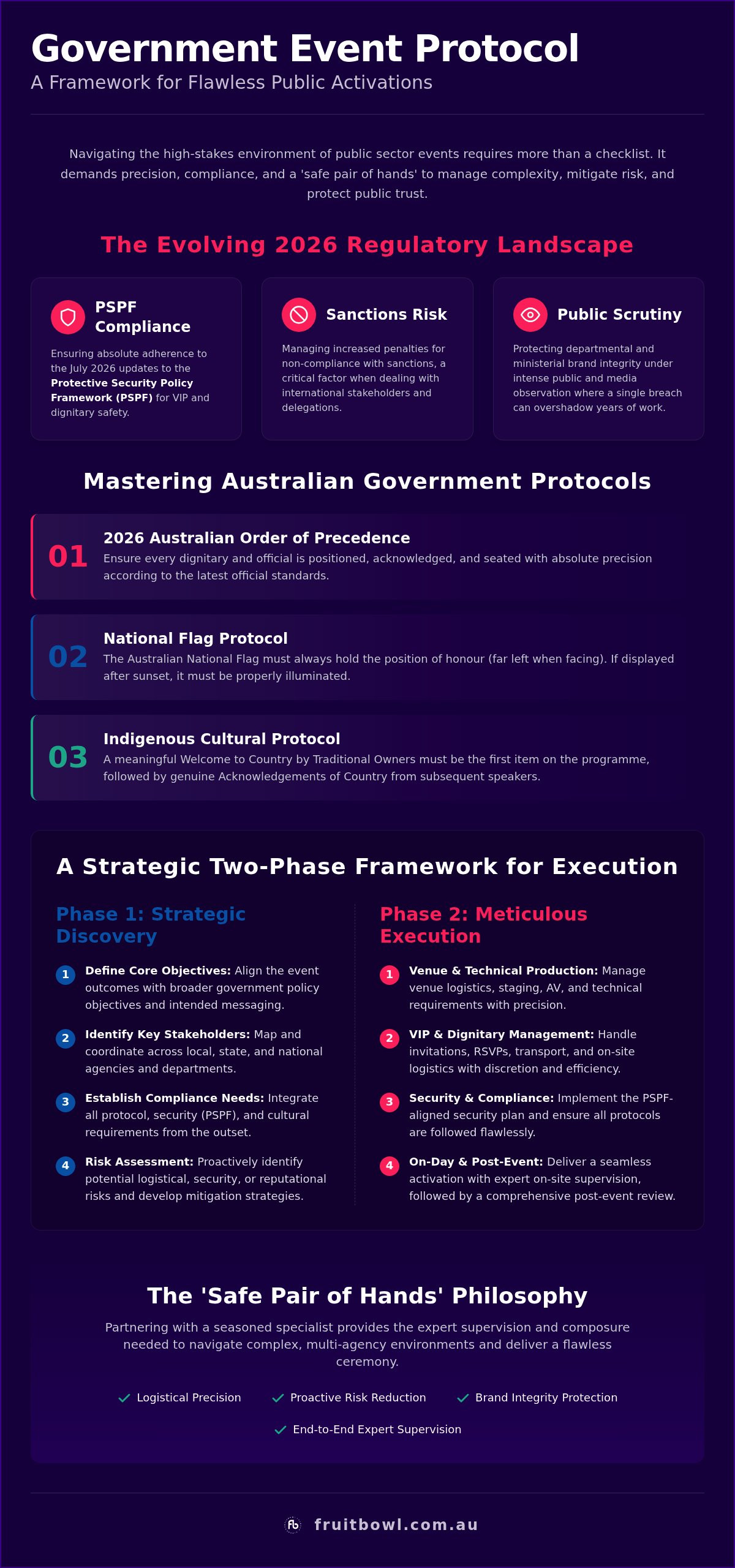
Execution of a high-stakes ceremony requires a methodology that mirrors the precision of the state itself. Our five-phase framework provides a logical progression from the initial strategic discovery to the final post-event evaluation. This structure ensures that government event protocol management remains integrated at every level. It prevents the fragmentation of responsibilities that often leads to logistical errors or protocol breaches. By aligning each phase with specific ministerial objectives and department policy, we create a narrative of order and competence that reassures all stakeholders.
- Phase 1: Strategic Discovery. Defining diplomatic objectives and aligning with the 2026 Order of Precedence.
- Phase 2: Procurement. Selecting venues and vendors who meet the latest July 2026 security standards.
- Phase 3: Technical Production. Merging creative vision with technical precision to support ceremonial impact.
- Phase 4: Real-time Execution. Managing the live environment with unflappable composure and immediate troubleshooting.
- Phase 5: Comprehensive Reporting. Delivering transparent evaluations on compliance, budget, and policy alignment.
Budgetary Oversight and Compliance
Public sector activations demand total transparency. Every cent of Australian Dollar (AUD) expenditure must be accounted for through rigorous tracking systems that withstand public scrutiny. We ensure all vendors meet strict compliance requirements, including the updated July 2026 Protective Security Policy Framework (PSPF) obligations. Measuring the success of these investments requires a sophisticated approach to government event planning. In this context, ROI is calculated not just in attendance numbers; it’s measured in the successful delivery of policy messaging and the maintenance of institutional reputation.
The Planning Timeline: A Sequential Pulse
A ceremony’s timeline usually begins 6 to 12 months before the event date. This duration allows for the meticulous coordination of multi-agency stakeholders and the procurement of high-security venues that require long lead times. Expertise in conference management is essential during this period to coordinate complex VIP logistics, travel requirements, and security clearances. A disciplined approach to government event protocol management during this phase prevents the last-minute stress that often compromises event quality. The final month is dedicated to site inspections and technical rehearsals, ensuring that every speaker and technician knows their role with total precision. To ensure your next activation is managed with this level of strategic oversight, partner with our experienced team for end-to-end delivery.
Partnering with Specialists for High-Stakes Government Events
A legacy spanning more than 28 years offers a level of stability that is essential for high-stakes public activations. Since 1996, our agency has navigated the complexities of the Australian public sector, refining a methodology that prioritises technical precision and administrative clarity. Entrusting government event protocol management to a seasoned specialist ensures that the focus remains on the strategic objectives of the mission rather than the stress of logistical coordination. This long-standing history serves as a guarantee of reliability, providing a “safe pair of hands” that has successfully managed countless official ceremonies through shifting political and security landscapes.
The advantage of an end-to-end solution lies in the seamless integration of every moving part. From the initial strategic discovery to the final post-event report, having a single point of accountability reduces project risk and eliminates communication gaps. We provide access to a national network of vetted suppliers and professional talent, all of whom understand the rigorous standards of government work. This network ensures that every vendor, from security personnel to technical crews, operates with the same commitment to precision and compliance that the department expects.
The Fruitbowl Advantage in Public Activations
Our approach to government ceremonies is built on the same foundations as our work in corporate event management, where high-impact delivery meets meticulous planning. We recognise that public activations are subject to intense scrutiny, and there is no margin for error. Our commitment to precision and safety ensures that every technical rider, seating plan, and flag protocol is executed with absolute accuracy. By managing these multifaceted processes, we provide a frictionless experience for organisers, allowing them to lead their departments with confidence while we oversee the technical and ceremonial details.
Next Steps: Securing Your Event’s Success
Initiating the briefing process for an official ceremony begins with a clear definition of your core requirements and timeline. We recommend engaging with a specialist partner at the earliest possible stage to ensure that protocol considerations are integrated into the venue procurement and budget management phases. Consulting with our technical directors early allows for a thorough assessment of production feasibility, ensuring that your creative vision aligns with the practicalities of the site. When you’re ready to discuss your strategic objectives, our team is available to provide the expert oversight required for a flawless delivery. Contact us to establish a project timeline that ensures your next activation meets the highest standards of government event protocol management and public diplomacy.
Elevating the Standard of Public Activations in Australia
Successful public ceremonies are the product of disciplined planning and a deep respect for established standards. By mastering the 2026 Order of Precedence and ensuring total alignment with the latest PSPF security requirements, you protect the integrity of the department and the safety of all attendees. Meticulous government event protocol management transforms a complex logistical challenge into a seamless display of national pride and diplomatic precision.
Delivering these high-stakes activations requires a partner who understands that there’s no margin for error. With over 28 years of industry expertise and a proven national delivery capability, our team serves as a trusted guide for your most significant ceremonial milestones. We specialise in the nuances of government protocol, ensuring every detail remains under expert supervision from strategy to execution. Partner with Fruitbowl Events Agency for your next official government ceremony to ensure a frictionless, protocol-compliant experience. We’re ready to help you deliver a flawless activation that achieves your strategic objectives with absolute confidence.
Frequently Asked Questions
What are the key components of an official government ceremony?
An official ceremony requires a combination of strict protocol adherence, robust security frameworks, and seamless technical execution. These components ensure the event reflects the dignity of the state while meeting all legislative requirements. Successful government event protocol management integrates these elements into a single, cohesive project plan. This approach allows for the clear communication of policy objectives and the safe management of public attendees and dignitaries alike.
How do I manage the Order of Precedence for seating at a government event?
Managing the Order of Precedence requires following the latest 2026 federal and state guidelines to determine the hierarchy of seating and address. Senior officials must be placed in positions of honour, typically starting from the right of the host. Seating plans must be finalised well in advance to ensure that arrival and departure sequences align with the status of each guest. Briefing staff on these nuances prevents errors that could lead to public embarrassment.
What is the correct protocol for displaying flags at an official ceremony?
The Australian National Flag must always be displayed in the position of honour, which is the far left of a person facing the stage. If multiple flags are present, specific rules dictate their order, including the state flag and the Australian Aboriginal Flag. All flags should be flown at the same height and be properly illuminated if the ceremony continues after sunset. Adhering to these standards ensures the ceremony maintains its formal and legal integrity.
How do I ensure a Welcome to Country is performed correctly?
A Welcome to Country must be performed by a Traditional Owner or Elder from the local land where the event is held. It’s the first formal item on the programme and serves to acknowledge the enduring connection of Indigenous Australians to the country. Organisers should engage local Land Councils early in the planning phase to ensure the ceremony is conducted with the appropriate cultural respect and procedural correctness. This ensures the activation begins with the required gravitas.
What security measures are required for ministerial attendance at a public event?
Security for ministerial attendance must comply with the 2026 Protective Security Policy Framework (PSPF) and involve close liaison with law enforcement. Measures include conducting thorough risk assessments of the venue, managing secure entry points, and providing discrete VIP protection. Effective government event protocol management ensures these security layers are integrated without disrupting the ceremonial flow. This approach provides a “safe pair of hands” for high-profile guests in public spaces.
How far in advance should I start planning an official government activation?
Planning for a high-stakes government activation should ideally commence 6 to 12 months before the scheduled date. This lead time is necessary to secure high-security venues, coordinate multi-agency stakeholders, and manage the complex procurement of technical services. Early engagement allows for the meticulous development of protocol plans and the navigation of strict government approval processes. A structured timeline ensures that every detail is refined and rehearsed before the live delivery.
How do I manage a budget for a government event with full transparency?
Managing a government budget requires total transparency and the tracking of every Australian Dollar (AUD) spent through rigorous accountability systems. Organisers must ensure that all expenditures align with procurement guidelines and that vendors meet strict compliance and safety standards. Delivering detailed financial reports at the conclusion of the event provides stakeholders with the assurance that public funds were managed with absolute integrity. This disciplined oversight is a hallmark of professional management.
What is the role of a technical director in an official ceremony?
The technical director oversees the integration of audio-visual systems, lighting, and stage management to ensure flawless delivery. Their role is to provide technical redundancy, particularly for critical ministerial speeches, so that no failure disrupts the proceedings. They work closely with protocol officers to ensure that the visual and auditory impact of the ceremony supports the formal objectives. This expertise allows the creative vision to exist in perfect symmetry with logistical requirements.
A single protocol breach in a high-stakes public ceremony can instantly overshadow years of carefully cultivated strategic relationship building. For those responsible for the execution of these events, the pressure to deliver a flawless experience is immense, particularly as the threat landscape and regulatory requirements continue to evolve. Effective government event protocol management isn’t just about following a basic checklist; it’s about providing a “safe pair of hands” that brings order and clarity to a complex, multi-agency environment.
You likely feel the weight of managing strict budgetary constraints while ensuring absolute compliance with the July 2026 updates to the Protective Security Policy Framework (PSPF). We recognise that the fear of public embarrassment or a security lapse is a constant concern when dealing with dignitaries and international stakeholders. This guide provides an authoritative framework for protocol and execution, offering the reassurance that every detail remains under expert supervision. We’ll explore the nuances of the current 2026 Order of Precedence, the impact of increased sanctions non-compliance penalties, and the tactical steps required for seamless VIP management across the Australian public sector.
Key Takeaways
- Understand the evolving landscape of Australian public sector activations and the critical role ceremonies play in maintaining public trust.
- Master the latest 2026 Australian Order of Precedence and flag protocols to ensure every dignitary and symbol is positioned with absolute precision.
- Implement robust security frameworks aligned with the 2026 Protective Security Policy Framework (PSPF) to manage high-stakes environments and VIP safety.
- Apply a structured, two-phase framework for government event protocol management that integrates strategic discovery with meticulous venue and budget oversight.
- Discover why partnering with a seasoned specialist provides the logistical precision and “safe pair of hands” needed for flawless, end-to-end ceremony delivery.
Navigating the Complexity of Official Government Ceremony Planning in 2026
The delivery of a public sector activation in 2026 requires more than logistical competence; it demands a sophisticated understanding of the intersection between civic duty and public perception. Government ceremonies serve as vital instruments for building public trust and strengthening international ties. Because these events are often broadcast globally or scrutinised by local constituents, a disciplined, results-oriented approach is essential. Effective government event protocol management ensures that every interaction reflects the dignity of the office it represents while adhering to modern standards of transparency and security.
Identifying core stakeholders is the foundational step in this meticulous process. Planners must coordinate across various tiers, including local municipal councils, state departments, and national agencies. Each entity brings its own set of compliance requirements, particularly following the July 1, 2026, update to the Protective Security Policy Framework (PSPF). Managing these layers requires strategic oversight that balances the needs of ministers, department heads, and the general public, ensuring that no single detail compromises the collective mission.
Defining the Scope of Official Activations
A clear distinction exists between community festivals and formal government ceremonies. While festivals focus on engagement and celebration, official activations prioritise the strict adherence to diplomatic protocol and statutory requirements. Success is measured by the seamless alignment of the event outcome with broader policy objectives. Whether it’s a ministerial announcement or a civic reception, the objectives must be clearly defined to ensure that the presence of high-ranking officials reinforces the intended message without distraction.
The ‘Safe Pair of Hands’ Philosophy
In high-stakes environments, experience is the most effective tool for risk reduction. Since 1996, our agency has focused on providing a “safe pair of hands” for complex activations, ensuring that technical production integrates perfectly with the creative vision. This philosophy is about maintaining composure when multi-layered delivery challenges arise. A seasoned partner understands the nuances of public scrutiny and works to protect the brand integrity of the department. By managing the minutiae of government event protocol management, we allow stakeholders to focus on their primary mission: engaging with the community and delivering on government promises with absolute confidence.
Mastering Protocols: Adhering to Australian Government Standards
Precision is the hallmark of successful government event protocol management. In 2026, the Australian Government continues to refine the standards for official ceremonies to ensure that national symbols and dignitaries are treated with the appropriate level of respect. This involves more than just aesthetics; it’s a rigorous exercise in legal and cultural compliance. Every element, from the positioning of the Australian National Flag to the wording on a formal invitation, must align with current federal and state guidelines to maintain the dignity of the occasion.
The Australian National Flag always takes the position of honour. When displayed with other flags, it must be placed on the far left of a person facing the stage. If the ceremony occurs after sunset, the flag must be properly illuminated to remain visible. Managing these requirements alongside the Event Starter Guide framework ensures that logistical precision supports the ceremonial intent. Formal invitations also require meticulous oversight, ensuring that RSVP management for high-profile dignitaries is handled with the discretion and efficiency their offices demand.
Indigenous Protocol and Cultural Sensitivity
Engaging Traditional Owners for a meaningful Welcome to Country is a core requirement for any significant Australian activation. This ceremony should be the first item on the formal programme, acknowledging the deep history and connection to the land. Subsequent speakers should deliver an Acknowledgement of Country with appropriate gravitas, ensuring the sentiment remains genuine rather than perfunctory. Integrating these cultural elements seamlessly into the event structure requires a nuanced understanding of local customs and a commitment to respectful engagement. For agencies seeking to deliver these complex requirements with confidence, partnering with specialists in government activations provides the necessary strategic oversight.
Order of Precedence and Dignitary Seating
The 2026 Order of Precedence dictates the hierarchy of importance for all official interactions. Seating plans must reflect this hierarchy exactly, placing the most senior officials in the positions of highest honour. This logic extends to arrival and departure sequences; typically, the most senior dignitary arrives last and departs first to ensure a smooth transition of proceedings. Briefing speakers on the correct forms of address and official titles is a critical step in government event protocol management. Even a minor error in addressing a minister or judicial officer can detract from the event’s success. We ensure every participant is fully prepared, providing a frictionless experience for both the hosts and their guests.
Logistical Precision: Security, Venue, and Stakeholder Management
Logistical success in government environments hinges on the exhaustive identification of variables. Comprehensive risk assessments for public spaces and government buildings must account for both physical safety and the preservation of official decorum. This is particularly vital in “crowded places” where security measures must be robust yet discreet. Coordination with law enforcement and private security teams ensures VIP protection remains a priority without creating an atmosphere of tension or unnecessary obstruction for the public.
Accessibility is a mandatory requirement for modern public activations. With one in five Australians living with a disability, every venue touchpoint must be inclusive. This requirement extends from physical ramps and hearing loops to digital interfaces for hybrid components. A disciplined approach to government event protocol management ensures that these considerations are integrated into the initial site selection rather than treated as an afterthought. We focus on creating a frictionless environment where every attendee, regardless of their needs, can engage with the ceremony with dignity.
Technical Direction for Ceremonial Impact
The technical execution of a ceremony must be invisible yet infallible. We prioritise av management for events to support official proceedings with absolute reliability. Critical ministerial speeches require built-in redundancy in sound systems to prevent any interruption. Lighting design also plays a strategic role; it must enhance the solemnity of the occasion while ensuring that official symbols and flags are correctly highlighted for both the live audience and archival media. Our technical direction ensures that the creative vision and the logistical requirements of the state exist in perfect symmetry.
Stakeholder Liaison and Multi-Agency Coordination
Managing high-stakes events involves navigating a complex web of government departments and agencies. Effective coordination requires a centralised project management system that offers total transparency to all parties involved. We manage the communication flow between department heads, security details, and venue managers to ensure total alignment. This includes the precise management of technical riders for high-profile guest speakers and performers. By centralising these moving parts, we maintain the “safe pair of hands” reputation that ensures a frictionless experience for every stakeholder, from the premier’s office to the on-site technical crew.
A Strategic Framework for Executing Flawless Public Activations
Execution of a high-stakes ceremony requires a methodology that mirrors the precision of the state itself. Our five-phase framework provides a logical progression from the initial strategic discovery to the final post-event evaluation. This structure ensures that government event protocol management remains integrated at every level. It prevents the fragmentation of responsibilities that often leads to logistical errors or protocol breaches. By aligning each phase with specific ministerial objectives and department policy, we create a narrative of order and competence that reassures all stakeholders.
- Phase 1: Strategic Discovery. Defining diplomatic objectives and aligning with the 2026 Order of Precedence.
- Phase 2: Procurement. Selecting venues and vendors who meet the latest July 2026 security standards.
- Phase 3: Technical Production. Merging creative vision with technical precision to support ceremonial impact.
- Phase 4: Real-time Execution. Managing the live environment with unflappable composure and immediate troubleshooting.
- Phase 5: Comprehensive Reporting. Delivering transparent evaluations on compliance, budget, and policy alignment.
Budgetary Oversight and Compliance
Public sector activations demand total transparency. Every cent of Australian Dollar (AUD) expenditure must be accounted for through rigorous tracking systems that withstand public scrutiny. We ensure all vendors meet strict compliance requirements, including the updated July 2026 Protective Security Policy Framework (PSPF) obligations. Measuring the success of these investments requires a sophisticated approach to government event planning. In this context, ROI is calculated not just in attendance numbers; it’s measured in the successful delivery of policy messaging and the maintenance of institutional reputation.
The Planning Timeline: A Sequential Pulse
A ceremony’s timeline usually begins 6 to 12 months before the event date. This duration allows for the meticulous coordination of multi-agency stakeholders and the procurement of high-security venues that require long lead times. Expertise in conference management is essential during this period to coordinate complex VIP logistics, travel requirements, and security clearances. A disciplined approach to government event protocol management during this phase prevents the last-minute stress that often compromises event quality. The final month is dedicated to site inspections and technical rehearsals, ensuring that every speaker and technician knows their role with total precision. To ensure your next activation is managed with this level of strategic oversight, partner with our experienced team for end-to-end delivery.
Partnering with Specialists for High-Stakes Government Events
A legacy spanning more than 28 years offers a level of stability that is essential for high-stakes public activations. Since 1996, our agency has navigated the complexities of the Australian public sector, refining a methodology that prioritises technical precision and administrative clarity. Entrusting government event protocol management to a seasoned specialist ensures that the focus remains on the strategic objectives of the mission rather than the stress of logistical coordination. This long-standing history serves as a guarantee of reliability, providing a “safe pair of hands” that has successfully managed countless official ceremonies through shifting political and security landscapes.
The advantage of an end-to-end solution lies in the seamless integration of every moving part. From the initial strategic discovery to the final post-event report, having a single point of accountability reduces project risk and eliminates communication gaps. We provide access to a national network of vetted suppliers and professional talent, all of whom understand the rigorous standards of government work. This network ensures that every vendor, from security personnel to technical crews, operates with the same commitment to precision and compliance that the department expects.
The Fruitbowl Advantage in Public Activations
Our approach to government ceremonies is built on the same foundations as our work in corporate event management, where high-impact delivery meets meticulous planning. We recognise that public activations are subject to intense scrutiny, and there is no margin for error. Our commitment to precision and safety ensures that every technical rider, seating plan, and flag protocol is executed with absolute accuracy. By managing these multifaceted processes, we provide a frictionless experience for organisers, allowing them to lead their departments with confidence while we oversee the technical and ceremonial details.
Next Steps: Securing Your Event’s Success
Initiating the briefing process for an official ceremony begins with a clear definition of your core requirements and timeline. We recommend engaging with a specialist partner at the earliest possible stage to ensure that protocol considerations are integrated into the venue procurement and budget management phases. Consulting with our technical directors early allows for a thorough assessment of production feasibility, ensuring that your creative vision aligns with the practicalities of the site. When you’re ready to discuss your strategic objectives, our team is available to provide the expert oversight required for a flawless delivery. Contact us to establish a project timeline that ensures your next activation meets the highest standards of government event protocol management and public diplomacy.
Elevating the Standard of Public Activations in Australia
Successful public ceremonies are the product of disciplined planning and a deep respect for established standards. By mastering the 2026 Order of Precedence and ensuring total alignment with the latest PSPF security requirements, you protect the integrity of the department and the safety of all attendees. Meticulous government event protocol management transforms a complex logistical challenge into a seamless display of national pride and diplomatic precision.
Delivering these high-stakes activations requires a partner who understands that there’s no margin for error. With over 28 years of industry expertise and a proven national delivery capability, our team serves as a trusted guide for your most significant ceremonial milestones. We specialise in the nuances of government protocol, ensuring every detail remains under expert supervision from strategy to execution. Partner with Fruitbowl Events Agency for your next official government ceremony to ensure a frictionless, protocol-compliant experience. We’re ready to help you deliver a flawless activation that achieves your strategic objectives with absolute confidence.
Frequently Asked Questions
What are the key components of an official government ceremony?
An official ceremony requires a combination of strict protocol adherence, robust security frameworks, and seamless technical execution. These components ensure the event reflects the dignity of the state while meeting all legislative requirements. Successful government event protocol management integrates these elements into a single, cohesive project plan. This approach allows for the clear communication of policy objectives and the safe management of public attendees and dignitaries alike.
How do I manage the Order of Precedence for seating at a government event?
Managing the Order of Precedence requires following the latest 2026 federal and state guidelines to determine the hierarchy of seating and address. Senior officials must be placed in positions of honour, typically starting from the right of the host. Seating plans must be finalised well in advance to ensure that arrival and departure sequences align with the status of each guest. Briefing staff on these nuances prevents errors that could lead to public embarrassment.
What is the correct protocol for displaying flags at an official ceremony?
The Australian National Flag must always be displayed in the position of honour, which is the far left of a person facing the stage. If multiple flags are present, specific rules dictate their order, including the state flag and the Australian Aboriginal Flag. All flags should be flown at the same height and be properly illuminated if the ceremony continues after sunset. Adhering to these standards ensures the ceremony maintains its formal and legal integrity.
How do I ensure a Welcome to Country is performed correctly?
A Welcome to Country must be performed by a Traditional Owner or Elder from the local land where the event is held. It’s the first formal item on the programme and serves to acknowledge the enduring connection of Indigenous Australians to the country. Organisers should engage local Land Councils early in the planning phase to ensure the ceremony is conducted with the appropriate cultural respect and procedural correctness. This ensures the activation begins with the required gravitas.
What security measures are required for ministerial attendance at a public event?
Security for ministerial attendance must comply with the 2026 Protective Security Policy Framework (PSPF) and involve close liaison with law enforcement. Measures include conducting thorough risk assessments of the venue, managing secure entry points, and providing discrete VIP protection. Effective government event protocol management ensures these security layers are integrated without disrupting the ceremonial flow. This approach provides a “safe pair of hands” for high-profile guests in public spaces.
How far in advance should I start planning an official government activation?
Planning for a high-stakes government activation should ideally commence 6 to 12 months before the scheduled date. This lead time is necessary to secure high-security venues, coordinate multi-agency stakeholders, and manage the complex procurement of technical services. Early engagement allows for the meticulous development of protocol plans and the navigation of strict government approval processes. A structured timeline ensures that every detail is refined and rehearsed before the live delivery.
How do I manage a budget for a government event with full transparency?
Managing a government budget requires total transparency and the tracking of every Australian Dollar (AUD) spent through rigorous accountability systems. Organisers must ensure that all expenditures align with procurement guidelines and that vendors meet strict compliance and safety standards. Delivering detailed financial reports at the conclusion of the event provides stakeholders with the assurance that public funds were managed with absolute integrity. This disciplined oversight is a hallmark of professional management.
What is the role of a technical director in an official ceremony?
The technical director oversees the integration of audio-visual systems, lighting, and stage management to ensure flawless delivery. Their role is to provide technical redundancy, particularly for critical ministerial speeches, so that no failure disrupts the proceedings. They work closely with protocol officers to ensure that the visual and auditory impact of the ceremony supports the formal objectives. This expertise allows the creative vision to exist in perfect symmetry with logistical requirements.
OUR BLOG
Event Insights & Expertise
Our blog is your go-to resource for all things events. From expert insights and the latest industry trends to practical planning tips, we share everything you need to deliver standout experiences.
Contact Us