Official Government Ceremony Planning: A Practical Australian Guide

A government ceremony can look effortless on the day, but that composure depends on decisions made well beforehand. Official government ceremony planning brings protocol, purpose and production together, even when the order of precedence, speaker sequence or approval pathway is not immediately clear.

If you’re coordinating senior officials, government teams, suppliers and cultural contributors, the complexity is real. Requirements can vary by jurisdiction and event type, so assumptions about protocol create avoidable uncertainty. A clear brief, confirmed responsibilities and careful liaison help keep each part connected.

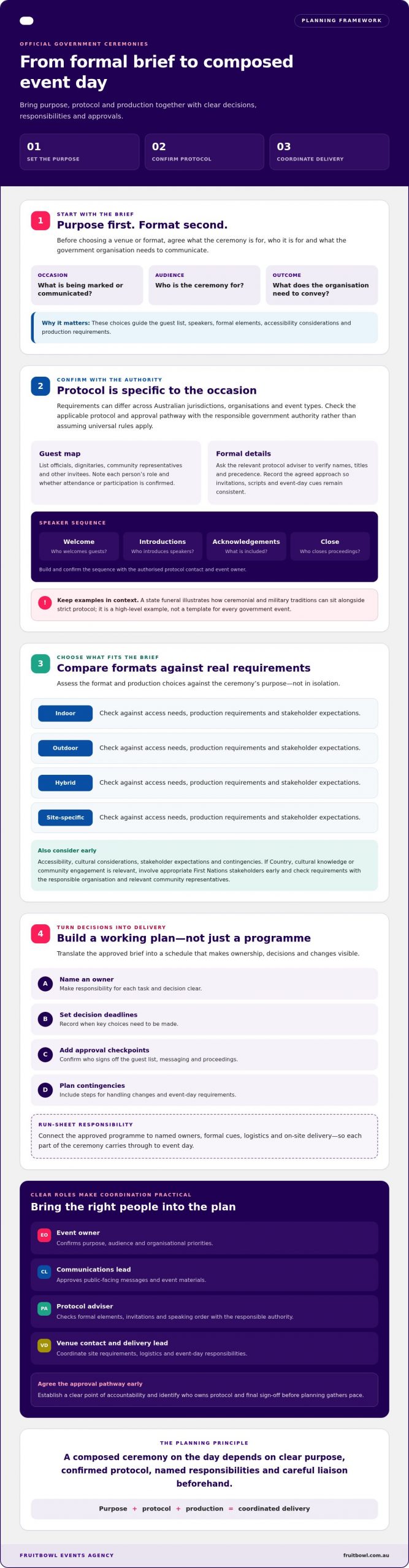
This guide shows how to turn a formal brief into a practical plan, with clear roles, approvals and run-sheet responsibilities from the first decisions through to event day. It covers how to confirm the ceremony’s purpose and audience, check protocol with the responsible government body, coordinate speakers and stakeholders, and plan for accessibility, cultural considerations and contingencies. The aim is a composed event-day experience, with the planning and delivery reflecting the significance of the occasion.

Key Takeaways

  • Start official government ceremony planning by defining the occasion, intended outcome and audience before choosing a format.
  • Confirm protocol, precedence and formal elements with the responsible government authority instead of assuming universal rules apply.
  • Compare indoor, outdoor, hybrid and site-specific options against access needs, production requirements and stakeholder expectations.
  • Turn the approved brief into a working schedule with named owners, decision deadlines, approval checkpoints and contingency steps.
  • Connect planning, logistics, stakeholder liaison, technical production and on-site delivery so the ceremony’s purpose carries through to event day.

Official government ceremony planning starts with purpose, audience and authority

A government ceremony is a formal occasion connected to a public organisation, official milestone or government purpose. Success depends not only on smooth delivery, but also on whether the event represents that purpose appropriately and meets the audience’s expectations. A public activation may prioritise participation or community engagement. A ceremony may also require formal acknowledgements, designated speakers and carefully ordered proceedings.

Definition: purpose shapes the plan

Before choosing a venue or format, state why the ceremony is being held, who it is for and what the government organisation needs to communicate. These decisions guide the guest list, speakers, formal elements, accessibility considerations and production requirements. Confirm applicable protocol and approvals with the responsible authority, as requirements can differ across Australian jurisdictions and organisations.

What makes a government ceremony different from a standard event?

Formal proceedings can carry public significance and accountability. Invitations, speaker selection, acknowledgements and the sequence of events may need to reflect the occasion and the roles of participating officials. A state funeral, for example, shows how ceremonial and military traditions can sit alongside strict rules of protocol. It is a high-level example, not a template for every government event. Confirm the expectations for your ceremony rather than assuming one protocol applies everywhere.

Who should be involved from the first planning meeting?

Bring together the people who set direction, approve decisions and deliver the event. Roles vary, but establish a clear point of accountability and identify who owns protocol and final sign-off before planning gathers pace.

  • Event owner: confirms purpose, audience and organisational priorities.
  • Communications lead: approves public-facing messages and event materials.
  • Protocol adviser: checks formal elements, invitations and speaking order with the responsible authority.
  • Venue contact and delivery lead: coordinate site requirements, logistics and event-day responsibilities.

Agree who can approve the guest list, messaging and changes to the proceedings. If Country, cultural knowledge or community engagement is relevant, identify and involve appropriate First Nations stakeholders early. Check cultural requirements with the responsible organisation and relevant community representatives, rather than leaving those conversations until the programme is fixed.

Record the agreed purpose, decision-makers and approval pathway in a concise brief. This gives the next planning stage a reliable foundation: assess format and production decisions against the ceremony’s intent, rather than making them in isolation. In official government ceremony planning, early clarity helps align formal expectations with practical delivery.

Government ceremony protocol: coordinate guests, speakers and formal elements

Protocol is not a single checklist for every Australian government ceremony. It involves decisions confirmed with the responsible authority to make formal proceedings clear and appropriate. Use the event’s purpose to guide those decisions, then record the agreed approach so invitations, scripts and event-day cues stay consistent.

Start with a guest map. List officials, dignitaries, community representatives and other invitees, noting their role in the occasion and whether their attendance or participation is confirmed. Ask the relevant government protocol adviser to verify names, titles and precedence. Don’t assume an order used by one agency or jurisdiction automatically applies to another.

How should invitations, precedence and speakers be coordinated?

Build the speaking sequence with the authorised protocol contact and event owner. Confirm who welcomes guests, introduces each speaker, delivers acknowledgements and closes proceedings. Check that sequence against the ceremony’s purpose and the confirmed attendance list. For international visits, the Australian Government’s guidance on Ceremonial Welcomes is a specific reference for formal welcomes involving heads of state and government. It is not a universal template for other events.

Prepare a verified list of names and pronunciations for presenters and stage management. Check it with the relevant individuals or their offices, and update the script when attendance changes. Confirm details before printing and rehearsal to reduce avoidable errors in introductions and spoken acknowledgements.

How can cultural and ceremonial elements be handled respectfully?

Where Country or cultural knowledge is relevant, consult appropriate First Nations representatives early and agree the approach with the commissioning organisation. A Welcome to Country and an Acknowledgement of Country are distinct. Confirm who is appropriate to deliver the Welcome with local Traditional Owners or knowledge holders, and check the organisation’s guidance on acknowledgements. Do not leave either conversation until the programme is set.

Apply the same confirmation process to flags and the national anthem. Requirements and expectations can depend on the occasion and responsible authority, so verify what applies before finalising the programme or production cues. The protocol contact should approve the wording and placement of each formal element.

  • Guest list: verify names, titles, roles and attendance.
  • Sequence: confirm precedence, speaker order and transitions.
  • Script: check acknowledgements, introductions and pronunciations.
  • Formal elements: confirm cultural protocols, flags and anthem decisions with the authorised contact.

Assign an owner and approval point to each item. This gives the delivery team a reliable reference for scripts, cues and rehearsals. For complex government activations, an experienced event partner can help connect stakeholder liaison with production and on-site coordination. Explore government activation planning as one potential support option.

Compare ceremony formats and production choices against the event brief

Choose a format by testing it against the ceremony’s purpose, audience and confirmed requirements, rather than starting with a preferred venue or production style. A contained indoor proceeding may suit a small invited audience and a formal sequence. An outdoor or site-specific event can make a public place central to the occasion, but brings extra considerations such as weather exposure, audience movement and site access.

Consider hybrid delivery when remote participation supports the purpose, rather than simply adding a broadcast. It also brings technical and presenter needs that should be planned alongside the in-person experience. In official government ceremony planning, the right format depends on the brief, venue and requirements confirmed with relevant stakeholders.

Format Production implications Stakeholder needs Key checks
Indoor Controlled staging, sound and lighting; consider room layout and sightlines. Coordinate venue access, seating and formal arrival arrangements. Check accessibility, capacity, acoustics and movement between spaces.
Outdoor Plan for weather exposure, power, sound coverage and a practical contingency. Align site access and audience management with venue and delivery contacts. Confirm the site suits the proceedings, access needs and operational plan.
Hybrid Integrate microphones, cameras, screens and remote participation into the run of show. Confirm who is participating remotely and who will manage broadcast elements. Test sound, picture, connectivity and transitions in the intended setup.
Site-specific Adapt staging and technical production to the location and its constraints. Engage relevant site contacts and consider how guests will arrive and move through the space. Check access, viewing positions, sound conditions and any site-specific approvals.

What technical and access decisions affect the experience?

Connect staging, sound, lighting, screens and presentation support to the order of proceedings. Speakers need to be heard and seen; remote audiences need a clear view and intelligible audio. Confirm cueing, microphone handovers and screen content with the technical team, then check that each element supports the ceremony instead of distracting from it.

Plan accessible arrival, seating, viewing, hearing and participation with relevant advisers and the venue. Consider routes through the space as well as the main viewing area, and confirm how people can follow spoken and visual content. The Department of Home Affairs’ citizenship ceremony guidance offers a practical example of a published order of proceedings. Adapt the planning principle to your event and verify applicable requirements with the responsible authority.
Official Government Ceremony Planning: A Practical Australian Guide

Build a government ceremony plan, run sheet and contingency process

Once the ceremony’s purpose, protocol and format are established, turn decisions into a controlled delivery plan. A master schedule should show what must happen, who owns each task, when decisions are due and which approvals other tasks depend on. This makes delays and unresolved decisions visible while there is still time to address them.

  1. Approve the brief: confirm the purpose, audience, format, key messages and requirements.
  2. Map stakeholders and responsibilities: name decision-makers, contributors, suppliers and approval owners.
  3. Set milestones and dependencies: schedule approvals for invitations, scripts, production, access arrangements and other event components.
  4. Build and check the run sheet: document the sequence, cues, transitions and contingency actions.
  5. Rehearse critical moments: walk through speaker movements, technical cues and handovers with the people responsible.
  6. Review after the event: capture what worked, issues to resolve and recommendations for future ceremonies.

What belongs in a ceremony run sheet?

Make the run sheet the event team’s operational reference, not just a list of times. Include arrivals and guest movement, introductions, speeches, formal elements, transitions and departures. For each item, record the timing, cue, responsible person, communications channel and any approved variation. Identify who gives a cue and who acts on it, so changes do not depend on guesswork.

Give each cue a named owner and a practical contingency. Distribute a controlled, current version to presenters, production staff and authorised stakeholders. Mark superseded versions clearly and set a process for sharing approved updates, so teams are not working from conflicting information.

How should event teams prepare for changes or disruption?

Assess risks relevant to the chosen format and site. These may include weather exposure, technical failure, a speaker or official being delayed, access issues or a programme running behind. For each relevant risk, agree the escalation contact, who has authority to decide and how the team will communicate the decision. A contingency should be usable, not merely listed.

Rehearse transitions with several dependencies, such as moving from an opening address to a formal element or switching to a backup presentation method. Confirm practical alternatives with suppliers and venue contacts, including what can change without further approval and what must be referred to the event owner. In official government ceremony planning, that distinction helps teams respond calmly while protecting the proceedings.

Coordinating the brief, schedule, stakeholder approvals and event-day delivery takes disciplined oversight. Explore government activation planning with Fruitbowl Events Agency if you’re considering support for the connected planning, logistics and on-site work.

Deliver an official government ceremony with a coordinated event partner

An event partner can connect planning, logistics, stakeholder liaison, technical production and on-site delivery. The benefit is not simply having more tasks managed in one place. It is having a clear process for decisions moving between the commissioning organisation, protocol contacts, suppliers and delivery team, while keeping the ceremony’s purpose in view.

That process starts with governance. Agree who owns the brief, who approves formal content and who can authorise programme changes. Then set a communication pathway for decisions and updates. This helps creative choices, protocol requirements and production plans develop together, rather than compete late in the process. A practical government event planning framework can help teams structure these workstreams. Ensure it reflects the responsible organisation’s approval and protocol requirements.

What should an agency brief include?

Give prospective partners a concise, current brief. Establish what the ceremony is for, who it needs to reach and what a successful outcome would look like. Separate confirmed information from decisions still in progress, particularly for the date, venue and programme.

  • Purpose and audience: occasion, desired outcomes and intended participants.
  • Governance: event owner, stakeholders, approval pathway and protocol contacts.
  • Requirements: accessibility needs, known constraints and cultural or formal considerations to confirm.
  • Delivery scope: logistics, technical production, communications, presenters or other support required.

A complete brief does not need to resolve every detail before planning begins. It should make open questions visible, name who will answer them and show which decisions depend on approval.

How can you assess whether a partner is the right fit?

Ask how the team would manage approvals, stakeholder communication, run-sheet control and event-day decisions. Look for a clear explanation of responsibilities and how planning connects with logistics, production and on-site delivery. Request relevant government or public-event examples only where the agency has permission to share them.

Fruitbowl Events Agency is an independent Australian event management firm offering government activations and end-to-end event planning across Australia. When assessing fit, consider whether its approach and proposed scope align with your ceremony’s needs. For official government ceremony planning, the working relationship should make decision ownership clear while leaving the commissioning organisation in control of its approvals and formal requirements.

If you’re preparing a government ceremony brief, you can discuss your requirements with Fruitbowl and explore whether its event management support is a suitable fit.

Turn a clear brief into a composed ceremony

Strong official government ceremony planning connects the occasion’s purpose with confirmed protocol, a format suited to its audience and a practical delivery plan. Confirm authority and approvals early, then give every run-sheet cue an owner and a workable contingency. These decisions help formal requirements and production details support the same outcome.

The ceremony should reflect its audience and significance while remaining manageable for the people delivering it. A clear brief, defined responsibilities and coordinated stakeholder communication provide a dependable foundation from initial planning through event-day delivery.

Fruitbowl Events Agency is an independent Australian event management firm founded in 1996. Its listed work includes government activations and public events, supported by end-to-end planning, logistics coordination and on-site event delivery.

If you’re developing a ceremony brief and would value experienced event management support, discuss your government ceremony brief with Fruitbowl. With the right decisions in place, your team can approach delivery with greater clarity and confidence.

Frequently Asked Questions

What is official government ceremony planning?

Official government ceremony planning is the coordinated preparation and delivery of a formal event connected to a government organisation, public occasion or official announcement. It brings together the event’s purpose, stakeholders, protocol decisions, guest experience, production and event-day operations. Requirements depend on the responsible organisation and occasion. Confirm formal expectations with the relevant authority rather than assuming one national process applies to every Australian government ceremony.

How do you plan an official government ceremony?

Start by confirming the purpose, audience, decision-makers and approval pathway. Identify protocol contacts, agree on the format, assess venue and access needs, then coordinate speakers and production. Document the sequence in a controlled run sheet, assigning an owner to each decision and cue. Before event day, confirm details with stakeholders, rehearse critical transitions and agree how authorised leads will manage changes. This creates a clear route from brief to delivery.

Who decides the protocol for an Australian government ceremony?

The responsible government organisation confirms which protocol guidance applies and who has authority to interpret it. An internal protocol adviser or designated official may coordinate titles, precedence, speakers and formal elements, depending on the occasion. A generic checklist can support preparation, but it is not a substitute for approval. Confirm requirements with the relevant authority early, particularly if multiple organisations or jurisdictions are involved, so the agreed approach informs invitations, scripts and sequencing.

Should a government ceremony include a Welcome to Country or Acknowledgement of Country?

The appropriate approach depends on the occasion, location, commissioning organisation and consultation with relevant First Nations representatives. A Welcome to Country is delivered by an appropriate Traditional Owner or representative, while an Acknowledgement of Country may be delivered by others. Confirm suitable practice and wording through respectful consultation and the organisation’s guidance. Plan these elements with care and avoid treating either as a generic production cue added after the programme is set.

What should be included in a government ceremony run sheet?

Include arrivals and audience movement, speaker introductions, approved speeches, formal elements, production cues, transitions and the close. For each item, record timing, the cue owner, the communications method and any approved variation. Add relevant access and contingency notes, then distribute a controlled version to authorised participants. Check the schedule with protocol, communications and production leads to ensure it reflects agreed decisions and gives each person a clear understanding of their role.

How far in advance should an official government ceremony be planned?

There is no single lead time for every ceremony. The schedule depends on factors such as venue availability, stakeholder approvals, protocol requirements, production complexity and public access arrangements. Begin planning as soon as the occasion is confirmed, then work backwards from the event date. Set decision deadlines and accountable owners, allowing time to verify formal details, brief speakers and rehearse essential transitions. Review the schedule as requirements develop, and flag dependencies that could affect delivery.

Do government ceremonies need a professional event planner?

Not every ceremony needs an external planner, but a dedicated event lead can help coordinate stakeholders, suppliers, approvals and production. Consider external support if the event has complex logistics, a large audience, technical requirements or several decision-makers. Before engaging a partner, clarify responsibilities and confirm that the organisation retains authority over protocol, messaging and final approvals. Fruitbowl Events Agency lists government activations and end-to-end event planning among its offerings, including logistics coordination and on-site delivery.

A government ceremony can look effortless on the day, but that composure depends on decisions made well beforehand. Official government ceremony planning brings protocol, purpose and production together, even when the order of precedence, speaker sequence or approval pathway is not immediately clear.

If you’re coordinating senior officials, government teams, suppliers and cultural contributors, the complexity is real. Requirements can vary by jurisdiction and event type, so assumptions about protocol create avoidable uncertainty. A clear brief, confirmed responsibilities and careful liaison help keep each part connected.

This guide shows how to turn a formal brief into a practical plan, with clear roles, approvals and run-sheet responsibilities from the first decisions through to event day. It covers how to confirm the ceremony’s purpose and audience, check protocol with the responsible government body, coordinate speakers and stakeholders, and plan for accessibility, cultural considerations and contingencies. The aim is a composed event-day experience, with the planning and delivery reflecting the significance of the occasion.

Key Takeaways

  • Start official government ceremony planning by defining the occasion, intended outcome and audience before choosing a format.
  • Confirm protocol, precedence and formal elements with the responsible government authority instead of assuming universal rules apply.
  • Compare indoor, outdoor, hybrid and site-specific options against access needs, production requirements and stakeholder expectations.
  • Turn the approved brief into a working schedule with named owners, decision deadlines, approval checkpoints and contingency steps.
  • Connect planning, logistics, stakeholder liaison, technical production and on-site delivery so the ceremony’s purpose carries through to event day.

Official government ceremony planning starts with purpose, audience and authority

A government ceremony is a formal occasion connected to a public organisation, official milestone or government purpose. Success depends not only on smooth delivery, but also on whether the event represents that purpose appropriately and meets the audience’s expectations. A public activation may prioritise participation or community engagement. A ceremony may also require formal acknowledgements, designated speakers and carefully ordered proceedings.

Definition: purpose shapes the plan

Before choosing a venue or format, state why the ceremony is being held, who it is for and what the government organisation needs to communicate. These decisions guide the guest list, speakers, formal elements, accessibility considerations and production requirements. Confirm applicable protocol and approvals with the responsible authority, as requirements can differ across Australian jurisdictions and organisations.

What makes a government ceremony different from a standard event?

Formal proceedings can carry public significance and accountability. Invitations, speaker selection, acknowledgements and the sequence of events may need to reflect the occasion and the roles of participating officials. A state funeral, for example, shows how ceremonial and military traditions can sit alongside strict rules of protocol. It is a high-level example, not a template for every government event. Confirm the expectations for your ceremony rather than assuming one protocol applies everywhere.

Who should be involved from the first planning meeting?

Bring together the people who set direction, approve decisions and deliver the event. Roles vary, but establish a clear point of accountability and identify who owns protocol and final sign-off before planning gathers pace.

  • Event owner: confirms purpose, audience and organisational priorities.
  • Communications lead: approves public-facing messages and event materials.
  • Protocol adviser: checks formal elements, invitations and speaking order with the responsible authority.
  • Venue contact and delivery lead: coordinate site requirements, logistics and event-day responsibilities.

Agree who can approve the guest list, messaging and changes to the proceedings. If Country, cultural knowledge or community engagement is relevant, identify and involve appropriate First Nations stakeholders early. Check cultural requirements with the responsible organisation and relevant community representatives, rather than leaving those conversations until the programme is fixed.

Record the agreed purpose, decision-makers and approval pathway in a concise brief. This gives the next planning stage a reliable foundation: assess format and production decisions against the ceremony’s intent, rather than making them in isolation. In official government ceremony planning, early clarity helps align formal expectations with practical delivery.

Government ceremony protocol: coordinate guests, speakers and formal elements

Protocol is not a single checklist for every Australian government ceremony. It involves decisions confirmed with the responsible authority to make formal proceedings clear and appropriate. Use the event’s purpose to guide those decisions, then record the agreed approach so invitations, scripts and event-day cues stay consistent.

Start with a guest map. List officials, dignitaries, community representatives and other invitees, noting their role in the occasion and whether their attendance or participation is confirmed. Ask the relevant government protocol adviser to verify names, titles and precedence. Don’t assume an order used by one agency or jurisdiction automatically applies to another.

How should invitations, precedence and speakers be coordinated?

Build the speaking sequence with the authorised protocol contact and event owner. Confirm who welcomes guests, introduces each speaker, delivers acknowledgements and closes proceedings. Check that sequence against the ceremony’s purpose and the confirmed attendance list. For international visits, the Australian Government’s guidance on Ceremonial Welcomes is a specific reference for formal welcomes involving heads of state and government. It is not a universal template for other events.

Prepare a verified list of names and pronunciations for presenters and stage management. Check it with the relevant individuals or their offices, and update the script when attendance changes. Confirm details before printing and rehearsal to reduce avoidable errors in introductions and spoken acknowledgements.

How can cultural and ceremonial elements be handled respectfully?

Where Country or cultural knowledge is relevant, consult appropriate First Nations representatives early and agree the approach with the commissioning organisation. A Welcome to Country and an Acknowledgement of Country are distinct. Confirm who is appropriate to deliver the Welcome with local Traditional Owners or knowledge holders, and check the organisation’s guidance on acknowledgements. Do not leave either conversation until the programme is set.

Apply the same confirmation process to flags and the national anthem. Requirements and expectations can depend on the occasion and responsible authority, so verify what applies before finalising the programme or production cues. The protocol contact should approve the wording and placement of each formal element.

  • Guest list: verify names, titles, roles and attendance.
  • Sequence: confirm precedence, speaker order and transitions.
  • Script: check acknowledgements, introductions and pronunciations.
  • Formal elements: confirm cultural protocols, flags and anthem decisions with the authorised contact.

Assign an owner and approval point to each item. This gives the delivery team a reliable reference for scripts, cues and rehearsals. For complex government activations, an experienced event partner can help connect stakeholder liaison with production and on-site coordination. Explore government activation planning as one potential support option.

Compare ceremony formats and production choices against the event brief

Choose a format by testing it against the ceremony’s purpose, audience and confirmed requirements, rather than starting with a preferred venue or production style. A contained indoor proceeding may suit a small invited audience and a formal sequence. An outdoor or site-specific event can make a public place central to the occasion, but brings extra considerations such as weather exposure, audience movement and site access.

Consider hybrid delivery when remote participation supports the purpose, rather than simply adding a broadcast. It also brings technical and presenter needs that should be planned alongside the in-person experience. In official government ceremony planning, the right format depends on the brief, venue and requirements confirmed with relevant stakeholders.

Format Production implications Stakeholder needs Key checks
Indoor Controlled staging, sound and lighting; consider room layout and sightlines. Coordinate venue access, seating and formal arrival arrangements. Check accessibility, capacity, acoustics and movement between spaces.
Outdoor Plan for weather exposure, power, sound coverage and a practical contingency. Align site access and audience management with venue and delivery contacts. Confirm the site suits the proceedings, access needs and operational plan.
Hybrid Integrate microphones, cameras, screens and remote participation into the run of show. Confirm who is participating remotely and who will manage broadcast elements. Test sound, picture, connectivity and transitions in the intended setup.
Site-specific Adapt staging and technical production to the location and its constraints. Engage relevant site contacts and consider how guests will arrive and move through the space. Check access, viewing positions, sound conditions and any site-specific approvals.

What technical and access decisions affect the experience?

Connect staging, sound, lighting, screens and presentation support to the order of proceedings. Speakers need to be heard and seen; remote audiences need a clear view and intelligible audio. Confirm cueing, microphone handovers and screen content with the technical team, then check that each element supports the ceremony instead of distracting from it.

Plan accessible arrival, seating, viewing, hearing and participation with relevant advisers and the venue. Consider routes through the space as well as the main viewing area, and confirm how people can follow spoken and visual content. The Department of Home Affairs’ citizenship ceremony guidance offers a practical example of a published order of proceedings. Adapt the planning principle to your event and verify applicable requirements with the responsible authority.

Build a government ceremony plan, run sheet and contingency process

Once the ceremony’s purpose, protocol and format are established, turn decisions into a controlled delivery plan. A master schedule should show what must happen, who owns each task, when decisions are due and which approvals other tasks depend on. This makes delays and unresolved decisions visible while there is still time to address them.

  1. Approve the brief: confirm the purpose, audience, format, key messages and requirements.
  2. Map stakeholders and responsibilities: name decision-makers, contributors, suppliers and approval owners.
  3. Set milestones and dependencies: schedule approvals for invitations, scripts, production, access arrangements and other event components.
  4. Build and check the run sheet: document the sequence, cues, transitions and contingency actions.
  5. Rehearse critical moments: walk through speaker movements, technical cues and handovers with the people responsible.
  6. Review after the event: capture what worked, issues to resolve and recommendations for future ceremonies.

What belongs in a ceremony run sheet?

Make the run sheet the event team’s operational reference, not just a list of times. Include arrivals and guest movement, introductions, speeches, formal elements, transitions and departures. For each item, record the timing, cue, responsible person, communications channel and any approved variation. Identify who gives a cue and who acts on it, so changes do not depend on guesswork.

Give each cue a named owner and a practical contingency. Distribute a controlled, current version to presenters, production staff and authorised stakeholders. Mark superseded versions clearly and set a process for sharing approved updates, so teams are not working from conflicting information.

How should event teams prepare for changes or disruption?

Assess risks relevant to the chosen format and site. These may include weather exposure, technical failure, a speaker or official being delayed, access issues or a programme running behind. For each relevant risk, agree the escalation contact, who has authority to decide and how the team will communicate the decision. A contingency should be usable, not merely listed.

Rehearse transitions with several dependencies, such as moving from an opening address to a formal element or switching to a backup presentation method. Confirm practical alternatives with suppliers and venue contacts, including what can change without further approval and what must be referred to the event owner. In official government ceremony planning, that distinction helps teams respond calmly while protecting the proceedings.

Coordinating the brief, schedule, stakeholder approvals and event-day delivery takes disciplined oversight. Explore government activation planning with Fruitbowl Events Agency if you’re considering support for the connected planning, logistics and on-site work.

Deliver an official government ceremony with a coordinated event partner

An event partner can connect planning, logistics, stakeholder liaison, technical production and on-site delivery. The benefit is not simply having more tasks managed in one place. It is having a clear process for decisions moving between the commissioning organisation, protocol contacts, suppliers and delivery team, while keeping the ceremony’s purpose in view.

That process starts with governance. Agree who owns the brief, who approves formal content and who can authorise programme changes. Then set a communication pathway for decisions and updates. This helps creative choices, protocol requirements and production plans develop together, rather than compete late in the process. A practical government event planning framework can help teams structure these workstreams. Ensure it reflects the responsible organisation’s approval and protocol requirements.

What should an agency brief include?

Give prospective partners a concise, current brief. Establish what the ceremony is for, who it needs to reach and what a successful outcome would look like. Separate confirmed information from decisions still in progress, particularly for the date, venue and programme.

  • Purpose and audience: occasion, desired outcomes and intended participants.
  • Governance: event owner, stakeholders, approval pathway and protocol contacts.
  • Requirements: accessibility needs, known constraints and cultural or formal considerations to confirm.
  • Delivery scope: logistics, technical production, communications, presenters or other support required.

A complete brief does not need to resolve every detail before planning begins. It should make open questions visible, name who will answer them and show which decisions depend on approval.

How can you assess whether a partner is the right fit?

Ask how the team would manage approvals, stakeholder communication, run-sheet control and event-day decisions. Look for a clear explanation of responsibilities and how planning connects with logistics, production and on-site delivery. Request relevant government or public-event examples only where the agency has permission to share them.

Fruitbowl Events Agency is an independent Australian event management firm offering government activations and end-to-end event planning across Australia. When assessing fit, consider whether its approach and proposed scope align with your ceremony’s needs. For official government ceremony planning, the working relationship should make decision ownership clear while leaving the commissioning organisation in control of its approvals and formal requirements.

If you’re preparing a government ceremony brief, you can discuss your requirements with Fruitbowl and explore whether its event management support is a suitable fit.

Turn a clear brief into a composed ceremony

Strong official government ceremony planning connects the occasion’s purpose with confirmed protocol, a format suited to its audience and a practical delivery plan. Confirm authority and approvals early, then give every run-sheet cue an owner and a workable contingency. These decisions help formal requirements and production details support the same outcome.

The ceremony should reflect its audience and significance while remaining manageable for the people delivering it. A clear brief, defined responsibilities and coordinated stakeholder communication provide a dependable foundation from initial planning through event-day delivery.

Fruitbowl Events Agency is an independent Australian event management firm founded in 1996. Its listed work includes government activations and public events, supported by end-to-end planning, logistics coordination and on-site event delivery.

If you’re developing a ceremony brief and would value experienced event management support, discuss your government ceremony brief with Fruitbowl. With the right decisions in place, your team can approach delivery with greater clarity and confidence.

Frequently Asked Questions

What is official government ceremony planning?

Official government ceremony planning is the coordinated preparation and delivery of a formal event connected to a government organisation, public occasion or official announcement. It brings together the event’s purpose, stakeholders, protocol decisions, guest experience, production and event-day operations. Requirements depend on the responsible organisation and occasion. Confirm formal expectations with the relevant authority rather than assuming one national process applies to every Australian government ceremony.

How do you plan an official government ceremony?

Start by confirming the purpose, audience, decision-makers and approval pathway. Identify protocol contacts, agree on the format, assess venue and access needs, then coordinate speakers and production. Document the sequence in a controlled run sheet, assigning an owner to each decision and cue. Before event day, confirm details with stakeholders, rehearse critical transitions and agree how authorised leads will manage changes. This creates a clear route from brief to delivery.

Who decides the protocol for an Australian government ceremony?

The responsible government organisation confirms which protocol guidance applies and who has authority to interpret it. An internal protocol adviser or designated official may coordinate titles, precedence, speakers and formal elements, depending on the occasion. A generic checklist can support preparation, but it is not a substitute for approval. Confirm requirements with the relevant authority early, particularly if multiple organisations or jurisdictions are involved, so the agreed approach informs invitations, scripts and sequencing.

Should a government ceremony include a Welcome to Country or Acknowledgement of Country?

The appropriate approach depends on the occasion, location, commissioning organisation and consultation with relevant First Nations representatives. A Welcome to Country is delivered by an appropriate Traditional Owner or representative, while an Acknowledgement of Country may be delivered by others. Confirm suitable practice and wording through respectful consultation and the organisation’s guidance. Plan these elements with care and avoid treating either as a generic production cue added after the programme is set.

What should be included in a government ceremony run sheet?

Include arrivals and audience movement, speaker introductions, approved speeches, formal elements, production cues, transitions and the close. For each item, record timing, the cue owner, the communications method and any approved variation. Add relevant access and contingency notes, then distribute a controlled version to authorised participants. Check the schedule with protocol, communications and production leads to ensure it reflects agreed decisions and gives each person a clear understanding of their role.

How far in advance should an official government ceremony be planned?

There is no single lead time for every ceremony. The schedule depends on factors such as venue availability, stakeholder approvals, protocol requirements, production complexity and public access arrangements. Begin planning as soon as the occasion is confirmed, then work backwards from the event date. Set decision deadlines and accountable owners, allowing time to verify formal details, brief speakers and rehearse essential transitions. Review the schedule as requirements develop, and flag dependencies that could affect delivery.

Do government ceremonies need a professional event planner?

Not every ceremony needs an external planner, but a dedicated event lead can help coordinate stakeholders, suppliers, approvals and production. Consider external support if the event has complex logistics, a large audience, technical requirements or several decision-makers. Before engaging a partner, clarify responsibilities and confirm that the organisation retains authority over protocol, messaging and final approvals. Fruitbowl Events Agency lists government activations and end-to-end event planning among its offerings, including logistics coordination and on-site delivery.

Back to Articles
Request A Quote

Make an
Enquiry

Untitled design

What Makes Us Different?

True end-to-end solution so you can hand off to us, focus on your priorities and enjoy the event without any stress

Unmatched industry expertise looking after diverse range of high-profile events, cultural festivals & activations

Meticulous attention to every detail and precise execution of events with our streamlined processes

Tailored solutions with bespoke strategies to ensure we align with your brand and objectives

Make an Enquiry

"*" indicates required fields

This field is for validation purposes and should be left unchanged.

"*" indicates required fields

This field is for validation purposes and should be left unchanged.