Mastering the Government Event Tender Process: A Strategic Guide for 2026

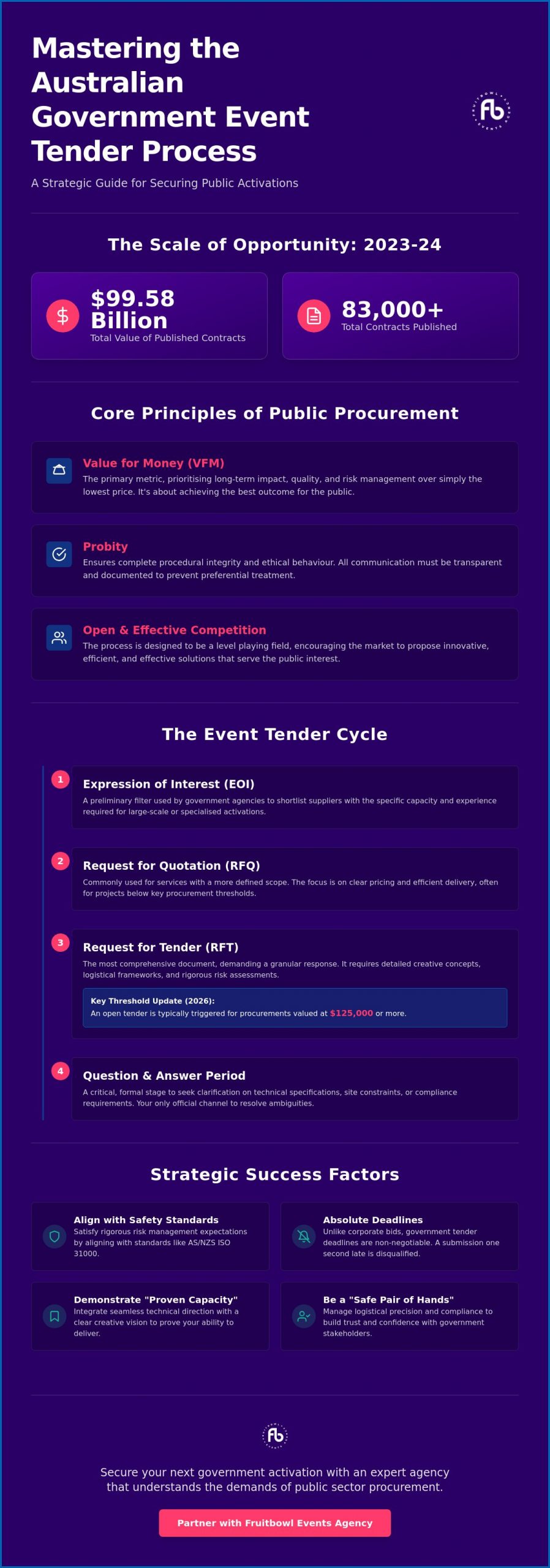
In the 2023-24 period, the Australian government published over 83,000 contracts with a total value of $99.58 billion. While the scale of opportunity is vast, the path to securing a contract for government activations is often obscured by rigid administrative hurdles and opaque procurement rules. You’ve likely felt the frustration of trying to balance a bold creative vision with the uncompromising value for money requirements of a public sector brief. It’s a high-stakes environment where a minor clerical error can lead to immediate disqualification, regardless of your team’s expertise.

This guide provides the clarity you need to master the government event tender process with absolute confidence. We’ll examine the critical 2026 updates to procurement thresholds, such as the $125,000 open tender trigger, and the latest local preferencing rules for Australian-owned businesses. You’ll gain a methodical roadmap of the tender cycle, from understanding probity to submitting a bid that meets every compliance benchmark. This strategic overview ensures your next submission is both a creative triumph and a logistical masterpiece.

Key Takeaways

  • Understand why “Value for Money” serves as the primary metric for public sector procurement, prioritising long-term impact and ethical governance over the lowest price.
  • Master the sequential stages of the government event tender process to ensure every technical clarification and administrative requirement is meticulously addressed.
  • Align your project planning with Australian Standards, specifically AS/NZS ISO 31000, to satisfy the rigorous risk management and public safety expectations of government stakeholders.
  • Demonstrate “proven capacity” by integrating seamless technical direction with a clear creative vision to secure high-visibility public activations.
  • Recognise the strategic advantage of partnering with a “safe pair of hands” to manage the logistical precision required for complex, high-stakes environments.

Understanding the Australian Government Event Tender Landscape

The government event tender process represents a formalised mechanism for the allocation of public funds, where accountability is as critical as creative output. This framework ensures that public money is spent transparently and ethically. While corporate bids may focus on brand alignment or aesthetic appeal, government procurement is anchored in a broader set of responsibilities. Whether you are bidding for a local council festival or a federal department conference, the requirements for transparency remain absolute. Government procurement standards in Australia demand a level of documentation and procedural rigour that can be daunting, yet these rules provide the security of a fair and level playing field for all applicants.

The Core Principles of Australian Public Procurement

The cornerstone of the procurement process is “Value for Money” (VFM). In an event context, this doesn’t mean the lowest price wins. Instead, the government assesses the total value, considering technical expertise, quality of delivery, and the management of public risk. Probity is another non-negotiable principle. It refers to the evidence of ethical behaviour and procedural integrity throughout the tender. During the bidding phase, probity dictates that all communication with the agency must be transparent and documented. This ensures no single supplier receives preferential treatment. Finally, the process must encourage open and effective competition, allowing the market to propose innovative solutions that serve the public interest.

Why Government Tenders Differ from Corporate Bids

Key Stages of the Event Tender Cycle for Public Activations

The government event tender process operates with a methodical rhythm that prioritises procedural fairness over speed. It begins long before a single piece of equipment arrives on site. Understanding this cycle is essential for maintaining control over your submission and ensuring every technical detail aligns with the agency’s objectives. The journey typically moves through distinct phases of notification, clarification, evaluation, and eventually, mobilisation. Each stage requires a specific set of documents and a disciplined approach to communication.

From EOI to RFT: Navigating the Documents

Agencies use different instruments depending on the scale and complexity of the project. An Expression of Interest (EOI) often acts as a preliminary filter to shortlist agencies with the specific capacity for high-impact government activations. For more direct needs, a Request for Quotation (RFQ) is commonly utilised for services under the $125,000 threshold, where the focus is often on speed and efficiency. The Request for Tender (RFT) remains the most comprehensive document. It demands a granular response that addresses every requirement, from creative concepts to detailed logistical frameworks and risk assessments.

A critical yet often overlooked phase is the formal “Question and Answer” period. This is your opportunity to clarify technical riders or site-specific constraints that could impact your pricing or delivery model. Aligning your queries with official Government purchasing guidelines ensures that your technical response is both compliant and realistic. It prevents the risk of over-promising on a creative vision that cannot be safely executed within the rigid procurement rules of the public sector.

The Evaluation and Award Process

Once submitted, your response enters the evaluation phase. Panels use a weighted scoring system to assess your bid against pre-defined criteria. These often include technical merit, relevant experience, and risk management capability. Price is rarely the sole factor. Instead, the panel looks for the best overall value. If you reach the final shortlist, you may be invited to provide a Best and Final Offer (BAFO). This stage allows for minor adjustments to the commercial or technical scope before the contract is officially awarded.

The process concludes with a mandatory debriefing session. For unsuccessful bidders, this is a valuable learning opportunity to understand exactly where the submission fell short. For the successful agency, it marks the start of the mobilisation period. This is the transition from a “paper plan” to the physical execution of the event. It requires a disciplined approach to project management to ensure the transition is seamless. Success at this stage relies on your ability to move from strategic oversight to precise logistical execution without losing sight of the original project goals.

Managing Compliance, Risk, and Public Safety Requirements

For government stakeholders, risk management is the foundation of every successful project. When navigating the government event tender process, you must demonstrate a sophisticated understanding of public safety protocols that extends far beyond a simple checklist. This involves a systematic integration of Australian Standards, specifically AS/NZS ISO 31000, into every facet of your event planning. Agencies look for evidence that your organisation possesses substantial Public Liability and Professional Indemnity insurance to safeguard against unforeseen incidents in high-visibility environments. Beyond physical safety, modern compliance now encompasses sustainability targets, universal accessibility, and modern slavery statements, all of which are weighted heavily during the procurement phase.

Developing a Robust Event Risk Management Plan

Public activations and large-scale festivals present unique challenges that require a disciplined approach to hazard identification. Your plan must address site-specific risks, such as the stability of temporary structures, electrical safety in outdoor settings, and the management of high-density pedestrian traffic. Effective crowd control strategies and detailed emergency evacuation protocols are not just administrative requirements; they are essential components of a winning bid. This level of preparation provides the peace of mind that defines a “Safe Pair of Hands” approach, where every potential complication is anticipated and mitigated through methodical planning and seasoned expertise.

Regulatory Compliance and Permit Coordination

Success in the public sector depends on the seamless coordination of permits and regulatory approvals across multiple jurisdictions. This process often involves:

  • Liaising with emergency services and transport authorities to manage public thoroughfares.
  • Securing local council permits for noise, waste management, and land use.
  • Conducting environmental impact assessments to ensure outdoor events meet modern sustainability benchmarks.
  • Ensuring all av management for events adheres to national safety codes and technical standards.

By integrating these regulatory requirements into your initial submission, you demonstrate a commitment to logistical precision. This proactive stance helps avoid the administrative errors that can lead to disqualification in the government event tender process. It also establishes your agency as a reliable partner capable of navigating the complex web of state and federal regulations. Ultimately, a compliant bid is a reassuring bid, signalling to the evaluation panel that the project is under expert supervision and is prepared for any operational challenge.
Strategic Success Factors for a Winning Tender Response

Integrating Creative Vision with Technical Precision

Managing the human element of a government event requires a high degree of diplomacy and procedural knowledge. Procuring high-profile speakers or entertainers must be done within strict government protocols, ensuring all bookings are ethical and transparent. You also need to demonstrate an ability to manage multifaceted stakeholder groups. This includes coordinating with ministers, departmental leads, and community representatives. Providing an end-to-end solution reduces the administrative burden on the client, allowing them to focus on policy objectives while you manage the logistical precision of the activation. If you are ready to submit a bid that balances creative vision with rigorous compliance, partner with an expert agency for government activations to ensure your project is in a safe pair of hands.

Ultimately, a winning tender response is one that removes uncertainty. It presents a logical progression from the initial creative spark to the final load-out, with every stage meticulously documented. By addressing the specific needs of the public sector—transparency, safety, and stakeholder alignment—you position your agency as a disciplined technician and a creative visionary. This dual capability is what separates a standard bid from a successful, high-impact public activation.

Partnering with an Expert Agency for Government Activations

Selecting a partner for public sector work requires an assessment of longevity and proven results. With over 28 years of industry experience, Fruitbowl understands the nuances of the government event tender process better than most. This extensive history allows us to anticipate procedural shifts and regulatory updates before they impact your timeline. Seasoned expertise is a critical differentiator when the success of a public activation depends on absolute compliance and logistical precision. We provide the steady, results-oriented approach necessary to navigate high-stakes environments with total confidence.

Fruitbowl’s End-to-End Strategic Framework

Our methodology covers every phase of the project lifecycle. This begins with an exhaustive feasibility study and moves through creative conceptualisation to meticulous on-site delivery. We believe that logistical excellence is the foundation of creative success. Our post-event reporting provides the data-driven insights necessary for government transparency and future planning. We apply the same corporate event management rigour to public activations, ensuring that every technical detail is under expert supervision. This end-to-end framework ensures that no element is left to chance, from the first site inspection to the final load-out.

Securing Your Next Public Event Success

High-pressure environments require a composed strategist and a meticulous guide. Whether you are planning a national festival, a major conference, or a series of community activations, we provide the order and clarity needed to succeed. Our team is accustomed to the rigid requirements of public procurement and the complexities of stakeholder management. We absorb the administrative and logistical burdens, allowing your department to focus on its core policy objectives. This partnership ensures that your event is not only compliant but also delivers a profound public impact.

If you are preparing for an upcoming project, we invite you to organise a briefing with our senior strategists. We can provide a strategic consultation to help you navigate the complexities of your next tender opportunity. Let us bring our 28 years of experience to your next mission, ensuring a frictionless experience from concept to completion.

Securing Your Success in Public Sector Activations

Mastering the government event tender process requires a disciplined balance between ambitious creative vision and uncompromising administrative rigour. By prioritising transparency, local content preferences, and robust risk management frameworks, you transform compliance from a bureaucratic hurdle into a distinct competitive advantage. Success in 2026 hinges on your ability to provide a comprehensive roadmap that addresses every stakeholder concern, from ministerial protocols to public safety standards.

Navigating these high-stakes requirements is a complex undertaking that benefits from a partner with deep institutional knowledge. Fruitbowl brings more than 28 years of high-stakes event experience to every project, offering a national delivery capability for government activations across Australia. Our proven track record in multi-stakeholder liaison and strict compliance ensures your project remains in a safe pair of hands. This methodical approach guarantees that your strategic objectives are translated into a seamless, high-impact reality.

Partner with the government event specialists at Fruitbowl Events Agency to ensure your next public activation is delivered with logistical precision and sophisticated impact. We look forward to providing the expert supervision and seasoned expertise your mission requires.

Frequently Asked Questions

What is the most common reason government event tenders are rejected?

Administrative non-compliance is the primary cause for immediate disqualification. This includes failing to sign mandatory declarations, missing the absolute submission deadline, or neglecting to address a specific evaluation criterion. Even a high-calibre creative proposal cannot overcome a failure to meet the rigid procedural requirements set out in the initial request for tender.

How much time should I allow for the government tender process?

You should generally allow four to eight weeks to prepare a comprehensive response. This timeframe accounts for the internal coordination of technical riders, risk assessments, and financial breakdowns. The entire government event tender process, from the initial notification to the final contract award, can often span several months depending on the complexity of the activation and the agency’s evaluation timeline.

Can a small agency win a large-scale national government event contract?

Yes, especially given the Australian government’s recent prioritisation of Small and Medium Enterprises (SMEs). For contracts under the $125,000 threshold, non-corporate Commonwealth entities are often required to prioritise SMEs. The key is demonstrating “proven capacity” and a robust methodology that suggests you are a safe pair of hands, regardless of your total headcount.

What insurance coverage is mandatory for government event activations?

Public Liability insurance is almost always mandatory, with a typical minimum coverage of $20 million per occurrence. You’ll also need Professional Indemnity insurance and valid Workers’ Compensation for all staff and contractors. Some high-visibility projects may require specific event-interruption insurance, so it’s vital to check the technical specifications in the tender documents early in the process.

How does “Value for Money” differ from the lowest price in event bidding?

Value for Money is a holistic assessment that balances cost against quality, reliability, and risk mitigation. A bid with the lowest price might be judged as poor value if it carries a high risk of operational failure or lacks technical precision. The government event tender process seeks the best overall outcome for the public, which often involves choosing a more experienced partner who guarantees a frictionless delivery.

What is an AusTender notification and how do I use it?

AusTender is the centralised platform for all Commonwealth procurement opportunities. You should register a business profile and set up specific “keyword alerts” for categories like event management or public activations. This ensures you receive an immediate email notification when a relevant tender is published, giving your team the maximum amount of time to prepare a disciplined response.

Do I need a specific risk management certification to bid?

While a specific “certification” isn’t always a prerequisite, your submission must demonstrate that your planning aligns with Australian Standards, specifically AS/NZS ISO 31000. You need to provide a documented framework for identifying hazards and implementing control measures. Showing a methodical approach to public safety is often more important to the evaluation panel than holding a particular certificate.

How are “social procurement” goals evaluated in an event tender?

Social procurement is typically assessed as a weighted percentage of your total score. You’ll be asked to demonstrate how your event supports local Australian businesses, Indigenous-owned enterprises, or disability employment services. Providing concrete evidence of your commitment to these social outcomes can often be the deciding factor between two technically similar bids.

In the 2023-24 period, the Australian government published over 83,000 contracts with a total value of $99.58 billion. While the scale of opportunity is vast, the path to securing a contract for government activations is often obscured by rigid administrative hurdles and opaque procurement rules. You’ve likely felt the frustration of trying to balance a bold creative vision with the uncompromising value for money requirements of a public sector brief. It’s a high-stakes environment where a minor clerical error can lead to immediate disqualification, regardless of your team’s expertise.

This guide provides the clarity you need to master the government event tender process with absolute confidence. We’ll examine the critical 2026 updates to procurement thresholds, such as the $125,000 open tender trigger, and the latest local preferencing rules for Australian-owned businesses. You’ll gain a methodical roadmap of the tender cycle, from understanding probity to submitting a bid that meets every compliance benchmark. This strategic overview ensures your next submission is both a creative triumph and a logistical masterpiece.

Key Takeaways

  • Understand why “Value for Money” serves as the primary metric for public sector procurement, prioritising long-term impact and ethical governance over the lowest price.
  • Master the sequential stages of the government event tender process to ensure every technical clarification and administrative requirement is meticulously addressed.
  • Align your project planning with Australian Standards, specifically AS/NZS ISO 31000, to satisfy the rigorous risk management and public safety expectations of government stakeholders.
  • Demonstrate “proven capacity” by integrating seamless technical direction with a clear creative vision to secure high-visibility public activations.
  • Recognise the strategic advantage of partnering with a “safe pair of hands” to manage the logistical precision required for complex, high-stakes environments.

Understanding the Australian Government Event Tender Landscape

The government event tender process represents a formalised mechanism for the allocation of public funds, where accountability is as critical as creative output. This framework ensures that public money is spent transparently and ethically. While corporate bids may focus on brand alignment or aesthetic appeal, government procurement is anchored in a broader set of responsibilities. Whether you are bidding for a local council festival or a federal department conference, the requirements for transparency remain absolute. Government procurement standards in Australia demand a level of documentation and procedural rigour that can be daunting, yet these rules provide the security of a fair and level playing field for all applicants.

The Core Principles of Australian Public Procurement

The cornerstone of the procurement process is “Value for Money” (VFM). In an event context, this doesn’t mean the lowest price wins. Instead, the government assesses the total value, considering technical expertise, quality of delivery, and the management of public risk. Probity is another non-negotiable principle. It refers to the evidence of ethical behaviour and procedural integrity throughout the tender. During the bidding phase, probity dictates that all communication with the agency must be transparent and documented. This ensures no single supplier receives preferential treatment. Finally, the process must encourage open and effective competition, allowing the market to propose innovative solutions that serve the public interest.

Why Government Tenders Differ from Corporate Bids

Key Stages of the Event Tender Cycle for Public Activations

The government event tender process operates with a methodical rhythm that prioritises procedural fairness over speed. It begins long before a single piece of equipment arrives on site. Understanding this cycle is essential for maintaining control over your submission and ensuring every technical detail aligns with the agency’s objectives. The journey typically moves through distinct phases of notification, clarification, evaluation, and eventually, mobilisation. Each stage requires a specific set of documents and a disciplined approach to communication.

From EOI to RFT: Navigating the Documents

Agencies use different instruments depending on the scale and complexity of the project. An Expression of Interest (EOI) often acts as a preliminary filter to shortlist agencies with the specific capacity for high-impact government activations. For more direct needs, a Request for Quotation (RFQ) is commonly utilised for services under the $125,000 threshold, where the focus is often on speed and efficiency. The Request for Tender (RFT) remains the most comprehensive document. It demands a granular response that addresses every requirement, from creative concepts to detailed logistical frameworks and risk assessments.

A critical yet often overlooked phase is the formal “Question and Answer” period. This is your opportunity to clarify technical riders or site-specific constraints that could impact your pricing or delivery model. Aligning your queries with official Government purchasing guidelines ensures that your technical response is both compliant and realistic. It prevents the risk of over-promising on a creative vision that cannot be safely executed within the rigid procurement rules of the public sector.

The Evaluation and Award Process

Once submitted, your response enters the evaluation phase. Panels use a weighted scoring system to assess your bid against pre-defined criteria. These often include technical merit, relevant experience, and risk management capability. Price is rarely the sole factor. Instead, the panel looks for the best overall value. If you reach the final shortlist, you may be invited to provide a Best and Final Offer (BAFO). This stage allows for minor adjustments to the commercial or technical scope before the contract is officially awarded.

The process concludes with a mandatory debriefing session. For unsuccessful bidders, this is a valuable learning opportunity to understand exactly where the submission fell short. For the successful agency, it marks the start of the mobilisation period. This is the transition from a “paper plan” to the physical execution of the event. It requires a disciplined approach to project management to ensure the transition is seamless. Success at this stage relies on your ability to move from strategic oversight to precise logistical execution without losing sight of the original project goals.

Managing Compliance, Risk, and Public Safety Requirements

For government stakeholders, risk management is the foundation of every successful project. When navigating the government event tender process, you must demonstrate a sophisticated understanding of public safety protocols that extends far beyond a simple checklist. This involves a systematic integration of Australian Standards, specifically AS/NZS ISO 31000, into every facet of your event planning. Agencies look for evidence that your organisation possesses substantial Public Liability and Professional Indemnity insurance to safeguard against unforeseen incidents in high-visibility environments. Beyond physical safety, modern compliance now encompasses sustainability targets, universal accessibility, and modern slavery statements, all of which are weighted heavily during the procurement phase.

Developing a Robust Event Risk Management Plan

Public activations and large-scale festivals present unique challenges that require a disciplined approach to hazard identification. Your plan must address site-specific risks, such as the stability of temporary structures, electrical safety in outdoor settings, and the management of high-density pedestrian traffic. Effective crowd control strategies and detailed emergency evacuation protocols are not just administrative requirements; they are essential components of a winning bid. This level of preparation provides the peace of mind that defines a “Safe Pair of Hands” approach, where every potential complication is anticipated and mitigated through methodical planning and seasoned expertise.

Regulatory Compliance and Permit Coordination

Success in the public sector depends on the seamless coordination of permits and regulatory approvals across multiple jurisdictions. This process often involves:

  • Liaising with emergency services and transport authorities to manage public thoroughfares.
  • Securing local council permits for noise, waste management, and land use.
  • Conducting environmental impact assessments to ensure outdoor events meet modern sustainability benchmarks.
  • Ensuring all av management for events adheres to national safety codes and technical standards.

By integrating these regulatory requirements into your initial submission, you demonstrate a commitment to logistical precision. This proactive stance helps avoid the administrative errors that can lead to disqualification in the government event tender process. It also establishes your agency as a reliable partner capable of navigating the complex web of state and federal regulations. Ultimately, a compliant bid is a reassuring bid, signalling to the evaluation panel that the project is under expert supervision and is prepared for any operational challenge.

Strategic Success Factors for a Winning Tender Response

Integrating Creative Vision with Technical Precision

Managing the human element of a government event requires a high degree of diplomacy and procedural knowledge. Procuring high-profile speakers or entertainers must be done within strict government protocols, ensuring all bookings are ethical and transparent. You also need to demonstrate an ability to manage multifaceted stakeholder groups. This includes coordinating with ministers, departmental leads, and community representatives. Providing an end-to-end solution reduces the administrative burden on the client, allowing them to focus on policy objectives while you manage the logistical precision of the activation. If you are ready to submit a bid that balances creative vision with rigorous compliance, partner with an expert agency for government activations to ensure your project is in a safe pair of hands.

Ultimately, a winning tender response is one that removes uncertainty. It presents a logical progression from the initial creative spark to the final load-out, with every stage meticulously documented. By addressing the specific needs of the public sector—transparency, safety, and stakeholder alignment—you position your agency as a disciplined technician and a creative visionary. This dual capability is what separates a standard bid from a successful, high-impact public activation.

Partnering with an Expert Agency for Government Activations

Selecting a partner for public sector work requires an assessment of longevity and proven results. With over 28 years of industry experience, Fruitbowl understands the nuances of the government event tender process better than most. This extensive history allows us to anticipate procedural shifts and regulatory updates before they impact your timeline. Seasoned expertise is a critical differentiator when the success of a public activation depends on absolute compliance and logistical precision. We provide the steady, results-oriented approach necessary to navigate high-stakes environments with total confidence.

Fruitbowl’s End-to-End Strategic Framework

Our methodology covers every phase of the project lifecycle. This begins with an exhaustive feasibility study and moves through creative conceptualisation to meticulous on-site delivery. We believe that logistical excellence is the foundation of creative success. Our post-event reporting provides the data-driven insights necessary for government transparency and future planning. We apply the same corporate event management rigour to public activations, ensuring that every technical detail is under expert supervision. This end-to-end framework ensures that no element is left to chance, from the first site inspection to the final load-out.

Securing Your Next Public Event Success

High-pressure environments require a composed strategist and a meticulous guide. Whether you are planning a national festival, a major conference, or a series of community activations, we provide the order and clarity needed to succeed. Our team is accustomed to the rigid requirements of public procurement and the complexities of stakeholder management. We absorb the administrative and logistical burdens, allowing your department to focus on its core policy objectives. This partnership ensures that your event is not only compliant but also delivers a profound public impact.

If you are preparing for an upcoming project, we invite you to organise a briefing with our senior strategists. We can provide a strategic consultation to help you navigate the complexities of your next tender opportunity. Let us bring our 28 years of experience to your next mission, ensuring a frictionless experience from concept to completion.

Securing Your Success in Public Sector Activations

Mastering the government event tender process requires a disciplined balance between ambitious creative vision and uncompromising administrative rigour. By prioritising transparency, local content preferences, and robust risk management frameworks, you transform compliance from a bureaucratic hurdle into a distinct competitive advantage. Success in 2026 hinges on your ability to provide a comprehensive roadmap that addresses every stakeholder concern, from ministerial protocols to public safety standards.

Navigating these high-stakes requirements is a complex undertaking that benefits from a partner with deep institutional knowledge. Fruitbowl brings more than 28 years of high-stakes event experience to every project, offering a national delivery capability for government activations across Australia. Our proven track record in multi-stakeholder liaison and strict compliance ensures your project remains in a safe pair of hands. This methodical approach guarantees that your strategic objectives are translated into a seamless, high-impact reality.

Partner with the government event specialists at Fruitbowl Events Agency to ensure your next public activation is delivered with logistical precision and sophisticated impact. We look forward to providing the expert supervision and seasoned expertise your mission requires.

Frequently Asked Questions

What is the most common reason government event tenders are rejected?

Administrative non-compliance is the primary cause for immediate disqualification. This includes failing to sign mandatory declarations, missing the absolute submission deadline, or neglecting to address a specific evaluation criterion. Even a high-calibre creative proposal cannot overcome a failure to meet the rigid procedural requirements set out in the initial request for tender.

How much time should I allow for the government tender process?

You should generally allow four to eight weeks to prepare a comprehensive response. This timeframe accounts for the internal coordination of technical riders, risk assessments, and financial breakdowns. The entire government event tender process, from the initial notification to the final contract award, can often span several months depending on the complexity of the activation and the agency’s evaluation timeline.

Can a small agency win a large-scale national government event contract?

Yes, especially given the Australian government’s recent prioritisation of Small and Medium Enterprises (SMEs). For contracts under the $125,000 threshold, non-corporate Commonwealth entities are often required to prioritise SMEs. The key is demonstrating “proven capacity” and a robust methodology that suggests you are a safe pair of hands, regardless of your total headcount.

What insurance coverage is mandatory for government event activations?

Public Liability insurance is almost always mandatory, with a typical minimum coverage of $20 million per occurrence. You’ll also need Professional Indemnity insurance and valid Workers’ Compensation for all staff and contractors. Some high-visibility projects may require specific event-interruption insurance, so it’s vital to check the technical specifications in the tender documents early in the process.

How does “Value for Money” differ from the lowest price in event bidding?

Value for Money is a holistic assessment that balances cost against quality, reliability, and risk mitigation. A bid with the lowest price might be judged as poor value if it carries a high risk of operational failure or lacks technical precision. The government event tender process seeks the best overall outcome for the public, which often involves choosing a more experienced partner who guarantees a frictionless delivery.

What is an AusTender notification and how do I use it?

AusTender is the centralised platform for all Commonwealth procurement opportunities. You should register a business profile and set up specific “keyword alerts” for categories like event management or public activations. This ensures you receive an immediate email notification when a relevant tender is published, giving your team the maximum amount of time to prepare a disciplined response.

Do I need a specific risk management certification to bid?

While a specific “certification” isn’t always a prerequisite, your submission must demonstrate that your planning aligns with Australian Standards, specifically AS/NZS ISO 31000. You need to provide a documented framework for identifying hazards and implementing control measures. Showing a methodical approach to public safety is often more important to the evaluation panel than holding a particular certificate.

How are “social procurement” goals evaluated in an event tender?

Social procurement is typically assessed as a weighted percentage of your total score. You’ll be asked to demonstrate how your event supports local Australian businesses, Indigenous-owned enterprises, or disability employment services. Providing concrete evidence of your commitment to these social outcomes can often be the deciding factor between two technically similar bids.

Back to Articles
Request A Quote

Make an
Enquiry

Untitled design

What Makes Us Different?

True end-to-end solution so you can hand off to us, focus on your priorities and enjoy the event without any stress

Unmatched industry expertise looking after diverse range of high-profile events, cultural festivals & activations

Meticulous attention to every detail and precise execution of events with our streamlined processes

Tailored solutions with bespoke strategies to ensure we align with your brand and objectives

Make an Enquiry

"*" indicates required fields

This field is for validation purposes and should be left unchanged.

"*" indicates required fields

This field is for validation purposes and should be left unchanged.