Mastering Large Scale Public Event Logistics: A Strategic Framework for 2026

What if the greatest threat to your event’s creative vision isn’t a lack of imagination, but a failure of the invisible architecture supporting it? In the high-stakes world of large scale public event logistics, the margin for error is non-existent. You likely understand that managing a multi-stakeholder environment across Australia requires more than just a good plan; it demands a sophisticated balance of creative ambition and unwavering technical discipline. It’s natural to feel the pressure of navigating stringent WHS regulations and the constant concern that a crowd control failure could overshadow your brand’s message.

This article provides a strategic framework for 2026 to help you harmonise bold ideas with the logistical precision required for success. You’ll discover how to transform complex compliance and regulatory burdens into a seamless attendee experience that protects both your audience and your reputation. We will outline a methodical approach to end-to-end management, from navigating City of Melbourne application fees to ensuring accessibility for the one in five Australians living with a disability, positioning your project as a “safe pair of hands” for any major activation.

Key Takeaways

  • Understand the distinction between standard event planning and the industrial-scale requirements of major public activations to ensure your creative vision is supported by robust infrastructure.
  • Navigate the Australian regulatory landscape with confidence by integrating Work Health and Safety (WHS) compliance and accessibility standards into your core site design.
  • Learn how to bridge the gap between creative ambition and physical constraints through expert technical direction and meticulous infrastructure management.
  • Discover the role of an Event Operations Centre (EOC) in maintaining real-time control over crowd flow, density, and emergency egress during high-pressure scenarios.
  • Master large scale public event logistics by applying a proven methodology that provides a “safe pair of hands” for high-stakes, multi-stakeholder environments.

The Invisible Architecture: Defining Large Scale Public Event Logistics

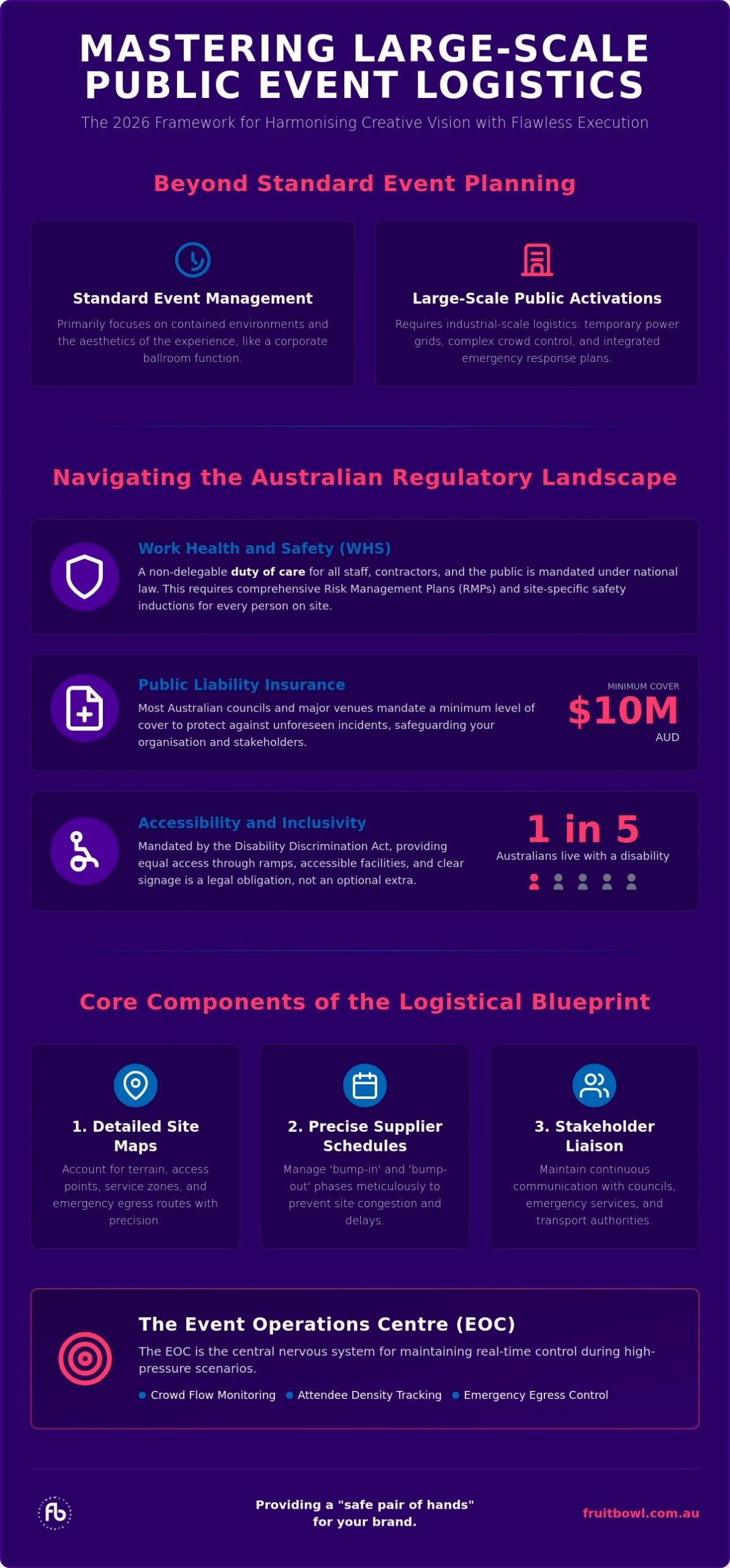
Large scale public event logistics represents the invisible architecture that supports every successful mass gathering. It’s the end-to-end orchestration of movement, infrastructure, and safety that ensures thousands of people can interact with a brand without friction. While standard event management might focus on the aesthetics of a ballroom, industrial-scale public activations require a different level of rigour. They demand temporary power grids, complex crowd control barriers, and integrated emergency response plans that can withstand the pressure of a massive audience.

For a 2026-ready project, this discipline has evolved beyond static spreadsheets. It now incorporates sophisticated data and real-time tracking to monitor asset movement and attendee density across vast sites. This technical precision acts as a strategic safeguard for brand reputation; a single failure in large scale public event logistics, such as a crowd bottleneck or a safety breach, can instantly dismantle years of brand equity. By prioritising logistical integrity, organisers ensure that the public’s focus remains entirely on the experience rather than the mechanics behind it.

The Strategic Intersection of Logistics and Creative Vision

Core Components of the Logistical Blueprint

Developing a robust logistical blueprint requires a sequential, logical progression that leaves no variable to chance. This process organises various moving parts into a cohesive system, including:

  • Detailed site maps that account for terrain, access points, and service zones.
  • Precise supplier schedules to manage the “bump-in” and “bump-out” phases without site congestion.
  • Continuous stakeholder liaison with local councils, emergency services, and transport authorities.

Compliance in Australia isn’t a box-ticking exercise; it’s a fundamental pillar of large scale public event logistics. Organisers operate under national harmonised Work Health and Safety (WHS) laws, which establish a non-delegable duty of care to staff, contractors, and the public. This requires a comprehensive Risk Management Plan (RMP) that identifies potential hazards and implements rigorous controls before a single piece of equipment arrives on site. Every supplier and contractor must undergo site-specific inductions to ensure they understand these safety protocols. To protect the organisation, most Australian councils and venues mandate a minimum of $10,000,000 AUD in public liability insurance, which serves as a baseline requirement for events scheduled in 2026.

True inclusivity is mandated by the Disability Discrimination Act. With one in five Australians living with a disability, site accessibility is a legal obligation rather than an optional feature. This involves meticulous planning for ramps, accessible toilets, and clear signage to ensure every attendee experiences the event safely and with dignity. Failing to address these requirements doesn’t just risk a safety breach; it can lead to significant legal and reputational consequences.

Work Health and Safety (WHS) for Public Activations

Government Protocol and Stakeholder Liaison

Managing high-stakes government event planning requires a nuanced understanding of public sector protocols. You must coordinate with local councils for permits, such as Melbourne’s public event application fees which can reach $3,022.00 for major gatherings, while simultaneously liaising with transport authorities and police. Successful Emergency Services Management relies on these relationships being established months in advance. Ensuring all compliance documentation is audit-ready well before the bump-in phase prevents last-minute delays and provides a clear paper trail for regulators.

An Integrated Management System (IMS) provides the necessary structure for document control and audit trails. It ensures every permit, induction record, and safety certificate is centrally located and easily accessible. Maintaining this level of order is essential for large scale public event logistics, allowing for a frictionless experience when authorities conduct site inspections. If you require a partner to navigate these complexities, our team offers a disciplined approach to compliance that ensures your activation remains secure and fully compliant with all Australian regulations.

Technical Direction and Infrastructure Management

AV Management and Technical Excellence

Supplier Coordination and Quality Control
Risk Management and Real-Time Operational Control

The heartbeat of any live activation is the Event Operations Centre (EOC). This centralised hub serves as the command and control point where all streams of data converge, allowing for real-time monitoring and rapid response. In the context of large scale public event logistics, the EOC is where the invisible architecture becomes visible through live feeds and communication networks. It’s here that senior leads maintain a bird’s-eye view of site activity, ensuring that every operational facet remains aligned with the safety and strategic objectives established during the planning phase.

Effective risk management relies on pre-defined emergency playbooks that cover every conceivable scenario, from severe weather events to critical technical failures or security incidents. These documents aren’t static. They’re living strategies that dictate precise actions for every member of the team. Maintaining composure under the intense pressure of a live event is what distinguishes a seasoned expert. This “Safe Pair of Hands” approach ensures that even when the unexpected occurs, the response is methodical, deliberate, and designed to restore order without causing alarm to the public.

Crowd Logistics and Attendee Safety

The Art of On-Site Contingency Planning

Logistical friction points are often identified and resolved through rigorous dry runs and rehearsals. These exercises test the chain of command and ensure that every staff member understands their specific role in incident reporting. The logistics lead must be empowered to make rapid-response decisions based on the live data provided by the EOC. This structured decision-making process prevents the fragmentation of authority during high-pressure situations, keeping the event on track and the brand’s reputation secure.

If you are planning a high-stakes activation and require a partner who brings order to complexity, contact our team to discuss your large scale public event logistics.

Strategic Event Management: The Fruitbowl Methodology

End-to-End Project Lifecycle Management

  • Comprehensive site restoration to meet local council and environmental standards.
  • Detailed ROI reporting that quantifies the success of the activation against your KPIs.
  • Asset recovery and inventory management for future event cycles.
  • Final compliance audits to ensure all regulatory obligations were met.

Why a Sophisticated Strategist is Essential for 2026

Partner with Fruitbowl Events Agency for your next large-scale public activation.

Building Operational Excellence for Your 2026 Activation

Mastering the complexities of 2026 requires a disciplined shift from standard planning to industrial-scale orchestration. Success hinges on the seamless integration of technical direction, rigorous WHS compliance, and real-time operational control. By establishing an Event Operations Centre and adhering to a methodical project lifecycle, you ensure that your creative ambition is never compromised by logistical failure. Executing large scale public event logistics with this level of precision protects your brand and provides a frictionless experience for every attendee.

With over 28 years of industry-leading experience, Fruitbowl offers national expertise in government and corporate activations through a comprehensive end-to-end methodology. We bring order and clarity to high-stakes environments, ensuring every detail is under expert supervision. Secure a safe pair of hands for your next event and deliver a safe, high-impact public activation that sets a new standard for excellence.

Frequently Asked Questions

What is the role of a logistics coordinator in a large scale public event?

A logistics coordinator manages the movement of every physical asset and person on the event site. They oversee complex delivery schedules and site layouts to ensure that infrastructure is placed correctly and on time. This role is the operational backbone of large scale public event logistics, bridging the gap between the initial strategic plan and the physical reality of the build.

How do you manage crowd safety for events with over 10,000 attendees?

Managing crowd safety for large audiences requires a combination of flow analysis and density monitoring. You must implement physical barriers, clear wayfinding signage, and designated egress routes that can handle peak volumes without creating bottlenecks. Real-time data from site marshals and surveillance allows for dynamic adjustments to crowd movement, ensuring that attendee density remains within safe limits at all times.

What are the key Australian WHS regulations for public event organisers?

Organisers must comply with national harmonised Work Health and Safety laws, which mandate a non-delegable duty of care. Key requirements include a detailed Risk Management Plan, site-specific inductions for all contractors, and adherence to Australian Standards for temporary structures and electrical installations. You are also legally required to maintain comprehensive insurance coverage, often starting at a minimum of $10,000,000 AUD in public liability for major gatherings.

How early should logistical planning begin for a national festival?

Logistical planning for a national festival should ideally commence 12 to 18 months before the event date. This extended lead time is necessary to secure high-demand venues, navigate complex council permit processes, and engage with transport authorities. Early planning allows for a more methodical approach to large scale public event logistics, providing the buffer needed to manage multi-stakeholder requirements and technical riders for international talent.

What is an Event Operations Centre (EOC) and why is it necessary?

An Event Operations Centre (EOC) is a centralised command hub where all communication and data streams are monitored in real-time. It’s necessary because it provides a single point of truth for incident reporting and rapid-response decision-making. By housing representatives from security, emergency services, and technical teams in one location, the EOC ensures that the response to any on-site issue is coordinated and immediate.

How do you coordinate multiple suppliers on a complex event site?

Coordination is achieved through a master bump-in schedule that dictates the precise arrival and departure times for every vendor. This prevents site congestion and ensures that infrastructure is built in a logical, sequential order. A central technical director or site manager oversees this process, conducting site inductions and ensuring that all third-party contractors adhere to the overarching safety and design standards established in the planning phase.

What happens if there is a technical failure during a live public event?

If a technical failure occurs, the team immediately activates pre-defined contingency plans and redundant systems. For example, if a primary power source fails, secondary generators with automatic transfer switches should engage to maintain critical infrastructure. The EOC manages the communication of the incident, ensuring that technical leads can resolve the issue while security and crowd marshals maintain order on the ground.

How is logistical success measured after a large scale public event?

Success is measured through a combination of quantitative data and qualitative reporting. This includes reviewing safety incident logs, analysing attendee flow data, and assessing the efficiency of the bump-out phase. A comprehensive post-event report also evaluates the effectiveness of budget management and stakeholder liaison, providing a clear picture of the return on investment and the quality of the site restoration.

What if the greatest threat to your event’s creative vision isn’t a lack of imagination, but a failure of the invisible architecture supporting it? In the high-stakes world of large scale public event logistics, the margin for error is non-existent. You likely understand that managing a multi-stakeholder environment across Australia requires more than just a good plan; it demands a sophisticated balance of creative ambition and unwavering technical discipline. It’s natural to feel the pressure of navigating stringent WHS regulations and the constant concern that a crowd control failure could overshadow your brand’s message.

This article provides a strategic framework for 2026 to help you harmonise bold ideas with the logistical precision required for success. You’ll discover how to transform complex compliance and regulatory burdens into a seamless attendee experience that protects both your audience and your reputation. We will outline a methodical approach to end-to-end management, from navigating City of Melbourne application fees to ensuring accessibility for the one in five Australians living with a disability, positioning your project as a “safe pair of hands” for any major activation.

Key Takeaways

  • Understand the distinction between standard event planning and the industrial-scale requirements of major public activations to ensure your creative vision is supported by robust infrastructure.
  • Navigate the Australian regulatory landscape with confidence by integrating Work Health and Safety (WHS) compliance and accessibility standards into your core site design.
  • Learn how to bridge the gap between creative ambition and physical constraints through expert technical direction and meticulous infrastructure management.
  • Discover the role of an Event Operations Centre (EOC) in maintaining real-time control over crowd flow, density, and emergency egress during high-pressure scenarios.
  • Master large scale public event logistics by applying a proven methodology that provides a “safe pair of hands” for high-stakes, multi-stakeholder environments.

The Invisible Architecture: Defining Large Scale Public Event Logistics

Large scale public event logistics represents the invisible architecture that supports every successful mass gathering. It’s the end-to-end orchestration of movement, infrastructure, and safety that ensures thousands of people can interact with a brand without friction. While standard event management might focus on the aesthetics of a ballroom, industrial-scale public activations require a different level of rigour. They demand temporary power grids, complex crowd control barriers, and integrated emergency response plans that can withstand the pressure of a massive audience.

For a 2026-ready project, this discipline has evolved beyond static spreadsheets. It now incorporates sophisticated data and real-time tracking to monitor asset movement and attendee density across vast sites. This technical precision acts as a strategic safeguard for brand reputation; a single failure in large scale public event logistics, such as a crowd bottleneck or a safety breach, can instantly dismantle years of brand equity. By prioritising logistical integrity, organisers ensure that the public’s focus remains entirely on the experience rather than the mechanics behind it.

The Strategic Intersection of Logistics and Creative Vision

Core Components of the Logistical Blueprint

Developing a robust logistical blueprint requires a sequential, logical progression that leaves no variable to chance. This process organises various moving parts into a cohesive system, including:

  • Detailed site maps that account for terrain, access points, and service zones.
  • Precise supplier schedules to manage the “bump-in” and “bump-out” phases without site congestion.
  • Continuous stakeholder liaison with local councils, emergency services, and transport authorities.

Compliance in Australia isn’t a box-ticking exercise; it’s a fundamental pillar of large scale public event logistics. Organisers operate under national harmonised Work Health and Safety (WHS) laws, which establish a non-delegable duty of care to staff, contractors, and the public. This requires a comprehensive Risk Management Plan (RMP) that identifies potential hazards and implements rigorous controls before a single piece of equipment arrives on site. Every supplier and contractor must undergo site-specific inductions to ensure they understand these safety protocols. To protect the organisation, most Australian councils and venues mandate a minimum of $10,000,000 AUD in public liability insurance, which serves as a baseline requirement for events scheduled in 2026.

True inclusivity is mandated by the Disability Discrimination Act. With one in five Australians living with a disability, site accessibility is a legal obligation rather than an optional feature. This involves meticulous planning for ramps, accessible toilets, and clear signage to ensure every attendee experiences the event safely and with dignity. Failing to address these requirements doesn’t just risk a safety breach; it can lead to significant legal and reputational consequences.

Work Health and Safety (WHS) for Public Activations

Government Protocol and Stakeholder Liaison

Managing high-stakes government event planning requires a nuanced understanding of public sector protocols. You must coordinate with local councils for permits, such as Melbourne’s public event application fees which can reach $3,022.00 for major gatherings, while simultaneously liaising with transport authorities and police. Successful Emergency Services Management relies on these relationships being established months in advance. Ensuring all compliance documentation is audit-ready well before the bump-in phase prevents last-minute delays and provides a clear paper trail for regulators.

An Integrated Management System (IMS) provides the necessary structure for document control and audit trails. It ensures every permit, induction record, and safety certificate is centrally located and easily accessible. Maintaining this level of order is essential for large scale public event logistics, allowing for a frictionless experience when authorities conduct site inspections. If you require a partner to navigate these complexities, our team offers a disciplined approach to compliance that ensures your activation remains secure and fully compliant with all Australian regulations.

Technical Direction and Infrastructure Management

AV Management and Technical Excellence

Supplier Coordination and Quality Control

Risk Management and Real-Time Operational Control

The heartbeat of any live activation is the Event Operations Centre (EOC). This centralised hub serves as the command and control point where all streams of data converge, allowing for real-time monitoring and rapid response. In the context of large scale public event logistics, the EOC is where the invisible architecture becomes visible through live feeds and communication networks. It’s here that senior leads maintain a bird’s-eye view of site activity, ensuring that every operational facet remains aligned with the safety and strategic objectives established during the planning phase.

Effective risk management relies on pre-defined emergency playbooks that cover every conceivable scenario, from severe weather events to critical technical failures or security incidents. These documents aren’t static. They’re living strategies that dictate precise actions for every member of the team. Maintaining composure under the intense pressure of a live event is what distinguishes a seasoned expert. This “Safe Pair of Hands” approach ensures that even when the unexpected occurs, the response is methodical, deliberate, and designed to restore order without causing alarm to the public.

Crowd Logistics and Attendee Safety

The Art of On-Site Contingency Planning

Logistical friction points are often identified and resolved through rigorous dry runs and rehearsals. These exercises test the chain of command and ensure that every staff member understands their specific role in incident reporting. The logistics lead must be empowered to make rapid-response decisions based on the live data provided by the EOC. This structured decision-making process prevents the fragmentation of authority during high-pressure situations, keeping the event on track and the brand’s reputation secure.

If you are planning a high-stakes activation and require a partner who brings order to complexity, contact our team to discuss your large scale public event logistics.

Strategic Event Management: The Fruitbowl Methodology

End-to-End Project Lifecycle Management

  • Comprehensive site restoration to meet local council and environmental standards.
  • Detailed ROI reporting that quantifies the success of the activation against your KPIs.
  • Asset recovery and inventory management for future event cycles.
  • Final compliance audits to ensure all regulatory obligations were met.

Why a Sophisticated Strategist is Essential for 2026

Partner with Fruitbowl Events Agency for your next large-scale public activation.

Building Operational Excellence for Your 2026 Activation

Mastering the complexities of 2026 requires a disciplined shift from standard planning to industrial-scale orchestration. Success hinges on the seamless integration of technical direction, rigorous WHS compliance, and real-time operational control. By establishing an Event Operations Centre and adhering to a methodical project lifecycle, you ensure that your creative ambition is never compromised by logistical failure. Executing large scale public event logistics with this level of precision protects your brand and provides a frictionless experience for every attendee.

With over 28 years of industry-leading experience, Fruitbowl offers national expertise in government and corporate activations through a comprehensive end-to-end methodology. We bring order and clarity to high-stakes environments, ensuring every detail is under expert supervision. Secure a safe pair of hands for your next event and deliver a safe, high-impact public activation that sets a new standard for excellence.

Frequently Asked Questions

What is the role of a logistics coordinator in a large scale public event?

A logistics coordinator manages the movement of every physical asset and person on the event site. They oversee complex delivery schedules and site layouts to ensure that infrastructure is placed correctly and on time. This role is the operational backbone of large scale public event logistics, bridging the gap between the initial strategic plan and the physical reality of the build.

How do you manage crowd safety for events with over 10,000 attendees?

Managing crowd safety for large audiences requires a combination of flow analysis and density monitoring. You must implement physical barriers, clear wayfinding signage, and designated egress routes that can handle peak volumes without creating bottlenecks. Real-time data from site marshals and surveillance allows for dynamic adjustments to crowd movement, ensuring that attendee density remains within safe limits at all times.

What are the key Australian WHS regulations for public event organisers?

Organisers must comply with national harmonised Work Health and Safety laws, which mandate a non-delegable duty of care. Key requirements include a detailed Risk Management Plan, site-specific inductions for all contractors, and adherence to Australian Standards for temporary structures and electrical installations. You are also legally required to maintain comprehensive insurance coverage, often starting at a minimum of $10,000,000 AUD in public liability for major gatherings.

How early should logistical planning begin for a national festival?

Logistical planning for a national festival should ideally commence 12 to 18 months before the event date. This extended lead time is necessary to secure high-demand venues, navigate complex council permit processes, and engage with transport authorities. Early planning allows for a more methodical approach to large scale public event logistics, providing the buffer needed to manage multi-stakeholder requirements and technical riders for international talent.

What is an Event Operations Centre (EOC) and why is it necessary?

An Event Operations Centre (EOC) is a centralised command hub where all communication and data streams are monitored in real-time. It’s necessary because it provides a single point of truth for incident reporting and rapid-response decision-making. By housing representatives from security, emergency services, and technical teams in one location, the EOC ensures that the response to any on-site issue is coordinated and immediate.

How do you coordinate multiple suppliers on a complex event site?

Coordination is achieved through a master bump-in schedule that dictates the precise arrival and departure times for every vendor. This prevents site congestion and ensures that infrastructure is built in a logical, sequential order. A central technical director or site manager oversees this process, conducting site inductions and ensuring that all third-party contractors adhere to the overarching safety and design standards established in the planning phase.

What happens if there is a technical failure during a live public event?

If a technical failure occurs, the team immediately activates pre-defined contingency plans and redundant systems. For example, if a primary power source fails, secondary generators with automatic transfer switches should engage to maintain critical infrastructure. The EOC manages the communication of the incident, ensuring that technical leads can resolve the issue while security and crowd marshals maintain order on the ground.

How is logistical success measured after a large scale public event?

Success is measured through a combination of quantitative data and qualitative reporting. This includes reviewing safety incident logs, analysing attendee flow data, and assessing the efficiency of the bump-out phase. A comprehensive post-event report also evaluates the effectiveness of budget management and stakeholder liaison, providing a clear picture of the return on investment and the quality of the site restoration.

Back to Articles
Request A Quote

Make an
Enquiry

Untitled design

What Makes Us Different?

True end-to-end solution so you can hand off to us, focus on your priorities and enjoy the event without any stress

Unmatched industry expertise looking after diverse range of high-profile events, cultural festivals & activations

Meticulous attention to every detail and precise execution of events with our streamlined processes

Tailored solutions with bespoke strategies to ensure we align with your brand and objectives

Make an Enquiry

"*" indicates required fields

This field is for validation purposes and should be left unchanged.

"*" indicates required fields

This field is for validation purposes and should be left unchanged.