What happens when a supplier’s late delivery shifts the schedule for AV, catering and the venue team at once? In event planning, one change can affect several workstreams. Managing multiple event vendors becomes difficult when updates sit in separate emails, documents and conversations, or no one knows who owns the next decision.
A clear coordination system makes that complexity manageable. Give every supplier a shared view of responsibilities, deliverables, deadlines and dependencies, then establish a reliable rhythm for updates and escalation. This guide covers practical ways to keep vendors aligned before and during your event, respond calmly when plans change and maintain focus on the experience you’re creating.
You’ll learn how to clarify ownership, build a master timeline, coordinate supplier communications and manage dependencies across workstreams. We’ll also look at how technical delivery and safety planning fit into the wider event plan. Fruitbowl Events Agency’s experience delivering corporate and public events across Australia informs this practical approach to bringing separate suppliers together as one coordinated team.
Key Takeaways
- Start by mapping the full delivery ecosystem so supplier scopes and timelines support the event’s objectives.
- Make managing multiple event vendors more reliable by recording each supplier’s deliverables, decision-maker, milestones and dependencies in one shared plan.
- Set a consistent communication protocol and document decisions so changes reach every affected supplier.
- Use a live run sheet to guide readiness checks, briefings, milestone monitoring and event-day close-out.
- Fruitbowl’s Event Management and In-House AV Production can bring supplier coordination and technical delivery into the wider event plan.
Table of Contents
- Managing multiple event vendors starts with understanding the whole delivery ecosystem
- Build an event vendor management plan around ownership and dependencies
- Keep multiple event vendors aligned with communication and change control
- Coordinate event vendors on the day with a live operational rhythm
- How Fruitbowl brings multiple event vendors together
Managing multiple event vendors starts with understanding the whole delivery ecosystem
Coordinating several suppliers means balancing different scopes, schedules and working methods while keeping the event’s purpose in view. Each supplier may focus on its own brief, but the event depends on their work fitting together. Venue access affects when staging can begin; staging readiness affects audiovisual setup; and technical checks can determine when entertainment is ready to rehearse.
Event vendor management is the practice of aligning external suppliers’ responsibilities, deliverables and timing with the event’s objectives so their separate contributions work as one coordinated delivery. This is the operational logic behind Event management principles: event logistics are connected, not isolated tasks. Managing multiple event vendors therefore starts with understanding what each supplier delivers and what other work depends on it.
Which event vendors need to work as one team?
The supplier mix depends on the event format, audience needs and delivery scope. A conference may involve a venue, catering, audiovisual and staffing suppliers, while a public event may also require entertainment suppliers and additional operational support. Each has a distinct deliverable, but the shared outcome is a smooth attendee journey, from arrival and access through the programme to departure.
Look beyond the contract list and map how each contribution connects to the next. The venue provides access and space, catering plans service around the schedule, and audiovisual suppliers prepare the technical environment for speakers or performers. The relationships vary by event, so record the actual hand-offs rather than assuming every supplier has the same requirements.
Where do vendor coordination gaps create event risk?
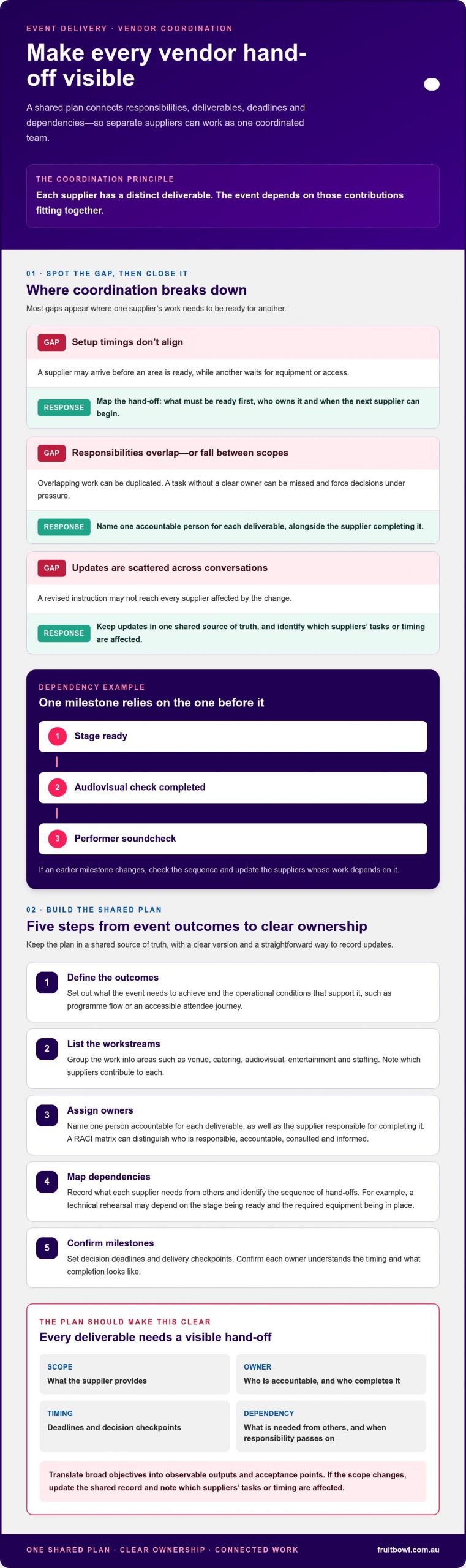
Gaps often appear at hand-offs. If setup timings aren’t aligned, one supplier may arrive before an area is ready, while another waits for equipment or access. If responsibilities overlap, work can be duplicated. If a task falls between scopes, it may be missed. Either problem can disrupt the schedule and force decisions under pressure.
Trace dependencies against the event run sheet. For example, a stage must be ready before an audiovisual check, and the check must finish before a performer’s soundcheck. Each milestone relies on the previous one. A change to access time may affect the whole sequence. Mapping these connections helps the event team identify which suppliers need an update and whether programme timings or attendee movement could be affected.
Not every dependency carries the same level of risk. A catering change may affect meal timing and guest flow, while a technical change may affect a session’s readiness. Make the sequence visible: what needs to happen, who owns it, what must be ready first and which shared event outcome depends on it. That ecosystem view gives coordination a clear foundation.
Build an event vendor management plan around ownership and dependencies
A useful plan does more than collect supplier contacts. It translates the event’s objectives into coordinated work, makes accountability visible and shows how one deliverable affects another. When managing multiple event vendors, keep the plan in a shared source of truth, with a clear version and a straightforward way to record updates.
- Define the outcomes. Set out what the event needs to achieve and the operational conditions that support it, such as the programme flow or an accessible attendee journey.
- List the workstreams. Group the work into areas such as venue, catering, audiovisual, entertainment and staffing, then note which suppliers contribute to each.
- Assign owners. Name one person accountable for each deliverable, alongside the supplier responsible for completing the work. A RACI matrix can help distinguish who is responsible, accountable, consulted and informed.
- Map dependencies. Record what each supplier needs from others and identify the sequence of hand-offs. For example, a technical rehearsal may depend on the stage being ready and the required equipment being in place.
- Confirm milestones. Set decision deadlines and delivery checkpoints, then confirm each owner understands the timing and what completion looks like.
Give every deliverable one accountable owner and a defined hand-off, so responsibility stays clear from the first brief to completion. The plan should capture each supplier’s scope, specific deliverables, decision-maker, deadlines and dependencies. Keep changes visible in the same record rather than leaving revised instructions in a conversation that other affected suppliers can’t access.
How do you make vendor scopes and hand-offs clear?
Translate broad objectives into observable outputs and acceptance points. Instead of asking a supplier to “support the programme”, specify the delivery required, who approves it and when it must be ready. Document what each supplier provides, what they need from others and the point at which responsibility passes between teams. If the scope changes, update the shared record and identify suppliers whose tasks or timing are affected.
How should the integrated vendor schedule work?
Build the schedule backwards from event opening. Include setup, technical testing, rehearsals and pack-down, then mark decision deadlines and dependencies alongside each milestone. If testing depends on equipment installation, show both the installation deadline and who is responsible for confirming readiness. This makes the order of work clear, not just the due dates.
For a conference, the conference logistics coordinator guide adds context on coordinating the moving parts of that format. A broader Event vendor management guide also explores supplier coordination across the event process. Fruitbowl’s event management approach connects workstreams with event objectives.
Keep multiple event vendors aligned with communication and change control
Managing multiple event vendors takes more than sending regular updates. Set one event-level communication protocol so suppliers know where information lives, when updates are shared and who has authority to make decisions. Choose a primary channel for current documents and formal updates, then agree on a check-in cadence that suits the planning stage. Name a decision owner and a backup contact so questions don’t stall when the lead is unavailable.
Keep a concise decision log alongside the current schedule. Record what was agreed, who made the decision, when it applies and which deliverables or suppliers are affected. A change to a session time, for example, may affect speakers, audiovisual cues, catering or staffing. Send the relevant update to each affected supplier, then ask the owners to acknowledge it and confirm any revised actions or timings.
What should a useful vendor briefing cover?
Give each supplier the event objectives, audience context, scope boundaries and operational expectations relevant to their work. Share the current schedule, site information, contact details and hand-off points they need. Don’t assume every supplier requires the same level of detail. Explain how to raise questions, report a change and escalate an urgent issue, including who can approve a decision.
How can change control prevent confusion?
Use a consistent sequence whenever plans shift: log the change and its reason, assess its effect on timing and supplier dependencies, assign the decision-maker, update the record, then notify affected vendors. Before confirming a change, check what relies on the original plan. For technical work, a shift in staging or programme timing can affect setup and testing. The AV management for events framework offers further context on coordinating those dependencies.
Issue one updated version of the relevant schedule or briefing information, with a clear revision date or status, and retire superseded copies. This reduces the chance that one supplier acts on an old time while another follows the new one. Keep the change record brief but complete: what changed, why, who approved it, which workstreams are affected and what each owner must do next.
Match escalation to the issue. A routine clarification can go to the relevant workstream owner. A delay affecting another supplier should be raised with the event-level decision-maker. Conflicting requirements or unresolved decisions may need the event lead to set priorities and communicate the outcome. If safety or attendee operations could be affected, treat the matter as time-sensitive and follow the event’s established safety and escalation arrangements. Close the loop by confirming owners understand the decision, not simply that a message was sent.
Coordinate event vendors on the day with a live operational rhythm
On event day, coordination needs to move from planning documents to clear, timely action. A designated control lead should maintain the event-wide view, monitor progress against the schedule and direct updates through the agreed channel. Suppliers can manage their own work while the control lead assesses how a change in one workstream may affect others. This avoids competing instructions and gives the team one point of coordination.
A single current run sheet gives every supplier the same reference for timing, contacts and transitions, helping separate tasks align around the live event. Keep it accessible to the people who need it, and make one person responsible for communicating approved updates. The run sheet should show key milestones, hand-offs and the relevant contact for each operational area.
How should the event-day vendor briefing run?
Before audience-facing activity begins, bring relevant suppliers together to reconfirm roles, schedule, hand-offs, communication channels and escalation responsibilities. Highlight time-critical dependencies, such as a technical check that must finish before a session begins, and summarise agreed changes since the latest briefing. Give suppliers a chance to raise practical issues while there’s still time to assess their impact and agree on an owner.
Keep the briefing focused on what people need to deliver next. Confirm who will issue updates, how suppliers should acknowledge a changed instruction and who can make decisions if requirements conflict. If not every supplier needs the full briefing, share the relevant information with each team while maintaining one consistent event-wide direction.
What belongs in the live vendor control process?
Use a steady sequence throughout delivery: confirm readiness, brief the team, monitor milestones, resolve issues and coordinate close-out. The control lead can compare reported progress with the run sheet, check in with owners at critical hand-offs and alert affected suppliers when a schedule change is approved. A change to a stage transition, for example, may need to reach technical and programme teams, not just the supplier who raised it.
Keep a risk register available to the control team, with priority issues, owners and response actions visible. When a problem arises, record the decision and next step, then follow up with the responsible person. Escalate issues that affect safety, event timing or multiple workstreams to the appropriate event decision-maker rather than allowing separate teams to act on conflicting assumptions.
Close-out is part of live coordination too. Confirm pack-down responsibilities, the order in which areas are cleared and how site hand-back will be managed. Check that supplier teams know when their work is complete and whether another team relies on the space or equipment being released. This helps prevent the final operational hand-off from becoming an afterthought.
Fruitbowl’s Event Management coordinates delivery around an event’s objectives, including the operational rhythm needed across suppliers. Fruitbowl’s event management services bring event workstreams into alignment.
How Fruitbowl brings multiple event vendors together
Managing multiple event vendors works best when coordination is tied to the event’s objectives, delivery requirements and audience needs. Fruitbowl provides complete or partial Event Management for corporate and public events across Australia, bringing planning, logistics and on-site delivery into a coordinated approach. The scope can be shaped around the support needed, from oversight of the wider event to focused coordination of particular workstreams.
This matters when suppliers’ work is closely connected. In-House AV Production integrates staging, lighting, sound, vision, LED screens and technical direction with the wider event plan. Rather than treating technical delivery as a separate task, consider it alongside programme timing, venue arrangements and audience experience. This joined-up view clarifies how production milestones and supplier hand-offs fit into the event’s delivery requirements.
When can an event management partner help coordinate vendors?
Additional coordination can help when an event involves many suppliers, complex dependencies or substantial on-site delivery requirements. Complete or partial Event Management can support planning, logistics and delivery, with oversight shaped around the event’s objectives and areas of complexity. The corporate event management framework provides broader context on organising delivery around intended outcomes.
Operational planning also needs to connect with Event Safety & Compliance. Risk assessments, crowd and traffic management, emergency procedures and supporting documentation are part of the event’s wider coordination picture. Clear responsibilities help carry these considerations into relevant workstreams and ensure the people involved in delivery understand them, rather than leaving them apart from the operational plan.
Fruitbowl brings established event experience to this work. The team has operated for 28+ years, delivered 2,500+ events and delivers 50+ successful events every year. These proof points reflect experience across corporate and public events, including work for councils, government bodies and major festivals.
What should a coordinated vendor team deliver?
A coordinated team aligns supplier workstreams around agreed objectives and audience needs. Each supplier brings its own expertise, while clear ownership, communication and operational oversight connect those contributions into a coherent event experience. The focus is not simply on completing individual tasks; it is on ensuring they support the programme and delivery requirements as a whole.
Fruitbowl brings Event Management, In-House AV Production and Event Safety & Compliance into the broader delivery picture. The right coordination structure depends on the event and the support required. Discuss your event with Fruitbowl to explore a tailored approach.
Set your event up for confident delivery
Before planning moves into its next phase, identify where coordination will matter most. Which decisions need a clear owner? Where could a change affect another workstream? What level of oversight will help your team stay focused on the event’s purpose? These questions turn managing multiple event vendors from a collection of separate arrangements into a deliberate approach built around your requirements.
Your coordination plan should be practical enough to guide decisions as the event develops, while flexible enough to accommodate changes without losing sight of the intended experience. Start by identifying the support your team needs, then shape responsibilities and communication around that need. A considered approach gives suppliers clearer direction and helps your team make decisions with greater confidence.
For a tailored approach to coordinating your event, explore event management with Fruitbowl. With the right structure in place, suppliers can contribute to a shared purpose and your team can move forward with confidence.
Frequently Asked Questions
How many vendors can one event manager coordinate?
There’s no universal maximum. The right level of coordination depends on the event’s scope, format, supplier dependencies and available support. Managing multiple event vendors is more workable when oversight matches the work: a straightforward supplier with few hand-offs may need less attention than a workstream linked to several others. Assess the number of decision points, potential clashes and required approvals, rather than relying on supplier count alone.
Can event vendors communicate directly with each other?
Yes. Direct communication can make a defined hand-off more efficient, provided it doesn’t create competing instructions. For example, two suppliers can coordinate a delivery time directly if it fits the approved schedule and neither is changing scope. Set boundaries for decisions that require the event lead’s approval, then record agreed actions in the shared event record so direct conversations remain consistent with current plans.
What happens if an event vendor changes a requirement close to event day?
Assess the proposed change before treating it as agreed. Consider its effect on the event objectives, schedule, safety considerations and any other supplier deliverables that depend on the original requirement. The authorised decision-maker can weigh the options, document the outcome and ensure affected parties receive the same direction. Some late changes may not be practical to accommodate, so a timely impact assessment supports informed choices.
Is a spreadsheet enough to manage multiple event vendors?
A spreadsheet may suit a straightforward event with a small number of workstreams, provided someone owns it and keeps it current. Check whether the right people can readily find responsibilities, deadlines, decisions and current documents. As contributors and dependencies grow, a static tracker may become harder to maintain. Choose a system that supports the event’s actual coordination needs without adding unnecessary complexity.
How do you manage confidential information shared with event vendors?
Share only the information a supplier needs to carry out its agreed responsibilities. Before distributing a brief, identify sensitive material and remove details that aren’t relevant to that supplier’s work. Use appropriate access controls for shared documents, organise versions so recipients can distinguish current files, and remove access when it’s no longer needed. These practical steps help limit unnecessary circulation without assuming every supplier needs identical information.
Should the same event vendors be used for every event?
Not necessarily. Reassess each supplier against the current event’s objectives, audience, format, technical requirements and delivery capacity. A familiar working relationship can make collaboration easier, but it doesn’t automatically make that supplier the right fit for a different brief. Record the reason for each appointment and how the supplier’s role supports the plan. That gives the team a clear basis for decisions as event requirements change.
What should happen in a post-event vendor review?
Review what was agreed against what was delivered, including timing, hand-offs and communication. Invite relevant feedback from suppliers and the event team while specific details are still fresh. Capture both issues and practices that worked well, then turn them into practical adjustments for future briefs, schedules or coordination arrangements. Keep the discussion evidence-based and focused on improving the working process rather than assigning blame.
What happens when a supplier’s late delivery shifts the schedule for AV, catering and the venue team at once? In event planning, one change can affect several workstreams. Managing multiple event vendors becomes difficult when updates sit in separate emails, documents and conversations, or no one knows who owns the next decision.
A clear coordination system makes that complexity manageable. Give every supplier a shared view of responsibilities, deliverables, deadlines and dependencies, then establish a reliable rhythm for updates and escalation. This guide covers practical ways to keep vendors aligned before and during your event, respond calmly when plans change and maintain focus on the experience you’re creating.
You’ll learn how to clarify ownership, build a master timeline, coordinate supplier communications and manage dependencies across workstreams. We’ll also look at how technical delivery and safety planning fit into the wider event plan. Fruitbowl Events Agency’s experience delivering corporate and public events across Australia informs this practical approach to bringing separate suppliers together as one coordinated team.
Key Takeaways
- Start by mapping the full delivery ecosystem so supplier scopes and timelines support the event’s objectives.
- Make managing multiple event vendors more reliable by recording each supplier’s deliverables, decision-maker, milestones and dependencies in one shared plan.
- Set a consistent communication protocol and document decisions so changes reach every affected supplier.
- Use a live run sheet to guide readiness checks, briefings, milestone monitoring and event-day close-out.
- Fruitbowl’s Event Management and In-House AV Production can bring supplier coordination and technical delivery into the wider event plan.
Table of Contents
- Managing multiple event vendors starts with understanding the whole delivery ecosystem
- Build an event vendor management plan around ownership and dependencies
- Keep multiple event vendors aligned with communication and change control
- Coordinate event vendors on the day with a live operational rhythm
- How Fruitbowl brings multiple event vendors together
Managing multiple event vendors starts with understanding the whole delivery ecosystem
Coordinating several suppliers means balancing different scopes, schedules and working methods while keeping the event’s purpose in view. Each supplier may focus on its own brief, but the event depends on their work fitting together. Venue access affects when staging can begin; staging readiness affects audiovisual setup; and technical checks can determine when entertainment is ready to rehearse.
Event vendor management is the practice of aligning external suppliers’ responsibilities, deliverables and timing with the event’s objectives so their separate contributions work as one coordinated delivery. This is the operational logic behind Event management principles: event logistics are connected, not isolated tasks. Managing multiple event vendors therefore starts with understanding what each supplier delivers and what other work depends on it.
Which event vendors need to work as one team?
The supplier mix depends on the event format, audience needs and delivery scope. A conference may involve a venue, catering, audiovisual and staffing suppliers, while a public event may also require entertainment suppliers and additional operational support. Each has a distinct deliverable, but the shared outcome is a smooth attendee journey, from arrival and access through the programme to departure.
Look beyond the contract list and map how each contribution connects to the next. The venue provides access and space, catering plans service around the schedule, and audiovisual suppliers prepare the technical environment for speakers or performers. The relationships vary by event, so record the actual hand-offs rather than assuming every supplier has the same requirements.
Where do vendor coordination gaps create event risk?
Gaps often appear at hand-offs. If setup timings aren’t aligned, one supplier may arrive before an area is ready, while another waits for equipment or access. If responsibilities overlap, work can be duplicated. If a task falls between scopes, it may be missed. Either problem can disrupt the schedule and force decisions under pressure.
Trace dependencies against the event run sheet. For example, a stage must be ready before an audiovisual check, and the check must finish before a performer’s soundcheck. Each milestone relies on the previous one. A change to access time may affect the whole sequence. Mapping these connections helps the event team identify which suppliers need an update and whether programme timings or attendee movement could be affected.
Not every dependency carries the same level of risk. A catering change may affect meal timing and guest flow, while a technical change may affect a session’s readiness. Make the sequence visible: what needs to happen, who owns it, what must be ready first and which shared event outcome depends on it. That ecosystem view gives coordination a clear foundation.
Build an event vendor management plan around ownership and dependencies
A useful plan does more than collect supplier contacts. It translates the event’s objectives into coordinated work, makes accountability visible and shows how one deliverable affects another. When managing multiple event vendors, keep the plan in a shared source of truth, with a clear version and a straightforward way to record updates.
- Define the outcomes. Set out what the event needs to achieve and the operational conditions that support it, such as the programme flow or an accessible attendee journey.
- List the workstreams. Group the work into areas such as venue, catering, audiovisual, entertainment and staffing, then note which suppliers contribute to each.
- Assign owners. Name one person accountable for each deliverable, alongside the supplier responsible for completing the work. A RACI matrix can help distinguish who is responsible, accountable, consulted and informed.
- Map dependencies. Record what each supplier needs from others and identify the sequence of hand-offs. For example, a technical rehearsal may depend on the stage being ready and the required equipment being in place.
- Confirm milestones. Set decision deadlines and delivery checkpoints, then confirm each owner understands the timing and what completion looks like.
Give every deliverable one accountable owner and a defined hand-off, so responsibility stays clear from the first brief to completion. The plan should capture each supplier’s scope, specific deliverables, decision-maker, deadlines and dependencies. Keep changes visible in the same record rather than leaving revised instructions in a conversation that other affected suppliers can’t access.
How do you make vendor scopes and hand-offs clear?
Translate broad objectives into observable outputs and acceptance points. Instead of asking a supplier to “support the programme”, specify the delivery required, who approves it and when it must be ready. Document what each supplier provides, what they need from others and the point at which responsibility passes between teams. If the scope changes, update the shared record and identify suppliers whose tasks or timing are affected.
How should the integrated vendor schedule work?
Build the schedule backwards from event opening. Include setup, technical testing, rehearsals and pack-down, then mark decision deadlines and dependencies alongside each milestone. If testing depends on equipment installation, show both the installation deadline and who is responsible for confirming readiness. This makes the order of work clear, not just the due dates.
For a conference, the conference logistics coordinator guide adds context on coordinating the moving parts of that format. A broader Event vendor management guide also explores supplier coordination across the event process. Fruitbowl’s event management approach connects workstreams with event objectives.
Keep multiple event vendors aligned with communication and change control
Managing multiple event vendors takes more than sending regular updates. Set one event-level communication protocol so suppliers know where information lives, when updates are shared and who has authority to make decisions. Choose a primary channel for current documents and formal updates, then agree on a check-in cadence that suits the planning stage. Name a decision owner and a backup contact so questions don’t stall when the lead is unavailable.
Keep a concise decision log alongside the current schedule. Record what was agreed, who made the decision, when it applies and which deliverables or suppliers are affected. A change to a session time, for example, may affect speakers, audiovisual cues, catering or staffing. Send the relevant update to each affected supplier, then ask the owners to acknowledge it and confirm any revised actions or timings.
What should a useful vendor briefing cover?
Give each supplier the event objectives, audience context, scope boundaries and operational expectations relevant to their work. Share the current schedule, site information, contact details and hand-off points they need. Don’t assume every supplier requires the same level of detail. Explain how to raise questions, report a change and escalate an urgent issue, including who can approve a decision.
How can change control prevent confusion?
Use a consistent sequence whenever plans shift: log the change and its reason, assess its effect on timing and supplier dependencies, assign the decision-maker, update the record, then notify affected vendors. Before confirming a change, check what relies on the original plan. For technical work, a shift in staging or programme timing can affect setup and testing. The AV management for events framework offers further context on coordinating those dependencies.
Issue one updated version of the relevant schedule or briefing information, with a clear revision date or status, and retire superseded copies. This reduces the chance that one supplier acts on an old time while another follows the new one. Keep the change record brief but complete: what changed, why, who approved it, which workstreams are affected and what each owner must do next.
Match escalation to the issue. A routine clarification can go to the relevant workstream owner. A delay affecting another supplier should be raised with the event-level decision-maker. Conflicting requirements or unresolved decisions may need the event lead to set priorities and communicate the outcome. If safety or attendee operations could be affected, treat the matter as time-sensitive and follow the event’s established safety and escalation arrangements. Close the loop by confirming owners understand the decision, not simply that a message was sent.
Coordinate event vendors on the day with a live operational rhythm
On event day, coordination needs to move from planning documents to clear, timely action. A designated control lead should maintain the event-wide view, monitor progress against the schedule and direct updates through the agreed channel. Suppliers can manage their own work while the control lead assesses how a change in one workstream may affect others. This avoids competing instructions and gives the team one point of coordination.
A single current run sheet gives every supplier the same reference for timing, contacts and transitions, helping separate tasks align around the live event. Keep it accessible to the people who need it, and make one person responsible for communicating approved updates. The run sheet should show key milestones, hand-offs and the relevant contact for each operational area.
How should the event-day vendor briefing run?
Before audience-facing activity begins, bring relevant suppliers together to reconfirm roles, schedule, hand-offs, communication channels and escalation responsibilities. Highlight time-critical dependencies, such as a technical check that must finish before a session begins, and summarise agreed changes since the latest briefing. Give suppliers a chance to raise practical issues while there’s still time to assess their impact and agree on an owner.
Keep the briefing focused on what people need to deliver next. Confirm who will issue updates, how suppliers should acknowledge a changed instruction and who can make decisions if requirements conflict. If not every supplier needs the full briefing, share the relevant information with each team while maintaining one consistent event-wide direction.
What belongs in the live vendor control process?
Use a steady sequence throughout delivery: confirm readiness, brief the team, monitor milestones, resolve issues and coordinate close-out. The control lead can compare reported progress with the run sheet, check in with owners at critical hand-offs and alert affected suppliers when a schedule change is approved. A change to a stage transition, for example, may need to reach technical and programme teams, not just the supplier who raised it.
Keep a risk register available to the control team, with priority issues, owners and response actions visible. When a problem arises, record the decision and next step, then follow up with the responsible person. Escalate issues that affect safety, event timing or multiple workstreams to the appropriate event decision-maker rather than allowing separate teams to act on conflicting assumptions.
Close-out is part of live coordination too. Confirm pack-down responsibilities, the order in which areas are cleared and how site hand-back will be managed. Check that supplier teams know when their work is complete and whether another team relies on the space or equipment being released. This helps prevent the final operational hand-off from becoming an afterthought.
Fruitbowl’s Event Management coordinates delivery around an event’s objectives, including the operational rhythm needed across suppliers. Fruitbowl’s event management services bring event workstreams into alignment.
How Fruitbowl brings multiple event vendors together
Managing multiple event vendors works best when coordination is tied to the event’s objectives, delivery requirements and audience needs. Fruitbowl provides complete or partial Event Management for corporate and public events across Australia, bringing planning, logistics and on-site delivery into a coordinated approach. The scope can be shaped around the support needed, from oversight of the wider event to focused coordination of particular workstreams.
This matters when suppliers’ work is closely connected. In-House AV Production integrates staging, lighting, sound, vision, LED screens and technical direction with the wider event plan. Rather than treating technical delivery as a separate task, consider it alongside programme timing, venue arrangements and audience experience. This joined-up view clarifies how production milestones and supplier hand-offs fit into the event’s delivery requirements.
When can an event management partner help coordinate vendors?
Additional coordination can help when an event involves many suppliers, complex dependencies or substantial on-site delivery requirements. Complete or partial Event Management can support planning, logistics and delivery, with oversight shaped around the event’s objectives and areas of complexity. The corporate event management framework provides broader context on organising delivery around intended outcomes.
Operational planning also needs to connect with Event Safety & Compliance. Risk assessments, crowd and traffic management, emergency procedures and supporting documentation are part of the event’s wider coordination picture. Clear responsibilities help carry these considerations into relevant workstreams and ensure the people involved in delivery understand them, rather than leaving them apart from the operational plan.
Fruitbowl brings established event experience to this work. The team has operated for 28+ years, delivered 2,500+ events and delivers 50+ successful events every year. These proof points reflect experience across corporate and public events, including work for councils, government bodies and major festivals.
What should a coordinated vendor team deliver?
A coordinated team aligns supplier workstreams around agreed objectives and audience needs. Each supplier brings its own expertise, while clear ownership, communication and operational oversight connect those contributions into a coherent event experience. The focus is not simply on completing individual tasks; it is on ensuring they support the programme and delivery requirements as a whole.
Fruitbowl brings Event Management, In-House AV Production and Event Safety & Compliance into the broader delivery picture. The right coordination structure depends on the event and the support required. Discuss your event with Fruitbowl to explore a tailored approach.
Set your event up for confident delivery
Before planning moves into its next phase, identify where coordination will matter most. Which decisions need a clear owner? Where could a change affect another workstream? What level of oversight will help your team stay focused on the event’s purpose? These questions turn managing multiple event vendors from a collection of separate arrangements into a deliberate approach built around your requirements.
Your coordination plan should be practical enough to guide decisions as the event develops, while flexible enough to accommodate changes without losing sight of the intended experience. Start by identifying the support your team needs, then shape responsibilities and communication around that need. A considered approach gives suppliers clearer direction and helps your team make decisions with greater confidence.
For a tailored approach to coordinating your event, explore event management with Fruitbowl. With the right structure in place, suppliers can contribute to a shared purpose and your team can move forward with confidence.
Frequently Asked Questions
How many vendors can one event manager coordinate?
There’s no universal maximum. The right level of coordination depends on the event’s scope, format, supplier dependencies and available support. Managing multiple event vendors is more workable when oversight matches the work: a straightforward supplier with few hand-offs may need less attention than a workstream linked to several others. Assess the number of decision points, potential clashes and required approvals, rather than relying on supplier count alone.
Can event vendors communicate directly with each other?
Yes. Direct communication can make a defined hand-off more efficient, provided it doesn’t create competing instructions. For example, two suppliers can coordinate a delivery time directly if it fits the approved schedule and neither is changing scope. Set boundaries for decisions that require the event lead’s approval, then record agreed actions in the shared event record so direct conversations remain consistent with current plans.
What happens if an event vendor changes a requirement close to event day?
Assess the proposed change before treating it as agreed. Consider its effect on the event objectives, schedule, safety considerations and any other supplier deliverables that depend on the original requirement. The authorised decision-maker can weigh the options, document the outcome and ensure affected parties receive the same direction. Some late changes may not be practical to accommodate, so a timely impact assessment supports informed choices.
Is a spreadsheet enough to manage multiple event vendors?
A spreadsheet may suit a straightforward event with a small number of workstreams, provided someone owns it and keeps it current. Check whether the right people can readily find responsibilities, deadlines, decisions and current documents. As contributors and dependencies grow, a static tracker may become harder to maintain. Choose a system that supports the event’s actual coordination needs without adding unnecessary complexity.
How do you manage confidential information shared with event vendors?
Share only the information a supplier needs to carry out its agreed responsibilities. Before distributing a brief, identify sensitive material and remove details that aren’t relevant to that supplier’s work. Use appropriate access controls for shared documents, organise versions so recipients can distinguish current files, and remove access when it’s no longer needed. These practical steps help limit unnecessary circulation without assuming every supplier needs identical information.
Should the same event vendors be used for every event?
Not necessarily. Reassess each supplier against the current event’s objectives, audience, format, technical requirements and delivery capacity. A familiar working relationship can make collaboration easier, but it doesn’t automatically make that supplier the right fit for a different brief. Record the reason for each appointment and how the supplier’s role supports the plan. That gives the team a clear basis for decisions as event requirements change.
What should happen in a post-event vendor review?
Review what was agreed against what was delivered, including timing, hand-offs and communication. Invite relevant feedback from suppliers and the event team while specific details are still fresh. Capture both issues and practices that worked well, then turn them into practical adjustments for future briefs, schedules or coordination arrangements. Keep the discussion evidence-based and focused on improving the working process rather than assigning blame.
OUR BLOG
Event Insights & Expertise
Our blog is your go-to resource for all things events. From expert insights and the latest industry trends to practical planning tips, we share everything you need to deliver standout experiences.
Contact Us