What if the most useful event content isn’t the highlight reel? For teams leveraging event content after the event, the real opportunity is to turn recordings, session insights and attendee perspectives into material that answers audience needs long after the doors close. Start by deciding what to capture and why, rather than simply collecting everything on the day.
It’s easy to see why this work gets delayed. Recordings sit untouched, useful ideas are buried in long sessions, and teams may not have a clear process for editing, approving and distributing content. A recap alone won’t serve every audience or channel. Give each asset a clear purpose, an intended audience and a suitable format.
This guide sets out a practical, repeatable approach to extending an event’s value. You’ll learn how to identify priority assets and audiences, adapt content into a focused sequence for relevant channels, and assess whether it’s useful. It also explains how event objectives, production planning and technical coordination can help make content ready to use beyond event day.
Key Takeaways
- Start leveraging event content after the event by matching recordings, insights and attendee perspectives to audience needs and clear objectives.
- Build a repeatable workflow to inventory, prioritise, adapt, approve, publish and review each asset, with an owner and intended next action.
- Choose formats such as session recordings, short clips, written summaries and speaker Q&As according to the audience, channel and purpose.
- Plan distribution around content approvals and audience access, then assess whether each asset supports its intended outcome.
- Bring content objectives into the event brief, run sheet and production planning so capture requirements support a coherent event experience.
Table of Contents
- Why leveraging event content after the event extends its value
- How to build a post-event content workflow from event-day capture
- Which event content formats suit different audiences and channels?
- How to distribute post-event content and assess its performance
- Build post-event content into a stronger event plan with Fruitbowl
Why leveraging event content after the event extends its value
An event’s value doesn’t have to end when the room clears. Post-event content is material drawn from the live experience and adapted to serve people afterwards. It can help attendees revisit a useful idea, give people who couldn’t attend access to key discussions, or help internal stakeholders share what the event achieved.
This follow-up works best when it supports the event’s wider purpose. Event marketing strategy places events within a broader effort to connect with audiences. A deliberate content plan carries that connection forward, using the event’s ideas and experiences in formats suited to what people need next. The aim isn’t to publish more for its own sake. It’s to make relevant learning and perspectives accessible beyond event day.
What counts as post-event content?
Start with the original assets: edited session recordings, speaker insights, presentation materials, event photography and attendee feedback. These capture what happened. From them, a team can create new editorial formats, such as a written summary of a presentation, a short extract from a speaker discussion or key takeaways for colleagues.
Give every asset an audience, purpose and publication context. A full session recording may suit an attendee who wants to revisit the discussion, while a concise summary may be more useful to someone looking for the main points. Source material is only the starting point. Thoughtful adaptation makes it relevant to the person receiving it.
Why plan content beyond the event itself?
People leave an event with different needs. Attendees may want to revisit a session or share an insight with their team. People who couldn’t attend may need an accessible account of the discussion. Internal stakeholders may need a concise record of themes, audience responses or outcomes related to the event’s objectives.
A planned sequence can preserve useful discussion without asking every audience to consume the same material. For example, edit a session recording for on-demand viewing and prepare a written summary for readers who need the main points quickly. An internal recap could capture lessons for future planning. These are distinct assets from the same event, each shaped for a different purpose.
Before publishing, decide how you’ll judge whether each asset is useful. You might measure whether the intended audience accesses it, returns to a resource or uses its insights in a relevant next step. Don’t assume publication will guarantee reach, engagement or commercial results. Keep each asset connected to the event’s objectives and review what it contributes. When those objectives inform event and production planning, teams can make more deliberate choices about what to capture and how it may be used later.
How to build a post-event content workflow from event-day capture
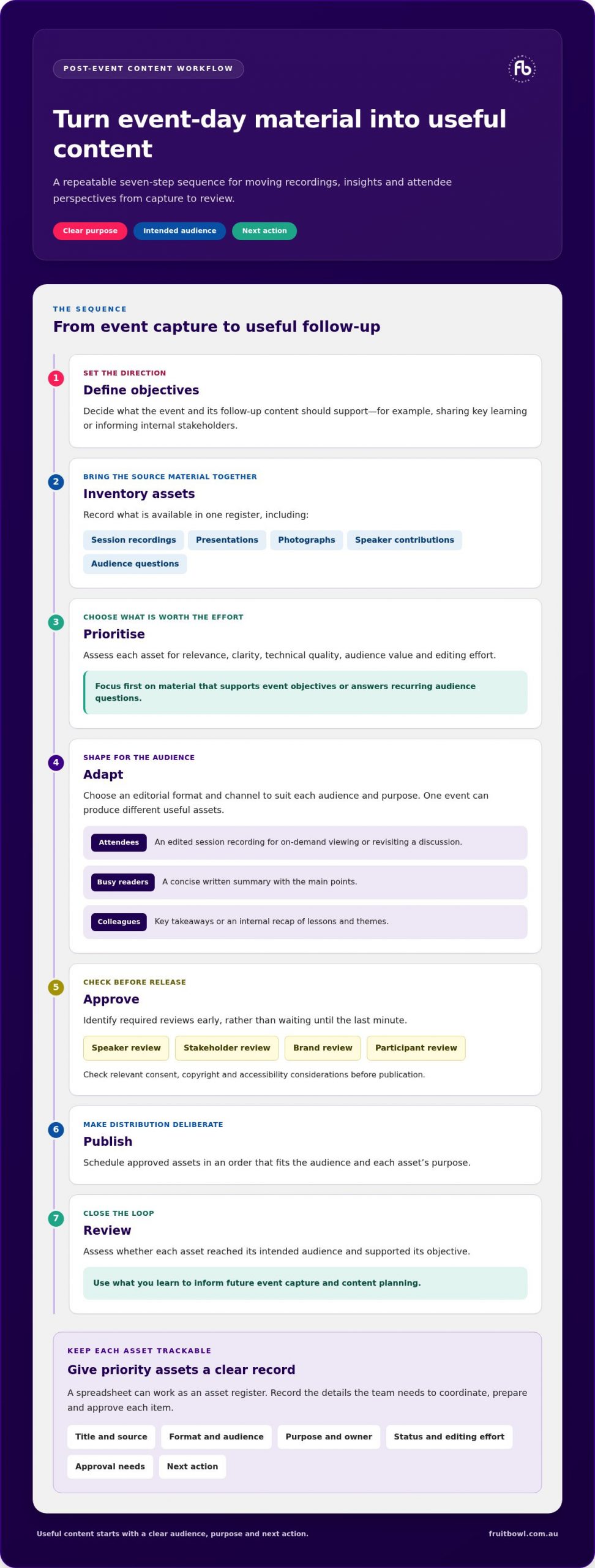
A clear workflow turns event-day material into approved, audience-focused content instead of leaving teams with a folder of unreviewed files. When leveraging event content after the event, assign each priority asset an owner, an intended audience and a next action. Then move it through a consistent sequence:
- 1. Define objectives. Identify what the event and follow-up content should support, such as sharing key learning or informing internal stakeholders.
- 2. Inventory assets. Record session recordings, presentations, photographs, speaker contributions and audience questions in one register.
- 3. Prioritise. Assess each asset for relevance, clarity, technical quality, audience value and editing effort. Focus first on material tied to event objectives or recurring audience questions.
- 4. Adapt. Choose an editorial format and channel for each audience. BizBash offers further ideas for effectively repurposing event content.
- 5. Approve. Identify the speaker, stakeholder, brand and participant reviews required. Check relevant consent, copyright and accessibility considerations before publication.
- 6. Publish. Schedule approved assets in an order that suits the audience and the content’s purpose.
- 7. Review. Assess whether each asset reached its intended audience and supported its objective. Use what you learn to inform future event capture and content planning.
Which event assets should you review first?
Gather the source material first: recordings, presentation files, photographs, speaker contributions and audience questions. A simple spreadsheet can serve as an asset register. For each item, record its title, source, format, intended audience, purpose, owner, status, editing effort and approval needs. This makes gaps visible and helps the team distinguish high-value material from content that would take substantial work to prepare.
Prioritise assets that are clear, relevant and technically usable, especially if they address questions raised during the event or support a stated objective. A recording with unclear audio may take more work to use than a concise speaker insight that can be shaped into a written summary.
How should teams manage approvals and ownership?
Assign one person to coordinate each selected asset and record its next action, such as editing, review or publication. Confirm who needs to review it before work moves forward, rather than seeking approval at the last minute. Store files in an accessible archive with consistent filenames, transcripts where appropriate and clear version control. This helps the team locate approved material and reduces the risk of publishing an outdated draft.
Planning capture, production and delivery as connected parts of an event can make this workflow easier to manage. Explore event planning and production as part of an integrated approach to event execution.
Which event content formats suit different audiences and channels?
The best format depends on what the audience needs to do with the information, not which channel is currently popular. A detailed session may be valuable to attendees who want to revisit its context, while someone who missed the event may need a brief introduction before deciding whether to explore further. One source asset can serve both audiences if each version has a distinct purpose and framing.
| Audience | Source asset | Suitable format | Effort | Intended purpose |
|---|---|---|---|---|
| Attendees and people seeking the full discussion | Session recording | Edited on-demand recording with a clear title and supporting context | High: review, editing and quality checks | Preserve depth and let viewers revisit the session |
| Prospective attendees or time-poor audiences | Recording or speaker contribution | Short clip focused on one self-contained idea | Medium: select, edit and caption | Introduce a key insight and guide viewers to more detail |
| Readers who need a quick reference | Presentation and session notes | Written summary or key takeaways | Medium: verify and structure content | Make the main points easy to scan, share and revisit |
| Attendees and interested readers | Speaker contribution or interview | Speaker Q&A | Medium: prepare questions, edit and approve | Explore a topic in a focused, accessible format |
| Internal teams and stakeholders | Session notes, audience questions and event observations | Internal recap | Low to medium: consolidate and contextualise | Share relevant themes, feedback and follow-up actions |
When should you use recordings, clips or written summaries?
Choose a full recording when the session’s nuance, sequence or discussion matters. Use a short clip to share one complete idea, keeping enough context for it to stand alone and checking captions for accuracy. A written summary suits people who need takeaways or a searchable reference without watching a full session. Whatever the format, preserve the speaker’s meaning while tailoring the material to its intended use.
How can content serve attendees and people who missed the event?
For attendees, provide useful follow-up such as consolidated resources, session takeaways or a recording that helps them revisit specific points. For people who couldn’t attend, begin with a concise introduction explaining the subject and why it matters, then offer a route to more detail. Don’t assume both groups share the same context. Frame the content accordingly.
For example, a session recording might become a detailed resource for attendees, while a short clip and summary introduce its central idea to a wider audience. This is a practical way of leveraging event content after the event without repeating the same message across every channel.
How to distribute post-event content and assess its performance
Publishing every asset at once can overwhelm audiences and leave useful material without context. Build a sequence around what each audience needs next, which approvals are outstanding and how long the asset is likely to remain timely. A concise event takeaway might be ready before a longer session recording, while a resource that supports an ongoing discussion may be scheduled later.
What should a post-event content distribution plan include?
For each asset, record its publishing order, responsible owner, target audience and review date. Match the channel to the audience’s access and the format’s requirements. A recording needs a suitable viewing destination; a written summary may fit an email update or a resource page. Use existing audience communications where appropriate, and tailor the introduction, captions, transcript and next step to the channel. Don’t assume a particular channel will deliver reach or engagement.
Give each item a role in the sequence. For example, a short introduction can direct interested readers to a fuller summary, while an attendee follow-up can focus on resources that support further learning. For organisations looking to connect these touchpoints to broader commercial goals, strategic marketing partners like Stratagon demonstrate how customer-centric campaigns can turn post-event insights into sustained pipeline engagement. Keep the message and call to action relevant to the audience instead of repeating identical copy across every channel.
Which measures show whether content is useful?
Start with the asset’s objective and choose measures that can help determine whether it served that purpose. Depending on the content, useful signals might include qualified views, completion of a resource download, use of a shared reference or relevant audience responses. Define what counts as a meaningful action before publishing, so the team doesn’t choose a success measure only after seeing the results.
Record a baseline and measurement period, then compare like with like. A view count may show exposure, but not whether the intended audience found the material useful. The performance of one content asset also doesn’t establish the overall return on the event. Assess event outcomes separately, using the measures agreed for the event’s objectives.
Set a review date in the distribution plan. Document what to repeat, revise or retire, note audience questions that warrant follow-up, and carry practical lessons into the next event’s capture plan. This closes the loop between content, measurement and future planning, making leveraging event content after the event a repeatable process rather than a one-off publishing task.
To connect event objectives with planning, production and follow-up, plan your next event with Fruitbowl.
Build post-event content into a stronger event plan with Fruitbowl
Useful post-event content starts before the event opens. If an organisation wants to share a particular discussion, insight or audience perspective afterwards, that objective can shape what the event team prioritises on the day. Include content intentions in the event brief, then carry them into the run sheet and production requirements so capture supports the event’s purpose without interrupting it.
What should teams plan before event day?
Identify priority sessions, speakers, key messages and audience questions that may be valuable to revisit. Consider what each audience might need afterwards and which source material could support it. For example, a session intended to inform a written summary may need clear presentation visibility and an organised record of the discussion.
Build capture requirements, technical coordination and approval checkpoints into the event plan. Coordinate speaker timings and audiovisual needs so important contributions can be captured clearly. Consider how lighting, staging and room setup affect both the live experience and the usability of recordings or photographs. Align these decisions with the intended post-event workflow, including who will review and shape the material.
How can Fruitbowl Events Agency support connected event delivery?
Fruitbowl Events Agency brings planning, logistics coordination, production and on-site delivery together, helping keep event execution aligned with client objectives. With more than 28 years of event industry experience, the team works across corporate events, conferences, festivals, public events and government activations. This integrated approach makes content planning part of the wider event plan, alongside the practical requirements of delivering the experience.
Technical direction coordinates audiovisual elements, lighting and staging with the event’s format and priorities. This coordination supports suitable conditions for clear, usable event material while keeping the live programme in view. It also helps teams decide what needs to be captured, rather than treating content as a separate task once the event is underway.
Planning for leveraging event content after the event is ultimately about connecting objectives, capture and follow-up. An integrated plan gives each part a clear role, from the event brief through to on-site delivery and the content work that follows.
To plan an event with both delivery and follow-up in view, discuss an event with Fruitbowl Events Agency.
Make your next event work harder beyond event day
Leveraging event content after the event works best when it’s planned as part of the event, not left as a last-minute task. Define what audiences should take away, capture material that supports those objectives, then adapt it into formats suited to their needs. A clear workflow for ownership, approvals, distribution and review helps useful content move from raw asset to purposeful follow-up.
That process depends on coordinated delivery. Event production and technical direction can support clear, usable capture, while a considered content plan helps teams decide what to share and how to assess its value. Fruitbowl brings more than 28 years of event industry experience, with end-to-end planning, logistics, production and on-site delivery aligned to client objectives.
Whether you’re planning a corporate event, conference, festival or activation, bring delivery and post-event content into the same conversation. Discuss an event plan with Fruitbowl and set a clear foundation for the experience and its follow-up. With the right preparation, your event can continue to inform and serve its audiences well beyond the day itself.
Frequently Asked Questions
What is the best content to share after an event?
The best post-event content serves a clear audience need and supports the event’s objectives. Consider who you want to reach, the quality of the available assets and how useful each format will be. A clear recording may suit people who need the full discussion, while a concise summary may work better as a quick reference. There’s no single format that suits every event.
How soon should you publish content after an event?
Publish each asset when it’s useful, ready and approved, rather than following a universal deadline. A brief thank-you or timely takeaway may be suitable soon after the event, while a recording or speaker Q&A may need editing and review first. Plan a sequence that reflects audience needs and the content’s useful life. This gives the team time to prepare material properly without delaying every follow-up until all assets are complete.
How can you repurpose a webinar or conference recording?
Review the recording, identify sections that answer audience questions or reinforce event objectives, then choose formats for different needs. A full edited recording can preserve context; a short clip can highlight one complete idea; and a written summary can make key points easy to scan. Add a clear introduction and relevant next step. Before publishing, check the edit, approvals, captions or transcript, and accessibility for the intended audience.
Can you use attendee photos and event recordings in post-event content?
You may be able to use attendee photos and recordings, but first consider permissions, consent, relevant contracts and applicable requirements. The appropriate steps can depend on how material was captured and how it will be used. Review the event’s arrangements and seek suitable advice if you’re unsure. This is general information, not legal advice; check current Australian guidance before relying on a specific interpretation or publishing identifiable material.
What should a post-event content plan include?
A practical plan connects each asset to an objective and audience. Include an inventory of available material, the owner responsible for each item, intended formats and channels, approval needs, publishing order and timing. Record the next action and a review date as well. Set measures that reflect the purpose of each asset, so the team can assess usefulness, capture lessons and improve the next event’s planning.
How do you measure the success of post-event content?
Measure each asset against the objective it was created to support. Depending on the purpose, useful signals may include qualified views, resource use, completion or relevant audience responses. Record a baseline and measurement period before reviewing results, and interpret the measures in context. A single metric can’t prove that content succeeded or establish overall event return on investment; assess event outcomes separately against their own objectives.
How can event content reach people who did not attend?
Give non-attendees an accessible introduction to the event’s most relevant ideas, then offer a clear route to deeper material. A concise written summary can explain the key points, while a selected recording or short clip can add speaker context. Provide captions or a transcript where appropriate, and make the next step relevant, such as viewing a full session or exploring related resources. Don’t assume non-attendees share the background knowledge of people who were there.
What if the most useful event content isn’t the highlight reel? For teams leveraging event content after the event, the real opportunity is to turn recordings, session insights and attendee perspectives into material that answers audience needs long after the doors close. Start by deciding what to capture and why, rather than simply collecting everything on the day.
It’s easy to see why this work gets delayed. Recordings sit untouched, useful ideas are buried in long sessions, and teams may not have a clear process for editing, approving and distributing content. A recap alone won’t serve every audience or channel. Give each asset a clear purpose, an intended audience and a suitable format.
This guide sets out a practical, repeatable approach to extending an event’s value. You’ll learn how to identify priority assets and audiences, adapt content into a focused sequence for relevant channels, and assess whether it’s useful. It also explains how event objectives, production planning and technical coordination can help make content ready to use beyond event day.
Key Takeaways
- Start leveraging event content after the event by matching recordings, insights and attendee perspectives to audience needs and clear objectives.
- Build a repeatable workflow to inventory, prioritise, adapt, approve, publish and review each asset, with an owner and intended next action.
- Choose formats such as session recordings, short clips, written summaries and speaker Q&As according to the audience, channel and purpose.
- Plan distribution around content approvals and audience access, then assess whether each asset supports its intended outcome.
- Bring content objectives into the event brief, run sheet and production planning so capture requirements support a coherent event experience.
Table of Contents
- Why leveraging event content after the event extends its value
- How to build a post-event content workflow from event-day capture
- Which event content formats suit different audiences and channels?
- How to distribute post-event content and assess its performance
- Build post-event content into a stronger event plan with Fruitbowl
Why leveraging event content after the event extends its value
An event’s value doesn’t have to end when the room clears. Post-event content is material drawn from the live experience and adapted to serve people afterwards. It can help attendees revisit a useful idea, give people who couldn’t attend access to key discussions, or help internal stakeholders share what the event achieved.
This follow-up works best when it supports the event’s wider purpose. Event marketing strategy places events within a broader effort to connect with audiences. A deliberate content plan carries that connection forward, using the event’s ideas and experiences in formats suited to what people need next. The aim isn’t to publish more for its own sake. It’s to make relevant learning and perspectives accessible beyond event day.
What counts as post-event content?
Start with the original assets: edited session recordings, speaker insights, presentation materials, event photography and attendee feedback. These capture what happened. From them, a team can create new editorial formats, such as a written summary of a presentation, a short extract from a speaker discussion or key takeaways for colleagues.
Give every asset an audience, purpose and publication context. A full session recording may suit an attendee who wants to revisit the discussion, while a concise summary may be more useful to someone looking for the main points. Source material is only the starting point. Thoughtful adaptation makes it relevant to the person receiving it.
Why plan content beyond the event itself?
People leave an event with different needs. Attendees may want to revisit a session or share an insight with their team. People who couldn’t attend may need an accessible account of the discussion. Internal stakeholders may need a concise record of themes, audience responses or outcomes related to the event’s objectives.
A planned sequence can preserve useful discussion without asking every audience to consume the same material. For example, edit a session recording for on-demand viewing and prepare a written summary for readers who need the main points quickly. An internal recap could capture lessons for future planning. These are distinct assets from the same event, each shaped for a different purpose.
Before publishing, decide how you’ll judge whether each asset is useful. You might measure whether the intended audience accesses it, returns to a resource or uses its insights in a relevant next step. Don’t assume publication will guarantee reach, engagement or commercial results. Keep each asset connected to the event’s objectives and review what it contributes. When those objectives inform event and production planning, teams can make more deliberate choices about what to capture and how it may be used later.
How to build a post-event content workflow from event-day capture
A clear workflow turns event-day material into approved, audience-focused content instead of leaving teams with a folder of unreviewed files. When leveraging event content after the event, assign each priority asset an owner, an intended audience and a next action. Then move it through a consistent sequence:
- 1. Define objectives. Identify what the event and follow-up content should support, such as sharing key learning or informing internal stakeholders.
- 2. Inventory assets. Record session recordings, presentations, photographs, speaker contributions and audience questions in one register.
- 3. Prioritise. Assess each asset for relevance, clarity, technical quality, audience value and editing effort. Focus first on material tied to event objectives or recurring audience questions.
- 4. Adapt. Choose an editorial format and channel for each audience. BizBash offers further ideas for effectively repurposing event content.
- 5. Approve. Identify the speaker, stakeholder, brand and participant reviews required. Check relevant consent, copyright and accessibility considerations before publication.
- 6. Publish. Schedule approved assets in an order that suits the audience and the content’s purpose.
- 7. Review. Assess whether each asset reached its intended audience and supported its objective. Use what you learn to inform future event capture and content planning.
Which event assets should you review first?
Gather the source material first: recordings, presentation files, photographs, speaker contributions and audience questions. A simple spreadsheet can serve as an asset register. For each item, record its title, source, format, intended audience, purpose, owner, status, editing effort and approval needs. This makes gaps visible and helps the team distinguish high-value material from content that would take substantial work to prepare.
Prioritise assets that are clear, relevant and technically usable, especially if they address questions raised during the event or support a stated objective. A recording with unclear audio may take more work to use than a concise speaker insight that can be shaped into a written summary.
How should teams manage approvals and ownership?
Assign one person to coordinate each selected asset and record its next action, such as editing, review or publication. Confirm who needs to review it before work moves forward, rather than seeking approval at the last minute. Store files in an accessible archive with consistent filenames, transcripts where appropriate and clear version control. This helps the team locate approved material and reduces the risk of publishing an outdated draft.
Planning capture, production and delivery as connected parts of an event can make this workflow easier to manage. Explore event planning and production as part of an integrated approach to event execution.
Which event content formats suit different audiences and channels?
The best format depends on what the audience needs to do with the information, not which channel is currently popular. A detailed session may be valuable to attendees who want to revisit its context, while someone who missed the event may need a brief introduction before deciding whether to explore further. One source asset can serve both audiences if each version has a distinct purpose and framing.
| Audience | Source asset | Suitable format | Effort | Intended purpose |
|---|---|---|---|---|
| Attendees and people seeking the full discussion | Session recording | Edited on-demand recording with a clear title and supporting context | High: review, editing and quality checks | Preserve depth and let viewers revisit the session |
| Prospective attendees or time-poor audiences | Recording or speaker contribution | Short clip focused on one self-contained idea | Medium: select, edit and caption | Introduce a key insight and guide viewers to more detail |
| Readers who need a quick reference | Presentation and session notes | Written summary or key takeaways | Medium: verify and structure content | Make the main points easy to scan, share and revisit |
| Attendees and interested readers | Speaker contribution or interview | Speaker Q&A | Medium: prepare questions, edit and approve | Explore a topic in a focused, accessible format |
| Internal teams and stakeholders | Session notes, audience questions and event observations | Internal recap | Low to medium: consolidate and contextualise | Share relevant themes, feedback and follow-up actions |
When should you use recordings, clips or written summaries?
Choose a full recording when the session’s nuance, sequence or discussion matters. Use a short clip to share one complete idea, keeping enough context for it to stand alone and checking captions for accuracy. A written summary suits people who need takeaways or a searchable reference without watching a full session. Whatever the format, preserve the speaker’s meaning while tailoring the material to its intended use.
How can content serve attendees and people who missed the event?
For attendees, provide useful follow-up such as consolidated resources, session takeaways or a recording that helps them revisit specific points. For people who couldn’t attend, begin with a concise introduction explaining the subject and why it matters, then offer a route to more detail. Don’t assume both groups share the same context. Frame the content accordingly.
For example, a session recording might become a detailed resource for attendees, while a short clip and summary introduce its central idea to a wider audience. This is a practical way of leveraging event content after the event without repeating the same message across every channel.
How to distribute post-event content and assess its performance
Publishing every asset at once can overwhelm audiences and leave useful material without context. Build a sequence around what each audience needs next, which approvals are outstanding and how long the asset is likely to remain timely. A concise event takeaway might be ready before a longer session recording, while a resource that supports an ongoing discussion may be scheduled later.
What should a post-event content distribution plan include?
For each asset, record its publishing order, responsible owner, target audience and review date. Match the channel to the audience’s access and the format’s requirements. A recording needs a suitable viewing destination; a written summary may fit an email update or a resource page. Use existing audience communications where appropriate, and tailor the introduction, captions, transcript and next step to the channel. Don’t assume a particular channel will deliver reach or engagement.
Give each item a role in the sequence. For example, a short introduction can direct interested readers to a fuller summary, while an attendee follow-up can focus on resources that support further learning. Keep the message and call to action relevant to the audience instead of repeating identical copy across every channel.
Which measures show whether content is useful?
Start with the asset’s objective and choose measures that can help determine whether it served that purpose. Depending on the content, useful signals might include qualified views, completion of a resource download, use of a shared reference or relevant audience responses. Define what counts as a meaningful action before publishing, so the team doesn’t choose a success measure only after seeing the results.
Record a baseline and measurement period, then compare like with like. A view count may show exposure, but not whether the intended audience found the material useful. The performance of one content asset also doesn’t establish the overall return on the event. Assess event outcomes separately, using the measures agreed for the event’s objectives.
Set a review date in the distribution plan. Document what to repeat, revise or retire, note audience questions that warrant follow-up, and carry practical lessons into the next event’s capture plan. This closes the loop between content, measurement and future planning, making leveraging event content after the event a repeatable process rather than a one-off publishing task.
To connect event objectives with planning, production and follow-up, plan your next event with Fruitbowl.
Build post-event content into a stronger event plan with Fruitbowl
Useful post-event content starts before the event opens. If an organisation wants to share a particular discussion, insight or audience perspective afterwards, that objective can shape what the event team prioritises on the day. Include content intentions in the event brief, then carry them into the run sheet and production requirements so capture supports the event’s purpose without interrupting it.
What should teams plan before event day?
Identify priority sessions, speakers, key messages and audience questions that may be valuable to revisit. Consider what each audience might need afterwards and which source material could support it. For example, a session intended to inform a written summary may need clear presentation visibility and an organised record of the discussion.
Build capture requirements, technical coordination and approval checkpoints into the event plan. Coordinate speaker timings and audiovisual needs so important contributions can be captured clearly. Consider how lighting, staging and room setup affect both the live experience and the usability of recordings or photographs. Align these decisions with the intended post-event workflow, including who will review and shape the material.
How can Fruitbowl Events Agency support connected event delivery?
Fruitbowl Events Agency brings planning, logistics coordination, production and on-site delivery together, helping keep event execution aligned with client objectives. With more than 28 years of event industry experience, the team works across corporate events, conferences, festivals, public events and government activations. This integrated approach makes content planning part of the wider event plan, alongside the practical requirements of delivering the experience.
Technical direction coordinates audiovisual elements, lighting and staging with the event’s format and priorities. This coordination supports suitable conditions for clear, usable event material while keeping the live programme in view. It also helps teams decide what needs to be captured, rather than treating content as a separate task once the event is underway.
Planning for leveraging event content after the event is ultimately about connecting objectives, capture and follow-up. An integrated plan gives each part a clear role, from the event brief through to on-site delivery and the content work that follows.
To plan an event with both delivery and follow-up in view, discuss an event with Fruitbowl Events Agency.
Make your next event work harder beyond event day
Leveraging event content after the event works best when it’s planned as part of the event, not left as a last-minute task. Define what audiences should take away, capture material that supports those objectives, then adapt it into formats suited to their needs. A clear workflow for ownership, approvals, distribution and review helps useful content move from raw asset to purposeful follow-up.
That process depends on coordinated delivery. Event production and technical direction can support clear, usable capture, while a considered content plan helps teams decide what to share and how to assess its value. Fruitbowl brings more than 28 years of event industry experience, with end-to-end planning, logistics, production and on-site delivery aligned to client objectives.
Whether you’re planning a corporate event, conference, festival or activation, bring delivery and post-event content into the same conversation. Discuss an event plan with Fruitbowl and set a clear foundation for the experience and its follow-up. With the right preparation, your event can continue to inform and serve its audiences well beyond the day itself.
Frequently Asked Questions
What is the best content to share after an event?
The best post-event content serves a clear audience need and supports the event’s objectives. Consider who you want to reach, the quality of the available assets and how useful each format will be. A clear recording may suit people who need the full discussion, while a concise summary may work better as a quick reference. There’s no single format that suits every event.
How soon should you publish content after an event?
Publish each asset when it’s useful, ready and approved, rather than following a universal deadline. A brief thank-you or timely takeaway may be suitable soon after the event, while a recording or speaker Q&A may need editing and review first. Plan a sequence that reflects audience needs and the content’s useful life. This gives the team time to prepare material properly without delaying every follow-up until all assets are complete.
How can you repurpose a webinar or conference recording?
Review the recording, identify sections that answer audience questions or reinforce event objectives, then choose formats for different needs. A full edited recording can preserve context; a short clip can highlight one complete idea; and a written summary can make key points easy to scan. Add a clear introduction and relevant next step. Before publishing, check the edit, approvals, captions or transcript, and accessibility for the intended audience.
Can you use attendee photos and event recordings in post-event content?
You may be able to use attendee photos and recordings, but first consider permissions, consent, relevant contracts and applicable requirements. The appropriate steps can depend on how material was captured and how it will be used. Review the event’s arrangements and seek suitable advice if you’re unsure. This is general information, not legal advice; check current Australian guidance before relying on a specific interpretation or publishing identifiable material.
What should a post-event content plan include?
A practical plan connects each asset to an objective and audience. Include an inventory of available material, the owner responsible for each item, intended formats and channels, approval needs, publishing order and timing. Record the next action and a review date as well. Set measures that reflect the purpose of each asset, so the team can assess usefulness, capture lessons and improve the next event’s planning.
How do you measure the success of post-event content?
Measure each asset against the objective it was created to support. Depending on the purpose, useful signals may include qualified views, resource use, completion or relevant audience responses. Record a baseline and measurement period before reviewing results, and interpret the measures in context. A single metric can’t prove that content succeeded or establish overall event return on investment; assess event outcomes separately against their own objectives.
How can event content reach people who did not attend?
Give non-attendees an accessible introduction to the event’s most relevant ideas, then offer a clear route to deeper material. A concise written summary can explain the key points, while a selected recording or short clip can add speaker context. Provide captions or a transcript where appropriate, and make the next step relevant, such as viewing a full session or exploring related resources. Don’t assume non-attendees share the background knowledge of people who were there.
OUR BLOG
Event Insights & Expertise
Our blog is your go-to resource for all things events. From expert insights and the latest industry trends to practical planning tips, we share everything you need to deliver standout experiences.
Contact Us