In-House vs Outsourced Event Planning: A Strategic Cost and ROI Analysis for 2026

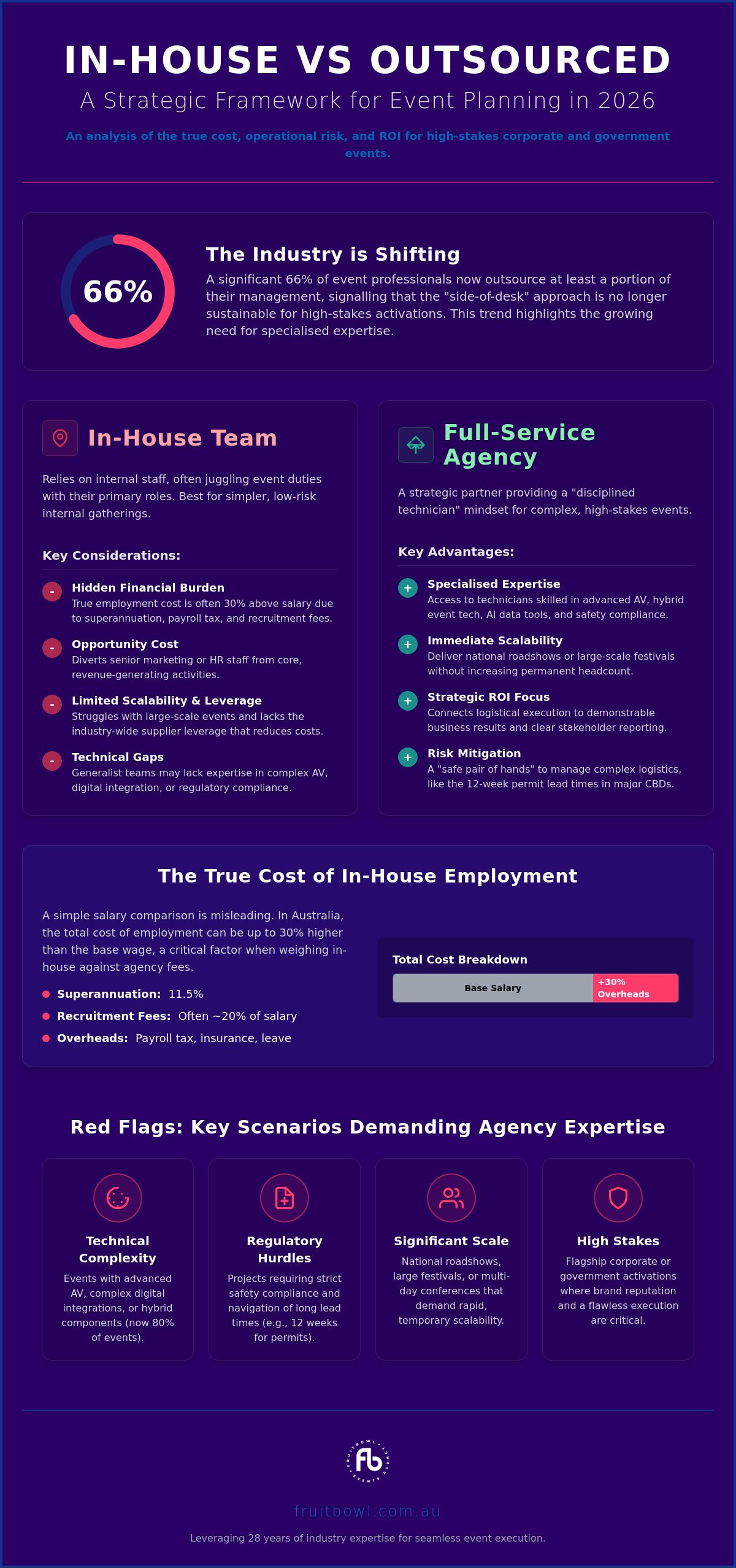
The “free” labour of your internal team might actually be the most expensive line item on your 2026 event budget. When weighing up in-house vs outsourced event planning, it’s easy to focus on the immediate agency fee while overlooking the hidden costs of staff burnout and technical gaps. You’ve likely seen the strain when a marketing lead is forced to troubleshoot a complex AV rig or manage the 12 week lead time now required for permits in high-demand zones. With 66% of event professionals now outsourcing at least a portion of their management, it’s clear that the “side-of-desk” approach is no longer sustainable for high-stakes corporate activations or government projects.

We understand that your priority is a seamless execution that protects your brand’s reputation and your bottom line. This analysis provides a rigorous framework to help you evaluate these delivery models, ensuring you can reduce operational risk and prove a clear ROI to your stakeholders. We’ll explore the impact of specialised technical requirements and the evolving regulatory landscape to help you make a composed, data-driven decision. By the end of this guide, you’ll have the clarity needed to choose the most secure path for your organisation’s future events.

Key Takeaways

  • Quantify the true cost of internal management by accounting for Australian payroll tax, superannuation, and the hidden burden of recruitment.
  • Evaluate the strategic benefits of in-house vs outsourced event planning to determine which model best mitigates operational risk for your 2026 event calendar.
  • Recognise the ‘red flag’ scenarios where technical complexities, such as advanced AV requirements, exceed the capacity of internal generalist teams.
  • Utilise a five-step decision framework to assess whether a project should be managed internally or elevated to a full-service agency partnership.
  • Learn how to leverage 28 years of industry expertise to ensure seamless execution and measurable results for high-stakes corporate and government activations.

The Evolving Landscape of Event Management: In-House vs Outsourced Models

Modern Event management has transitioned from a purely logistical function into a high-stakes technical discipline. In 2026, the choice between in-house vs outsourced event planning isn’t merely a budgetary one; it’s a decision about risk tolerance and strategic alignment. Organisations are moving away from simple gatherings toward “experience-first” activations that demand sophisticated technical production, immersive digital integration, and strict safety compliance. This shift requires a level of expertise that goes beyond traditional administrative skills, placing a premium on partners who can navigate complex regulatory environments and high-pressure delivery timelines.

We’re seeing a significant trend where Australian corporate circles are adopting a hybrid delivery model. This approach allows internal teams to focus on high-level strategy and stakeholder management while delegating the granular, technical execution to external specialists. It’s a response to the increasing complexity of modern events, where 80% of planners now incorporate hybrid components. Aligning your delivery model with long-term brand objectives ensures that every event isn’t just a standalone moment, but a strategic asset that contributes to the organisation’s overarching mission. When the stakes are high, the composure of an experienced partner provides the security needed to push creative boundaries without compromising on safety or budget.

What Defines In-House Event Planning?

In-house planning typically involves internal staff managing event logistics alongside their primary responsibilities. These individuals possess a deep, intuitive understanding of company culture and are immediately accessible for internal consultations. However, this model often struggles with scalability. When a marketing manager is tasked with procurement, they lack the industry-wide supplier leverage that an established agency provides. This often leads to higher costs for venues and catering, which currently account for nearly 65% of corporate event budgets. The internal team’s focus is often divided, which can lead to oversight in complex areas like cybersecurity risk assessments or the 12 week permit lead times now required in major Australian CBDs.

The Full-Service Agency Advantage

Partnering with a full-service agency introduces a “disciplined technician” mindset to the project. This approach treats every event as a complex machine with many moving parts that must integrate seamlessly. Agencies provide immediate scalability, allowing organisations to deliver large-scale festivals or national roadshows without increasing permanent headcount. When evaluating in-house vs outsourced event planning, the agency model offers the distinct advantage of strategic oversight. They don’t just book venues; they connect logistical execution to demonstrable business ROI. With 58% of professionals now using AI and automation to enhance attendee data, an external partner provides the specialised technical knowledge required to navigate these new tools effectively. They act as a safe pair of hands, ensuring that creative vision is always grounded in logistical precision.

Analysing the True Cost: Salary, Overheads, and Opportunity Costs

When evaluating in-house vs outsourced event planning, the comparison often begins and ends with a base salary versus an agency fee. This surface-level view neglects the substantial fiscal reality of the Australian corporate environment. Beyond the base wage, organisations must account for superannuation, which is currently 11.5%, alongside payroll tax, workers’ compensation insurance, and the inevitable recruitment fees that frequently reach 20% of an annual salary. Understanding the key differences in in-house vs. outsourced models requires a comprehensive look at the total cost of employment, which often sits 30% above the gross salary figure.

The most significant hidden expense is the opportunity cost. When senior marketing or HR staff are pulled into “side-of-desk” event tasks, they’re diverted from revenue-generating activities. A marketing director spending thirty hours on a venue search is thirty hours not spent on brand growth or strategic lead generation. This friction often results in team burnout and a diluted focus on core business objectives. Consulting with a specialist event agency allows for a more predictable, project-based budget that eliminates these internal inefficiencies while protecting your team’s primary output.

The Hidden Burden of Internal Staffing

Maintaining an internal events department introduces ongoing costs that persist regardless of your event calendar’s density. During quieter quarters, you’re still paying for the headcount, office space, and specialized software licenses. Furthermore, the management overhead required to supervise even a junior internal events role is considerable. Senior leadership must dedicate time to performance reviews, professional development, and technical oversight, which adds another layer of indirect cost. Training internal staff on the latest 2026 event technologies, such as AI-driven personalisation or hybrid platform management, requires a continuous investment that an external partner already absorbs as part of their business model.

Agency Procurement and Supplier Leverage

An established agency provides immediate access to a vetted network of suppliers, built over decades of high-volume procurement. This leverage allows agencies to pass on bulk-buying discounts for venues, catering, and AV that are simply unavailable to a single-entity internal team. For example, venue and catering costs account for 65% of most corporate event budgets; even a 10% saving through agency negotiation can offset a significant portion of the management fee. Transparent agency fee structures also provide a buffer against the unpredictable nature of internal “scope creep”, ensuring that the financial boundaries of a project remain firm from inception to execution. This disciplined approach to procurement reduces project risk and ensures that every dollar spent is maximised for the best possible attendee experience.

Technical Precision and Risk Management: Where Generalist Teams Struggle

High-stakes events leave no room for “best efforts.” A “safe pair of hands” represents a level of technical mastery where risks are mitigated long before the first guest arrives. When comparing in-house vs outsourced event planning, the most significant point of failure often lies in the technical execution. Generalist teams, while capable of administrative tasks, frequently lack the specialized skills of outsourced teams. This gap becomes evident when managing the sophisticated AV management for events required in 2026. Today’s audiences expect immersive visuals and flawless audio, elements that require a disciplined technician’s oversight to integrate successfully.

Professional technical direction ensures that creative ambition is always grounded in logistical reality. It is the difference between a presentation that merely functions and an experience that resonates. By centralising technical oversight, an agency provides the security needed for high-pressure environments. This composed approach allows stakeholders to focus on their objectives, confident that every technical detail is under expert supervision. Order and clarity are the products of seasoned expertise, ensuring that the final delivery is both ambitious and safe.

Navigating Australian Compliance and Safety

Compliance in the Australian event sector has become increasingly rigorous. Managing public liability and Work Health and Safety (WHS) for large crowds requires more than a standard risk assessment. It demands a deep understanding of current AS/NZS safety standards. Agencies are indispensable for strategic government event planning, where compliance with fire safety and crowd flow modelling is non-negotiable. In 2026, digital and cybersecurity risk assessments have also become essential components of the safety protocol. An external partner ensures that every piece of infrastructure, from staging to ticketing systems, meets these evolving legal requirements and protects the organisation from unforeseen liabilities.

Production Excellence and Technical Direction

The allure of “dry hire” equipment often masks the reality of operational risk. Without professional technical direction, high-end gear is frequently underutilised or improperly configured. A dedicated technical director manages the complex interplay of lighting, audio, and staging riders, especially when coordinating high-profile talent. This level of precision transforms a standard corporate gathering into a seamless production. When evaluating in-house vs outsourced event planning, consider the value of a partner who has navigated every possible technical challenge. This history of successful delivery ensures a frictionless experience for the audience and a demonstrable ROI for the organisation.
The Strategic Decision Framework: When to Outsource Your Event Portfolio

Deciding between in-house vs outsourced event planning requires a methodical approach to risk and resource management. While internal teams are often well-suited for routine internal meetings or small-scale workshops, high-stakes activations demand a different level of logistical precision. A strategic framework ensures that your choice is based on data and project requirements rather than habit or perceived short-term savings. We recommend a five-step assessment to determine the most secure delivery model for your upcoming project.

  • Risk Profiling: Identify if the event is brand-critical, public-facing, or government-linked.
  • Technical Audit: Determine if the production requires specialised AV, immersive digital integration, or complex staging.
  • Capacity Mapping: Calculate if your internal staff can realistically absorb 200 or more hours of planning without compromising their primary roles.
  • Compliance Review: Assess the need for sophisticated WHS modelling, fire safety sign-offs, or complex permit submissions.
  • Procurement Scope: Evaluate the depth of talent procurement and the legal intricacies of multiple vendor contracts.

A primary red flag is the transition from routine logistics to high-impact corporate event management. When an event moves into the public eye or involves high-profile stakeholders, the margin for error disappears. In these scenarios, relying on a generalist internal team poses a significant threat to organisational reputation. If your assessment reveals gaps in technical oversight or a lack of seasoned crisis management experience, it’s time to engage a professional event agency to secure your delivery.

Assessing Event Scale and Complexity

Scale is not just about the number of attendees; it’s about the complexity of the moving parts. Public-facing festivals or government activations involve layers of stakeholder liaison and reporting that can overwhelm internal departments. Does the project require sophisticated talent procurement and the negotiation of complex staging riders? If the event involves high-attendance figures or high-pressure environments, the “disciplined technician” approach of an agency provides the necessary order and clarity. Meticulous planning at this scale is what prevents budget blowouts and ensures a frictionless experience for all participants.

Evaluating Internal Resource Capability

Before committing to an internal delivery, honestly evaluate your team’s current bandwidth. Do you have a dedicated conference logistics coordinator with the technical expertise to manage modern AV requirements? Planning a major conference can easily absorb hundreds of hours. If your team attempts to manage this alongside their primary KPIs, burnout is inevitable. Furthermore, consider if your staff possesses the unflappable experience required to handle on-site crises. A seasoned agency acts as a safe pair of hands, bringing a level of composure that only comes from decades of navigating high-stakes environments.

Partnering for Success: The Value of a Comprehensive Event Agency

Choosing between in-house vs outsourced event planning is ultimately a decision about who you trust with your organisation’s most visible moments. A comprehensive agency isn’t a mere vendor; it’s a sophisticated strategist that brings order to the inherent complexity of live environments. With over 28 years of industry experience, we’ve refined an end-to-end methodology that transforms high-level strategy into flawless on-site delivery. This history allows us to act as a meticulous guide, identifying and mitigating risks long before they impact your event. We prioritise a seamless integration of all moving parts, ensuring that your vision is supported by a foundation of logistical excellence.

Our approach is built on the belief that technical precision is the prerequisite for creative success. By integrating every facet of the process—from technical direction to talent procurement—we ensure that no detail is left to chance. This level of coordination is particularly vital for government activations and corporate conferences where the margin for error is non-existent. We provide the security of a partner who has navigated every possible industry challenge, allowing you to move forward with absolute confidence in the final outcome. Transitioning to an agency model means gaining a partner deeply committed to your mission’s success.

Order and Clarity in High-Stakes Environments

Disciplined project management is the foundation of a frictionless attendee experience. In high-stakes environments, a steady, results-oriented approach replaces the frantic energy often found in less experienced teams. We maintain expert supervision from the initial concept through to the final pack-down, ensuring that every element aligns with your strategic goals. This level of oversight provides stakeholders with the reassurance that their brand reputation is protected. It’s about creating a narrative of control and excellence that reflects your organisation’s values to every guest in the room, regardless of the event’s scale.

The Fruitbowl Approach to National Excellence

Our national service capability ensures that whether you’re delivering a series of brand activations across Australia or a single, high-impact seminar, the quality of execution remains unwavering. We specialise in brand activation event planning, leveraging 28 years of experience to deliver measurable ROI. When weighing up in-house vs outsourced event planning, the agency model offers a depth of technical knowledge and supplier leverage that’s difficult to replicate with internal resources. We invite you to focus on your overarching brand objectives while we handle the meticulous logistical precision required to ensure your mission’s success. Our “safe pair of hands” philosophy means you’re never left to manage the complexities of production alone.

Securing Your Organisation’s Strategic Event Future

Navigating the complexities of in-house vs outsourced event planning requires a shift from viewing events as a logistical burden to seeing them as a strategic asset. We have analysed how the hidden overheads of internal staffing can quietly erode your budget while diverting your team from their core revenue-generating tasks. By prioritising technical precision and rigorous Australian compliance, you protect your brand from the unforeseen risks of generalist management.

Choosing an external partner provides the order and clarity necessary for high-stakes environments. It allows your internal stakeholders to focus on high-level objectives while seasoned experts manage the intricate details of production and talent procurement. With 28 years of expertise in Australian event management, Fruitbowl offers a full end-to-end strategic and technical delivery that ensures every activation is both ambitious and secure.

Partner with Fruitbowl for a high-impact, risk-mitigated event experience. Our unflappable experts are ready to bring your 2026 event calendar to life with meticulous precision. We look forward to ensuring your next mission is a resounding success.

Frequently Asked Questions

Is it actually cheaper to outsource event management in Australia?

Outsourcing is often more cost-effective because it eliminates the 30% loading on base salaries for superannuation, payroll tax, and workers’ compensation. Agencies also leverage established supplier relationships to negotiate better rates on venues and catering, which typically account for 65% of event budgets. This project-based model provides fiscal flexibility that a fixed internal headcount cannot match during quieter periods.

What are the biggest risks of managing a large-scale event in-house?

The most significant risks include technical production failures and non-compliance with evolving AS/NZS safety standards. Large-scale activations require specialised knowledge in crowd flow modelling and cybersecurity that generalist teams rarely possess. A single oversight in permit submissions or technical riders can lead to significant budget blowouts or reputational damage that far outweighs the cost of professional management.

How do I know if my internal team is burnt out by event planning?

Look for signs such as a decline in primary KPI performance or increased stress during the 12 week lead-up to an activation. When in-house vs outsourced event planning is managed as a side-of-desk task, team members often experience burnout from juggling logistical minutiae alongside their core responsibilities. This fatigue is a clear indicator that your delivery model requires a more sustainable approach.

Can an external agency really represent our brand culture accurately?

A professional agency functions as a sophisticated strategist, immersing themselves in your brand guidelines to ensure every touchpoint is authentic. Through a disciplined discovery process, external partners align creative vision with your corporate identity. This objective perspective often uncovers new ways to communicate your culture that internal teams might overlook due to their proximity to the daily business.

What is the difference between an event planner and a full-service production agency?

While a planner focuses on basic logistics like RSVP lists and catering, a full-service production agency provides end-to-end technical direction and strategic oversight. This includes managing complex AV rigs, talent procurement, and comprehensive risk assessments. An agency acts as a disciplined technician, ensuring that the creative ambition of the event is grounded in logistical precision and safety.

When should I begin the process of engaging an external event partner?

Engagement should ideally begin 18 to 24 months before a major conference or festival to secure preferred venues. Lead times for large convention centres have extended significantly in 2026, making early booking essential. Early partnership allows for a methodical progression through strategy, procurement, and technical design, ensuring every detail is under expert supervision from the inception of the project.

How does an agency help with government compliance and safety standards?

Agencies possess deep expertise in current Australian safety regulations and the specific permit requirements for high-demand zones. They manage the technical infrastructure to meet AS/NZS standards and coordinate with authorities for fire safety and crowd management. This safe pair of hands approach ensures your organisation remains compliant while reducing the administrative burden on your internal staff.

What metrics should I use to measure the ROI of an outsourced event?

ROI should be measured through a combination of attendee engagement data, lead conversion rates, and procurement savings. Use data analytics to track session popularity and attendee behaviour to prove value to stakeholders. A successful partnership demonstrates ROI by delivering a frictionless experience that meets specific brand objectives within a risk-mitigated and predictable budget framework.

The “free” labour of your internal team might actually be the most expensive line item on your 2026 event budget. When weighing up in-house vs outsourced event planning, it’s easy to focus on the immediate agency fee while overlooking the hidden costs of staff burnout and technical gaps. You’ve likely seen the strain when a marketing lead is forced to troubleshoot a complex AV rig or manage the 12 week lead time now required for permits in high-demand zones. With 66% of event professionals now outsourcing at least a portion of their management, it’s clear that the “side-of-desk” approach is no longer sustainable for high-stakes corporate activations or government projects.

We understand that your priority is a seamless execution that protects your brand’s reputation and your bottom line. This analysis provides a rigorous framework to help you evaluate these delivery models, ensuring you can reduce operational risk and prove a clear ROI to your stakeholders. We’ll explore the impact of specialised technical requirements and the evolving regulatory landscape to help you make a composed, data-driven decision. By the end of this guide, you’ll have the clarity needed to choose the most secure path for your organisation’s future events.

Key Takeaways

  • Quantify the true cost of internal management by accounting for Australian payroll tax, superannuation, and the hidden burden of recruitment.
  • Evaluate the strategic benefits of in-house vs outsourced event planning to determine which model best mitigates operational risk for your 2026 event calendar.
  • Recognise the ‘red flag’ scenarios where technical complexities, such as advanced AV requirements, exceed the capacity of internal generalist teams.
  • Utilise a five-step decision framework to assess whether a project should be managed internally or elevated to a full-service agency partnership.
  • Learn how to leverage 28 years of industry expertise to ensure seamless execution and measurable results for high-stakes corporate and government activations.

The Evolving Landscape of Event Management: In-House vs Outsourced Models

Modern Event management has transitioned from a purely logistical function into a high-stakes technical discipline. In 2026, the choice between in-house vs outsourced event planning isn’t merely a budgetary one; it’s a decision about risk tolerance and strategic alignment. Organisations are moving away from simple gatherings toward “experience-first” activations that demand sophisticated technical production, immersive digital integration, and strict safety compliance. This shift requires a level of expertise that goes beyond traditional administrative skills, placing a premium on partners who can navigate complex regulatory environments and high-pressure delivery timelines.

We’re seeing a significant trend where Australian corporate circles are adopting a hybrid delivery model. This approach allows internal teams to focus on high-level strategy and stakeholder management while delegating the granular, technical execution to external specialists. It’s a response to the increasing complexity of modern events, where 80% of planners now incorporate hybrid components. Aligning your delivery model with long-term brand objectives ensures that every event isn’t just a standalone moment, but a strategic asset that contributes to the organisation’s overarching mission. When the stakes are high, the composure of an experienced partner provides the security needed to push creative boundaries without compromising on safety or budget.

What Defines In-House Event Planning?

In-house planning typically involves internal staff managing event logistics alongside their primary responsibilities. These individuals possess a deep, intuitive understanding of company culture and are immediately accessible for internal consultations. However, this model often struggles with scalability. When a marketing manager is tasked with procurement, they lack the industry-wide supplier leverage that an established agency provides. This often leads to higher costs for venues and catering, which currently account for nearly 65% of corporate event budgets. The internal team’s focus is often divided, which can lead to oversight in complex areas like cybersecurity risk assessments or the 12 week permit lead times now required in major Australian CBDs.

The Full-Service Agency Advantage

Partnering with a full-service agency introduces a “disciplined technician” mindset to the project. This approach treats every event as a complex machine with many moving parts that must integrate seamlessly. Agencies provide immediate scalability, allowing organisations to deliver large-scale festivals or national roadshows without increasing permanent headcount. When evaluating in-house vs outsourced event planning, the agency model offers the distinct advantage of strategic oversight. They don’t just book venues; they connect logistical execution to demonstrable business ROI. With 58% of professionals now using AI and automation to enhance attendee data, an external partner provides the specialised technical knowledge required to navigate these new tools effectively. They act as a safe pair of hands, ensuring that creative vision is always grounded in logistical precision.

Analysing the True Cost: Salary, Overheads, and Opportunity Costs

When evaluating in-house vs outsourced event planning, the comparison often begins and ends with a base salary versus an agency fee. This surface-level view neglects the substantial fiscal reality of the Australian corporate environment. Beyond the base wage, organisations must account for superannuation, which is currently 11.5%, alongside payroll tax, workers’ compensation insurance, and the inevitable recruitment fees that frequently reach 20% of an annual salary. Understanding the key differences in in-house vs. outsourced models requires a comprehensive look at the total cost of employment, which often sits 30% above the gross salary figure.

The most significant hidden expense is the opportunity cost. When senior marketing or HR staff are pulled into “side-of-desk” event tasks, they’re diverted from revenue-generating activities. A marketing director spending thirty hours on a venue search is thirty hours not spent on brand growth or strategic lead generation. This friction often results in team burnout and a diluted focus on core business objectives. Consulting with a specialist event agency allows for a more predictable, project-based budget that eliminates these internal inefficiencies while protecting your team’s primary output.

The Hidden Burden of Internal Staffing

Maintaining an internal events department introduces ongoing costs that persist regardless of your event calendar’s density. During quieter quarters, you’re still paying for the headcount, office space, and specialized software licenses. Furthermore, the management overhead required to supervise even a junior internal events role is considerable. Senior leadership must dedicate time to performance reviews, professional development, and technical oversight, which adds another layer of indirect cost. Training internal staff on the latest 2026 event technologies, such as AI-driven personalisation or hybrid platform management, requires a continuous investment that an external partner already absorbs as part of their business model.

Agency Procurement and Supplier Leverage

An established agency provides immediate access to a vetted network of suppliers, built over decades of high-volume procurement. This leverage allows agencies to pass on bulk-buying discounts for venues, catering, and AV that are simply unavailable to a single-entity internal team. For example, venue and catering costs account for 65% of most corporate event budgets; even a 10% saving through agency negotiation can offset a significant portion of the management fee. Transparent agency fee structures also provide a buffer against the unpredictable nature of internal “scope creep”, ensuring that the financial boundaries of a project remain firm from inception to execution. This disciplined approach to procurement reduces project risk and ensures that every dollar spent is maximised for the best possible attendee experience.

Technical Precision and Risk Management: Where Generalist Teams Struggle

High-stakes events leave no room for “best efforts.” A “safe pair of hands” represents a level of technical mastery where risks are mitigated long before the first guest arrives. When comparing in-house vs outsourced event planning, the most significant point of failure often lies in the technical execution. Generalist teams, while capable of administrative tasks, frequently lack the specialized skills of outsourced teams. This gap becomes evident when managing the sophisticated AV management for events required in 2026. Today’s audiences expect immersive visuals and flawless audio, elements that require a disciplined technician’s oversight to integrate successfully.

Professional technical direction ensures that creative ambition is always grounded in logistical reality. It is the difference between a presentation that merely functions and an experience that resonates. By centralising technical oversight, an agency provides the security needed for high-pressure environments. This composed approach allows stakeholders to focus on their objectives, confident that every technical detail is under expert supervision. Order and clarity are the products of seasoned expertise, ensuring that the final delivery is both ambitious and safe.

Navigating Australian Compliance and Safety

Compliance in the Australian event sector has become increasingly rigorous. Managing public liability and Work Health and Safety (WHS) for large crowds requires more than a standard risk assessment. It demands a deep understanding of current AS/NZS safety standards. Agencies are indispensable for strategic government event planning, where compliance with fire safety and crowd flow modelling is non-negotiable. In 2026, digital and cybersecurity risk assessments have also become essential components of the safety protocol. An external partner ensures that every piece of infrastructure, from staging to ticketing systems, meets these evolving legal requirements and protects the organisation from unforeseen liabilities.

Production Excellence and Technical Direction

The allure of “dry hire” equipment often masks the reality of operational risk. Without professional technical direction, high-end gear is frequently underutilised or improperly configured. A dedicated technical director manages the complex interplay of lighting, audio, and staging riders, especially when coordinating high-profile talent. This level of precision transforms a standard corporate gathering into a seamless production. When evaluating in-house vs outsourced event planning, consider the value of a partner who has navigated every possible technical challenge. This history of successful delivery ensures a frictionless experience for the audience and a demonstrable ROI for the organisation.

The Strategic Decision Framework: When to Outsource Your Event Portfolio

Deciding between in-house vs outsourced event planning requires a methodical approach to risk and resource management. While internal teams are often well-suited for routine internal meetings or small-scale workshops, high-stakes activations demand a different level of logistical precision. A strategic framework ensures that your choice is based on data and project requirements rather than habit or perceived short-term savings. We recommend a five-step assessment to determine the most secure delivery model for your upcoming project.

  • Risk Profiling: Identify if the event is brand-critical, public-facing, or government-linked.
  • Technical Audit: Determine if the production requires specialised AV, immersive digital integration, or complex staging.
  • Capacity Mapping: Calculate if your internal staff can realistically absorb 200 or more hours of planning without compromising their primary roles.
  • Compliance Review: Assess the need for sophisticated WHS modelling, fire safety sign-offs, or complex permit submissions.
  • Procurement Scope: Evaluate the depth of talent procurement and the legal intricacies of multiple vendor contracts.

A primary red flag is the transition from routine logistics to high-impact corporate event management. When an event moves into the public eye or involves high-profile stakeholders, the margin for error disappears. In these scenarios, relying on a generalist internal team poses a significant threat to organisational reputation. If your assessment reveals gaps in technical oversight or a lack of seasoned crisis management experience, it’s time to engage a professional event agency to secure your delivery.

Assessing Event Scale and Complexity

Scale is not just about the number of attendees; it’s about the complexity of the moving parts. Public-facing festivals or government activations involve layers of stakeholder liaison and reporting that can overwhelm internal departments. Does the project require sophisticated talent procurement and the negotiation of complex staging riders? If the event involves high-attendance figures or high-pressure environments, the “disciplined technician” approach of an agency provides the necessary order and clarity. Meticulous planning at this scale is what prevents budget blowouts and ensures a frictionless experience for all participants.

Evaluating Internal Resource Capability

Before committing to an internal delivery, honestly evaluate your team’s current bandwidth. Do you have a dedicated conference logistics coordinator with the technical expertise to manage modern AV requirements? Planning a major conference can easily absorb hundreds of hours. If your team attempts to manage this alongside their primary KPIs, burnout is inevitable. Furthermore, consider if your staff possesses the unflappable experience required to handle on-site crises. A seasoned agency acts as a safe pair of hands, bringing a level of composure that only comes from decades of navigating high-stakes environments.

Partnering for Success: The Value of a Comprehensive Event Agency

Choosing between in-house vs outsourced event planning is ultimately a decision about who you trust with your organisation’s most visible moments. A comprehensive agency isn’t a mere vendor; it’s a sophisticated strategist that brings order to the inherent complexity of live environments. With over 28 years of industry experience, we’ve refined an end-to-end methodology that transforms high-level strategy into flawless on-site delivery. This history allows us to act as a meticulous guide, identifying and mitigating risks long before they impact your event. We prioritise a seamless integration of all moving parts, ensuring that your vision is supported by a foundation of logistical excellence.

Our approach is built on the belief that technical precision is the prerequisite for creative success. By integrating every facet of the process—from technical direction to talent procurement—we ensure that no detail is left to chance. This level of coordination is particularly vital for government activations and corporate conferences where the margin for error is non-existent. We provide the security of a partner who has navigated every possible industry challenge, allowing you to move forward with absolute confidence in the final outcome. Transitioning to an agency model means gaining a partner deeply committed to your mission’s success.

Order and Clarity in High-Stakes Environments

Disciplined project management is the foundation of a frictionless attendee experience. In high-stakes environments, a steady, results-oriented approach replaces the frantic energy often found in less experienced teams. We maintain expert supervision from the initial concept through to the final pack-down, ensuring that every element aligns with your strategic goals. This level of oversight provides stakeholders with the reassurance that their brand reputation is protected. It’s about creating a narrative of control and excellence that reflects your organisation’s values to every guest in the room, regardless of the event’s scale.

The Fruitbowl Approach to National Excellence

Our national service capability ensures that whether you’re delivering a series of brand activations across Australia or a single, high-impact seminar, the quality of execution remains unwavering. We specialise in brand activation event planning, leveraging 28 years of experience to deliver measurable ROI. When weighing up in-house vs outsourced event planning, the agency model offers a depth of technical knowledge and supplier leverage that’s difficult to replicate with internal resources. We invite you to focus on your overarching brand objectives while we handle the meticulous logistical precision required to ensure your mission’s success. Our “safe pair of hands” philosophy means you’re never left to manage the complexities of production alone.

Securing Your Organisation’s Strategic Event Future

Navigating the complexities of in-house vs outsourced event planning requires a shift from viewing events as a logistical burden to seeing them as a strategic asset. We have analysed how the hidden overheads of internal staffing can quietly erode your budget while diverting your team from their core revenue-generating tasks. By prioritising technical precision and rigorous Australian compliance, you protect your brand from the unforeseen risks of generalist management.

Choosing an external partner provides the order and clarity necessary for high-stakes environments. It allows your internal stakeholders to focus on high-level objectives while seasoned experts manage the intricate details of production and talent procurement. With 28 years of expertise in Australian event management, Fruitbowl offers a full end-to-end strategic and technical delivery that ensures every activation is both ambitious and secure.

Partner with Fruitbowl for a high-impact, risk-mitigated event experience. Our unflappable experts are ready to bring your 2026 event calendar to life with meticulous precision. We look forward to ensuring your next mission is a resounding success.

Frequently Asked Questions

Is it actually cheaper to outsource event management in Australia?

Outsourcing is often more cost-effective because it eliminates the 30% loading on base salaries for superannuation, payroll tax, and workers’ compensation. Agencies also leverage established supplier relationships to negotiate better rates on venues and catering, which typically account for 65% of event budgets. This project-based model provides fiscal flexibility that a fixed internal headcount cannot match during quieter periods.

What are the biggest risks of managing a large-scale event in-house?

The most significant risks include technical production failures and non-compliance with evolving AS/NZS safety standards. Large-scale activations require specialised knowledge in crowd flow modelling and cybersecurity that generalist teams rarely possess. A single oversight in permit submissions or technical riders can lead to significant budget blowouts or reputational damage that far outweighs the cost of professional management.

How do I know if my internal team is burnt out by event planning?

Look for signs such as a decline in primary KPI performance or increased stress during the 12 week lead-up to an activation. When in-house vs outsourced event planning is managed as a side-of-desk task, team members often experience burnout from juggling logistical minutiae alongside their core responsibilities. This fatigue is a clear indicator that your delivery model requires a more sustainable approach.

Can an external agency really represent our brand culture accurately?

A professional agency functions as a sophisticated strategist, immersing themselves in your brand guidelines to ensure every touchpoint is authentic. Through a disciplined discovery process, external partners align creative vision with your corporate identity. This objective perspective often uncovers new ways to communicate your culture that internal teams might overlook due to their proximity to the daily business.

What is the difference between an event planner and a full-service production agency?

While a planner focuses on basic logistics like RSVP lists and catering, a full-service production agency provides end-to-end technical direction and strategic oversight. This includes managing complex AV rigs, talent procurement, and comprehensive risk assessments. An agency acts as a disciplined technician, ensuring that the creative ambition of the event is grounded in logistical precision and safety.

When should I begin the process of engaging an external event partner?

Engagement should ideally begin 18 to 24 months before a major conference or festival to secure preferred venues. Lead times for large convention centres have extended significantly in 2026, making early booking essential. Early partnership allows for a methodical progression through strategy, procurement, and technical design, ensuring every detail is under expert supervision from the inception of the project.

How does an agency help with government compliance and safety standards?

Agencies possess deep expertise in current Australian safety regulations and the specific permit requirements for high-demand zones. They manage the technical infrastructure to meet AS/NZS standards and coordinate with authorities for fire safety and crowd management. This safe pair of hands approach ensures your organisation remains compliant while reducing the administrative burden on your internal staff.

What metrics should I use to measure the ROI of an outsourced event?

ROI should be measured through a combination of attendee engagement data, lead conversion rates, and procurement savings. Use data analytics to track session popularity and attendee behaviour to prove value to stakeholders. A successful partnership demonstrates ROI by delivering a frictionless experience that meets specific brand objectives within a risk-mitigated and predictable budget framework.

Back to Articles
Request A Quote

Make an
Enquiry

Untitled design

What Makes Us Different?

True end-to-end solution so you can hand off to us, focus on your priorities and enjoy the event without any stress

Unmatched industry expertise looking after diverse range of high-profile events, cultural festivals & activations

Meticulous attention to every detail and precise execution of events with our streamlined processes

Tailored solutions with bespoke strategies to ensure we align with your brand and objectives

Make an Enquiry

"*" indicates required fields

This field is for validation purposes and should be left unchanged.

"*" indicates required fields

This field is for validation purposes and should be left unchanged.